
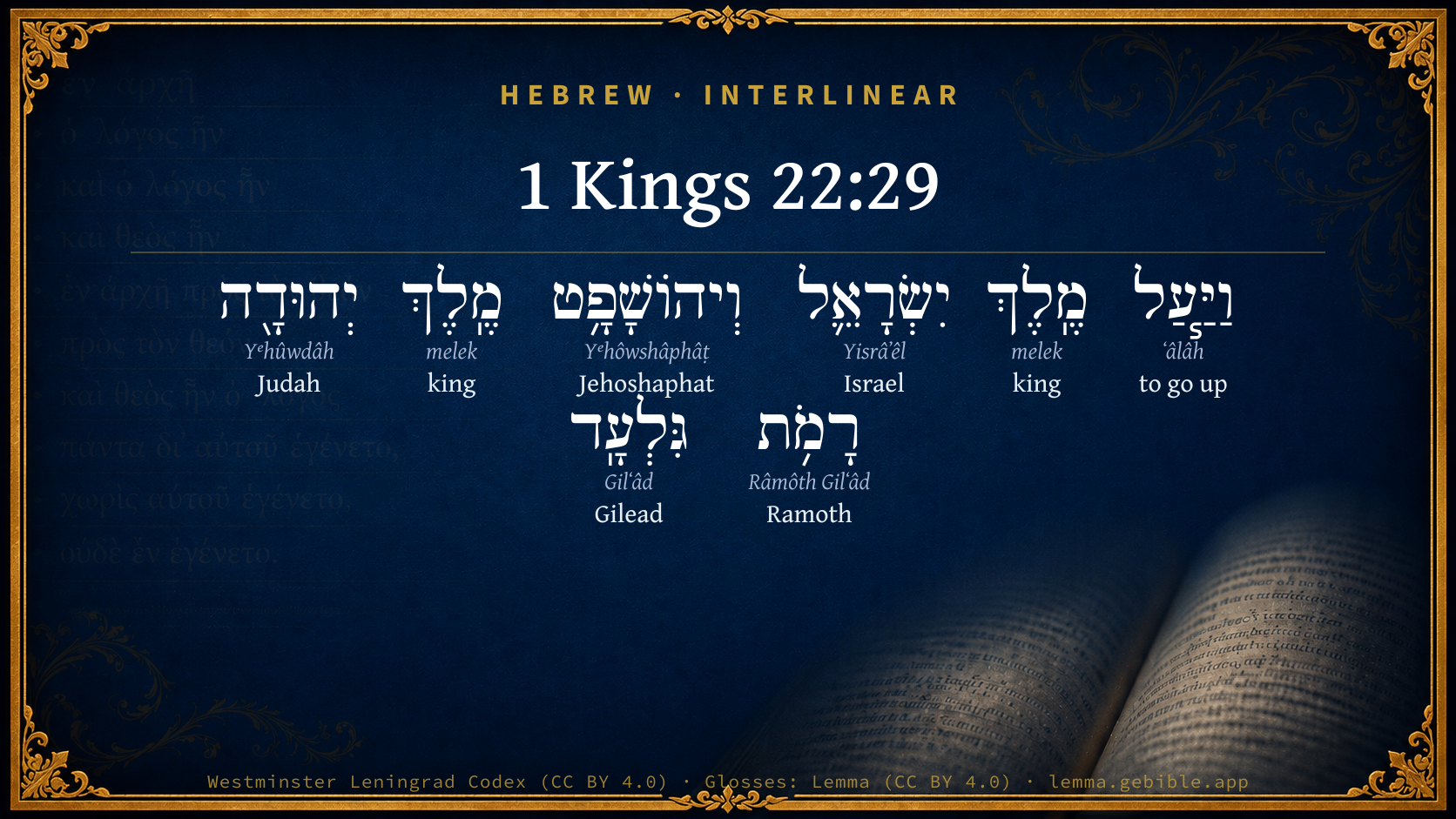
1 Kings 22:29

Hebrew (Westminster Leningrad Codex) 1 Kings 22:29 appears in the Hebrew Old Testament. The text above is from the Westminster Leningrad Codex. Each word links to its Strong’s number, a concise gloss, and parsing drawn from the Open Scriptures Hebrew Bible morphology. Click any word for its full Brown-Driver-Briggs (BDB) entry.
Download image
Cite this verse

1 Kings 22:29 (World English Bible). Public Domain. Lemma interlinear Bible study tool, https://lemma.gebible.app/v/1-kings/22/29.

Show BibTeX & RIS
BibTeX
RIS
English Translation
So the king of Israel and Jehoshaphat the king of Judah went up to Ramoth-gilead.
World English Bible · Public Domain
Download a study sheet

One document with this verse’s original text, its word-by-word gloss line, the meaning frame, cross-references with their text, attributed commentary, and full source and license credits — printable, and it pastes into notes with its structure intact.

This verse Autodidact and up

Study sheet (.html) Plain text (.txt)

A passage Seminary Student

Up to 50 verses in one chapter. A passage sheet keeps up to 6 commentary sources and 12 cross-references per verse, in the order this page ranks them, and says so on the sheet whenever that leaves anything out. Ask for a single verse and you get the Autodidact verse sheet above.

Everything on this page stays free to read, with no account — the sheet is a download of what is already on screen, not access to it.

Want to remove ads? Support Godless Engineer
Compare translations 3

The same verse in 3 English versions, stacked beneath the original-language interlinear above. Click any original word for its lexicon entry.

Each is an independent rendering of the whole verse — the interlinear is not word-aligned to these translations.

Highlighted words mark where these versions differ — a whole-verse word diff, not a word-by-word alignment.

  • World English Bible Public Domain
    So the king of Israel and Jehoshaphat the king of Judah went up to Ramoth-gilead.
  • King James Version Public Domain
    So the king of Israel and Jehoshaphat the king of Judah went up to Ramothgilead.
  • unfoldingWord Literal Text CC BY-SA 4.0
    And the king of Israel and Jehoshaphat, the king of Judah, went up Ramoth Gilead.

unfoldingWord Literal Text — © unfoldingWord, licensed CC BY-SA 4.0. Word-aligned USFM3 via Door43 (git.door43.org/unfoldingWord/en_ult).

Versions to compare (up to 4)

3 of 4 selected

Show all 18 translations

Every available English version of this verse, each an independent rendering of the whole verse.

  • World English Bible Public Domain
    So the king of Israel and Jehoshaphat the king of Judah went up to Ramoth-gilead.
  • Berean Standard Bible Public Domain
    So the king of Israel and Jehoshaphat king of Judah went up to Ramoth-gilead.
  • Majority Standard Bible Public Domain
    So the king of Israel and Jehoshaphat king of Judah went up to Ramoth-gilead.
  • King James Version Public Domain
    So the king of Israel and Jehoshaphat the king of Judah went up to Ramothgilead.
  • American Standard Version (1901) Public Domain
    So the king of Israel and Jehoshaphat the king of Judah went up to Ramoth-gilead.
  • Revised Version (1885) Public Domain
    So the king of Israel and Jehoshaphat the king of Judah went up to Ramoth-gilead.
  • Geneva Bible (1599) Public Domain
    So the King of Israel and Iehoshaphat the King of Iudah went vp to Ramoth Gilead.
  • Douay-Rheims (1899) Public Domain
    So the king of Israel, and Josaphat king of Juda went up to Ramoth Galaad.
  • Young's Literal Translation Public Domain
    And the king of Israel goeth up, and Jehoshaphat king of Judah, to Ramoth-Gilead.
  • Literal Standard Version CC BY-SA 4.0
    And the king of Israel goes up—and Jehoshaphat king of Judah—to Ramoth-Gilead.
  • Unlocked Literal Bible CC BY-SA 4.0
    So Ahab, the king of Israel, and Jehoshaphat, the king of Judah, went up to Ramoth Gilead.
  • unfoldingWord Literal Text CC BY-SA 4.0
    And the king of Israel and Jehoshaphat, the king of Judah, went up Ramoth Gilead.
  • Darby Bible Public Domain
    And the king of Israel and Jehoshaphat the king of Judah went up to Ramoth-Gilead.
  • World Messianic Bible Public Domain
    So the king of Israel and Jehoshaphat the king of Judah went up to Ramoth Gilead.
  • Webster's Bible Public Domain
    So the king of Israel and Jehoshaphat the king of Judah went up to Ramoth-gilead.
  • Free Bible Version CC BY-SA 4.0
    The king of Israel and Jehoshaphat, king of Judah, went to attack Ramoth-gilead.
  • Bible in Basic English Public Domain
    So the king of Israel and Jehoshaphat, the king of Judah, went up to Ramoth-gilead.
  • JPS Tanakh (1917) Public Domain
    So the king of Israel and Jehoshaphat the king of Judah went up to Ramoth-gilead.

Literal Standard Version (2020), Covenant Press — licensed CC BY-SA 4.0. Text via the HelloAO Bible API (eBible.org). Unlocked Literal Bible (unfoldingWord) — licensed CC BY-SA 4.0. Text via the HelloAO Bible API (eBible.org). unfoldingWord Literal Text — © unfoldingWord, licensed CC BY-SA 4.0. Word-aligned USFM3 via Door43 (git.door43.org/unfoldingWord/en_ult). Free Bible Version, Dr. Jonathan Gallagher — licensed CC BY-SA 4.0. Text via the HelloAO Bible API (eBible.org).

Word by word

More ways to search: Search by grammar → Find every occurrence → Compare this word →

Practice this passage: Drill this verse → Learn its vocabulary →

About this verse

These counts appear in no published source. They are computed here, from the morphology-tagged text and Lemma’s own curated glosses. What Lemma adds →

8
words
7
distinct lemmas
Historical
section

Notable vocabulary

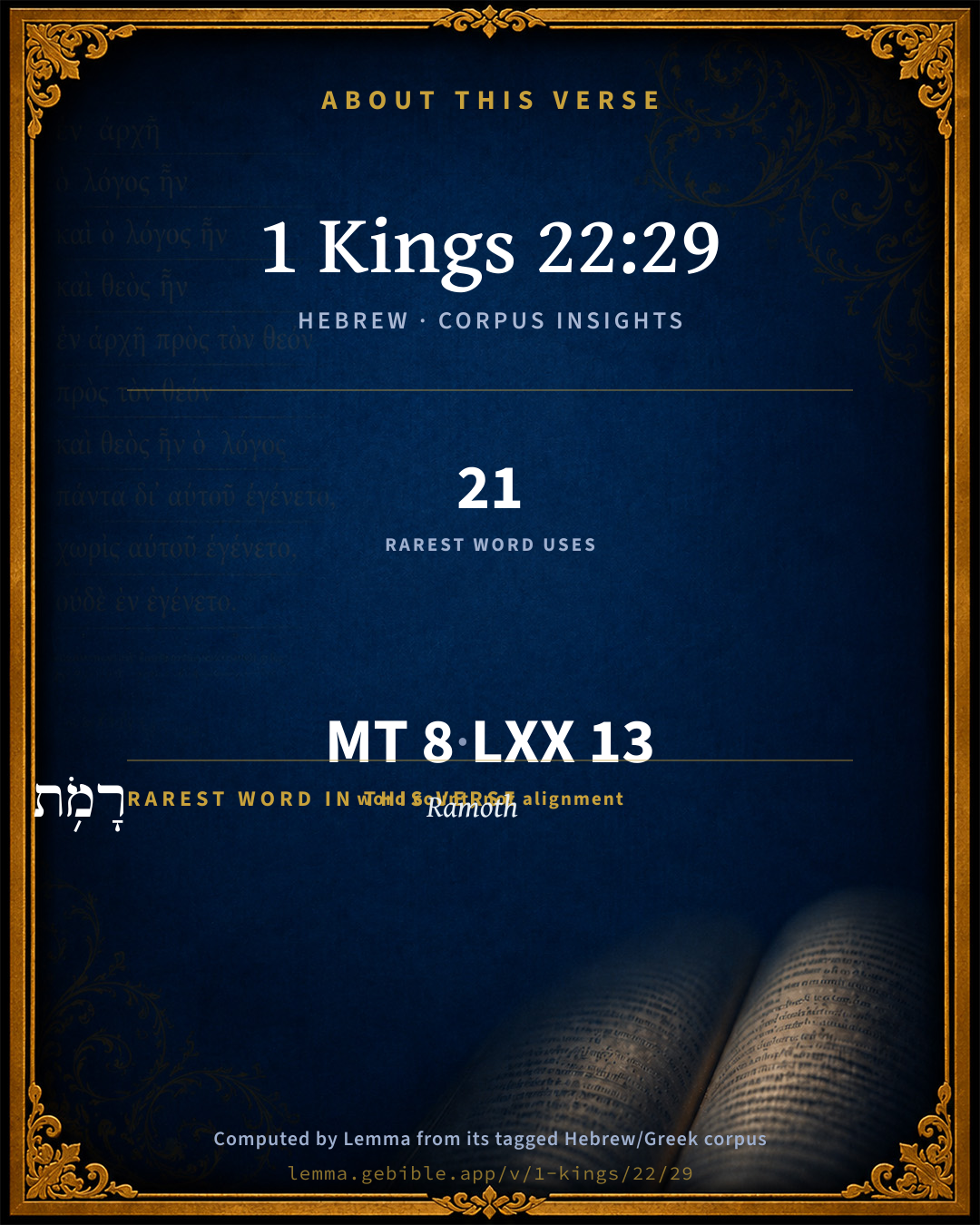
The rarest word here is רָמֹ֥ת Ramoth H7433 — appearing just 21 times in the whole Hebrew Bible.

Shared distinctive vocabulary

רָמֹ֥ת Ramoth H7433 occurs in 21 verses of the Hebrew Bible. Also found in:

Grammatical profile

  • 1 verb
  • 7 nouns

Verb forms

  • וַיַּ֧עַל Qal · Sequential Imperfect

Repetition

A word recurs within this verse — often emphatic in Hebrew:

  • מֶֽלֶךְ king H4428 ×2

Hebrew & Septuagint length

In English translation the verse runs 15 words from the Hebrew and 17 from the Septuagint (LXX English) — closely comparable.

A rough comparison of the two English renderings, which tokenize alike — not a word-level alignment.

Word counts can differ between the Hebrew and the Greek without any difference in meaning — e.g. the Hebrew direct-object marker אֵת has no separate Greek word, and Greek often adds the article ὁ.

In the original languages it is 8 Hebrew tokens and 13 Greek tokens — but the two are counted differently (Hebrew bundles its prefixes and suffixes into one token; the Greek is in lemma form), so that isn’t a like-for-like length.

Cross-references

2

Topical passages linked to 1 Kings 22:29 in the Treasury of Scripture Knowledge — connected by theme and wording, ordered by reader-vote popularity; previews shown in the World English Bible.

  • 1 Kings 22:2–9 It happened in the third year, that Jehoshaphat the king of Judah came down to the king of Israel.
  • 2 Chronicles 18:28 So the king of Israel and Jehoshaphat the king of Judah went up to Ramoth-gilead.

Cross-references courtesy of OpenBible.info (CC BY 4.0).

Hebrew and Greek witnesses Masoretic Hebrew ↔ Greek Septuagint

The same verse in the two great witnesses to the Old Testament, shown verse-for-verse.

These are two independent witnesses, not word-aligned to each other, and the Septuagint is shown in lemma (dictionary) form.

Hebrew 1 Kings 22:29 Masoretic · Westminster Leningrad Codex

וַיַּ֧עַל מֶֽלֶךְ יִשְׂרָאֵ֛ל וְיהוֹשָׁפָ֥ט מֶֽלֶךְ יְהוּדָ֖ה רָמֹ֥ת גִּלְעָֽד

So the king of Israel and Jehoshaphat the king of Judah went up to Ramoth-gilead.

World English Bible · Public Domain

Greek LXX 1 Kings 22:29 Septuagint · lemma form

καί ἀναβαίνω βασιλεύς ἰσραήλ καί ιωσαφατ βασιλεύς ιουδα μετά αὐτός εἰς ρεμμαθ γαλαάδ

So the king of Israel went up, and Josaphat king of Juda with him to Remmath Galaad.

LXX2012 (modern English Septuagint) · Public Domain

On this verse, Matthew Henry's Commentary discusses the Septuagint’s reading. Read the note in Commentary ↓

Hebrew: Westminster Leningrad Codex (CC BY 4.0). Greek: Septuagint (public domain); English from LXX2012 (modern English Septuagint) (Public Domain). How the Septuagint differs from the Hebrew →

Targum (Aramaic paraphrase)

1

The Targum is the ancient Jewish Aramaic paraphrase of the Hebrew Scriptures — an interpretive translation, not the Hebrew text itself. Onkelos (literal) and Pseudo-Jonathan (expansive) render the Torah, and Jonathan the Prophets. Coverage is partial: where no permissively-licensed English translation exists for a verse, only the Aramaic is shown. This is verse-level text, not a word-by-word alignment to the Hebrew.

  1. Targum Jonathan Prophets (Joshua–Malachi)
    וּסְלֵיק מַלְכָּא דְיִשְׂרָאֵל וִיהוֹשָׁפָט מֶלֶךְ שִׁבְטָא דְבֵית יְהוּדָה רָמוֹת גִלְעָד:

    (no public-domain English translation for this verse)

    Targum Jonathan — Aramaic: “Mikraot Gedolot” (public domain). English: “Sefaria Community Translation” (CC0 1.0 (public-domain dedication)); “London "Chaldee Paraphrase," 1871” (public domain). Text via Sefaria.

Commentary

Notes on 1 Kings 22:29 from classic Christian and Jewish commentators (each source and its license shown beneath its notes). The classic Christian expositions comment on the surrounding passage and are grouped to its opening verse, so a note may address several verses; the Jewish commentaries on the Tanakh (Rashi and others) are per-verse, so they appear only where the commentator wrote on this verse.

Lemma curates 59 commentaries, every one of them public domain or Creative Commons licensed, each selected and text-cleaned for this edition rather than reprinted as found. About our sources →

Matthew Henry's Commentary

The matter in contest between God's prophet and Ahab's prophets is here soon determined, and it is made to appear which was in the right. Here,

I. The two kings march with their forces to Ramoth-Gilead, Kg1 22:29. That the king of Israel, who hated God's prophet, should so far disbelieve his admonition as to persist in his resolution, notwithstanding, is not strange; but that Jehoshaphat, that pious prince, who had desired to enquire by a prophet of the Lord, as disrelishing and discrediting Ahab's prophets, should yet proceed, after so fair a warning, is matter of astonishment. But by the easiness of his temper he was carried away with the delusion (as Barnabas was with the dissimulation, Gal 2:13) of his friends. He gave too much heed to Ahab's prophets, because they pretended to speak from God too, and in his country he had never been imposed upon by such cheats. He was ready to give his opinion with the majority, and to conclude that it was 400 to one but they should succeed. Micaiah had not forbidden them to go; nay, at first, he said, Go, and prosper. If it came to the worst, it was only Ahab's fall that was foretold, and therefore Jehoshaphat hoped he might safely venture.

II. Ahab adopts a contrivance by which he hopes to secure himself and expose his friend (Kg1 22:30): "I will disguise myself, and go in the habit of a common soldier, but let Jehoshaphat put on his robes, to appear in the dress of a general." He pretended thereby to do honour to Jehoshaphat, and to compliment him with the sole command of the army in this action. He shall direct and give orders, and Ahab will serve as a soldier under him. But he intended, 1. To make a liar of a good prophet. Thus he hoped to elude the danger, and so to defeat the threatening, as if, by disguising himself, he could escape the divine cognizance and the judgments that pursued him. 2. To make a fool of a good king, whom he did not cordially love, because he was one that adhered to God and so condemned his apostasy. He knew that if any perished it must be the shepherd (so Micaiah had foretold); and perhaps he had intimation of the charge the enemy had to fight chiefly against the king of Israel, and therefore basely intended to betray Jehoshaphat to the danger, that he might secure himself. Ahab was marked for ruin; one would not have been in his coat for a great sum; yet he will over-persuade this godly king to muster for him. See what those get that join in affinity with vicious men, whose consciences are debauched, and who are lost to every thing that is honourable. How can it be expected that he should be true to his friend that has been false to his God?

III. Jehoshaphat, having more piety than policy, put himself into the post of honour, though it was the post of danger, and was thereby brought into the peril of his life, but God graciously delivered him. The king of Syria charged his captains to level their force, not against the king of Judah, for with him he had no quarrel, but against the king of Israel only (Kg1 22:31), to aim at his person, as if against him he had a particular enmity. Now Ahab was justly repaid for sparing Ben-hadad, who, as the seed of the serpent commonly do, stung the bosom in which he was fostered and saved from perishing. Some think that he designed only to have him taken prisoner, that he might now give him as honourable a treatment as he had formerly received from him. Whatever was the reason, this charge the officers received, and endeavoured to oblige their prince in this matter; for, seeing Jehoshaphat in his royal habit, they took him for the king of Israel, and surrounded him. Now, 1. By his danger God let him know that he was displeased with him for joining in confederacy with Ahab. Jehoshaphat had said, in compliment to Ahab (Kg1 22:4), I am as thou art; and now he was indeed taken for him. Those that associate with evil doers are in danger of sharing in their plagues. 2. By his deliverance God let him know that, though he was displeased with him, yet he had not deserted him. Some of the captains that knew him perceived their mistake, and so retired from the pursuit of him; but it is said (Ch2 18:31) that God moved them (for he has all hearts in his hand) to depart from him. To him he cried out, not in cowardice, but devotion, and from him his relief came: Ahab was in no care to succour him. God is a friend that will not fail us when other friends do.

IV. Ahab receives his mortal wound in the battle, notwithstanding his endeavours to secure himself in the habit of a private sentinel. Let no man think to hide himself from God's judgment, no, not in masquerade. Thy hand shall find out all thy enemies, whatever disguise they are in, Kg1 22:34. The Syrian that shot him little thought of doing such a piece of service to God and his king; for he drew a bow at a venture, not aiming particularly at any man, yet God so directed the arrow that, 1. He hit the right person, the man that was marked for destruction, whom, if they had taken alive, as was designed, perhaps Ben-hadad would have spared. Those cannot escape with life whom God hath doomed to death. 2. He hit him in the right place, between the joints of the harness, the only place about him where this arrow of death could find entrance. No armour is of proof against the darts of divine vengeance. Case the criminal in steel, and it is all one, he that made him can make his sword to approach him. That which to us seems altogether casual is done by the determinate counsel and fore-knowledge of God.

V. The army is dispersed by the enemy and sent home by the king. Either Jehoshaphat or Ahab ordered the retreat of the sheep, when the shepherd was smitten: Every man to his city, for it is to no purpose to attempt any thing more, Kg1 22:36. Ahab himself lived long enough to see that part of Micaiah's prophecy accomplished that all Israel should be scattered upon the mountains of Gilead (Kg1 22:17), and perhaps with his dying lips did himself give orders for it; for though he would be carried out of the army, to have his wounds dressed (Kg1 22:34), yet he would be held up in his chariot, to see if his army were victorious. But, when he saw the battle increase against them, his spirits sunk, and he died, but his death was so lingering that he had time to feel himself die; and we may well imagine with what horror he now reflected upon the wickedness he had committed, the warnings he had slighted, Baal's altars, Naboth's vineyard, Micaiah's imprisonment. Now he sees himself flattered into his own ruin, and Zedekiah's horns of iron pushing, not the Syrians, but himself, into destruction. Thus is he brought to the king of terrors without hope in his death.

VI. The royal corpse is brought to Samaria and buried there (Kg1 22:37), and hither are brought the bloody chariot and bloody armour in which he died, Kg1 22:38. One particular circumstance is taken notice of, because there was in it the accomplishment of a prophecy, that when they brought the chariot to the pool of Samaria, to be washed, the dogs (and swine, says the Septuagint) gathered about it, and, as is usual, licked the blood, or, as some think, the water in which it was washed, with which the blood was mingled: the dogs made no difference between royal blood and other blood. Now Naboth's blood was avenged (Kg1 21:19), and that word of David, as well as Elijah's word, was fulfilled (Psa 68:23), That thy foot may be dipped in the blood of thy enemies, and the tongue of thy dogs in the same. The dogs licking the guilty blood was perhaps designed to represent the terrors that prey upon the guilty soul after death.

Lastly, The story of Ahab is here concluded in the usual form, Kg1 22:39, Kg1 22:40. Among his works mention is made of an ivory house which he built, so called because many parts of it were inlaid with ivory; perhaps it was intended to vie with the stately palace of the kings of Judah, which Solomon built.

Matthew Henry's Commentary on the Whole Bible (1708–1710) — public domain (CC PDM 1.0). Text via the HelloAO Bible API.

Trapp's Complete Commentary

John Trapp

1Ki 22:29 So the king of Israel and Jehoshaphat the king of Judah went up to Ramothgilead.

Ver. 29. And Jehoshaphat the king of Judah went up.] Strange, that being so fairly warned, he should yet go with Ahab: but he had passed his word to him, and was loath to shrink back. So the queen of Navarre, wanting a French wife for her son, would not hear such of her ministers as dissuaded it in regard of the diversity of religions; but went on with it, to the destruction of herself and three hundred thousand others in the Parisian massacre.

John Trapp, A Commentary or Exposition upon All the Books of the Old and New Testament (1647–1656) — public domain. Text from a community e-Sword module.

Joseph Benson's Commentary

1Ki 22:29. So the king of Israel and Jehoshaphat — went up, &c. — Notwithstanding the declaration Micaiah had made of God’s decree, Jehoshaphat was persuaded by Ahab and other prophets to go on this expedition; partly because Micaiah was a person unknown to him, and both he and the other prophets professing to speak from God, it seemed difficult to him to determine the controversy between them, which, he probably thought, only the event could decide: and partly because the war was just and lawful, being undertaken to recover Ahab’s rights, which the Syrian king unjustly detained from him.

Joseph Benson's Commentary on the Old and New Testaments (1811–1818) — public domain. Text from a community e-Sword module.

The Preacher's Complete Homiletical Commentary

Joseph S. Exell (gen. ed.)

CRITICAL AND EXPLANATORY NOTES.—

1Ki_22:32. They turned aside to fight against him—יּסָרֻו—they turned to him. Sept. has εκύκλωσαν, surrounded him.

1Ki_22:34.—Drew a bow at a venture—Lit., “in bis simplicity.” So 2Sa_15:11.

1Ki_22:38. They washed his armour—A manifestly incorrect reading. Lit., The harlots bathed; either bathed him, or themselves bathed in the stream stained with his blood, his chariot having been washed therein. To the prediction chap. 1Ki_21:19, the Sept. adds: “And the harlots shall wash themselves in thy blood.” Theodoret says it was customary for harlots—probably temple prostitutes—to bathe at evening.

HOMILETICS OF 1Ki_22:29-40

THE DEATH OF A WICKED KING

I. That the death of a wicked king may be precipitated by an unbelieving disregard of divine warnings (1Ki_22:29 compare with 1Ki_22:17-23).

1. A wicked king is not indifferent to human threats (1Ki_22:30-31). It is very likely that Ahab had heard, through the agency of his spies, of the order of the Syrian king for his charioteers to fight only with the king of Israel, and this had more effect upon him than the warning words of Micaiah, though he might regard them as an evil omen. To baffle the object of Benhadad, and perhaps with a secret wish to prove the words of Micaiah false, Ahab disguised himself. A wicked man is often more easily scared by the bluster and bullying of a weak, sinful, human creature, than by the threatenings of heaven.

2. A wicked king is reckless as to the danger in which he exposes his ally (1Ki_22:32-33). Jehoshaphat in his kingly robes was mistaken for the king of Israel, and very nearly fell a victim to the Syrian fury. He cried to Heaven for help (2Ch_18:31), perhaps using his own peculiar battle cry, which, as it contained the name of Jehovah, would be distinct from that of Ahab’s, and was probably known to the Syrians. Jehoshaphat now sees to his sorrow the great inconvenience of being in bad company; and that green wood also, if bound up with dry, easily takes fire and they burn together. Selfishness is the essence of wickedness; so that the sinner himself escapes, it matters little to him what may become of his companions.

II. That the death of a wicked king may be brought about by what seems the merest accident.

1. He may meet death with a princely fortitude (1Ki_22:34-35). An archer shoots an arrow in the air, little dreaming what mischief it will work; it is the death warrant of the king of Israel. Feeling himself mortally wounded, he directed his chariot to be quietly driven aside that he might have his wounds dressed; and then returned to the battle, supported in his chariot in sight of his army until the sunset, when he expired. Let us give Ahab full credit for whatever was commendable in his conduct. Bad as he was, there was a touch of true heroism in the brave, resolute manner in which he insisted on being stayed up in his chariot, while his life-blood flowed about his feet, and his wound festered under the irritating heat of the sun. His death was kingly, and became him better than his life.

2. His death decides the fate of an important expedition (1Ki_22:36). The attack on the Syrians was abandoned and the army dispersed, according to the custom of the Orientals on the death of the king. Death interrupts the work of the wicked, and in some cases happily ends it. The decease of a wicked ruler is an opportunity for the reform of national abuses.

III. That the death of a wicked king was accomplished in a manner that fulfilled the disregarded warnings of heaven (1Ki_22:38). The manner of Ahab’s end left its traces in a form not to be mistaken. The blood which all through that day had been flowing from his wound had covered both the armour in which he was dressed and the chariot in which he had stood for so many hours. The chariot, perhaps the armour, was washed in state—according to one version in the tank of Samaria, according to another in the spring of Jezreel. The bystanders remembered that the blood, shed as it had been on the distant battle field, streamed into the same waters which had been polluted by the blood of Naboth and his sons, and was lapped up from the margin by the same dogs and swine, still prowling round the spot; and that when the abandoned outcasts of the city—probably those who had assisted in the profligate rites of the temple of Ashtaroth—came, according to their shameless usage, for their morning bath in the pool, they found it red with the blood of the first apostate king of Israel. So were accomplished the warnings of Elijah and Micaiah. So ended what may be called the first part of the tragedy of the House of Omri (Stanley). What would be the thoughts of the dying king that day on the battle field? Already he had proof of the fulfilment of one of Micaiah’s warnings regarding himself, and perhaps sullenly anticipated that the rest would follow. With what horror would he reflect upon his wicked life—the warnings he had slighted, the idolatry he had committed and championed, the stolen vineyard of Naboth, the heartless imprisonment of Micaiah! If we reject the warnings of heaven, we shall not prevent their accomplishment. The apparent delay affords time for repentance, and is not to be mistaken for indiscriminate leniency or forgetfulness.

IV. That the death of a wicked king was the more striking and humiliating that it occurred in the midst of external magnificence and power (1Ki_22:39-40). All that Ahab lived for—affluence, pomp, pleasure—was taken away in a moment. The ivory house—a rival of the stately palace of the kings of Judah—the fortified and prosperous cities he had reared, the ease and gaiety of his luxurious court, must be abandoned for ever; and what would he get in exchange? Death is no respecter of persons or circumstances. The mortal scythe is master of the royal sceptre. What will riches, magnificent monuments, or heroic deeds avail when God requires the sinner’s soul? A wicked life does not pay.

LESSONS:—

1. Royalty is no defence against the havoc of death.

2. A wicked life will be cut short by an ignominious end.

3. A monarch who has lived for himself will perish unregretted.

GERM NOTES ON THE VERSES

1Ki_22:29-40. Ahab’s end was truly tragical. It was brought about, not by a blind fate, but by a God who is just in His ways and holy in all His works (Psa_145:17), whose judgments are unsearchable, and His ways past finding out (Rom_11:33). The conflict which Ahab had sought, and which no warning could induce him to abandon, became his punishment. He fell in battle with that very enemy who had once been delivered into his hands, and whom he had released out of vanity and weakness, to the harm of Israel; and so he made good the words of the prophet (1Ki_20:42). He thought that a disguise would render him secure from the Syrian leaders who sought to find him out, and he did, indeed, escape them; but an unknown man, who did not know him and had no intention against him, shot him, while Jeshoshaphat, though undisguised, escaped unharmed. The arrow which struck him was not warded off by his corselet, but just struck the narrow opening between the corselet and the skirt, where it could penetrate and inflict a fatal wound. Everyone, therefore, who does not regard all incidents as accidents, must recognize the hand which guided the shaft. The words of the psalmist held true—“If he will not turn, he will whet his sword, he hath bent his bow and made it ready. He hath also prepared for him the instruments of death; he ordaineth his arrows against the persecutors” (Psa_7:12-13). Finally, Ahab did not die at once, but at evening, in consequence of the loss of blood. His blood flowed down in the chariot, which was so besmeared by it that it had to be washed. It was washed at the pool before the city, where dogs drank and harlots bathed. So it came to pass, although he was buried with all honour, that he was marked in his death as one condemned by God, and Elijah’s word was fulfilled (1Ki_21:19).—Lange.

1Ki_22:29. It might have been expected that Jehoshaphat, who had pressed enquiry at the Word of the Lord, and had not rested till a real prophet of Jehovah was sent for and made his appearance, would have withdrawn from the expedition when he heard Micaiah denounce it as fated to end in disaster. It must be remembered, however, that he had rashly committed himself to take part in the war by a solemn promise, couched in the strongest terms (1Ki_22:4), before he bethought himself of enquiring what was the will of God in the matter. His honour was thus pledged, and he would be ashamed to draw back, especially as Ahab, whom the prophecy chiefly threatened, was resolved to brave it. He may also have had a personal affection for Ahab, and so have been loth to desert him in his need. This seems to be implied in the rebuke addressed to him by the prophet Jehu after his return to Jerusalem—“Shouldest thou help the ungodly, and love them that hate the Lord? Therefore is wrath upon thee from before the Lord” (2Ch_19:2).—Speaker’s Comm.

—Men do far too readily what they want to do, although it is contrary to God’s will, putting aside God’s Word, or the warnings of others, or the voice of conscience. The event was never good. How often men ask for advice, yet follow their own will only! Jehoshaphat’s example ought to make us shy of the society of the wicked. The sun of grace in his heart became gradually dimmed. At first he had courage to remonstrate with Ahab, but gradually he comes to silence and indifference, even while Micaiah is abused and remanded to prison. In the end this evil companionship would have cost him his life, if God had not wonderfully interposed.—Kyburz.

1Ki_22:30. The vanity of disguise. I. An evidence of cowardice and fear. II. Easily penetrated by the eye of the Omniscient Judge. III. Does not prevent the catastrophe it seeks to avoid.

—Unbelief in Ahab joined hands with superstition. The king despises and rejects the Word of God which is announced to him, and yet he is frightened, and seeks to escape the threatened dangers by disguising himself. This stratagem was intended to prove the prophet false. Neither cunning nor might avails against God’s will. Thou mayest disguise thyself as thou wilt: God will find thee when and where no man recognises thee (Psa_139:7-12).

1Ki_22:31. The king of Syria gives charge to his captains to fight against none but the king of Israel. Thus doth the unthankful infidel repay the mercy of his late victor; ill was the snake saved that requites the favour of his life with a sting: thus still the greatest are the fairest mark to envious eyes. By how much more eminent any man is in the Israel of God, so many more and more dangerous enemies must he expect: both earth and hell conspire in their opposition to the worthiest. Those who are advanced above others have so much more need of the guard, both of their own vigilancy and others’ prayers. Jehoshaphat had liked to have paid dear for his love: he is pursued for him in whose amity he offended; his cries deliver him—his cries, not to his pursuers, but to his God, whose mercy takes not advantage of our infirmity, but rescues us from those evils which we wilfully provoke. It is Ahab against whom, not the Syrians only, but for himself intends this quarrel; the enemy is taken off from Jehoshaphat.—Bp. Hall.

1Ki_22:34. The greatest calamities. I. Often brought about by undesigned and accidental causes. II. Often occur to those who have taken the greatest pains to avoid them. III. May be traced to the unerring operations of retributive justice.

—The less of the human there is in those things which we commonly call accidents, the more there is of the Divine. The weal or woe of whole nations often depends on those things which are called accidents.

—O the just and mighty hand of that Divine providence which directeth all our actions to His own ends, which takes order where every shaft shall light, and guides the arrow of the strong archer into the joints of Ahab’s harness! It was shot at a venture, falls by a destiny; and there falls where it may carry death to a hidden debtor. In all actions, both voluntary and casual, thy will, O God, shall be done by us, with whatever intentions. Little did the Syrian know whom he had stricken, no more than the arrow with which he struck. An invisible hand disposeth of both, to the punishment of Ahab, to the vindication of Micaiah. How worthily, O God, art thou to be adored in thy justice and wisdom! to be feared in thy judgments! Too late doth Ahab now think of the fair warnings of Micaiah, which he unwisely condemned; of the painful flatteries of Zedekiah, which he stubbornly believed. That guilty blood of his runs down out of his wound into the midst of his chariot, and pays Naboth his arrearages.—Bp. Hall.

1Ki_22:37-40. O Ahab, what art thou the better for thine ivory house, while thou hast a black soul? What comfort has thou now in those flattering prophets which tickled thine ears and secured thee of victories? What joy is it to thee now that thou wast great? Who had not rather be Micaiah in the jail, than Ahab in the chariot? Wicked men have the advantage of the way; godly men of the end. The chariot is washed in the pool of Samaria; the dogs come to claim their due; they lick up the blood of the great king of Israel. The tongues of those brute creatures shall make good the tongue of God’s prophet. Micaiah is justified, Naboth is revenged, the Baalites confounded, Ahab judged. “Righteous art thou, O God, in all thy ways, and holy in all thy works”!—Bp. Hall.

1Ki_22:37. And now God was even with him for his idolatry, persecution of the prophets, cruelty to Naboth, who now was in far better condition, likely. The wicked are like hawks, of great esteem while living, but after, nothing worth. The godly are compared to tamer fowls, which are hushed forth and little heeded whilst living; but after death are brought into the parlour. Then, there is as much difference as betwixt the falcon and the capon, the hawk and the hen.—Trapp.

1Ki_22:37-38. The death of Ahab.

1. It was sudden (1Sa_20:3; Luk_12:20). From sudden death, good Lord, deliver us.

2. It was unrepentant. Without conviction of sin, or repentance for it, or longing for grace and pardon.

3. It was shameful. He was indeed buried with honour, like the rich man (Luke 16); but the dogs licked his blood, and his memory does not remain in honour (Psa_73:19; therefore, Psa_90:12; Psa_39:5). As he lived, so he died; as he died, so he was judged. The death of Ahab is a testimony to Rom_11:33; Gal_6:7; Isa_40:8.—Lange.

1Ki_22:38. The inexorable law of retribution.

1. Is proportioned to the character and degree of the sin it punishes.

2. Is the terrible completion of the warnings and threatenings which foreshadowed it.

3. A proof of the unchanging justice of Jehovah.

4. An awful yet salutary method of instruction to all nations in all ages.

—From a narrative like this, it need scarcely be said, the stern justice of God may well be engraven on every heart. The examples we have of retributive providence in sacred Scripture are, to say the least, exceedingly striking. Judas hanged himself. Herod the Great, who slew the children of Bethlehem, was smitten with ulcers, from which issued swarms of loathsome vermin, and died in the greatest agony; a humbling spectacle to his meanest slave. Herod Agrippa, who permitted his fawning parasites to adore him as God, “was eaten of worms and gave up the ghost.” The other Herod, who sent and beheaded the Baptist, spent his closing years with his guilty partner an exile in Lyons; while Salome, who asked the Baptist’s head in a charger, met with her death, as related by Nicephorus, at the hand of a common assassin. Let examples such as these stand alongside of Ahab, to teach that even in this world these awful words have frequently an awful meaning: “Vengeance is mine, I will repay, saith the Lord.”—Howat.

1Ki_22:39. Nothing is known of these cities; but the fact of Ahab’s building cities is important, as indicating the general prosperity of the country in his time, and his own activity as a ruler. The close relations which he established with Phœnicia and Judea tended naturally to bring about a flourishing condition of things in Samaria; and thus the decay of religion was accompanied by a temporary increase in the material prosperity (2Ki_3:4), the commercial enterprize (1Ki_22:49), and even the military vigour of the country. Such prosperity, it is plain, may for awhile co-exist with causes which are sapping the vital power of a nation, and leading it surely, if slowly, to destruction.—Speaker’s Comm.

The Preacher's Complete Homiletical Commentary (gen. ed. Joseph S. Exell; Funk & Wagnalls, c. 1892) — public domain (pre-1929). A full-Bible homiletical/sermon-outline anthology covering 65 of 66 books (2 John is absent from the source module). Text from a community e-Sword module.

Tyndale Open Study Notes

Tyndale Open Resources

22:29-33 Ahab hoped to avoid direct reprisal from Ben-hadad by wearing a disguise. By urging Jehoshaphat to wear his royal robes, Ahab hoped to escape detection and thwart Micaiah’s prophecy.

Tyndale Open Study Notes — © Tyndale Open Resources, licensed CC BY-SA 4.0. Text via the HelloAO Bible API.

Jamieson, Fausset & Brown

Robert Jamieson, A. R. Fausset & David Brown

went up to Ramoth-gilead--The king of Israel, bent on this expedition, marched, accompanied by his ally, with all his forces to the siege; but on approaching the scene of action, his courage failed, and, hoping to evade the force of Micaiah's prophecy by a secret stratagem, he assumed the uniform of a subaltern, while he advised Jehoshaphat to fight in his royal attire. The Syrian king, with a view either to put the speediest end to the war, or perhaps to wipe out the stain of his own humiliation (Kg1 20:31), had given special instructions to his generals to single out Ahab, and to take or kill him, as the author of the war. The officers at first directed their assault on Jehoshaphat, but, becoming aware of their mistake, desisted. Ahab was wounded by a random arrow, which, being probably poisoned, and the state of the weather increasing the virulence of the poison, he died at sunset. The corpse was conveyed to Samaria; and, as the chariot which brought it was being washed, in a pool near the city, from the blood that had profusely oozed from the wound, the dogs, in conformity with Elijah's prophecy, came and licked it [Kg1 21:19]. Ahab was succeeded by his son Ahaziah [Kg1 22:40].

Next: (2 Kings) Introduction

Jamieson, Fausset & Brown — Commentary Critical and Explanatory on the Whole Bible (1871) — public domain (CC PDM 1.0). Text via the HelloAO Bible API.

Ellicott's Commentary for English Readers

(29) So . . . Jehoshaphat.—The continued adhesion of Jehoshaphat, against the voice of prophecy, which he had himself invoked (severely rebuked in 2Ch_18:31), and, indeed, the subservient part which he plays throughout, evidently indicate a position of virtual dependence of Judah on the stronger power of Israel, of which the alliance by marriage—destined to be all but fatal to the dynasty of David (2Ki_11:1-2)—was at once the sign and the cause.

A Bible Commentary for English Readers, edited by Charles John Ellicott (1878–1897) — public domain. Text from a community e-Sword module.

John Gill's Exposition

And it came to pass, when the captains of the chariots perceived that it was not the king of Israel,.... Against whom only their orders were to fight:

that they turned back from pursuing him; for upon so great a force coming upon him he could not withstand, he fled.

John Gill's Exposition of the Whole Bible (1746–1763) — public domain (CC PDM 1.0). Text via the HelloAO Bible API.

Albert Barnes' Notes on the Bible

It might have been expected that Jehoshaphat would have withdrawn from the expedition when he heard Micaiah denounce it. He had, however, rashly committed himself to take part in the war by a solemn promise, before he bethought himself of inquiring what was the will of God in the matter. Now he was ashamed to draw back, especially as Ahab, whom the prophecy chiefly threatened, was resolved to brave it. He may also have had a personal affection for Ahab, and so have been loth to desert him in his need. Compare 2Ch 19:2.

Albert Barnes' Notes on the Bible (1834–1885) — public domain. Text from a community e-Sword/MySword module.

Haydock's Catholic Bible Commentary

CHAPTER XXII.

George Leo Haydock (1774–1849), Haydock's Catholic Family Bible and Commentary, 1859 edition — public domain. Excludes Psalms (Douay-Rheims chapter numbering differs from Protestant) and Deuterocanonical books (Catholic canon only).

Matthew Poole's English Annotations

Jehoshaphat, though a good man, yet was easily deceived in this matter; partly because Micaiah was a person unknown to him, and both he and the other prophets pretending to give their answer in the name of the Lord, it seemed hard to him to determine the controversy, which only the event could decide; and therefore it is no wonder if he was overborne by the vast disproportion of four hundred prophets to one, and by his relation, and obligation, and affection to Ahab: and partly because the war was just and lawful, to recover his own rights, which the Syrian king unjustly detained from him.

Matthew Poole's English Annotations on the Holy Bible (1683–1685) — public domain. Text from a community e-Sword/MySword module.

The Pulpit Commentary

So the king of Israel and Jehoshapat the king of Judah went up to Ramoth-Gilead to battle. "By the very network of evil counsel which he has woven for himself is the king of Israel led to his ruin" (Stanley). We can hardly doubt that Jehoshaphat at least would have been well content to abandon the expedition. After the solicitude he had manifested for the sanction of one of the prophets of Jehovah, and after that the one who had been consulted had predicted the defeat of the army, the king of Judah must have had re,my misgivings. But it is not difficult to understand why, notwithstanding his fears, he did not draw back. For, in the first place, he had committed himself to the war by the rash and positive promise of ver. 4. In the next place, he was Ahab"s guest, and had been sumptuously entertained by him, and it would therefore require some moral courage to extricate himself from the toils in which he was entangled. Moreover he would have subjected himself to the imputation of cowardice had he deserted his ally because of a prophecy which threatened the latter with death. The people around him, again, including perhaps his own retinue, were possessed with the spirit of battle, and treated the prophecy of Micaiah with contempt, and it would be difficult for him to swim alone against the current. It is probable, too, that he discounted the portentous words of Micaiah on account of the long. standing quarrel between him and Ahab. And, finally, we must remember that his own interests were threatened by Syria, and he may well have feared trouble from that quarter in case this war were abandoned. Rawlinson suggests that he may have conceived a personal affection for Ahab; but 2Ch_19:2 affords but slender ground for this conclusion.

Vers. 29-40.

The Certainty of God"s Threatenings.

I AHAB"S ATTEMPT TO ELUDE THE DIVINE VENGEANCE.

1. His apprehension of coming evil. If Micaiah"s words were not the words of God, why should he take precautions? His heart gives the lie to his own unbelief; the words cling to him. The bold refusal to listen to God"s word is no assurance that the soul will not afterwards be shaken by a fearful looking for of judgment.

2. His ungenerousness (ver. 30). "I will disguise myself; but put thou on thy robes." The effect of the counsel was necessarily to concentrate the enemy"s attention upon Jehoshaphat. Sin not only makes a man a coward, it robs him of nobleness.

3. The immediate effect of Ahabs stratagem. Ben-hadad"s arrangements for the capture or slaughter of Ahab were rendered of no avail. The captains could not find the man they sought. A momentary success often attends the plans of those who endeavour to flee from God.

4. The chance shot. The success of Ahab"s device only served to make the blow come more plainly from the hand of God. Ben-hadad"s purpose could be baffled, but not His. There is no escape from God.

II THE FULFILMENT OF GOD"S WORD.

1. He fell at Ramoth Gilead (ver. 20).

2. "Israel was scattered upon the hills," and the command was given to return (vers. 17, 86).

3. The dogs licked Ahabs blood, (1Ki_21:19) not in Jezreel, indeed, because the judgment then pronounced was that of the overthrow of the dynasty. This was delayed on account of Ahab"s repentance, and happened, as predicted, "is his son"s days". (1Ki_21:29) But the personal part of the prediction, "The dogs shall lick thy blood, even thine," was not revoked. There are prophecies both of evil and of good, within the range of which we set ourselves. God"s words are touching us, and will likewise be literally fulfilled. U.

The Pulpit Commentary (1880–1919), ed. H.D.M. Spence-Jones & Joseph S. Exell — public domain. Text from a community e-Sword module.

Kretzmann's Popular Commentary

Paul E. Kretzmann

The Death of Ahab

v. 29. So the king of Israel and Jehoshaphat, the king of Judah, went up to Ramoth-gilead, the latter apparently being unwilling to take back his promise, since Ahab had declared Micaiah to be his personal opponent.

v. 30. And the king of Israel said unto Jehoshaphat, in his anxiety to safeguard his own life, I will disguise myself and enter into the battle, contrary to the custom according to which the king preceded his troops clothed in royal garments; but put thou on thy robes, for in his case the enemies would have no special reason to single him out and put him to death. And the king of Israel disguised himself’ and went into the battle.

v. 31. But the king of Syria commanded his thirty and two captains, 1Ki 20:24, that had rule over his chariots, saying, Fight neither with small nor great, save only with the king of Israel; they were to concentrate their efforts on the killing of Ahab, for the end of Ahab would mean the end of the war and victory for the Syrian forces.

v. 32. And it came to pass, when the captains of the chariots saw Jehoshaphat, who was immediately distinguishable by his royal costume, that they said, Surely it Is the king of Israel. And. they turned aside to fight against him, they turned their chariots in his direction; and Jehoshaphat cried out, either calling his name or shouting to his own soldiers to come to his aid.

v. 33. And it came to pass, when the captains of the chariots perceived that it was not the king of Israel, that they turned back from pursuing him, for their orders were to take or kill Ahab.

v. 34. And a certain man drew a bow at a venture, without being conscious of the fact that the man he aimed at, who wore the clothing of an ordinary soldier, was the king of Israel, and smote the king of Israel between the joints of the harness, in the narrow opening between the skirt and the breastplate of his armor; wherefore he said unto the driver of his chariot, Turn thine hand, guiding the horses away from the battle-line, and carry me out of the host, for I am wounded, no longer able to take part in the conflict, forced to retire from the fight.

v. 35. And the battle increased that day, it was waged with great bitterness on both sides. And the king was stayed up in his chariot against the Syrians, unable to reach a place of shelter on account of the bitterness of the encounter, and died at even; and the blood ran out of the wound, which could not be dressed, into the midst of the chariot, collecting in pools in the rounded part of the chariot-floor.

v. 36. And there went a proclamation throughout the host, evidently started by the discouraged soldiers themselves, about the going down of the sun, saying, Every man to his city and every man to his own country! They abandoned the field and scattered to their homes.

v. 37. So the king died, and was brought to Samaria, coming not as a victor, but as a corpse; and they buried the king in Samaria.

v. 38. And one washed the chariot in the pool of Samaria, for this city, like others, had its reservoir; and the dogs licked up his blood, as it flowed out of the chariot, mingled with water. And they washed his armor, literally, "the harlots were bathing," they used this polluted water in their evening washing, thus bringing more shame upon the memory of Ahab, according unto the word of the Lord which He spake, 1Ki 21:19.

v. 39. Now the rest of the acts of Ahab and all that he did, and the ivory house which he made, the palace richly decorated with ivory, either in Jezreel or in Samaria, and all the cities that he built, are they not written in the Book of the Chronicles of the Kings of Israel?

v. 40. So Ahab slept with his fathers; and Ahasiah, his son, reigned in his stead. Such was the terrible and disgraceful end of the proud king. And in like manner, eternal shame and disgrace is the end of all those who rebel against the Lord of heaven.

Paul E. Kretzmann, Popular Commentary of the Bible (1921–1924) — public domain. Text from a community e-Sword module.

unfoldingWord translationNotes

Door43 World Missions Community

Ahab, the king of Israel, and Jehoshaphat, the king of Judah, went up

Here the kings represent themselves accompanied by their armies. AT: "Ahab, the king of Israel, and Jehoshaphat, the king of Judah led their armies up" (See: Synecdoche)

disguise

This means to change the usual appearance so as not to be identified.

translationWords

Ahab

Jehoshaphat

kingdom of Judah

Ramoth

Gilead

royal

robe

unfoldingWord translationNotes — © Distant Shores Media and the Door43 World Missions Community, licensed CC BY-SA 4.0. Source: git.door43.org/Door43/en_tn.

Lesson kit

Teaching starters — assembled from the data on this page, not authored interpretation. Every prompt links to the verse data it draws on. Edit before teaching.

1 Kings, in the Historical, opens this verse with 8 words (7 distinct Hebrew lemmas). Its most distinctive word is Râmôth Gilʻâd (“Ramoth”). A historical commentator’s framing appears above. Read the whole chapter for the surrounding context.

Discussion questions

  1. How does “Ramoth” (Râmôth Gilʻâd) shape what this verse is saying?
  2. Joshua 21:38 shares the word «Ramoth» with this verse. How do the two illuminate each other?
  3. “king” occurs 2× in this one verse. What is the effect of the repetition?
  4. The translations on this page render this verse differently — a whole-verse word diff, not a word-by-word alignment. What might account for the different wordings?
  5. The verb «וַיַּ֧עַל» is Qal Sequential Imperfect. How does its form color the action?
  6. Reading how Matthew Henry's Commentary and Trapp's Complete Commentary read this verse, where do the two commentators agree and where do they part?

Things to notice

Reading settings

Reading text

Shown beneath each verse's original-language words.

Old Testament
Old Testament edition

Read the OT as the Masoretic Hebrew (MT) or the Greek Septuagint (LXX).

English shown for the Greek Septuagint (in the Hebrew ↔ Greek comparison).

Comparing translations? Open the Compare panel on any verse page to stack up to four side by side.