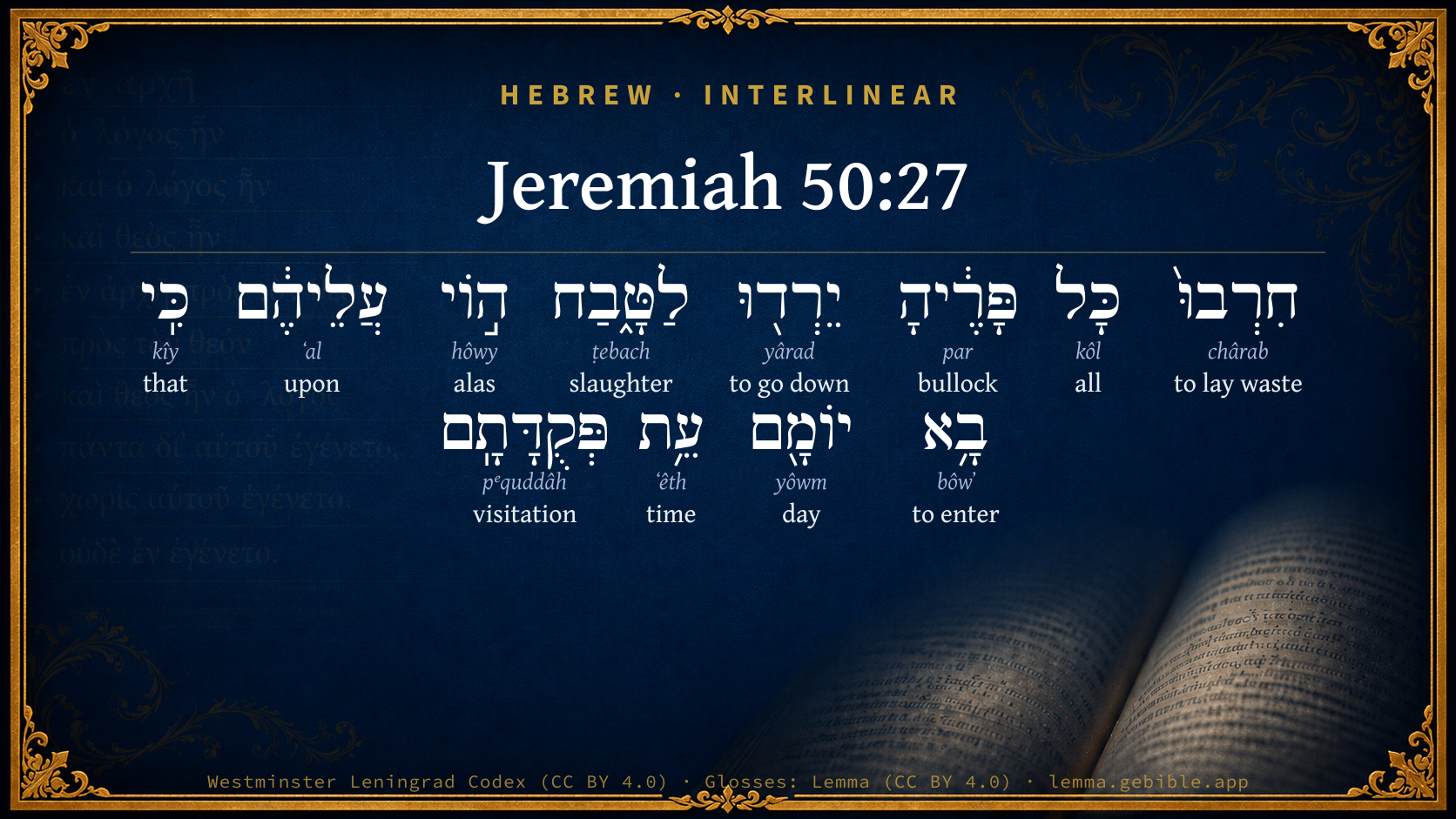
Jeremiah 50:27

Hebrew (Westminster Leningrad Codex) Jeremiah 50:27 appears in the Hebrew Old Testament. The text above is from the Westminster Leningrad Codex. Each word links to its Strong’s number, a concise gloss, and parsing drawn from the Open Scriptures Hebrew Bible morphology. Click any word for its full Brown-Driver-Briggs (BDB) entry.
Download image
Cite this verse

Jeremiah 50:27 (World English Bible). Public Domain. Lemma interlinear Bible study tool, https://lemma.gebible.app/v/jeremiah/50/27.

Show BibTeX & RIS
BibTeX
RIS
English Translation
Kill all her bulls; let them go down to the slaughter: woe to them! for their day is come, the time of their visitation.
World English Bible · Public Domain
Download a study sheet

One document with this verse’s original text, its word-by-word gloss line, the meaning frame, cross-references with their text, attributed commentary, and full source and license credits — printable, and it pastes into notes with its structure intact.

This verse Autodidact and up

Study sheet (.html) Plain text (.txt)

A passage Seminary Student

Up to 50 verses in one chapter. A passage sheet keeps up to 6 commentary sources and 12 cross-references per verse, in the order this page ranks them, and says so on the sheet whenever that leaves anything out. Ask for a single verse and you get the Autodidact verse sheet above.

Everything on this page stays free to read, with no account — the sheet is a download of what is already on screen, not access to it.

Want to remove ads? Support Godless Engineer
Compare translations 3

The same verse in 3 English versions, stacked beneath the original-language interlinear above. Click any original word for its lexicon entry.

Each is an independent rendering of the whole verse — the interlinear is not word-aligned to these translations.

Highlighted words mark where these versions differ — a whole-verse word diff, not a word-by-word alignment.

  • World English Bible Public Domain
    Kill all her bulls; let them go down to the slaughter: woe to them! for their day is come, the time of their visitation.
  • King James Version Public Domain
    Slay all her bullocks; let them go down to the slaughter: woe unto them! for their day is come, the time of their visitation.
  • unfoldingWord Literal Text CC BY-SA 4.0
    Kill all her bulls. Send them down to the place of slaughter. Woe to them, for their day has come—the time for their punishment.

unfoldingWord Literal Text — © unfoldingWord, licensed CC BY-SA 4.0. Word-aligned USFM3 via Door43 (git.door43.org/unfoldingWord/en_ult).

Versions to compare (up to 4)

3 of 4 selected

Show all 18 translations

Every available English version of this verse, each an independent rendering of the whole verse.

  • World English Bible Public Domain
    Kill all her bulls; let them go down to the slaughter: woe to them! for their day is come, the time of their visitation.
  • Berean Standard Bible Public Domain
    Kill all her young bulls; let them go down to the slaughter. Woe to them, for their day has come—the time of their punishment.
  • Majority Standard Bible Public Domain
    Kill all her young bulls; let them go down to the slaughter. Woe to them, for their day has come—the time of their punishment.
  • King James Version Public Domain
    Slay all her bullocks; let them go down to the slaughter: woe unto them! for their day is come, the time of their visitation.
  • American Standard Version (1901) Public Domain
    Slay all her bullocks; let them go down to the slaughter: woe unto them! for their day is come, the time of their visitation.
  • Revised Version (1885) Public Domain
    Slay all her bullocks; let them go down to the slaughter: woe unto them! for their day is come, the time of their visitation.
  • Geneva Bible (1599) Public Domain
    Destroy all her bullockes: let them goe downe to the slaughter. Wo vnto them, for their day is come, and the time of their visitation.
  • Douay-Rheims (1899) Public Domain
    Destroy all her valiant men, let them go down to the slaughter: woe to them, for their day is come, the time of their visitation.
  • Young's Literal Translation Public Domain
    Slay all her kine, they go down to slaughter, Wo `is' on them, for come hath their day, The time of their inspection.
  • Literal Standard Version CC BY-SA 4.0
    Slay all her cows, they go down to slaughter, || Woe [is] on them, for their day has come, || The time of their inspection.
  • Unlocked Literal Bible CC BY-SA 4.0
    Kill all her bulls. Send them down to the place of slaughter. Woe to them, for their day has come—the time for their punishment.
  • unfoldingWord Literal Text CC BY-SA 4.0
    Kill all her bulls. Send them down to the place of slaughter. Woe to them, for their day has come—the time for their punishment.
  • Darby Bible Public Domain
    Slay all her bullocks; let them go down to the slaughter: woe unto them! for their day is come, the time of their visitation.
  • World Messianic Bible Public Domain
    Kill all her bulls. Let them go down to the slaughter. Woe to them! For their day has come, the time of their visitation.
  • Webster's Bible Public Domain
    Slay all her bullocks; let them go down to the slaughter: woe to them! for their day is come, the time of their visitation.
  • Free Bible Version CC BY-SA 4.0
    Kill all her young bulls with the sword; let them be slaughtered. What a disaster for them, because their time has come when they're punished.
  • Bible in Basic English Public Domain
    Put all her oxen to the sword; let them go down to death: sorrow is theirs, for their day has come, the time of their punishment.
  • JPS Tanakh (1917) Public Domain
    Slay all her bullocks, let them go down to the slaughter; woe unto them! for their day is come, the time of their visitation.

Literal Standard Version (2020), Covenant Press — licensed CC BY-SA 4.0. Text via the HelloAO Bible API (eBible.org). Unlocked Literal Bible (unfoldingWord) — licensed CC BY-SA 4.0. Text via the HelloAO Bible API (eBible.org). unfoldingWord Literal Text — © unfoldingWord, licensed CC BY-SA 4.0. Word-aligned USFM3 via Door43 (git.door43.org/unfoldingWord/en_ult). Free Bible Version, Dr. Jonathan Gallagher — licensed CC BY-SA 4.0. Text via the HelloAO Bible API (eBible.org).

Word by word

More ways to search: Search by grammar → Find every occurrence → Compare this word →

Practice this passage: Drill this verse → Learn its vocabulary →

לַטָּ֑בַח
ṭebach
H2874
“to/for the · slaughter”
Preposition, Determined + Noun, Common, Masculine, Singular, Absolute
Part of Speech
Preposition + Noun
Type
Common
Gender
Masculine
Number
Singular
State
Absolute
Full BDB Definition

Origin: from H2873

TWOT: 786a

slaughter, slaughtering, animal - slaughtering, slaughter (of animals) - slaughter (figuratively)
  1. חִרְבוּ֙ chârab H2717 “lay waste” Verb, Qal, Imperative, 2nd Person, Masculine, Plural
  2. כָּל kôl H3605 “all of” Noun, Common, Masculine, Singular, Construct
  3. פָּרֶ֔יהָ par H6499 “bullocks · her” Noun, Common, Masculine, Plural, Construct + Suffix, Personal, 3rd Person, Feminine, Singular
  4. יֵרְד֖וּ yârad H3381 “to go down” Verb, Qal, Imperfect, 3rd Person, Masculine, Plural
  5. ה֣וֹי hôwy H1945 “alas” Particle, Interjection
  6. עֲלֵיהֶ֔ם ʻal H5921 “upon · them” Preposition + Suffix, Personal, 3rd Person, Masculine, Plural
  7. כִּֽי kîy H3588 “that” Conjunction
  8. בָ֥א bôwʼ H935 “to enter” Verb, Qal, Perfect, 3rd Person, Masculine, Singular
  9. יוֹמָ֖ם yôwm H3117 “day · their” Noun, Common, Masculine, Singular, Construct + Suffix, Personal, 3rd Person, Masculine, Plural
  10. עֵ֥ת ʻêth H6256 “time of” Noun, Common, Both, Singular, Construct
  11. פְּקֻדָּתָֽם pᵉquddâh H6486 “visitation · their” Noun, Common, Feminine, Singular, Construct + Suffix, Personal, 3rd Person, Masculine, Plural

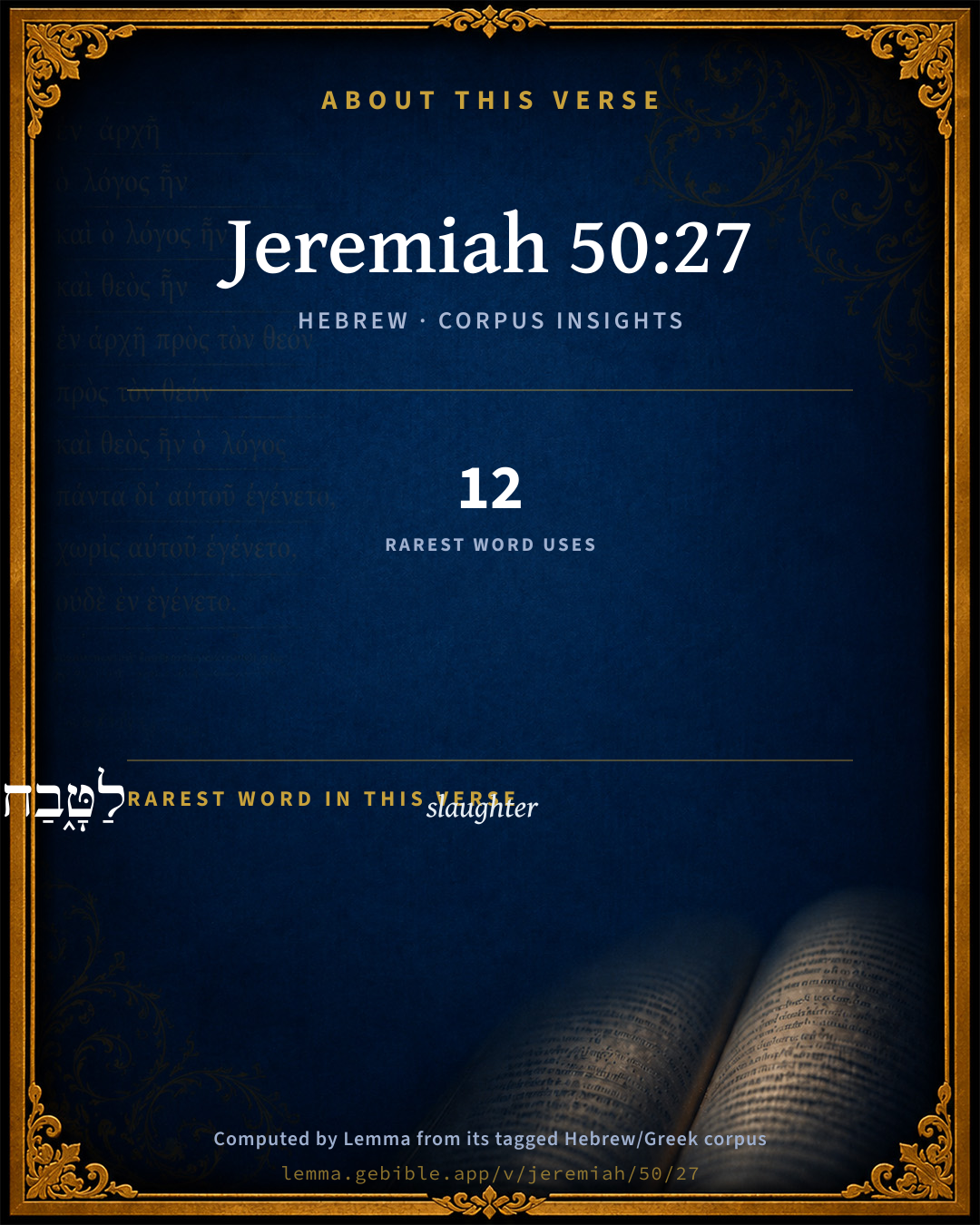
About this verse

These counts appear in no published source. They are computed here, from the morphology-tagged text and Lemma’s own curated glosses. What Lemma adds →

12
words
12
distinct lemmas
Prophets
section

Notable vocabulary

The rarest word here is לַטָּ֑בַח slaughter H2874 — appearing just 12 times in the whole Hebrew Bible.

Shared distinctive vocabulary

לַטָּ֑בַח slaughter H2874 occurs in 12 verses of the Hebrew Bible. Also found in:

Grammatical profile

  • 3 verbs
  • 6 nouns
  • 1 preposition
  • 1 conjunction
  • 1 particle

Verb forms

  • חִרְבוּ֙ Qal · Imperative
  • יֵרְד֖וּ Qal · Imperfect
  • בָ֥א Qal · Perfect

Cross-references

14

Topical passages linked to Jeremiah 50:27 in the Treasury of Scripture Knowledge — connected by theme and wording, ordered by reader-vote popularity; previews shown in the World English Bible.

  • Isaiah 34:7 The wild-oxen shall come down with them, and the bulls with the bulls: and their land shall be drunken with blood, and their dust made fat with fatness.
  • Jeremiah 46:21 Also her hired men in the midst of her are like calves of the stall; for they also are turned back, they are fled away together, they didn't stand: for the day of their calamity is come on them, the time of their visitation.
  • Psalms 22:12 Many bulls have surrounded me. Strong bulls of Bashan have encircled me.
  • Psalms 37:13 The Lord will laugh at him, For he sees that his day is coming.
  • Jeremiah 48:44 He who flees from the fear shall fall into the pit; and he who gets up out of the pit shall be taken in the snare: for I will bring on him, even on Moab, the year of their visitation, says Yahweh.
  • Jeremiah 27:7 All the nations shall serve him, and his son, and his son's son, until the time of his own land come: and then many nations and great kings shall make him their bondservant.
  • Jeremiah 50:11 Because you are glad, because you rejoice, O you who plunder my heritage, because you are wanton as a heifer that treads out [the grain], and neigh as strong horses;
  • Jeremiah 50:31 Behold, I am against you, you proud one, says the Lord, Yahweh of Hosts; for your day is come, the time that I will visit you.
  • Lamentations 1:21 They have heard that I sigh; there is none to comfort me; All my enemies have heard of my trouble; they are glad that you have done it: You will bring the day that you have proclaimed, and they shall be like me.
  • Ezekiel 7:5–7 Thus says the Lord Yahweh: An evil, an only evil; behold, it comes.
  • Ezekiel 39:17–20 You, son of man, thus says the Lord Yahweh: Speak to the birds of every sort, and to every animal of the field, Assemble yourselves, and come; gather yourselves on every side to my sacrifice that I do sacrifice for you, even a great sacrifice on the mountains of Israel, that you may eat flesh and drink blood.
  • Revelation 16:17–19 The seventh poured out his bowl into the air. A loud voice came forth out of the temple of heaven, from the throne, saying, "It is done!"
  • Revelation 18:10 standing far away for the fear of her torment, saying, 'Woe, woe, the great city, Babylon, the strong city! For your judgment has come in one hour.'
  • Revelation 19:17 I saw an angel standing in the sun. He cried with a loud voice, saying to all the birds that fly in the sky, "Come! Be gathered together to the great supper of God,

Cross-references courtesy of OpenBible.info (CC BY 4.0).

Hebrew and Greek witnesses Masoretic Hebrew ↔ Greek Septuagint

The same verse in the two great witnesses to the Old Testament, shown verse-for-verse.

These are two independent witnesses, not word-aligned to each other, and the Septuagint is shown in lemma (dictionary) form.

Hebrew Jeremiah 50:27 Masoretic · Westminster Leningrad Codex

חִרְבוּ֙ כָּל פָּרֶ֔יהָ יֵרְד֖וּ לַטָּ֑בַח ה֣וֹי עֲלֵיהֶ֔ם כִּֽי בָ֥א יוֹמָ֖ם עֵ֥ת פְּקֻדָּתָֽם

Kill all her bulls; let them go down to the slaughter: woe to them! for their day is come, the time of their visitation.

World English Bible · Public Domain

Greek LXX Structure differs

In the Septuagint, Jeremiah is about an eighth shorter than the Hebrew and arranges its material differently — the Oracles Against the Nations (Hebrew chapters 46–51) appear in the middle of the Greek book, after 25:13. Because the chapter and verse boundaries do not line up, a verse-for-verse comparison with the Hebrew is not shown.

A verse-for-verse comparison isn’t shown here because the chapters and verses don’t line up. Switch to the LXX edition with the MT / LXX toggle above to read the Greek directly.

Hebrew: Westminster Leningrad Codex (CC BY 4.0). Greek: Septuagint (public domain); English from a public-domain English Septuagint. How the Septuagint differs from the Hebrew →

Targum (Aramaic paraphrase)

1

The Targum is the ancient Jewish Aramaic paraphrase of the Hebrew Scriptures — an interpretive translation, not the Hebrew text itself. Onkelos (literal) and Pseudo-Jonathan (expansive) render the Torah, and Jonathan the Prophets. Coverage is partial: where no permissively-licensed English translation exists for a verse, only the Aramaic is shown. This is verse-level text, not a word-by-word alignment to the Hebrew.

  1. Targum Jonathan Prophets (Joshua–Malachi)
    שֵׁיצִיאִי כָּל גִבָּרָהָא אִתְמַסְרָא לִקְטָלָא וַי עֲלֵיהוֹן אֲרֵי מְטָא יוֹם תְּבִירְהוֹן עִדַן סְעוּרַן בִּישַׁתְהוֹן:

    (no public-domain English translation for this verse)

    Targum Jonathan — Aramaic: “Mikraot Gedolot” (public domain). English: “Sefaria Community Translation” (CC0 1.0 (public-domain dedication)); “London "Chaldee Paraphrase," 1871” (public domain). Text via Sefaria.

Commentary

Notes on Jeremiah 50:27 from classic Christian and Jewish commentators (each source and its license shown beneath its notes). The classic Christian expositions comment on the surrounding passage and are grouped to its opening verse, so a note may address several verses; the Jewish commentaries on the Tanakh (Rashi and others) are per-verse, so they appear only where the commentator wrote on this verse.

Lemma curates 59 commentaries, every one of them public domain or Creative Commons licensed, each selected and text-cleaned for this edition rather than reprinted as found. About our sources →

Trapp's Complete Commentary

John Trapp

Jer 50:27 Slay all her bullocks; let them go down to the slaughter: woe unto them! for their day is come, the time of their visitation.

Ver. 27. Slay all her bullocks.] Heb., Sword them, sheath your swords in their sides. See Jer 50:24.

John Trapp, A Commentary or Exposition upon All the Books of the Old and New Testament (1647–1656) — public domain. Text from a community e-Sword module.

Geneva Bible (1599)

Geneva Bible translators

Her princes and mighty men.

Geneva Bible (1599) marginal notes — public domain. Text via Bolls.life.

Jamieson, Fausset & Brown

Robert Jamieson, A. R. Fausset & David Brown

bullocks--that is, princes and strong warriors (Jer 46:21; Psa 22:12; Isa 34:7).

go down to . . . slaughter--The slaughterhouses lay low beside the river; therefore it is said, "go down"; appropriate to Babylon on the Euphrates, the avenue through which the slaughterers entered the city.

Jamieson, Fausset & Brown — Commentary Critical and Explanatory on the Whole Bible (1871) — public domain (CC PDM 1.0). Text via the HelloAO Bible API.

Adam Clarke's Commentary

Verse 27. Slay all her bullocks] Princes, magistrates, &c., &c.

Adam Clarke's Commentary on the Bible (1810–1826) — public domain. Text from a community e-Sword/MySword module.

John Calvin's Commentaries

He goes on with the same subject; he bids the Persians and the Medes to slay every strong man in Chaldea; for by bullocks he no doubt means by a metaphor all those who excelled in strength, or in power, or in wealth. The sum of what he says is, that the vengeance of which he now speaks, would not only be against the common people, but also against the highest and the choicest among them. He includes then the nobles as well as all the men of war; for he refers not only to strength of body, but also to power and authority.

Slay, then, he says, all her bullocks, that is, whatever is most valued in Chaldea: that was to perish when the day of vengeance came. He afterwards says, let them descend to the slaughter We must ever bear in mind what I have said, that the Prophet gave orders as though he had the Medes and the Persians under his own hand and authority, because the whole world is subject to God’s word. He says, Woe to them! for their day is come, and the time of their visitation This was added, because the faithful might have disputed with themselves and said, “How can it be that Babylon should perish so quickly?” For God seemed to have favored that monarchy for a long time, as though he intended to protect it perpetually. Hence the Prophet speaks here of the time of visitation, so that the faithful might not doubt respecting this prophecy, because God had not as yet put forth his band. He then reminded them that God has his fixed times, and that he does not every day visit nations, that is, that he does not execute his judgments every moment, but at the time which he has appointed. Whenever, then, the ungodly securely exult and triumph, let us ever remember this truth, that the time is not yet come for God to execute his judgment; how so? because there is a fixed time of visitation, and that is dependent on God’s will. Let us then learn to bear patiently all our trials until it shall please God to show that he is the judge of the world. It follows,—

John Calvin's Commentaries (1540-1563) — public domain. Text from the Calvin Translation Society English edition (1840s-50s) via the Christian Classics Ethereal Library (ccel.org). Calvin's coverage is partial (roughly two-thirds of the Bible); uncommented books and verses are honest gaps, never fabricated. The 19th-century editor's footnotes and remarks are omitted so the notes are faithfully Calvin's own voice.

Ellicott's Commentary for English Readers

(27) Slay all her bullocks.—The words are probably to be taken figuratively of the captains and men of war of Babylon, as in Psa_22:12; Isa_34:7; Jer_48:15 (see Note), and Jer_51:40.

A Bible Commentary for English Readers, edited by Charles John Ellicott (1878–1897) — public domain. Text from a community e-Sword module.

The Cambridge Bible for Schools and Colleges

gen. ed. J. J. S. Perowne

27. her bullocks] her choice youths, the flower of her army. Cp. for the figure Isa_34:7. For the expression “go down to the slaughter” cp. Jer_48:15, and for “the time of their visitation” Jer_46:21.

The Cambridge Bible for Schools and Colleges (gen. ed. J. J. S. Perowne; Cambridge University Press, 1878–1918) — public domain. Text from a community e-Sword module.

John Gill's Exposition

Slay all her bullocks,.... Or, "all her mighty ones", as the Targum and Vulgate Latin version; her princes and great men, as Jarchi, Kimchi, and Abarbinel; compared to bullocks for their strength, fatness, and fierceness; see Psa 22:12; this may well be applied to the slaughter of kings, captains, and mighty men, at the battle of Armageddon, Rev 19:18;

let them go down to the slaughter; to the place slaughter, as oxen do, insensible, and whether they will or not:

woe unto them, for their day is come, the time of their visitation; the time of their destruction, of visiting or punishing them for their sins, appointed by the Lord, which they could not pass; and so a woeful and dreadful time to them.

John Gill's Exposition of the Whole Bible (1746–1763) — public domain (CC PDM 1.0). Text via the HelloAO Bible API.

Albert Barnes' Notes on the Bible

Her bullocks - Her strong youths.

Albert Barnes' Notes on the Bible (1834–1885) — public domain. Text from a community e-Sword/MySword module.

Matthew Poole's English Annotations

By

bullocks in this place interpreters generally understand the great and rich men of Babylon.

Matthew Poole's English Annotations on the Holy Bible (1683–1685) — public domain. Text from a community e-Sword/MySword module.

Whedon's Commentary on the Bible

Daniel D. Whedon

27. Bullocks — Her warlike young men, the flower of her population.

Daniel D. Whedon (gen. ed.), Commentary on the Old and New Testaments (1874–1909) — public domain. Text from a community e-Sword module.

The Pulpit Commentary

In this verse we are told that the kherem, i.e. the Divine ban, falls upon the entire male population, as in the holy wars of Joshua. (Jos_6:21 Jos_11:11, Jos_11:20) All her bullocks. As in Jer_51:40 Isa_34:6, the doomed people is likened to sacrificial victims. (Jer_46:10) The same fact is described without figure in Jer_48:15. Go down to the slaughter; i.e. be forced down to the slaughtering trough.

The Pulpit Commentary (1880–1919), ed. H.D.M. Spence-Jones & Joseph S. Exell — public domain. Text from a community e-Sword module.

John Wesley's Explanatory Notes

Bullocks - The great and rich men of Babylon.

John Wesley, Explanatory Notes Upon the Whole Bible (1754–1765) — public domain. Text via the GEBible commentary corpus.

unfoldingWord translationNotes

Door43 World Missions Community

General Information:

Yahweh continues telling how to destroy the people of Babylon and Chaldea.

Kill all her bulls. Send them down to the place of slaughter

Possible meaning of "bulls" is 1) soldiers or 2) strong young men. Killing them is spoken of as taking them to a place of slaughter. (See: Metaphor)

Kill all her bulls

Yahweh speaks this to the enemies of Babylon. This can be made clear. AT: "You enemies of Babylon, kill all her bulls" (See: Assumed Knowledge and Implicit Information)

her bulls

The word "her" refers to Babylon.

them ... their

The word "them" and "their" refer to the people of Babylon.

their day has come—the time for their punishment

The phrases "their day" and "the time" mean the same thing and can be combined. AT: "the time for their punishment has come" (See: Doublet)

There is the sound of those fleeing

"Listen and you will hear those who are fleeing"

those ... those ... These

The words "those" and "These" refer to the survivors from Babylon who will tell others about Yahweh's vengeance.

the vengeance of Yahweh our God for Zion, and vengeance for his temple

The abstract noun "vengeance" can be stated as an action. AT: "Yahweh our God has taken revenge for what they did to Zion and to his temple in Jerusalem" (See: Abstract Nouns)

translationWords

cow

send

slaughter

woe

punish

report

avenge

Zion

temple

unfoldingWord translationNotes — © Distant Shores Media and the Door43 World Missions Community, licensed CC BY-SA 4.0. Source: git.door43.org/Door43/en_tn.

Rashi

Rabbi Shlomo Yitzchaki (Rashi)

all her bulls Her princes. So is the custom of the prophets to compare the princes to mighty bulls and to he-goats.

Rashi on the Tanakh — English translations: “The Judaica Press complete Tanach with Rashi, translated by A. J. Rosenberg” (CC BY 4.0); “Pentateuch with Rashi's commentary by M. Rosenbaum and A.M. Silbermann, 1929-1934” (public domain); “The Metsudah Tanach series, Lakewood, N.J” (CC BY 4.0); and “The Book of Joshua, Metsudah Publications, 1997” (CC BY 4.0). Text via Sefaria.

Lesson kit

Teaching starters — assembled from the data on this page, not authored interpretation. Every prompt links to the verse data it draws on. Edit before teaching.

Jeremiah, in the Prophets, opens this verse with 12 words (12 distinct Hebrew lemmas). Its most distinctive word is ṭebach (“slaughter”). A historical commentator’s framing appears above. Read the whole chapter for the surrounding context.

Discussion questions

  1. How does “slaughter” (ṭebach) shape what this verse is saying?
  2. How does Genesis 43:16, which shares the word «slaughter», read alongside this verse?
  3. These translations render this verse differently; the difference is in the English rendering, not the original. What questions does that raise?
  4. «חִרְבוּ֙» is a Qal Imperative verb. How does that grammatical form shape the action described?
  5. Compare how Trapp's Complete Commentary and Geneva Bible (1599) read this verse. Where do they agree or differ?

Things to notice

Reading settings

Reading text

Shown beneath each verse's original-language words.

Old Testament
Old Testament edition

Read the OT as the Masoretic Hebrew (MT) or the Greek Septuagint (LXX).

English shown for the Greek Septuagint (in the Hebrew ↔ Greek comparison).

Comparing translations? Open the Compare panel on any verse page to stack up to four side by side.