
Isaiah 37:18

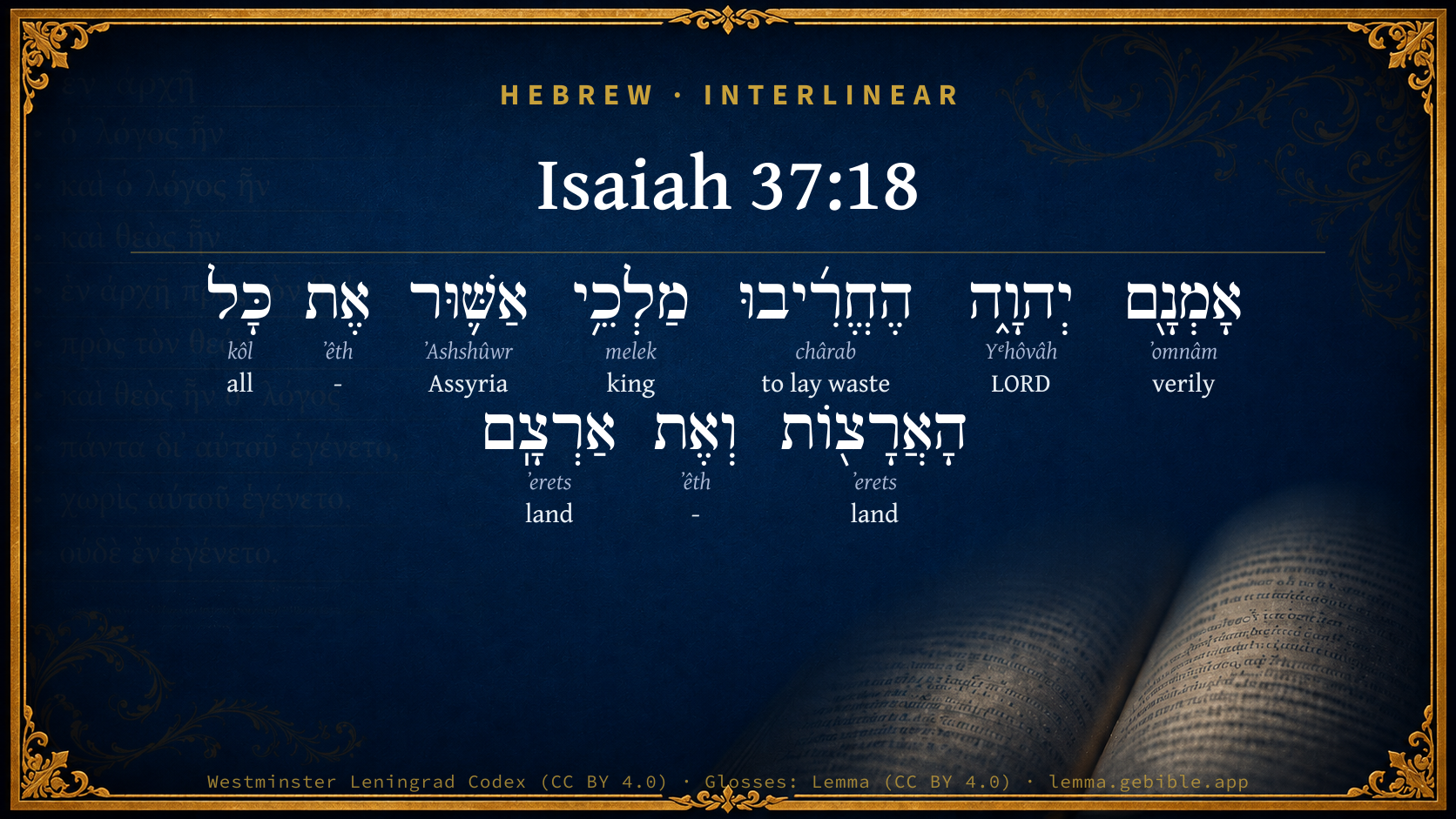
Hebrew (Westminster Leningrad Codex) Isaiah 37:18 appears in the Hebrew Old Testament. The text above is from the Westminster Leningrad Codex. Each word links to its Strong’s number, a concise gloss, and parsing drawn from the Open Scriptures Hebrew Bible morphology. Click any word for its full Brown-Driver-Briggs (BDB) entry.
Download image
Cite this verse

Isaiah 37:18 (World English Bible). Public Domain. Lemma interlinear Bible study tool, https://lemma.gebible.app/v/isaiah/37/18.

Show BibTeX & RIS
BibTeX
RIS
English Translation
Of a truth, Yahweh, the kings of Assyria have laid waste all the countries, and their land,
World English Bible · Public Domain
Download a study sheet

One document with this verse’s original text, its word-by-word gloss line, the meaning frame, cross-references with their text, attributed commentary, and full source and license credits — printable, and it pastes into notes with its structure intact.

This verse Autodidact and up

Study sheet (.html) Plain text (.txt)

A passage Seminary Student

Up to 50 verses in one chapter. A passage sheet keeps up to 6 commentary sources and 12 cross-references per verse, in the order this page ranks them, and says so on the sheet whenever that leaves anything out. Ask for a single verse and you get the Autodidact verse sheet above.

Everything on this page stays free to read, with no account — the sheet is a download of what is already on screen, not access to it.

Want to remove ads? Support Godless Engineer
Compare translations 3

The same verse in 3 English versions, stacked beneath the original-language interlinear above. Click any original word for its lexicon entry.

Each is an independent rendering of the whole verse — the interlinear is not word-aligned to these translations.

Highlighted words mark where these versions differ — a whole-verse word diff, not a word-by-word alignment.

  • World English Bible Public Domain
    Of a truth, Yahweh, the kings of Assyria have laid waste all the countries, and their land,
  • King James Version Public Domain
    Of a truth, LORD, the kings of Assyria have laid waste all the nations, and their countries,
  • unfoldingWord Literal Text CC BY-SA 4.0
    Truly, Yahweh, the kings of Assyria have destroyed all of the nations and their land.

unfoldingWord Literal Text — © unfoldingWord, licensed CC BY-SA 4.0. Word-aligned USFM3 via Door43 (git.door43.org/unfoldingWord/en_ult).

Versions to compare (up to 4)

3 of 4 selected

Show all 18 translations

Every available English version of this verse, each an independent rendering of the whole verse.

  • World English Bible Public Domain
    Of a truth, Yahweh, the kings of Assyria have laid waste all the countries, and their land,
  • Berean Standard Bible Public Domain
    Truly, O LORD, the kings of Assyria have laid waste all these countries and their lands.
  • Majority Standard Bible Public Domain
    Truly, O LORD, the kings of Assyria have laid waste all these countries and their lands.
  • King James Version Public Domain
    Of a truth, LORD, the kings of Assyria have laid waste all the nations, and their countries,
  • American Standard Version (1901) Public Domain
    Of a truth, Jehovah, the kings of Assyria have laid waste all the countries, and their land,
  • Revised Version (1885) Public Domain
    Of a truth, LORD, the kings of Assyria have laid waste all the countries, and their land,
  • Geneva Bible (1599) Public Domain
    Trueth it is, O Lord, that the Kings of Asshur haue destroyed all lands, and their countrey,
  • Douay-Rheims (1899) Public Domain
    For of a truth, O Lord, the kings of the Assyrians have laid waste lands, and their countries.
  • Young's Literal Translation Public Domain
    `Truly, O Jehovah, kings of Asshur have laid waste all the lands and their land,
  • Literal Standard Version CC BY-SA 4.0
    Truly, O YHWH, kings of Asshur have laid waste all the lands and their land,
  • Unlocked Literal Bible CC BY-SA 4.0
    It is true, Yahweh, the kings of Assyria have destroyed all the nations and their lands.
  • unfoldingWord Literal Text CC BY-SA 4.0
    Truly, Yahweh, the kings of Assyria have destroyed all of the nations and their land.
  • Darby Bible Public Domain
    Of a truth, Jehovah, the kings of Assyria have laid waste all the lands, and their countries,
  • World Messianic Bible Public Domain
    Truly, LORD, the kings of Assyria have destroyed all the countries and their land,
  • Webster's Bible Public Domain
    Of a truth, LORD, the kings of Assyria have laid waste all the nations, and their countries,
  • Free Bible Version CC BY-SA 4.0
    Yes, it's true, Lord, that the Assyrian kings have destroyed these nations and their lands.
  • Bible in Basic English Public Domain
    Truly, O Lord, the kings of Assyria have made waste all the nations and their lands,
  • JPS Tanakh (1917) Public Domain
    Of a truth, LORD, the kings of Assyria have laid waste all the countries, and their land,

Literal Standard Version (2020), Covenant Press — licensed CC BY-SA 4.0. Text via the HelloAO Bible API (eBible.org). Unlocked Literal Bible (unfoldingWord) — licensed CC BY-SA 4.0. Text via the HelloAO Bible API (eBible.org). unfoldingWord Literal Text — © unfoldingWord, licensed CC BY-SA 4.0. Word-aligned USFM3 via Door43 (git.door43.org/unfoldingWord/en_ult). Free Bible Version, Dr. Jonathan Gallagher — licensed CC BY-SA 4.0. Text via the HelloAO Bible API (eBible.org).

Word by word

More ways to search: Search by grammar → Find every occurrence → Compare this word →

Practice this passage: Drill this verse → Learn its vocabulary →

About this verse

These counts appear in no published source. They are computed here, from the morphology-tagged text and Lemma’s own curated glosses. What Lemma adds →

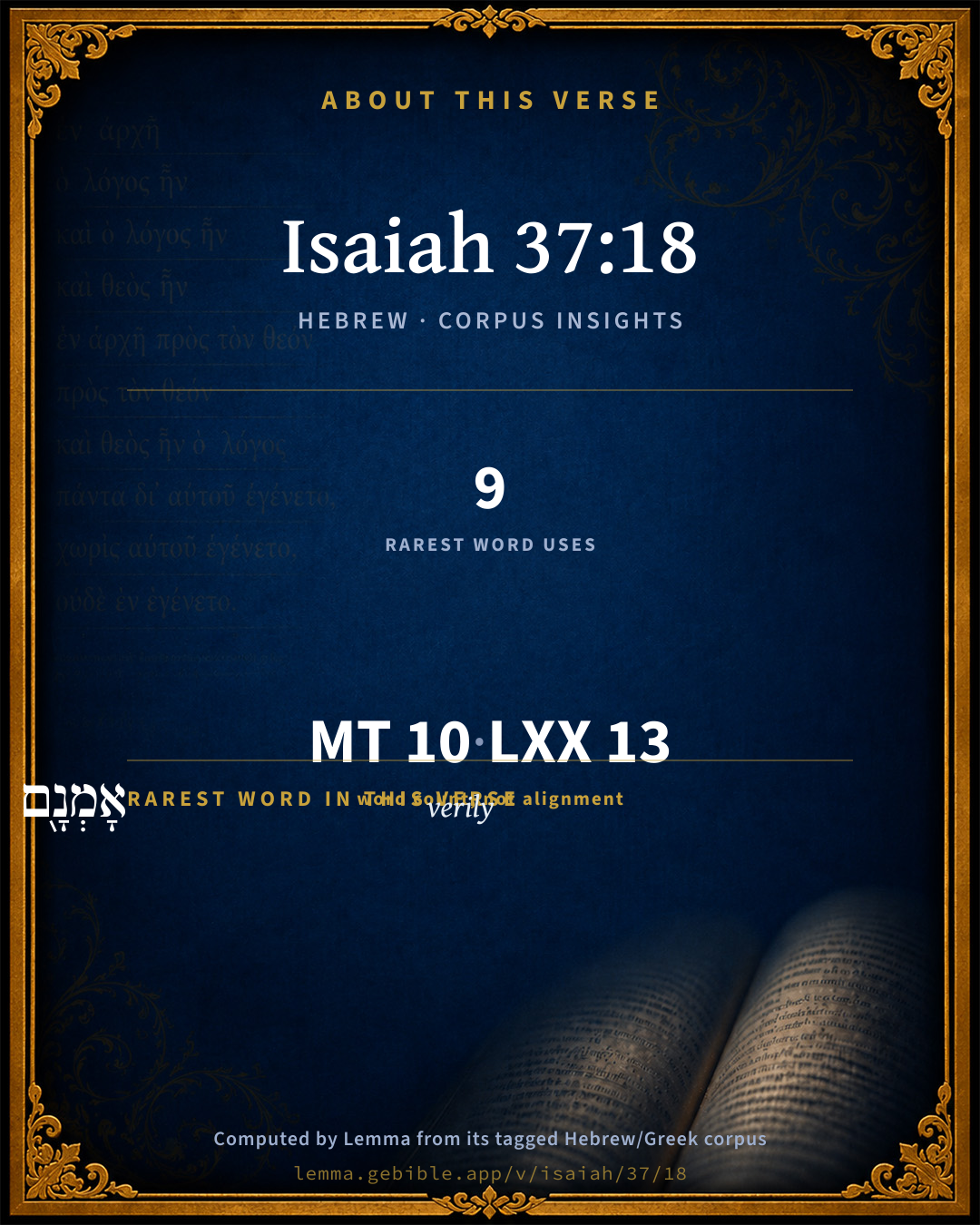
10
words
8
distinct lemmas
Prophets
section

Notable vocabulary

The rarest word here is אָמְנָ֖ם verily H551 — appearing just 9 times in the whole Hebrew Bible.

Shared distinctive vocabulary

אָמְנָ֖ם verily H551 occurs in 9 verses of the Hebrew Bible. Also found in:

Grammatical profile

  • 1 verb
  • 6 nouns
  • 1 adverb
  • 2 particles

Verb forms

  • הֶחֱרִ֜יבוּ Hiphil · Perfect

Repetition

A word recurs within this verse — often emphatic in Hebrew:

  • הָאֲרָצ֖וֹת land H776 ×2

Hebrew & Septuagint length

In English translation the verse runs 17 words from the Hebrew and 20 from the Septuagint (LXX English) — closely comparable.

A rough comparison of the two English renderings, which tokenize alike — not a word-level alignment.

Word counts can differ between the Hebrew and the Greek without any difference in meaning — e.g. the Hebrew direct-object marker אֵת has no separate Greek word, and Greek often adds the article ὁ.

In the original languages it is 10 Hebrew tokens and 13 Greek tokens — but the two are counted differently (Hebrew bundles its prefixes and suffixes into one token; the Greek is in lemma form), so that isn’t a like-for-like length.

Cross-references

6

Topical passages linked to Isaiah 37:18 in the Treasury of Scripture Knowledge — connected by theme and wording, ordered by reader-vote popularity; previews shown in the World English Bible.

  • 2 Kings 15:29 In the days of Pekah king of Israel came Tiglath Pileser king of Assyria, and took Ijon, and Abel Beth Maacah, and Janoah, and Kedesh, and Hazor, and Gilead, and Galilee, all the land of Naphtali; and he carried them captive to Assyria.
  • Nahum 2:11–12 Where is the den of the lions, and the feeding-place of the young lions, where the lion and the lioness walked, the lion's cubs, and no one made them afraid?
  • 2 Kings 16:9 The king of Assyria listened to him; and the king of Assyria went up against Damascus, and took it, and carried [the people of] it captive to Kir, and killed Rezin.
  • 2 Kings 17:6 In the ninth year of Hoshea the king of Assyria took Samaria, and carried Israel away to Assyria, and placed them in Halah, and on the Habor, the river of Gozan, and in the cities of the Medes.
  • 2 Kings 17:24 The king of Assyria brought men from Babylon, and from Cuthah, and from Avva, and from Hamath and Sepharvaim, and placed them in the cities of Samaria instead of the children of Israel; and they possessed Samaria, and lived in the cities of it.
  • 1 Chronicles 5:26 The God of Israel stirred up the spirit of Pul king of Assyria, and the spirit of Tilgath Pilneser king of Assyria, and he carried them away, even the Reubenites, and the Gadites, and the half-tribe of Manasseh, and brought them to Halah, and Habor, and Hara, and to the river of Gozan, to this day.

Cross-references courtesy of OpenBible.info (CC BY 4.0).

Hebrew and Greek witnesses Masoretic Hebrew ↔ Greek Septuagint

The same verse in the two great witnesses to the Old Testament, shown verse-for-verse.

These are two independent witnesses, not word-aligned to each other, and the Septuagint is shown in lemma (dictionary) form.

Hebrew Isaiah 37:18 Masoretic · Westminster Leningrad Codex

אָמְנָ֖ם יְהוָ֑ה הֶחֱרִ֜יבוּ מַלְכֵ֥י אַשּׁ֛וּר אֶת כָּל הָאֲרָצ֖וֹת וְאֶת אַרְצָֽם

Of a truth, Yahweh, the kings of Assyria have laid waste all the countries, and their land,

World English Bible · Public Domain

Greek LXX Isaiah 37:18 Septuagint · lemma form

ἐπί ἀλήθεια γάρ ἐρημόω βασιλεύς ἀσσύριος ὁ οἰκέω ὅλος καί ὁ χώρα αὐτός

For of a truth, Lord, the kings of the Assyrians have laid waste the whole world, and the countries thereof,

LXX2012 (modern English Septuagint) · Public Domain

Hebrew: Westminster Leningrad Codex (CC BY 4.0). Greek: Septuagint (public domain); English from LXX2012 (modern English Septuagint) (Public Domain). How the Septuagint differs from the Hebrew →

Targum (Aramaic paraphrase)

1

The Targum is the ancient Jewish Aramaic paraphrase of the Hebrew Scriptures — an interpretive translation, not the Hebrew text itself. Onkelos (literal) and Pseudo-Jonathan (expansive) render the Torah, and Jonathan the Prophets. Coverage is partial: where no permissively-licensed English translation exists for a verse, only the Aramaic is shown. This is verse-level text, not a word-by-word alignment to the Hebrew.

  1. Targum Jonathan Prophets (Joshua–Malachi)
    בְּקוּשְׁטָא יְיָ אַחְרִיבוּ מַלְכֵי אַתּוּר יַת כָּל מְדִינָתָא וְיַת אַרְעֲהוֹן:

    Of a truth, O Lord, the kings of Assyria have laid waste all the provinces and their lands,

    Targum Jonathan — Aramaic: “Mikraot Gedolot” (public domain). English: “Sefaria Community Translation” (CC0 1.0 (public-domain dedication)); “London "Chaldee Paraphrase," 1871” (public domain). Text via Sefaria.

Commentary

Notes on Isaiah 37:18 from classic Christian and Jewish commentators (each source and its license shown beneath its notes). The classic Christian expositions comment on the surrounding passage and are grouped to its opening verse, so a note may address several verses; the Jewish commentaries on the Tanakh (Rashi and others) are per-verse, so they appear only where the commentator wrote on this verse.

Lemma curates 59 commentaries, every one of them public domain or Creative Commons licensed, each selected and text-cleaned for this edition rather than reprinted as found. About our sources →

Geneva Bible (1599)

Geneva Bible translators

Meaning, the ten tribes.

Geneva Bible (1599) marginal notes — public domain. Text via Bolls.life.

Jamieson, Fausset & Brown

Robert Jamieson, A. R. Fausset & David Brown

have laid waste--conceding the truth of the Assyrian's allegation (Isa 36:18-20), but adding the reason, "For they were no gods."

Jamieson, Fausset & Brown — Commentary Critical and Explanatory on the Whole Bible (1871) — public domain (CC PDM 1.0). Text via the HelloAO Bible API.

Adam Clarke's Commentary

Verse 18. The nations] הארצות haratsoth, "the lands;" instead of this word, which destroys the sense, ten of Kennicott's and five of De Rossi's MSS. (one ancient) have here גוים goyim, "nations;" which is undoubtedly the true reading, being preserved also in the other copy; 2Kg 19:17. Another MS. suggests another method of rectifying the sense in this place, by reading מלכם malcam, "their king, "instead of ארצם artsam, "their land;" but it ought to be מלכיהם malcheyhem, "all the countries and their kings."

Adam Clarke's Commentary on the Bible (1810–1826) — public domain. Text from a community e-Sword/MySword module.

Ellicott's Commentary for English Readers

(18) Of a truth, Lord . . .—The facts of Rabshakeh’s induction are admitted, but the inference denied, on the ground that the cases were not parallel. The gods of the nations had been cast into the fire (an alternative to their being taken as trophies for the temples of Asshur and Ishtar), but this could never happen to Jehovah, of whom there was no graven image, and He would show that He alone was ruler of the earth and of the heavens.

A Bible Commentary for English Readers, edited by Charles John Ellicott (1878–1897) — public domain. Text from a community e-Sword module.

The Cambridge Bible for Schools and Colleges

gen. ed. J. J. S. Perowne

18. all the nations, and their countries] R.V., following the received text, has “all the countries (lit., lands) and their land.” But the true reading is preserved in the corresponding verse of 2 Kings, which A.V. has rightly followed here.

have laid waste] This verb is never used of nations, except in ch. Isa_60:12. It differs by a single letter from “laid under the ban” in Isa_37:11, and ought probably to be altered accordingly.

The Cambridge Bible for Schools and Colleges (gen. ed. J. J. S. Perowne; Cambridge University Press, 1878–1918) — public domain. Text from a community e-Sword module.

John Gill's Exposition

Now therefore, O Lord our God, save us from his hand,.... The hand of the king of Assyria. The Lord had promised that he would and Hezekiah believed he would; but he knew that for this he would be inquired of by him, and he pleads covenant interest, in him, and entreats for salvation upon that account, as well as for the reason following:

that all the kingdoms of the earth may know that thou art the Lord, even thou only; by doing that which other gods could not do; they could not save the nations that worshipped them from the hand of the Assyrians; if therefore the God of Israel saved his people from them, this would be a proof to all the world that he is God and there is none besides him.

John Gill's Exposition of the Whole Bible (1746–1763) — public domain (CC PDM 1.0). Text via the HelloAO Bible API.

Albert Barnes' Notes on the Bible

Of a truth - It is as he has said, that all the nations had been subjected to the arms of the Assyrian. He now intends to add Jerusalem to the number of vanquished cities and kingdoms, and to boast; that he has subdued the nation under the protection of Yahweh, as he had done the nations under the protection of idol-gods.

Have laid waste all, the nations - Hebrew, as Margin, ‘All the lands.’ But this is evidently an elliptical form of expression, meaning all the inhabitants or people of the lands. In 2Ki 19:17, it is thus expressed. ‘The kings of Assyria have destroyed the nations and their lands.’

Albert Barnes' Notes on the Bible (1834–1885) — public domain. Text from a community e-Sword/MySword module.

Haydock's Catholic Bible Commentary

Lands. Hebrew, "all the lands and their land." The parallel text is more correct, "the nations and their land." (Kennicott)

George Leo Haydock (1774–1849), Haydock's Catholic Family Bible and Commentary, 1859 edition — public domain. Excludes Psalms (Douay-Rheims chapter numbering differs from Protestant) and Deuterocanonical books (Catholic canon only).

The Pulpit Commentary

Of a truth, Lord, the kings of Assyria have laid waste all the nations. This was a stubborn fact, which it was impossible to deny. From the time of Asshur-izir-pal at any rate, about B.C. 880, Assyria had pursued for nearly two centuries a steady career of conquest, reducing the nations which were her neighbors, almost without exception, and gradually spreading her power from the tract immediately about Nineveh to the Persian Gulf on the south, the great plateau of Iran on the east, the Armenian Mountains (Niphates and Taurus) on the north, and on the west to Cilicia and the Mediterranean. Her progress towards the west alone is marked in Scripture, since there alone she came in contact with God"s people. Under Pul (about B.C. 760) she attacked Samaria; (2Ki_15:19) under Tiglath-Pileser II she carried off a portion of the ten tribes; (2Ki_15:29) under the same monarch she subjugated Damascus; (2Ki_16:9) under Shalmaneser she besieged, (2Ki_17:5) and under Sargon took, Samaria; (2Ki_17:6) under Sargon also she invaded Philistia and captured Ashdod. (Isa_20:1) Now she was bent on subduing Judaea, and so preparing the way for the reduction of Egypt. Humanly speaking, it was most unlikely that the small and weak state of Judaea would be able to resist her. But God was all-powerful, and might be pleased to cast down, as he had been pleased to exalt. (Isa_10:5-19) Hence Hezekiah"s appeal.

Vers. 18, 19. Faith neither blind to seemingly adverse facts, nor chary of admitting them.

Sennacherib thought to destroy Hezekiah"s trust in Jehovah by an array of facts which he regarded as having the force of an induction. Hezekiah fully admitted the facts ("Of a truth, Lord, the kings of Assyria have laid waste all the nations, and their countries"), but did not suffer his faith to be shaken by them. His faith rested upon another distinct set of facts, which Sennacherib"s did not and could not invalidate. The truth is that inductions, being never complete, are never demonstrative they do but establish a probability, and the first adverse fact that can be adduced against them upsets them, or rather upsets the general conclusion that has been drawn from them. Faith, therefore, has no need to be afraid of any amount of seemingly adverse facts, drawn from the region of the sensible. For faith"s facts lie mainly in a different sphere, and are untouched by the facts of sense, however numerous. The miracle of our Lord"s resurrection rests, for instance, first upon prophecy, secondly upon testimony, thirdly upon vision. (Rev_1:18) No amount of ascertained facts that others have not risen, can touch the sufficiently established fact that our Lord did rise. There is no even seeming clashing or contradiction, until the physicist proceeds to draw from his army of facts the general conclusion: "Therefore no men rise." But this conclusion is one that he has no right to draw; it is illogical; the data do not entitle him to infer more than that" Most men do not rise," or rather, "have not yet risen." And so generally with the facts that are adduced against the dicta of faith. They are no disproof of that which they are alleged to disprove. Faith, real faith, is always ready to admit the facts, when once they are established as facts. It disputes the illogical conclusions drawn from the facts, and the ingenious hypotheses projected from the brains of scientists to account for them.

The conduct of the king on hearing the haughty message of the Assyrian is that of a man of habitually religious mind and religious practice.

1. He rends his garments and covers himself with sackcloth. This was significant of sorrow and of self-humiliation: "Humble yourselves beneath the mighty hand of God, and he will exalt you in due time." Instead of searching far and wide for the causes of our distress, it were well to look first into our own hearts, and that closely. There, where the mischief has begun, the remedy and the hope may be revealed.

2. He sends a deputation to the minister of God; also clothed in sackcloth. They give the king"s message to Isaiah, "This day is a day of trouble, punishment, and contumely." The outward forms and shows of grief could not denote them truly. They had "That within which passed show, Beneath the trappings and the suits of woe.

The mourning garb expresses the need of the rending of the heart, and the bowing down of its pride before the judgments of God. Human extremity is confessed: "There is no strength to bring forth." The toil over insoluble problems the matching of one"s strength against a superhuman enterprise, the comparison of one"s idea of what should be with one"s sense of the absence of resources for its accomplishment, brings utter exhaustion. It is under such conditions that men learn that whatever strength they had at any time is from God, that whatever help is needed must come from him now. In the house of God, in the attitude of humility and penitence, in communion with men of God, let us be found in the day of distress.

I THE HUMAN INTERCESSOR. In common life we recognize the principle of intercession. We shelter ourselves behind the worth of another; we seek to gain interest with the powerful and the good. To carry things by personal interest and partiality doubtless opens the door to abuses; but alter all it is founded itself upon love. Logic says," Let every case be judged by its merits, every man stand or fall by merit or demerit of his person." Love, softening down the hard lines of logical principle, or concealing them with flowing ornament, says, "Let fellow-feeling and pity, kinship of blood or of mind, have their influence on the decision." The great truth of the mediation of Christ is reflected in a weaker but still emphatic way in the office of an Abraham, a Moses, a Samuel. Scripture expressly recognizes: "The prayer of a righteous man availeth much". (cf. Jer_15:1) Our objection to the Romish doctrine of the intercession of saints should not carry us too far. It might lead us to a cold denial of the influence of loving thought upon one another"s weal. What limit is there to the far-reaching influences of love? Because some assume to know too much of those influences and the manner in which they may be secured, that is no reason why we should ignore them. "An interest in the prayers of good men," it is natural to seek, and blessed to have secured. The belief in the intercession of good men rests on the belief that some men stand nearer to God than others. They have a firmer faith, a steadier insight into the methods of Providence, and therefore a clearer outlook into the future, and a courage which is inspiring to others. On this occasion Isaiah is found to be calm and undisturbed by the revilings of the Assyrian. He can speak of his officers with contempt as the "minions of the King of Assyria." He can foretell that a "spirit" will be put in the enemy an impulse quite contrary to that now animating him; he will hear ill news, will return to his own land, and will fall by the sword. The prophet sustains the king; Hezekiah leans on Isaiah; true policy finds its inspiration in religion. The ministers of state, if wise, will own the worth of the service of the ministers of God.

II BUSINESS LAID BEFORE GOD. The threat of the Assyrian, the taunting arguments on which he had before relied, are repeated. Let Hezekiah beware of trusting in Jehovah, for he may prove no better resource than the "gods of the nations" which have been subdued by the Assyrians. Hezekiah takes the letter, goes up into the house of Jehovah, and spreads it open before Jehovah. We may be reminded, as we read, of the prayer-machines of the Buddhists; or of the waxen tablets hung upon the statues of the gods by the Romans. inscribed with prayers, as alluded to by Juvenal in his tenth Satire. But where the outward act is similar, the intention may be widely different. If we look to the essence of the act, there is nothing in itself more superstitious in laying open a written letter before God, than in addressing him orally on its contents. If the spreading out is a "prayer without words," the prayer with words follows. There is no external form which we may not fill out with the life of our spirit and make vital and real; none from which we may not withdraw that life, and so leave dead and cold. It is idle to suppose that the mere abandonment of certain forms will remove the foundations of superstition, which is certain to spring up in a mechanical and lifeless state of mind.

III HEZEKIAH"S PRAYER. His thoughts of God. He is revealed in nature and in human life. He is enthroned upon the cherubim those mysterious creatures of poetic and plastic fancy, representing spiritual power revealed in strong wind and cloud, and figured in the ark. Analogous figures are common in Oriental art. Jehovah is the God of nature, the Creator of heavens and earth. He is the only true Ruler of the kingdoms of the earth. The heathen believed that their gods swayed in the sphere both of nature and of human life that their glory and power was revealed, not only in sun, and moon, and stars, and wind, but in the might of warriors and the ascendency of kings. But the contrast is that these pretensions were unreal, that of Jehovah alone. founded on truth and facts. Those "gods of the nations" who had been put into the fire by the Assyrian were no genuine gods, as the result has proved. When the idol was destroyed, the visible image of the god, the faith of the worshipper lost its visible support, and his hope fled. There was no Saviour here. True faith is not dependent on such visible props; they may fail it remains. The symbols of religion may change; old sanctuaries may fall into decay; Jerusalem may be taken; the Shechinah-glory may fade from the hallowed spot; but Jehovah remains. In superstition, when the idols are broken, the false faith dies; in true religion, when the idols are broken, the true faith rises into new life. Adversity, fatal to imposture, brings the genuine tradition to light. The true God is bound by his very nature to be the Saviour, the Deliverer of men. The cry for salvation must sooner or later, in one or another way, be answered from him. If the cry be not answered, it is a proof that we have not directed it to the true Object not to Jehovah, the Alone, the Eternal, but to some creature, the fabrication, if not of our hands, of our sensuous and unspiritual fancy. J.

The Pulpit Commentary (1880–1919), ed. H.D.M. Spence-Jones & Joseph S. Exell — public domain. Text from a community e-Sword module.

J. A. Alexander on Isaiah

Joseph Addison Alexander

“It is true, O Jehovah, the kings of Assyria have wasted all the lands and their land.” The first word in the original is a particle of concession, admitting the truth of what Sennacherib had said, so far as it related merely to his conquest of the nations and destruction of their idols. The repetition, lands and land, has much perplexed interpreters. The best construction is that which brings the sentence into strict agreement, not as to form but as to sense, with the parallel passage (2Ki 19:17) where we have the unambiguous term nations.

Joseph Addison Alexander, The Prophecies of Isaiah (1846–1847; New York: Scribner, 1870–1878) — public domain. Text from a community e-Sword module.

Rashi

Rabbi Shlomo Yitzchaki (Rashi)

Indeed, O Lord It is true that the kings of Assyria destroyed

all the countries and their land “The countries” refers to the (capitals) of the provinces, and (“their land” refers to) the land near them, the royal cities, which are the heads of the provinces, he calls “countries” and the remaining regions surrounding them he calls “their land.” And in the Book of II Kings (19:7) it is written: “the nations and their land.” It has, however, one meaning.

Rashi on the Tanakh — English translations: “The Judaica Press complete Tanach with Rashi, translated by A. J. Rosenberg” (CC BY 4.0); “Pentateuch with Rashi's commentary by M. Rosenbaum and A.M. Silbermann, 1929-1934” (public domain); “The Metsudah Tanach series, Lakewood, N.J” (CC BY 4.0); and “The Book of Joshua, Metsudah Publications, 1997” (CC BY 4.0). Text via Sefaria.

Lesson kit

Teaching starters — assembled from the data on this page, not authored interpretation. Every prompt links to the verse data it draws on. Edit before teaching.

Isaiah, in the Prophets, opens this verse with 10 words (8 distinct Hebrew lemmas). Its most distinctive word is ʼomnâm (“verily”). A historical commentator’s framing appears above. Read the whole chapter for the surrounding context.

Discussion questions

  1. What does “verily” (ʼomnâm) contribute to the verse as a whole?
  2. Ruth 3:12 shares the word «verily» with this verse. How do the two illuminate each other?
  3. “land” occurs 2× in this one verse. What is the effect of the repetition?
  4. These translations render this verse differently; the difference is in the English rendering, not the original. What questions does that raise?
  5. The verb «הֶחֱרִ֜יבוּ» is Hiphil Perfect. How does its form color the action?
  6. Reading how Geneva Bible (1599) and Jamieson, Fausset & Brown read this verse, where do the two commentators agree and where do they part?

Things to notice

Reading settings

Reading text

Shown beneath each verse's original-language words.

Old Testament
Old Testament edition

Read the OT as the Masoretic Hebrew (MT) or the Greek Septuagint (LXX).

English shown for the Greek Septuagint (in the Hebrew ↔ Greek comparison).

Comparing translations? Open the Compare panel on any verse page to stack up to four side by side.