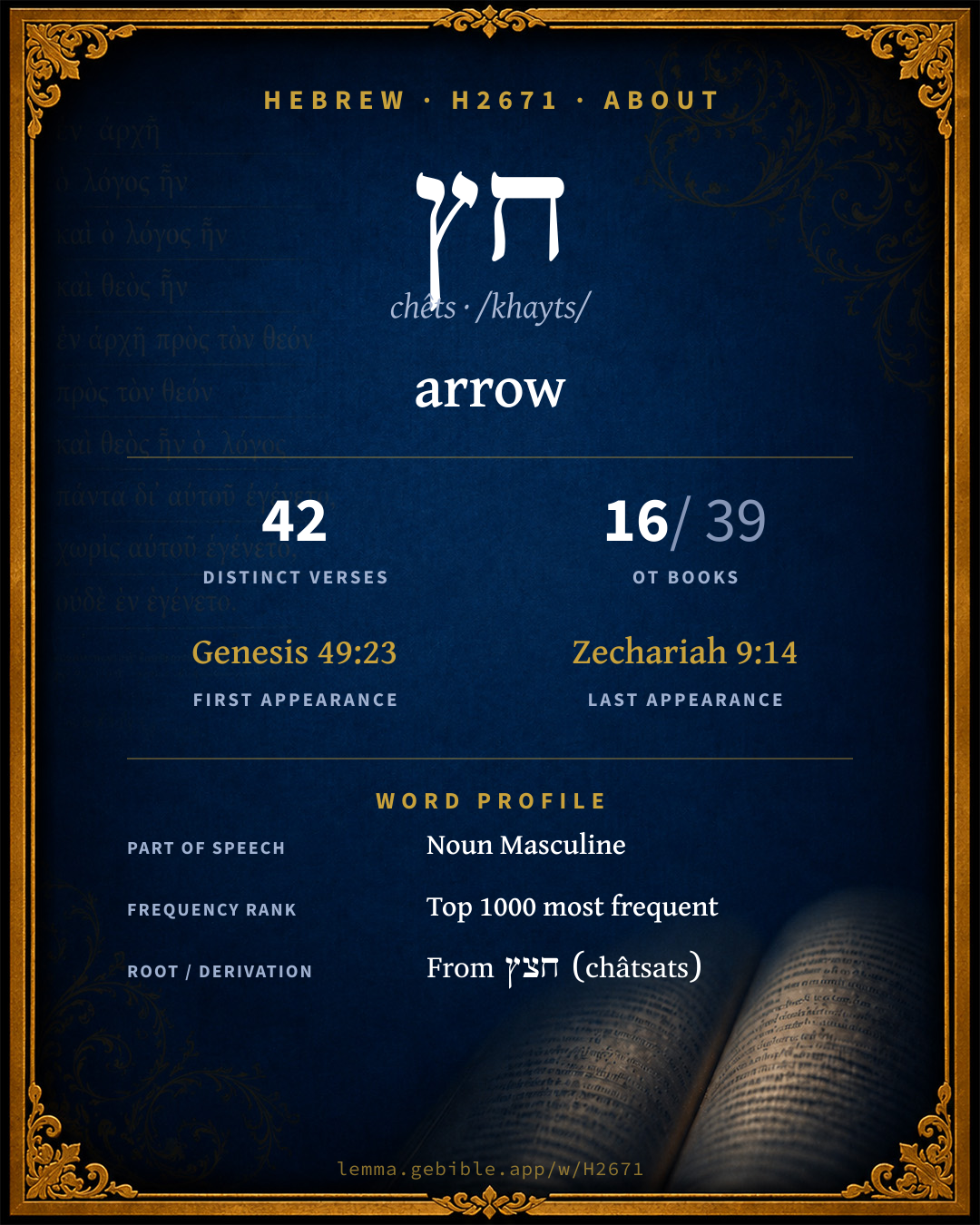
חֵץ
arrow
Full lexicon entry — Brown-Driver-Briggs (BDB)
From Brown-Driver-Briggs (BDB)
Where this word appears
See every Construct-state word in the Hebrew Bible →
Grammar key — what these labels mean
Part of speech
- Noun
- A naming word — a person, place, thing, or idea.
Noun type
- Common
- A common noun — a general class of person, place, or thing (“king,” “city,” “water”), not a specific name.
State
- Absolute
- The independent form of a noun, not bound to a following word.
- Construct
- A noun bound to a following noun in a possessive / “of” relationship (the construct chain).
Gender
- Masculine
- Grammatically masculine.
Number
- Singular
- One.
- Plural
- More than one (in Hebrew, generally three or more).
Grammatical forms
- Noun, Common, Masculine, Plural, Construct 16 times (36%)
- Noun, Common, Masculine, Plural, Absolute 11 times (24%)
- Noun, Common, Masculine, Singular, Absolute 10 times (22%)
- Noun, Common, Masculine, Singular, Construct 8 times (18%)
Parsed forms decoded from the imported morphology (morphhb / Westminster Leningrad Codex — WLC text public domain, morphhb tagging CC BY 4.0), counted across 45 parsed occurrences — not distinct verses.
Every verse where H2671 appears — 42 distinct verses across 16 books. Click any verse to open its interlinear word-by-word view. Verse text shown in the World English Bible for context — . Each verse’s Hebrew form is shown with its reference; the English is not keyword-highlighted, since the data carries no word-level English alignment. Use “Compare translations” on any verse to read it across multiple English versions. This concordance covers the Hebrew Bible; Septuagint (Greek Old Testament) occurrences are not indexed here.
Genesis 1 verse
Numbers 1 verse
Deuteronomy 2 verses
- Deuteronomy 32:23 חִצַּ֖/י n c mp cs + sfx pers 1cs I will heap evils on them; I will spend my arrows on them:
- Deuteronomy 32:42 חִצַּ/י֙ n c mp cs + sfx pers 1cs I will make my arrows drunk with blood, My sword shall devour flesh; With the blood of the slain and the captives, From the head of the leaders of the enemy.
1 Samuel 1 verse
2 Samuel 1 verse
2 Kings 3 verses
- 2 Kings 13:15 וְ/חִצִּ֑ים וְ/חִצִּֽים conj + n c mp conj + n c mp Elisha said to him, Take bow and arrows; and he took to him bow and arrows.
- 2 Kings 13:17 חֵץ וְ/חֵ֣ץ n c ms cs conj + n c ms cs He said, Open the window eastward; and he opened it. Then Elisha said, Shoot; and he shot. He said, Yahweh's arrow of victory, even the arrow of victory over Syria; for you shall strike the Syrians in Aphek, until you have consumed them.
- 2 Kings 19:32 חֵ֑ץ n c ms Therefore thus says Yahweh concerning the king of Assyria, He shall not come to this city, nor shoot an arrow there, neither shall he come before it with shield, nor cast up a mound against it.
1 Chronicles 1 verse
Job 2 verses
- Job 6:4 חִצֵּ֪י n c mp cs For the arrows of the Almighty are within me, My spirit drinks up their poison. The terrors of God set themselves in array against me.
- Job 34:6 חִצִּ֣/י n c ms cs + sfx pers 1cs Notwithstanding my right I am considered a liar; My wound is incurable, though I am without disobedience.'
Psalms 13 verses
- Psalms 7:13 חִ֝צָּ֗י/ו n c mp cs + sfx pers 3ms He has also prepared for himself the instruments of death. He makes ready his flaming arrows.
- Psalms 11:2 חִצָּ֣/ם n c ms cs + sfx pers 3mp For, behold, the wicked bend their bows. They set their arrows on the strings, That they may shoot in darkness at the upright in heart.
- Psalms 18:14 חִ֭צָּי/ו n c mp cs + sfx pers 3ms He sent out his arrows, and scattered them; Yes, great lightning bolts, and routed them.
- Psalms 38:2 חִ֭צֶּי/ךָ n c mp cs + sfx pers 2ms For your arrows have pierced me, Your hand presses hard on me.
- Psalms 45:5 חִצֶּ֗י/ךָ n c mp cs + sfx pers 2ms Your arrows are sharp. The nations fall under you, with arrows in the heart of the king's enemies.
- Psalms 57:4 וְ/חִצִּ֑ים conj + n c mp My soul is among lions. I lie among those who are set on fire, Even the sons of men, whose teeth are spears and arrows, And their tongue a sharp sword.
- Psalms 58:7 חצ/ו חִ֝צָּ֗י/ו n c ms cs + sfx pers 3ms n c mp cs + sfx pers 3ms Let them vanish as water that flows away. When they draw the bow, let their arrows be made blunt.
- Psalms 64:3 חִ֝צָּ֗/ם n c ms cs + sfx pers 3mp Who sharpen their tongue like a sword, And aim their arrows, deadly words,
- Psalms 64:7 חֵ֥ץ n c ms But God will shoot at them. They will be suddenly struck down with an arrow.
- Psalms 91:5 מֵ֝/חֵ֗ץ prep + n c ms You shall not be afraid of the terror by night, Nor of the arrow that flies by day;
- Psalms 120:4 חִצֵּ֣י n c mp cs Sharp arrows of the mighty, With coals of juniper.
- Psalms 127:4 כְּ/חִצִּ֥ים prep + n c mp As arrows in the hand of a mighty man, So are the children of youth.
- Psalms 144:6 חִ֝צֶּ֗י/ךָ n c mp cs + sfx pers 2ms Throw out lightning, and scatter them. Send out your arrows, and rout them.
Proverbs 3 verses
- Proverbs 7:23 חֵ֡ץ n c ms Until an arrow strikes through his liver, As a bird hurries to the snare, And doesn't know that it will cost his life.
- Proverbs 25:18 וְ/חֵ֣ץ conj + n c ms A man who gives false testimony against his neighbor Is like a club, a sword, or a sharp arrow.
- Proverbs 26:18 חִצִּ֥ים n c mp Like a madman who shoots firebrands, arrows, and death,
Isaiah 3 verses
- Isaiah 5:28 חִצָּי/ו֙ n c mp cs + sfx pers 3ms Whose arrows are sharp, And all their bows bent. Their horses' hoofs will be like flint, And their wheels like a whirlwind.
- Isaiah 37:33 חֵ֑ץ n c ms Therefore thus says Yahweh concerning the king of Assyria, He shall not come to this city, nor shoot an arrow there, neither shall he come before it with shield, nor cast up a mound against it.
- Isaiah 49:2 לְ/חֵ֣ץ prep + n c ms and he has made my mouth like a sharp sword; in the shadow of his hand has he hid me: and he has made me a polished shaft; in his quiver has he kept me close:
Jeremiah 4 verses
- Jeremiah 9:8 חֵ֥ץ n c ms Their tongue is a deadly arrow; it speaks deceit: one speaks peaceably to his neighbor with his mouth, but in his heart he lays wait for him.
- Jeremiah 50:9 חִצָּי/ו֙ n c mp cs + sfx pers 3ms For, behold, I will stir up and cause to come up against Babylon a company of great nations from the north country; and they shall set themselves in array against her; from there she shall be taken: their arrows shall be as of an expert mighty man; none shall return in vain.
- Jeremiah 50:14 חֵ֑ץ n c ms Set yourselves in array against Babylon round about, all you who bend the bow; shoot at her, spare no arrows: for she has sinned against Yahweh.
- Jeremiah 51:11 הַ/חִצִּים֮ ptcl def.art + n c mp Make sharp the arrows; hold firm the shields: Yahweh has stirred up the spirit of the kings of the Medes; because his purpose is against Babylon, to destroy it: for it is the vengeance of Yahweh, the vengeance of his temple.
Lamentations 1 verse
Ezekiel 4 verses
- Ezekiel 5:16 חִצֵּי֩ n c mp cs when I shall send on them the evil arrows of famine, that are for destruction, which I will send to destroy you: and I will increase the famine on you, and will break your staff of bread;
- Ezekiel 21:21 בַּֽ/חִצִּים֙ prep det + n c mp For the king of Babylon stood at the parting of the way, at the head of the two ways, to use divination: he shook the arrows back and forth, he consulted the teraphim, he looked in the liver.
- Ezekiel 39:3 וְ/חִצֶּ֕י/ךָ conj + n c mp cs + sfx pers 2ms and I will strike your bow out of your left hand, and will cause your arrows to fall out of your right hand.
- Ezekiel 39:9 וּ/בְ/חִצִּ֔ים conj + prep + n c mp Those who dwell in the cities of Israel shall go forth, and shall make fires of the weapons and burn them, both the shields and the bucklers, the bows and the arrows, and the war clubs, and the spears, and they shall make fires of them seven years;
Habakkuk 1 verse
Zechariah 1 verse
About this entry
At a glance — auto-summarized from this page’s data, not written by a person. Every figure links to its source below. This summary describes the numbers; it doesn’t interpret them.
The Hebrew noun חץ centers on the idea of “arrow.” First canonically at Genesis 49:23, it enters the text early. The Hebrew Bible uses it across 42 verses — moderately common. Psalms dominates its distribution — 13 of 42 verses. Related forms include חצץ, חצה and חצץ. Dig into 42-verse concordance and the renderings breakdown below.
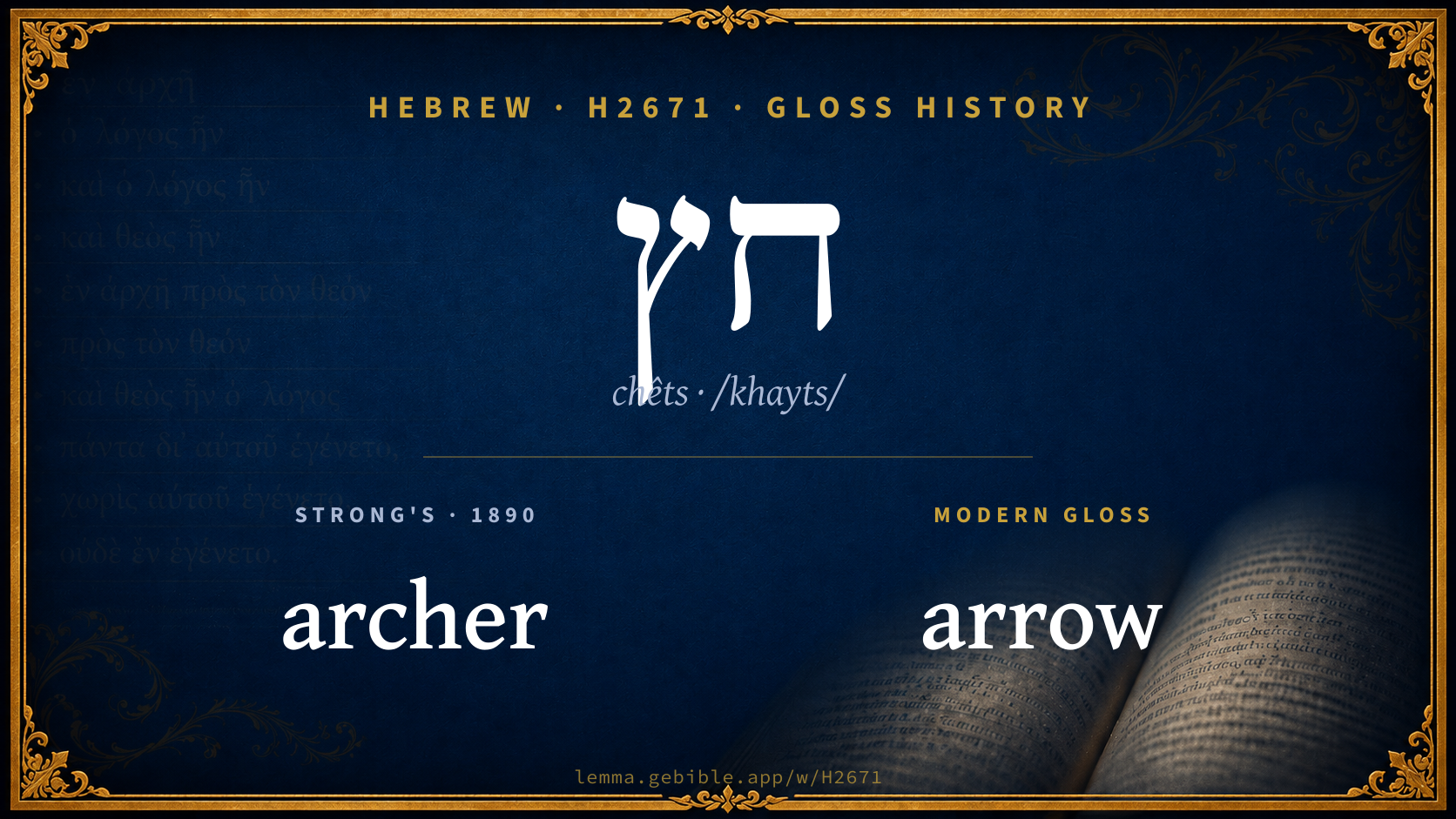
Gloss history
Strong's 1890 vs modern scholarship
About this word
Strong's H2671 catalogs a Hebrew word from the Hebrew Old Testament.
These counts are not copied from any lexicon or concordance. They are computed here, from the morphology-tagged Hebrew Old Testament. What Lemma adds →
- 42
- distinct verses
- The word appears in 42 distinct verses.
- 16 / 39
- OT books
- The word appears in 16 of 39 Old Testament books.
- #810
- by frequency
- Top 1000 most frequent Hebrew words (rank 810 of 8,640 Hebrew words by occurrence).
View all 42 occurrences in the concordance →
By section of the Old Testament
By traditional corpus
Conventional, traditional groupings — biblical authorship is debated, so this is a traditional corpus grouping, not an authorship claim. Each share is this word’s portion of its verses in that division of the Hebrew canon. Each figure is a share of the word’s 42 distinct verses.
- Writings (Ketuvim) 20 verses · 48%
- Prophets (Nevi'im) 18 verses · 43%
- Torah (Pentateuch) 4 verses · 10%
How translations render this word
Counts come from each version’s own published word-to-Strong’s tagging or interlinear alignment — an approximate guide to how each version renders this word, not a word-level alignment the data otherwise carries. Because each total is that version’s own tagged count, the per-version totals vary from one another and need not match the appearance or distinct-verse counts above. These counts may also differ from a printed concordance because Lemma counts each distinctly tagged rendering and does not collapse phrase taggings into a single head-word total. This is a fixed set of word-tagged versions (KJV, ASV, BSB, ULT) and does not change with the reading translation you choose elsewhere. Each version’s license is shown beside its name below (and on Sources).
BDB lists this Strong’s number as 2 distinct words (homographs). Each count above pools all of them and is not split by sense — see the Senses section below. A low-frequency rendering may belong to a different one of those words, not the primary meaning.
- King James Version†: Arrows 27×, Arrow 9×, Behold the arrows 2×
- American Standard Version†: Arrows 26×, Arrow 8×, Behold 2×
- Berean Standard Bible†: Arrows 32×, Arrow 12×, Like arrows 2×
- unfoldingWord Literal Text†: Arrows 23×, Arrow 12×, A 3×
King James Version Public Domain
Renders H2671 across 51† tagged occurrences — most commonly:
Plus 13 renderings that appear only once — usually multi-word phrases or single function words the recovered tagging swept in, not distinct renderings. Not rendered by a distinct English word in 2 further occurrences.
American Standard Version Public Domain
Renders H2671 across 51† tagged occurrences — most commonly:
Plus 15 renderings that appear only once — usually multi-word phrases or single function words the recovered tagging swept in, not distinct renderings.
Berean Standard Bible Public Domain
Renders H2671 across 52† tagged occurrences — most commonly:
Plus 4 renderings that appear only once — usually multi-word phrases or single function words the recovered tagging swept in, not distinct renderings. Not rendered by a distinct English word in 1 further occurrence.
unfoldingWord Literal Text CC BY-SA 4.0
Renders H2671 across 48† tagged occurrences — most commonly:
Plus 8 renderings that appear only once — usually multi-word phrases or single function words the recovered tagging swept in, not distinct renderings.
Senses in the full BDB
What do BDB’s symbols mean?
BDB uses these scholarly abbreviations:
| Symbol | Meaning |
|---|---|
| 𝔊 | the Septuagint (the ancient Greek translation, LXX) |
| 𝔙 | the Vulgate (the Latin translation) |
| 𝔖 | the Syriac version (the Peshitta) |
| 𝔗 | the Targum (the Aramaic translation) |
| ψ | the Psalms |
| √ | root (the underlying root or stem) |
| ‖ | parallel passage (a synonymous or contrasted parallel) |
| † | the dagger: every passage where the word occurs is cited |
The 2 senses and sub-senses the full Brown-Driver-Briggs lexicon distinguishes for this word, in lexicon order (not ranked by frequency), with BDB’s own verbatim wording and sub-sense lettering. Shown in Hebrew script with BDB’s own scholarly abbreviations. The condensed entry is in the Lexicon Entry tab. See also the Forms in the corpus table below.
- 1. lit., shot from bow by hand 1 S 20:20, 21(×2), 22 (𝔊 We sg., i.e. הַחֵצִי, in v 21, 22, see also Dr) v 36, 38 Qr 2 K 19:32 = Is 37:33, Is 5:28; 7:24; Je 50:9, 14; 51:11; Ez 39:3, 9; 1 Ch 12:2; shot from engine of war 2 Ch 26:15; used in divination Ez 21:26 cf. 2 K 13:15(×2), 17(×2), 18; בַּעֲלֵי חִצִּים = archers Gn 49:23. e.g. 1 Samuel 20:20
- 2. fig. of Israel’s weapons Nu 24:8, of the (Messianic) king ψ 45:6, of Yahweh’s judgments Dt 32:23, 42; Jb 6:4 (cf. חִצִּי = my wound 34:6), ψ 7:14; 38:3; 58:3 (but on text cf. Checrit. n.) 64:8; 120:4 (? cf. Che); further Pr 7:23; La 3:12; Ez 5:16; in theoph. ψ 18:15 = 2 S 22:15, cf. Hb 3:11 Zc 9:14 ψ 77:18; 144:6; of wicked men’s violence ψ 11:2 cf. 91:5, under fig. of lion’s teeth ψ 57:5; their words ψ 64:4 cf. Pr 25:18; Je 9:8; simile, of strength and efficiency derived from one’s children, ψ 127:4; of a deceiver’s words Pr 26:18; metaph. of servant of ח׳ בָּרוּר י׳ Is 49:2.—In 1 S 17:7 read עֵץ (for חֵץ) as Qr and ‖ 2 S 21:19 = the shaft; v. עֵץ; so Klo Dr e.g. Numbers 24:8
Senses from the full Brown-Driver-Briggs lexicon (Brown, Driver, Briggs; Oxford 1906 — public domain), digitized via Sefaria, supplemented by the OpenScriptures HebrewLexicon (CC BY 4.0). Full attribution on Sources.
Word origin
n.m. 1 S 20:20 arrow, mostly poet. and proph. (cf. חֵצִי supr. sub חצה)—abs. ח׳ ψ 91:5 + 9 times + 1 S 17:7 Kt (Qr עֵץ q.v.); cstr. id. 2 K 13:17(×2); sf. חִצִּי Jb 34:6, חִצּוֹ ψ 58:8 Zc 9:14, חִצָּם ψ 11:2; 64:4; Pl. חִצִּים Gn 49:23 + 17 times + 1 S 20:38 Qr (Kt חֵ֫צִי q.v.) + 2 S 22:15 (חִצָּיו ‖ ψ 18:15); cstr. חִצֵּי Jb 6:4 ψ 120:4 + Ez 5:16 (Co חִצַּי cf. 𝔊 𝔖 Hi); חִצַּי Dt 32:23, 42 (Ez 5:16 v. supr.), חִצֶּיךָ ψ 38:3 + 4 times חֲצָצֶיךָ 77:18; חִצָּיו Is 5:28 + 5 times;—
— Brown-Driver-Briggs (Oxford 1906, public domain), digitized via Sefaria, supplemented by the OpenScriptures HebrewLexicon (CC BY 4.0). See Sources.
Derived from חצץ (châtsats) (H2686) — to divide.
Jastrow Dictionary
A second Hebrew/Aramaic lexicon for comparison, covering Aramaic and post-biblical (Talmudic, Targumic, Midrashic) usage that the biblical-Hebrew BDB does not. Matched by lemma rather than by Strong’s number, so a lemma may carry more than one Jastrow headword (shown separately below), and the entries cover usage well beyond the Bible.
חֵץ
- 1. wedge, arrow. Mikv. X, 8 חץ שהוא תחוב באדם an arrow sticking in a person’s body; Tosef. ib. VII (VIII), 9. Arakh. 15ᵇ חץ עד מ"ה אמה the range of an arrow is forty five cubits. Ib. אין חץ אלא לשון arrow means (an evil) tongue (ref. to Jer. IX, 7); a. fr. [Y. Keth. II., beg. 26ᵃ שחיצה, read: שחֶצְיָהּ]—Pl. חִצִּים, חִצִּין, חִי׳. Lam. R. to III, 12 (expl. כמטרה לחץ ib.) כקורת ח׳ וכ׳ like the post for arrows (for military practice) at which all shoot &c.—Tanḥ. Nitsab. 1 (ref. to Deut. XXXII, 23) חִצַּי כלין וכ׳ my arrows will be spent, but they (Israel) shall not cease; ib. חִצָּיו כלין וכ׳ his arrows will be spent, but the post will remain; Sot. 9ᵃ. B. Kam. 22ᵃ אשו משום חִצָּיו he is responsible for his fire, because it is his arrows (i.e. his action), opp. משום ממונו because it is his property which caused the damage. Ib. חציו דכלב it is the action of (his) dog; חציו דגמל of his camel; a. fr. e.g. Jeremiah 9:7
- 2. shaft.—Pl. as ab. Succ. 12ᵇ; 15ᵃ ה׳ זכרים plain shafts, opp. נקבות shafts with a hole into which the arrow-head is sat.
A Dictionary of the Targumim, the Talmud Babli and Yerushalmi, and the Midrashic Literature (Marcus Jastrow; London, Luzac, 1903) — Public Domain. Digitized via Sefaria. Digitized via Sefaria. Full attribution on Sources.
Forms in the corpus
The 38 distinct written forms H2671 takes in the Hebrew Bible, most frequent first — each parse links to that state’s occurrences in the concordance. Hebrew forms include their vowel points and cantillation, so a single lemma takes many written forms.
Same root — word family
Other BDB entries built from the same root as H2671, grouped by Strong’s listed origin. These share a root / origin per the lexicon — not necessarily a shared meaning. Each links to that word’s own entry.
Derives from
Shares the same root
Derived from this word
Proper names from this root
People and places named from this root — a name, not an additional meaning of the word.
Compare all same-root words → Showing 4 of 6 — not the complete family. 1 of the same-root words is a proper name (a person or place). They share a root, not necessarily a meaning.
Septuagint verse parallels
This word appears in 41 verses that also exist in the Greek Old Testament (Septuagint), out of the 42 Hebrew verses it occurs in. You can read those verses in Greek by switching the Old Testament edition to the Septuagint.
Read these verses in the Septuagint
- Genesis 49:23
- Numbers 24:8
- Deuteronomy 32:23
- 1 Samuel 17:7
- 2 Samuel 22:15
- 2 Kings 13:15
- 1 Chronicles 12:2
- Job 6:4
- Psalms 7:13
- Proverbs 7:23
- Isaiah 5:28
- Jeremiah 9:8
This is a verse-level parallel only — the same verses exist in both the Hebrew and Greek Old Testaments. No word-level Hebrew↔Greek correspondence is claimed: the data carries no such alignment, so no Greek word is shown as this Hebrew word’s translation. Coverage is not total — the Septuagint omits the deuterocanon and renumbers the Psalms, so some Hebrew verses have no direct Greek parallel.