
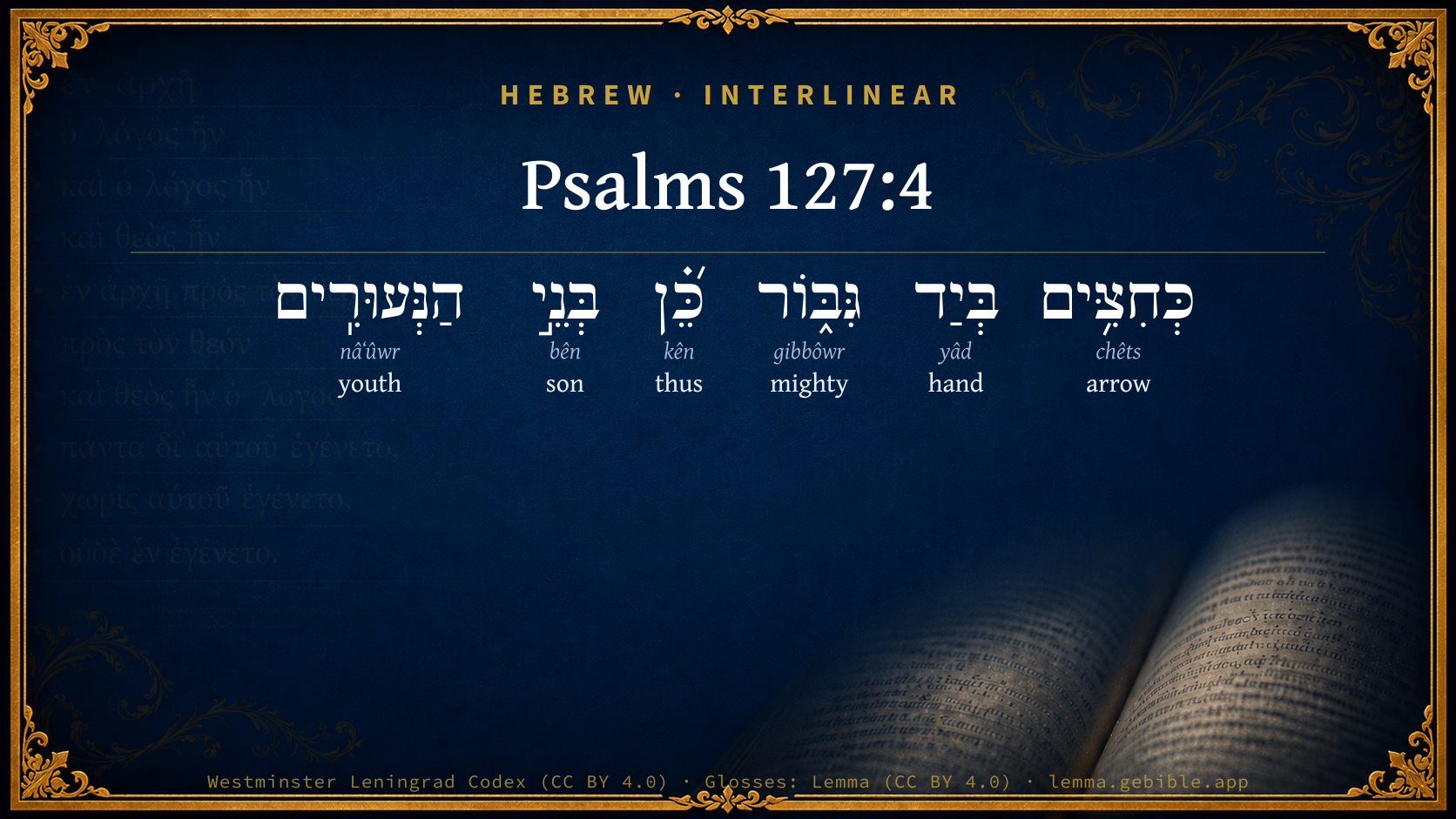
Psalms 127:4

Hebrew (Westminster Leningrad Codex) Psalms 127:4 appears in the Hebrew Old Testament. The text above is from the Westminster Leningrad Codex. Each word links to its Strong’s number, a concise gloss, and parsing drawn from the Open Scriptures Hebrew Bible morphology. Click any word for its full Brown-Driver-Briggs (BDB) entry.
Download image
Cite this verse

Psalms 127:4 (World English Bible). Public Domain. Lemma interlinear Bible study tool, https://lemma.gebible.app/v/psalms/127/4.

Show BibTeX & RIS
BibTeX
RIS
English Translation
As arrows in the hand of a mighty man, So are the children of youth.
World English Bible · Public Domain
Download a study sheet

One document with this verse’s original text, its word-by-word gloss line, the meaning frame, cross-references with their text, attributed commentary, and full source and license credits — printable, and it pastes into notes with its structure intact.

This verse Autodidact and up

Study sheet (.html) Plain text (.txt)

A passage Seminary Student

Up to 50 verses in one chapter. A passage sheet keeps up to 6 commentary sources and 12 cross-references per verse, in the order this page ranks them, and says so on the sheet whenever that leaves anything out. Ask for a single verse and you get the Autodidact verse sheet above.

Everything on this page stays free to read, with no account — the sheet is a download of what is already on screen, not access to it.

Want to remove ads? Support Godless Engineer
Compare translations 3

The same verse in 3 English versions, stacked beneath the original-language interlinear above. Click any original word for its lexicon entry.

Each is an independent rendering of the whole verse — the interlinear is not word-aligned to these translations.

Highlighted words mark where these versions differ — a whole-verse word diff, not a word-by-word alignment.

  • World English Bible Public Domain
    As arrows in the hand of a mighty man, So are the children of youth.
  • King James Version Public Domain
    As arrows are in the hand of a mighty man; so are children of the youth.
  • unfoldingWord Literal Text CC BY-SA 4.0
    Like arrows in the hand of a warrior, thus the sons of the youth.

unfoldingWord Literal Text — © unfoldingWord, licensed CC BY-SA 4.0. Word-aligned USFM3 via Door43 (git.door43.org/unfoldingWord/en_ult).

Versions to compare (up to 4)

3 of 4 selected

Show all 18 translations

Every available English version of this verse, each an independent rendering of the whole verse.

  • World English Bible Public Domain
    As arrows in the hand of a mighty man, So are the children of youth.
  • Berean Standard Bible Public Domain
    Like arrows in the hand of a warrior, so are children born in one’s youth.
  • Majority Standard Bible Public Domain
    Like arrows in the hand of a warrior, so are children born in one’s youth.
  • King James Version Public Domain
    As arrows are in the hand of a mighty man; so are children of the youth.
  • American Standard Version (1901) Public Domain
    As arrows in the hand of a mighty man, So are the children of youth.
  • Revised Version (1885) Public Domain
    As arrows in the hand of a mighty man, so are the children of youth.
  • Geneva Bible (1599) Public Domain
    As are the arrowes in the hand of ye strong man: so are the children of youth.
  • Douay-Rheims (1899) Public Domain
    Turn again our captivity, O Lord, as a stream in the south.
  • Young's Literal Translation Public Domain
    As arrows in the hand of a mighty one, So `are' the sons of the young men.
  • Literal Standard Version CC BY-SA 4.0
    As arrows in the hand of a mighty one, || So [are] the sons of the young men.
  • Unlocked Literal Bible CC BY-SA 4.0
    Like arrows in the hand of a warrior, so are the children of one's youth.
  • unfoldingWord Literal Text CC BY-SA 4.0
    Like arrows in the hand of a warrior, thus the sons of the youth.
  • Darby Bible Public Domain
    As arrows in the hand of a mighty man, so are the children of youth.
  • World Messianic Bible Public Domain
    As arrows in the hand of a mighty man, so are the children of youth.
  • Webster's Bible Public Domain
    As arrows are in the hand of a mighty man: so are children of the youth.
  • Free Bible Version CC BY-SA 4.0
    Like arrows in the hand of a warrior are the children of a young man.
  • Bible in Basic English Public Domain
    Like arrows in the hand of a man of war, are the children of the young.
  • JPS Tanakh (1917) Public Domain
    As arrows in the hand of a mighty man, so are the children of one's youth.

Literal Standard Version (2020), Covenant Press — licensed CC BY-SA 4.0. Text via the HelloAO Bible API (eBible.org). Unlocked Literal Bible (unfoldingWord) — licensed CC BY-SA 4.0. Text via the HelloAO Bible API (eBible.org). unfoldingWord Literal Text — © unfoldingWord, licensed CC BY-SA 4.0. Word-aligned USFM3 via Door43 (git.door43.org/unfoldingWord/en_ult). Free Bible Version, Dr. Jonathan Gallagher — licensed CC BY-SA 4.0. Text via the HelloAO Bible API (eBible.org).

Word by word

More ways to search: Search by grammar → Find every occurrence → Compare this word →

Practice this passage: Drill this verse → Learn its vocabulary →

About this verse

These counts appear in no published source. They are computed here, from the morphology-tagged text and Lemma’s own curated glosses. What Lemma adds →

6
words
6
distinct lemmas
Wisdom
section

Shared distinctive vocabulary

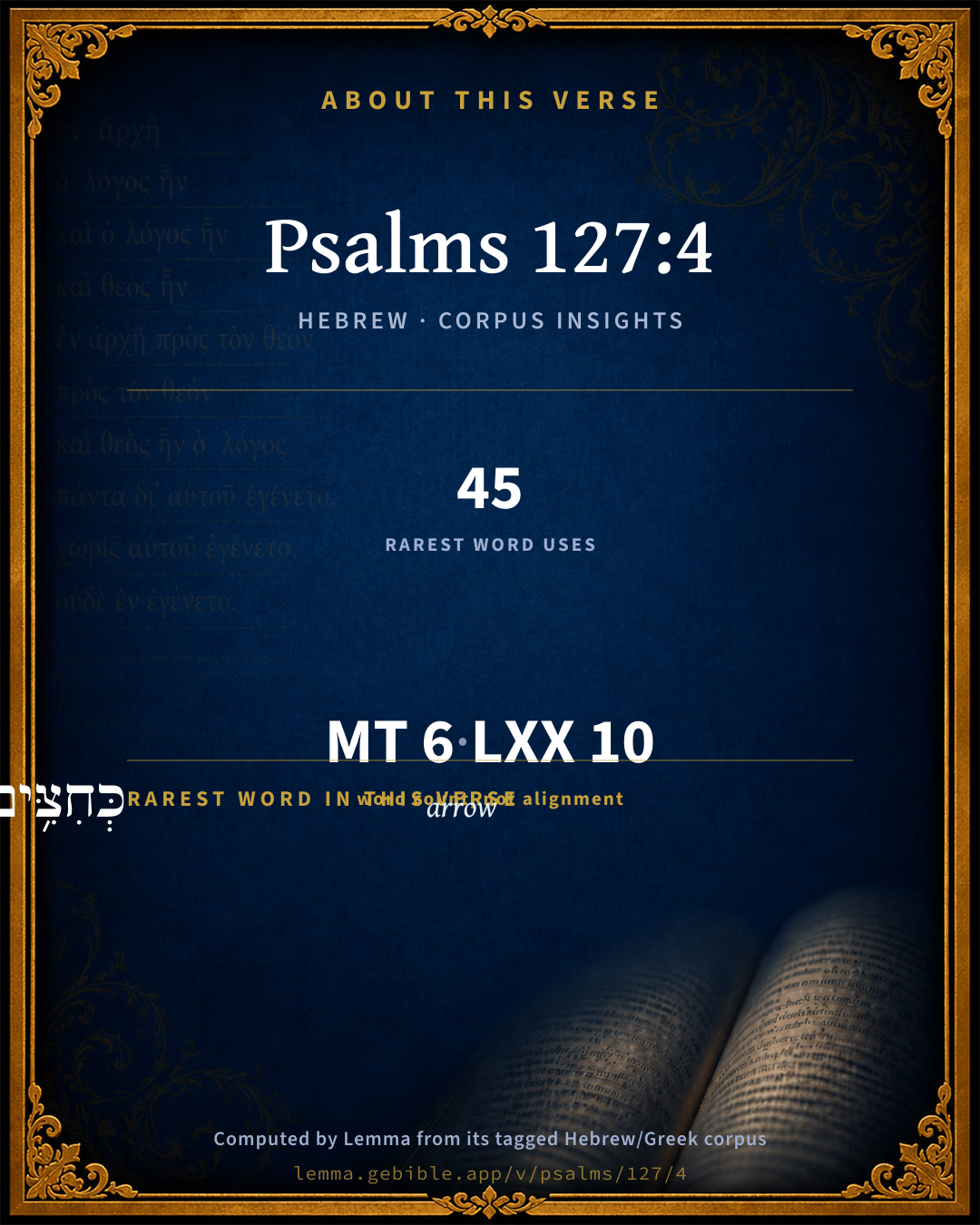
כְּחִצִּ֥ים arrow H2671 occurs in 42 verses of the Hebrew Bible. Also found in:

Grammatical profile

  • 4 nouns
  • 1 adjective
  • 1 particle

Hebrew & Septuagint length

In English translation the verse runs 15 words from the Hebrew and 18 from the Septuagint (LXX English) — closely comparable.

A rough comparison of the two English renderings, which tokenize alike — not a word-level alignment.

Word counts can differ between the Hebrew and the Greek without any difference in meaning — e.g. the Hebrew direct-object marker אֵת has no separate Greek word, and Greek often adds the article ὁ.

In the original languages it is 6 Hebrew tokens and 10 Greek tokens — but the two are counted differently (Hebrew bundles its prefixes and suffixes into one token; the Greek is in lemma form), so that isn’t a like-for-like length.

Cross-references

4

Topical passages linked to Psalms 127:4 in the Treasury of Scripture Knowledge — connected by theme and wording, ordered by reader-vote popularity; previews shown in the World English Bible.

  • Proverbs 17:6 Children's children are the crown of old men; The glory of children are their parents.
  • Proverbs 31:28 Her children rise up and call her blessed. Her husband also praises her:
  • Jeremiah 50:9 For, behold, I will stir up and cause to come up against Babylon a company of great nations from the north country; and they shall set themselves in array against her; from there she shall be taken: their arrows shall be as of an expert mighty man; none shall return in vain.
  • Psalms 120:4 Sharp arrows of the mighty, With coals of juniper.

Cross-references courtesy of OpenBible.info (CC BY 4.0).

Hebrew and Greek witnesses Masoretic Hebrew ↔ Greek Septuagint

The same verse in the two great witnesses to the Old Testament, shown verse-for-verse.

You’re reading Greek Psalm 126 (Hebrew Psalm 127). The Septuagint counts the superscription, so verse numbers can differ from the Hebrew — chapter-level alignment, not verse-by-verse. Numbering follows Rahlfs.

These are two independent witnesses, not word-aligned to each other, and the Septuagint is shown in lemma (dictionary) form.

Hebrew Psalms 127:4 Masoretic · Westminster Leningrad Codex

כְּחִצִּ֥ים בְּיַד גִּבּ֑וֹר כֵּ֝֗ן בְּנֵ֣י הַנְּעוּרִֽים

As arrows in the hand of a mighty man, So are the children of youth.

World English Bible · Public Domain

Greek LXX Greek Psalm 126:4 Septuagint · lemma form

ὡσεί βέλος ἐν χείρ δυνατός οὕτως ὁ υἱός ὁ ἐκτινάσσω

As arrows in the hand of a mighty man; so are the children of those who were outcasts.

LXX2012 (modern English Septuagint) · Public Domain

Hebrew: Westminster Leningrad Codex (CC BY 4.0). Greek: Septuagint (public domain); English from LXX2012 (modern English Septuagint) (Public Domain). How the Septuagint differs from the Hebrew →

Commentary

Notes on Psalms 127:4 from classic Christian and Jewish commentators (each source and its license shown beneath its notes). The classic Christian expositions comment on the surrounding passage and are grouped to its opening verse, so a note may address several verses; the Jewish commentaries on the Tanakh (Rashi and others) are per-verse, so they appear only where the commentator wrote on this verse.

Lemma curates 59 commentaries, every one of them public domain or Creative Commons licensed, each selected and text-cleaned for this edition rather than reprinted as found. About our sources →

Trapp's Complete Commentary

John Trapp

Psa 127:4 As arrows [are] in the hand of a mighty man; so [are] children of the youth.

Ver. 4. As arrows are in the hand of a mighty man] Heb. of a giant, who shooteth them with a courage, and is cunning at it. As clean and well kept arrows. This similitude importeth that children must have more in them than nature; for arrows are no arrows by growth, but by art; so they must be such children, the knottiness of whose nature is refined and reformed, and made smooth by grace; and then they are cared for. As, if they prove otherwise, they are a singular heartbreak to their poor parents, who are seen to sit under Elijah’s juniper, wishing for death, and saying, with Moses, Num 11:14-15, I am not able to bear all this sore affliction, "because it is too heavy for me. And if thou deal thus with me, kill me, I pray thee, out of hand, if I have found favour in thy sight; and let me not see my wretchedness."

So are children of the youth] Or, young sons, or lads, springlings, striplings, vegetous and vigorous, able to be a guard to their aged parents against the children of violence, who seek to press in upon them at the door, as the Sodomites dealt by righteous Lot, {see Psa 127:5} besides the service they may do to the commonwealth (as did the Horatii and Curiatii) by their impetus heroici, valour and virtue.

John Trapp, A Commentary or Exposition upon All the Books of the Old and New Testament (1647–1656) — public domain. Text from a community e-Sword module.

The Biblical Illustrator

Joseph S. Exell

Psa_127:4

As arrows are in the hand of a mighty man, so are the children of the youth.

Children likened to arrows

1. An arrow is small, but powerful. One slew Ahab. Latent capacities of a child.

2. An arrow must be sharpened. A child must-be educated, its faculties developed. Note its natural sharpness.

3. An arrow travels far. Who can measure the influence of a child?

4. Its power depends upon the strength and judgment with which it is sent. A lesson to parents.

5. It is firmly imbedded, is the twig is bent, so it will grow.

6. Let us not send into the world poisoned arrows. (Homiletic Review.)

Children as arrows

Children, you may perceive here what is the duty which you owe your parents. You are to protect them in their old age, and be to them as arrows in the hands of the warrior. Protect them from the assaults of poverty, should they require your assistance in this respect. Poverty and old age are unsuitable companions: let it be your pleasure to alleviate this distressing yoke as far as you can. They did not leave you to the cold charity of strangers when you were more feeble than they now are. Why should you act differently towards them, and pay back your debt with an immense ingratitude? You are to protect them under all the infirmities of declining years. If you cannot bear with the fretfulness of disease, and with the deepening shadows of those to whom under God you owe your existence, and who toiled for you and watched over you when you could do neither for yourselves, what sympathy can be expected from others? (N. McMichael.)

.

Psa_128:1-6

The Biblical Illustrator, edited by Joseph S. Exell (c. 1880s–1900s) — public domain. Text from a community e-Sword module.

Joseph Benson's Commentary

Psa 127:4-5. As arrows are in the hand of a mighty man — That knows how to use them for his own safety and advantage; so are children of the youth — Children born to their parents when they are young, who are generally the strongest and most healthful children, grow up, and become qualified to serve their parents by the time they need their service, and who live longest with them; whereas those who are born in old age seldom arrive at mature age before their parents die. Such children, when well educated, pious, and obedient, are like so many arrows in the hand of a mighty man, “ready winged with duty and love to fly to the mark; polished and keen to grace and maintain the cause of their parents, to defend them from hostile invasions, and instantly to repel every assailant.” Happy is he who hath his quiver full of them — Whose house is as full of children as the quiver of a mighty man is of arrows. They — These parents, who have such a numerous issue; shall not be ashamed, &c. — Shall courageously plead their cause in courts of judicature, which were held at the gates of cities, not fearing to be crushed by the might of their adversaries, as weak and helpless persons frequently are. Or, as some understand the words, the children shall not be ashamed to plead for their parents in the gates, but will be ready at all times to appear for them, to answer any charge that may be brought against them and to vindicate them in their persons, their good name, or their property.

Joseph Benson's Commentary on the Old and New Testaments (1811–1818) — public domain. Text from a community e-Sword module.

J. A. Alexander on Psalms

Joseph Addison Alexander

4. (Psa 127:4) As arrows in the hand of a warrior, so are the sons of youth. The first clause describes them as defenders of their parents. A warrior, literally a strong or (mighty) one. Sons of youth, i.e. born while their parents are still young. See Gen 37:3, Isa 54:6. The allusion is not only to the vigour (Gen 49:3), but to the value of their aid to the parent in declining age.

Joseph Addison Alexander, The Psalms Translated and Explained (1850) — public domain. Text from a community e-Sword module.

Tyndale Open Study Notes

Tyndale Open Resources

127:4-5 like arrows: God uses children to protect the reputation of his people against the wicked (cp. 120:4; 7:12-13).

Tyndale Open Study Notes — © Tyndale Open Resources, licensed CC BY-SA 4.0. Text via the HelloAO Bible API.

Geneva Bible (1599)

Geneva Bible translators

That is, endued with strength and virtues from God: for these are signs of God’s blessings, and not the number.

Geneva Bible (1599) marginal notes — public domain. Text via Bolls.life.

Adam Clarke's Commentary

Verse 4. As arrows are in the hand of a mighty man] Each child will, in the process of time, be a defence and support to the family, as arrows in the quiver of a skilful and strong archer; the more he has, the more enemies he may slay, and consequently the more redoubted shall he be.

Children of the youth.] The children of young people are always more strong and vigorous, more healthy, and generally longer lived than those of elderly, or comparatively elderly persons. Youth is the time for marriage; I do not mean infancy or a comparative childhood, in which several fools join in marriage who are scarcely fit to leave the nursery or school. Such couples generally disagree; they cannot bear the boyish and girlish petulancies and caprices of each other; their own growth is hindered, and their offspring, (if any,) have never much better than an embryo existence. On the other hand age produces only a dwarfish or rickety offspring, that seldom live to procreate; and when they do, it is only to perpetuate deformity and disease. It would be easy to assign reasons for all this; but the interpretation of Scripture will seldom admit of physiological details. It is enough that God has said, Children of the youth are strong and active, like arrows in the hands of the mighty.

Adam Clarke's Commentary on the Bible (1810–1826) — public domain. Text from a community e-Sword/MySword module.

Ellicott's Commentary for English Readers

(4) Children of the youth—i.e., the offspring of an early marriage. Aquila, “sons of young and vigorous parents.” The young man, with his numerous family around him, is like the vigorous warrior with his quiver full of arrows.

A Bible Commentary for English Readers, edited by Charles John Ellicott (1878–1897) — public domain. Text from a community e-Sword module.

The Cambridge Bible for Schools and Colleges

gen. ed. J. J. S. Perowne

4. children of the youth] The sons of youth; sons born while their parents are young and vigorous (Gen_49:3; contrast ‘the son of his old age,’ Gen_37:3), not only as being themselves more vigorous, but because they grow up in time to be the defence and succour of their parents’ old age. The figure of the arrows in the hand of the warrior was a natural one when the restoration of the state had to be carried on in face of opposition from within and from without.

The Cambridge Bible for Schools and Colleges (gen. ed. J. J. S. Perowne; Cambridge University Press, 1878–1918) — public domain. Text from a community e-Sword module.

John Gill's Exposition

As arrows are in the hand of a mighty man,.... Are shot out with great strength; come with much force, and do execution, and do not return in vain; with which men defend themselves, and annoy their enemies; see Jer 50:9;

so are children of the youth: not young children, or children in their youth; but such who are born to their parents when they are in their youth; and which are generally healthful and strong, and their parents live to see them grown up; and who are useful to protect them, and defend their persons and properties from enemies when grown old and feeble, and unable to defend themselves: whereas children born to them in old age are generally unhealthy and weak; and besides, their parents rarely live to see them brought up, or to be helpful to them. So Christ's spiritual seed and offspring, who are the dew of his youth, are strong, and overcome the evil one; and are serviceable in the defence of his cause and interest.

John Gill's Exposition of the Whole Bible (1746–1763) — public domain (CC PDM 1.0). Text via the HelloAO Bible API.

Albert Barnes' Notes on the Bible

As arrows are in the hand of a mighty man - They are what a parent may rely on for defense in danger, or for help in securing provision for himself and family - as the warrior or the hunter relies on his arrows.

So are children of the youth - Sons in their youth; in their prime and vigor. The comparison of sons with arrows or spears is common in Arabic poetry. See Rosenmuller, Com. in loc. Also Morgenland, in loc.

Albert Barnes' Notes on the Bible (1834–1885) — public domain. Text from a community e-Sword/MySword module.

Matthew Poole's English Annotations

In the hand of a mighty man; when they are shot out of a bow by a man of great strength against his enemy, which are of great use and power, both to offend the enemy, and to defend himself.

Children of the youth; children begotten in youth, as a husband or wife married in their youth are called a husband or wife of youth, Pro 5:18; Isa 54:6; Joe 1:8, and as a son begotten in old age is called a son of old age, Gen 37:3. And these he prefers before other children in this point, partly because such are commonly more strong and vigorous than others; and partly because they live longest with their parents, and to their comfort and support, whereas children born in old age seldom come to any maturity of years before their parents’ death.

Matthew Poole's English Annotations on the Holy Bible (1683–1685) — public domain. Text from a community e-Sword/MySword module.

The Treasury of David

Charles H. Spurgeon

Ver. 4. As arrows are in the hand of a mighty man; so are children of the youth. Children born to men in their early days, by God's blessing become the comfort of their riper years. A man of war is glad of weapons which may fly where he cannot: good sons are their father's arrows speeding to hit the mark which their sires aim at. What wonders a good man can accomplish if he has affectionate children to second his desires, and lend themselves to his designs! To this end we must have our children in hand while they are yet children, or they are never likely to be so when they are grown up; and we must try to point them and straighten them, so as to make arrows of them in their youth, lest they should prove crooked and unserviceable in after life. Let the Lord favour us with loyal, obedient, affectionate offspring, and we shall find in them our best helpers. We shall see them shot forth into life to our comfort and delight, if we take care from the very beginning that they are directed to the right point.

Ver. 4. As arrows. Well doth David call children "arrows"; for if they be well bred, they shoot at their parents' enemies; and if they be evil bred, they shoot at their parents. Henry Smith. 1560-1591.

Ver. 4. As arrows. Children are compared to "arrows". Now, we know that sticks are not by nature arrows; they do not grow so, but they are made so; by nature they are knotty and rugged, but by art they are made smooth and handsome. So children by nature are rugged and untoward, but by education are refined and reformed, made pliable to the divine will and pleasure. George Swinnock, 1627-1673.

Ver. 4. As arrows. "Our children are what we make them. They are represented As arrows in the hand of a mighty man, and arrows go the way we aim them."

Ver. 4. As arrows. In a collection of Chinese Proverbs and Apophthegms, subjoined to Hau Kiou Choaan, or, The Pleasing History, I find a proverb cited from Du Halde, which seems full to our purpose. It is this: "When a son is born into a family, a bow and arrow are hung before the gate." To which the following note is added: "As no such custom appears to be literally observed, this should seem to be a metaphorical expression, signifying that a new protector is added to the family", equivalent to that of the Psalms, "as arrows", etc. James Merrick (1720-1769), in "Annotations on the Psalms."

Ver. 4. Children of the youth are arrows in the hand, which, with prudence, may be directed aright to the mark, God's glory, and the service of their generation; but afterwards, when they are gone abroad in the world, they are arrows out of the hand; it is too late to bend them then. But these "arrows in the hand" too often prove arrows in the heart, a constant grief to their godly parents, whose grey hairs they bring with sorrow to the grave. Matthew Henry.

Ver. 4. Children of the youth. Sons of youth, i.e., born while their parents are still young. See Ge 37:2 Isa 54:6. The allusion is not only to their rigour Ge 49:3, but the value of their aid to the parent in declining age. Joseph Addison Alexander.

Ver. 4. Children of the youth. If the right interpretation is commonly given to this phrase, this Psalm greatly encourages early marriages. It is a growing evil of modern times that marriages are so often deferred till it is highly improbable that in the course of nature the father can live to mould his offspring to habits of honour and virtue. William Swan Plumer (1802-1880), in "Studies in the Book of Psalms."

Ver. 4. The spiritual uses of children.

1. When they die in infancy, awakening parents.

2. When they go home from Sunday school carrying holy influences.

3. When they become converted.

4. When they grow up and become useful men and women.

Ver. 4-5.

1. The dependence of children upon parents.

a) For safety. They are in their quiver.

b) For direction. They are sent forth by them.

c) For support. They are in the hands of the mighty.

2. The dependence of parents upon children.

a) For defence. Who will hear a parent spoken against?

b) For happiness. "A wise son maketh", etc. Children elicit some of the noblest and most tender emotions of human nature. Happy is the Christian minister who with a full quiver can say, "Here am I, and the children which thou hast given me." G. R.

Charles H. Spurgeon's The Treasury of David (1869–1885) — public domain. Psalms only. Text from a community e-Sword/MySword module.

Whedon's Commentary on the Bible

Daniel D. Whedon

4. Children of the youth—Children born while their parents are young. Thus Gen_49:3, “My firstborn, my might, and the beginning of my strength,” distinguished from those begotten when their parents were aged.

Gen_37:3

Daniel D. Whedon (gen. ed.), Commentary on the Old and New Testaments (1874–1909) — public domain. Text from a community e-Sword module.

The Pulpit Commentary

As arrows are in the hand of a mighty man; so are children of the youth; rather, the children of youth; i.e. children born to a man in his youth. Such children protect their aged parents as effectually as arrows in the hand of a warrior.

Children as arrows.

The psalmist takes far other than that pessimistic view, so common in our day, as to God"s gift of children. Men now too often look upon them as so many misfortunes and encumbrances, and as compelling poverty and privation where else these evils had not been, and as so many channels through which trouble may come to the home in which they have been born. How beautifully and blessedly different is the teaching of this and the following psalm on this matter! Of course, where social conditions are such that, let a man be ever so willing to work, no work can be found for him, and toil as he will he cannot make a living, then the fact of a large family is, at any rate for a time, but an increase of sorrow. But then, such social conditions ought not to be, and the fact that by them what God designed to be so great a blessing is made to be only a terrible calamity, is reason enough why men should strive for a better condition of things. And there can be no doubt that many of man"s laws and, yet more, man"s sins do turn God"s blessings into a curse. But children, it is never to be forgotten, were designed to be God"s blessings, and in myriads of homes they are so. The special blessing the psalmist has in his mind, as coming through our children, is that they are as arrows in the hand of a mighty man. The similitude is a suggestive one.

I THEY ARE SO FOR PROTECTION. Those children that are born when their parents are young will be of age to help and maintain their parents when these need such help. They defend their home from the attack of poverty and want. Long ere these have reached their home, these arrows have made them turn back.

II FOR HELP IN THE BATTLE OF LIFE. The spur and stimulus which children impart to their parents, the pleasure they give, the love they awaken, the aspirations after good they arouse, all these things are of vast help in life"s battle, even "as arrows are," etc.

III NEED TO BE CAREFULLY PREPARED. Arrows do not grow of themselves: they have to be wrought out with much thought and care. So our children.

IV AND TO BE WELL AIMED. What is our aim for our children? The arrows will go where they are sent. How many parents there are who have no worthy aim for their children! They will be glad for them to "get on," to become rich, and to take good positions in society. If they have aim, it is no higher one than that. And those who profess the higher aim, that their children should be the Lord"s, how badly, clumsily, carelessly, they seek that aim!

V SENT FORTH WITH ALL POWER. See the mighty man," how "he bends his bow and makes ready his arrow upon the string," and then draws it back to its full length, that it may speed with the more force on the way he would have it go; that is a picture of the strenuous, careful endeavor we should make to urge our arrows, our children, in the right way. But what all too little strenuousness there is in this matter!

VI THEY ARE SURE TO WOUND, IF NOT KILL, SOMEWHERE. The foes of the home want, godlessness, evil reputation and character, strife and ill will, hopelessness and despair, the malice of men, and much else, the children should slay, and not suffer them to come near us; and good children do this. But if we have not so trained them to thus serve the home, then they will turn and wound and pierce their parents to the heart. Bad children do this. Yes, always, they are "as arrows. S.C.

Children a man"s power.

"As arrows are in the hand of a mighty man; so are children of the youth." They are his effective agents in the battle of life. This is illustrated in many a business. The man is greatly helped as difficulties develop, and responsibilities increase, who has his own sons to share his burdens. The service of hirelings, however devoted and faithful, can never equal that of sons. A man gradually outgrows the toiling part of life. He may think and plan better than ever; but the executive power fails; and it is well if sons arise to be not only arrows, but even arms, for him. In the entire active sphere of life a man"s sons may come to take his place.

I CHILDREN ARE A MAN"S POWER WHEN RIGHT RELATIONS ARE MAINTAINED. The assumption of the psalm is that they are maintained. The godly man"s God-fearing children alone are in thought. When children grow up willful, wayward, un-son-like, they are a man"s weakness. They are arrows bent from the straight, which may do more mischief than good. So on children the Word of God presses the duty of maintaining the family relation, and "honoring the father and the mother." And the relation must be preserved right up to the close of life. For long a son stands with his father; the time comes when he may have to stand for his father. Neglect of, and cruelty to, aged parents belong to heathenism, not to the religion of the eternal Father.

II CHILDREN ARE A MAN"S POWER WHEN RIGHT CHARACTER IS CULTURED. What children are to their parents will of necessity depend much on natural disposition. Even an affectionate disposition finds expression in various forms. But it depends very much more on home-training. Parents may make themselves too independent, and, seeking little help from their children, get but little when they sorely need it. True home-culture nourishes mutual service. Only out of the practice of a Common service can the special ministries of times of strain be found to grow. R.T.

The Pulpit Commentary (1880–1919), ed. H.D.M. Spence-Jones & Joseph S. Exell — public domain. Text from a community e-Sword module.

John Wesley's Explanatory Notes

Youth - These he prefers before other children, because they live longest with their parents, and to their comfort and support, whereas children born in old age seldom come to maturity before their parents death.

John Wesley, Explanatory Notes Upon the Whole Bible (1754–1765) — public domain. Text via the GEBible commentary corpus.

Rashi

Rabbi Shlomo Yitzchaki (Rashi)

Like arrows in the hand of a mighty man with which to battle his enemies.

so are the sons of one’s youth The disciples that a man sets up in his youth.

Rashi on the Tanakh — English translations: “The Judaica Press complete Tanach with Rashi, translated by A. J. Rosenberg” (CC BY 4.0); “Pentateuch with Rashi's commentary by M. Rosenbaum and A.M. Silbermann, 1929-1934” (public domain); “The Metsudah Tanach series, Lakewood, N.J” (CC BY 4.0); and “The Book of Joshua, Metsudah Publications, 1997” (CC BY 4.0). Text via Sefaria.

Lesson kit

Teaching starters — assembled from the data on this page, not authored interpretation. Every prompt links to the verse data it draws on. Edit before teaching.

Psalms, in the Wisdom, opens this verse with 6 words (6 distinct Hebrew lemmas). Its most distinctive word is chêts (“arrow”). A historical commentator’s framing appears above. Read the whole chapter for the surrounding context.

Discussion questions

  1. The word chêts carries the sense “arrow.” How does it shape the verse?
  2. Genesis 49:23 shares the word «arrow» with this verse. How do the two illuminate each other?
  3. The translations on this page render this verse differently — a whole-verse word diff, not a word-by-word alignment. What might account for the different wordings?
  4. Reading how Trapp's Complete Commentary and The Biblical Illustrator read this verse, where do the two commentators agree and where do they part?

Things to notice

Reading settings

Reading text

Shown beneath each verse's original-language words.

Old Testament
Old Testament edition

Read the OT as the Masoretic Hebrew (MT) or the Greek Septuagint (LXX).

English shown for the Greek Septuagint (in the Hebrew ↔ Greek comparison).

Comparing translations? Open the Compare panel on any verse page to stack up to four side by side.