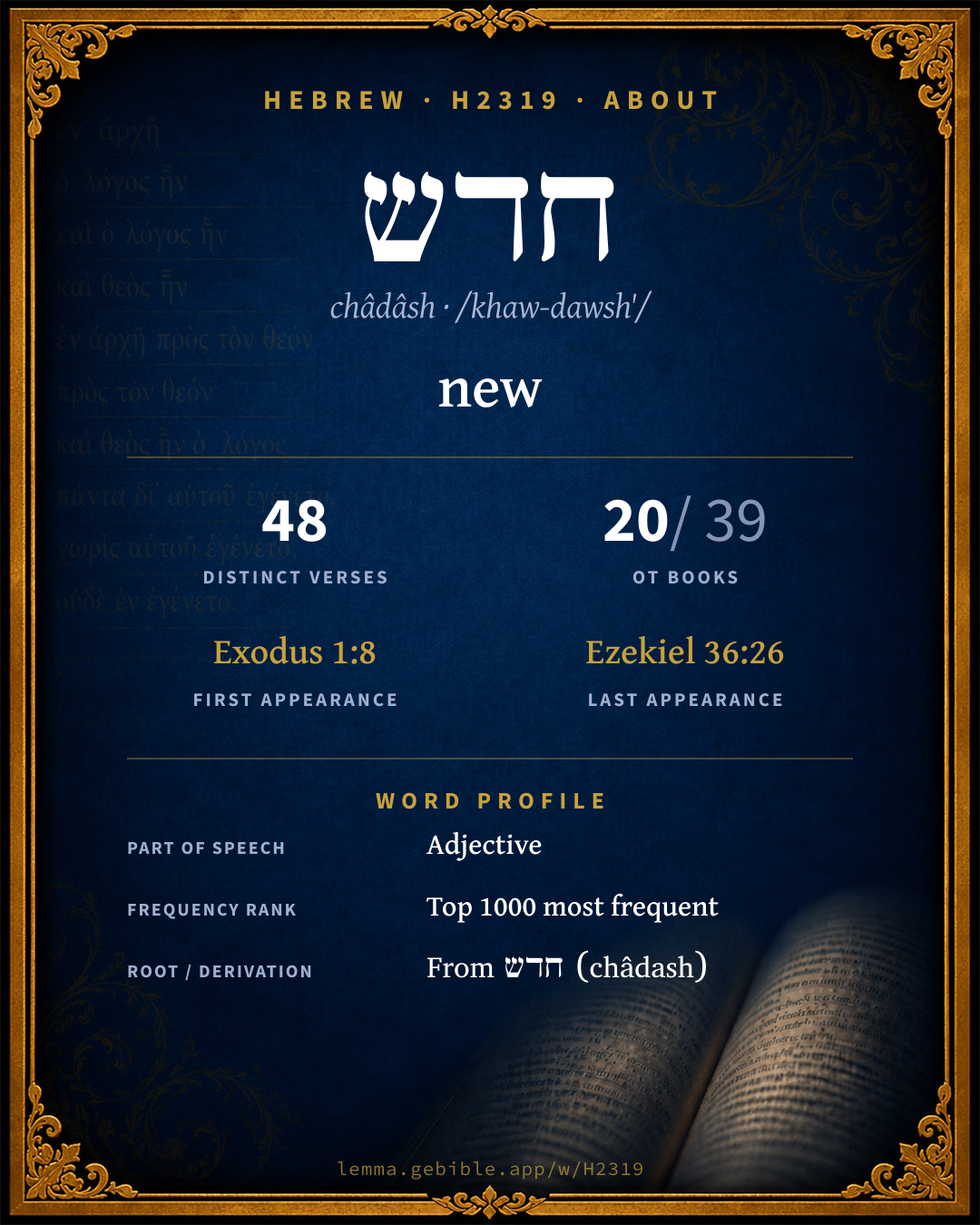
חָדָשׁ
new
Full lexicon entry — Brown-Driver-Briggs (BDB)
From Brown-Driver-Briggs (BDB)
Where this word appears
Grammar key — what these labels mean
Part of speech
- Adjective
- A word that describes or qualifies a noun.
State
- Absolute
- The independent form of a noun, not bound to a following word.
Gender
- Masculine
- Grammatically masculine.
- Feminine
- Grammatically feminine.
Number
- Singular
- One.
- Plural
- More than one (in Hebrew, generally three or more).
Grammatical forms
- Adjective, Adjective, Masculine, Singular, Absolute 20 times (38%)
- Adjective, Adjective, Feminine, Singular, Absolute 20 times (38%)
- Adjective, Adjective, Masculine, Plural, Absolute 11 times (21%)
- Adjective, Adjective, Feminine, Plural, Absolute 2 times (4%)
Parsed forms decoded from the imported morphology (morphhb / Westminster Leningrad Codex — WLC text public domain, morphhb tagging CC BY 4.0), counted across 53 parsed occurrences — not distinct verses.
Every verse where H2319 appears — 48 distinct verses across 20 books. Click any verse to open its interlinear word-by-word view. Verse text shown in the World English Bible for context — . Each verse’s Hebrew form is shown with its reference; the English is not keyword-highlighted, since the data carries no word-level English alignment. Use “Compare translations” on any verse to read it across multiple English versions. This concordance covers the Hebrew Bible; Septuagint (Greek Old Testament) occurrences are not indexed here.
Exodus 1 verse
Leviticus 2 verses
Numbers 1 verse
Deuteronomy 4 verses
- Deuteronomy 20:5 חָדָשׁ֙ adj Adjective ms The officers shall speak to the people, saying, What man is there who has built a new house, and has not dedicated it? let him go and return to his house, lest he die in the battle, and another man dedicate it.
- Deuteronomy 22:8 חָדָ֔שׁ adj Adjective ms When you build a new house, then you shall make a battlement for your roof, that you don't bring blood on your house, if any man fall from there.
- Deuteronomy 24:5 חֲדָשָׁ֔ה adj Adjective fs When a man takes a new wife, he shall not go out in the host, neither shall he be charged with any business: he shall be free at home one year, and shall cheer his wife whom he has taken.
- Deuteronomy 32:17 חֲדָשִׁים֙ adj Adjective mp They sacrificed to demons, [which were] no God, To gods that they didn't know, To new [gods] that came up of late, Which your fathers didn't dread.
Joshua 1 verse
Judges 4 verses
- Judges 5:8 חֲדָשִׁ֔ים adj Adjective mp They chose new gods; Then was war in the gates: Was there a shield or spear seen Among forty thousand in Israel?
- Judges 15:13 חֲדָשִׁ֔ים adj Adjective mp They spoke to him, saying, No; but we will bind you fast, and deliver you into their hand: but surely we will not kill you. They bound him with two new ropes, and brought him up from the rock.
- Judges 16:11 חֲדָשִׁ֔ים adj Adjective mp He said to her, If they only bind me with new ropes with which no work has been done, then shall I become weak, and be as another man.
- Judges 16:12 חֲדָשִׁ֜ים adj Adjective mp So Delilah took new ropes, and bound him therewith, and said to him, The Philistines are on you, Samson. The liers-in-wait were abiding in the inner chamber. He broke them off his arms like a thread.
1 Samuel 1 verse
2 Samuel 2 verses
- 2 Samuel 6:3 חֲדָשָׁ֔ה חֲדָשָֽׁה adj Adjective fs adj Adjective fs They set the ark of God on a new cart, and brought it out of the house of Abinadab that was in the hill: and Uzzah and Ahio, the sons of Abinadab, drove the new cart.
- 2 Samuel 21:16 חֲדָשָׁ֑ה adj Adjective fs and Ishbibenob, who was of the sons of the giant, the weight of whose spear was three hundred [shekels] of brass in weight, he being girded with a new [sword], thought to have slain David.
1 Kings 2 verses
- 1 Kings 11:29 חֲדָשָׁ֔ה adj Adjective fs It happened at that time, when Jeroboam went out of Jerusalem, that the prophet Ahijah the Shilonite found him in the way; now [Ahijah] had clad himself with a new garment; and they two were alone in the field.
- 1 Kings 11:30 הַ/חֲדָשָׁ֖ה ptcl def.art + Adjective Adjective fs Ahijah laid hold of the new garment that was on him, and tore it in twelve pieces.
2 Kings 1 verse
1 Chronicles 1 verse
2 Chronicles 1 verse
Job 2 verses
Psalms 6 verses
- Psalms 33:3 חָדָ֑שׁ adj Adjective ms Sing to him a new song. Play skillfully with a shout of joy!
- Psalms 40:3 חָדָשׁ֮ adj Adjective ms He has put a new song in my mouth, even praise to our God. Many shall see it, and fear, and shall trust in Yahweh.
- Psalms 96:1 חָדָ֑שׁ adj Adjective ms Sing to Yahweh a new song! Sing to Yahweh, all the earth.
- Psalms 98:1 חָ֭דָשׁ adj Adjective ms Sing to Yahweh a new song, For he has done marvelous things! His right hand, and his holy arm, have worked salvation for him.
- Psalms 144:9 חָ֭דָשׁ adj Adjective ms I will sing a new song to you, God. On a ten-stringed lyre, I will sing praises to you.
- Psalms 149:1 חָדָ֑שׁ adj Adjective ms Praise Yahweh! Sing to Yahweh a new song, His praise in the assembly of the saints.
Ecclesiastes 2 verses
- Ecclesiastes 1:9 חָדָ֖שׁ adj Adjective ms That which has been is that which shall be; and that which has been done is that which shall be done: and there is no new thing under the sun.
- Ecclesiastes 1:10 חָדָ֣שׁ adj Adjective ms Is there a thing of which it may be said, "Behold, this is new?" It has been long ago, in the ages which were before us.
Song of Solomon 1 verse
Isaiah 8 verses
- Isaiah 41:15 חָדָ֔שׁ adj Adjective ms Behold, I have made you [to be] a new sharp threshing instrument having teeth; you shall thresh the mountains, and beat them small, and shall make the hills as chaff.
- Isaiah 42:9 וַֽ/חֲדָשׁוֹת֙ conj + Adjective Adjective fp Behold, the former things have happened, and new things do I declare. Before they spring forth I tell you of them.
- Isaiah 42:10 חָדָ֔שׁ adj Adjective ms Sing to Yahweh a new song, and his praise from the end of the earth; you who go down to the sea, and all that is therein, the isles, and the inhabitants of it.
- Isaiah 43:19 חֲדָשָׁה֙ adj Adjective fs Behold, I will do a new thing; now shall it spring forth; shall you not know it? I will even make a way in the wilderness, and rivers in the desert.
- Isaiah 48:6 חֲדָשׁוֹת֙ adj Adjective fp You have heard it; see all this; and you, will you not declare it? I have shown you new things from this time, even hidden things, which you have not known.
- Isaiah 62:2 חָדָ֔שׁ adj Adjective ms The nations shall see your righteousness, and all kings your glory, and you shall be called by a new name, which the mouth of Yahweh shall name.
- Isaiah 65:17 חֲדָשִׁ֖ים חֲדָשָׁ֑ה adj Adjective mp adj Adjective fs For, behold, I create new heavens and a new earth; and the former things shall not be remembered, nor come into mind.
- Isaiah 66:22 הַ֠/חֳדָשִׁים הַ/חֲדָשָׁ֜ה ptcl def.art + Adjective Adjective mp ptcl def.art + Adjective Adjective fs For as the new heavens and the new earth, which I will make, shall remain before me, says Yahweh, so shall your seed and your name remain.
Jeremiah 4 verses
- Jeremiah 26:10 הֶ/חָדָֽשׁ ptcl def.art + Adjective Adjective ms When the princes of Judah heard these things, they came up from the king's house to the house of Yahweh; and they sat in the entry of the new gate of Yahweh's [house].
- Jeremiah 31:22 חֲדָשָׁה֙ adj Adjective fs How long will you go here and there, you backsliding daughter? for Yahweh has created a new thing in the earth: a woman shall encompass a man.
- Jeremiah 31:31 חֲדָשָֽׁה adj Adjective fs Behold, the days come, says Yahweh, that I will make a new covenant with the house of Israel, and with the house of Judah:
- Jeremiah 36:10 הֶֽ/חָדָ֔שׁ ptcl def.art + Adjective Adjective ms Then read Baruch in the book the words of Jeremiah in the house of Yahweh, in the chamber of Gemariah the son of Shaphan, the scribe, in the upper court, at the entry of the new gate of Yahweh's house, in the ears of all the people.
Lamentations 1 verse
Ezekiel 3 verses
- Ezekiel 11:19 חֲדָשָׁ֖ה adj Adjective fs I will give them one heart, and I will put a new spirit within you; and I will take the stony heart out of their flesh, and will give them a heart of flesh;
- Ezekiel 18:31 חָדָ֖שׁ חֲדָשָׁ֑ה adj Adjective ms adj Adjective fs Cast away from you all your transgressions, in which you have transgressed; and make you a new heart and a new spirit: for why will you die, house of Israel?
- Ezekiel 36:26 חָדָ֔שׁ חֲדָשָׁ֖ה adj Adjective ms adj Adjective fs A new heart also will I give you, and a new spirit will I put within you; and I will take away the stony heart out of your flesh, and I will give you a heart of flesh.
About this entry
At a glance — auto-summarized from this page’s data, not written by a person. Every figure links to its source below. This summary describes the numbers; it doesn’t interpret them.
חדש — transliterated châdâsh — is a Hebrew adjective carrying the sense “new.” It first appears in Exodus 1:8. The Hebrew Bible uses it across 48 verses — moderately common. Related forms include חדש, חדש and חדת. See the sense tree, 48-verse concordance, and the renderings breakdown below.
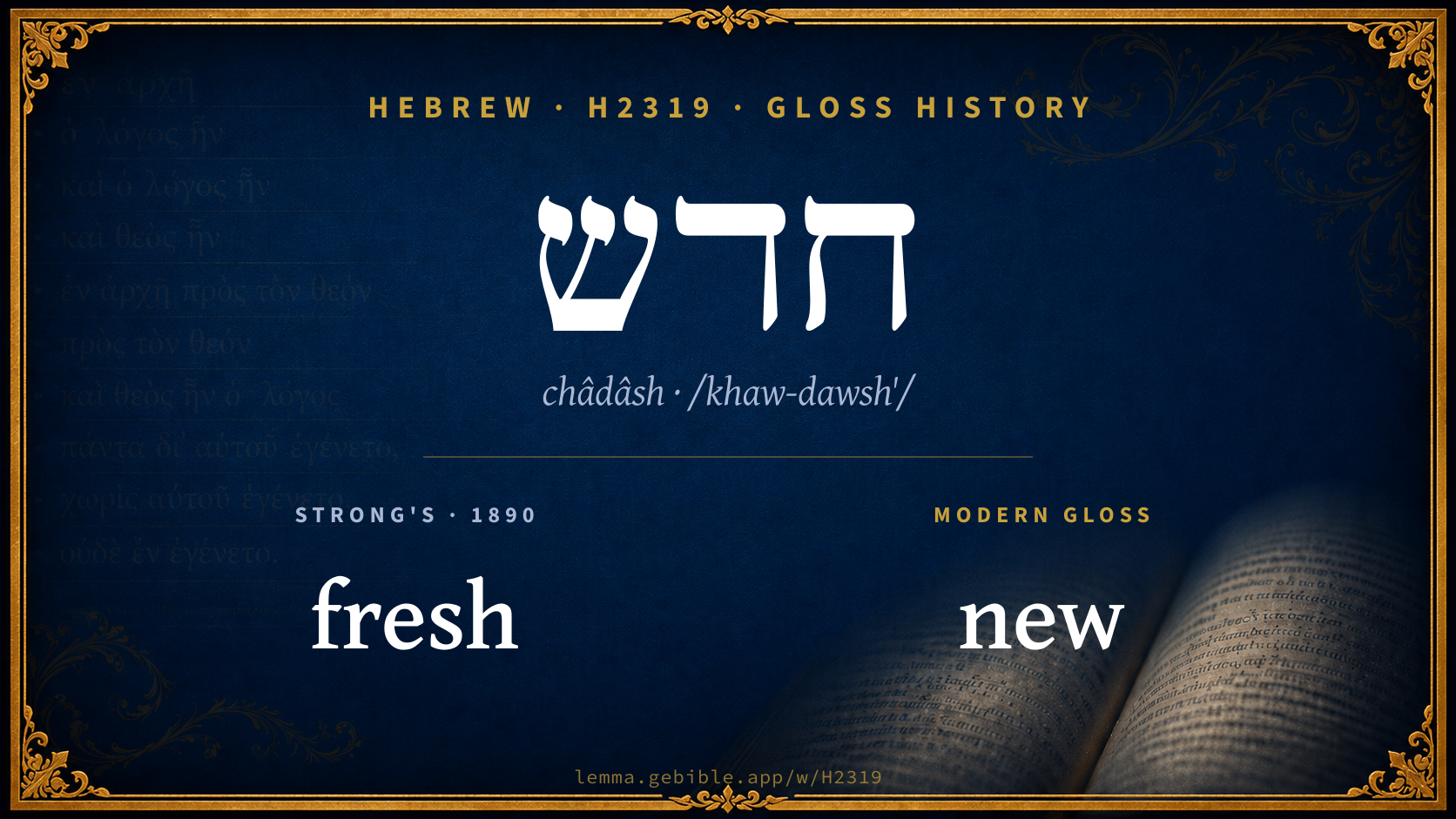
Gloss history
Strong's 1890 vs modern scholarship
About this word
Strong's H2319 catalogs a Hebrew word from the Hebrew Old Testament.
These counts are not copied from any lexicon or concordance. They are computed here, from the morphology-tagged Hebrew Old Testament. What Lemma adds →
- 48
- distinct verses
- The word appears in 48 distinct verses.
- 20 / 39
- OT books
- The word appears in 20 of 39 Old Testament books.
- #709
- by frequency
- Top 1000 most frequent Hebrew words (rank 709 of 8,640 Hebrew words by occurrence).
View all 48 occurrences in the concordance →
Most concentrated in
- Isaiah 8 verses 17%
- Psalms 6 verses 13%
- Deuteronomy 4 verses 8%
By section of the Old Testament
By traditional corpus
Conventional, traditional groupings — biblical authorship is debated, so this is a traditional corpus grouping, not an authorship claim. Each share is this word’s portion of its verses in that division of the Hebrew canon. Each figure is a share of the word’s 48 distinct verses.
- Prophets (Nevi'im) 26 verses · 54%
- Writings (Ketuvim) 14 verses · 29%
- Torah (Pentateuch) 8 verses · 17%
How translations render this word
Counts come from each version’s own published word-to-Strong’s tagging or interlinear alignment — an approximate guide to how each version renders this word, not a word-level alignment the data otherwise carries. Because each total is that version’s own tagged count, the per-version totals vary from one another and need not match the appearance or distinct-verse counts above. These counts may also differ from a printed concordance because Lemma counts each distinctly tagged rendering and does not collapse phrase taggings into a single head-word total. This is a fixed set of word-tagged versions (KJV, ASV, BSB, ULT) and does not change with the reading translation you choose elsewhere. Each version’s license is shown beside its name below (and on Sources).
- King James Version: New 38×, New thing 2×
- American Standard Version: New 36×
- Berean Standard Bible: New 40×, Is new 2×, New things 2×
- unfoldingWord Literal Text: New 44×, New ones 2×
King James Version Public Domain
Renders H2319 across 53 tagged occurrences — most commonly:
Plus 13 renderings that appear only once — usually multi-word phrases or single function words the recovered tagging swept in, not distinct renderings.
American Standard Version Public Domain
Renders H2319 across 53 tagged occurrences — most commonly:
Plus 17 renderings that appear only once — usually multi-word phrases or single function words the recovered tagging swept in, not distinct renderings.
Berean Standard Bible Public Domain
Renders H2319 across 53 tagged occurrences — most commonly:
Plus 7 renderings that appear only once — usually multi-word phrases or single function words the recovered tagging swept in, not distinct renderings.
unfoldingWord Literal Text CC BY-SA 4.0
Renders H2319 across 51 tagged occurrences — most commonly:
Plus 5 renderings that appear only once — usually multi-word phrases or single function words the recovered tagging swept in, not distinct renderings.
Senses in the full BDB
What do BDB’s symbols mean?
BDB uses these scholarly abbreviations:
| Symbol | Meaning |
|---|---|
| 𝔊 | the Septuagint (the ancient Greek translation, LXX) |
| 𝔙 | the Vulgate (the Latin translation) |
| 𝔖 | the Syriac version (the Peshitta) |
| 𝔗 | the Targum (the Aramaic translation) |
| ψ | the Psalms |
| √ | root (the underlying root or stem) |
| ‖ | parallel passage (a synonymous or contrasted parallel) |
| † | the dagger: every passage where the word occurs is cited |
The 2 senses and sub-senses the full Brown-Driver-Briggs lexicon distinguishes for this word, in lexicon order (not ranked by frequency), with BDB’s own verbatim wording and sub-sense lettering. Shown in Hebrew script with BDB’s own scholarly abbreviations. The condensed entry is in the Lexicon Entry tab. See also the Forms in the corpus table below.
- a. attrib. Ex 1:8 (E) a new king; so of house Dt 20:5, 22, wife 24:5, cords Ju 15:13; 16:11, 12, cart 1 S 6:7 2 S 6:3(×2) (but del. in v b, cf. We Dr)=1 Ch; 13:7; garment 1 K 11:29, 30, vessel 2 K 2:20, wine-skins Jos 9:13 (JE) Jb 32:19, threshing instr. Is 41:15; meal-offering Lv 23:16 (H) Nu 28:26 (P); especially (poet.) שִׁיר ח׳ a new song (of praise) ψ 33:3; 40:4; 96:1; 98:1; 144:9 149:1 Is 42:10; בְּרִית ח׳ Je 31:31; שָׁמַיִם חדשׁים וארץ חדשׁה Is 65:17 cf. 65:17 cf. 66:22; שֵׁם ח׳ Is 62:2; רוּחַ ח׳ a new spirit Ez 11:19; 18:31; 36:26, + לֵב ח׳ 18:31; 36:26; פֶּתַח שַׁעַר־י׳ הֶח׳ Je 26:10 new gate of (house of) י׳, cf. 36:10 (v. Gf Je 20:2); also הֶחָצֵר הַח׳ 2 Ch 20:5 the new court (v. Be Öt); אלהים חדשׁים Ju 5:8 new gods? judges? text prob. corrupt, cf. NöZMG 1888, 477, MüllKönigsb. Stud. i., GACookeDeb. 34 ff. and conj. by BuRS, 103, RS in BlaJudges; in gen. אֵין כָּל־ח׳ Ec 1:9 there is nothing new; with no subst. expr. חָגוּר חֲדָשָׁה 2 S 21:16 girt with a new (sword: but text perhaps corrupt, cf. We Klo Dr), of (food-)products of earth (opp. יָשָׁן) Lv 26:10 (H) Ct 7:14; חֲדָשִׁים Dt 32:17 new ones (i.e. gods; ‖ מִקָּרֹב בָּאוּ); in gen. f. חֲדָשָׁה a new thing Is 43:19 Je 31:22, fpl. Is 42:9 (opp. הָרִאשֹׁנוֹת), 48:6. e.g. Exodus 1:8
- b. very rarely predicate: of י׳’s compassions חדשׁים לַבְּקָרִם La 3:23 they are new every morning; כְּבוֹדִי ח׳ עִמָּדִי Jb 29:20 my glory shall be fresh with me; רְאֵה זֶה ח׳ הוּא Ec 1:10 see, this is new! e.g. Lamentations 3:23
Senses from the full Brown-Driver-Briggs lexicon (Brown, Driver, Briggs; Oxford 1906 — public domain), digitized via Sefaria, supplemented by the OpenScriptures HebrewLexicon (CC BY 4.0). Full attribution on Sources.
Word origin
adj. new(on format. v. LgBN 48)—ח׳ abs. Ex 1:8 + 19 times; f. חֲדָשָׁה Lv 23:16 + 19 times; pl. חֲדָשִׁים Dt 32:17 + 10 times; f. חֲדָשׁוֹת Is 42:9; 48:6;—new, usually
— Brown-Driver-Briggs (Oxford 1906, public domain), digitized via Sefaria, supplemented by the OpenScriptures HebrewLexicon (CC BY 4.0). See Sources.
Derived from חדש (châdash) (H2318) — to renew.
Jastrow Dictionary
A second Hebrew/Aramaic lexicon for comparison, covering Aramaic and post-biblical (Talmudic, Targumic, Midrashic) usage that the biblical-Hebrew BDB does not. Matched by lemma rather than by Strong’s number, so a lemma may carry more than one Jastrow headword (shown separately below), and the entries cover usage well beyond the Bible.
חָדַשׁ
- (b. h.) [to be bright,] to be new.
- 1. to renew, renovate, polish. Lev. R. s. 29 (ref. to בחדש, Ps. LXXXI, 4) תְּחַדְּשׁוּ מעשיכם ye shall polish (cleanse) your doings. Gen. R. s. 78, beg. (ref. to Lam. III, 23) אתה מְחַדְּשֵׁנוּ וכ׳ thou renewest our lives every morning; אתה מח׳ לבוקרן וכ׳ thou inspirest us with new life in the morning (rise to power) &c., v. בֹּקֶר; a. fr. e.g. Psalms 81:4
- 2. to commence anew, do again. R. Hash. 7ᵃ, a. e. (ref. to Num. XXVIII, 14) חַדֵּשׁ והבא וכ׳ commence a new account and offer T’rumah of the new produces. e.g. Numbers 28:14
- 3. to promulgate a new law, to establish a new interpretation of a Biblical law; to find a new point. Sabb. 104ᵃ, a. fr. (ref. to Lev. XXVI, 46) אין נביא רשאי לְחַדֵּשׁ וכ׳ (v. Rabb. D. S. a. l.) since the promulgation of these laws no prophet has a right to issue a new law. Y. Erub. V, 22ᶜ bot. it is called the New Gate, because there חִידְּשׁוּ וכ׳ (not חו׳) the Sof’rim instituted the interpretation (Halakhah); a. fr. e.g. Leviticus 26:46
- 1. to be renewed, to be established as a new interpretation (cmp. Lat. novellae); to be offered as a new point (דבר חדש). Y. Yeb. VIII, 9ᶜ top (ref. to I Chr. VIII, 9) שעל ידיה נִתְחַדְּשָׁה הלכה וכ׳ at her instance the new interpretation (of the law Deut. XXIII, 4) was established; Midr. Sam. ch. XXII; Ruth R. to II, 5 כבר נ׳ הלכה the law has been interpreted long before. Sot. 3ᵇ, a. fr. לא נשנית אלא בשביל דבר שנ׳ בה the section is repeated for the sake of a new point added. e.g. 1 Chronicles 8:9
- 2. to change turns. Yoma 26ᵃ משמרות מִתְחַדְּשׁוֹת the Temple attendants are relieved.
חָדָשׁ
- preced.) new, fresh, additional. Ber. IX, 3. Sifra introd. לידון בדבר ח׳ in order to be defined by a new point (not included in the general law); a. fr.—Esp. הֶחָ׳ or חָ׳ the new produces of the field not permitted for use before the Omer day (Lev. XXIII, 10—14). Kidd. I, 9 (37ᵃ) אף (מןּ) הח׳ also with the exception of the new produces (the law concerning which applies even to foreign countries). Ib. 39ᵃ תני ח׳ read ‘the new fruit’ (leaving out ‘also’). Dem. IV, 7 שלי ח׳ הוא mine is new fruit (not yet permitted); a. fr.—Pl. חֲדָשִׁים. Yoma II, 4 ח׳ לקטורת בֹּאוּ new men for offering incense (such as never before have performed that function), come and &c. Ib. ח׳ גם ישנים new men and also old ones (who have officiated before this). Lev. R. s. 2, end (ref. to Cant. VII, 14) ח׳ the later leaders, opp. to ישנים the patriarchs; a. fr.—Fem. חֲדָשָׁה. Lev. R. s. 13 תורה ח׳ a new law, expl. חִדּוּשׁ תורה a novel interpretation of the law (concerning slaughtering). Pesik. Baḥod., p. 102ᵃ פרוזדוגמא ח׳ a recent decree; a. fr. e.g. Leviticus 23:10
חֹדֶשׁ
- preced.)
- 1. new moon, i.e. the first appearance of the crescent. R. Hash. I, 9, a. e. מי שראה את הח׳ he who sees the new moon (when it was his duty to travel to the place of the Supreme Court to testify). Ib. יוצאין לעדות הח׳ they travel for the purpose of testifying to the sight of the new moon; a. fr.
- 2. month. Snh. V, 1 באיזה ח׳ in what month?; בכמה בַּח׳ on what day of the month?; a. v. fr.—ראש ח׳ (abbr. ר"ח) the first day of the month, the festival of New Moon. Meg. 21ᵇ פרשת ר"ח the section of the Law read on the New Moon Day (Num. XXVIII, 1—15); a. fr.—Pl. חֳדָשִׁים. Ib. III, 4 בראשי ח׳ on New Moon Days. R. Hash. I, 3 על ששה ח׳ וכ׳ for the proclamation of six New Moon Days messengers are sent abroad. Keth. 60ᵃ שלשה ח׳ at an age of three months; a. fr. [Pesik. Baḥod., p. 154ᵇ ניטש מח׳ וכ׳, read חוֹרֶשׁ.—Y. Shebi. IV, 35ᵇ bot. בחדשי׳, read בחרשי׳, v. חוֹרֶשׁ.] e.g. Numbers 28:1
A Dictionary of the Targumim, the Talmud Babli and Yerushalmi, and the Midrashic Literature (Marcus Jastrow; London, Luzac, 1903) — Public Domain. Digitized via Sefaria. Digitized via Sefaria. Full attribution on Sources.
Forms in the corpus
The 25 distinct written forms H2319 takes in the Hebrew Bible, most frequent first — each parse links to that state’s occurrences in the concordance. Hebrew forms include their vowel points and cantillation, so a single lemma takes many written forms.
| Form | Parsing | Example | Uses |
|---|---|---|---|
| חֲדָשָׁ֔ה | Adjective, Adjective, Feminine, Singular, Absolute | Deuteronomy 24:5 | 5 |
| חָדָ֔שׁ | Adjective, Adjective, Masculine, Singular, Absolute | Deuteronomy 22:8 | 5 |
| חֲדָשִׁ֔ים | Adjective, Adjective, Masculine, Plural, Absolute | Joshua 9:13 | 4 |
| חֲדָשָׁה֙ | Adjective, Adjective, Feminine, Singular, Absolute | 1 Samuel 6:7 | 4 |
| חָדָ֖שׁ | Adjective, Adjective, Masculine, Singular, Absolute | Ecclesiastes 1:9 | 4 |
| חֲדָשָׁ֑ה | Adjective, Adjective, Feminine, Singular, Absolute | Ezekiel 18:31 | 3 |
| חֲדָשָׁ֖ה | Adjective, Adjective, Feminine, Singular, Absolute | Ezekiel 11:19 | 3 |
| חָדָ֑שׁ | Adjective, Adjective, Masculine, Singular, Absolute | Psalms 33:3 | 3 |
| חֲדָשִׁ֖ים | Adjective, Adjective, Masculine, Plural, Absolute | Isaiah 65:17 | 2 |
| חֲדָשִׁים֙ | Adjective, Adjective, Masculine, Plural, Absolute | Deuteronomy 32:17 | 2 |
| חֲדָשָֽׁה | Adjective, Adjective, Feminine, Singular, Absolute | 2 Samuel 6:3 | 2 |
| חָ֭דָשׁ | Adjective, Adjective, Masculine, Singular, Absolute | Psalms 98:1 | 2 |
| חָדָ֣שׁ | Adjective, Adjective, Masculine, Singular, Absolute | Ecclesiastes 1:10 | 2 |
| הֶ/חָדָֽשׁ | Adjective, Adjective, Masculine, Singular, Absolute | Jeremiah 26:10 | 1 |
| הֶֽ/חָדָ֔שׁ | Adjective, Adjective, Masculine, Singular, Absolute | Jeremiah 36:10 | 1 |
| הַ/חֲדָשָׁ֖ה | Adjective, Adjective, Feminine, Singular, Absolute | 1 Kings 11:30 | 1 |
| הַ/חֲדָשָׁ֜ה | Adjective, Adjective, Feminine, Singular, Absolute | Isaiah 66:22 | 1 |
| הַ/חֲדָשָֽׁה | Adjective, Adjective, Feminine, Singular, Absolute | 2 Chronicles 20:5 | 1 |
| הַ֠/חֳדָשִׁים | Adjective, Adjective, Masculine, Plural, Absolute | Isaiah 66:22 | 1 |
| וַֽ/חֲדָשׁוֹת֙ | Adjective, Adjective, Feminine, Plural, Absolute | Isaiah 42:9 | 1 |
| חֲ֝דָשִׁ֗ים | Adjective, Adjective, Masculine, Plural, Absolute | Job 32:19 | 1 |
| חֲדָשִׁ֜ים | Adjective, Adjective, Masculine, Plural, Absolute | Judges 16:12 | 1 |
| חֲדָשׁוֹת֙ | Adjective, Adjective, Feminine, Plural, Absolute | Isaiah 48:6 | 1 |
| חָדָשׁ֙ | Adjective, Adjective, Masculine, Singular, Absolute | Deuteronomy 20:5 | 1 |
| חָדָשׁ֮ | Adjective, Adjective, Masculine, Singular, Absolute | Psalms 40:3 | 1 |
Same root — word family
Other BDB entries built from the same root as H2319, grouped by Strong’s listed origin. These share a root / origin per the lexicon — not necessarily a shared meaning. Each links to that word’s own entry.
Derives from
Shares the same root
Derived from this word
Proper names from this root
People and places named from this root — a name, not an additional meaning of the word.
Compare all same-root words → Showing 4 of 5 — not the complete family. 1 of the same-root words is a proper name (a person or place). They share a root, not necessarily a meaning.
Septuagint verse parallels
This word appears in 47 verses that also exist in the Greek Old Testament (Septuagint), out of the 48 Hebrew verses it occurs in. You can read those verses in Greek by switching the Old Testament edition to the Septuagint.
Read these verses in the Septuagint
- Exodus 1:8
- Leviticus 23:16
- Numbers 28:26
- Deuteronomy 20:5
- Joshua 9:13
- Judges 5:8
- 1 Samuel 6:7
- 2 Samuel 6:3
- 1 Kings 11:29
- 2 Kings 2:20
- 1 Chronicles 13:7
- 2 Chronicles 20:5
This is a verse-level parallel only — the same verses exist in both the Hebrew and Greek Old Testaments. No word-level Hebrew↔Greek correspondence is claimed: the data carries no such alignment, so no Greek word is shown as this Hebrew word’s translation. Coverage is not total — the Septuagint omits the deuterocanon and renumbers the Psalms, so some Hebrew verses have no direct Greek parallel.