
Psalms 144:9

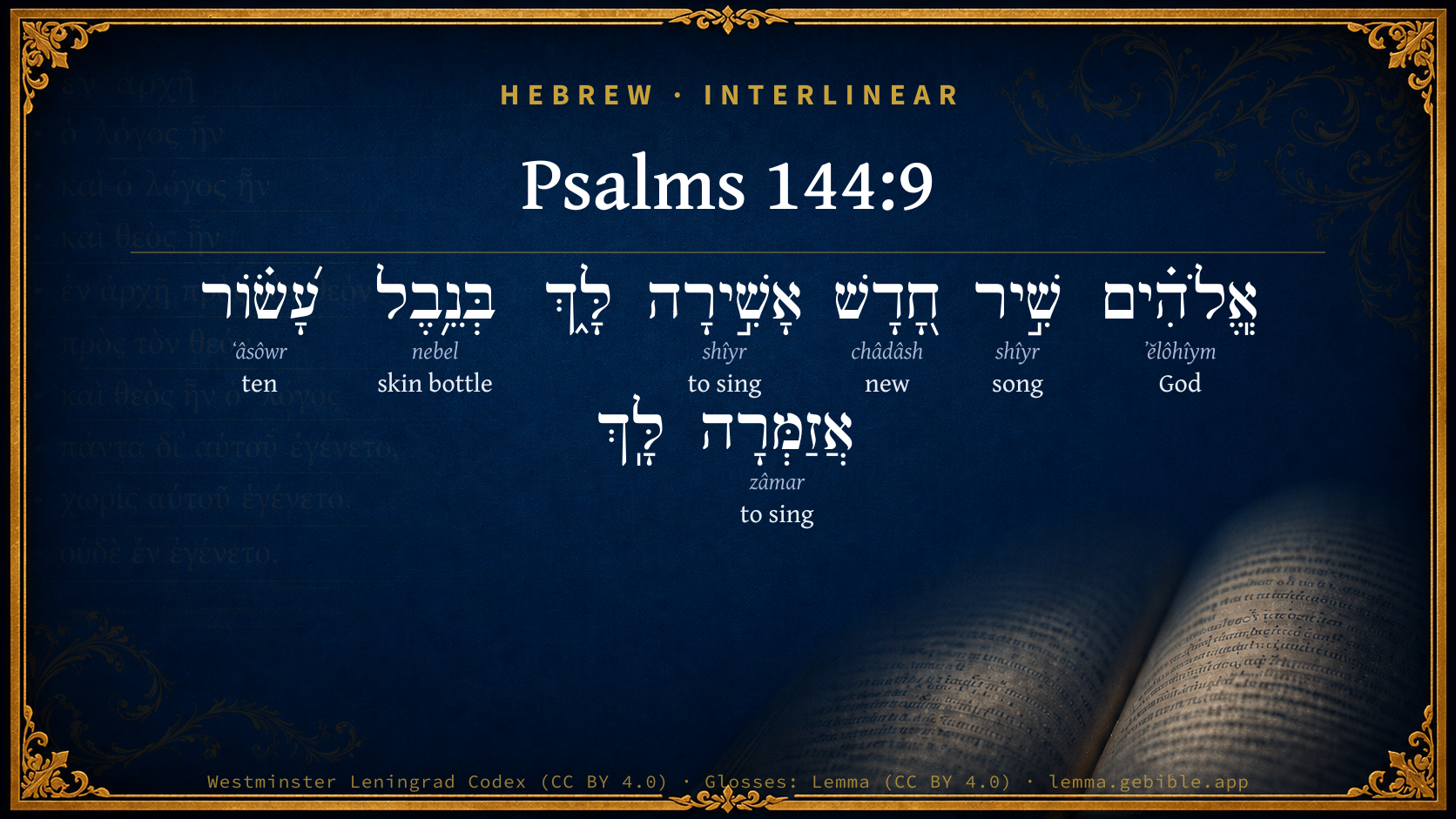
Hebrew (Westminster Leningrad Codex) Psalms 144:9 appears in the Hebrew Old Testament. The text above is from the Westminster Leningrad Codex. Each word links to its Strong’s number, a concise gloss, and parsing drawn from the Open Scriptures Hebrew Bible morphology. Click any word for its full Brown-Driver-Briggs (BDB) entry.
Download image
Cite this verse

Psalms 144:9 (World English Bible). Public Domain. Lemma interlinear Bible study tool, https://lemma.gebible.app/v/psalms/144/9.

Show BibTeX & RIS
BibTeX
RIS
English Translation
I will sing a new song to you, God. On a ten-stringed lyre, I will sing praises to you.
World English Bible · Public Domain
Download a study sheet

One document with this verse’s original text, its word-by-word gloss line, the meaning frame, cross-references with their text, attributed commentary, and full source and license credits — printable, and it pastes into notes with its structure intact.

This verse Autodidact and up

Study sheet (.html) Plain text (.txt)

A passage Seminary Student

Up to 50 verses in one chapter. A passage sheet keeps up to 6 commentary sources and 12 cross-references per verse, in the order this page ranks them, and says so on the sheet whenever that leaves anything out. Ask for a single verse and you get the Autodidact verse sheet above.

Everything on this page stays free to read, with no account — the sheet is a download of what is already on screen, not access to it.

Want to remove ads? Support Godless Engineer
Compare translations 3

The same verse in 3 English versions, stacked beneath the original-language interlinear above. Click any original word for its lexicon entry.

Each is an independent rendering of the whole verse — the interlinear is not word-aligned to these translations.

Highlighted words mark where these versions differ — a whole-verse word diff, not a word-by-word alignment.

  • World English Bible Public Domain
    I will sing a new song to you, God. On a ten-stringed lyre, I will sing praises to you.
  • King James Version Public Domain
    I will sing a new song unto thee, O God: upon a psaltery and an instrument of ten strings will I sing praises unto thee.
  • unfoldingWord Literal Text CC BY-SA 4.0
    God, I will sing a new song to you; with a lyre of ten I will make music to you,

unfoldingWord Literal Text — © unfoldingWord, licensed CC BY-SA 4.0. Word-aligned USFM3 via Door43 (git.door43.org/unfoldingWord/en_ult).

Versions to compare (up to 4)

3 of 4 selected

Show all 18 translations

Every available English version of this verse, each an independent rendering of the whole verse.

  • World English Bible Public Domain
    I will sing a new song to you, God. On a ten-stringed lyre, I will sing praises to you.
  • Berean Standard Bible Public Domain
    I will sing to You a new song, O God; on a harp of ten strings I will make music to You—
  • Majority Standard Bible Public Domain
    I will sing to You a new song, O God; on a harp of ten strings I will make music to You—
  • King James Version Public Domain
    I will sing a new song unto thee, O God: upon a psaltery and an instrument of ten strings will I sing praises unto thee.
  • American Standard Version (1901) Public Domain
    I will sing a new song unto thee, O God: Upon a psaltery of ten strings will I sing praises unto thee.
  • Revised Version (1885) Public Domain
    I will sing a new song unto thee, O God: upon a psaltery of ten strings will I sing praises unto thee.
  • Geneva Bible (1599) Public Domain
    I wil sing a new song vnto thee, O God, and sing vnto thee vpon a viole, and an instrument of ten strings.
  • Douay-Rheims (1899) Public Domain
    Deliver me from my enemies, O Lord, to thee have I fled:
  • Young's Literal Translation Public Domain
    O God, a new song I sing to Thee, On a psaltery of ten strings I sing praise to Thee.
  • Literal Standard Version CC BY-SA 4.0
    O God, I sing to You a new song, || I sing praise to You on a stringed instrument of ten strings.
  • Unlocked Literal Bible CC BY-SA 4.0
    I will sing a new song to you, God; on a lute of ten strings I will sing praises to you,
  • unfoldingWord Literal Text CC BY-SA 4.0
    God, I will sing a new song to you; with a lyre of ten I will make music to you,
  • Darby Bible Public Domain
    O God, I will sing a new song unto thee; with the ten-stringed lute will I sing psalms unto thee:
  • World Messianic Bible Public Domain
    I will sing a new song to you, God. On a ten-stringed lyre, I will sing praises to you.
  • Webster's Bible Public Domain
    I will sing a new song to thee, O God: upon a psaltery and an instrument of ten strings will I sing praises to thee.
  • Free Bible Version CC BY-SA 4.0
    God, I will sing a new song to you, accompanied by a ten-stringed harp,
  • Bible in Basic English Public Domain
    I will make a new song to you, O God; I will make melody to you on an instrument of ten cords.
  • JPS Tanakh (1917) Public Domain
    O God, I will sing a new song unto Thee, upon a psaltery of ten strings will I sing praises unto Thee;

Literal Standard Version (2020), Covenant Press — licensed CC BY-SA 4.0. Text via the HelloAO Bible API (eBible.org). Unlocked Literal Bible (unfoldingWord) — licensed CC BY-SA 4.0. Text via the HelloAO Bible API (eBible.org). unfoldingWord Literal Text — © unfoldingWord, licensed CC BY-SA 4.0. Word-aligned USFM3 via Door43 (git.door43.org/unfoldingWord/en_ult). Free Bible Version, Dr. Jonathan Gallagher — licensed CC BY-SA 4.0. Text via the HelloAO Bible API (eBible.org).

Word by word

More ways to search: Search by grammar → Find every occurrence → Compare this word →

Practice this passage: Drill this verse → Learn its vocabulary →

About this verse

These counts appear in no published source. They are computed here, from the morphology-tagged text and Lemma’s own curated glosses. What Lemma adds →

9
words
7
distinct lemmas
Wisdom
section

Notable vocabulary

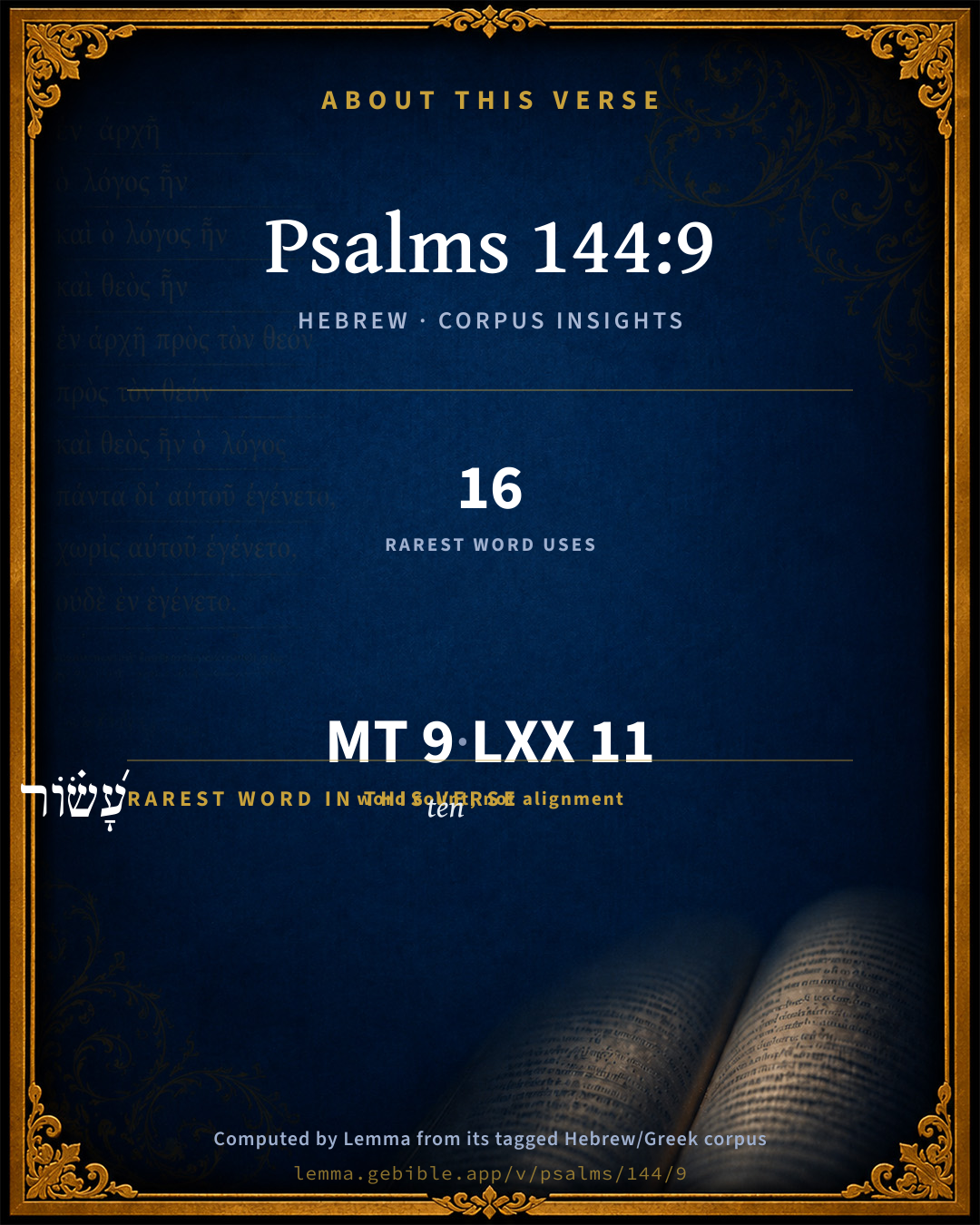
The rarest word here is עָ֝שׂ֗וֹר ten H6218 — appearing just 16 times in the whole Hebrew Bible.

Shared distinctive vocabulary

עָ֝שׂ֗וֹר ten H6218 occurs in 16 verses of the Hebrew Bible. Also found in:

Grammatical profile

  • 2 verbs
  • 4 nouns
  • 1 adjective
  • 2 prepositions

Verb forms

  • אָשִׁ֣ירָה Qal · Cohortative
  • אֲזַמְּרָה Piel · Cohortative

Hebrew & Septuagint length

In English translation the verse runs 19 words from the Hebrew and 21 from the Septuagint (LXX English) — closely comparable.

A rough comparison of the two English renderings, which tokenize alike — not a word-level alignment.

Word counts can differ between the Hebrew and the Greek without any difference in meaning — e.g. the Hebrew direct-object marker אֵת has no separate Greek word, and Greek often adds the article ὁ.

In the original languages it is 9 Hebrew tokens and 11 Greek tokens — but the two are counted differently (Hebrew bundles its prefixes and suffixes into one token; the Greek is in lemma form), so that isn’t a like-for-like length.

Cross-references

10

Topical passages linked to Psalms 144:9 in the Treasury of Scripture Knowledge — connected by theme and wording, ordered by reader-vote popularity; previews shown in the World English Bible.

  • Psalms 33:2–3 Give thanks to Yahweh with the lyre. Sing praises to him with the harp of ten strings.
  • Psalms 40:3 He has put a new song in my mouth, even praise to our God. Many shall see it, and fear, and shall trust in Yahweh.
  • Psalms 81:1–3 Sing aloud to God, our strength! Make a joyful shout to the God of Jacob!
  • Psalms 149:1 Praise Yahweh! Sing to Yahweh a new song, His praise in the assembly of the saints.
  • Psalms 150:3–5 Praise him with the sounding of the trumpet! Praise him with harp and lyre!
  • 1 Chronicles 25:1–6 Moreover, David and the captains of the host set apart for the service certain of the sons of Asaph, and of Heman, and of Jeduthun, who should prophesy with harps, with psalteries, and with cymbals: and the number of those who did the work according to their service was:
  • Psalms 98:1 Sing to Yahweh a new song, For he has done marvelous things! His right hand, and his holy arm, have worked salvation for him.
  • Psalms 108:2–3 Wake up, harp and lyre! I will wake up the dawn.
  • Revelation 5:9–10 They sang a new song, saying, "You are worthy to take the book, And to open its seals: For you were killed, And bought us for God with your blood, Out of every tribe, language, people, and nation,
  • Revelation 14:3 They sing a new song before the throne, and before the four living creatures and the elders. No one could learn the song except the one hundred forty-four thousand, those who had been redeemed out of the earth.

Cross-references courtesy of OpenBible.info (CC BY 4.0).

Hebrew and Greek witnesses Masoretic Hebrew ↔ Greek Septuagint

The same verse in the two great witnesses to the Old Testament, shown verse-for-verse.

You’re reading Greek Psalm 143 (Hebrew Psalm 144). The Septuagint counts the superscription, so verse numbers can differ from the Hebrew — chapter-level alignment, not verse-by-verse. Numbering follows Rahlfs.

These are two independent witnesses, not word-aligned to each other, and the Septuagint is shown in lemma (dictionary) form.

Hebrew Psalms 144:9 Masoretic · Westminster Leningrad Codex

אֱֽלֹהִ֗ים שִׁ֣יר חָ֭דָשׁ אָשִׁ֣ירָה לָּ֑ךְ בְּנֵ֥בֶל עָ֝שׂ֗וֹר אֲזַמְּרָה לָּֽךְ

I will sing a new song to you, God. On a ten-stringed lyre, I will sing praises to you.

World English Bible · Public Domain

Greek LXX Greek Psalm 143:9 Septuagint · lemma form

ὁ θεός ᾠδή καινός ᾄδω σύ ἐν ψαλτήριον δεκάχορδος ψάλλω σύ

O God, I will sing a new song to you: I will play to you on a lute of ten strings.

LXX2012 (modern English Septuagint) · Public Domain

On this verse, The Treasury of David discusses the Septuagint’s reading. Read the note in Commentary ↓

Hebrew: Westminster Leningrad Codex (CC BY 4.0). Greek: Septuagint (public domain); English from LXX2012 (modern English Septuagint) (Public Domain). How the Septuagint differs from the Hebrew →

Commentary

Notes on Psalms 144:9 from classic Christian and Jewish commentators (each source and its license shown beneath its notes). The classic Christian expositions comment on the surrounding passage and are grouped to its opening verse, so a note may address several verses; the Jewish commentaries on the Tanakh (Rashi and others) are per-verse, so they appear only where the commentator wrote on this verse.

Lemma curates 59 commentaries, every one of them public domain or Creative Commons licensed, each selected and text-cleaned for this edition rather than reprinted as found. About our sources →

Matthew Henry's Commentary

The method is the same in this latter part of the psalm as in the former; David first gives glory to God and then begs mercy from him.

I. He praises God for the experiences he had had of his goodness to him and the encouragements he had to expect further mercy from him, Psa 144:9, Psa 144:10. In the midst of his complaints concerning the power and treachery of his enemies, here is a holy exultation in his God: I will sing a new song to thee, O God! a song of praise for new mercies, for those compassions that are new every morning. Fresh favours call for fresh returns of thanks; nay, we must praise God for the mercies we hope for by his promise as well as those we have received by his providence, Ch2 20:20, Ch2 20:21. He will join music with his songs of praise, to express and excite his holy joy in God; he will praise God upon a psaltery of ten strings, in the best manner, thinking all little enough to set forth the praises of God. He tells us what this new song shall be (Psa 144:10): It is he that giveth salvation unto kings. This intimates, 1. That great kings cannot save themselves without him. Kings have their life-guards, and have armies at command, and all the means of safety that can be devised; but, after all, it is God that gives them their salvation, and secures them by those means, which he could do, if there were occasion, without them, Psa 33:16. Kings are the protectors of their people, but it is God that is their protector. How much service do they owe him then with their power who gives them all their salvations! 2. That good kings, who are his ministers for the good of their subjects, shall be protected and saved by him. He has engaged to give salvation to those kings that are his subjects and rule for him; witness the great things he had done for David his servant, whom he had many a time delivered from the hurtful sword, to which Saul's malice, and his own zeal for the service of his country, had often exposed him. This may refer to Christ the Son of David, and then it is a new song indeed, a New Testament song. God delivered him from the hurtful sword, upheld him as his servant, and brought him off a conqueror over all the powers of darkness, Isa 42:1; Isa 49:8. To him he gave salvation, not for himself only, but for us, raising him up to be a horn of salvation.

II. He prays for the continuance of God's favour.

1. That he might be delivered from the public enemies, Psa 144:11. Here he repeats his prayer and plea, Psa 144:7, Psa 144:8. His persecutors were still of the same character, false and perfidious, and who would certainly over-reach an honest man and be too hard for him: "Therefore, Lord, do thou deliver me from them, for they are a strange sort of people."

2. That he might see the public peace and prosperity: "Lord, let us have victory, that we may have quietness, which we shall never have while our enemies have it in their power to do us mischief." David, as a king, here expresses the earnest desire he had of the welfare of his people, wherein he was a type of Christ, who provides effectually for the good of his chosen. We have here,

(1.) The particular instances of that public prosperity which David desired for his people. [1.] A hopeful progeny (Psa 144:12): "That our sons and our daughters may be in all respects such as we could wish." He means not those only of his own family, but those of his subjects, that are the seed of the next generation. It adds much to the comfort and happiness of parents in this world to see their children promising and likely to do well. First, It is pleasant to see our sons as plants grown up in their youth, as olive-plants (Psa 128:1-6 :), the planting of the Lord (Isa 61:3), - to see them as plants, not as weeds, not as thorns, - to see them as plants growing great, not withered and blasted, - to see them of a healthful constitution, a quick capacity, a towardly disposition, and especially of a pious inclination, likely to bring forth fruit unto God in their day, - to see them in their youth, their growing time, increasing in every thing that is good, growing wiser and better, till they grow strong in spirit. Secondly, It is no less desirable to see our daughters as corner-stones, or corner-pillars, polished after the similitude of a palace, or temple. By daughters families are united and connected, to their mutual strength, as the parts of a building are by the corner-stones; and when they are graceful and beautiful both in body and mind they are then polished after the similitude of a nice and curious structure. When we see our daughters well-established and stayed with wisdom and discretion, as corner-stones are fastened in the building, - when we see them by faith united to Christ, as the chief corner-stone, adorned with the graces of God's Spirit, which are the polishing of that which is naturally rough, and become women professing godliness, - when we see them purified and consecrated to God as living temples, we think ourselves happy in them. [2.] Great plenty. Numerous families increase the care, perhaps more than the comfort, where there is not sufficient for their maintenance; and therefore he prays for a growing estate with a growing family. First, That their store-houses might be well-replenished with the fruits and products of the earth: That our garners may be full, like those of the good householder, who brings out of them things new and old (those things that are best new he has in that state, those that are best when they are kept he has in that state), - that we may have in them all manner of stores, for ourselves and our friends, - that, living plentifully, we may live not luxuriously, for then we abuse our plenty, but cheerfully and usefully, - that, having abundance, we may be thankful to God, generous to our friends, and charitable to the poor; otherwise, what profit is it to have our garners full? Jam 5:3. Secondly, That their flocks might greatly increase: That our sheep may bring forth thousands, and ten thousands, in our folds. Much of the wealth of their country consisted in their flocks (Pro 27:26), and this is the case with ours too, else wool would not be, as it is, a staple commodity. The increase of our cattle is a blessing in which God is to be acknowledged. Thirdly, That their beasts designed for service might be fit for it: That our oxen may be strong to labour in the plough, that they may be fat and fleshy (so some), in good working case. We were none of us made to be idle, and therefore we should pray for bodily health, not that we may be easy and take our pleasures, but that we may be strong to labour, that we may do the work of our place and day, else we are worse than the beasts; for when they are strong it is for labour. [3.] An uninterrupted peace. First, That there be no war, no breaking in of invaders, no going out of deserters. "Let not our enemies break in upon us; let us not have occasion to march out against them." War brings with it abundance of mischiefs, whether it be offensive or defensive. Secondly, That there be no oppression nor faction - no complaining in our streets, that the people may have no cause to complain either of their government or of one another, nor may be so peevish as to complain without cause. It is desirable thus to dwell in quiet habitations.

(2.) His reflection upon this description of the prosperity of the nation, which he so much desired (Psa 144:15): Happy are the people that are in such a case (but it is seldom so, and never long so), yea, happy are the people whose God is the Lord. The relation of a people to God as theirs is here spoken of either, [1.] As that which is the fountain whence all those blessings flow. Happy are the Israelites if they faithfully adhere to the Lord as their God, for they may expect to be in such a case. National piety commonly brings national prosperity; for nations as such, in their national capacity, are capable of rewards and punishments only in this life. Or, [2.] As that which is abundantly preferable to all these enjoyments. The psalmist began to say, as most do, Happy are the people that are in such a case; those are blessed that prosper in the world. But he immediately corrects himself: Yea, rather, happy are the people whose God is the Lord, who have his favour, and love, and grace, according to the tenour of the covenant, though they have not abundance of this world's goods. As all this, and much more, cannot make us happy, unless the Lord be our God, so, if he be, the want of this, the loss of this, nay, the reverse of this, cannot make us miserable.

Matthew Henry's Commentary on the Whole Bible (1708–1710) — public domain (CC PDM 1.0). Text via the HelloAO Bible API.

Trapp's Complete Commentary

John Trapp

Psa 144:9 I will sing a new song unto thee, O God: upon a psaltery [and] an instrument of ten strings will I sing praises unto thee.

Ver. 9. I will sing a new song] Upon the receipt of any new mercy, like as in a lottery, at every new prize drawn the trumpet soundeth.

John Trapp, A Commentary or Exposition upon All the Books of the Old and New Testament (1647–1656) — public domain. Text from a community e-Sword module.

Joseph Benson's Commentary

Psa 144:9-10. I will sing a new song unto thee — When thou hast granted this my request, Psa 144:7-8, which I know assuredly thou wilt do. He giveth salvation to kings — Who are not preserved by their own power or prudence, but by God’s special providence, which, for the public good of the world, watcheth over them.

Joseph Benson's Commentary on the Old and New Testaments (1811–1818) — public domain. Text from a community e-Sword module.

Keil & Delitzsch

C. F. Keil & F. Delitzsch

With the exception of Psa 108:1-13, which is composed of two Davidic Elohim-Psalms, the Elohim in Psa 144:9 of this strophe is the only one in the last two Books of the Psalter, and is therefore a feeble attempt also to reproduce the Davidic Elohimic style. The "new song" calls to mind Psa 33:3; Psa 40:4; and נבל עשׂור also recalls Psa 33:2 (which see). The fact that David mentions himself by name in his own song comes about in imitation of Ps 18:51. From the eminence of thanksgiving the song finally descends again to petition, Psa 144:7-8, being repeated as a refrain. The petition developes itself afresh out of the attributes of the Being invoked (Psa 144:10), and these are a pledge of its fulfilment. For how could the God to whom all victorious kings owe their victory (Psa 33:16, cf. Kg2 5:1; Sa1 17:47) possibly suffer His servant David to succumb to the sword of the enemy! חרב רעה is the sword that is engaged in the service of evil.

Keil & Delitzsch — Biblical Commentary on the Old Testament (1861–1891) — public domain (CC PDM 1.0). Text via the HelloAO Bible API. (Old Testament only.)

J. A. Alexander on Psalms

Joseph Addison Alexander

9. (Psa 144:9) O God, a new song I will sing to thee; with a lyre of ten (strings) I will play (or make music) to thee. See above, on Psa 33:2-3, where David exhorts others to do what he here resolves and vows to do himself. The new song still implies a new occasion for it, so that he here begins to anticipate the answer to his foregoing prayers.

Joseph Addison Alexander, The Psalms Translated and Explained (1850) — public domain. Text from a community e-Sword module.

Geneva Bible (1599)

Geneva Bible translators

That is, a rare and excellent song, as thy great benefits deserve.

Geneva Bible (1599) marginal notes — public domain. Text via Bolls.life.

Adam Clarke's Commentary

Verse 9. I will sing a new song] A song of peculiar excellence. I will pour forth all my gratitude, and all my skill, on its composition. See on Ps 33:2; Ps 33:3.

Adam Clarke's Commentary on the Bible (1810–1826) — public domain. Text from a community e-Sword/MySword module.

John Calvin's Commentaries

9. O God! I will sing a new song to thee. He again sets himself, with self-possession, to the exercise of praising God, not doubting but he would continue those mercies which he had once bestowed. I have taken notice in another place that by a new song is meant one of a singular or uncommon kind; and we are left from this to infer that David’s expectations stretched beyond the conclusions of man’s judgment; for, with a view to the greatness of the help to be extended, he promises a song of praise unprecedented in its nature, and distinguished, by the title here applied to it, from ordinary thanksgiving’s. As to the nablum and psaltery, I have elsewhere observed that they formed part of that system of training under the law to which the Church was subjected in its infancy. But the chief thing to be noticed is the subject of his songs that God, who is the preserver of kings, had kept — and even rescued from the sword — David, whom he had made and anointed king by his authoritative decree. As to the idea of there being implied in the term kings an opposition to the commonalty, David meaning that not only the common class of people are indebted to divine preservation, but the more influential, and such as appear to have sufficient and abundant strength of their own, I question whether it be well founded. His meaning seems to me rather to be different from this, That while God preserves all men without exception, his care is peculiarly extended to the maintenance of political order, which is the foundation of the common safety of all. It is in effect as if he called him the guardian and defender of kingdoms; for as the very mention of government is an odious thing, and none willingly obeys another, and nothing is more contrary to natural inclination than servitude, men would seek to throw off the yoke, and subvert the thrones of kings, were these not hedged round by a hidden divine presidency. David, however, distinguishes himself from other kings, as elsewhere he is called “the firstborn of kings,” (Psalm 89:27;) at least he speaks of the goodness of God as having been preeminently shown to him, representing himself as holding the highest place, on account of the holy anointing which had been more eminently bestowed upon him. As a title of distinction, he claims the special name of God’s servant; for although all kings are God’s servants, and Cyrus has the name applied to him by Isaiah emphatically, (Isaiah 45:1,) yet as no heathen prince ever recognized himself as called of God, and David alone of all others in the world was invested with legitimate authority, and had a warrant to reign which faith could rest upon with certainty, it was not without reason that this mark of distinction is applied to him. By the hurtful sword, are doubtless meant all the dangers he had passed through for a series of years, which were such that he might be truly said to have come to the throne by deaths oft, and to have been settled upon the throne in the midst of them.

John Calvin's Commentaries (1540-1563) — public domain. Text from the Calvin Translation Society English edition (1840s-50s) via the Christian Classics Ethereal Library (ccel.org). Calvin's coverage is partial (roughly two-thirds of the Bible); uncommented books and verses are honest gaps, never fabricated. The 19th-century editor's footnotes and remarks are omitted so the notes are faithfully Calvin's own voice.

Ellicott's Commentary for English Readers

(9) See Psa_33:2-3.

O God.—The only instance of Elohim in the last two books of the psalter with the exception of Psalms 108, which is a compilation from two older songs.

A Bible Commentary for English Readers, edited by Charles John Ellicott (1878–1897) — public domain. Text from a community e-Sword module.

The Cambridge Bible for Schools and Colleges

gen. ed. J. J. S. Perowne

9. From Psa_33:2-3.

O God] An imitation of the usage of the Elohistic Psalms of Books II and III. Nowhere else in Books IV, V is Elohim (God) used absolutely for Jehovah, except in Psalms 108, which is directly taken from two Elohistic Psalms. See Introd. p. lv.

upon a psaltery and an instrument of ten strings] R.V. upon a psaltery of ten strings.

9–11. A promise to give thanks for the victory which he is confident will be granted, and a repetition of his prayer for deliverance.

The Cambridge Bible for Schools and Colleges (gen. ed. J. J. S. Perowne; Cambridge University Press, 1878–1918) — public domain. Text from a community e-Sword module.

John Gill's Exposition

I will sing a new song unto thee, O God,.... The author of his being, the Father of mercies, temporal and spiritual, and therefore to him praise is always due; a new song of praise is to be sung for new mercies; and as these are new every morning, and are renewed day by day, new songs should be sung continually: or this is a song suited to New Testament times, in which all things are become new; there is a new covenant of grace; and a new and living way to the throne of grace; a newly slain sacrifice; redemption newly wrought out, and therefore the new song of redeeming grace must be sung. Arama suggests that this refers to the days of the Messiah;

upon a psaltery, and an instrument of ten strings, will I sing praises unto thee; such instruments of music were used in the Old Testament dispensation, and were typical of the hearts of God's people; which are the harps they now strike upon, and where they make melody to the Lord; see Psa 33:2.

John Gill's Exposition of the Whole Bible (1746–1763) — public domain (CC PDM 1.0). Text via the HelloAO Bible API.

Albert Barnes' Notes on the Bible

I will sing a new song unto thee, O God - There will be occasion in such a deliverance, or manifestation of mercy, for a new expression of praise. On the phrase, “a new song,” see the notes at Psa 33:3.

Upon a psaltery, and an instrument of ten strings - The word “and” should not have been inserted here. The idea is, “Upon a lyre or harp (Nebel) of ten strings, will I sing praise.” See the notes at Isa 5:12; and notes at Psa 33:2.

Albert Barnes' Notes on the Bible (1834–1885) — public domain. Text from a community e-Sword/MySword module.

Matthew Poole's English Annotations

When thou hast granted this request of mine, Psa 144:7,8, which I know assuredly thou wilt do.

Matthew Poole's English Annotations on the Holy Bible (1683–1685) — public domain. Text from a community e-Sword/MySword module.

The Treasury of David

Charles H. Spurgeon

Ver. 9. I will sing a new song unto thee, O God. Weary of the false, I will adore the true. Fired with fresh enthusiasm, my gratitude shall make a new channel for itself. I will sing as others have done; but it shall be a new song, such as no others have sung. That song shall be all and altogether for my God: I will extol none but the Lord, from whom my deliverance has come.

Upon a psaltery and an instrument of ten strings will I sing praises unto thee. His hand should aid his tongue, not as in the case of the wicked, cooperating in deceit; but his hand should unite with his mouth in truthful praise. David intended to tune his best instruments as well as to use his best vocal music: the best is all too poor for so great a God, and therefore we must not fall short of our utmost. He meant to use many instruments of music, that by all means he might express his great joy in God. The Old Testament dispensation abounded in types, and figures, and outward ritual, and therefore music dropped naturally into its place in the "worldly sanctuary"; but, after all, it can do no more than represent praise, and assist our expression of it; the real praise is in the heart, the true music is that of the soul. When music drowns the voice, and artistic skill takes a higher place than hearty singing, it is time that instruments were banished from public worship; but when they are subordinate to the song, as here, it is not for us to prohibit them, or condemn those who use them, though we ourselves greatly prefer to do without them, since it seems to us that the utmost simplicity of praise is far more congruous with the spirit of the gospel than pomp of organs. The private worshipper, singing his solo unto the Lord, has often found it helpful to accompany himself on some familiar instrument, and of this David in the present psalm is an instance, for he says, "I will sing praise unto thee", that is, not so much in the company of others as by himself alone. He saith not "we", but "I."

Ver. 9. Psalteryan instrument of ten strings. Nebelazor. We are led to the conclusion that the nebel was the veritable harp of the Hebrews. It could not have been large, because it is so frequently mentioned in the Bible as being carried in processions ...The English translators render nebel (apparently without any special reason) by no less than four words; (1) psaltery, (2) psalm, (3) lute, (4) viol. The first of these is by far the most common in the Authorized Version, and is no doubt the most correct translation if the word be understood in its true sense as a portable harp. Nebels were made of fir wood, and afterwards of almug, or algum, which was, perhaps, the red sandalwood of India...With nebel is often associated the word azor, which is traced to a root signifying ten, and which has therefore been rendered in the Septuagint by by en dekacordw or as qalthrion dekacordon, (psalterium decem chordarum) or in dechachordo psalterio in the Vulgate. In the Chaldee, Syriac, and Arabic versions also are found words implying the existence of ten strings in the nebelazor. The word azor may therefore be considered as qualifying or describing the special kind of nebel to be used, much in the same way as we now speak of a trichord pianoforte. It is in our English version always rendered by the words "ten stringed." John Stainer, in "The Music of the Bible", 1882.

Ver. 9. For God's Ear.

1. The Singer. A grateful heart.

2. The Song. Full of Praise. New.

3. The Accompaniment: "Psaltery." Helps to devotion. Give God the best.

4. The Auditor and Object of the eulogium: "Thee, O God." W.B.H.

Psalms 144:10*

Charles H. Spurgeon's The Treasury of David (1869–1885) — public domain. Psalms only. Text from a community e-Sword/MySword module.

The Pulpit Commentary

I will sing a new song unto thee, O God. Another change of strain. The psalmist returns to his original theme of the praise of God (see vers. 1, 2), and promises a "new song," as in Psa_40:3. Upon a psaltery and an instrument of ten strings will I sing praises unto thee; rather, upon a psaltery of ten strings. (see the Revised Version, and comp. Psa_33:2) Assyrian harps had commonly, in the earlier ages, either eight, nine, or ten strings ("Ancient Monarchies," vol. 1. p. 530, 2nd edit.).

The Pulpit Commentary (1880–1919), ed. H.D.M. Spence-Jones & Joseph S. Exell — public domain. Text from a community e-Sword module.

unfoldingWord translationNotes

Door43 World Missions Community

new song

Possible meanings are 1) "a song no one has ever sung before" or 2) "a song I have never sung before."

you, who give ... kings, who rescued

"you. It is you who give ... kings. It is you who rescued"

David your servant

David speaks of himself as if he were someone else. "me, David, your servant"

from an evil sword

David speaks of evil people as if they were the swords they use as weapons. AT: "from evil people who were trying to kill him" (See: Metonymy)

Rescue me and free me

"Please rescue me and free me"

from the hand of foreigners

Here "hand" refers to power. See how you translated these words in Psalms 144:7-8. AT: "from the power of foreigners" (See: Metonymy)

Their mouths speak lies

The people are represented by their "mouths." See how you translated these words in Psalms 144:7-8. AT: "They speak lies" (See: Synecdoche)

their right hand is falsehood

Possible meanings are 1) David speaks of the custom of raising the right hand to swear that what one is about to say in court is true, "they lie even when they swear to tell the truth," or 2) the "right hand" is a metaphor for power, "everything they have gotten, they have gotten by telling lies."See how you translated these words Psalms 144:7-8. (See: Metaphor)

translationWords

lute

praise

save

king

David

servant

evil

sword

free

hand

alien

right hand

unfoldingWord translationNotes — © Distant Shores Media and the Door43 World Missions Community, licensed CC BY-SA 4.0. Source: git.door43.org/Door43/en_tn.

Lesson kit

Teaching starters — assembled from the data on this page, not authored interpretation. Every prompt links to the verse data it draws on. Edit before teaching.

Psalms, in the Wisdom, opens this verse with 9 words (7 distinct Hebrew lemmas). Its most distinctive word is ʻâsôwr (“ten”). A historical commentator’s framing appears above. Read the whole chapter for the surrounding context.

Discussion questions

  1. The word ʻâsôwr carries the sense “ten.” How does it shape the verse?
  2. Genesis 24:55 shares the word «ten» with this verse. How do the two illuminate each other?
  3. These translations render this verse differently. What is at stake in choosing one wording over another?
  4. The verb «אָשִׁ֣ירָה» is Qal Cohortative. How does its form color the action?
  5. Reading how Matthew Henry's Commentary and Trapp's Complete Commentary read this verse, where do the two commentators agree and where do they part?

Things to notice

Reading settings

Reading text

Shown beneath each verse's original-language words.

Old Testament
Old Testament edition

Read the OT as the Masoretic Hebrew (MT) or the Greek Septuagint (LXX).

English shown for the Greek Septuagint (in the Hebrew ↔ Greek comparison).

Comparing translations? Open the Compare panel on any verse page to stack up to four side by side.