
Job 29:20

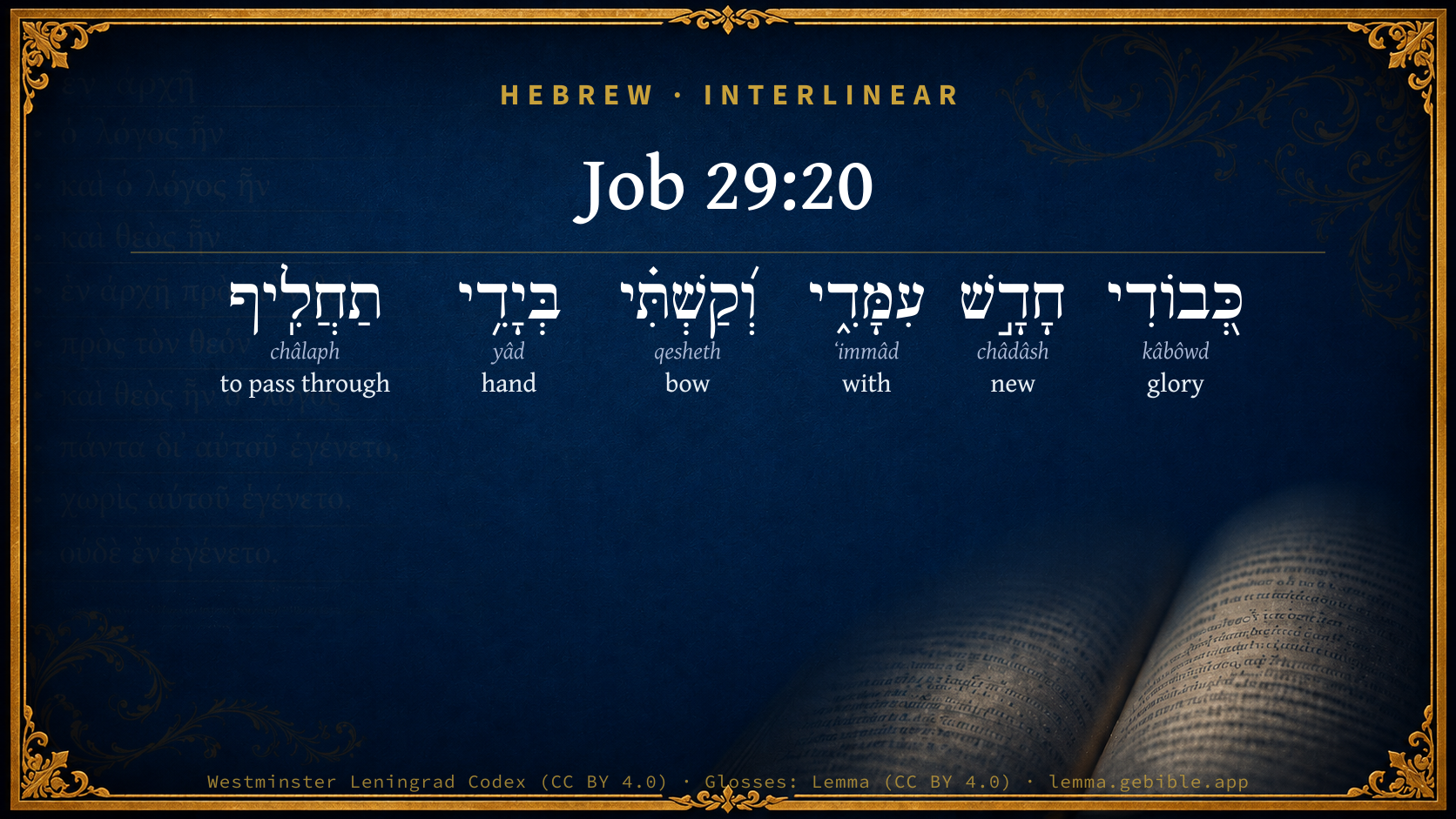
Hebrew (Westminster Leningrad Codex) Job 29:20 appears in the Hebrew Old Testament. The text above is from the Westminster Leningrad Codex. Each word links to its Strong’s number, a concise gloss, and parsing drawn from the Open Scriptures Hebrew Bible morphology. Click any word for its full Brown-Driver-Briggs (BDB) entry.
Download image
Cite this verse

Job 29:20 (World English Bible). Public Domain. Lemma interlinear Bible study tool, https://lemma.gebible.app/v/job/29/20.

Show BibTeX & RIS
BibTeX
RIS
English Translation
My glory is fresh in me, My bow is renewed in my hand.'
World English Bible · Public Domain
Download a study sheet

One document with this verse’s original text, its word-by-word gloss line, the meaning frame, cross-references with their text, attributed commentary, and full source and license credits — printable, and it pastes into notes with its structure intact.

This verse Autodidact and up

Study sheet (.html) Plain text (.txt)

A passage Seminary Student

Up to 50 verses in one chapter. A passage sheet keeps up to 6 commentary sources and 12 cross-references per verse, in the order this page ranks them, and says so on the sheet whenever that leaves anything out. Ask for a single verse and you get the Autodidact verse sheet above.

Everything on this page stays free to read, with no account — the sheet is a download of what is already on screen, not access to it.

Want to remove ads? Support Godless Engineer
Compare translations 3

The same verse in 3 English versions, stacked beneath the original-language interlinear above. Click any original word for its lexicon entry.

Each is an independent rendering of the whole verse — the interlinear is not word-aligned to these translations.

Highlighted words mark where these versions differ — a whole-verse word diff, not a word-by-word alignment.

  • World English Bible Public Domain
    My glory is fresh in me, My bow is renewed in my hand.'
  • King James Version Public Domain
    My glory was fresh in me, and my bow was renewed in my hand.
  • unfoldingWord Literal Text CC BY-SA 4.0
    My glory fresh in me, and my bow sprouts in my hand.’

unfoldingWord Literal Text — © unfoldingWord, licensed CC BY-SA 4.0. Word-aligned USFM3 via Door43 (git.door43.org/unfoldingWord/en_ult).

Versions to compare (up to 4)

3 of 4 selected

Show all 18 translations

Every available English version of this verse, each an independent rendering of the whole verse.

  • World English Bible Public Domain
    My glory is fresh in me, My bow is renewed in my hand.'
  • Berean Standard Bible Public Domain
    My glory is ever new within me, and my bow is renewed in my hand.’
  • Majority Standard Bible Public Domain
    My glory is ever new within me, and my bow is renewed in my hand.’
  • King James Version Public Domain
    My glory was fresh in me, and my bow was renewed in my hand.
  • American Standard Version (1901) Public Domain
    My glory is fresh in me, And my bow is renewed in my hand.
  • Revised Version (1885) Public Domain
    My glory is fresh in me, and my bow is renewed in my hand.
  • Geneva Bible (1599) Public Domain
    My glory shall renue towarde me, and my bowe shall be restored in mine hand.
  • Douay-Rheims (1899) Public Domain
    My glory shall always be renewed, and my bow in my hand shall be repaired.
  • Young's Literal Translation Public Domain
    My honour `is' fresh with me, And my bow in my hand is renewed.
  • Literal Standard Version CC BY-SA 4.0
    My glory [is] fresh with me, || And my bow is renewed in my hand.
  • Unlocked Literal Bible CC BY-SA 4.0
    The honor in me is always fresh, and the bow of my strength is always new in my hand.'
  • unfoldingWord Literal Text CC BY-SA 4.0
    My glory fresh in me, and my bow sprouts in my hand.’
  • Darby Bible Public Domain
    My glory shall be fresh in me, and my bow be renewed in my hand.
  • World Messianic Bible Public Domain
    My glory is fresh in me. My bow is renewed in my hand.’
  • Webster's Bible Public Domain
    My glory was fresh in me, and my bow was renewed in my hand.
  • Free Bible Version CC BY-SA 4.0
    Fresh honors were always being given to me; my strength was renewed like an unfailing bow.
  • Bible in Basic English Public Domain
    My glory will be ever new, and my bow will be readily bent in my hand.
  • JPS Tanakh (1917) Public Domain
    My glory shall be fresh in me, and my bow shall be renewed in my hand.'

Literal Standard Version (2020), Covenant Press — licensed CC BY-SA 4.0. Text via the HelloAO Bible API (eBible.org). Unlocked Literal Bible (unfoldingWord) — licensed CC BY-SA 4.0. Text via the HelloAO Bible API (eBible.org). unfoldingWord Literal Text — © unfoldingWord, licensed CC BY-SA 4.0. Word-aligned USFM3 via Door43 (git.door43.org/unfoldingWord/en_ult). Free Bible Version, Dr. Jonathan Gallagher — licensed CC BY-SA 4.0. Text via the HelloAO Bible API (eBible.org).

Word by word

More ways to search: Search by grammar → Find every occurrence → Compare this word →

Practice this passage: Drill this verse → Learn its vocabulary →

תַחֲלִֽיף
châlaph
H2498
“to pass through”
Verb, Hiphil, Imperfect, 3rd Person, Feminine, Singular
Part of Speech
Verb
Stem
Hiphil
Form
Imperfect
Person
3rd Person
Gender
Feminine
Number
Singular
Full BDB Definition

Origin: a primitive root

TWOT: 666

to pass on or away, pass through, pass by, go through, grow up, change, to go on from - (Qal) - to pass on quickly - to pass away (vanish) - to come on anew, sprout again (of grass) - to pass through - to overstep, transgress - (Piel) to cause to pass, change - (Hiphil) - to change, substitute, alter, change for better, renew - to show newness (of tree)
  1. כְּ֭בוֹדִי kâbôwd H3519 “glory · my” Noun, Common, Both, Singular, Construct + Suffix, Personal, 1st Person, Common, Singular
  2. חָדָ֣שׁ châdâsh H2319 “new” Adjective, Adjective, Masculine, Singular, Absolute
  3. עִמָּדִ֑י ʻimmâd H5978 “with · me” Preposition + Suffix, Personal, 1st Person, Common, Singular
  4. וְ֝קַשְׁתִּ֗י qesheth H7198 “and · bow · my” Conjunction + Noun, Common, Feminine, Singular, Construct + Suffix, Personal, 1st Person, Common, Singular
  5. בְּיָדִ֥י yâd H3027 “in/at · hand · my” Preposition + Noun, Common, Both, Singular, Construct + Suffix, Personal, 1st Person, Common, Singular

About this verse

These counts appear in no published source. They are computed here, from the morphology-tagged text and Lemma’s own curated glosses. What Lemma adds →

6
words
6
distinct lemmas
Wisdom
section

Shared distinctive vocabulary

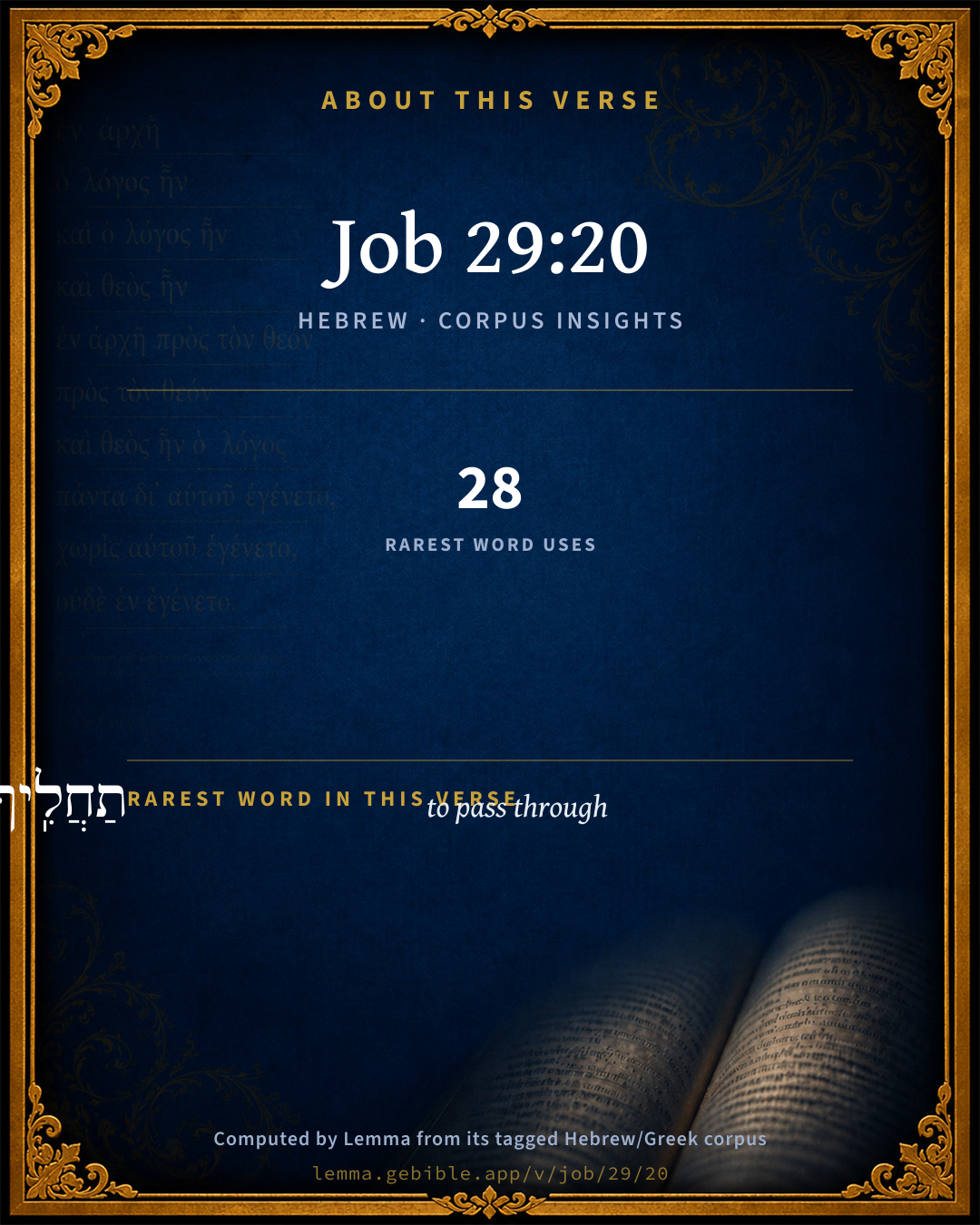
תַחֲלִֽיף to pass through H2498 occurs in 27 verses of the Hebrew Bible. Also found in:

Grammatical profile

  • 1 verb
  • 3 nouns
  • 1 adjective
  • 1 preposition

Verb forms

  • תַחֲלִֽיף Hiphil · Imperfect

Hebrew & Septuagint length

In English translation the verse runs 13 words from the Hebrew and 13 from the Septuagint (LXX English) — the same length.

A rough comparison of the two English renderings, which tokenize alike — not a word-level alignment.

Word counts can differ between the Hebrew and the Greek without any difference in meaning — e.g. the Hebrew direct-object marker אֵת has no separate Greek word, and Greek often adds the article ὁ.

Cross-references

9

Topical passages linked to Job 29:20 in the Treasury of Scripture Knowledge — connected by theme and wording, ordered by reader-vote popularity; previews shown in the World English Bible.

  • Genesis 49:24 But his bow abode in strength, The arms of his hands were made strong, By the hands of the Mighty One of Jacob, (From there is the shepherd, the stone of Israel),
  • Isaiah 40:31 but those who wait for Yahweh shall renew their strength; they shall mount up with wings as eagles; they shall run, and not be weary; they shall walk, and not faint.
  • Genesis 45:13 You shall tell my father of all my glory in Egypt, and of all that you have seen. You shall hurry and bring my father down here."
  • Psalms 3:3 But you, Yahweh, are a shield around me, My glory, and the one who lifts up my head.
  • Psalms 18:34 He teaches my hands to war; So that my arms bend a bow of bronze.
  • Psalms 103:5 Who satisfies your desire with good things, So that your youth is renewed like the eagle's.
  • 2 Corinthians 4:16 Therefore we don't faint, but though our outward man is decaying, yet our inward man is renewed day by day.
  • Job 19:9 He has stripped me of my glory, And taken the crown from my head.
  • Job 29:14 I put on righteousness, and it clothed me. My justice was as a robe and a diadem.

Cross-references courtesy of OpenBible.info (CC BY 4.0).

Hebrew and Greek witnesses Masoretic Hebrew ↔ Greek Septuagint

The same verse in the two great witnesses to the Old Testament, shown verse-for-verse.

These are two independent witnesses, not word-aligned to each other, and the Septuagint is shown in lemma (dictionary) form.

Hebrew Job 29:20 Masoretic · Westminster Leningrad Codex

כְּ֭בוֹדִי חָדָ֣שׁ עִמָּדִ֑י וְ֝קַשְׁתִּ֗י בְּיָדִ֥י תַחֲלִֽיף

My glory is fresh in me, My bow is renewed in my hand.'

World English Bible · Public Domain

Greek LXX Job 29:20 Septuagint · lemma form

ὁ δόξα ἐγώ καινός μετά ἐγώ καί ὁ τόξον ἐγώ ἐν χείρ αὐτός πορεύομαι

My glory was fresh in me, and by bow prospered in his hand.

LXX2012 (modern English Septuagint) · Public Domain

Hebrew: Westminster Leningrad Codex (CC BY 4.0). Greek: Septuagint (public domain); English from LXX2012 (modern English Septuagint) (Public Domain). How the Septuagint differs from the Hebrew →

Commentary

Notes on Job 29:20 from classic Christian and Jewish commentators (each source and its license shown beneath its notes). The classic Christian expositions comment on the surrounding passage and are grouped to its opening verse, so a note may address several verses; the Jewish commentaries on the Tanakh (Rashi and others) are per-verse, so they appear only where the commentator wrote on this verse.

Lemma curates 59 commentaries, every one of them public domain or Creative Commons licensed, each selected and text-cleaned for this edition rather than reprinted as found. About our sources →

Trapp's Complete Commentary

John Trapp

Job 29:20 My glory [was] fresh in me, and my bow was renewed in my hand.

Ver. 20. My glory was fresh in me] i.e. I had daily new accessions to mine honours; and I was herein like a bay tree, that is always green. This was also Joseph’s happiness in Egypt; David’s in the court of Saul; Mordecai’s and Daniel’s in the court of Persia; and Queen Elizabeth’s; concerning whom (besides that famous epitaph set upon her tomb by command of King James) Thuanus, a French historian, testifieth, that the Lady Anna Atestina, mother to the Guises and Nemours, pronounced her to be Gloriosissimam et omnium quae unquam sceptrum gestarunt felicissimam foeminam, The most glorious and happiest woman that ever swayed sceptre. Among her subjects she got a continual increase of honour and respects, by coupling mildness with majesty, and stooping, yet in a stately manner, to the lowest sort; but especially by setting up God and his sincere service wherever she had to do, trusting God with her precious life (so much sought for by Popish assassinates); which while her contemporary, Henry IV of France, dared not do, he lost his life, and much of his honour; witness that known anagram, Borbonius, once Bonus orbi, the good of the bereft now Orbus boni. bereft of good.

And my bow was renewed in my hand] That is, I had fresh and new supplies of strength, by friends and otherwise, outwardly and inwardly, according to that above, Job 17:9, "The righteous also shall hold on his way, and he that hath clean hands shall be stronger and stronger." Robur meum instaurabitur maiusque reddetur (Vatab.). See Gen 49:24 1Sa 2:4.

John Trapp, A Commentary or Exposition upon All the Books of the Old and New Testament (1647–1656) — public domain. Text from a community e-Sword module.

The Biblical Illustrator

Joseph S. Exell

Job_29:20

My glory was fresh in me, and my bow was renewed in my hand.

Freshness

The text tells us of the renown of Job, and of the way in which the providence of God continued to maintain the glory of his estate, his bodily health, and his prosperity, His glory was fresh in him. He did not achieve a hasty fame, and then suddenly become forgotten. He did not blaze out like a meteor, and then vanish into darkness. He says that his bow was renewed in his hand: whereas usually the bow loses its force by use, and is less able to shoot the arrow after a little while, and needs to lie still with a slack string, it was by no means so with him. He could send one arrow, and then another, and then another, and the bow seemed to gather strength by use. That is to say, he never seemed to be worn out in mind or body. However, this did not last always, for Job in this chapter is telling us of something that used to be--something that was--some-thing the loss of which he very sorrowfully deplored--my glory was fresh in me. He found himself suddenly stripped of riches and of honour, and put last in the list instead of first. So far as glory was concerned, he was forgotten as a dead man out of mind. This reads us a lesson that we put not our trust in the stability of earthly things.

I. First, then, notice the excellency of freshness. I shall be anointed with fresh oil (Psa_92:10). David had been anointed while still a youth to be king over Israel. He was anointed yet again when he came to the kingdom: that outward anointing with actual oil was the testimony of Gods choice and the ensign of Davids authorisation, and oftentimes when his throne seemed precarious God confirmed him in it, and subdued the people under him. When his dominion waxed weak, God strengthened him and strengthened his servants, and gave them great victories; so that as a king he was frequently anointed with fresh oil. Freshness is a most delightful thing if you see it in another. It is a charm in nature. How pleasant to go into the garden and see the spring flowers just peeping up. How agreeable to mark the rills, with their fresh water leaping down the hills after showers of rain. But spiritual freshness has a double charm. Sometimes we know what it is to have a freshness of soul, which is the dew from the Lord.

1. How that freshness is seen in a mans devotions. Oh, I have heard some prayers that are really fusty. I have heard them before so often that I dread the old familiar sounds. Some hackneyed expressions I recollect hearing when I was a boy. But, on the other hand, you hear a man pray who does pray, whose soul is fully in communion with God, and what life and freshness is there!

2. And so it is well to have a freshness about our feelings. I know that we do not hope to be saved by our feelings; neither do we put feeling side by side with faith; yet I should be very sorry to be trusting and yet never feeling. Whether it be joy or sorrow, let it be living feeling, fresh from the deep fountains of the heart. Whether it be exultation or depression, let it be true and not superficial or simulated. I hate the excitement which needs to be pumped up. God keep us from stale feelings, and give us freshness of emotion.

3. I believe that there is a very great beauty and excellence in freshness of utterance. Do not hinder yourself from that.

4. There should be a freshness, dear friends, about our labour. We ought to serve the Lord today with just as much novelty in it as there was ten years ago.

II. Now I will dwell upon the fear of losing it--the fear of its departure. I have heard some express the thought that perhaps the things of God might lose their freshness to us by our familiarity with them. I think that the very reverse will turn out to be the case if the familiarity be that of a sanctified heart. Let me tell you some points on which, I fear, we have good ground of alarm, for we do our best to rob ourselves of all life and freshness. Christian people can lose the freshness of their own selves by imitating one another. By adopting as our model some one form of the Christian life other than that which is embodied in the person of our Lord we shall soon manufacture a set of paste gems, but the diamond flash and glory will be unknown. Another way of spoiling your freshness is by repression. The feebler sort of Christians dare not say, feel, or do until they have asked their leaders leave. If we want to keep up our freshness, however, the main thing is never to fall into neglect about our souls. Do you know what state the man is generally in when you are charmed by his freshness? Is he not in fine health? Let the fountain of the heart be right, and then the freshness will speedily be seen. I have shogun you the things by which a man may lose his freshness; avoid them carefully.

III. I close with the third point, which is this precious word which gives us hope of its renewal. Let us not think that we must grow stale, and heavenly things grow old with us: For, first, our God in whom we trust renews the face of the year. He is beginning His work again in the fair processes of nature. The dreary winter has passed away. Put your trust, in God, who renews the face of the earth, and look for His Spirit to revive you. Moreover, there is an excellent reason why you may expect to have all your freshness coming back again: it is because Christ dwells in you. Then there is the other grand doctrine of the indwelling of the Holy Ghost. He dwells in you. (C. H. Spurgeon.)

.

The Biblical Illustrator, edited by Joseph S. Exell (c. 1880s–1900s) — public domain. Text from a community e-Sword module.

Jamieson, Fausset & Brown

Robert Jamieson, A. R. Fausset & David Brown

My renown, like my bodily health, was continually fresh.

bow--Metaphor from war, for, my strength, which gains me "renown," was ever renewed (Jer 49:35).

Jamieson, Fausset & Brown — Commentary Critical and Explanatory on the Whole Bible (1871) — public domain (CC PDM 1.0). Text via the HelloAO Bible API.

Adam Clarke's Commentary

Verse 20. My glory was fresh in me] My vegetative power was great; my glory - my splendid blossom, large and mellow fruit, was always in season, and in every season.

My bow was renewed] I was never without means to accomplish all my wishes. I had prosperity everywhere.

Adam Clarke's Commentary on the Bible (1810–1826) — public domain. Text from a community e-Sword/MySword module.

The Cambridge Bible for Schools and Colleges

gen. ed. J. J. S. Perowne

20. His “glory,” i. e. high respect and rank, would continue “fresh,” lit. new, never be tarnished or diminished. His bow, symbol of strength and power, would like a tree renew its freshness and suppleness in his hand.

The Cambridge Bible for Schools and Colleges (gen. ed. J. J. S. Perowne; Cambridge University Press, 1878–1918) — public domain. Text from a community e-Sword module.

John Gill's Exposition

My glory was,.... "Is" or "shall be";

fresh in me; or "new" (g); renewed day by day, having fresh additions made unto it; which was true of Job's temporal honour from among men; as a prince and civil magistrate, he had the honour given him that was due unto him, and this was continually increasing; and also of his spiritual glory, which lay, as every good man's glory does, in the grace of God wrought in him, and in the righteousness of Christ put upon him, Psa 45:9; which grace is renewed and increased in them by the Holy Spirit, and is therefore called the renewing of the Holy Ghost; and which righteousness is revealed "from faith to faith", Rom 1:17, from a lesser degree of it to a greater:

and my bow was renewed in my hand; "is" or "shall be"; meaning either his authority as a civil magistrate, increasing daily to the terror of evildoers, and to the praise, profit, and defence of them that did well; or his strength, as Gersom interprets it, his spiritual strength, as in Isa 40:31; where the same word is used as here; so that he grew stronger and stronger in faith and other graces, and went from strength to strength; the bow was a warlike instrument, and required strength to draw it, and is put for it; see Gen 48:22.

(g) "nova", Mercerus, Piscator, Michaelis, Schultens.

John Gill's Exposition of the Whole Bible (1746–1763) — public domain (CC PDM 1.0). Text via the HelloAO Bible API.

Albert Barnes' Notes on the Bible

My glory was fresh in me - Margin, “new.” “As we say, the man shall not overlive himself.” Umbreit. The idea is, that he was not exhausted; he continued in vigor and strength. The image is probably taken from that suggested in the previous verse - from a tree, whose beauty and vigor were continued by the waters, and by the dew that lay on its branches.

And my bow - An emblem of vigor and strength. The ancients fought with the bow, and hence, a man who was able to keep his bow constantly drawn, was an image of undiminished and unwearied vigor; compare Gen 49:24 : “But his bow abode in strength.”

Was renewed in my hand - Margin, as in Hebrew “changed.” The meaning is, that it constantly renewed its strength. The idea is taken from a tree, which “changes” by renewing its leaves, beauty, and vigor; Isa 9:10; compare Job 14:7. The sense is that his bow gathered strength in his hand. The figure is very common in Arabic poetry, many specimens of which may be seen in Schultens in loc.

Albert Barnes' Notes on the Bible (1834–1885) — public domain. Text from a community e-Sword/MySword module.

Haydock's Catholic Bible Commentary

Bow, strength. I thought my glory would never end. (Menochius)

George Leo Haydock (1774–1849), Haydock's Catholic Family Bible and Commentary, 1859 edition — public domain. Excludes Psalms (Douay-Rheims chapter numbering differs from Protestant) and Deuterocanonical books (Catholic canon only).

Matthew Poole's English Annotations

My glory was fresh; the reputation which I had gained by my just and virtuous life was not decaying, but growing, and every day augmented with the accession of new honours.

In me, Heb. with me.

My bow, i.e. my strength, which is signified by a bow, Gen 49:24; 1Sa 2:4, because in ancient times the bow and arrows were principal instruments of war.

Was renewed, Heb. changed itself, i.e. grew as it were a new bow, when other bows by much use grow weak and useless. Or, changed its strength, which word may be here understood, as it is expressed, Isa 40:31, i.e. hath got new strength.

Matthew Poole's English Annotations on the Holy Bible (1683–1685) — public domain. Text from a community e-Sword/MySword module.

Whedon's Commentary on the Bible

Daniel D. Whedon

20. By glory he means honour with God and man. The bow, the principal weapon of the ancient Egyptians, Assyrians, and Hebrews, was a recognised symbol of strength and dignity.

Renewed — The same word as in Job_14:7; “sprout again.” The dead bow should revive, a figure expressive of renewed life and vigour.

Daniel D. Whedon (gen. ed.), Commentary on the Old and New Testaments (1874–1909) — public domain. Text from a community e-Sword module.

The Pulpit Commentary

My glory was fresh in me; i.e. "my glory remained fresh received no tarnish, continued as bright as it had been at the first. And my bow was renewed in my hand. My strength did not fail. When it seemed on the point of failing, it was secretly and mysteriously "renewed." Some commentators regard vers. 19 and 20 as a portion of the speech begun in ver. 18, and view the verbs, not as past tenses, but as futures (compare the translation of the Revised Version). The general meaning is much the same, whichever of the two views we take.

The Pulpit Commentary (1880–1919), ed. H.D.M. Spence-Jones & Joseph S. Exell — public domain. Text from a community e-Sword module.

John Wesley's Explanatory Notes

Glory - My reputation was growing every day. Bow - My strength which is signified by a bow, Gen. xlix, 24; 1 Sam. ii, 4, because in ancient times the bow and arrows were the principal instruments of war.

John Wesley, Explanatory Notes Upon the Whole Bible (1754–1765) — public domain. Text via the GEBible commentary corpus.

unfoldingWord translationNotes

Door43 World Missions Community

The honor in me is always fresh

The abstract noun "honor" can be expressed with the verb "honor." Here "fresh" represents the honor being constantly given. AT: "People constantly give me honor" or "People always honor me" (See: Abstract Nouns)

the bow of my strength is always new in my hand

A new bow is very strong. Job's bow of strength in his hand represents his physical strength. AT: "I am always strong like a new bow" (See: Metaphor)

my speech dropped like water on them

Here "dropped like water on them" represents refreshing the people who heard him. The abstract noun "speech" can be translated with the verb "speak" or "say." AT: "my speech refreshed their hearts as drops of water refresh people's bodies" or "what I said to them refreshed them like drops of water" (See: Simile and Abstract Nouns)

translationWords

honor

bow and arrow

word

unfoldingWord translationNotes — © Distant Shores Media and the Door43 World Missions Community, licensed CC BY-SA 4.0. Source: git.door43.org/Door43/en_tn.

Rashi

Rabbi Shlomo Yitzchaki (Rashi)

And I thought that my honor would be renewed. which is with meconstantly.

and my bow And my strength will constantly change for the better.

Rashi on the Tanakh — English translations: “The Judaica Press complete Tanach with Rashi, translated by A. J. Rosenberg” (CC BY 4.0); “Pentateuch with Rashi's commentary by M. Rosenbaum and A.M. Silbermann, 1929-1934” (public domain); “The Metsudah Tanach series, Lakewood, N.J” (CC BY 4.0); and “The Book of Joshua, Metsudah Publications, 1997” (CC BY 4.0). Text via Sefaria.

Lesson kit

Teaching starters — assembled from the data on this page, not authored interpretation. Every prompt links to the verse data it draws on. Edit before teaching.

Job, in the Wisdom, opens this verse with 6 words (6 distinct Hebrew lemmas). Its most distinctive word is châlaph (“to pass through”). A historical commentator’s framing appears above. Read the whole chapter for the surrounding context.

Discussion questions

  1. The word châlaph carries the sense “to pass through.” How does it shape the verse?
  2. Genesis 31:7 shares the word «to pass through» with this verse. How do the two illuminate each other?
  3. These translations render this verse differently. What is at stake in choosing one wording over another?
  4. The verb «תַחֲלִֽיף» is Hiphil Imperfect. How does its form color the action?
  5. Reading how Trapp's Complete Commentary and The Biblical Illustrator read this verse, where do the two commentators agree and where do they part?

Things to notice

Reading settings

Reading text

Shown beneath each verse's original-language words.

Old Testament
Old Testament edition

Read the OT as the Masoretic Hebrew (MT) or the Greek Septuagint (LXX).

English shown for the Greek Septuagint (in the Hebrew ↔ Greek comparison).

Comparing translations? Open the Compare panel on any verse page to stack up to four side by side.