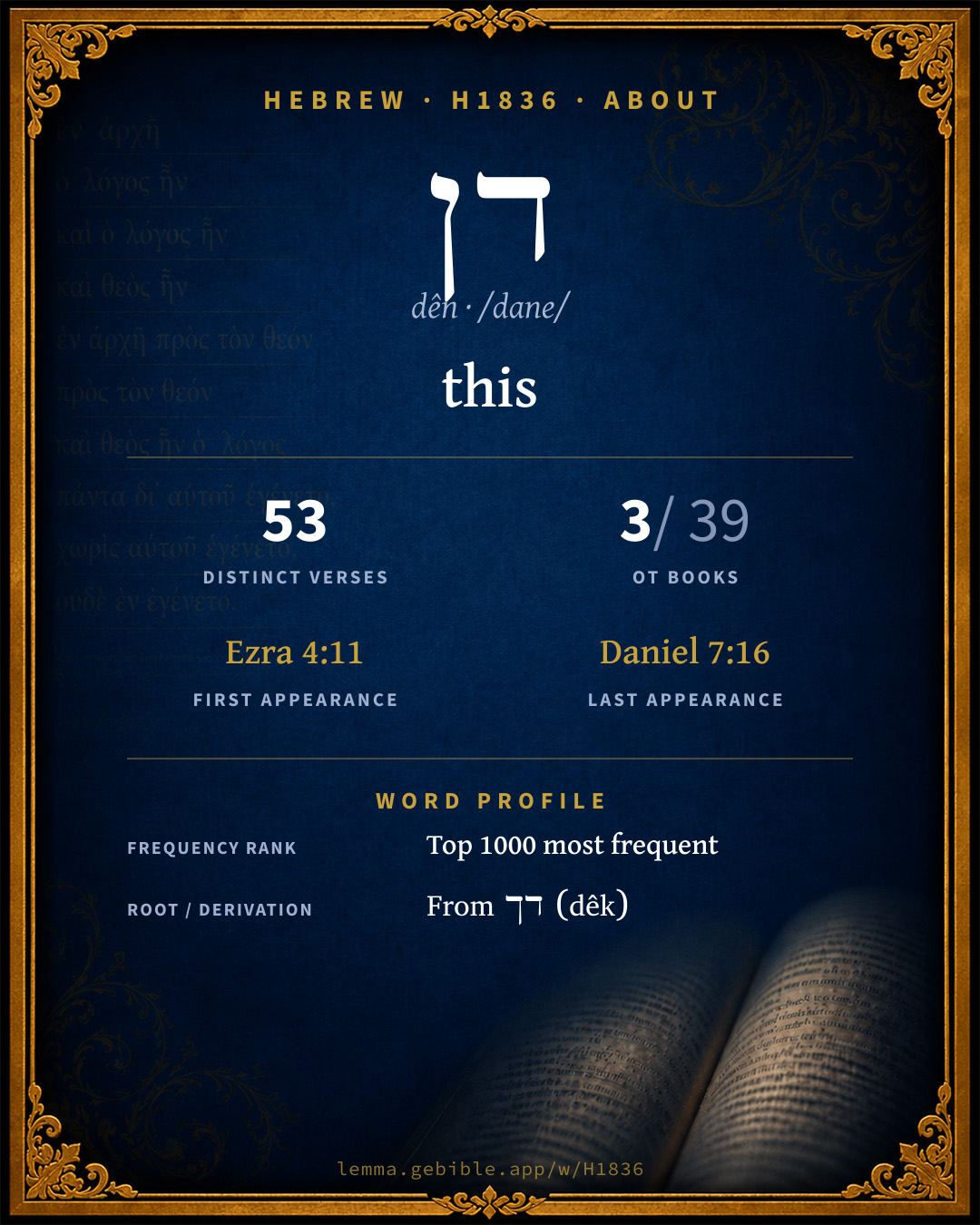
דְּנָה
this
‘this’ is one of 2 main senses fuller range ↓
Full lexicon entry — Brown-Driver-Briggs (BDB)
From Brown-Driver-Briggs (BDB)
Where this word appears
Grammar key — what these labels mean
Part of speech
- Pronoun
- A word standing in for a noun (“he,” “this,” “who”).
- Conjunction
- A joining word (e.g. “and,” “but”) linking words or clauses.
Gender
- Masculine
- Grammatically masculine.
- Common
- Either gender — not distinguished for this form.
Number
- Singular
- One.
- Plural
- More than one (in Hebrew, generally three or more).
Grammatical forms
- Pronoun, Demonstrative, Masculine, Singular 44 times (76%)
- Conjunction 8 times (14%)
- Pronoun, Demonstrative, Common, Singular 5 times (9%)
- Pronoun, Demonstrative, Masculine, Plural 1 time (2%)
Parsed forms decoded from the imported morphology (morphhb / Westminster Leningrad Codex — WLC text public domain, morphhb tagging CC BY 4.0), counted across 58 parsed occurrences — not distinct verses.
Every verse where H1836 appears — 53 distinct verses across 3 books. Click any verse to open its interlinear word-by-word view. Verse text shown in the World English Bible for context — . Each verse’s Hebrew form is shown with its reference; the English is not keyword-highlighted, since the data carries no word-level English alignment. Use “Compare translations” on any verse to read it across multiple English versions. This concordance covers the Hebrew Bible; Septuagint (Greek Old Testament) occurrences are not indexed here.
Ezra 20 verses
- Ezra 4:11 דְּנָה֙ pron dem ms This is the copy of the letter that they sent to Artaxerxes the king: Your servants the men beyond the River, and so forth.
- Ezra 4:14 דְּנָ֔ה pron dem ms Now because we eat the salt of the palace, and it is not appropriate for us to see the king's dishonor, therefore have we sent and informed the king;
- Ezra 4:15 דְּנָ֔ה pron dem ms that search may be made in the book of the records of your fathers: so shall you find in the book of the records, and know that this city is a rebellious city, and hurtful to kings and provinces, and that they have moved sedition within the same of old time; for which cause was this city laid waste.
- Ezra 4:16 דְּנָ֔ה conj We inform the king that, if this city be built, and the walls finished, by this means you shall have no portion beyond the River.
- Ezra 4:22 דְּנָ֑ה pron dem cs Take heed that you not be slack herein: why should damage grow to the hurt of the kings?
- Ezra 5:3 דְנָה֙ דְנָ֖ה pron dem ms pron dem ms At the same time came to them Tattenai, the governor beyond the River, and Shetharbozenai, and their companions, and said thus to them, Who gave you a decree to build this house, and to finish this wall?
- Ezra 5:4 דְנָ֥ה pron dem ms Then we told them after this manner, what the names of the men were who were making this building.
- Ezra 5:5 דְּנָֽה pron dem cs But the eye of their God was on the elders of the Jews, and they did not make them cease, until the matter should come to Darius, and then answer should be returned by letter concerning it.
- Ezra 5:7 וְ/כִ/דְנָה֙ conj + prep + pron dem ms they sent a letter to him, in which was written thus: To Darius the king, all peace.
- Ezra 5:9 דְנָה֙ דְנָ֖ה pron dem mp pron dem ms Then asked we those elders, and said to them thus, Who gave you a decree to build this house, and to finish this wall?
- Ezra 5:11 דְּנָה֙ pron dem ms Thus they returned us answer, saying, We are the servants of the God of heaven and earth, and are building the house that was built these many years ago, which a great king of Israel built and finished.
- Ezra 5:12 דְנָה֙ pron dem ms But after that our fathers had provoked the God of heaven to wrath, he gave them into the hand of Nebuchadnezzar king of Babylon, the Chaldean, who destroyed this house, and carried the people away into Babylon.
- Ezra 5:13 דְנָ֖ה pron dem ms But in the first year of Cyrus king of Babylon, Cyrus the king made a decree to build this house of God.
- Ezra 5:17 דְּנָ֖ה pron dem cs Now therefore, if it seem good to the king, let there be search made in the king's treasure-house, which is there at Babylon, whether it be so, that a decree was made of Cyrus the king to build this house of God at Jerusalem; and let the king send his pleasure to us concerning this matter.
- Ezra 6:11 דְנָ֔ה דְּנָֽה pron dem ms pron dem cs Also I have made a decree, that whoever shall alter this word, let a beam be pulled out from his house, and let him be lifted up and fastened thereon; and let his house be made a dunghill for this:
- Ezra 6:15 דְנָ֔ה pron dem ms This house was finished on the third day of the month Adar, which was in the sixth year of the reign of Darius the king.
- Ezra 6:16 דְנָ֖ה pron dem ms The children of Israel, the priests, and the Levites, and the rest of the children of the captivity, kept the dedication of this house of God with joy.
- Ezra 6:17 דְנָה֒ pron dem ms They offered at the dedication of this house of God one hundred bulls, two hundred rams, four hundred lambs; and for a sin-offering for all Israel, twelve male goats, according to the number of the tribes of Israel.
- Ezra 7:17 דְּנָה֩ דְנָ֗ה conj pron dem ms therefore you shall with all diligence buy with this money bulls, rams, lambs, with their meal-offerings and their drink-offerings, and shall offer them on the altar of the house of your God which is in Jerusalem.
- Ezra 7:24 דְנָ֑ה pron dem ms Also we inform you, that touching any of the priests and Levites, the singers, porters, Nethinim, or servants of this house of God, it shall not be lawful to impose tribute, custom, or toll, on them.
Jeremiah 1 verse
Daniel 32 verses
- Daniel 2:10 כִ/דְנָה֙ prep + pron dem ms The Chaldeans answered before the king, and said, There is not a man on the earth who can show the king's matter, because no king, lord, or ruler, has asked such a thing of any magician, or enchanter, or Chaldean.
- Daniel 2:12 דְּנָ֔ה conj For this cause the king was angry and very furious, and commanded to destroy all the wise men of Babylon.
- Daniel 2:18 דְּנָ֑ה pron dem ms that they would desire mercies of the God of heaven concerning this secret; that Daniel and his companions should nor perish with the rest of the wise men of Babylon.
- Daniel 2:24 דְּנָ֗ה conj Therefore Daniel went in to Arioch, whom the king had appointed to destroy the wise men of Babylon; he went and said thus to him: Don't destroy the wise men of Babylon; bring me in before the king, and I will show to the king the interpretation.
- Daniel 2:28 דְּנָ֥ה pron dem ms but there is a God in heaven who reveals secrets, and he has made known to the king Nebuchadnezzar what shall be in the latter days. Your dream, and the visions of your head on your bed, are these:
- Daniel 2:29 דְנָ֑ה pron dem ms as for you, O king, your thoughts came [into your mind] on your bed, what should happen hereafter; and he who reveals secrets has made known to you what shall happen.
- Daniel 2:30 דְנָ֖ה pron dem ms But as for me, this secret is not revealed to me for any wisdom that I have more than any living, but to the intent that the interpretation may be made known to the king, and that you may know the thoughts of your heart.
- Daniel 2:36 דְּנָ֣ה pron dem ms This is the dream; and we will tell the interpretation of it before the king.
- Daniel 2:43 דְּנָ֣ה דְּנָ֑ה pron dem ms pron dem ms Whereas you saw the iron mixed with miry clay, they shall mingle themselves with the seed of men; but they shall not cling to one another, even as iron does not mingle with clay.
- Daniel 2:45 דְנָ֑ה pron dem ms Because you saw that a stone was cut out of the mountain without hands, and that it broke in pieces the iron, the brass, the clay, the silver, and the gold; the great God has made known to the king what shall happen hereafter: and the dream is certain, and the interpretation of it sure.
- Daniel 2:47 דְנָֽה pron dem ms The king answered to Daniel, and said, Of a truth your God is the God of gods, and the Lord of kings, and a revealer of secrets, seeing you have been able to reveal this secret.
- Daniel 3:7 דְּנָ֡ה conj Therefore at that time, when all the peoples heard the sound of the horn, flute, zither, lyre, harp, pipe, and all kinds of music, all the peoples, the nations, and the languages, fell down and worshiped the golden image that Nebuchadnezzar the king had set up.
- Daniel 3:8 דְּנָה֙ conj Therefore at that time certain Chaldeans came near, and brought accusation against the Jews.
- Daniel 3:16 דְּנָ֛ה pron dem ms Shadrach, Meshach, and Abednego answered the king, Nebuchadnezzar, we have no need to answer you in this matter.
- Daniel 3:22 דְּנָ֗ה conj Therefore because the king's commandment was urgent, and the furnace exceeding hot, the flame of the fire killed those men who took up Shadrach, Meshach, and Abednego.
- Daniel 3:29 כִּ/דְנָֽה prep + pron dem ms Therefore I make a decree, that every people, nation, and language, which speak anything evil against the God of Shadrach, Meshach, and Abednego, shall be cut in pieces, and their houses shall be made a dunghill; because there is no other god who is able to deliver after this sort.
- Daniel 4:18 דְּנָה֙ pron dem ms This dream I, king Nebuchadnezzar, have seen; and you, Belteshazzar, declare the interpretation, because all the wise men of my kingdom are not able to make known to me the interpretation; but you are able; for the spirit of the holy gods is in you.
- Daniel 4:24 דְּנָ֥ה pron dem ms this is the interpretation, O king, and it is the decree of the Most High, which is come on my lord the king:
- Daniel 5:7 דְנָ֗ה pron dem ms The king cried aloud to bring in the enchanters, the Chaldeans, and the soothsayers. The king spoke and said to the wise men of Babylon, Whoever shall read this writing, and show me the interpretation of it, shall be clothed with purple, and have a chain of gold about his neck, and shall be the third ruler in the kingdom.
- Daniel 5:15 דְנָה֙ pron dem ms Now the wise men, the enchanters, have been brought in before me, that they should read this writing, and make known to me the interpretation of it; but they could not show the interpretation of the thing.
- Daniel 5:22 דְּנָ֖ה pron dem ms You his son, Belshazzar, have not humbled your heart, though you knew all this,
- Daniel 5:24 דְנָ֖ה pron dem ms Then was the part of the hand sent from before him, and this writing was inscribed.
- Daniel 5:25 וּ/דְנָ֥ה conj + pron dem ms This is the writing that was inscribed: MENE, MENE, TEKEL, UPHARSIN.
- Daniel 5:26 דְּנָ֖ה pron dem ms This is the interpretation of the thing: MENE; God has numbered your kingdom, and brought it to an end;
- Daniel 6:3 דְּנָ֔ה pron dem ms Then this Daniel was distinguished above the presidents and the satraps, because an excellent spirit was in him; and the king thought to set him over the whole realm.
- Daniel 6:5 דְּנָ֖ה pron dem ms Then said these men, We shall not find any occasion against this Daniel, except we find it against him concerning the law of his God.
- Daniel 6:9 דְּנָ֑ה conj Therefore king Darius signed the writing and the interdict.
- Daniel 6:10 דְּנָֽה pron dem ms When Daniel knew that the writing was signed, he went into his house (now his windows were open in his chamber toward Jerusalem) and he kneeled on his knees three times a day, and prayed, and gave thanks before his God, as he did before.
- Daniel 6:28 דְּנָ֔ה pron dem ms So this Daniel prospered in the reign of Darius, and in the reign of Cyrus the Persian.
- Daniel 7:6 דְּנָ֜ה pron dem ms After this I saw, and, behold, another, like a leopard, which had on its back four wings of a bird; the animal had also four heads; and dominion was given to it.
- Daniel 7:7 דְּנָה֩ pron dem ms After this I saw in the night-visions, and, behold, a fourth animal, awesome and powerful, and strong exceedingly; and it had great iron teeth; it devoured and broke in pieces, and stamped the residue with its feet: and it was diverse from all the animals that were before it; and it had ten horns.
- Daniel 7:16 דְּנָ֑ה pron dem ms I came near to one of those who stood by, and asked him the truth concerning all this. So he told me, and made me know the interpretation of the things.
About this entry
At a glance — auto-summarized from this page’s data, not written by a person. Every figure links to its source below. This summary describes the numbers; it doesn’t interpret them.
“this” is the headline sense of the Hebrew word דן (dên). More than half of its appearances fall in Daniel. It appears 53 verses across 3 books of the Hebrew Bible, among its moderately common vocabulary. First canonically at Ezra 4:11, it enters the text early. Lexicons map it across 2 senses. The sections below give every sense, occurrence, and version rendering.
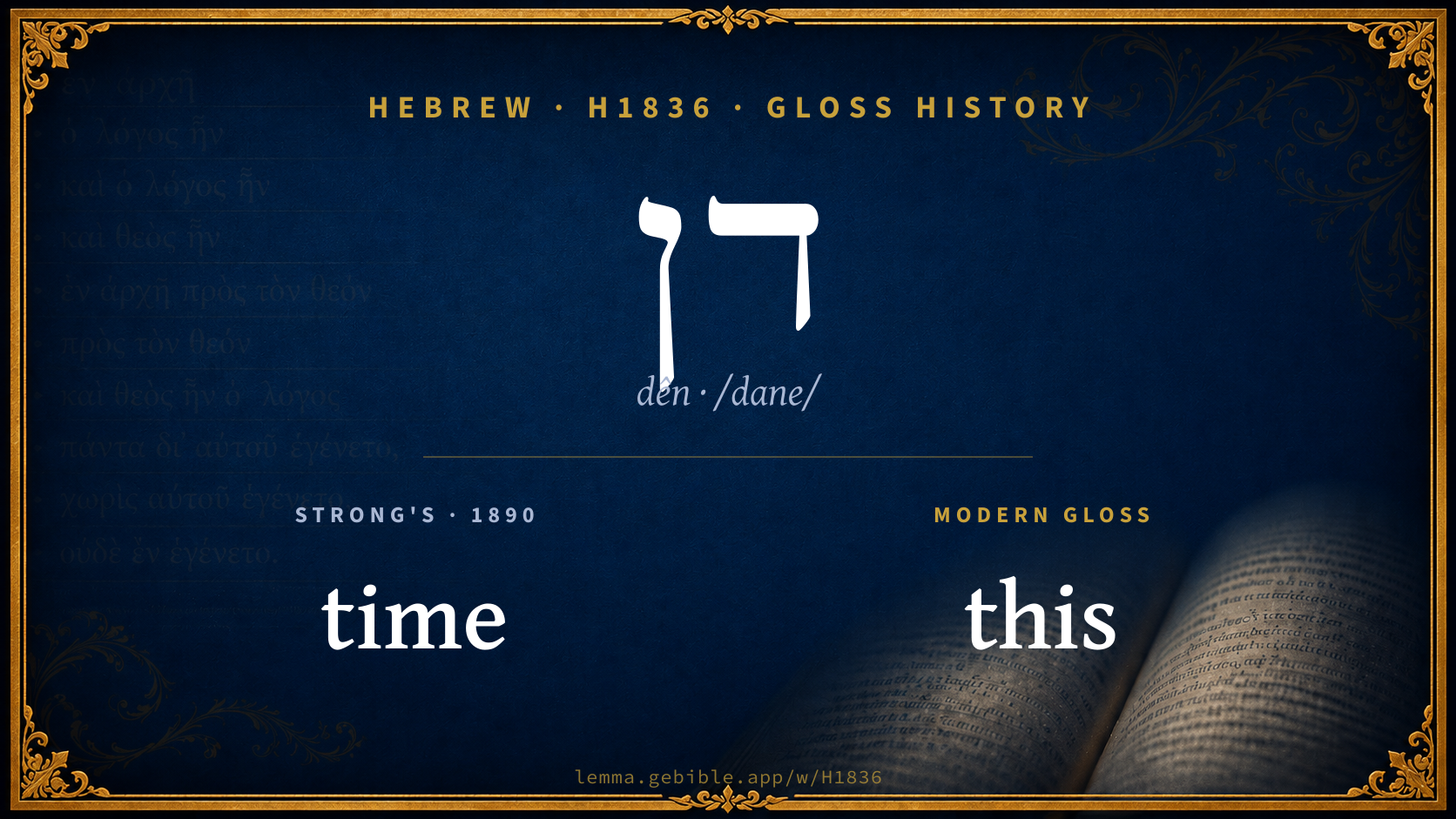
Gloss history
Strong's 1890 vs modern scholarship
About this word
Strong's H1836 catalogs a Hebrew word from the Hebrew Old Testament.
These counts are not copied from any lexicon or concordance. They are computed here, from the morphology-tagged Hebrew Old Testament. What Lemma adds →
- 53
- distinct verses
- The word appears in 53 distinct verses.
- 3 / 39
- OT books
- The word appears in 3 of 39 Old Testament books.
- #658
- by frequency
- Top 1000 most frequent Hebrew words (rank 658 of 8,640 Hebrew words by occurrence).
View all 53 occurrences in the concordance →
By section of the Old Testament
By traditional corpus
Conventional, traditional groupings — biblical authorship is debated, so this is a traditional corpus grouping, not an authorship claim. Each share is this word’s portion of its verses in that division of the Hebrew canon. Each figure is a share of the word’s 53 distinct verses.
- Writings (Ketuvim) 52 verses · 98%
- Prophets (Nevi'im) 1 verse · 2%
How translations render this word
Counts come from each version’s own published word-to-Strong’s tagging or interlinear alignment — an approximate guide to how each version renders this word, not a word-level alignment the data otherwise carries. Because each total is that version’s own tagged count, the per-version totals vary from one another and need not match the appearance or distinct-verse counts above. These counts may also differ from a printed concordance because Lemma counts each distinctly tagged rendering and does not collapse phrase taggings into a single head-word total. This is a fixed set of word-tagged versions (KJV, ASV, BSB, ULT) and does not change with the reading translation you choose elsewhere. Each version’s license is shown beside its name below (and on Sources).
- King James Version: This 37×, These 2×, Thus 2×
- American Standard Version: This 35×, Thus 2×
- Berean Standard Bible: This 28×, The 3×, Matter 2×
- unfoldingWord Literal Text: This 42×, Therefore 5×, Like this 2×
King James Version Public Domain
Renders H1836 across 49 tagged occurrences — most commonly:
Plus 8 renderings that appear only once — usually multi-word phrases or single function words the recovered tagging swept in, not distinct renderings. Not rendered by a distinct English word in 8 further occurrences.
American Standard Version Public Domain
Renders H1836 across 51 tagged occurrences — most commonly:
Plus 14 renderings that appear only once — usually multi-word phrases or single function words the recovered tagging swept in, not distinct renderings.
Berean Standard Bible Public Domain
Renders H1836 across 42 tagged occurrences — most commonly:
Plus 7 renderings that appear only once — usually multi-word phrases or single function words the recovered tagging swept in, not distinct renderings. Not rendered by a distinct English word in 16 further occurrences.
unfoldingWord Literal Text CC BY-SA 4.0
Renders H1836 across 58 tagged occurrences — most commonly:
Plus 7 renderings that appear only once — usually multi-word phrases or single function words the recovered tagging swept in, not distinct renderings.
Senses in BDB
The 2 senses BDB distinguishes for this word, in lexicon order (not ranked by frequency or importance). The full entry — with sub-senses — is in the Lexicon Entry tab.
- this, on account of this (demonstrative pronoun feminine)
- therefore (adverb)
Word origin
דְּנָה 57 demonstr.pr.comm. this
— Brown-Driver-Briggs (Oxford 1906, public domain), digitized via Sefaria, supplemented by the OpenScriptures HebrewLexicon (CC BY 4.0). See Sources.
Derived from דך (dêk) (H1791).
Jastrow Dictionary
A second Hebrew/Aramaic lexicon for comparison, covering Aramaic and post-biblical (Talmudic, Targumic, Midrashic) usage that the biblical-Hebrew BDB does not. Matched by lemma rather than by Strong’s number, so a lemma may carry more than one Jastrow headword (shown separately below), and the entries cover usage well beyond the Bible.
דָּן
- (b. h.)
- 1. pr. n. m. Dan, son of Jacob. Pes. 4ᵃ מדן קאתי he is a descendant of Dan; a. e.
- 2. pr. n. pl. Dan in northern Palestine. Pesik. Shek. p. 15ᵃ מזבח שבדן the altar (erected by Jeroboam) in Dan.—Targ. Y. II, Num. XXXIV, 15. Targ. Cant. V, 4; Pirké d’R. El. ch. XXVII expl. = פמיאס, Paneas; Midr. Sam. ch. XXX; XXXII דנה (יען) פנייס.—Y. Dem. II, 22ᶜ bot. כְּפר דָּן.
- 3. name of an idol Dan. Sabb. 67ᵇ; Tosef. ib. VII (VIII), 3; Y. ib. VI, 8ᶜ bot. (ref. to Am. VIII, 14). e.g. Amos 8:14
דֵּן
- c. (cmp. דָּא, דֵּךְ) this, that. Targ. Is. VI, 3. Targ. Deut. II, 3 הָדֵן (ed. Berl. הָדֵין = הָא ד׳); a. v. fr.—Lev. R. s. 7 מן הד׳ קריא from this verse (it is proven). Lev. R. s. 8 ד׳ אמר לינא בעיא לד׳ וכ׳ the one said, I do not want this (woman) &c. Sabb. 112ᵇ לית ד׳ ב"א this is not (an ordinary) human being; ib. כגון ד׳ וכ׳ a man like this is worth the name of a human being; a. fr.—Y. Ab. Zar. II, 41ᵈ bot.; a. e. אסיר לך דנא this (piece) is forbidden to thee.—מן קדמת דנא ere this, formerly. Y. Sot. II, 17ᵈ; a. e.—כְּדֵ׳ a) = h. פֹּה, here (cmp. כָּא, הָכָא). Targ. Jud. XVIII, 3. Targ. Is. XXII, 16 (some ed. בְּדֵין); b) like this, thus. Targ. Gen. XXXII, 4. Targ. Jud. XVIII, 4; a. fr. [Targ. Ps. II, 10 read; כְּדוּן.]—B. Bath. 75ᵃ (play on כדכד, Is. LIV, 12) ליהוי כד׳ וכד׳ let it be as this one says, and as that one; Pesik. Aniy. p. 135ᵇ; Pesik. R. s. 32.—בִּכְדֵין in this manner. Targ. I Kings XXII, 20.—מָדֵין = h. מַה־זֶּה, why. Targ. Jer. XXVI, 9; a. e.—אֵי מִדֵּין from what, which. Targ. Jon. I, 8.—דֵּינוּ (= דֵּין הוּ) this. Y. Erub. VII, 24ᶜ top, a. e. חֵי ד׳ צד וכ׳ (= h. אֵיזֶהוּ) which is ‘side’, and which &c.?, v. הַיְידְּנוּ.—Pl. דֵּינוּן, דֵּינֵי. Y. Snh. IV, 22ᵇ bot. הי ד׳ וכ׳ which are the two additional ones?—[הָדֵין then, v. הֵידֵין.] e.g. Isaiah 54:12
A Dictionary of the Targumim, the Talmud Babli and Yerushalmi, and the Midrashic Literature (Marcus Jastrow; London, Luzac, 1903) — Public Domain. Digitized via Sefaria. Digitized via Sefaria. Full attribution on Sources.
Forms in the corpus
The 25 distinct written forms H1836 takes in the Hebrew Bible, most frequent first — each parse links to that state’s occurrences in the concordance. Hebrew forms include their vowel points and cantillation, so a single lemma takes many written forms.
| Form | Parsing | Example | Uses |
|---|---|---|---|
| דְּנָ֔ה | Pronoun, Demonstrative, Masculine, Singular | Daniel 6:3 | 6 |
| דְנָ֖ה | Pronoun, Demonstrative, Masculine, Singular | Daniel 2:30 | 6 |
| דְּנָ֑ה | Pronoun, Demonstrative, Masculine, Singular | Daniel 2:18 | 5 |
| דְנָה֙ | Pronoun, Demonstrative, Masculine, Singular | Daniel 5:15 | 4 |
| דְּנָ֖ה | Pronoun, Demonstrative, Masculine, Singular | Daniel 5:22 | 4 |
| דְּנָה֙ | Pronoun, Demonstrative, Masculine, Singular | Daniel 4:18 | 4 |
| דְּנָֽה | Pronoun, Demonstrative, Common, Singular | Ezra 5:5 | 3 |
| דְנָ֑ה | Pronoun, Demonstrative, Masculine, Singular | Daniel 2:29 | 3 |
| דְּנָה֩ | Conjunction | Ezra 7:17 | 2 |
| דְנָ֔ה | Pronoun, Demonstrative, Masculine, Singular | Ezra 6:11 | 2 |
| דְנָ֗ה | Pronoun, Demonstrative, Masculine, Singular | Daniel 5:7 | 2 |
| דְּנָ֗ה | Conjunction | Daniel 2:24 | 2 |
| דְּנָ֣ה | Pronoun, Demonstrative, Masculine, Singular | Daniel 2:36 | 2 |
| דְּנָ֥ה | Pronoun, Demonstrative, Masculine, Singular | Daniel 2:28 | 2 |
| דְנָ֥ה | Pronoun, Demonstrative, Masculine, Singular | Ezra 5:4 | 1 |
| דְנָֽה | Pronoun, Demonstrative, Masculine, Singular | Daniel 2:47 | 1 |
| דְנָה֒ | Pronoun, Demonstrative, Masculine, Singular | Ezra 6:17 | 1 |
| דְּנָ֛ה | Pronoun, Demonstrative, Masculine, Singular | Daniel 3:16 | 1 |
| דְּנָ֜ה | Pronoun, Demonstrative, Masculine, Singular | Daniel 7:6 | 1 |
| דְּנָ֡ה | Conjunction | Daniel 3:7 | 1 |
| וְ/כִ/דְנָה֙ | Pronoun, Demonstrative, Masculine, Singular | Ezra 5:7 | 1 |
| וּ/דְנָ֥ה | Pronoun, Demonstrative, Masculine, Singular | Daniel 5:25 | 1 |
| כִ/דְנָה֙ | Pronoun, Demonstrative, Masculine, Singular | Daniel 2:10 | 1 |
| כִּ/דְנָֽה | Pronoun, Demonstrative, Masculine, Singular | Daniel 3:29 | 1 |
| כִּ/דְנָה֙ | Pronoun, Demonstrative, Common, Singular | Jeremiah 10:11 | 1 |
Same root — word family
Other BDB entries built from the same root as H1836, grouped by Strong’s listed origin. These share a root / origin per the lexicon — not necessarily a shared meaning. Each links to that word’s own entry.
Derives from
Shares the same root
Compare all same-root words → They share a root, not necessarily a meaning.
Septuagint verse parallels
This word appears in 49 verses that also exist in the Greek Old Testament (Septuagint), out of the 53 Hebrew verses it occurs in. You can read those verses in Greek by switching the Old Testament edition to the Septuagint.
Read these verses in the Septuagint
This is a verse-level parallel only — the same verses exist in both the Hebrew and Greek Old Testaments. No word-level Hebrew↔Greek correspondence is claimed: the data carries no such alignment, so no Greek word is shown as this Hebrew word’s translation. Coverage is not total — the Septuagint omits the deuterocanon and renumbers the Psalms, so some Hebrew verses have no direct Greek parallel.