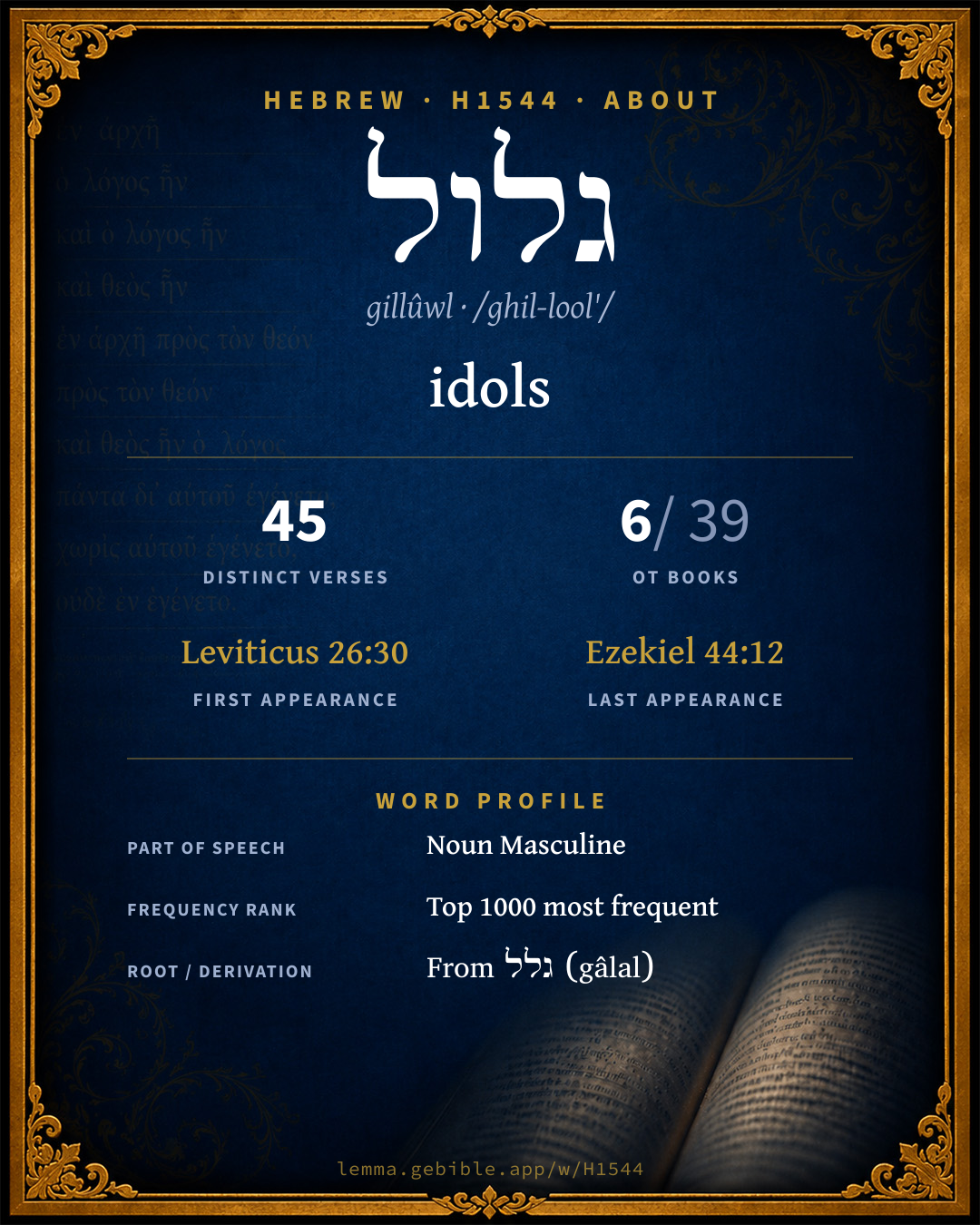
גִּלּוּל
idols
Full lexicon entry — Brown-Driver-Briggs (BDB)
From Brown-Driver-Briggs (BDB)
Where this word appears
See every Construct-state word in the Hebrew Bible →
Grammar key — what these labels mean
Part of speech
- Noun
- A naming word — a person, place, thing, or idea.
Noun type
- Common
- A common noun — a general class of person, place, or thing (“king,” “city,” “water”), not a specific name.
State
- Construct
- A noun bound to a following noun in a possessive / “of” relationship (the construct chain).
- Absolute
- The independent form of a noun, not bound to a following word.
Gender
- Masculine
- Grammatically masculine.
Number
- Plural
- More than one (in Hebrew, generally three or more).
Grammatical forms
- Noun, Common, Masculine, Plural, Construct 40 times (83%)
- Noun, Common, Masculine, Plural, Absolute 8 times (17%)
Parsed forms decoded from the imported morphology (morphhb / Westminster Leningrad Codex — WLC text public domain, morphhb tagging CC BY 4.0), counted across 48 parsed occurrences — not distinct verses.
Every verse where H1544 appears — 45 distinct verses across 6 books. Click any verse to open its interlinear word-by-word view. Verse text shown in the World English Bible for context — . Each verse’s Hebrew form is shown with its reference; the English is not keyword-highlighted, since the data carries no word-level English alignment. Use “Compare translations” on any verse to read it across multiple English versions. This concordance covers the Hebrew Bible; Septuagint (Greek Old Testament) occurrences are not indexed here.
Leviticus 1 verse
Deuteronomy 1 verse
1 Kings 2 verses
- 1 Kings 15:12 הַ/גִּלֻּלִ֔ים ptcl def.art + n c mp He put away the sodomites out of the land, and removed all the idols that his fathers had made.
- 1 Kings 21:26 הַ/גִּלֻּלִ֑ים ptcl def.art + n c mp He did very abominably in following idols, according to all that the Amorites did, whom Yahweh cast out before the children of Israel.)
2 Kings 4 verses
- 2 Kings 17:12 הַ/גִּלֻּלִ֑ים ptcl def.art + n c mp and they served idols, of which Yahweh had said to them, You shall not do this thing.
- 2 Kings 21:11 בְּ/גִלּוּלָֽי/ו prep + n c mp cs + sfx pers 3ms Because Manasseh king of Judah has done these abominations, and has done wickedly above all that the Amorites did, who were before him, and has made Judah also to sin with his idols;
- 2 Kings 21:21 הַ/גִּלֻּלִים֙ ptcl def.art + n c mp He walked in all the way that his father walked in, and served the idols that his father served, and worshiped them:
- 2 Kings 23:24 הַ/גִּלֻּלִ֜ים ptcl def.art + n c mp Moreover those who had familiar spirits, and the wizards, and the teraphim, and the idols, and all the abominations that were seen in the land of Judah and in Jerusalem, did Josiah put away, that he might confirm the words of the law which were written in the book that Hilkiah the priest found in the house of Yahweh.
Jeremiah 1 verse
Ezekiel 36 verses
- Ezekiel 6:4 גִּלּוּלֵי/כֶֽם n c mp cs + sfx pers 2mp Your altars shall become desolate, and your sun-images shall be broken; and I will cast down your slain men before your idols.
- Ezekiel 6:5 גִּלּֽוּלֵי/הֶ֑ם n c mp cs + sfx pers 3mp I will lay the dead bodies of the children of Israel before their idols; and I will scatter your bones round about your altars.
- Ezekiel 6:6 גִּלּ֣וּלֵי/כֶ֔ם n c mp cs + sfx pers 2mp In all your dwelling-places the cities shall be laid waste, and the high places shall be desolate; that your altars may be laid waste and made desolate, and your idols may be broken and cease, and your sun-images may be hewn down, and your works may be abolished.
- Ezekiel 6:9 גִּלּֽוּלֵי/הֶ֑ם n c mp cs + sfx pers 3mp Those of you that escape shall remember me among the nations where they shall be carried captive, how that I have been broken with their lewd heart, which has departed from me, and with they eyes, which play the prostitute after their idols: and they shall loathe themselves in their own sight for the evils which they have committed in all their abominations.
- Ezekiel 6:13 גִּלּ֣וּלֵי/הֶ֔ם גִּלּוּלֵי/הֶֽם n c mp cs + sfx pers 3mp n c mp cs + sfx pers 3mp You shall know that I am Yahweh, when their slain men shall be among their idols round about their altars, on every high hill, on all the tops of the mountains, and under every green tree, and under every thick oak, the places where they offered sweet savor to all their idols.
- Ezekiel 8:10 גִּלּוּלֵ֖י n c mp cs So I went in and saw; and see, every form of creeping things, and abominable animals, and all the idols of the house of Israel, portrayed on the wall round about.
- Ezekiel 14:3 גִלּֽוּלֵי/הֶם֙ n c mp cs + sfx pers 3mp Son of man, these men have taken their idols into their heart, and put the stumbling block of their iniquity before their face: should I be inquired of at all by them?
- Ezekiel 14:4 גִּלּוּלָ֜י/ו גִּלּוּלָֽי/ו n c mp cs + sfx pers 3ms n c mp cs + sfx pers 3ms Therefore speak to them, and tell them, Thus says the Lord Yahweh: Every man of the house of Israel who takes his idols into his heart, and puts the stumbling block of his iniquity before his face, and comes to the prophet; I Yahweh will answer him therein according to the multitude of his idols;
- Ezekiel 14:5 בְּ/גִלּֽוּלֵי/הֶ֖ם prep + n c mp cs + sfx pers 3mp that I may take the house of Israel in their own heart, because they are all estranged from me through their idols.
- Ezekiel 14:6 גִּלּֽוּלֵי/כֶ֑ם n c mp cs + sfx pers 2mp Therefore tell the house of Israel, Thus says the Lord Yahweh: Return you, and turn yourselves from your idols; and turn away your faces from all your abominations.
- Ezekiel 14:7 גִּלּוּלָי/ו֙ n c mp cs + sfx pers 3ms For everyone of the house of Israel, or of the strangers who sojourn in Israel, who separates himself from me, and takes his idols into his heart, and puts the stumbling block of his iniquity before his face, and comes to the prophet to inquire for himself of me; I Yahweh will answer him by myself:
- Ezekiel 16:36 גִּלּוּלֵ֣י n c mp cs Thus says the Lord Yahweh, Because your filthiness was poured out, and your nakedness uncovered through your prostitution with your lovers; and because of all the idols of your abominations, and for the blood of your children, that you gave to them;
- Ezekiel 18:6 גִּלּוּלֵ֖י n c mp cs and has not eaten on the mountains, neither has lifted up his eyes to the idols of the house of Israel, neither has defiled his neighbor's wife, neither has come near to a woman in her impurity,
- Ezekiel 18:12 הַ/גִּלּוּלִים֙ ptcl def.art + n c mp has wronged the poor and needy, has taken by robbery, has not restored the pledge, and has lifted up his eyes to the idols, has committed abomination,
- Ezekiel 18:15 גִּלּוּלֵ֖י n c mp cs who has not eaten on the mountains, neither has lifted up his eyes to the idols of the house of Israel, has not defiled his neighbor's wife,
- Ezekiel 20:7 וּ/בְ/גִלּוּלֵ֥י conj + prep + n c mp cs I said to them, Cast you away every man the abominations of his eyes, and don't defile yourselves with the idols of Egypt; I am Yahweh your God.
- Ezekiel 20:8 גִּלּוּלֵ֥י n c mp cs But they rebelled against me, and would not listen to me; they did not every man cast away the abominations of their eyes, neither did they forsake the idols of Egypt. Then I said I would pour out my wrath on them, to accomplish my anger against them in the midst of the land of Egypt.
- Ezekiel 20:16 גִלּוּלֵי/הֶ֖ם n c mp cs + sfx pers 3mp because they rejected my ordinances, and didn't walk in my statutes, and profaned my Sabbaths: for their heart went after their idols.
- Ezekiel 20:18 וּ/בְ/גִלּוּלֵי/הֶ֖ם conj + prep + n c mp cs + sfx pers 3mp I said to their children in the wilderness, Don't you walk in the statutes of your fathers, neither observe their ordinances, nor defile yourselves with their idols.
- Ezekiel 20:24 גִּלּוּלֵ֣י n c mp cs because they had not executed my ordinances, but had rejected my statutes, and had profaned my Sabbaths, and their eyes were after their fathers' idols.
- Ezekiel 20:31 גִּלּֽוּלֵי/כֶם֙ n c mp cs + sfx pers 2mp and when you offer your gifts, when you make your sons to pass through the fire, do you pollute yourselves with all your idols to this day? and shall I be inquired of by you, house of Israel? As I live, says the Lord Yahweh, I will not be inquired of by you;
- Ezekiel 20:39 גִּלּוּלָי/ו֙ וּ/בְ/גִלּוּלֵי/כֶֽם n c mp cs + sfx pers 3ms conj + prep + n c mp cs + sfx pers 2mp As for you, house of Israel, thus says the Lord Yahweh: Go you, serve everyone his idols, and hereafter also, if you will not listen to me; but my holy name shall you no more profane with your gifts, and with your idols.
- Ezekiel 22:3 גִלּוּלִ֛ים n c mp You shall say, Thus says the Lord Yahweh: A city that sheds blood in the midst of her, that her time may come, and that makes idols against herself to defile her!
- Ezekiel 22:4 וּ/בְ/גִלּוּלַ֤יִ/ךְ conj + prep + n c mp cs + sfx pers 2fs You have become guilty in your blood that you have shed, and are defiled in your idols which you have made; and you have caused your days to draw near, and are come even to your years: therefore have I made you a reproach to the nations, and a mocking to all the countries.
- Ezekiel 23:7 גִּלּוּלֵי/הֶ֖ם n c mp cs + sfx pers 3mp She bestowed her prostitution on them, the choicest men of Assyria all of them; and on whoever she doted, with all their idols she defiled herself.
- Ezekiel 23:30 בְּ/גִלּוּלֵי/הֶֽם prep + n c mp cs + sfx pers 3mp These things shall be done to you, because you have played the prostitute after the nations, and because you are polluted with their idols.
- Ezekiel 23:37 גִּלּֽוּלֵי/הֶ֖ן n c mp cs + sfx pers 3fp For they have committed adultery, and blood is in their hands; and with their idols have they committed adultery; and they have also caused their sons, whom they bore to me, to pass through [the fire] to them to be devoured.
- Ezekiel 23:39 לְ/גִלּ֣וּלֵי/הֶ֔ם prep + n c mp cs + sfx pers 3mp For when they had slain their children to their idols, then they came the same day into my sanctuary to profane it; and, behold, thus have they done in the midst of my house.
- Ezekiel 23:49 גִלּוּלֵי/כֶ֖ן n c mp cs + sfx pers 2fp They shall recompense your lewdness on you, and you shall bear the sins of your idols; and you shall know that I am the Lord Yahweh.
- Ezekiel 30:13 גִלּוּלִ֜ים n c mp Thus says the Lord Yahweh: I will also destroy the idols, and I will cause the images to cease from Memphis; and there shall be no more a prince from the land of Egypt: and I will put a fear in the land of Egypt.
- Ezekiel 33:25 גִּלּוּלֵי/כֶ֖ם n c mp cs + sfx pers 2mp Therefore tell them, Thus says the Lord Yahweh: You eat with the blood, and lift up your eyes to your idols, and shed blood: and shall you possess the land?
- Ezekiel 36:18 וּ/בְ/גִלּוּלֵי/הֶ֖ם conj + prep + n c mp cs + sfx pers 3mp Therefore I poured out my wrath on them for the blood which they had poured out on the land, and because they had defiled it with their idols;
- Ezekiel 36:25 גִּלּ֥וּלֵי/כֶ֖ם n c mp cs + sfx pers 2mp I will sprinkle clean water on you, and you shall be clean: from all your filthiness, and from all your idols, will I cleanse you.
- Ezekiel 37:23 בְּ/גִלּֽוּלֵי/הֶם֙ prep + n c mp cs + sfx pers 3mp neither shall they defile themselves any more with their idols, nor with their detestable things, nor with any of their transgressions; but I will save them out of all their dwelling-places, in which they have sinned, and will cleanse them: so shall they be my people, and I will be their God.
- Ezekiel 44:10 גִּלּֽוּלֵי/הֶ֑ם n c mp cs + sfx pers 3mp But the Levites who went far from me, when Israel went astray, who went astray from me after their idols, they shall bear their iniquity.
- Ezekiel 44:12 גִלּֽוּלֵי/הֶ֔ם n c mp cs + sfx pers 3mp Because they ministered to them before their idols, and became a stumbling block of iniquity to the house of Israel; therefore have I lifted up my hand against them, says the Lord Yahweh, and they shall bear their iniquity.
About this entry
At a glance — auto-summarized from this page’s data, not written by a person. Every figure links to its source below. This summary describes the numbers; it doesn’t interpret them.
גלול (gillûwl) is a Hebrew noun most often rendered “idols.” Ezekiel dominates its distribution — 36 of 45 verses. The Hebrew Bible uses it across 45 verses — moderately common. Debuting at Leviticus 26:30, it then recurs through the corpus. Related forms include גלל, גל and גל. For the data behind this summary, explore the sense tree and the renderings breakdown below.
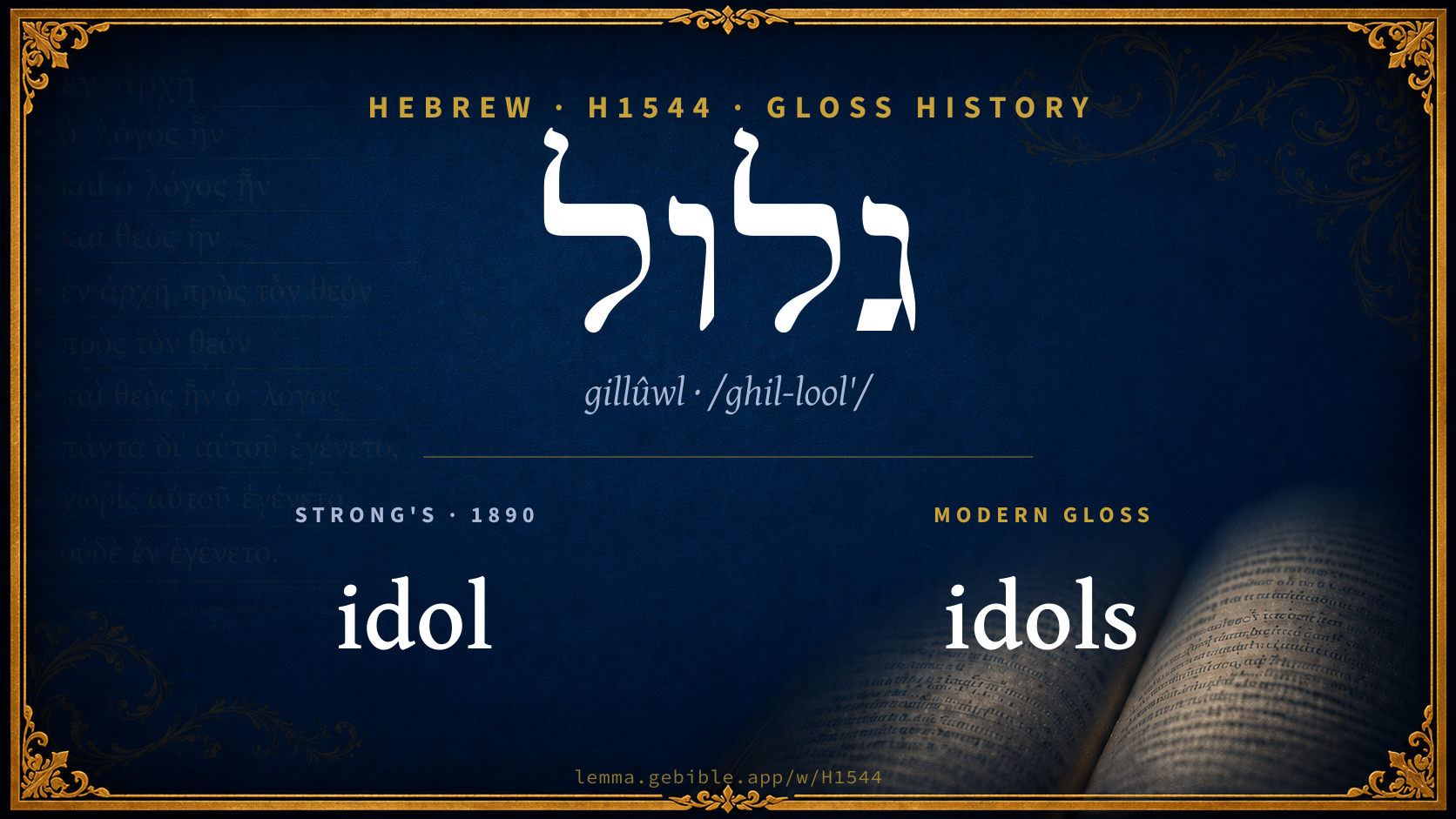
Gloss history
Strong's 1890 vs modern scholarship
About this word
Strong's H1544 catalogs a Hebrew word from the Hebrew Old Testament.
These counts are not copied from any lexicon or concordance. They are computed here, from the morphology-tagged Hebrew Old Testament. What Lemma adds →
- 45
- distinct verses
- The word appears in 45 distinct verses.
- 6 / 39
- OT books
- The word appears in 6 of 39 Old Testament books.
- #767
- by frequency
- Top 1000 most frequent Hebrew words (rank 767 of 8,640 Hebrew words by occurrence).
View all 45 occurrences in the concordance →
By section of the Old Testament
By traditional corpus
Conventional, traditional groupings — biblical authorship is debated, so this is a traditional corpus grouping, not an authorship claim. Each share is this word’s portion of its verses in that division of the Hebrew canon. Each figure is a share of the word’s 45 distinct verses.
- Prophets (Nevi'im) 43 verses · 96%
- Torah (Pentateuch) 2 verses · 4%
How translations render this word
Counts come from each version’s own published word-to-Strong’s tagging or interlinear alignment — an approximate guide to how each version renders this word, not a word-level alignment the data otherwise carries. Because each total is that version’s own tagged count, the per-version totals vary from one another and need not match the appearance or distinct-verse counts above. These counts may also differ from a printed concordance because Lemma counts each distinctly tagged rendering and does not collapse phrase taggings into a single head-word total. This is a fixed set of word-tagged versions (KJV, ASV, BSB, ULT) and does not change with the reading translation you choose elsewhere. Each version’s license is shown beside its name below (and on Sources).
- King James Version: Idols 33×, All the idols 3×, All their idols 2×
- American Standard Version: Idols 35×, All the idols 3×
- Berean Standard Bible: Idols 45×, Idolatry 2×
- unfoldingWord Literal Text: Idols 40×
King James Version Public Domain
Renders H1544 across 48 tagged occurrences — most commonly:
Plus 10 renderings that appear only once — usually multi-word phrases or single function words the recovered tagging swept in, not distinct renderings.
American Standard Version Public Domain
Renders H1544 across 48 tagged occurrences — most commonly:
Plus 10 renderings that appear only once — usually multi-word phrases or single function words the recovered tagging swept in, not distinct renderings.
Berean Standard Bible Public Domain
Renders H1544 across 48 tagged occurrences — most commonly:
Plus 1 rendering that appears only once — usually multi-word phrases or single function words the recovered tagging swept in, not distinct renderings.
unfoldingWord Literal Text CC BY-SA 4.0
Renders H1544 across 47 tagged occurrences — most commonly:
Plus 7 renderings that appear only once — usually multi-word phrases or single function words the recovered tagging swept in, not distinct renderings.
Senses in BDB
The 1 sense BDB distinguishes for this word, in lexicon order (not ranked by frequency or importance). The full entry — with sub-senses — is in the Lexicon Entry tab.
- idols
Word origin
[ גִּלּוּל ] n.m. only pl. idols (= logs, blocks, shapeless things)
— Brown-Driver-Briggs (Oxford 1906, public domain), digitized via Sefaria, supplemented by the OpenScriptures HebrewLexicon (CC BY 4.0). See Sources.
Derived from גלל (gâlal) (H1556) — to roll.
Jastrow Dictionary
A second Hebrew/Aramaic lexicon for comparison, covering Aramaic and post-biblical (Talmudic, Targumic, Midrashic) usage that the biblical-Hebrew BDB does not. Matched by lemma rather than by Strong’s number, so a lemma may carry more than one Jastrow headword (shown separately below), and the entries cover usage well beyond the Bible.
גִּלּוּל
- , pl. גִּלּוּלִים, גִּי׳ (b. h.; filth (v. גָּלָל), idols. Meg. 13ᵃ to clean herself מִגִּלּוּלֵי בית אביה from the contamination of her paternal idolatry. Ib. מרדה בגילולי וכ׳ she rejected &c.—עובד ג׳, עבודת ג׳ (abbr. ע"ג) idolator, idolatry. In some ed. for עכ"ום, ע"ז &c.; v. זָר a. כּוֹכָב.
A Dictionary of the Targumim, the Talmud Babli and Yerushalmi, and the Midrashic Literature (Marcus Jastrow; London, Luzac, 1903) — Public Domain. Digitized via Sefaria. Digitized via Sefaria. Full attribution on Sources.
Forms in the corpus
The 40 distinct written forms H1544 takes in the Hebrew Bible, most frequent first — each parse links to that state’s occurrences in the concordance. Hebrew forms include their vowel points and cantillation, so a single lemma takes many written forms.
Same root — word family
Other BDB entries built from the same root as H1544, grouped by Strong’s listed origin. These share a root / origin per the lexicon — not necessarily a shared meaning. Each links to that word’s own entry.
Derives from
Shares the same root
- גל gal H1530 wave
- גל gôl H1531 bowl, basin
- גלגל galgal H1534 whirlwind
- גלגלת gulgôleth H1538 skull
- גלה gullâh H1543 bowl
- גליל gâlîyl H1550 circuit
- גלל gâlâl H1557 dung
- גלל gâlâl H1558 on account of
- גלל gᵉlâl H1560 rolling
- מגלה mᵉgillâh H4039 scroll
Proper names from this root
People and places named from this root — a name, not an additional meaning of the word.
Compare all same-root words → Showing 4 of 13 — not the complete family. 1 of the same-root words is a proper name (a person or place). They share a root, not necessarily a meaning.
Septuagint verse parallels
This word appears in 45 verses that also exist in the Greek Old Testament (Septuagint), out of the 45 Hebrew verses it occurs in. You can read those verses in Greek by switching the Old Testament edition to the Septuagint.
Read these verses in the Septuagint
This is a verse-level parallel only — the same verses exist in both the Hebrew and Greek Old Testaments. No word-level Hebrew↔Greek correspondence is claimed: the data carries no such alignment, so no Greek word is shown as this Hebrew word’s translation. Coverage is not total — the Septuagint omits the deuterocanon and renumbers the Psalms, so some Hebrew verses have no direct Greek parallel.