Ezekiel 23:7

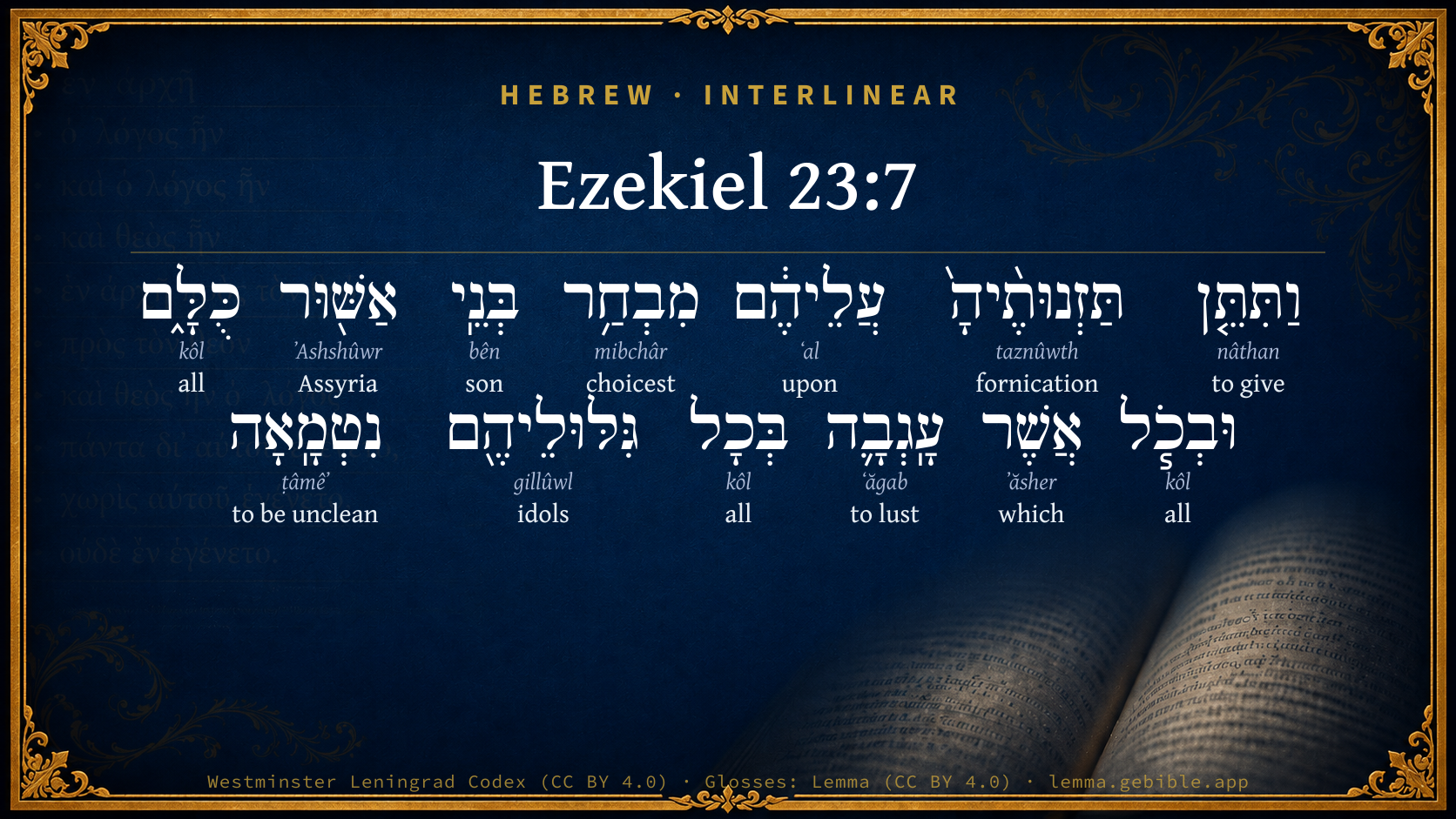
Hebrew (Westminster Leningrad Codex) Ezekiel 23:7 appears in the Hebrew Old Testament. The text above is from the Westminster Leningrad Codex. Each word links to its Strong’s number, a concise gloss, and parsing drawn from the Open Scriptures Hebrew Bible morphology. Click any word for its full Brown-Driver-Briggs (BDB) entry.
Download image
Cite this verse

Ezekiel 23:7 (World English Bible). Public Domain. Lemma interlinear Bible study tool, https://lemma.gebible.app/v/ezekiel/23/7.

Show BibTeX & RIS
BibTeX
RIS
English Translation
She bestowed her prostitution on them, the choicest men of Assyria all of them; and on whoever she doted, with all their idols she defiled herself.
World English Bible · Public Domain
Download a study sheet

One document with this verse’s original text, its word-by-word gloss line, the meaning frame, cross-references with their text, attributed commentary, and full source and license credits — printable, and it pastes into notes with its structure intact.

This verse Autodidact and up

Study sheet (.html) Plain text (.txt)

A passage Seminary Student

Up to 50 verses in one chapter. A passage sheet keeps up to 6 commentary sources and 12 cross-references per verse, in the order this page ranks them, and says so on the sheet whenever that leaves anything out. Ask for a single verse and you get the Autodidact verse sheet above.

Everything on this page stays free to read, with no account — the sheet is a download of what is already on screen, not access to it.

Want to remove ads? Support Godless Engineer
Compare translations 3

The same verse in 3 English versions, stacked beneath the original-language interlinear above. Click any original word for its lexicon entry.

Each is an independent rendering of the whole verse — the interlinear is not word-aligned to these translations.

Highlighted words mark where these versions differ — a whole-verse word diff, not a word-by-word alignment.

  • World English Bible Public Domain
    She bestowed her prostitution on them, the choicest men of Assyria all of them; and on whoever she doted, with all their idols she defiled herself.
  • King James Version Public Domain
    Thus she committed her whoredoms with them, with all them that were the chosen men of Assyria, and with all on whom she doted: with all their idols she defiled herself.
  • unfoldingWord Literal Text CC BY-SA 4.0
    So she gave herself as a prostitute to them, to all the best of Assyria’s men, and she made herself unclean with everyone she lusted for—and with all their idols.

unfoldingWord Literal Text — © unfoldingWord, licensed CC BY-SA 4.0. Word-aligned USFM3 via Door43 (git.door43.org/unfoldingWord/en_ult).

Versions to compare (up to 4)

3 of 4 selected

Show all 18 translations

Every available English version of this verse, each an independent rendering of the whole verse.

  • World English Bible Public Domain
    She bestowed her prostitution on them, the choicest men of Assyria all of them; and on whoever she doted, with all their idols she defiled herself.
  • Berean Standard Bible Public Domain
    She offered sexual favors to all the elite of Assyria. She defiled herself with all the idols of those for whom she lusted.
  • Majority Standard Bible Public Domain
    She offered sexual favors to all the elite of Assyria. She defiled herself with all the idols of those for whom she lusted.
  • King James Version Public Domain
    Thus she committed her whoredoms with them, with all them that were the chosen men of Assyria, and with all on whom she doted: with all their idols she defiled herself.
  • American Standard Version (1901) Public Domain
    And she bestowed her whoredoms upon them, the choicest men of Assyria all of them; and on whomsoever she doted, with all their idols she defiled herself.
  • Revised Version (1885) Public Domain
    And she bestowed her whoredoms upon them, the choicest men of Assyria all of them: and on whomsoever she doted, with all their idols she defiled herself.
  • Geneva Bible (1599) Public Domain
    Thus she committed her whoredome with them, euen with all them that were the chosen men of Asshur, and with all on whome she doted, and defiled her selfe with all their idoles.
  • Douay-Rheims (1899) Public Domain
    And she committed her fornications with those chosen men, all sons of the Assyrians: and she defiled herself with the uncleanness of all them on whom she doted.
  • Young's Literal Translation Public Domain
    And she giveth her whoredoms on them, The choice of the sons of Asshur, All of them -- even all on whom she doted, By all their idols she hath been defiled.
  • Literal Standard Version CC BY-SA 4.0
    And she gives her whoredoms on them, || The choice of the sons of Asshur, || All of them—even all on whom she lusted, || She has been defiled by all their idols.
  • Unlocked Literal Bible CC BY-SA 4.0
    So she gave herself as a prostitute to them, to all the best of Assyria's men, and she made herself unclean with everyone she lusted for—and with all their idols.
  • unfoldingWord Literal Text CC BY-SA 4.0
    So she gave herself as a prostitute to them, to all the best of Assyria’s men, and she made herself unclean with everyone she lusted for—and with all their idols.
  • Darby Bible Public Domain
    And she bestowed her whoredoms upon them, all of them the choice of the children of Asshur; and with all after whom she lusted, with all their idols she defiled herself.
  • World Messianic Bible Public Domain
    She gave herself as a prostitute to them, all of them the choicest men of Assyria. She defiled herself with the idols of whomever she lusted after.
  • Webster's Bible Public Domain
    Thus she committed her lewd deeds with them, with all them that were the chosen men of Assyria, and with all on whom she doted: with all their idols she defiled herself.
  • Free Bible Version CC BY-SA 4.0
    She gave away herself sexually to all the important men of Assyria. She made herself unclean by her worship of all the idols of those men she wanted to have sex with.
  • Bible in Basic English Public Domain
    And she gave her unclean love to them, all of them the noblest men of Assyria: and she made herself unclean with the images of all who were desired by her.
  • JPS Tanakh (1917) Public Domain
    And she bestowed her harlotries upon them, the choicest men of Assyria all of them; and on whomsoever she doted, with all their idols she defiled herself.

Literal Standard Version (2020), Covenant Press — licensed CC BY-SA 4.0. Text via the HelloAO Bible API (eBible.org). Unlocked Literal Bible (unfoldingWord) — licensed CC BY-SA 4.0. Text via the HelloAO Bible API (eBible.org). unfoldingWord Literal Text — © unfoldingWord, licensed CC BY-SA 4.0. Word-aligned USFM3 via Door43 (git.door43.org/unfoldingWord/en_ult). Free Bible Version, Dr. Jonathan Gallagher — licensed CC BY-SA 4.0. Text via the HelloAO Bible API (eBible.org).

Word by word

More ways to search: Search by grammar → Find every occurrence → Compare this word →

Practice this passage: Drill this verse → Learn its vocabulary →

עָֽגְבָ֛ה
ʻăgab
H5689
“to lust”
Verb, Qal, Perfect, 3rd Person, Feminine, Singular
Part of Speech
Verb
Stem
Qal
Form
Perfect
Person
3rd Person
Gender
Feminine
Number
Singular
Full BDB Definition

Origin: a primitive root

TWOT: 1559

(Qal) to have inordinate affection or lust - lust (participle) - paramours (participle as subst)
  1. וַתִּתֵּ֤ן nâthan H5414 “and · to give” Conjunction + Verb, Qal, Sequential Imperfect, 3rd Person, Feminine, Singular
  2. תַּזְנוּתֶ֨יהָ֙ taznûwth H8457 “fornications · her” Noun, Common, Feminine, Plural, Construct + Suffix, Personal, 3rd Person, Feminine, Singular
  3. עֲלֵיהֶ֔ם ʻal H5921 “upon · them” Preposition + Suffix, Personal, 3rd Person, Masculine, Plural
  4. מִבְחַ֥ר mibchâr H4005 “choicest of” Noun, Common, Masculine, Singular, Construct
  5. בְּנֵֽי bên H1121 “sons of” Noun, Common, Masculine, Plural, Construct
  6. אַשּׁ֖וּר ʼAshshûwr H804 “Assyria” Noun, Proper
  7. כֻּלָּ֑ם kôl H3605 “all · their” Noun, Common, Masculine, Singular, Construct + Suffix, Personal, 3rd Person, Masculine, Plural
  8. וּבְכֹ֧ל kôl H3605 “and · in/at · all” Conjunction + Preposition + Noun, Common, Masculine, Singular, Absolute
  9. אֲשֶׁר ʼăsher H834 “which” Particle, Relative
  10. בְּכָל kôl H3605 “in/at · all of” Preposition + Noun, Common, Masculine, Singular, Construct
  11. גִּלּוּלֵיהֶ֖ם gillûwl H1544 “idols · their” Noun, Common, Masculine, Plural, Construct + Suffix, Personal, 3rd Person, Masculine, Plural
  12. נִטְמָֽאָה ṭâmêʼ H2930 “to be unclean” Verb, Niphal, Perfect, 3rd Person, Feminine, Singular

About this verse

These counts appear in no published source. They are computed here, from the morphology-tagged text and Lemma’s own curated glosses. What Lemma adds →

13
words
11
distinct lemmas
Prophets
section

Notable vocabulary

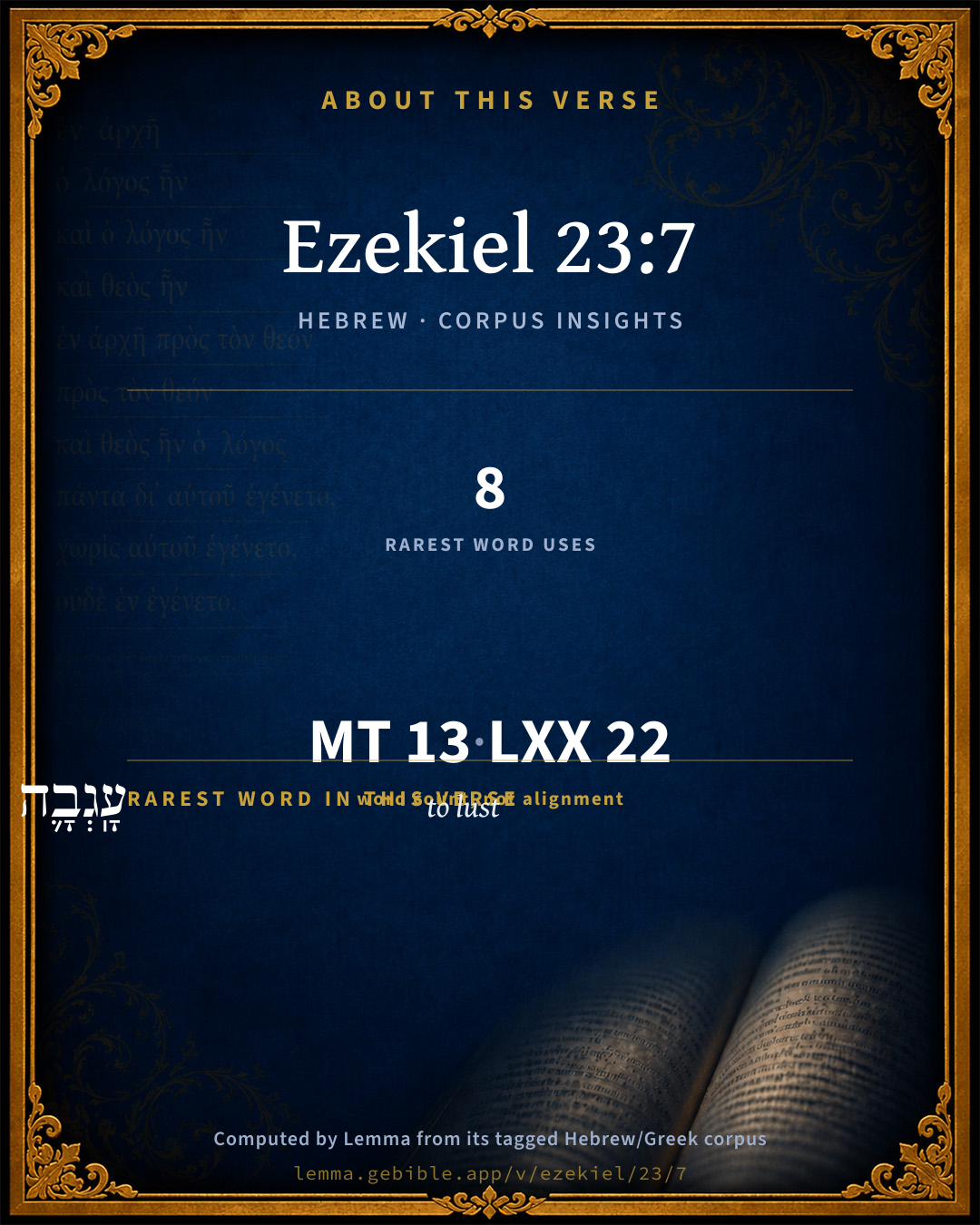
The rarest word here is עָֽגְבָ֛ה to lust H5689 — appearing just 8 times in the whole Hebrew Bible.

Shared distinctive vocabulary

עָֽגְבָ֛ה to lust H5689 occurs in 7 verses of the Hebrew Bible. Also found in:

Grammatical profile

  • 3 verbs
  • 8 nouns
  • 1 preposition
  • 1 particle

Verb forms

  • וַתִּתֵּ֤ן Qal · Sequential Imperfect
  • עָֽגְבָ֛ה Qal · Perfect
  • נִטְמָֽאָה Niphal · Perfect

Repetition

A word recurs within this verse — often emphatic in Hebrew:

  • כֻּלָּ֑ם all H3605 ×3

Hebrew & Septuagint length

In English translation the verse runs 26 words from the Hebrew and 29 from the Septuagint (LXX English) — closely comparable.

A rough comparison of the two English renderings, which tokenize alike — not a word-level alignment.

Word counts can differ between the Hebrew and the Greek without any difference in meaning — e.g. the Hebrew direct-object marker אֵת has no separate Greek word, and Greek often adds the article ὁ.

In the original languages it is 13 Hebrew tokens and 22 Greek tokens — but the two are counted differently (Hebrew bundles its prefixes and suffixes into one token; the Greek is in lemma form), so that isn’t a like-for-like length.

Cross-references

8

Topical passages linked to Ezekiel 23:7 in the Treasury of Scripture Knowledge — connected by theme and wording, ordered by reader-vote popularity; previews shown in the World English Bible.

  • Hosea 5:3 I know Ephraim, And Israel is not hidden from me; For now, Ephraim, you have played the prostitute. Israel is defiled.
  • Hosea 6:10 In the house of Israel I have seen a horrible thing. There is prostitution in Ephraim. Israel is defiled.
  • Ezekiel 20:7 I said to them, Cast you away every man the abominations of his eyes, and don't defile yourselves with the idols of Egypt; I am Yahweh your God.
  • Ezekiel 22:3–4 You shall say, Thus says the Lord Yahweh: A city that sheds blood in the midst of her, that her time may come, and that makes idols against herself to defile her!
  • Genesis 10:22 The sons of Shem: Elam, Asshur, Arpachshad, Lud, and Aram.
  • Psalms 106:39 Thus were they defiled with their works, And prostituted themselves in their deeds.
  • Ezekiel 16:15 But you did trust in your beauty, and played the prostitute because of your renown, and poured out your prostitution on everyone who passed by; his it was.
  • Ezekiel 23:30 These things shall be done to you, because you have played the prostitute after the nations, and because you are polluted with their idols.

Cross-references courtesy of OpenBible.info (CC BY 4.0).

Hebrew and Greek witnesses Masoretic Hebrew ↔ Greek Septuagint

The same verse in the two great witnesses to the Old Testament, shown verse-for-verse.

These are two independent witnesses, not word-aligned to each other, and the Septuagint is shown in lemma (dictionary) form.

Hebrew Ezekiel 23:7 Masoretic · Westminster Leningrad Codex

וַתִּתֵּ֤ן תַּזְנוּתֶ֨יהָ֙ עֲלֵיהֶ֔ם מִבְחַ֥ר בְּנֵֽי אַשּׁ֖וּר כֻּלָּ֑ם וּבְכֹ֧ל אֲשֶׁר עָֽגְבָ֛ה בְּכָל גִּלּוּלֵיהֶ֖ם נִטְמָֽאָה

She bestowed her prostitution on them, the choicest men of Assyria all of them; and on whoever she doted, with all their idols she defiled herself.

World English Bible · Public Domain

Greek LXX Ezekiel 23:7 Septuagint · lemma form

καί δίδωμι ὁ πορνεία αὐτός ἐπί αὐτός ἐπίλεκτος υἱός ἀσσύριος πᾶς καί ἐπί πᾶς ὅς ἐπιτίθημι ἐν πᾶς ὁ ἐνθύμημα αὐτός μιαίνω

And she bestowed her fornication upon them; all were choice sons of the Assyrians: and on whoever she doted herself, with them she defiled herself in all their devices.

LXX2012 (modern English Septuagint) · Public Domain

Hebrew: Westminster Leningrad Codex (CC BY 4.0). Greek: Septuagint (public domain); English from LXX2012 (modern English Septuagint) (Public Domain). How the Septuagint differs from the Hebrew →

Targum (Aramaic paraphrase)

1

The Targum is the ancient Jewish Aramaic paraphrase of the Hebrew Scriptures — an interpretive translation, not the Hebrew text itself. Onkelos (literal) and Pseudo-Jonathan (expansive) render the Torah, and Jonathan the Prophets. Coverage is partial: where no permissively-licensed English translation exists for a verse, only the Aramaic is shown. This is verse-level text, not a word-by-word alignment to the Hebrew.

  1. Targum Jonathan Prophets (Joshua–Malachi)
    וְאִתְרְעִיאַת לְמִטְעֵי בַתְרֵיהוֹן עוּלֵימֵי בְנֵי אַתּוּר כוּלְהוֹן וּבְכָל דְאִתְרְעִיאַת בְּכָל פּוּלְחַן טַעֲוָתְהוֹן אִסְתַּאֲבָת:

    (no public-domain English translation for this verse)

    Targum Jonathan — Aramaic: “Mikraot Gedolot” (public domain). English: “Sefaria Community Translation” (CC0 1.0 (public-domain dedication)); “London "Chaldee Paraphrase," 1871” (public domain). Text via Sefaria.

Commentary

Notes on Ezekiel 23:7 from classic Christian and Jewish commentators (each source and its license shown beneath its notes). The classic Christian expositions comment on the surrounding passage and are grouped to its opening verse, so a note may address several verses; the Jewish commentaries on the Tanakh (Rashi and others) are per-verse, so they appear only where the commentator wrote on this verse.

Lemma curates 59 commentaries, every one of them public domain or Creative Commons licensed, each selected and text-cleaned for this edition rather than reprinted as found. About our sources →

Trapp's Complete Commentary

John Trapp

Eze 23:7 Thus she committed her whoredoms with them, with all them [that were] the chosen men of Assyria, and with all on whom she doted: with all their idols she defiled herself.

Ver. 7. Thus she committed her whoredoms with them.] Heb., She bestowed her whoredoms upon them; she was no niggard. A little entreaty served turn. Cuilibet sui copiam faciebat, such was her idol madness.

John Trapp, A Commentary or Exposition upon All the Books of the Old and New Testament (1647–1656) — public domain. Text from a community e-Sword module.

Joseph Benson's Commentary

Eze 23:7-10. Thus she committed whoredoms with them — She defiled herself with idols, as the sense is more plainly expressed at the end of the verse. Neither left she her whoredoms brought from Egypt — She added new idolatries to those she had formerly committed: see Eze 23:3. Wherefore I delivered her into the hand of her lovers — God made these very Assyrians the executioners of his judgments upon the ten tribes, many of them being carried away captive by Pul, king of Assyria, afterward by Tiglath-pileser, and at length the whole country was subdued and depopulated by Shalmaneser: see the margin. The kings of Babylon were likewise styled kings of Assyria, 2Ki 23:29; 2Ch 33:11. Lovers mean the same with allies; those whose friendship and assistance the Jews courted, by complying with them in their idolatries, Eze 16:37. These discovered her nakedness: they took her sons and her daughters — These stripped her of every thing, and carried her and her children away captive: see the margin, and Eze 23:29. And slew her with the sword — Those that were not led captive were slain in the field of battle, or in the siege of Samaria, 2Ki 17:5. And she became famous among women — The Hebrew reads, She became a nation among women: as she had been formerly renowned among the heathen for her beauty, (Eze 16:14,) so now she was everywhere talked of as a remarkable instance of God’s vengeance, and set forth for an example to other cities and nations, to deter them from the like abominations.

Joseph Benson's Commentary on the Old and New Testaments (1811–1818) — public domain. Text from a community e-Sword module.

Jamieson, Fausset & Brown

Robert Jamieson, A. R. Fausset & David Brown

all their idols--There was nothing that she refused to her lovers.

Jamieson, Fausset & Brown — Commentary Critical and Explanatory on the Whole Bible (1871) — public domain (CC PDM 1.0). Text via the HelloAO Bible API.

Ellicott's Commentary for English Readers

(7) With all their idols.—The reality breaks through the figure, and leaves no doubt of the meaning of the allegory.

A Bible Commentary for English Readers, edited by Charles John Ellicott (1878–1897) — public domain. Text from a community e-Sword module.

The Cambridge Bible for Schools and Colleges

gen. ed. J. J. S. Perowne

7. with all their idols] The alliance with Assyria brought in Assyrian idolatry, cf. 2Ki_23:11, where horses and chariots of the sun are mentioned, and also the altars on the roofs, where incense was burnt to the host of heaven, Eze_23:12, Jer_19:13.

The Cambridge Bible for Schools and Colleges (gen. ed. J. J. S. Perowne; Cambridge University Press, 1878–1918) — public domain. Text from a community e-Sword module.

John Gill's Exposition

Thus she committed her whoredoms with them,.... Entered into alliance with them, and joined them in their idolatrous worship:

with all them that were the chosen men of Assyria; before described by their habit, office, and age:

and with all on whom she doted; had an insatiable desire and lust after:

with all their idols she defiled herself; worshipped all the idols the Assyrians did; and which were defiling, as they must needs be, since, as the word used signifies, they were dunghill gods.

John Gill's Exposition of the Whole Bible (1746–1763) — public domain (CC PDM 1.0). Text via the HelloAO Bible API.

Matthew Poole's English Annotations

Thus, by the eye and familiar converse, she fell to idolatry. Committed her whoredoms: see Eze 23:3.

With all them; she embraced the friendship and religion of all of them, and relied on the Assyrian’s idols for deliverance and peace.

And with all, i.e. other nations with whom she had commerce and made leagues,

on whom she doted; like an adulterous wife, she was mad in her love to them, to their persons, customs, idols, and religion, with all which she polluted herself.

Matthew Poole's English Annotations on the Holy Bible (1683–1685) — public domain. Text from a community e-Sword/MySword module.

Whedon's Commentary on the Bible

Daniel D. Whedon

7-10. This vile creature is not even true to her Assyrian paramour, but continues the adultery with Egypt began in her youth. It was because her Assyrian lovers discovered her intrigues with Egypt that they tore off her beautiful garments and left her stricken and destitute.

Famous [literally, a name] among women — See notes Eze_16:37. It is especially emphasized that it shall be those for whom she has forsaken her loving husband who shall oppress her and make her a byword. The language and comparisons were intended to shock the hearers and compel them to acknowledge that the most indecent actions of the most shameless prostitutes were not as bad as the treatment of Jehovah by Samaria and Judah.

Daniel D. Whedon (gen. ed.), Commentary on the Old and New Testaments (1874–1909) — public domain. Text from a community e-Sword module.

The Pulpit Commentary

Vers. 7-10 The next two verses paint the consequence of the alliance first with Assyria and then with Egypt. She adopted the religion of Assyria, probably in the form of the worship of Ishtar (Ashtoreth) as the queen of heaven. Having done this, the kings of Israel sought to play off one kingdom against the other. (see Hos_7:11; 2Ki_17:4) It was, in fact, the discovery of Hoshea"s treachery in this matter that led Shalmaneser to besiege Samaria. The result of that siege is described in general terms in Ver. 10. She, the city of Samaria, was slain with the sword, tier sons and daughters were taken into exile. So she became famous (i.e. infamous, like the Latin famosus ), literally, a name among women, so. among the neighboring nations.

The Pulpit Commentary (1880–1919), ed. H.D.M. Spence-Jones & Joseph S. Exell — public domain. Text from a community e-Sword module.

John Wesley's Explanatory Notes

With all - Other nations, with whom she had commerce.

John Wesley, Explanatory Notes Upon the Whole Bible (1754–1765) — public domain. Text via the GEBible commentary corpus.

Rashi

Rabbi Shlomo Yitzchaki (Rashi)

And she bestowed her harlotries upon them Her adulterous heart and her promiscuous spirit she bestowed upon them, for she desired them.

and in all that she lusted In all the nations with whom she collaborated, she learned their ways and became defiled with their idols.

Rashi on the Tanakh — English translations: “The Judaica Press complete Tanach with Rashi, translated by A. J. Rosenberg” (CC BY 4.0); “Pentateuch with Rashi's commentary by M. Rosenbaum and A.M. Silbermann, 1929-1934” (public domain); “The Metsudah Tanach series, Lakewood, N.J” (CC BY 4.0); and “The Book of Joshua, Metsudah Publications, 1997” (CC BY 4.0). Text via Sefaria.

Lesson kit

Teaching starters — assembled from the data on this page, not authored interpretation. Every prompt links to the verse data it draws on. Edit before teaching.

Ezekiel, in the Prophets, opens this verse with 13 words (11 distinct Hebrew lemmas). Its most distinctive word is ʻăgab (“to lust”). A historical commentator’s framing appears above. Read the whole chapter for the surrounding context.

Discussion questions

  1. How does “to lust” (ʻăgab) shape what this verse is saying?
  2. How does Jeremiah 4:30, which shares the word «to lust», read alongside this verse?
  3. What does the repetition of “all” (3× in this one verse) do in this verse?
  4. The translations on this page render this verse differently — a whole-verse word diff, not a word-by-word alignment. What might account for the different wordings?
  5. «וַתִּתֵּ֤ן» is a Qal Sequential Imperfect verb. How does that grammatical form shape the action described?
  6. Compare how Trapp's Complete Commentary and Joseph Benson's Commentary read this verse. Where do they agree or differ?

Things to notice

Reading settings

Reading text

Shown beneath each verse's original-language words.

Old Testament
Old Testament edition

Read the OT as the Masoretic Hebrew (MT) or the Greek Septuagint (LXX).

English shown for the Greek Septuagint (in the Hebrew ↔ Greek comparison).

Comparing translations? Open the Compare panel on any verse page to stack up to four side by side.