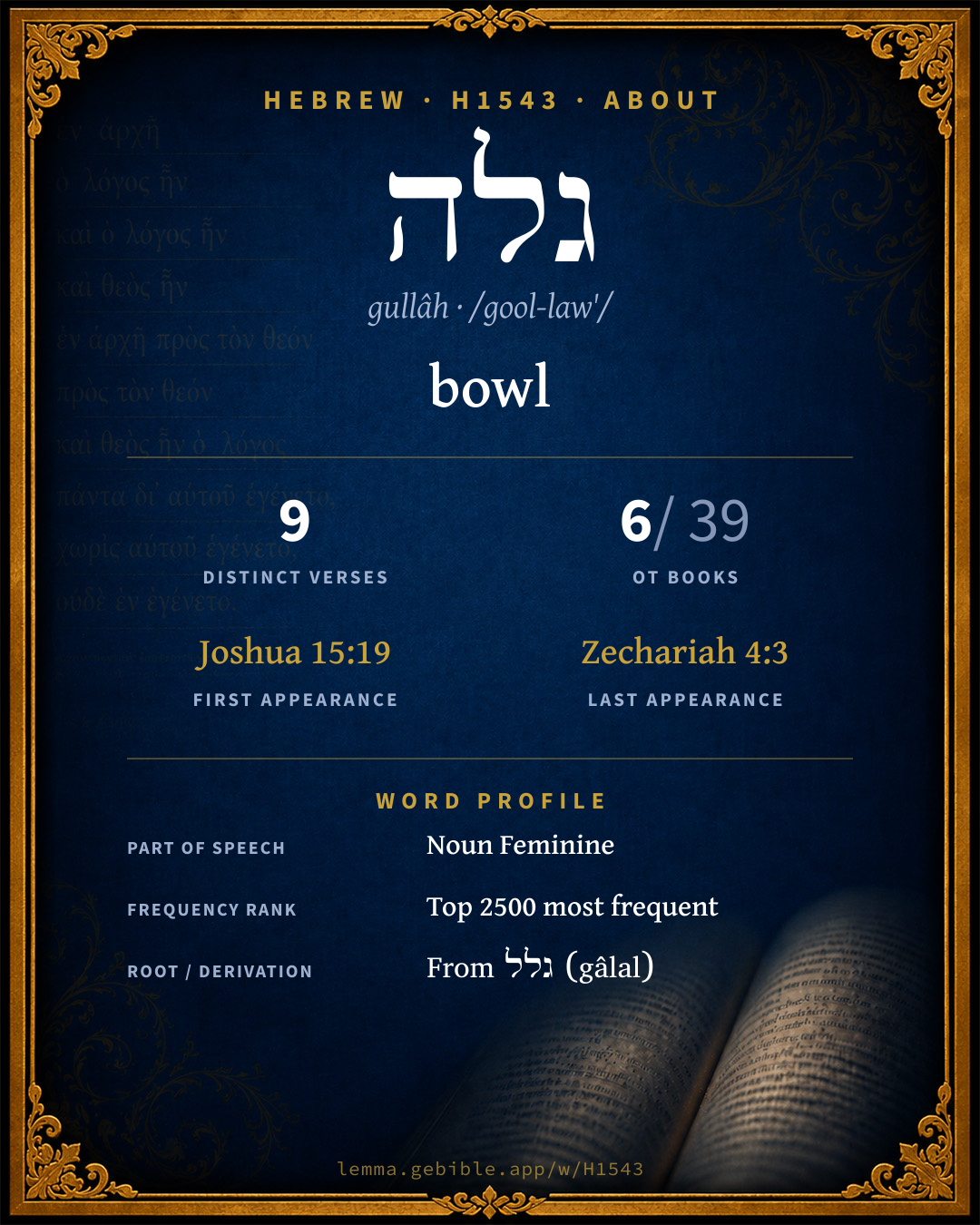
גֻּלָּה
bowl
also: spring, basin fuller range ↓
Full lexicon entry — Brown-Driver-Briggs (BDB)
From Brown-Driver-Briggs (BDB)
Where this word appears
See every Construct-state word in the Hebrew Bible →
Grammar key — what these labels mean
Part of speech
- Noun
- A naming word — a person, place, thing, or idea.
Noun type
- Common
- A common noun — a general class of person, place, or thing (“king,” “city,” “water”), not a specific name.
State
- Construct
- A noun bound to a following noun in a possessive / “of” relationship (the construct chain).
- Absolute
- The independent form of a noun, not bound to a following word.
Gender
- Feminine
- Grammatically feminine.
Number
- Plural
- More than one (in Hebrew, generally three or more).
- Singular
- One.
Grammatical forms
- Noun, Common, Feminine, Plural, Construct 9 times (60%)
- Noun, Common, Feminine, Plural, Absolute 3 times (20%)
- Noun, Common, Feminine, Singular, Absolute 2 times (13%)
- Noun, Common, Feminine, Singular, Construct 1 time (7%)
Parsed forms decoded from the imported morphology (morphhb / Westminster Leningrad Codex — WLC text public domain, morphhb tagging CC BY 4.0), counted across 15 parsed occurrences — not distinct verses.
Every verse where H1543 appears — 9 distinct verses across 6 books. Click any verse to open its interlinear word-by-word view. Verse text shown in the World English Bible for context — . Each verse’s Hebrew form is shown with its reference; the English is not keyword-highlighted, since the data carries no word-level English alignment. Use “Compare translations” on any verse to read it across multiple English versions. This concordance covers the Hebrew Bible; Septuagint (Greek Old Testament) occurrences are not indexed here.
Joshua 1 verse
Judges 1 verse
1 Kings 2 verses
- 1 Kings 7:41 וְ/גֻלֹּ֧ת גֻּלֹּ֣ת conj + n c fp cs n c fp cs the two pillars, and the two bowls of the capitals that were on the top of the pillars; and the two networks to cover the two bowls of the capitals that were on the top of the pillars;
- 1 Kings 7:42 גֻּלֹּ֣ת n c fp cs and the four hundred pomegranates for the two networks; two rows of pomegranates for each network, to cover the two bowls of the capitals that were on the pillars;
2 Chronicles 2 verses
- 2 Chronicles 4:12 וְ/הַ/גֻּלּ֧וֹת גֻּלּ֣וֹת conj + ptcl def.art + n c fp n c fp cs the two pillars, and the bowls, and the two capitals which were on the top of the pillars, and the two networks to cover the two bowls of the capitals that were on the top of the pillars,
- 2 Chronicles 4:13 גֻּלּ֣וֹת n c fp cs and the four hundred pomegranates for the two networks; two rows of pomegranates for each network, to cover the two bowls of the capitals that were on the pillars.
Ecclesiastes 1 verse
Zechariah 2 verses
- Zechariah 4:2 וְ/גֻלָּ֣הּ conj + n c fs He said to me, "What do you see?" I said, "I have seen, and, behold, a lampstand all of gold, with its bowl on the top of it, and its seven lamps thereon; there are seven pipes to each of the lamps, which are on the top of it;
- Zechariah 4:3 הַ/גֻּלָּ֔ה ptcl def.art + n c fs and two olive trees by it, one on the right side of the bowl, and the other on the left side of it."
About this entry
At a glance — auto-summarized from this page’s data, not written by a person. Every figure links to its source below. This summary describes the numbers; it doesn’t interpret them.
גלה — transliterated gullâh — is a Hebrew noun carrying the sense “bowl.” The King James Version usually renders it “springs,” while modern versions prefer “the” (unfoldingWord Literal Text) — see the renderings breakdown. With 9 verses in 6 books, it is an uncommon word in the Hebrew Bible. Debuting at Joshua 15:19, it then recurs through the corpus. Alongside “bowl” the lexicon also lists “spring” and “basin” — part of its full sense range. See the sense tree, 9-verse concordance, and the renderings breakdown below.
Gloss history
Strong's 1890 vs modern scholarship
About this word
Strong's H1543 catalogs a Hebrew word from the Hebrew Old Testament.
These counts are not copied from any lexicon or concordance. They are computed here, from the morphology-tagged Hebrew Old Testament. What Lemma adds →
- 9
- distinct verses
- The word appears in 9 distinct verses.
- 6 / 39
- OT books
- The word appears in 6 of 39 Old Testament books.
- #1,836
- by frequency
- Top 2500 most frequent Hebrew words (rank 1,836 of 8,640 Hebrew words by occurrence).
View all 9 occurrences in the concordance →
Most concentrated in
- 1 Kings 2 verses 22%
- 2 Chronicles 2 verses 22%
- Zechariah 2 verses 22%
By section of the Old Testament
By traditional corpus
Conventional, traditional groupings — biblical authorship is debated, so this is a traditional corpus grouping, not an authorship claim. Each share is this word’s portion of its verses in that division of the Hebrew canon. Each figure is a share of the word’s 9 distinct verses.
- Prophets (Nevi'im) 6 verses · 67%
- Writings (Ketuvim) 3 verses · 33%
How translations render this word
Counts come from each version’s own published word-to-Strong’s tagging or interlinear alignment — an approximate guide to how each version renders this word, not a word-level alignment the data otherwise carries. Because each total is that version’s own tagged count, the per-version totals vary from one another and need not match the appearance or distinct-verse counts above. These counts may also differ from a printed concordance because Lemma counts each distinctly tagged rendering and does not collapse phrase taggings into a single head-word total. This is a fixed set of word-tagged versions (KJV, ASV, BSB, ULT) and does not change with the reading translation you choose elsewhere. Each version’s license is shown beside its name below (and on Sources).
BDB lists this Strong’s number as 2 distinct words (homographs). Each count above pools all of them and is not split by sense — see the Senses section below. A low-frequency rendering may belong to a different one of those words, not the primary meaning.
- King James Version†: Springs 6×, Pommels 3×, Bowls 2×
- American Standard Version†: Springs 6×, Bowls 5×
- Berean Standard Bible†: Bowl-shaped 4×, Springs 4×, Bowl 3×
- unfoldingWord Literal Text†: The 8×, Bowls of 5×, Springs 4×
King James Version Public Domain
Renders H1543 across 14† tagged occurrences — most commonly:
Plus 3 renderings that appear only once — usually multi-word phrases or single function words the recovered tagging swept in, not distinct renderings.
American Standard Version Public Domain
Renders H1543 across 14† tagged occurrences — most commonly:
Plus 3 renderings that appear only once — usually multi-word phrases or single function words the recovered tagging swept in, not distinct renderings.
Berean Standard Bible Public Domain
Renders H1543 across 13† tagged occurrences — most commonly:
Not rendered by a distinct English word in 2 further occurrences.
unfoldingWord Literal Text CC BY-SA 4.0
Renders H1543 across 23† tagged occurrences — most commonly:
Plus 2 renderings that appear only once — usually multi-word phrases or single function words the recovered tagging swept in, not distinct renderings.
Senses in the full BDB
What do BDB’s symbols mean?
BDB uses these scholarly abbreviations:
| Symbol | Meaning |
|---|---|
| 𝔊 | the Septuagint (the ancient Greek translation, LXX) |
| 𝔙 | the Vulgate (the Latin translation) |
| 𝔖 | the Syriac version (the Peshitta) |
| 𝔗 | the Targum (the Aramaic translation) |
| ψ | the Psalms |
| √ | root (the underlying root or stem) |
| ‖ | parallel passage (a synonymous or contrasted parallel) |
| † | the dagger: every passage where the word occurs is cited |
The 4 senses and sub-senses the full Brown-Driver-Briggs lexicon distinguishes for this word, in lexicon order (not ranked by frequency), with BDB’s own verbatim wording and sub-sense lettering. Shown in Hebrew script with BDB’s own scholarly abbreviations. The condensed entry is in the Lexicon Entry tab. See also the Forms in the corpus table below.
גלה I v sub גלל.
גלה II basin, bowl
- 1. basin (pool, well?) ג׳ מַיִם Jos 15:19 = Ju 1:15; om. מ׳ Jos 15:19(×2) = Ju 1:15(×2) (prob. old n.pr.loc., cf. Di). e.g. Joshua 15:19
- 2. bowl,
- a. of lamp, i.e. oil-receptacle Zc 4:3, also v 2, where MT גֻּלָּהּ as if from [גֹּל]; read גֻּלָּה Brd Ges§ 91. 1, R. 2.; (> Hi-St Bö§ 734 b De on ψ 27:5 Sta§ 347 c, who think גֻּלָּהּ = גֻּלָּתָהּ);—so also Ec 12:6 גֻּלַּת הַזָּהָב. e.g. Zechariah 4:3
- b. of bowl- or globe-shaped portion of capitals of the two pillars in temple 1 K 7:41(×2), 42 = 2 Ch 4:12(×2), 13. e.g. 1 Kings 7:41
Senses from the full Brown-Driver-Briggs lexicon (Brown, Driver, Briggs; Oxford 1906 — public domain), digitized via Sefaria, supplemented by the OpenScriptures HebrewLexicon (CC BY 4.0). Full attribution on Sources.
Word origin
n.f. basin, bowl—ג׳ Zc 4:3 + v 2 cf. infr.; cstr. גֻּלַּת Ec 12:6; pl. abs. גֻּלֹּת Jos 15:19(×2) + 2 times; ־וֹת 2 Ch 4:12; cstr. גֻּלֹּת (־וֹת) 1 K 7:41 (הַגּ׳ Th, so ‖ 2 Ch 4:12 cf. Be), v 41 + 3 times;—
— Brown-Driver-Briggs (Oxford 1906, public domain), digitized via Sefaria, supplemented by the OpenScriptures HebrewLexicon (CC BY 4.0). See Sources.
Derived from גלל (gâlal) (H1556) — to roll.
Jastrow Dictionary
A second Hebrew/Aramaic lexicon for comparison, covering Aramaic and post-biblical (Talmudic, Targumic, Midrashic) usage that the biblical-Hebrew BDB does not. Matched by lemma rather than by Strong’s number, so a lemma may carry more than one Jastrow headword (shown separately below), and the entries cover usage well beyond the Bible.
גִּלָּה
- (גלל, cmp. גַּל 3) a valve, folding. Y. Sabb. XII, beg. 13ᶜ מטה של ג׳ folding couch.—Pl. גִּלִּין. Bab. Sabb. 138ᵃ כסא ג׳ camp chair.
גֻּלָּה
- , v. גּוּלָּה
גָּלָה
- , v. גלי
גלי
- (b. h.)
- 1. to be uncovered. Tosef. Mikv. III, 1 a pit שגָּלַת ed. Zuck. which was left open.—Part. pass. גָּלוּי open, revealed. Sabb. 55ᵃ ג׳ וידוע וכ׳ it is open and known to me. Ber. 60ᵇ; a. fr. V. גָּלוּי.
- 2. (of a place) to become bare of inhabitants (v. Jud. XVIII, 30; Jer. I, 3); (of the inhabitants) to leave home, go into exile. Y. Taan. I, 64ᵃ top בכ"מ שגָּלוּ … גָּלַת וכ׳ whithersoever Israel went as exiles, the Divine Majesty went with them (ref. to נגלה, I Sam. II, 27); Meg. 29ᵃ; a. e.—Pesik. Haḥod. p. 48ᵃ אם ג׳ אחד מכם … כאילו גְּלִיתֶם כולכם if one of you is banished (by the Roman Government) to &c.: … as though ye all had been banished; Pesik. R. s. 15; Cant. R. to II, 8. Arakh. 12ᵃ; Meg. 11ᵇ גָּלוּ בשבע they were transported to Babylonia in the seventh year (after the subjection of Jojakim). Macc. II, 1 אלו הן הַגּוֹלִין the following (involuntary homicides) have to leave for the city of refuge. Ib. אינו גוֹלֶה is not bound to flee to &c. Ib. 3 האב גולה ע"י הבן a father is banished for killing his son; a. fr. e.g. Judges 18:30
- to banish, carry into captivity. Macc. 12ᵇ היו … מַגְלִין וכ׳ the Israelites executed the law of banishment in the desert. Num. R. s. 23, end. Ruth R. to I, 1 ומַגְלָם מארצם and is the cause of their exile &c.; a. fr.—Koh. R. to XII, 6 (play on גלת ib.) ‘the golden bowl’ is the gullet, שהיא מַגְלָה את הזהב ומריצה וכ׳ (not שהיה; Lev. R. s. 18 שמכלה, corr. acc.) which banishes the gold and makes the silver run, i.e. which impoverishes the glutton.
- to be discovered, exposed to view; to reveal one’s self, appear. Tanḥ. Sh’moth 19 נ׳ עליו בקולו וכ׳ He revealed Himself to Moses with the voice of Amram &c.; Ex. R. s. 3. Ex. R. s. 2, end בכ"מ שהשכינה נִגְלֵית wherever the Divine Glory appears. Snh. II, 1, v. כָּסָה II; a. fr.
- to uncover, remove; to discover, reveal, publish. Ex. R. s. 15, beg. גִּלּוּ הצדיקים וכ׳ the righteous uncovered their heads. Sot. V, 2; Gen. R. s. 21 מי יְגַלֶּה עפר וכ׳ Oh that one would remove the dust from over thy eyes, i.e. Oh, that thou wouldst resurrect!; Y. Ber. IX, 13ᵈ bot.—Sabb. 88ᵃ מי גי׳ וכ׳ who revealed this secret to my children? Meg. 3ᵃ; a. fr.—ג׳ משפחות to expose to suspicion the legitimacy of families. Tosef. Naz. I, 3; Kidd. 71ᵃ.—ג׳ פנים בתורה (שלא כהלכה) a) to interpret the Law in opposition to the adopted sense, tomisinterpret, pervert. Ab. III, 11; a. e. b) to put the Law to shame by treating its teachers irreverently. Snh. 99ᵃ; a. e.—ג׳ פנים (in gen.) to expose, put to shame. Pirké d’R. El. ch. XLIV, v. לָבַן II.—Part. pass. מְגוּלֶּה, f. מְגוּלָּה uncovered. Par. XI, 1; Ḥull. 9ᵇ; a. fr. Pl. מְגוּלִּין. Ib.; a. fr.
- to be revealed; to be exposed. Pirké d’R. El. ch. XXIII ונתגל בתוך האהל his nakedness was exposed &c. Yoma 9ᵇ נתג׳ עונם their sins were public (they did not hide them); נתג׳ קיצם the end of their captivity was revealed (through prophecy). Naz. 23ᵇ נ׳ קלונו his disgrace is published.—Pes. 119ᵃ; a. fr.—Tanḥ. Mishp. 6; Yalk. Prov. 956, v. גָּלַע.
A Dictionary of the Targumim, the Talmud Babli and Yerushalmi, and the Midrashic Literature (Marcus Jastrow; London, Luzac, 1903) — Public Domain. Digitized via Sefaria. Digitized via Sefaria. Full attribution on Sources.
Forms in the corpus
The 8 distinct written forms H1543 takes in the Hebrew Bible, most frequent first — each parse links to that state’s occurrences in the concordance. Hebrew forms include their vowel points and cantillation, so a single lemma takes many written forms.
| Form | Parsing | Example | Uses |
|---|---|---|---|
| גֻּלֹּ֣ת | Noun, Common, Feminine, Plural, Construct | 1 Kings 7:41 | 6 |
| גֻּלֹּ֥ת | Noun, Common, Feminine, Plural, Absolute | Joshua 15:19 | 2 |
| גֻּלּ֣וֹת | Noun, Common, Feminine, Plural, Construct | 2 Chronicles 4:12 | 2 |
| גֻּלַּ֣ת | Noun, Common, Feminine, Singular, Construct | Ecclesiastes 12:6 | 1 |
| הַ/גֻּלָּ֔ה | Noun, Common, Feminine, Singular, Absolute | Zechariah 4:3 | 1 |
| וְ/גֻלָּ֣הּ | Noun, Common, Feminine, Singular, Absolute | Zechariah 4:2 | 1 |
| וְ/גֻלֹּ֧ת | Noun, Common, Feminine, Plural, Construct | 1 Kings 7:41 | 1 |
| וְ/הַ/גֻּלּ֧וֹת | Noun, Common, Feminine, Plural, Absolute | 2 Chronicles 4:12 | 1 |
Same root — word family
Other BDB entries built from the same root as H1543, grouped by Strong’s listed origin. These share a root / origin per the lexicon — not necessarily a shared meaning. Each links to that word’s own entry.
Derives from
Shares the same root
- גל gal H1530 wave
- גל gôl H1531 bowl, basin
- גלגל galgal H1534 whirlwind
- גלגלת gulgôleth H1538 skull
- גלול gillûwl H1544 idols
- גליל gâlîyl H1550 circuit
- גלל gâlâl H1557 dung
- גלל gâlâl H1558 on account of
- גלל gᵉlâl H1560 rolling
- מגלה mᵉgillâh H4039 scroll
Proper names from this root
People and places named from this root — a name, not an additional meaning of the word.
Compare all same-root words → Showing 4 of 13 — not the complete family. 1 of the same-root words is a proper name (a person or place). They share a root, not necessarily a meaning.
Septuagint verse parallels
This word appears in 9 verses that also exist in the Greek Old Testament (Septuagint), out of the 9 Hebrew verses it occurs in. You can read those verses in Greek by switching the Old Testament edition to the Septuagint.
Read these verses in the Septuagint
This is a verse-level parallel only — the same verses exist in both the Hebrew and Greek Old Testaments. No word-level Hebrew↔Greek correspondence is claimed: the data carries no such alignment, so no Greek word is shown as this Hebrew word’s translation. Coverage is not total — the Septuagint omits the deuterocanon and renumbers the Psalms, so some Hebrew verses have no direct Greek parallel.