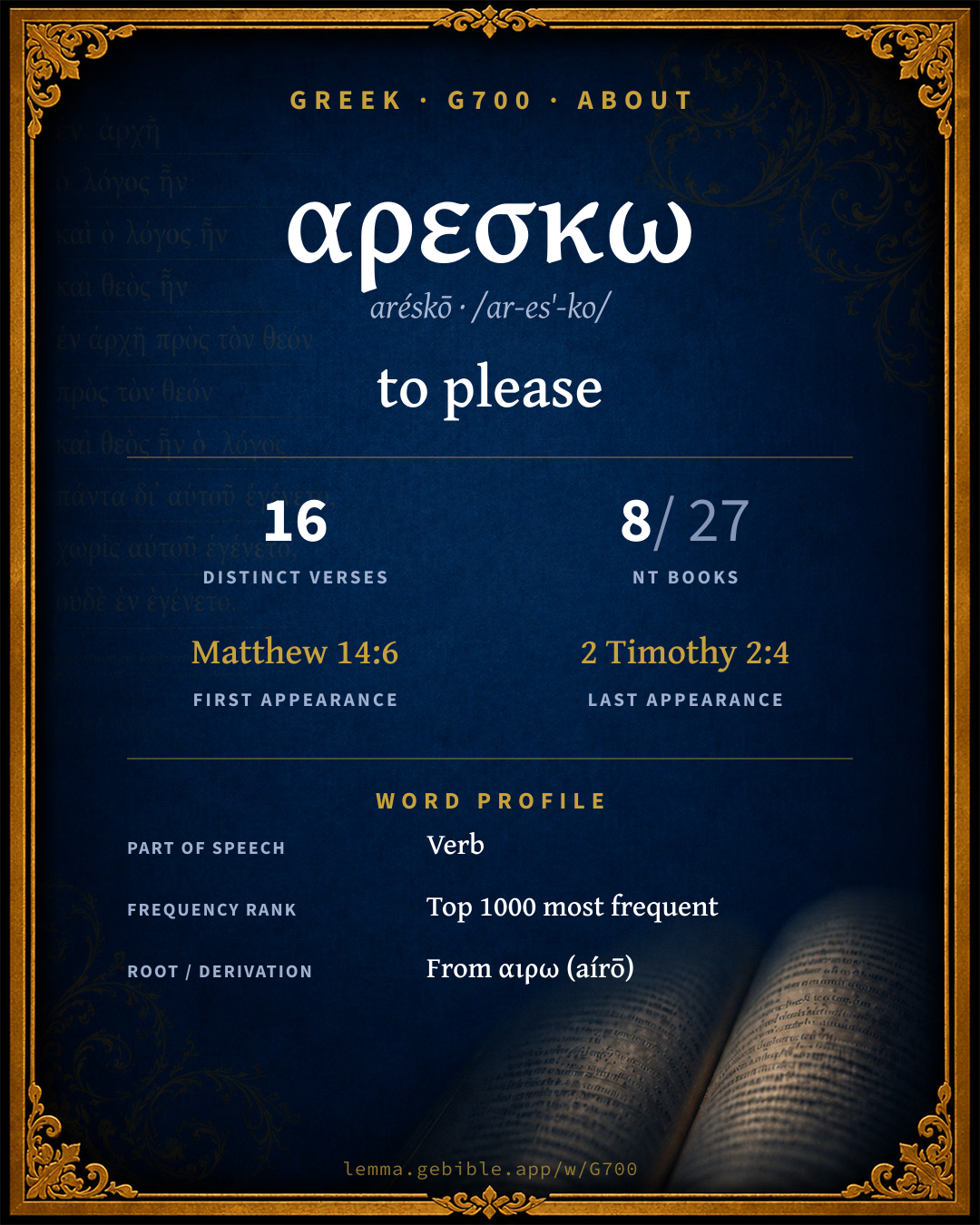
ἀρέσκω
to please
‘to please’ is one of 2 main senses fuller range ↓
Full lexicon entry — Thayer's Greek Lexicon
From Thayer's Greek Lexicon
Where this word appears
Grammar key — what these labels mean
Part of speech
- Verb
- An action or state-of-being word.
Tense
- Aorist
- Action viewed as a simple whole, without regard to duration — often past (perfective aspect).
- Present
- Ongoing or general action in present time (imperfective aspect).
- Imperfect
- Continuous or repeated action in past time (“was writing”).
Voice
- Active
- The subject performs the action.
Mood
- Indicative
- States a fact or asks a factual question (the mood of reality).
- Subjunctive
- Expresses probability, purpose, or possibility (the mood of contingency).
- Infinitive
- A verbal noun (“to write”), unmarked for person or number.
- Imperative
- Expresses a command or request.
- Participle
- A verbal adjective (“writing,” “having written”).
Case
- Genitive
- The case of source, possession, or “of” — answers “whose / from what.”
- Nominative
- The case of the subject (and the predicate nominative).
Person
- 3rd person
- The one spoken about (“he / she / it / they”).
- 1st person
- The speaker (“I / we”).
Gender
- Masculine
- Grammatically masculine.
Number
- Singular
- One.
- Plural
- More than one.
Every verse where G700 appears in the Book of Acts — 1 distinct verse. Click any verse to open its interlinear word-by-word view. Verse text shown in the World English Bible for context — . Each verse’s Greek form is shown with its reference; the English is not keyword-highlighted, since the data carries no word-level English alignment. Use “Compare translations” on any verse to read it across multiple English versions. This concordance covers the Greek New Testament; Septuagint (Greek Old Testament) occurrences of this word are not indexed here.
Acts
About this entry
At a glance — auto-summarized from this page’s data, not written by a person. Every figure links to its source below. This summary describes the numbers; it doesn’t interpret them.
αρεσκω — transliterated aréskō — is a Greek verb carrying the sense “to please.” Debuting at Matthew 14:6, it then recurs through the corpus. Spanning 16 verses in 8 books, it ranks among the uncommon words of the Greek New Testament. Its uses concentrate in Romans (25% of all occurrences). Its lexical range runs to 2 senses. Each statement above links to its evidence; the full detail follows below.
Gloss history
Strong's 1890 vs modern scholarship
About this word
Strong's G700 catalogs a Greek word from the Greek New Testament.
These counts are not copied from any lexicon or concordance. They are computed here, from the morphology-tagged Greek New Testament. What Lemma adds →
- 16
- distinct verses
- The word appears in 16 distinct verses.
- 8 / 27
- NT books
- The word appears in 8 of 27 New Testament books.
- #697
- by frequency
- Top 1000 most frequent Greek words (rank 697 of 5,347 Greek words by occurrence).
View all 16 occurrences in the concordance →
Most concentrated in
- Romans 4 verses 25%
- 1 Corinthians 4 verses 25%
- 1 Thessalonians 3 verses 19%
By section of the New Testament
By traditional corpus
Conventional, traditional groupings — biblical authorship is debated, so this is a traditional corpus grouping, not an authorship claim. Some books belong to more than one corpus (Luke is in both the Gospels and the Lukan corpus, and so on), so these shares overlap and need not total 100%. Each figure is a share of the word’s 16 distinct verses.
- Pauline corpus 13 verses · 81%
- Gospels 2 verses · 13%
- Lukan (Luke–Acts) 1 verse · 6%
How translations render this word
Counts come from each version’s own published word-to-Strong’s tagging or interlinear alignment — an approximate guide to how each version renders this word, not a word-level alignment the data otherwise carries. Because each total is that version’s own tagged count, the per-version totals vary from one another and need not match the appearance or distinct-verse counts above. These counts may also differ from a printed concordance because Lemma counts each distinctly tagged rendering and does not collapse phrase taggings into a single head-word total. This is a fixed set of word-tagged versions (KJV, ASV, BSB, ULT) and does not change with the reading translation you choose elsewhere. Each version’s license is shown beside its name below (and on Sources).
- King James Version: Please 6×, Pleased 5×, He may please 3×
- American Standard Version: Please 6×, He may please 3×, Pleased 3×
- Berean Standard Bible: Please 7×, He can please 2×, Pleased 2×
- unfoldingWord Literal Text: Please 7×, Pleasing 2×
King James Version Public Domain
Renders G700 across 19 tagged occurrences — most commonly:
Plus 5 renderings that appear only once — usually multi-word phrases or single function words the recovered tagging swept in, not distinct renderings.
American Standard Version Public Domain
Renders G700 across 18 tagged occurrences — most commonly:
Plus 4 renderings that appear only once — usually multi-word phrases or single function words the recovered tagging swept in, not distinct renderings.
Berean Standard Bible Public Domain
Renders G700 across 17 tagged occurrences — most commonly:
Plus 6 renderings that appear only once — usually multi-word phrases or single function words the recovered tagging swept in, not distinct renderings.
unfoldingWord Literal Text CC BY-SA 4.0
Renders G700 across 20 tagged occurrences — most commonly:
Plus 11 renderings that appear only once — usually multi-word phrases or single function words the recovered tagging swept in, not distinct renderings.
Senses in Thayer's
The 2 senses Thayer's distinguishes for this word, in lexicon order (not ranked by frequency or importance). The full entry — with sub-senses — is in the Lexicon Entry tab.
- to please
- to accommodate one's self to the opinions desires and interests of others
Word origin
Derived from αιρω (aírō) (G142) — to raise up.
Probably from G142 (through the idea of exciting emotion); to be agreeable (or by implication to seek to be so): - please.
— Strong’s Exhaustive Concordance (1890), public domain.
Forms in the corpus
The 9 distinct written forms G700 takes in the Greek New Testament, most frequent first — each parse links to that tense’s occurrences in the concordance.
| Form | Parsing | Example | Uses |
|---|---|---|---|
| ἀρέσῃ arésē | Verb, Aorist, Active, Subjunctive, 3rd person, Singular | 1 Corinthians 7:32 | 4 |
| ἤρεσεν ḗresen | Verb, Aorist, Active, Indicative, 3rd person, Singular | Matthew 14:6 | 4 |
| ἀρέσκειν aréskein | Verb, Present, Active, Infinitive | Romans 15:1 | 3 |
| ἀρέσαι arésai | Verb, Aorist, Active, Infinitive | Romans 8:8 | 1 |
| ἀρέσκοντες aréskontes | Verb, Present, Active, Participle, Nominative, Plural, Masculine | 1 Thessalonians 2:4 | 1 |
| ἀρέσκω aréskō | Verb, Present, Active, Indicative, 1st person, Singular | 1 Corinthians 10:33 | 1 |
| ἀρεσκέτω areskétō | Verb, Present, Active, Imperative, 3rd person, Singular | Romans 15:2 | 1 |
| ἀρεσκόντων areskóntōn | Verb, Present, Active, Participle, Genitive, Plural, Masculine | 1 Thessalonians 2:15 | 1 |
| ἤρεσκον ḗreskon | Verb, Imperfect, Active, Indicative, 1st person, Singular | Galatians 1:10 | 1 |
Same root — word family
Other Thayer's entries built from the same root as G700, grouped by Strong’s listed origin. These share a root / origin per the lexicon — not necessarily a shared meaning. Each links to that word’s own entry.
Derives from
Shares the same root
- αιρεομαι hairéomai G138 to choose
- αρα ará G685 curse
- αρα ára G686 therefore
- αριθμος arithmós G706 number
- αρκεω arkéō G714 to ward off
- αρρην árrhēn G730 male
- αρτι árti G737 now
- αρτος ártos G740 bread
- αρτυω artýō G741 to season
- αρωμα árōma G759 spice
- ορος óros G3735 mountain
Derived from this word
Compare all same-root words → Showing 4 of 15 — not the complete family. They share a root, not necessarily a meaning.
Septuagint usage
The same Greek word αρεσκω appears 34 times in the Greek Old Testament (Septuagint), across 32 verses in 14 books.
- 34
- LXX occurrences
- Tagged occurrences of this Greek word in the Septuagint.
- 32
- verses
- Distinct Septuagint verses containing this word.
- 14 / 39
- OT books
- The word appears in 14 of the 39 Old Testament books.
Sample Septuagint occurrences
- Genesis 19:8 ἀρέσκω
- Leviticus 10:20 ἀρέσκω
- Numbers 22:34 ἀρέσκω
- Deuteronomy 1:23 ἀρέσκω
- Joshua 9:25 ἀρέσκω
- Judges 21:14 ἀρέσκω
- 2 Samuel 3:19 ἀρέσκω
- 1 Kings 3:10 ἀρέσκω
- 2 Chronicles 30:4 ἀρέσκω
- Esther 1:21 ἀρέσκω
- Job 31:10 ἀρέσκω
- Psalms 68:32 ἀρέσκω
Septuagint occurrences (same lexeme)
Every verse where the same Strong’s number (G700) appears in the Greek Septuagint. Verse text shown in the World English Bible for context; the Greek form is the matched word — the English is not keyword-highlighted.
- Genesis 19:8 ἀρέσκω See now, I have two virgin daughters. Please let me bring them out to you, and do you to them as is good in your eyes. Only don't do anything to these men, because they have come under the shadow of my roof."
- Genesis 20:15 ἀρέσκω Abimelech said, "Behold, my land is before you. Dwell where it pleases you."
- Genesis 34:18 ἀρέσκω Their words pleased Hamor, and Shechem, Hamor's son.
- Genesis 41:37 ἀρέσκω The thing was good in the eyes of Pharaoh, and in the eyes of all his servants.
- Leviticus 10:20 ἀρέσκω When Moses heard that, it was pleasing in his sight.
- Numbers 22:34 ἀρέσκω Balaam said to the angel of Yahweh, I have sinned; for I didn't know that you stood in the way against me: now therefore, if it displease you, I will get me back again.
- Numbers 23:27 ἀρέσκω Balak said to Balaam, Come now, I will take you to another place; peradventure it will please God that you may curse me them from there.
- Numbers 36:6 ἀρέσκω This is the thing which Yahweh does command concerning the daughters of Zelophehad, saying, Let them be married to whom they think best; only into the family of the tribe of their father shall they be married.
- Deuteronomy 1:23 ἀρέσκω The thing pleased me well; and I took twelve men of you, one man for every tribe:
- Deuteronomy 23:17 ἀρέσκω There shall be no prostitute of the daughters of Israel, neither shall there be a sodomite of the sons of Israel.
- Joshua 9:25 ἀρέσκω Now, behold, we are in your hand: as it seems good and right to you to do to us, do.
- Joshua 22:30 ἀρέσκω When Phinehas the priest, and the princes of the congregation, even the heads of the thousands of Israel that were with him, heard the words that the children of Reuben and the children of Gad and the children of Manasseh spoke, it pleased them well.
- Joshua 22:33 ἀρέσκω The thing pleased the children of Israel; and the children of Israel blessed God, and spoke no more of going up against them to war, to destroy the land in which the children of Reuben and the children of Gad lived.
- Joshua 24:15 ἀρέσκω If it seem evil to you to serve Yahweh, choose you this day whom you will serve; whether the gods which your fathers served that were beyond the River, or the gods of the Amorites, in whose land you dwell: but as for me and my house, we will serve Yahweh.
- Judges 21:14 ἀρέσκω Benjamin returned at that time; and they gave them the women whom they had saved alive of the women of Jabesh Gilead: and yet so they weren't enough for them.
- 2 Samuel 3:19 ἀρέσκω Abner also spoke in the ears of Benjamin: and Abner went also to speak in the ears of David in Hebron all that seemed good to Israel, and to the whole house of Benjamin.
- 2 Samuel 3:36 ἀρέσκω All the people took notice of it, and it pleased them; as whatever the king did pleased all the people.
- 2 Samuel 18:4 ἀρέσκω The king said to them, What seems you best I will do. The king stood by the gate-side, and all the people went out by hundreds and by thousands.
- 1 Kings 3:10 ἀρέσκω The speech pleased the Lord, that Solomon had asked this thing.
- 1 Kings 9:12 ἀρέσκω Hiram came out from Tyre to see the cities which Solomon had given him; and they didn't please him.
- 1 Kings 12:24 ἀρέσκω Thus says Yahweh, You shall not go up, nor fight against your brothers the children of Israel: return every man to his house; for this thing is of me. So they listened to the word of Yahweh, and returned and went their way, according to the word of Yahweh.
- 1 Kings 20:2 ἀρέσκω He sent messengers to Ahab king of Israel, into the city, and said to him, Thus says Ben Hadad,
- 2 Chronicles 30:4 ἀρέσκω The thing was right in the eyes of the king and of all the assembly.
- Esther 1:21 ἀρέσκω The saying pleased the king and the princes; and the king did according to the word of Memucan:
- Esther 2:4 ἀρέσκω and let the maiden who pleases the king be queen instead of Vashti. The thing pleased the king; and he did so.
- Esther 2:9 ἀρέσκω The maiden pleased him, and she obtained kindness of him; and he speedily gave her things for her purification, with her portions, and the seven maidens who were meet to be given her out of the king's house: and he removed her and her maidens to the best place of the house of the women.
- Esther 5:11 ἀρέσκω Haman recounted to them the glory of his riches, and the multitude of his children, and all the things in which the king had promoted him, and how he had advanced him above the princes and servants of the king.
- Esther 5:12 ἀρέσκω Haman said moreover, Yes, Esther the queen did let no man come in with the king to the banquet that she had prepared but myself; and tomorrow also am I invited by her together with the king.
- Job 31:10 ἀρέσκω Then let my wife grind for another, And let others sleep with her.
- Psalms 68:32 ἀρέσκω Sing to God, you kingdoms of the earth! Sing praises to the Lord! Selah.
- Isaiah 59:15 ἀρέσκω Yes, truth is lacking; and he who departs from evil makes himself a prey. Yahweh saw it, and it displeased him who there was no justice.
- Jeremiah 18:4 ἀρέσκω When the vessel that he made of the clay was marred in the hand of the potter, he made it again another vessel, as seemed good to the potter to make it.
These are occurrences of the same Greek lexeme (G700) in the Septuagint — not a translation of any one Hebrew word. The store carries no word-level Hebrew↔Greek alignment, so no Hebrew original is asserted here. Counts come from the recovered LXX Strong's tagging — high-frequency vocabulary is well covered, while rare or late forms may be untagged — so they reflect tagged occurrences and may slightly undercount.