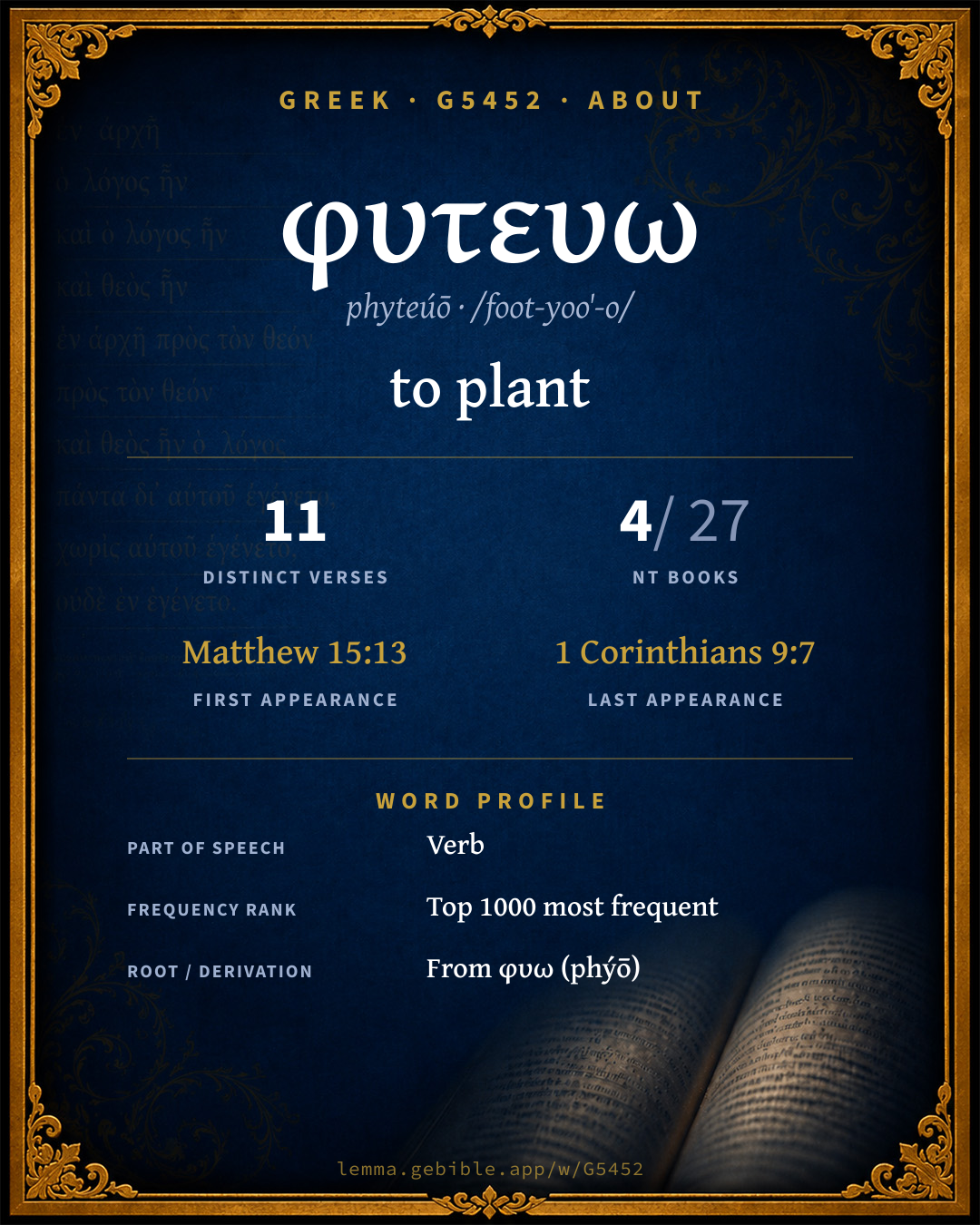
φυτεύω
to plant
Full lexicon entry — Thayer's Greek Lexicon
From Thayer's Greek Lexicon
Where this word appears
See every Aorist-tense verb in the Greek New Testament →
Grammar key — what these labels mean
Part of speech
- Verb
- An action or state-of-being word.
Tense
- Aorist
- Action viewed as a simple whole, without regard to duration — often past (perfective aspect).
- Present
- Ongoing or general action in present time (imperfective aspect).
- Imperfect
- Continuous or repeated action in past time (“was writing”).
- Perfect
- A completed past action with continuing present results.
Voice
- Active
- The subject performs the action.
- Passive
- The subject receives the action.
Mood
- Indicative
- States a fact or asks a factual question (the mood of reality).
- Participle
- A verbal adjective (“writing,” “having written”).
- Imperative
- Expresses a command or request.
Case
- Nominative
- The case of the subject (and the predicate nominative).
- Accusative
- The case of the direct object and of extent.
Person
- 3rd person
- The one spoken about (“he / she / it / they”).
- 1st person
- The speaker (“I / we”).
- 2nd person
- The one addressed (“you”).
Gender
- Masculine
- Grammatically masculine.
- Feminine
- Grammatically feminine.
Number
- Singular
- One.
- Plural
- More than one.
1 verse where G5452 appears in the Perfect tense in the Book of Luke. Filtered view — show all forms. Click any verse to open its interlinear word-by-word view. Verse text shown in the World English Bible for context — . Each verse’s Greek form is shown with its reference; the English is not keyword-highlighted, since the data carries no word-level English alignment. Use “Compare translations” on any verse to read it across multiple English versions. This concordance covers the Greek New Testament; Septuagint (Greek Old Testament) occurrences of this word are not indexed here.
Luke
About this entry
At a glance — auto-summarized from this page’s data, not written by a person. Every figure links to its source below. This summary describes the numbers; it doesn’t interpret them.
φυτευω (phyteúō) is a Greek verb most often rendered “to plant.” Scripture first uses it in Matthew 15:13. It turns up in 11 verses across 4 books, an uncommon footprint. It concentrates in Luke, which alone accounts for 36% of its uses. It clusters with φυω, φυλη and φυραμα under a shared root. The sections below give every sense, occurrence, and version rendering.
Gloss history
Strong's 1890 vs modern scholarship

About this word
Strong's G5452 catalogs a Greek word from the Greek New Testament.
These counts are not copied from any lexicon or concordance. They are computed here, from the morphology-tagged Greek New Testament. What Lemma adds →
- 11
- distinct verses
- The word appears in 11 distinct verses.
- 4 / 27
- NT books
- The word appears in 4 of 27 New Testament books.
- #978
- by frequency
- Top 1000 most frequent Greek words (rank 978 of 5,347 Greek words by occurrence).
View all 11 occurrences in the concordance →
Most concentrated in
- Luke 4 verses 36%
- 1 Corinthians 4 verses 36%
- Matthew 2 verses 18%
By section of the New Testament
By traditional corpus
Conventional, traditional groupings — biblical authorship is debated, so this is a traditional corpus grouping, not an authorship claim. Some books belong to more than one corpus (Luke is in both the Gospels and the Lukan corpus, and so on), so these shares overlap and need not total 100%. Each figure is a share of the word’s 11 distinct verses.
- Gospels 7 verses · 64%
- Lukan (Luke–Acts) 4 verses · 36%
- Pauline corpus 4 verses · 36%
How translations render this word
Counts come from each version’s own published word-to-Strong’s tagging or interlinear alignment — an approximate guide to how each version renders this word, not a word-level alignment the data otherwise carries. Because each total is that version’s own tagged count, the per-version totals vary from one another and need not match the appearance or distinct-verse counts above. These counts may also differ from a printed concordance because Lemma counts each distinctly tagged rendering and does not collapse phrase taggings into a single head-word total. This is a fixed set of word-tagged versions (KJV, ASV, BSB, ULT) and does not change with the reading translation you choose elsewhere. Each version’s license is shown beside its name below (and on Sources).
- King James Version: Planted 5×, He that planteth 2×
- American Standard Version: Planted 5×, Planteth 3×
- Berean Standard Bible: Planted 5×, Plants 3×
- unfoldingWord Literal Text: Planted 6×, Planting 2×
King James Version Public Domain
Renders G5452 across 12 tagged occurrences — most commonly:
Plus 5 renderings that appear only once — usually multi-word phrases or single function words the recovered tagging swept in, not distinct renderings.
American Standard Version Public Domain
Renders G5452 across 11 tagged occurrences — most commonly:
Plus 3 renderings that appear only once — usually multi-word phrases or single function words the recovered tagging swept in, not distinct renderings.
Berean Standard Bible Public Domain
Renders G5452 across 11 tagged occurrences — most commonly:
Plus 3 renderings that appear only once — usually multi-word phrases or single function words the recovered tagging swept in, not distinct renderings.
unfoldingWord Literal Text CC BY-SA 4.0
Renders G5452 across 12 tagged occurrences — most commonly:
Plus 4 renderings that appear only once — usually multi-word phrases or single function words the recovered tagging swept in, not distinct renderings.
Senses in Thayer's
The 1 sense Thayer's distinguishes for this word, in lexicon order (not ranked by frequency or importance). The full entry — with sub-senses — is in the Lexicon Entry tab.
- to plant
Word origin
Derived from φυω (phýō) (G5453) — to grow.
From a derivative of G5453 ; to set out in the earth that is implant . Figuratively to instil doctrine : - plant.
— Strong’s Exhaustive Concordance (1890), public domain.
Forms in the corpus
The 7 distinct written forms G5452 takes in the Greek New Testament, most frequent first — each parse links to that tense’s occurrences in the concordance.
| Form | Parsing | Example | Uses |
|---|---|---|---|
| ἐφύτευσεν ephýteusen | Verb, Aorist, Active, Indicative, 3rd person, Singular | Matthew 15:13 | 4 |
| φυτεύων phyteúōn | Verb, Present, Active, Participle, Nominative, Singular, Masculine | 1 Corinthians 3:7 | 2 |
| πεφυτευμένην pephyteuménēn | Verb, Perfect, Passive, Participle, Accusative, Singular, Feminine | Luke 13:6 | 1 |
| φυτεύει phyteúei | Verb, Present, Active, Indicative, 3rd person, Singular | 1 Corinthians 9:7 | 1 |
| φυτεύθητι phyteúthēti | Verb, Aorist, Passive, Imperative, 2nd person, Singular | Luke 17:6 | 1 |
| ἐφύτευον ephýteuon | Verb, Imperfect, Active, Indicative, 3rd person, Plural | Luke 17:28 | 1 |
| ἐφύτευσα ephýteusa | Verb, Aorist, Active, Indicative, 1st person, Singular | 1 Corinthians 3:6 | 1 |
Same root — word family
Other Thayer's entries built from the same root as G5452, grouped by Strong’s listed origin. These share a root / origin per the lexicon — not necessarily a shared meaning. Each links to that word’s own entry.
Derives from
Shares the same root
Derived from this word
Compare all same-root words → Showing 4 of 6 — not the complete family. They share a root, not necessarily a meaning.
Septuagint usage
The same Greek word φυτευω appears 42 times in the Greek Old Testament (Septuagint), across 40 verses in 11 books.
- 42
- LXX occurrences
- Tagged occurrences of this Greek word in the Septuagint.
- 40
- verses
- Distinct Septuagint verses containing this word.
- 11 / 39
- OT books
- The word appears in 11 of the 39 Old Testament books.
Sample Septuagint occurrences
- Genesis 2:8 φυτεύω
- Deuteronomy 16:21 φυτεύω
- Joshua 24:13 φυτεύω
- Psalms 1:3 φυτεύω
- Proverbs 27:18 φυτεύω
- Ecclesiastes 2:4 φυτεύω
- Isaiah 5:2 φυτεύω
- Jeremiah 2:21 φυτεύω
- Ezekiel 19:10 φυτεύω
- Daniel 4:13 φυτεύω
- Amos 5:11 φυτεύω
Septuagint occurrences (same lexeme)
Every verse where the same Strong’s number (G5452) appears in the Greek Septuagint. Verse text shown in the World English Bible for context; the Greek form is the matched word — the English is not keyword-highlighted.
- Genesis 2:8 φυτεύω Yahweh God planted a garden eastward, in Eden, and there he put the man whom he had formed.
- Genesis 9:20 φυτεύω Noah began to be a farmer, and planted a vineyard.
- Genesis 21:33 φυτεύω Abraham planted a tamarisk tree in Beersheba, and called there on the name of Yahweh, the Everlasting God.
- Deuteronomy 16:21 φυτεύω You shall not plant you an Asherah of any kind of tree beside the altar of Yahweh your God, which you shall make you.
- Deuteronomy 20:6 φυτεύω What man is there who has planted a vineyard, and has not used the fruit of it? let him go and return to his house, lest he die in the battle, and another man use the fruit of it.
- Deuteronomy 28:30 φυτεύω You shall betroth a wife, and another man shall lie with her: you shall build a house, and you shall not dwell therein: you shall plant a vineyard, and shall not use the fruit of it.
- Deuteronomy 28:39 φυτεύω You shall plant vineyards and dress them, but you shall neither drink of the wine, nor gather [the grapes]; for the worm shall eat them.
- Joshua 24:13 φυτεύω I gave you a land whereon you had not labored, and cities which you didn't build, and you dwell therein; of vineyards and olive groves which you didn't plant do you eat.
- Psalms 1:3 φυτεύω He will be like a tree planted by the streams of water, That brings forth its fruit in its season, Whose leaf also does not wither. Whatever he does shall prosper.
- Psalms 79:16 φυτεύω
- Psalms 91:14 φυτεύω "Because he has set his love on me, therefore I will deliver him. I will set him on high, because he has known my name.
- Psalms 93:9 φυτεύω
- Psalms 103:16 φυτεύω For the wind passes over it, and it is gone. Its place remembers it no more.
- Psalms 106:37 φυτεύω Yes, they sacrificed their sons and their daughters to demons.
- Proverbs 27:18 φυτεύω Whoever tends the fig tree shall eat its fruit. He who looks after his master shall be honored.
- Ecclesiastes 2:4 φυτεύω I made myself great works. I built myself houses. I planted myself vineyards.
- Ecclesiastes 2:5 φυτεύω I made myself gardens and parks, and I planted trees in them of all kinds of fruit.
- Ecclesiastes 3:2 φυτεύω A time to be born, And a time to die; A time to plant, And a time to pluck up that which is planted;
- Ecclesiastes 12:11 φυτεύω The words of the wise are like goads; and like nails well fastened are words from the masters of assemblies, which are given from one shepherd.
- Isaiah 5:2 φυτεύω He dug it up, Gathered out its stones, Planted it with the choicest vine, Built a tower in its midst, And also cut out a winepress therein. He looked for it to yield grapes, But it yielded wild grapes.
- Isaiah 17:10 φυτεύω For you have forgotten the God of your salvation, and have not been mindful of the rock of your strength; therefore you plant pleasant plants, and set it with strange slips.
- Isaiah 17:11 φυτεύω In the day of your planting you hedge it in, and in the morning you make your seed to blossom; but the harvest flees away in the day of grief and of desperate sorrow.
- Isaiah 37:30 φυτεύω This shall be the sign to you: you shall eat this year that which grows of itself, and in the second year that which springs of the same; and in the third year sow you, and reap, and plant vineyards, and eat the fruit of it.
- Isaiah 40:24 φυτεύω Yes, they have not been planted; yes, they have not been sown; yes, their stock has not taken root in the earth: moreover he blows on them, and they wither, and the whirlwind takes them away as stubble.
- Isaiah 44:14 φυτεύω He cuts down cedars for himself, and takes the cypress and the oak, and strengthens for himself one among the trees of the forest: he plants a fir tree, and the rain nourishes it.
- Isaiah 65:22 φυτεύω They shall not build, and another inhabit; they shall not plant, and another eat: for as the days of a tree shall be the days of my people, and my chosen shall long enjoy the work of their hands.
- Jeremiah 2:21 φυτεύω Yet I had planted you a noble vine, wholly a right seed: how then are you turned into the degenerate branches of a foreign vine to me?
- Jeremiah 12:2 φυτεύω You have planted them, yes, they have taken root; they grow, yes, they bring forth fruit: you are near in their mouth, and far from their heart.
- Jeremiah 36:5 φυτεύω Jeremiah commanded Baruch, saying, I am shut up; I can't go into the house of Yahweh:
- Jeremiah 36:23 φυτεύω It happened, when Jehudi had read three or four leaves, that [the king] cut it with the penknife, and cast it into the fire that was in the brazier, until all the scroll was consumed in the fire that was in the brazier.
- Jeremiah 38:5 φυτεύω Zedekiah the king said, Behold, he is in your hand; for the king is not he who can do anything against you.
- Jeremiah 39:41 φυτεύω
- Jeremiah 49:10 φυτεύω But I have made Esau bare, I have uncovered his secret places, and he shall not be able to hide himself: his seed is destroyed, and his brothers, and his neighbors; and he is no more.
- Jeremiah 51:34 φυτεύω Nebuchadrezzar the king of Babylon has devoured me, he has crushed me, he has made me an empty vessel, he has, like a monster, swallowed me up, he has filled his maw with my delicacies; he has cast me out.
- Ezekiel 19:10 φυτεύω Your mother was like a vine, in your blood, planted by the waters: it was fruitful and full of branches by reason of many waters.
- Ezekiel 19:13 φυτεύω Now it is planted in the wilderness, in a dry and thirsty land.
- Ezekiel 28:26 φυτεύω They shall dwell securely therein; yes, they shall build houses, and plant vineyards, and shall dwell securely, when I have executed judgments on all those who do them despite round about them; and they shall know that I am Yahweh their God.
- Daniel 4:13 φυτεύω I saw in the visions of my head on my bed, and, behold, a watcher and a holy one came down from the sky.
- Amos 5:11 φυτεύω Forasmuch therefore as you trample on the poor, And take taxes from him of wheat: You have built houses of hewn stone, But you will not dwell in them. You have planted pleasant vineyards, But you shall not drink their wine.
- Amos 9:14 φυτεύω I will bring back the captivity of my people Israel, And they will rebuild the ruined cities, and inhabit them; and they will plant vineyards, and drink wine from them. They shall also make gardens, And eat the fruit of them.
These are occurrences of the same Greek lexeme (G5452) in the Septuagint — not a translation of any one Hebrew word. The store carries no word-level Hebrew↔Greek alignment, so no Hebrew original is asserted here. Counts come from the recovered LXX Strong's tagging — high-frequency vocabulary is well covered, while rare or late forms may be untagged — so they reflect tagged occurrences and may slightly undercount.