Daniel 4:13

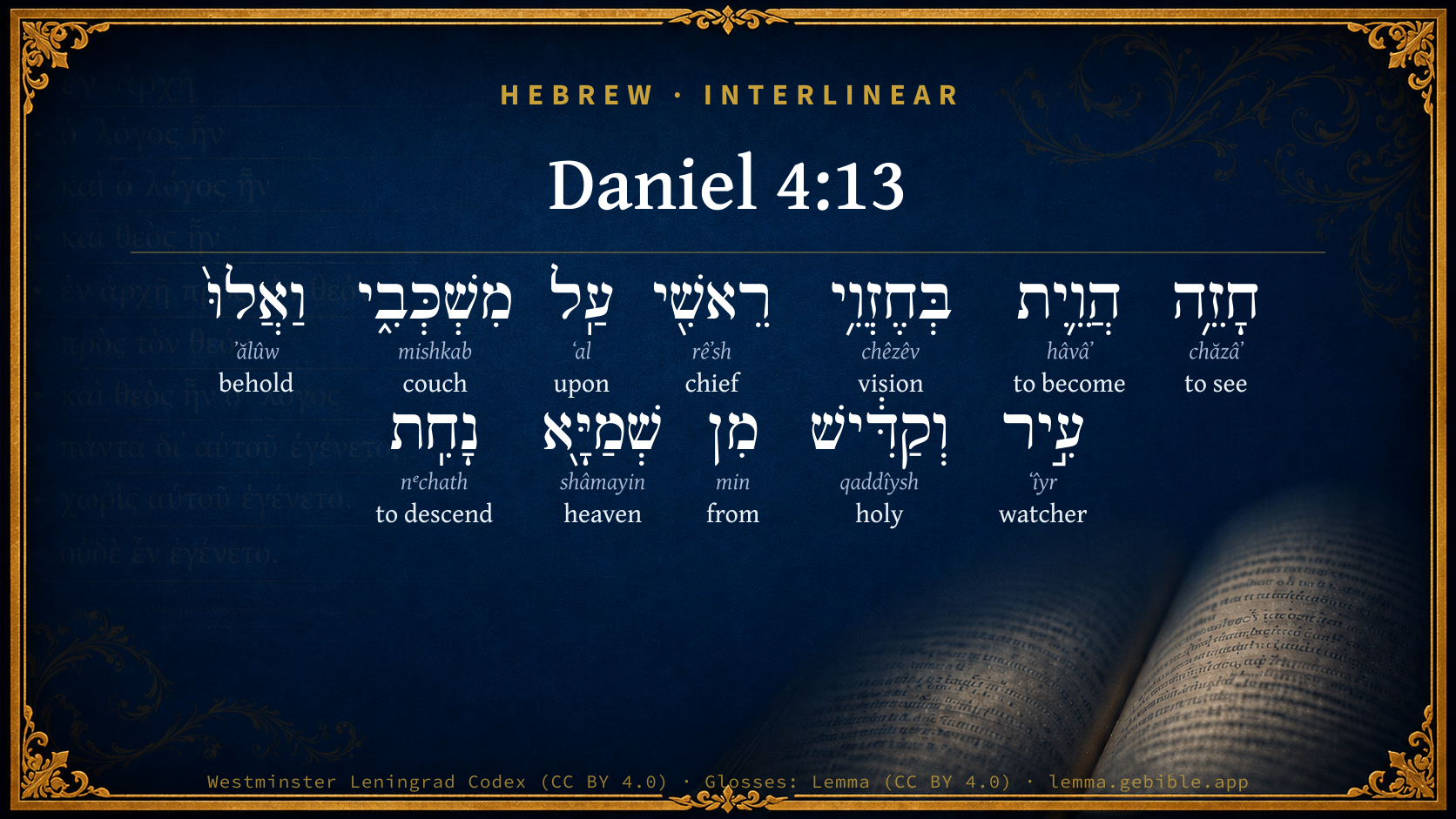
Hebrew (Westminster Leningrad Codex) Daniel 4:13 appears in the Hebrew Old Testament. The text above is from the Westminster Leningrad Codex. Each word links to its Strong’s number, a concise gloss, and parsing drawn from the Open Scriptures Hebrew Bible morphology. Click any word for its full Brown-Driver-Briggs (BDB) entry.
Download image
Cite this verse

Daniel 4:13 (World English Bible). Public Domain. Lemma interlinear Bible study tool, https://lemma.gebible.app/v/daniel/4/13.

Show BibTeX & RIS
BibTeX
RIS
English Translation
I saw in the visions of my head on my bed, and, behold, a watcher and a holy one came down from the sky.
World English Bible · Public Domain
Highlights
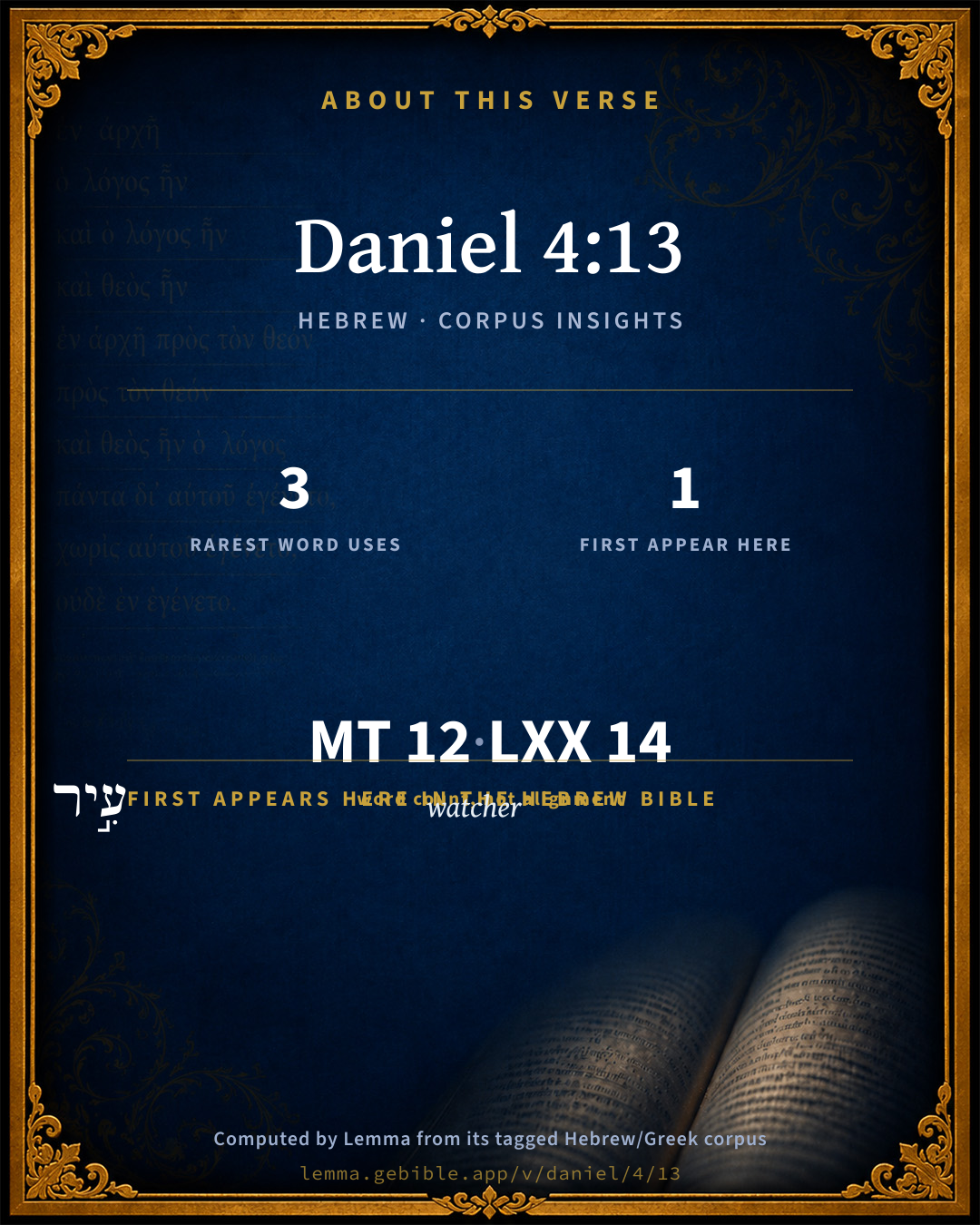
  • 1 first appearance in the Hebrew Bible
Full analysis ↓
Download a study sheet

One document with this verse’s original text, its word-by-word gloss line, the meaning frame, cross-references with their text, attributed commentary, and full source and license credits — printable, and it pastes into notes with its structure intact.

This verse Autodidact and up

Study sheet (.html) Plain text (.txt)

A passage Seminary Student

Up to 50 verses in one chapter. A passage sheet keeps up to 6 commentary sources and 12 cross-references per verse, in the order this page ranks them, and says so on the sheet whenever that leaves anything out. Ask for a single verse and you get the Autodidact verse sheet above.

Everything on this page stays free to read, with no account — the sheet is a download of what is already on screen, not access to it.

Want to remove ads? Support Godless Engineer
Compare translations 3

The same verse in 3 English versions, stacked beneath the original-language interlinear above. Click any original word for its lexicon entry.

Each is an independent rendering of the whole verse — the interlinear is not word-aligned to these translations.

Highlighted words mark where these versions differ — a whole-verse word diff, not a word-by-word alignment.

  • World English Bible Public Domain
    I saw in the visions of my head on my bed, and, behold, a watcher and a holy one came down from the sky.
  • King James Version Public Domain
    I saw in the visions of my head upon my bed, and, behold, a watcher and an holy one came down from heaven;
  • unfoldingWord Literal Text CC BY-SA 4.0
    I was looking in the visions of my head as I lay on my bed, and behold, a watcher, a holy one, came down from heaven.

unfoldingWord Literal Text — © unfoldingWord, licensed CC BY-SA 4.0. Word-aligned USFM3 via Door43 (git.door43.org/unfoldingWord/en_ult).

Versions to compare (up to 4)

3 of 4 selected

Show all 18 translations

Every available English version of this verse, each an independent rendering of the whole verse.

  • World English Bible Public Domain
    I saw in the visions of my head on my bed, and, behold, a watcher and a holy one came down from the sky.
  • Berean Standard Bible Public Domain
    As I lay on my bed, I also saw in the visions of my mind a watcher, a holy one, coming down from heaven.
  • Majority Standard Bible Public Domain
    As I lay on my bed, I also saw in the visions of my mind a watcher, a holy one, coming down from heaven.
  • King James Version Public Domain
    I saw in the visions of my head upon my bed, and, behold, a watcher and an holy one came down from heaven;
  • American Standard Version (1901) Public Domain
    I saw in the visions of my head upon my bed, and, behold, a watcher and a holy one came down from heaven.
  • Revised Version (1885) Public Domain
    I saw in the visions of my head upon my bed, and, behold, a watcher and an holy one came down from heaven.
  • Geneva Bible (1599) Public Domain
    Let his heart be changed from mans nature, and let a beasts heart be giuen vnto him, and let seuen times be passed ouer him.
  • Douay-Rheims (1899) Public Domain
    I saw in the vision of my head upon my bed, and behold a watcher, and a holy one came down from heaven.
  • Young's Literal Translation Public Domain
    `I was looking, in the visions of my head on my bed, and lo, a sifter, even a holy one, from the heavens is coming down.
  • Literal Standard Version CC BY-SA 4.0
    I was looking, in the visions of my head on my bed, and behold, a sifter, even a holy one, from the heavens is coming down.
  • Unlocked Literal Bible CC BY-SA 4.0
    I saw in my mind as I lay on my bed, and a holy messenger came down from the heavens.
  • unfoldingWord Literal Text CC BY-SA 4.0
    I was looking in the visions of my head as I lay on my bed, and behold, a watcher, a holy one, came down from heaven.
  • Darby Bible Public Domain
    I saw in the visions of my head upon my bed, and behold, a watcher and a holy one came down from the heavens;
  • World Messianic Bible Public Domain
    “I saw in the visions of my head on my bed, and behold, a holy watcher came down from the sky.
  • Webster's Bible Public Domain
    I saw in the visions of my head upon my bed, and behold, a watcher and a holy one came down from heaven;
  • Free Bible Version CC BY-SA 4.0
    As I went on dreaming, lying on my bed, I saw a watcher, a holy one, coming down from heaven.
  • Bible in Basic English Public Domain
    In the visions of my head on my bed I saw a watcher, a holy one, coming down from heaven,
  • JPS Tanakh (1917) Public Domain
    (4-10) I saw in the visions of my head upon my bed, and, behold, a watcher and a holy one came down from heaven.

Literal Standard Version (2020), Covenant Press — licensed CC BY-SA 4.0. Text via the HelloAO Bible API (eBible.org). Unlocked Literal Bible (unfoldingWord) — licensed CC BY-SA 4.0. Text via the HelloAO Bible API (eBible.org). unfoldingWord Literal Text — © unfoldingWord, licensed CC BY-SA 4.0. Word-aligned USFM3 via Door43 (git.door43.org/unfoldingWord/en_ult). Free Bible Version, Dr. Jonathan Gallagher — licensed CC BY-SA 4.0. Text via the HelloAO Bible API (eBible.org).

Word by word

More ways to search: Search by grammar → Find every occurrence → Compare this word →

Practice this passage: Drill this verse → Learn its vocabulary →

About this verse

These counts appear in no published source. They are computed here, from the morphology-tagged text and Lemma’s own curated glosses. What Lemma adds →

12
words
12
distinct lemmas
Prophets
section

Notable vocabulary

The rarest word here is עִ֣יר watcher H5894 — appearing just 3 times in the whole Hebrew Bible.

First appearance in Scripture

This word makes its first canonical appearance in the Hebrew Bible here:

  • עִ֣יר watcher H5894

Shared distinctive vocabulary

עִ֣יר watcher H5894 occurs in 3 verses of the Hebrew Bible. Also found in:

Grammatical profile

  • 1 noun
  • 9 adjectives
  • 2 particles

Hebrew & Septuagint length

In English translation the verse runs 24 words from the Hebrew and 28 from the Septuagint (LXX English) — closely comparable.

A rough comparison of the two English renderings, which tokenize alike — not a word-level alignment.

Word counts can differ between the Hebrew and the Greek without any difference in meaning — e.g. the Hebrew direct-object marker אֵת has no separate Greek word, and Greek often adds the article ὁ.

In the original languages it is 12 Hebrew tokens and 14 Greek tokens — but the two are counted differently (Hebrew bundles its prefixes and suffixes into one token; the Greek is in lemma form), so that isn’t a like-for-like length.

Cross-references

16

Topical passages linked to Daniel 4:13 in the Treasury of Scripture Knowledge — connected by theme and wording, ordered by reader-vote popularity; previews shown in the World English Bible.

  • Deuteronomy 33:2 He said, Yahweh came from Sinai, Rose from Seir to them; He shined forth from Mount Paran, He came from the ten thousands of holy ones: At his right hand was a fiery law for them.
  • Daniel 7:1 In the first year of Belshazzar king of Babylon Daniel had a dream and visions of his head on his bed: then he wrote the dream and told the sum of the matters.
  • Daniel 8:13 Then I heard a holy one speaking; and another holy one said to that certain one who spoke, How long shall be the vision [concerning] the continual [burnt-offering], and the disobedience that makes desolate, to give both the sanctuary and the host to be trodden under foot?
  • Psalms 89:7 A very awesome God in the council of the holy ones, To be feared above all those who are around him?
  • Daniel 4:5 I saw a dream which made me afraid; and the thoughts on my bed and the visions of my head troubled me.
  • Daniel 4:23 Whereas the king saw a watcher and a holy one coming down from the sky, and saying, Hew down the tree, and destroy it; nevertheless leave the stump of the roots of it in the earth, even with a band of iron and brass, in the tender grass of the field, and let it be wet with the dew of the sky: and let his portion be with the animals of the field, until seven times pass over him;
  • Zechariah 14:5 You shall flee by the valley of my mountains; for the valley of the mountains shall reach to Azel; yes, you shall flee, just like you fled from before the earthquake in the days of Uzziah king of Judah. Yahweh my God will come, and all the holy ones with you.
  • Jude 1:14 About these also Enoch, the seventh from Adam, prophesied, saying, "Behold, the Lord came with ten thousands of his holy ones,
  • Psalms 103:20 Praise Yahweh, you angels of his, Who are mighty in strength, who fulfill his word, Obeying the voice of his word.
  • Daniel 4:10 Thus were the visions of my head on my bed: I saw, and, behold, a tree in the midst of the earth; and the height of it was great.
  • Daniel 7:17 These great animals, which are four, are four kings, who shall arise out of the earth.
  • Daniel 7:23 Thus he said, The fourth animal shall be a fourth kingdom on earth, which shall be diverse from all the kingdoms, and shall devour the whole earth, and shall tread it down, and break it in pieces.
  • Matthew 25:31 "But when the Son of Man comes in his glory, and all the holy angels with him, then he will sit on the throne of his glory.
  • Mark 1:24 saying, "Ha! What do we have to do with you, Jesus, you Nazarene? Have you come to destroy us? I know you who you are: the Holy One of God!"
  • Luke 4:34 saying, "Ah! what have we to do with you, Jesus of Nazareth? Have you come to destroy us? I know you who you are: the Holy One of God!"
  • Revelation 14:10 he also will drink of the wine of the wrath of God, which is prepared unmixed in the cup of his anger. He will be tormented with fire and sulfur in the presence of the holy angels, and in the presence of the Lamb.

Cross-references courtesy of OpenBible.info (CC BY 4.0).

Hebrew and Greek witnesses Masoretic Hebrew ↔ Greek Septuagint

The same verse in the two great witnesses to the Old Testament, shown verse-for-verse.

These are two independent witnesses, not word-aligned to each other, and the Septuagint is shown in lemma (dictionary) form.

Hebrew Daniel 4:13 Masoretic · Westminster Leningrad Codex

חָזֵ֥ה הֲוֵ֛ית בְּחֶזְוֵ֥י רֵאשִׁ֖י עַֽל מִשְׁכְּבִ֑י וַאֲלוּ֙ עִ֣יר וְקַדִּ֔ישׁ מִן שְׁמַיָּ֖א נָחִֽת

I saw in the visions of my head on my bed, and, behold, a watcher and a holy one came down from the sky.

World English Bible · Public Domain

Greek LXX Daniel 4:13 Septuagint · lemma form

ὁ δένδρον ὁ ἐν ὁ γῆ φυτεύω ὅς ὁ ὅρασις μέγας σύ εἰμί βασιλεύς

His heart shall be changed from that of man, and the heart of a wild beast shall be given to him; and seven times shall pass over him.

LXX2012 (modern English Septuagint) · Public Domain

On this verse, Ellicott's Commentary for English Readers discusses the Septuagint’s reading. Read the note in Commentary ↓

Hebrew: Westminster Leningrad Codex (CC BY 4.0). Greek: Septuagint (public domain); English from LXX2012 (modern English Septuagint) (Public Domain). How the Septuagint differs from the Hebrew →

Commentary

Notes on Daniel 4:13 from classic Christian and Jewish commentators (each source and its license shown beneath its notes). The classic Christian expositions comment on the surrounding passage and are grouped to its opening verse, so a note may address several verses; the Jewish commentaries on the Tanakh (Rashi and others) are per-verse, so they appear only where the commentator wrote on this verse.

Lemma curates 59 commentaries, every one of them public domain or Creative Commons licensed, each selected and text-cleaned for this edition rather than reprinted as found. About our sources →

Trapp's Complete Commentary

John Trapp

Dan 4:13 I saw in the visions of my head upon my bed, and, behold, a watcher and an holy one came down from heaven;

Ver. 13. And, behold, a watcher and an holy one,] i.e., A holy angel, active and watchful to know and do the will and commands of God for the good of the Church. Hence angels are said to be full of eyes, {Eze 1:18} and to stand always beholding the face of God, {Mat 18:10} as waiting an employment. How ready was that angel here {Dan 4:31} to interrupt the proud king from heaven, and to tell him his doom! So in the next words.

John Trapp, A Commentary or Exposition upon All the Books of the Old and New Testament (1647–1656) — public domain. Text from a community e-Sword module.

Albert Barnes' Notes on the Bible

I saw in the visions of my head upon my bed - In the visions that passed before me as I lay upon my bed, Dan 4:10.

And, behold, a watcher and an holy one - Or rather, perhaps, “even a holy one;” or, “who was a holy one.” He evidently does not intend to refer to two beings, a “watcher,” and “one who was holy;” but he means to designate the character of the watcher, that he was holy, or that he was one of the class of “watchers” who were ranked as holy - as if there were others to whom the name “watcher” might be applied who were not holy. So Bertholdt, “not two, but only one, who was both a watcher, and was holy; one of those known as watchers and as holy ones.” The copulative ו (v) and may be so used as to denote not an additional one or thing, but to specify something in addition to, or in explanation of, what the name applied would indicate. Compare 1Sa 28:3 : “In Ramah, even (ו v) in his own city.” 1Sa 17:40 : “and put them in a shepherd’s bag which he had, even (ו v) in a scrip.”

Compare Psa 68:9 (10); Amo 3:11; Amo 4:10; Jer 15:13; Isa 1:13; Isa 13:14; Isa 57:11; Ecc 8:2. - Gesenius, “Lex.” The word rendered “watcher” (עיר ‛ı̂yr) is rendered in the Vulgate vigil; in the Greek of Theodotion the word is retained without an attempt to translate it - εἴρ eir; the Codex Chisianus has ἄγγελος angelos - “an angel was sent in his strength from heaven.” The original word (עיר ‛ı̂yr) means, properly, “a watcher,” from עיר ‛ı̂yr, to be hot and ardent; then to be lively, or active, and then to awake, to be awake, to be awake at night, to watch. Compare Son 5:2; Mal 2:12. The word used here is employed to denote one who watches, only in this chapter of Daniel, Dan 4:13, Dan 4:17, Dan 4:23. It is in these places evidently applied to the angels, but “why” this term is used is unknown. Gesenius (“Lex.”) supposes that it is given to them as watching over the souls of men.

Jerome (in loc.) says that the reason why the name is given is because they always watch, and are prepared to do the will of God. According to Jerome, the Greek ἴρις iris as applied to the rainbow, and which seems to be a heavenly being sent down to the earth, is derived from this word. Compare the “Iliad,” ii. 27. Theodoret says that the name is given to an angel, to denote that the angel is without a body - ἀσώματον asōmaton - “for he that is encompassed with a body is the servant of sleep, but he that is free from a body is superior to the necessity of sleep.” The term “watchers,” as applied to the celestial beings, is of Eastern origin, and not improbably was derived from Persia. “The seven Amhaspands received their name on account of their great, holy eyes, and so, generally, all the heavenly Izeds watch in the high heaven over the world and the souls of men, and on this account are called the watchers of the world.” - Zendavesta, as quoted by Bertholdt, in loc. “The Bun-Dehesh, a commentary on the Zendavesta, contains an extract from it, which shows clearly the name and object of the watchers in the ancient system of Zoroaster. It runs thus: “Ormuzd has set four “watchers” in the four parts of the heavens, to keep their eye upon the host of the stars.

They are bound to keep watch over the hosts of the celestial stars. One stands here as the watcher of his circle; the other there. He has placed them at such and such posts, as watchers over such and such a circle of the heavenly regions; and this by his own power and might. Tashter guards the east, Statevis watches the west, Venant the south, and Haftorang the north.” - Rhode, Die heilige Sage des Zendvolks, p. 267, as quoted by Prof. Stuart., in loc. “The epithet “good” is probably added here to distinguish this class of watchers from the “bad” ones, for Ahriman, the evil genius, had “Archdeves” and “Deves,” who corresponded in rank with the Amhaspands and Izeds of the Zendavesta, and who “watched” to do evil as anxiously as the others did to do good.” - Prof. Stuart. It is not improbable that these terms, as applicable to celestial beings, would be known in the kingdom of Babylon, and nothing is more natural than that it should be so used in this book. It is not found in any of the books of pure Hebrew.

Albert Barnes' Notes on the Bible (1834–1885) — public domain. Text from a community e-Sword/MySword module.

Tyndale Open Study Notes

Tyndale Open Resources

4:13 a holy one: The term holy is not widely used in the Semitic languages outside of the Bible. It simply refers to that which is out of the ordinary or nonhuman. Nebuchadnezzar was most probably using it that way here.

Tyndale Open Study Notes — © Tyndale Open Resources, licensed CC BY-SA 4.0. Text via the HelloAO Bible API.

Ibn Ezra

Rabbi Abraham ibn Ezra

[Daniel 4:13 (4:10 Heb)] His mind (לִבְבֵהּ֙): [Means] his heart/mind (לִבּוֹ - libbo) will be changed from [that of] a human (מִלֵּב אֱנוֹשׁ יְשַׁנּוּ - mi-lev enosh yeshannu).

Pass over (יַחְלְפ֥וּן): [Meaning] they will pass (יַעַבְרוּ - ya'avru). Like [the usage in Song of Songs 2:11]: “the rain is over and gone” (הַגֶּשֶׁם חָלַף הָלַךְ לוֹ - ha-geshem chalaf halach lo).

Ibn Ezra on the Tanakh — English translations: “Sefaria Community Translation” (CC0 1.0 (public-domain dedication)); “Yalkut, Sifsei Chachomim Chumash, Metsudah Publications, 2009” (CC BY 4.0); and “Commentary of Ibn Ezra on Isaiah - trans. by M. Friedlander, 1873” (public domain). Text via Sefaria.

Geneva Bible (1599)

Geneva Bible translators

Hereby he meaneth that Nebuchadnezzar should not only for a time lose his kingdom, but be like a beast.

Geneva Bible (1599) marginal notes — public domain. Text via Bolls.life.

Jamieson, Fausset & Brown

Robert Jamieson, A. R. Fausset & David Brown

watcher and an holy one--rather, "even an holy one." Only one angel is intended, and he not one of the bad, but of the holy angels. Called a "watcher," because ever on the watch to execute God's will [JEROME], (Psa 103:20-21). Compare as to their watchfulness, Rev 4:8, "full of eyes within . . . they rest not day and night." Also they watch good men committed to their charge (Psa 34:7; Heb 1:14); and watch over the evil to record their sins, and at God's bidding at last punish them (Jer 4:16-17), "watchers" applied to human instruments of God's vengeance. As to GOD (Dan 9:14; Job 7:12; Job 14:16; Jer 44:27). In a good sense (Gen 31:49; Jer 31:28). The idea of heavenly "watchers" under the supreme God (called in the Zendavesta of the Persian Zoroaster, Ormuzd) was founded on the primeval revelation as to evil angels having watched for an opportunity until they succeeded in tempting man to his ruin, and good angels ministering to God's servants (as Jacob, Gen 28:15; Gen 32:1-2). Compare the watching over Abraham for good, and over Sodom for wrath after long watching in vain for good men it it, for whose sake He would spare it, Gen 18:23-33; and over Lot for good, Gen. 19:1-38 Daniel fitly puts in Nebuchadnezzar's mouth the expression, though not found elsewhere in Scripture, yet substantially sanctioned by it (Ch2 16:9; Pro 15:3; Jer 32:19), and natural to him according to Oriental modes of thought.

Jamieson, Fausset & Brown — Commentary Critical and Explanatory on the Whole Bible (1871) — public domain (CC PDM 1.0). Text via the HelloAO Bible API.

Adam Clarke's Commentary

Verse 13. A watcher and a holy one] These are both angels; but, according to the Chaldean oracles, of different orders. They appear, according to their opinions, to be a kind of judges of human actions who had the power of determining the lot of men; see Da 4:17.

Adam Clarke's Commentary on the Bible (1810–1826) — public domain. Text from a community e-Sword/MySword module.

John Calvin's Commentaries

The second part of the dream follows here. Hitherto Nebuchadnezzar has described the beauty and excellency of his state under the figure of a lofty tree which afforded shade to the beasts and on whose fruit they fed, and next as giving, nests to the birds of heaven under its boughs. The cutting down of the tree now follows. I saw, says he, in the visions of my head upon my couch, and, behold, a watcher and a holy one came down from heaven No doubt we ought to understand an angel by a watcher. He is called “a holy one,” which is only another form of expression for an angel; and they are worthy of this name, because they are perpetually watchful in the performance of God’s commands. They are not subject to slumber, they are not nourished by either food or drink, but live a spiritual life; hence they have no use for sleep, which is the result of drink and food. Lastly, as angels have no bodies, their very spiritual nature makes them watchful. But this phrase not only expresses their nature but also their duty; because God has them at hand to fulfill his bidding, and destines them to the performance of his commands, hence they are called “watchers.” (Psalm 103:20.) In this Psalm angels are said to do his bidding, because, by an agility incomprehensible to us, they run about hither and thither, and fly directly from heaven to earth, from one end of the world to another — from the rising even to the setting sun. Since, therefore, angels can so easily and promptly fulfill God’s orders, they are deservedly called “watchers ” They are called “holy ones,” because they are not infected by human infirmities. But we are filled with really sins, not merely because we are earthly, but since we have contracted pollution from our first parents, which vitiates alike the whole body and mind. By this expression, then, Nebuchadnezzar desired to distinguish between angels and mortals. For although God here sanctifies his elect, yet as long as they dwell in the prison of the body they never arrive at the holiness of angels. Here then we mark the difference between angels and men. Nebuchadnezzar could not understand this by himself, but he was taught of God to perceive the destruction of the tree to arise not from man but from the Almighty.

John Calvin's Commentaries (1540-1563) — public domain. Text from the Calvin Translation Society English edition (1840s-50s) via the Christian Classics Ethereal Library (ccel.org). Calvin's coverage is partial (roughly two-thirds of the Bible); uncommented books and verses are honest gaps, never fabricated. The 19th-century editor's footnotes and remarks are omitted so the notes are faithfully Calvin's own voice.

Ellicott's Commentary for English Readers

(13) A watcher and a holy one—i.e., a holy one who is watchful; translated “angel” by the LXX., but simply transliterated into “Eir” by Theodotion. The word is used twice by the king, and once by Daniel (Dan_4:23), but it is to be noticed that the prophet substitutes “the Most High” for the words of the king in Dan_4:17). We must suppose that Nebuchadnezzar dreamed in a language familiar to himself, and that the objects of his dream were things with which his Babylonian education had made him acquainted. According to his mythology, the god of Nergal was regarded as “manifesting himself in watching,” so that he may have dreamed that he witnessed a descent of one of his deities. In this he is corrected by Daniel, being assured that the whole is sent from heaven, that the decree is ordered by the one true God, and that the holy watcher is an angel of God.

A Bible Commentary for English Readers, edited by Charles John Ellicott (1878–1897) — public domain. Text from a community e-Sword module.

The Cambridge Bible for Schools and Colleges

gen. ed. J. J. S. Perowne

13. a watcher] i.e. not a guardian, but a wakeful one (Aq., Symm., ἐγρήγορος, Vulg. vigil); so Dan_4:17; Dan_4:23. The term denotes an angel,—or, possibly, a particular class of angels,—so called, either as being ever ready to fulfil the Divine behests, or as being ever wakeful for some particular purpose (e.g. praise). It is of frequent occurrence in the Book of Enoch (in the Greek ἐγρήγοροι), where it is applied usually (i. 5, x. 9, 15, xii. 4, xiii. 10, xiv. 1, 3, xv. 2, xvi. 1, 2, xci. 15) to the fallen angels, but it is also (xii. 3, and perhaps xii. 2) used of the holy angels, though it is not perfectly clear (see the note in Dillmann’s edition, p. 104 f.) whether it denotes them generally, or whether it is the name of a particular class (cf. Charles on i. 5, xxxix. 12): the use of the synonyms ‘the holy angels who watch’ in xx. 1 (in the Ethiopic, but not in the Greek text[240]) of six archangels, and ‘those who sleep not’ in xxxix. 12, 13, xl. 2, lxi. 12, lxxi. 7, of certain exalted angels who incessantly hymn the Almighty, and guard His throne, does not entirely remove the uncertainty. The same word which is used here is also often used of angels in Syriac; see Payne Smit[241] Thes. Syr. col. 2843–4.

[240] See p. 356 in Charles’ edition (Oxford, 1893).

[241] yne Smith R. Payne Smith, Thesaurus Syriacus.

and a holy one] another term denoting an angel: in the O.T., Job_5:1; Job_15:15, Psa_89:5; Psa_89:7, Zec_14:5, Dan_8:13 [A.V. ‘saint’ in these passages: see the note on Dan_8:13]; and repeatedly in the Book of Enoch, i. 9 (whence Judges 14), xii. 2, xiv. 23, xxxix. 5, &c. (see Charles’ note on i. 9).

The Cambridge Bible for Schools and Colleges (gen. ed. J. J. S. Perowne; Cambridge University Press, 1878–1918) — public domain. Text from a community e-Sword module.

John Gill's Exposition

I saw in the visions of my head upon my bed,.... The king goes on to relate what other things presented themselves to his imagination in his dream, concerning this tree which signified himself:

and, behold, a watcher: which Saadiah interprets of Bath Kol; but Aben Ezra, Jarchi, Jacchiades, and Ben Melech of an angel; so called because incorporeal, ever watches, and never sleeps, and is always attentive to, and observant of, the commands of God so the angels in the fragment of Enoch are called "egregori", watchers; and the same word is here used in the Alexandrian copy. Some (k) render it "an enemy", "an holy one": according to the sense of the word in Sa1 28:16, and produce it to show that angels are called enemies:

and an Holy One; one of the holy angels that never sinned, nor left their first estate, but continued in it; in which they are established by Christ, and are impeccable; are perfectly pure and holy in their nature and actions: such an one came down from heaven; the place of their abode, as it seemed to Nebuchadnezzar in his dream.

(k) Lex. Kabalist. in voce p. 54, 55.

John Gill's Exposition of the Whole Bible (1746–1763) — public domain (CC PDM 1.0). Text via the HelloAO Bible API.

Haydock's Catholic Bible Commentary

Changed, &c. It does not appear, by Scripture, that Nabuchodonosor was changed from human shape, much less that he was changed into an ox, but only that he lost his reason, and became mad; and in this condition remained abroad in the company of beasts, eating grass like an ox, till his hair grew in such a manner as to resemble the feathers of an eagle, and his nails to be like birds’ claws. (Challoner) --- Origen represents the whole as an allegorical description of the fall of Lucifer. See St. Jerome. But his arguments have made little impression: and it is universally believed that Nabuchodonosor was thus punished for his pride, after a whole year had been allowed him to see if he would repent. The manner of this strange metamorphose has been variously explained. But it seems that he was seized with the species of madness styled Lycanthropy, (Calmet) as Virgil (Eclogues vi. 48.) relates of the daughters of Prœtus, who "with mimick’d mooings fill’d the fields." (Haydock) --- Thus many fancy they are kings, or horses, (Calmet) and that they are continually mounting above the clouds, of which we have an instance in a woman still living at Whitby, who in other respects appears to be sufficiently sensible, (Haydock) as Tertullian and others think Nabuchodonosor was, that he might suffer more. Yet it is commonly supposed he lost his senses for a while, till God was pleased to restore them at the time appointed; when his former humiliating state might make a deep impression upon his mind, as well as upon his subjects, and caution all future generations to guard against the fatal consequences of pride. His son, Evilmerodac, probably ruled during his absence. Most of the Chaldee writings have perished; so that we need not be surprised if they take no notice of this event, wheich was so disgraceful to the nation. Yet Megasthenes, (in Eusebius, præp. ix. ultra) seems to hint at it, when he represents the king seized with a divine fury, and crying out: (Calmet, Diss.) "I, the same Nabuchodonosor, foretell unto you, Babylonians, a fatal calamity, which neither my ancestor Belus, nor even the kingdom of Bel, (Haydock, the gods) have power to avert. For a Persian mule (Cyrus. (Calmet)) shall come, assisted by your demons, and bring on slavery....Having uttered this oracle, he suddenly disappeared." (Haydock) --- Beast’s heart. In his hypochondriac temper he imagined himself (Calmet) to be an ox, (Haydock) avoided the society of men, going naked and feeding on grass, upon his hands and feet, till (after seven years) God restored him to his senses and kingdom. (Worthington) --- The food which he used would tend to purge him, and naturally abate the disorder. (Barthol.) --- Yet none but God could tell precisely when the madness would seize or leave him. --- Times. This usually denotes years, in Daniel; (vii. 25. and xii. 7.) and of course (Calmet) we must understand it here in this sense; (Worthington) though some have explained it of an indeterminate length of time, or of weeks, months, or seasons. Only winter and summer were admitted, so that his period would thus suffice. See Theod. (Calmet)

George Leo Haydock (1774–1849), Haydock's Catholic Family Bible and Commentary, 1859 edition — public domain. Excludes Psalms (Douay-Rheims chapter numbering differs from Protestant) and Deuterocanonical books (Catholic canon only).

Matthew Poole's English Annotations

By

a watcher is meant an angel, a holy or good angel, the instruments of God, and his messengers to execute God’s judgments, which they watch constantly to perform, Psa 103:20,21.

Matthew Poole's English Annotations on the Holy Bible (1683–1685) — public domain. Text from a community e-Sword/MySword module.

Whedon's Commentary on the Bible

Daniel D. Whedon

13, 14. A holy one from heaven (compare Zec_4:10, where “seven eyes” should probably read “seven watchers”) — the “guardian angel” of Babylon (compare Dan_10:13-14) — pronounces the death doom of this empire, declaring that what has been the protection of the nations will now be their destruction if they do not flee away from it. Perhaps this watcher took the form in Nebuchadnezzar’s eyes of one of the colossal cherubim who were called the “guardians” or “watchers” in front of the palaces. (See notes Ezekiel 10.)

Daniel D. Whedon (gen. ed.), Commentary on the Old and New Testaments (1874–1909) — public domain. Text from a community e-Sword module.

The Pulpit Commentary

I saw in the visions of my head upon my bed, and, behold, a watcher and a holy one came down from heaven. The Septuagint Version is shorter here, and therefore, other things being equal, is to be preferred, "And I saw in my dream, and an angel was sent in power from heaven." Theodotion is as usual in closer accord with the text of the Massoretic than is the Septuagint; yet he omits "of my head." The Peshitta, yet closer to the Massoretic text, only omits "behold." There is now a change in the vision. The monarch sees "a watcher and a holy one descend." This is rendered rightly by the Septuagint, "an angel." Jephet-ibn-Ali maintains that there are two, and that the watcher is the higher. The word ryi ("eer), "watcher," occurs only in this chapter in the Bible. In the Book of Enoch the name occurs almost a score of times, and is used to designate the archangels. In the present case the word vyDiq; (qaddeesh), "a holy one," is in all likelihood an explanatory addition, the word being unknown before probably an adaptation of some Assyrian name. On the other hand, in the Book of Enoch every one is supposed to be as well acquainted with the of Daniel as with the cherubim and ophanim of Ezekiel and the seraphim of Isaiah. Does not this imply that, at the time the Book of Enoch was written, the Book of Daniel was equally well known with those of the two other prophets? The latest conceivable date for Enoch is B.C. 130, and so late a date never would have been thought of had there not been a necessity to place its date after that at which critics in their wisdom had placed Daniel. The date above mentioned implies that Judas Maccabaeus is unmentioned in a struggle of which he was the crowning hero. Even grant that later date, it is inconceivable that a single generation could have given Daniel such a place of honour as to be regarded as the equal with Isaiah and Ezekiel. In this connection it is to be noticed that, though the ophunim, "wheels," of Ezekiel are made use of, the soosim, "horses," of Zechariah do not appear in the later books. Yet they are declared to be spirits. If Daniel were a contemporary of Ezekiel, and his writings had thus had time to sink into the mind of the Jewish people, this phenomenon can be understood.

The Pulpit Commentary (1880–1919), ed. H.D.M. Spence-Jones & Joseph S. Exell — public domain. Text from a community e-Sword module.

John Wesley's Explanatory Notes

A watcher - A holy angel, the instrument of God, to execute God's judgments which the angels watch constantly to perform.

John Wesley, Explanatory Notes Upon the Whole Bible (1754–1765) — public domain. Text via the GEBible commentary corpus.

Keil & Delitzsch

C. F. Keil & F. Delitzsch

By the words "I saw," etc., a new incident of the dream is introduced. "A watcher and an holy one came down from heaven." וקדּישׁ with the explic. ,ו even, and that too, brings it before us in a very expressive way that the עיר was an "holy one." עיר is not to be combined with ציר, a messenger, but is derived from עוּר, to watch, and corresponds with the Hebr. ער, Sol 5:2; Mal 2:12, and signifies not keeping watch, but being watchful, one who is awake, as the scholium to the εἴρ of Theodotion in the Cod. Alex. explains it: ἐγρήγορος καὶ ἄγρυπνος. Similarly Jerome remarks: "significat angelos, quod semper vigilent et ad Dei imperium sint parati." From this place is derived the name of ἐγρήγορος for the higher angels, who watch and slumber not, which is found in the book of Enoch and in other apocryphal writings, where it is used of good and of bad angels or demons. The designation of the angel as עיר is peculiar to this passage in the O.T. This gives countenance to the conjecture that it is a word associated with the Chaldee doctrine of the gods. Kliefoth quite justly, indeed, remarks, that this designation does not come merely from the lips of Nebuchadnezzar, but is uttered also by the holy watcher himself (Dan 4:14), as well as by Daniel; and he draws thence the conclusion, that obviously the holy watcher himself used this expression first of himself and the whole council of his companions, that Nebuchadnezzar used the same expression after him (Dan 4:10), and that Daniel again adopted it from Nebuchadnezzar. Thence it follows that by the word angel we are not to understand a heathen deity; for as certainly as, according to this narrative, the dream was given to Nebuchadnezzar by God, so certainly was it a messenger of God who brought it. But from this it is not to be concluded that the name accords with the religious conceptions of Nebuchadnezzar and of the Babylonians. Regarding the Babylonian gods Diod. Sic. ii. 30, says: "Under the five planets (= gods) are ranked thirty others whom they call the counselling gods (θεοὶ βούλαιοι), the half of whom have the oversight of the regions under the earth, and the other half oversee that which goes on on the earth, and among men, and in heaven. Every ten days one of these is sent as a messenger of the stars from the upper to the lower, and at the same time also one from the lower to the upper regions."

If, according to Dan 4:14, the עירין constitute a deliberative council forming a resolution regarding the fate of men, and then one of these עירין comes down and makes known the resolution to the king, the conclusion is tenable that the עירין correspond to the θεοὶ βούλαιοι of the Babylonians. The divine inspiration of the dream corresponds with this idea. The correct thought lay at the foundation of the Chaldean representation of the θεοὶ βούλαιοι, that the relation of God to the world was mediate through the instrumentality of heavenly beings. The biblical revelation recognises these mediating beings, and calls them messengers of God, or angels and holy ones. Yea, the Scripture speaks of the assembling of angels before the throne of God, in which assemblies God forms resolutions regarding the fate of men which the angels carry into execution; cf. Job 1:6., Kg1 22:19., Psa 89:8 (7). Accordingly, if Nebuchadnezzar's dream came from God, we can regard the עיר as an angel of God who belonged to the קדשׁים סוד around the throne of God (Psa 89:8). But this angel announced himself to the Chaldean king not as a messenger of the most high God, not as an angel in the sense of Scripture, but he speaks (Psa 89:14) of עירין גּזרת, of a resolution of the watchers, a fatum of the θεοὶ βούλαιοι who have the oversight of this world. The conception עירין גּזרת is not biblical, but Babylonian heathen. According to the doctrine of Scripture, the angels do not determine the fate of men, but God alone does, around whom the angels stand as ministering spirits to fulfil His commands and make known His counsel to men. The angel designates to the Babylonian king the divine resolution regarding that judgment which would fall upon him from God to humble him for his pride as "the resolution of the watchers," that it might be announced to him in the way most easily understood by him as a divine judgment. On the other hand, one may not object that a messenger of God cannot give himself the name of a heathen deity, and that if Nebuchadnezzar had through misunderstanding given to the bringer of the dream the name of one of his heathen gods, Daniel ought, in interpreting the dream, to have corrected the misunderstanding, as Klief. says. For the messenger of God obviated this misunderstanding by the explanation that the matter was a decree of the watchers, to acknowledge the living God, that the Most High rules over the kingdom of men and gives it to whomsoever He will (Dan 4:17), whereby he distinctly enough announces himself as a messenger of the Most High, i.e., of the living God. To go yet further, and to instruct the king that his religious conceptions of the gods, the עירין, or θεοὶ βούλαιοι, were erroneous, inasmuch as, besides the Highest, the only God, there are no other gods, but only angels, who are no θεοί, but creatures of God, was not at all necessary fore the purpose of his message. This purpose was only to lead Nebuchadnezzar to an acknowledgment of the Most High, i.e., to an acknowledgment that the Most High rules as King of heaven over the kingdom of men. Now, since this was declared by the messenger of God, Daniel in interpreting the dream to the king needed to say nothing more than what he said in vv. 21, 22 (24, 25), where he designates the matter as a resolution of the Most High, and thereby indirectly corrects the view of the king regarding the "resolutions of the watchers," and gives the king distinctly to understand that the humiliation announced to him was determined,

(Note: We must altogether reject the assertion of Berth., v. Leng., Hitz., and Maur., that the language of this verse regarding the angel sent to Nebuchadnezzar is formed in accordance with the Persian representation of the seven Amschaspands (Amēschȧ-cpenta), since, according to the judgment of all those most deeply conversant with Parsism, the doctrine of the Amēschȧ-cpenta does not at all occur in the oldest parts of the Avesta, and the Avesta altogether is not so old as that the Babylonian doctrine of the gods can be shown to be dependent on the Zend doctrine of the Parsees.)

not by the θεοὶ βούλαιοι of the Babylonians, but by the only true God, whom Daniel and his people worshipped. For Nebuchadnezzar designates עיר as קדּישׁ in the same sense in which, in Dan 4:5, he speaks of the holy gods.

Keil & Delitzsch — Biblical Commentary on the Old Testament (1861–1891) — public domain (CC PDM 1.0). Text via the HelloAO Bible API. (Old Testament only.)

Scofield Reference Notes

C. I. Scofield

watcher

Dan 4:17; Dan 4:23 plural in 17.

The Scofield Reference Bible (1917 edition), notes by C. I. Scofield — public domain. Text from a community e-Sword module.

unfoldingWord translationNotes

Door43 World Missions Community

General Information:

In verses 1-18, Nebuchadnezzar describes in the first person his vision from God. (See: First, Second, or Third Person)

I saw in my mind

This refers to seeing a dream or vision. AT: "I saw in my dream"

He shouted and said

It can be made clear that the holy messenger was speaking to more than one person. AT: "He shouted to some people and said" (See: Assumed Knowledge and Implicit Information)

Let the animals flee ... from its branches

"The animals will flee from under it and the bird will fly away from its branches"

translationWords

mind

holy

messenger

heaven

unfoldingWord translationNotes — © Distant Shores Media and the Door43 World Missions Community, licensed CC BY-SA 4.0. Source: git.door43.org/Door43/en_tn.

Rashi

Rabbi Shlomo Yitzchaki (Rashi)

and seven periods seven years.

will pass over him will pass over him with this decree.

Rashi on the Tanakh — English translations: “The Judaica Press complete Tanach with Rashi, translated by A. J. Rosenberg” (CC BY 4.0); “Pentateuch with Rashi's commentary by M. Rosenbaum and A.M. Silbermann, 1929-1934” (public domain); “The Metsudah Tanach series, Lakewood, N.J” (CC BY 4.0); and “The Book of Joshua, Metsudah Publications, 1997” (CC BY 4.0). Text via Sefaria.

Lesson kit

Teaching starters — assembled from the data on this page, not authored interpretation. Every prompt links to the verse data it draws on. Edit before teaching.

Daniel, in the Prophets, opens this verse with 12 words (12 distinct Hebrew lemmas). Its most distinctive word is ʻîyr (“watcher”). A historical commentator’s framing appears above. Read the whole chapter for the surrounding context.

Discussion questions

  1. How does “watcher” (ʻîyr) shape what this verse is saying?
  2. This is the first place “watcher” appears in Scripture (first appears here). What does its debut here establish?
  3. How does Daniel 4:17, which shares the word «watcher», read alongside this verse?
  4. These translations render this verse differently; the difference is in the English rendering, not the original. What questions does that raise?
  5. Compare how Trapp's Complete Commentary and Albert Barnes' Notes on the Bible read this verse. Where do they agree or differ?

Things to notice

Reading settings

Reading text

Shown beneath each verse's original-language words.

Old Testament
Old Testament edition

Read the OT as the Masoretic Hebrew (MT) or the Greek Septuagint (LXX).

English shown for the Greek Septuagint (in the Hebrew ↔ Greek comparison).

Comparing translations? Open the Compare panel on any verse page to stack up to four side by side.