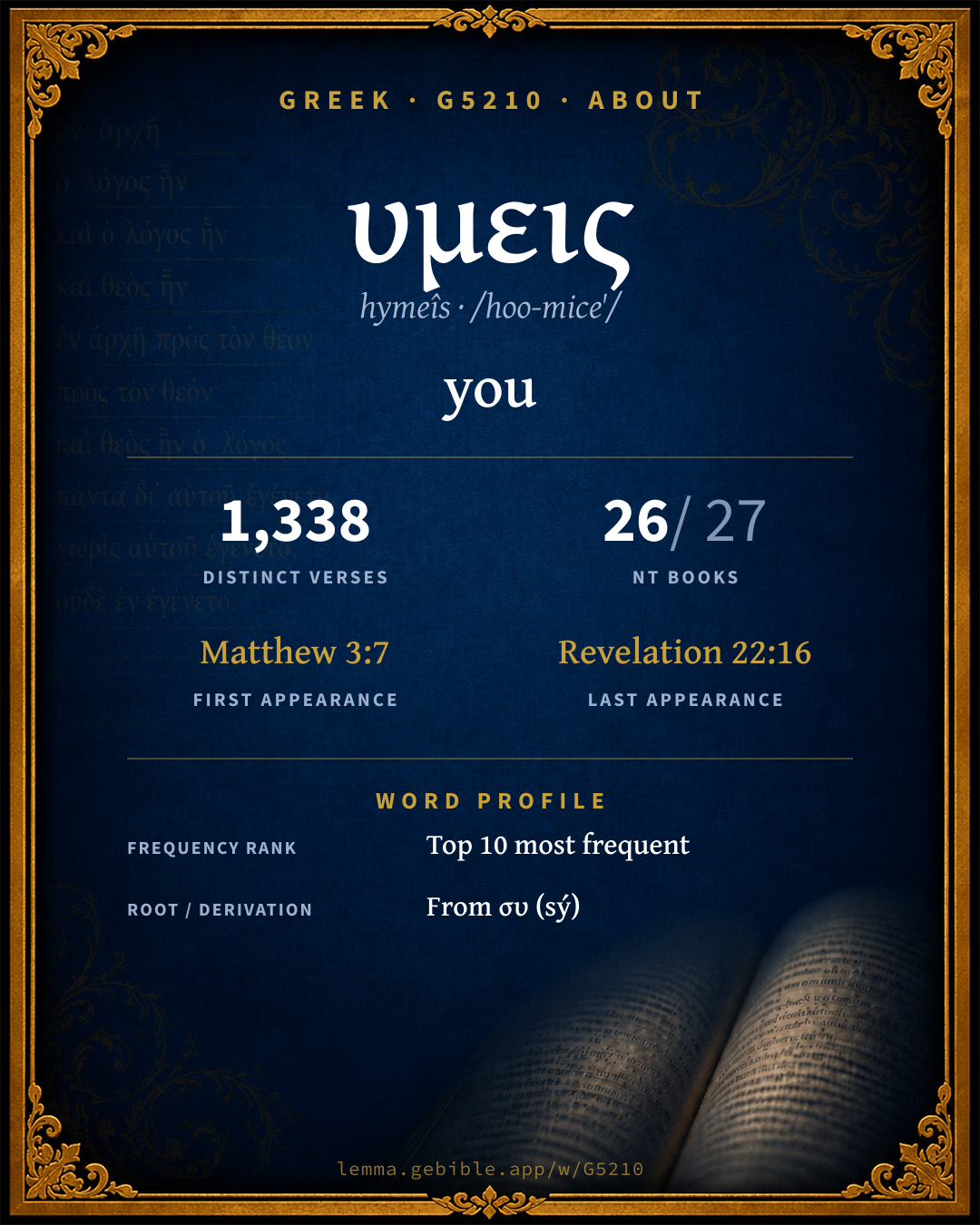
ὑμείς
you
Full lexicon entry — Thayer's Greek Lexicon
From Thayer's Greek Lexicon
Where this word appears
See every Accusative-case word in the Greek New Testament →
Grammar key — what these labels mean
Part of speech
- Personal pronoun
- Stands in for a person already named (“I,” “you,” “he”).
Case
- Dative
- The case of the indirect object, means, or location — “to / for / with / in.”
- Genitive
- The case of source, possession, or “of” — answers “whose / from what.”
- Accusative
- The case of the direct object and of extent.
- Nominative
- The case of the subject (and the predicate nominative).
Person
- 2nd person
- The one addressed (“you”).
Number
- Plural
- More than one.
50 verses where G5210 appears in the Accusative case in the Book of 2 Corinthians. Filtered view — show all forms. Click any verse to open its interlinear word-by-word view. Verse text shown in the World English Bible for context — . Each verse’s Greek form is shown with its reference; the English is not keyword-highlighted, since the data carries no word-level English alignment. Use “Compare translations” on any verse to read it across multiple English versions. This concordance covers the Greek New Testament; Septuagint (Greek Old Testament) occurrences of this word are not indexed here.
2 Corinthians
- 2 Corinthians 1:8 ὑμᾶς pron 2 acc pl For we don't desire to have you uninformed, brothers, concerning our affliction which happened to us in Asia, that we were weighed down exceedingly, beyond our power, so much that we despaired even of life.
- 2 Corinthians 1:12 ὑμᾶς pron 2 acc pl For our boasting is this: the testimony of our conscience, that in holiness and sincerity of God, not in fleshly wisdom but in the grace of God we behaved ourselves in the world, and more abundantly toward you.
- 2 Corinthians 1:15 ὑμᾶς pron 2 acc pl In this confidence, I was determined to come first to you, that you might have a second benefit;
- 2 Corinthians 1:16 ὑμῶν ὑμᾶς ὑμῶν pron 2 gen pl pron 2 acc pl pron 2 gen pl and by you to pass into Macedonia, and again from Macedonia to come to you, and to be sent forward by you on my journey to Judea.
- 2 Corinthians 1:18 ὑμᾶς pron 2 acc pl But as God is faithful, our word toward you was not "Yes and no."
- 2 Corinthians 2:1 ὑμᾶς pron 2 acc pl But I determined this for myself, that I would not come to you again in sorrow.
- 2 Corinthians 2:2 ὑμᾶς pron 2 acc pl For if I make you sorry, then who will make me glad but he who is made sorry by me?
- 2 Corinthians 2:3 ὑμᾶς ὑμῶν pron 2 acc pl pron 2 gen pl And I wrote this very thing to you, so that, when I came, I wouldn't have sorrow from them of whom I ought to rejoice; having confidence in you all, that my joy would be shared by all of you.
- 2 Corinthians 2:4 ὑμῖν ὑμᾶς pron 2 dat pl pron 2 acc pl For out of much affliction and anguish of heart I wrote to you with many tears, not that you should be made sorry, but that you might know the love that I have so abundantly for you.
- 2 Corinthians 2:5 ὑμᾶς pron 2 acc pl But if any has caused sorrow, he has caused sorrow, not to me, but in part (that I not press too heavily) to you all.
- 2 Corinthians 2:8 ὑμᾶς pron 2 acc pl Therefore I beg you to confirm your love toward him.
- 2 Corinthians 2:10 ὑμᾶς pron 2 acc pl Now I also forgive whomever you forgive anything. For if indeed I have forgiven anything, I have forgiven that one for your sakes in the presence of Christ,
- 2 Corinthians 3:1 ὑμᾶς ὑμῶν pron 2 acc pl pron 2 gen pl Are we beginning again to commend ourselves? Or do we need, as do some, letters of commendation to you or from you?
- 2 Corinthians 4:15 ὑμᾶς pron 2 acc pl For all things are for your sakes, that the grace, being multiplied through the many, may cause the thanksgiving to abound to the glory of God.
- 2 Corinthians 6:1 ὑμᾶς pron 2 acc pl Working together, we entreat also that you not receive the grace of God in vain,
- 2 Corinthians 6:11 ὑμᾶς pron 2 acc pl Our mouth is open to you, Corinthians. Our heart is enlarged.
- 2 Corinthians 6:17 ὑμᾶς pron 2 acc pl Therefore, "'Come out from among them, And be separate,' says the Lord, 'Touch no unclean thing. I will receive you.
- 2 Corinthians 7:4 ὑμᾶς ὑμῶν pron 2 acc pl pron 2 gen pl Great is my boldness of speech toward you. Great is my boasting on your behalf. I am filled with comfort. I overflow with joy in all our affliction.
- 2 Corinthians 7:8 ὑμᾶς ὑμᾶς pron 2 acc pl pron 2 acc pl For though I made you sorry with my letter, I do not regret it, though I did regret it. For I see that my letter made you sorry, though just for a while.
- 2 Corinthians 7:12 ὑμῖν ὑμῶν ὑμᾶς pron 2 dat pl pron 2 gen pl pron 2 acc pl So although I wrote to you, I wrote not for his cause that did the wrong, nor for his cause that suffered the wrong, but that your earnest care for us might be revealed in you in the sight of God.
- 2 Corinthians 7:15 ὑμᾶς ὑμῶν pron 2 acc pl pron 2 gen pl His affection is more abundantly toward you, while he remembers all of your obedience, how with fear and trembling you received him.
- 2 Corinthians 8:6 ὑμᾶς pron 2 acc pl So we urged Titus, that as he made a beginning before, so he would also complete in you this grace.
- 2 Corinthians 8:9 ὑμᾶς ὑμεῖς pron 2 acc pl pron 2 nom pl For you know the grace of our Lord Jesus Christ, that, though he was rich, yet for your sakes he became poor, that you through his poverty might become rich.
- 2 Corinthians 8:17 ὑμᾶς pron 2 acc pl For he indeed accepted our exhortation, but being himself very earnest, he went out to you of his own accord.
- 2 Corinthians 8:22 ὑμᾶς pron 2 acc pl We have sent with them our brother, whom we have many times proved earnest in many things, but now much more earnest, by reason of the great confidence which he has in you.
- 2 Corinthians 8:23 ὑμᾶς pron 2 acc pl As for Titus, he is my partner and fellow worker for you. As for our brothers, they are the apostles of the assemblies, the glory of Christ.
- 2 Corinthians 9:4 ὑμᾶς ὑμεῖς pron 2 acc pl pron 2 nom pl so that I won't by any means, if there come with me any of Macedonia and find you unprepared, we (to say nothing of you) should be disappointed in this confident boasting.
- 2 Corinthians 9:5 ὑμᾶς ὑμῶν pron 2 acc pl pron 2 gen pl I thought it necessary therefore to entreat the brothers that they would go before to you, and arrange ahead of time the generous gift that you promised before, that the same might be ready as a matter of generosity, and not of greediness.
- 2 Corinthians 9:8 ὑμᾶς pron 2 acc pl And God is able to make all grace abound to you, that you, always having all sufficiency in everything, may abound to every good work.
- 2 Corinthians 9:14 ὑμῶν ὑμᾶς ὑμῖν pron 2 gen pl pron 2 acc pl pron 2 dat pl while they themselves also, with supplication on your behalf, yearn for you by reason of the exceeding grace of God in you.
- 2 Corinthians 10:1 ὑμᾶς ὑμῖν ὑμᾶς pron 2 acc pl pron 2 dat pl pron 2 acc pl Now I Paul, myself, entreat you by the humility and gentleness of Christ; I who in your presence am lowly among you, but being absent am of good courage toward you.
- 2 Corinthians 10:9 ὑμᾶς pron 2 acc pl that I may not seem as if I desire to terrify you by my letters.
- 2 Corinthians 10:14 ὑμᾶς ὑμῶν pron 2 acc pl pron 2 gen pl For we don't stretch ourselves too much, as though we didn't reach to you. For we came even as far as to you with the Gospel of Christ,
- 2 Corinthians 11:2 ὑμᾶς ὑμᾶς pron 2 acc pl pron 2 acc pl For I am jealous over you with a godly jealousy. For I married you to one husband, that I might present you as a pure virgin to Christ.
- 2 Corinthians 11:6 ὑμᾶς pron 2 acc pl But though I am unskilled in speech, yet I am not unskilled in knowledge. No, in every way we have been revealed to you in all things.
- 2 Corinthians 11:8 ὑμῶν ὑμᾶς pron 2 gen pl pron 2 acc pl I robbed other assemblies, taking wages from them that I might serve you.
- 2 Corinthians 11:11 ὑμᾶς pron 2 acc pl Why? Because I don't love you? God knows.
- 2 Corinthians 11:20 ὑμᾶς ὑμᾶς pron 2 acc pl pron 2 acc pl For you bear with a man, if he brings you into bondage, if he devours you, if he takes you captive, if he exalts himself, if he strikes you on the face.
- 2 Corinthians 12:14 ὑμᾶς ὑμῶν ὑμᾶς pron 2 acc pl pron 2 gen pl pron 2 acc pl Behold, this is the third time I am ready to come to you, and I will not be a burden to you; for I seek not your possessions, but you. For the children ought not to save up for the parents, but the parents for the children.
- 2 Corinthians 12:15 ὑμῶν ὑμᾶς pron 2 gen pl pron 2 acc pl I will most gladly spend and be spent for your souls. If I love you more abundantly, am I loved the less?
- 2 Corinthians 12:16 ὑμᾶς ὑμᾶς pron 2 acc pl pron 2 acc pl But be it so, I did not myself burden you. But, being crafty, I caught you with deception.
- 2 Corinthians 12:17 ὑμᾶς ὑμᾶς pron 2 acc pl pron 2 acc pl Did I take advantage of you by anyone of them whom I have sent to you?
- 2 Corinthians 12:18 ὑμᾶς pron 2 acc pl I exhorted Titus, and I sent the brother with him. Did Titus take any advantage of you? Didn't we walk in the same spirit? Didn't we walk in the same steps?
- 2 Corinthians 12:20 ὑμᾶς ὑμῖν pron 2 acc pl pron 2 dat pl For I am afraid that by any means, when I come, I might find you not the way I want to, and that I might be found by you as you don't desire; that by any means there would be strife, jealousy, outbursts of anger, factions, slander, whisperings, proud thoughts, riots;
- 2 Corinthians 12:21 ὑμᾶς pron 2 acc pl that again when I come my God would humble me before you, and I would mourn for many of those who have sinned before now, and not repented of the uncleanness and sexual immorality and lustfulness which they committed.
- 2 Corinthians 13:1 ὑμᾶς pron 2 acc pl This is the third time I am coming to you. "At the mouth of two or three witnesses shall every word established."
- 2 Corinthians 13:3 ὑμᾶς ὑμῖν pron 2 acc pl pron 2 dat pl seeing that you seek a proof of Christ who speaks in me; who toward you is not weak, but is powerful in you.
- 2 Corinthians 13:4 ὑμᾶς pron 2 acc pl For he was crucified through weakness, yet he lives through the power of God. For we also are weak in him, but we will live with him through the power of God toward you.
- 2 Corinthians 13:7 ὑμᾶς ὑμεῖς pron 2 acc pl pron 2 nom pl Now I pray to God that you do no evil; not that we may appear approved, but that you may do that which is honorable, though we are as reprobate.
- 2 Corinthians 13:12 ὑμᾶς pron 2 acc pl Greet one another with a holy kiss.
About this entry
At a glance — auto-summarized from this page’s data, not written by a person. Every figure links to its source below. This summary describes the numbers; it doesn’t interpret them.
υμεις (hymeîs) is a Greek word most often rendered “you.” It first appears in Matthew 3:7. It turns up in 1,338 verses across 26 books, one of the most common footprint. From the same root come συ, σε and σοι. For the data behind this summary, explore the sense tree and the renderings breakdown below.
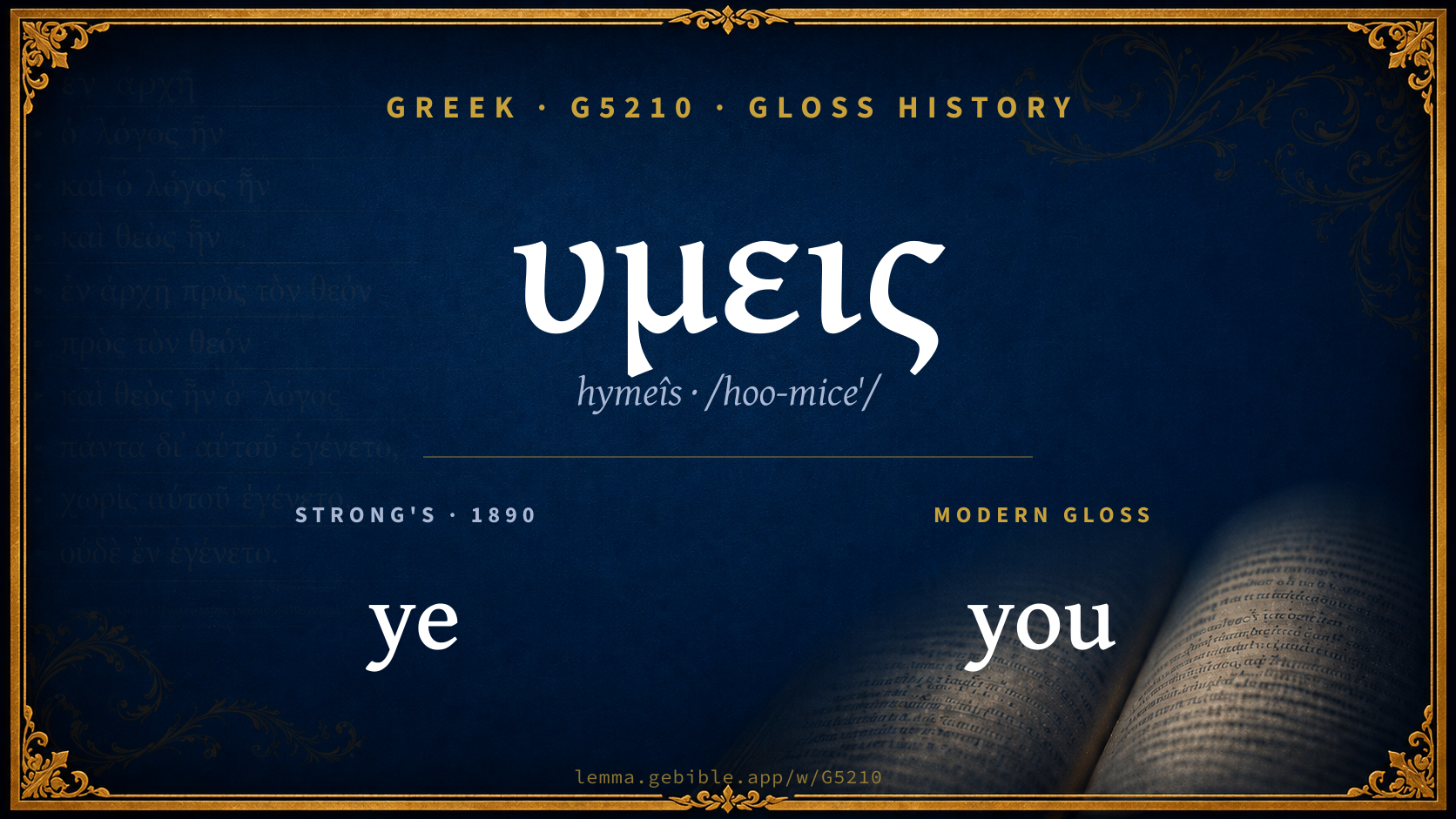
Gloss history
Strong's 1890 vs modern scholarship
About this word
Strong's G5210 catalogs a Greek word from the Greek New Testament.
These counts are not copied from any lexicon or concordance. They are computed here, from the morphology-tagged Greek New Testament. What Lemma adds →
- 1,338
- distinct verses
- The word appears in 1,338 distinct verses.
- 26 / 27
- NT books
- The word appears in 26 of 27 New Testament books.
- #8
- by frequency
- Top 10 most frequent Greek words (rank 8 of 5,347 Greek words by occurrence).
View all 1,338 occurrences in the concordance →
By section of the New Testament
By traditional corpus
Conventional, traditional groupings — biblical authorship is debated, so this is a traditional corpus grouping, not an authorship claim. Some books belong to more than one corpus (Luke is in both the Gospels and the Lukan corpus, and so on), so these shares overlap and need not total 100%. Each figure is a share of the word’s 1,338 distinct verses.
- Gospels 566 verses · 42%
- Pauline corpus 525 verses · 39%
- Lukan (Luke–Acts) 256 verses · 19%
- Johannine 194 verses · 14%
- General (Catholic) Epistles 121 verses · 9%
- Hebrews 28 verses · 2%
- Revelation 9 verses · 1%
How translations render this word
Counts come from each version’s own published word-to-Strong’s tagging or interlinear alignment — an approximate guide to how each version renders this word, not a word-level alignment the data otherwise carries. Because each total is that version’s own tagged count, the per-version totals vary from one another and need not match the appearance or distinct-verse counts above. These counts may also differ from a printed concordance because Lemma counts each distinctly tagged rendering and does not collapse phrase taggings into a single head-word total. This is a fixed set of word-tagged versions (KJV, ASV, BSB, ULT) and does not change with the reading translation you choose elsewhere. Each version’s license is shown beside its name below (and on Sources).
- King James Version: Ye 229×, Do ye 3×, Thither ye 2×
- American Standard Version: Ye 220×, Do ye 4×
King James Version Public Domain
Renders G5210 across 242 tagged occurrences — most commonly:
Plus 8 renderings that appear only once — usually multi-word phrases or single function words the recovered tagging swept in, not distinct renderings.
American Standard Version Public Domain
Renders G5210 across 237 tagged occurrences — most commonly:
Plus 13 renderings that appear only once — usually multi-word phrases or single function words the recovered tagging swept in, not distinct renderings.
Senses in Thayer's
The 1 sense Thayer's distinguishes for this word, in lexicon order (not ranked by frequency or importance). The full entry — with sub-senses — is in the Lexicon Entry tab.
- you
Word origin
Derived from συ (sý) (G4771) — you.
Irregular plural of G4771 ; you (as subject of verb): - ye (yourselves) you.
— Strong’s Exhaustive Concordance (1890), public domain.
Forms in the corpus
The 5 distinct written forms G5210 takes in the Greek New Testament, most frequent first — each parse links to that case’s occurrences in the concordance.
| Form | Parsing | Example | Uses |
|---|---|---|---|
| ὑμῖν hymîn | Personal pronoun, 2nd person, Dative, Plural | Matthew 3:7 | 601 |
| ὑμῶν hymō̂n | Personal pronoun, 2nd person, Genitive, Plural | Matthew 5:11 | 560 |
| ὑμᾶς hymâs | Personal pronoun, 2nd person, Accusative, Plural | Matthew 3:11 | 432 |
| ὑμεῖς hymeîs | Personal pronoun, 2nd person, Nominative, Plural | Matthew 5:48 | 230 |
| Ὑμεῖς Hymeîs | Personal pronoun, 2nd person, Nominative, Plural | Matthew 5:13 | 5 |
Same root — word family
Other Thayer's entries built from the same root as G5210, grouped by Strong’s listed origin. These share a root / origin per the lexicon — not necessarily a shared meaning. Each links to that word’s own entry.
Derives from
Shares the same root
Derived from this word
Compare all same-root words → Showing 4 of 10 — not the complete family. They share a root, not necessarily a meaning.
Septuagint usage
The same Greek word υμεις appears 3 times in the Greek Old Testament (Septuagint), across 3 verses in 1 book.
- 3
- LXX occurrences
- Tagged occurrences of this Greek word in the Septuagint.
- 3
- verses
- Distinct Septuagint verses containing this word.
- 1 / 39
- OT books
- The word appears in 1 of the 39 Old Testament books.
Sample Septuagint occurrences
- Jeremiah 41:17 ὑμεῖς
Septuagint occurrences (same lexeme)
Every verse where the same Strong’s number (G5210) appears in the Greek Septuagint. Verse text shown in the World English Bible for context; the Greek form is the matched word — the English is not keyword-highlighted.
- Jeremiah 41:17 ὑμεῖς and they departed, and lived in Geruth Chimham, which is by Bethlehem, to go to enter into Egypt,
- Jeremiah 51:2 ὑμεῖς I will send to Babylon strangers, who shall winnow her; and they shall empty her land: for in the day of trouble they shall be against her round about.
- Jeremiah 51:25 ὑμεῖς Behold, I am against you, destroying mountain, says Yahweh, which destroy all the earth; and I will stretch out my hand on you, and roll you down from the rocks, and will make you a burnt mountain.
These are occurrences of the same Greek lexeme (G5210) in the Septuagint — not a translation of any one Hebrew word. The store carries no word-level Hebrew↔Greek alignment, so no Hebrew original is asserted here. Counts come from the recovered LXX Strong's tagging — high-frequency vocabulary is well covered, while rare or late forms may be untagged — so they reflect tagged occurrences and may slightly undercount.