
2 Corinthians 10:9

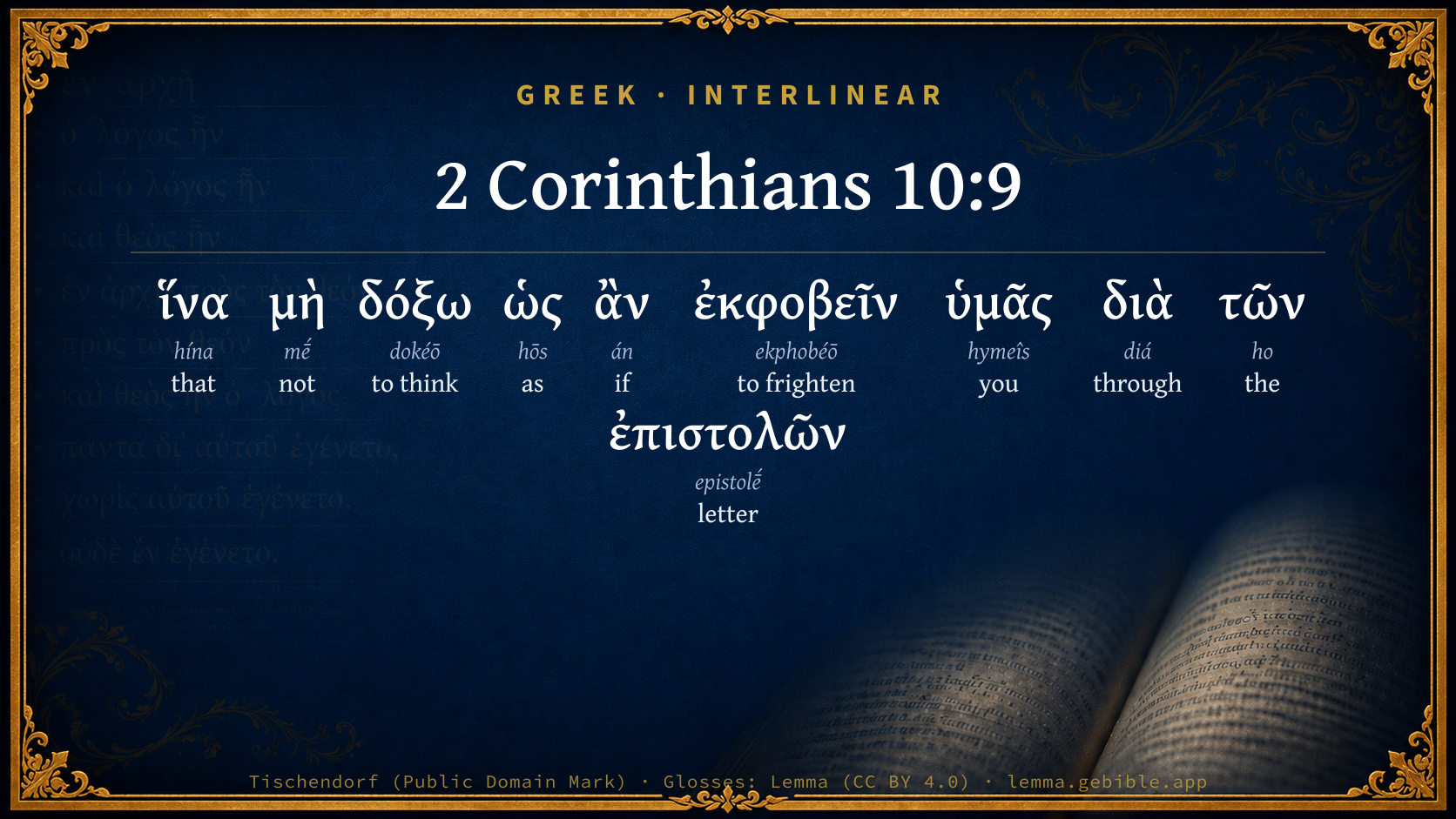
Greek (Tischendorf 8th ed.) 2 Corinthians 10:9 appears in the Greek New Testament. The text above is from the Tischendorf 8th edition. Each word links to its Strong’s number and a concise gloss. Click any word for its full Thayer’s Greek Lexicon entry.
Download image
Cite this verse

2 Corinthians 10:9 (World English Bible). Public Domain. Lemma interlinear Bible study tool, https://lemma.gebible.app/v/2-corinthians/10/9.

Show BibTeX & RIS
BibTeX
RIS
English Translation
that I may not seem as if I desire to terrify you by my letters.
World English Bible · Public Domain
Highlights
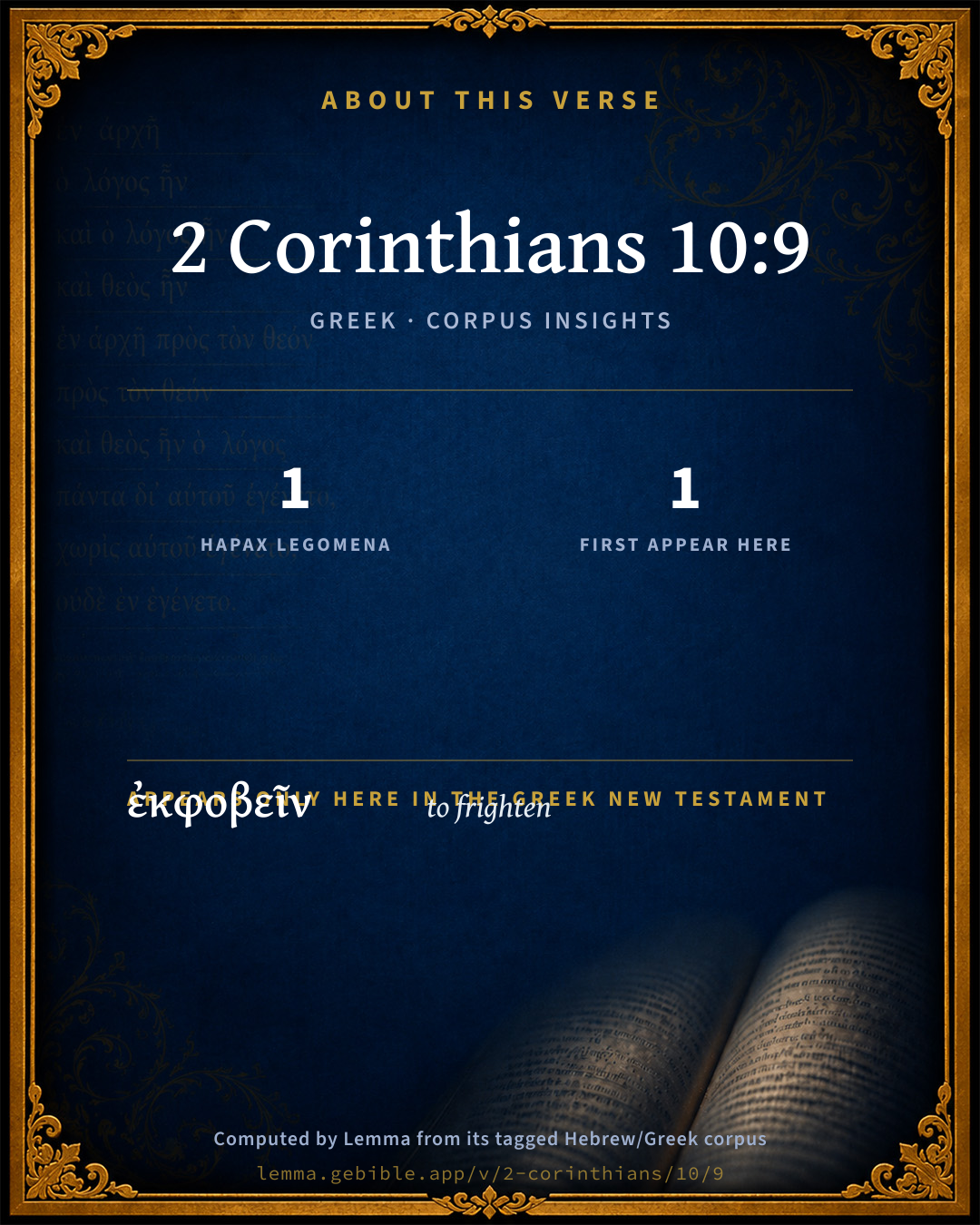
  • 1 hapax legomenon — only here in the Greek New Testament
  • 1 first appearance in the Greek New Testament
Full analysis ↓
Download a study sheet

One document with this verse’s original text, its word-by-word gloss line, the meaning frame, cross-references with their text, attributed commentary, and full source and license credits — printable, and it pastes into notes with its structure intact.

This verse Autodidact and up

Study sheet (.html) Plain text (.txt)

A passage Seminary Student

Up to 50 verses in one chapter. A passage sheet keeps up to 6 commentary sources and 12 cross-references per verse, in the order this page ranks them, and says so on the sheet whenever that leaves anything out. Ask for a single verse and you get the Autodidact verse sheet above.

Everything on this page stays free to read, with no account — the sheet is a download of what is already on screen, not access to it.

Want to remove ads? Support Godless Engineer
Compare translations 3

The same verse in 3 English versions, stacked beneath the original-language interlinear above. Click any original word for its lexicon entry.

Each is an independent rendering of the whole verse — the interlinear is not word-aligned to these translations.

Highlighted words mark where these versions differ — a whole-verse word diff, not a word-by-word alignment.

  • World English Bible Public Domain
    that I may not seem as if I desire to terrify you by my letters.
  • King James Version Public Domain
    That I may not seem as if I would terrify you by letters.
  • unfoldingWord Literal Text CC BY-SA 4.0
    so that I would not seem as if to terrify you through my letters.

unfoldingWord Literal Text — © unfoldingWord, licensed CC BY-SA 4.0. Word-aligned USFM3 via Door43 (git.door43.org/unfoldingWord/en_ult).

Versions to compare (up to 4)

3 of 4 selected

Show all 19 translations

Every available English version of this verse, each an independent rendering of the whole verse.

  • World English Bible Public Domain
    that I may not seem as if I desire to terrify you by my letters.
  • Berean Standard Bible Public Domain
    I do not want to seem to be trying to frighten you by my letters.
  • Majority Standard Bible Public Domain
    I do not want to seem to be trying to frighten you by my letters.
  • King James Version Public Domain
    That I may not seem as if I would terrify you by letters.
  • American Standard Version (1901) Public Domain
    that I may not seem as if I would terrify you by my letters.
  • Revised Version (1885) Public Domain
    that I may not seem as if I would terrify you by my letters.
  • Geneva Bible (1599) Public Domain
    This I say, that I may not seeme as it were to feare you with letters.
  • Douay-Rheims (1899) Public Domain
    But that I may not be thought as it were to terrify you by epistles,
  • Young's Literal Translation Public Domain
    that I may not seem as if I would terrify you through the letters,
  • Literal Standard Version CC BY-SA 4.0
    that I may not seem as if I would terrify you through the letters,
  • Unlocked Literal Bible CC BY-SA 4.0
    I do not want it to appear that I am terrifying you by my letters.
  • unfoldingWord Literal Text CC BY-SA 4.0
    so that I would not seem as if to terrify you through my letters.
  • Darby Bible Public Domain
    that I may not seem as if I was frightening you by letters:
  • World Messianic Bible Public Domain
    that I may not seem as if I desire to terrify you by my letters.
  • Webster's Bible Public Domain
    That I may not seem as if I would terrify you by letters.
  • Free Bible Version CC BY-SA 4.0
    I'm not trying to scare you by my letters.
  • Bible in Basic English Public Domain
    That I may not seem to have the desire of causing you fear by my letters.
  • Text-Critical English NT CC BY 4.0
    For I do not want to seem as though I am trying to frighten you by my letters.
  • Tyndale New Testament (1534) Public Domain
    This saye I lest I shuld seme as though I went about to make you a frayde with letters.

Literal Standard Version (2020), Covenant Press — licensed CC BY-SA 4.0. Text via the HelloAO Bible API (eBible.org). Unlocked Literal Bible (unfoldingWord) — licensed CC BY-SA 4.0. Text via the HelloAO Bible API (eBible.org). unfoldingWord Literal Text — © unfoldingWord, licensed CC BY-SA 4.0. Word-aligned USFM3 via Door43 (git.door43.org/unfoldingWord/en_ult). Free Bible Version, Dr. Jonathan Gallagher — licensed CC BY-SA 4.0. Text via the HelloAO Bible API (eBible.org).

Word by word

More ways to search: Search by grammar → Find every occurrence → Compare this word →

Practice this passage: Drill this verse → Learn its vocabulary →

About this verse

These counts appear in no published source. They are computed here, from the morphology-tagged text and Lemma’s own curated glosses. What Lemma adds →

10
words
10
distinct lemmas
Pauline Epistles
section

Notable vocabulary

1 hapax legomenon — a word that appears only here in the entire Greek New Testament:

  • ἐκφοβεῖν to frighten G1629

First appearance in Scripture

This word makes its first canonical appearance in the Greek New Testament here:

  • ἐκφοβεῖν to frighten G1629

Shared distinctive vocabulary

ἐπιστολῶν letter G1992 occurs in 23 verses of the Greek New Testament. Also found in:
Cross-references

3

Topical passages linked to 2 Corinthians 10:9 in the Treasury of Scripture Knowledge — connected by theme and wording, ordered by reader-vote popularity; previews shown in the World English Bible.

  • 1 Corinthians 4:19–21 But I will come to you shortly, if the Lord is willing. And I will know, not the word of those who are puffed up, but the power.
  • 1 Corinthians 4:5 Therefore judge nothing before the time, until the Lord comes, who will both bring to light the hidden things of darkness, and reveal the counsels of the hearts. Then each man will get his praise from God.
  • 2 Corinthians 10:10 For, "His letters," they say, "are weighty and strong, but his bodily presence is weak, and his speech is despised."

Cross-references courtesy of OpenBible.info (CC BY 4.0).

Commentary

Notes on 2 Corinthians 10:9 from classic Christian and Jewish commentators (each source and its license shown beneath its notes). The classic Christian expositions comment on the surrounding passage and are grouped to its opening verse, so a note may address several verses; the Jewish commentaries on the Tanakh (Rashi and others) are per-verse, so they appear only where the commentator wrote on this verse.

Lemma curates 59 commentaries, every one of them public domain or Creative Commons licensed, each selected and text-cleaned for this edition rather than reprinted as found. About our sources →

Bengel's Gnomon

Johann Albrecht Bengel

2Co 10:9. Ἴνα μὴ) I say this, lest, etc.—ὠς ἄν) Apposite particles [as though I would].—ἐκφοβεῖν ὑμᾶς, terrify you) as if you were children, with vain terror.

Bengel's Gnomon of the New Testament — English translation (T&T Clark, Edinburgh, 1860) — public domain. Text from a community e-Sword module.

Meyer's Critical & Exegetical Commentary

Heinrich August Wilhelm Meyer

2Co_10:9 is taken by Chrysostom, Calvin, Schulz, Morus, Zachariae, Emmerling, Vater, Rückert, Olshausen, de Wette, Ewald, Maier, Hofmann, as the protasis of 2Co_10:11, so that 2Co_10:10 becomes a parenthesis. But by Erasmus, Luther, Castalio, Beza, Grotius, Bengel, and others, also Billroth and Schrader, it is attached to 2Co_10:8, in which case, however, some (Beza, Bengel, comp. Billroth) supply before ἵνα a quod ego idcirco dico, others (Grotius, comp. Erasmus): non addam plura ea de re. The latter is pure invention; and from the supplement of Beza there would not at all logically result what is said in 2Co_10:9. No; let ἵνα μὴ δόξω κ.τ.λ. be joined immediately, without assuming any intervening thought, to οὐκ αἰσχυνθήσομαι: I shall not be put to shame (now comes the definition, in a negative form, of the divine aim with reference to the charge in question), in order that I may not appear, etc., that the matter may not remain on the footing of the mere word, but it may be apparent in point of fact that I am something quite other than the man who wishes to frighten you by his letters. If in this way the passage proceeds simply and correctly without logical difficulty, the less simple connection of Chrysostom et al. (see above) is superfluous, and is, moreover, not to be accepted, because the new part of the passage would begin, in a very palpably abrupt way, with ἵνα without any connecting particle,[304] and because what Paul says in 2Co_10:11 could not destroy the appearance indicated in 2Co_10:9, to which belonged matter of fact.

ὡς ἂν ἐκφοβεῖν ὑμᾶς] The Vulgate rightly has: tanquam terrere vos, and Beza: ceu perterrefacere vos. The ὡς ἄν modestly takes away from the harsh and strong ἐκφοβεῖν the offensiveness, which in the feeling of the apostle it would have had, if taken by itself and in its full sense. It is not modal (in any way, Hofmann), but comparative, corresponding quite to our modifying as [German wie]: that I may not appear to put you as in dread. In later Greek ὡς ἄν certainly has the meaning tanquam, quasi, ἄν having lost its specific reference. See Hermann, de part. ἄν, 4. 3, p. 184; Bornemann, in d. Sächs. Stud. 1846, p. 61; Buttmann, neut. Gram. p. 189 [E. T. 219]. To resolve it into ὡς ἂν ἐκφοβοῖμι ὑμᾶς (Olshausen) is arbitrary, as if it were oratio directa. The classical ὡς ἄν with optative and subjunctive (Klotz, ad Devar. p. 767), as in 1Th_2:7, is not to be brought into comparison her.

διὰ τῶν ἐπιστ.] namely, which I write to you (article); he had already written two. The plural does not justify the hypothesis of a third letter already written (Bleek).

The compound ἐκφοβεῖν (comp. ἔκφοβος, Mar_9:6; Heb_12:21) is stronger than the simple form, Plato, Gorg. p. 483 C; Ephesians 3, p. 318 B; Thuc. iii. 42. 4; Polyb. xiv. 10. 3; Wis_17:9; Wis_17:19; 1Ma_14:17.

[304] Hence also at a very early time there crept in after ἵνα a δέ, which we still find in Syr. Vulg. Chrys. Theophyl. Pel. Ambrosiast. and several cursives.

Meyer — Critical and Exegetical Commentary on the New Testament — English translation by Peter Christie, edited by Frederick Crombie (T&T Clark, 1880) — public domain. Text from a community e-Sword module.

Expositor's Greek Testament

ed. W. Robertson Nicoll

2Co 10:9 . ἵνα μὴ δόξω κ . τ . λ .: that I may not seem as if I would scare you by my letters . It is best to take these words with εἰς οἰκοδομήν of the preceding verse; his purpose in writing so severely is not to terrify them, but to build them up in holiness and obedience. ὡς ἄν = tanquam , with the infin. is only found here in the N.T. The plural τῶν ἐπιστολῶν suggests (what we know from 1Co 5:9 ) that at least one letter of rebuke in addition to 1 Cor. had been written before this.

The Expositor's Greek Testament, edited by W. Robertson Nicoll (1897–1910) — public domain. Text from a community e-Sword module.

Cambridge Greek Testament for Schools and Colleges

9. ἵνα μὴ δόξω ὡς ἂν ἐκφοβεῖν ὑμᾶς τῶν ἐπιστολῶν. The construction is uncertain; but it is very forced to make 2Co 10:9 the protasis of 2Co 10:11, with 2Co 10:10 as a parenthesis; “That I may not seem … let such a one count this.” Moreover the beginning of 2Co 10:9 becomes in that case very abrupt; and so Chrysostom slips in a δέ, and the Vulgate and Calvin an autem, which has no authority of any weight: ut autem non existimer tanquam terrere vos (Vulg.); ne autem videar terrere vos (Calv.). More probably ἵνα μὴ δόξω depends upon 2Co 10:8; and some such thought as ‘I say this,’ or ‘I refrain from using stronger language,’ is to be understood. But nothing need be inserted in English, any more than in the Greek. As ἐκφοβεῖν is a strong word, it is toned down by ὡς ἄν: that I may not seem, as it were, to terrify you by my letters. This is a rare instance of ἄν with the infin. But perhaps ὡς and ἄν coalesce as ὡσάν = quasi. Winer, p. 390 note. In the LXX. ἐκφοβεῖν is frequent (Job 7:14; Job 33:16; Wis 11:19; Wis 17:6; &c.), especially in the phrase οὐκ ἔσται ὁ ἐκφοβῶν (Lev 26:6; Jdg 16:25; Mic 4:4; &c.), but nowhere else in the N.T.: we have ἔκφοβος Mar 9:6; Heb 12:21. We know of two letters, viz. 1 Corinthians and the lost letter of 1Co 5:9; and we have seen that another letter seems to be required (see notes on 2Co 1:23, 2Co 2:3; 2Co 2:9, 2Co 7:8). If 2 Corinthians 1-13 is all one letter, then the Corinthians had received three letters before this was written; but more probably 2 Corinthians 10-12. is part of this third letter

Cambridge Greek Testament for Schools and Colleges (Cambridge University Press, 1896; 21 vols, various authors incl. Carr, Maclear, Plummer, Farrar, Lumby, Moule, M. R. James, Simcox) — public domain. Text from a community e-Sword module.

Jamieson, Fausset & Brown

Robert Jamieson, A. R. Fausset & David Brown

I say this lest I should seem to be terrifying you, as children, with empty threats [BENGEL]. ESTIUS explains, "I might boast more of my authority, but I forbear to do so, that I may not seem as if," &c. But this ellipsis is harsh: and Co2 10:10-11 confirm BENGEL'S view.

Jamieson, Fausset & Brown — Commentary Critical and Explanatory on the Whole Bible (1871) — public domain (CC PDM 1.0). Text via the HelloAO Bible API.

Adam Clarke's Commentary

Verse 9. That I may not seem, c.] This is an elliptical sentence, and may be supplied thus: "I have not used this authority nor will I add any more concerning this part of the subject, lest I should seem, as my adversary has insinuated, to wish to terrify you by my letters.

Adam Clarke's Commentary on the Bible (1810–1826) — public domain. Text from a community e-Sword/MySword module.

John Calvin's Commentaries

9 That I may not seem to terrify. Again he touches on the calumny which he had formerly refuted, (2 Corinthians 10:2,) that he was bold in his writings, while in their presence his courage failed him. On this pretext they disparaged his writings. “What!” Said they, “will he terrify us by letters when at a distance, while, if present with us, he would scarcely venture to mutter a word!” Lest, therefore, his letters should have less weight, he answers, that no objection is advanced against him, that should either destroy or weaken his credit, and that of his doctrine, for deeds were not to be less valued than words. He was not less powerful in actions when present, than he was by words when absent. Hence it was unfair, that his bodily presence should be looked upon as contemptible. By deed, here, he means, in my opinion, the efficacy and success of his preaching, as well as the excellences that were worthy of an Apostle, and his whole manner of life. Speech, on the other hand, denotes — not the very substance of doctrine, but simply the form of it, and the bark, so to speak: for he would have contended for doctrine with greater keeness. The contempt, however, proceeded from this — that he was deficient in that ornament and splendor of eloquence, which secures favor.

John Calvin's Commentaries (1540-1563) — public domain. Text from the Calvin Translation Society English edition (1840s-50s) via the Christian Classics Ethereal Library (ccel.org). Calvin's coverage is partial (roughly two-thirds of the Bible); uncommented books and verses are honest gaps, never fabricated. The 19th-century editor's footnotes and remarks are omitted so the notes are faithfully Calvin's own voice.

Ellicott's Commentary for English Readers

(9) That I may not seem as if I would terrify you by letters.—The logical sequence of thought is: “I say this” (i.e., that my sentence of delivery to Satan will not be a hollow form) “in order that I may not seem to frighten you as with a bug-bear.” This, it is clear from what follows, had been said. (Comp. the sneer in the next verse.) The use of the plural in this verse and that which follows is in favour of the hypothesis of a lost letter being referred to in 1Co_5:9, but does not absolutely prove it.

A Bible Commentary for English Readers, edited by Charles John Ellicott (1878–1897) — public domain. Text from a community e-Sword module.

The Cambridge Bible for Schools and Colleges

gen. ed. J. J. S. Perowne

9. that I may not seem as if I would terrify you by letters] Literally, by means of the letters, i.e. this and the two former. See note on 1Co_5:9. The connection of thought is not clear at first sight, but a little consideration will serve to bring it out. St Paul is about to boast of his authority. This boast is no brutum fulmen. He means to act upon it in all seriousness when he comes to Corinth. He wishes them to understand that it will not be confined to words, but will be shewn in deeds when he arrives. See note on 2Co_10:6.

The Cambridge Bible for Schools and Colleges (gen. ed. J. J. S. Perowne; Cambridge University Press, 1878–1918) — public domain. Text from a community e-Sword module.

John Gill's Exposition

That I may not seem as if I would terrify you by letters. Here seems to be something wanting, which is to be supplied, The sense is, though I might lawfully boast of the superior authority which we apostles have above other persons, in using sharpness with men insolent and hardened in sin; yet I will not, I forbear every thing of that kind, I drop it, I do not choose to insist upon it; , "I overlook", or "neglect" it, "I do not care" to do it, as the Syriac version supplies it; and this he thought most prudent and advisable, lest he should give any occasion to the above calumny that he was bold, and blustering, and terrifying by his letters when absent, and only threatened that he had no power to perform.

That I may not seem as if I would terrify you by letters. Here seems to be something wanting, which is to be supplied, The sense is, though I might lawfully boast of the superior authority which we apostles have above other persons, in using sharpness with men insolent and hardened in sin; yet I will not, I forbear every thing of that kind, I drop it, I do not choose to insist upon it; , "I overlook", or "neglect" it, "I do not care" to do it, as the Syriac version supplies it; and this he thought most prudent and advisable, lest he should give any occasion to the above calumny that he was bold, and blustering, and terrifying by his letters when absent, and only threatened that he had no power to perform.

2 Corinthians 10:10

co2 10:10

co2 10:10

co2 10:10For his letters, say they, are weighty and powerful,.... These words contain the reason why he did not choose to say any more of his authority as an apostle to punish offenders, that he might give no occasion for such a calumny, some among them, or the false apostles, had cast upon him; that his epistles, referring particularly to his former epistle, and that part of it which respected the incestuous person, and his delivery to Satan, were blustering and thundering; were laden with sharp reproofs and severe menaces; were heavy with charges, were filled with great swelling words, with boasts of power and authority, and with threatenings what he would do, when he came among them; whereas when present, as at his first coming to them, he was mild and gentle, even to a degree of meanness and baseness, as they suggested; and so they concluded he would be, should he come again; and therefore his letters were not to be regarded:

but his bodily presence is weak, and his speech contemptible: he made a mean figure, being of a low stature, and having an infirm body: the account the historian (m) gives of him is this, that

"he had a small and contracted body, somewhat crooked and bowed, a pale face, looked old, and had a little head; he had a sharp eye; his eyebrows hung downwards; his nose was beautifully bent, somewhat long; his beard thick and pretty long; and that, as the hair of his head, had a sprinkling of gray hairs:''

hence one in Lucian (n) scoffingly says of him,

"when the bald headed Galilean met me, with his hook nose, who went through the air to the third heaven:''

though the words of this text rather regard his mind and mien than the make of his body; and suggest that he was not a man of that greatness of soul, and largeness of mind, not possessed of those abilities and gifts, and of that freedom of speech, and flow of words, his letters promised; but instead of that, was a man of a mean spirit, very abject and servile, and to be despised; his conduct weak, and carrying no majesty and authority with his presence, his words without weight, his language vulgar, and style neglected; and, upon all accounts, a person worthy of no notice, and not at all to be either feared or regarded.

(m) Nicephorus, l. 2. c. 37. (n) In Philopatr.

John Gill's Exposition of the Whole Bible (1746–1763) — public domain (CC PDM 1.0). Text via the HelloAO Bible API.

Trapp's Complete Commentary

John Trapp

9 That I may not seem as if I would terrify you by letters.

Ver. 9. Terrify you by letters] As the false apostles object against me. Aspersions must be carefully cleared, when the fruit of a man’s ministry is thereby impeached and impeded.

John Trapp, A Commentary or Exposition upon All the Books of the Old and New Testament (1647–1656) — public domain. Text from a community e-Sword module.

Albert Barnes' Notes on the Bible

That I may not seem ... - The meaning of this verse seems to be this. “I say that I might boast more of my power in order that I may not appear disposed to terrify you with my letters merely. I do not threaten more than I can perform. I have it in my power to execute all that I have threatened, and to strike an awe not only by my letters, but by the infliction of extraordinary miraculous punishments. And if I should boast that I had done this, and could do it again, I should have no reason to be ashamed. It would not be vain and empty boasting; not boasting which is not well-founded.”

Albert Barnes' Notes on the Bible (1834–1885) — public domain. Text from a community e-Sword/MySword module.

Matthew Poole's English Annotations

This was one imputation upon the apostle, as we may learn by the next verse. I tell you, saith the apostle, that I have an authority, and a further authority than those who vilify me can pretend unto: but I also tell you, I have no authority to do any harm to any of you; all the authority I have is for your edification, as much as lieth in me to promote the business of your salvation; so that I need not be reported as one that went about to terrify you by my letters; yet I know there are some who so represent me unto you.

Matthew Poole's English Annotations on the Holy Bible (1683–1685) — public domain. Text from a community e-Sword/MySword module.

The Pulpit Commentary

By letters; rather, by the letters. He had certainly addressed two letters to them. (1Co_5:9)

The Pulpit Commentary (1880–1919), ed. H.D.M. Spence-Jones & Joseph S. Exell — public domain. Text from a community e-Sword module.

John Wesley's Explanatory Notes

I say this, that I may not seem to terrify you by letters - Threatening more than I can perform.

John Wesley, Explanatory Notes Upon the Whole Bible (1754–1765) — public domain. Text via the GEBible commentary corpus.

Burkitt's Expository Notes on the New Testament

William Burkitt

Our apostle here goes on, vindicating himself from the aspersions and reflections which the false teachers cast upon him. They told the Corinthians, that St. Paul’s letters were indeed severe and authoritative, terrifying and affrighting: but his personal presence was weak, and his speech contemptible.

Tradition tells us, that Paul (according to his name) was a man of very little stature, and his voice answerably small; whence probably, the false apostles took occasion to raise this report of his presence and speech. St. Chrysostom saith, that St. Paul’s stature was low, his body crooked, his head bald; and when it is added, that his speech was contemptible, it cannot be understood as if it were so for want of eloquence, but it is thought, this refers rather to some infirmity, or natural impediment, which the apostle might have in his speech.

The gift of knowledge and learning, and the gift of utterance and elocution, as they are distinct in their nature, so they are separable in their subject, and do not always go together; a person of the profoundest knowledge is not always happy in elocution and utterance.

However, in these false teachers we see the constant method and practice of impostors and seducers; namely, to asperse and lessen all that stand in their light. This is an old way of insinuating into the people. The false apostles feared they should never reign at Corinth, but by bringing St. Paul into disesteem with the Corinthians; therefore they say, his letters are weighty, but his bodily presence weak.

But the apostle, 2Co 10:11. gives them to understand, that they should find him the same both absent and present; and that his deeds then should appear as awful as his words now; that when he came again, he would not spare, but punish all disobedience.

Note here, That the things which St. Paul would have his accusers fear, was that by the miraculous gift of the Holy Ghost given to him, to inflict corporal punishments upon disobedient persons, they should speed as Elymas did, Act 13:8 who was smitten with blindness, &c.

William Burkitt's Expository Notes on the New Testament (1700–1703) — public domain. Text from a community e-Sword module.

McGarvey & Pendleton's Commentaries

J. W. McGarvey

that I may not seem as if I would terrify you by my letters .

J. W. McGarvey (with Philip Y. Pendleton), Commentaries on the New Testament (The Fourfold Gospel, 1914; Acts; and the epistles) — public domain. Text from a community e-Sword/MySword module.

The People's New Testament

B. W. Johnson

9, 10. That I may not seem, etc. His enemies said that his letters were weighty and stern, but his presence was very different. In other words, he terrified by empty threats.

B. W. Johnson's The People's New Testament with Notes (1889–1891) — public domain. Electronic text from the Christian Classics Ethereal Library (CCEL) ThML edition.

unfoldingWord translationNotes

Door43 World Missions Community

I am terrifying you

"I am trying to frighten you"

serious and powerful

"demanding and forceful"

translationWords

terror

epistle

worthy

unfoldingWord translationNotes — © Distant Shores Media and the Door43 World Missions Community, licensed CC BY-SA 4.0. Source: git.door43.org/Door43/en_tn.

Alford’s Greek Testament

Henry Alford

9.] follows on ver. 8, but requires some clause to be supplied such as ‘And I say this,’ or the like. Meyer would join it immediately to αἰσχυνθ., and regard it as the purpose to be served by the fact verifying his boast. But as De W. observes, a particular result like this can hardly be bound on to a general assertion like that of ver. 8. To suppose the purpose of Paul’s boast of apostolic power being borne out, to be merely ἵνα μὴ δόξω, &c., would be out of keeping with the importance of the fact. So that ἵνα μὴ δόξω is much better taken subjectively—I say this, because I wish not to seem, &c. ὡς ἄν,—as Vulg. ‘tanquam terrere vos.’ It takes off the harshness of ἐκφοβεῖν. “ὡς ἄν in later (? see ref.) Greek, has the sense of ‘quasi, tanquam,’—ἄν losing its proper force, in a commonly current expression; and the sense is much the same as that of ὡς alone.” Meyer. Winer takes ὡς ἂν ἐκφοβεῖν as = ὡς ἂν ἐκφοβοῖμι, edn. 6, § 42. 6 (but see Moulton’s note, p. 390, 1, who prefers the account given above), and is followed by Olsh., but this, in the presence of the above idiom, is unnecessary.

διὰ τῶν ἐπιστολῶν] He had written two before this, see 1Co 5:9; but this is not necessarily here implied: for he may reckon this which he is now writing. Still less can we infer hence that a third had been written before this (Bleek).

Henry Alford, The Greek Testament (1849–1861) — public domain. Text from a community e-Sword module.

International Critical Commentary

9. ἵνα μὴ δόξω κ.τ.λ. This depends on v. 8 as a whole, not on any one clause or word. To make v. 10 a parenthesis and carry on ἵνα to v. 11 is an intolerable constr.; ‘That I may not seem … let such a one, etc.’ But it is perhaps in order to ease such a connexion that Chrys. inserts δέ and Vulg. autem* after ἵνα, for if ἵνα has no connexion with v. 8, ἵνα μὴ δόξω is felt to be very abrupt. Ne videar without autem would be right.

ὡς ἂν ἐκφοβεῖν ὑμᾶς. ‘As it were, to terrify you.’ The compound verb has a strong meaning, ‘to scare you out of your senses,’ and to tone this down ὡς ἄν is prefixed; quasi perterrefacere vos. It is freq. in LXX (Job 7:14, 33:16; Wisd. 11:19, 17:6, 19; etc.), esp. in the phrase οὐκ ἔσται ὁ ἐκφοβῶν (Lev 26:6; Deu 28:26; Mic 4:4; Zech. 3:13; Eze 34:28, Eze 39:26), but is found nowhere else in N.T. It is doubtful whether we ought to count this as a very rare instance of ἄν c. infin. We perhaps ought to write ὡσάν, which occurs in mod. Grk.; as also σάν, = ‘as,’ ‘like,’ or ‘when.’ Moulton, p. 167.

διὰ τῶν ἐπιστολῶν. ‘By my letters.’ We know certainly of two letters, 1 Cor. and its predecessor (1Co 5:9). Unless these four chapters are part of the severe letter (1:23, 2:3, 9, 7:8), we know of three before these words were written, and there may have been others. But the strict injunctions about fornicators in the first letter (1Co 5:9), and the severe sentence on the incestuous person in 1 Cor. (1Co 5:3-5), would justify the expression ‘terrifying by my letters,’ without the addition of another severe letter.

International Critical Commentary — older volumes (1896–1929), various authors — public domain. Text from a community e-Sword module.

Vincent's Word Studies in the New Testament

Marvin R. Vincent

That I may not seem. The construction is abrupt. Probably something is to be supplied, as I say this in order that I may not seem, etc.

Marvin R. Vincent, Word Studies in the New Testament (1887–1900) — public domain. Text from a community e-Sword/MySword module.

Lesson kit

Teaching starters — assembled from the data on this page, not authored interpretation. Every prompt links to the verse data it draws on. Edit before teaching.

2 Corinthians, in the Pauline Epistles, opens this verse with 10 words (10 distinct Greek lemmas). Its most distinctive word is ekphobéō (“to frighten”). A historical commentator’s framing appears above. Read the whole chapter for the surrounding context.

Discussion questions

  1. How does “to frighten” (ekphobéō) shape what this verse is saying?
  2. This verse holds 1 word here found nowhere else in the Greek New Testament. What might the rare word draw attention to?
  3. The word “to frighten” first appears here in Scripture. What is being introduced at this debut?
  4. Acts 9:2 shares the word «letter» with this verse. How do the two illuminate each other?
  5. These translations render this verse differently; the difference is in the English rendering, not the original. What questions does that raise?
  6. Reading how Bengel's Gnomon and Meyer's Critical & Exegetical Commentary read this verse, where do the two commentators agree and where do they part?

Things to notice

  • 1 word in this verse appears nowhere else in the Greek New Testament.
  • 1 word makes its first canonical appearance in Scripture here.
  • These translations choose different wording for 4 words in this verse.
  • 10 distinct Greek lemmas span 10 words in this verse.

Reading settings

Reading text

Shown beneath each verse's original-language words.

Old Testament
Old Testament edition

Read the OT as the Masoretic Hebrew (MT) or the Greek Septuagint (LXX).

English shown for the Greek Septuagint (in the Hebrew ↔ Greek comparison).

Comparing translations? Open the Compare panel on any verse page to stack up to four side by side.