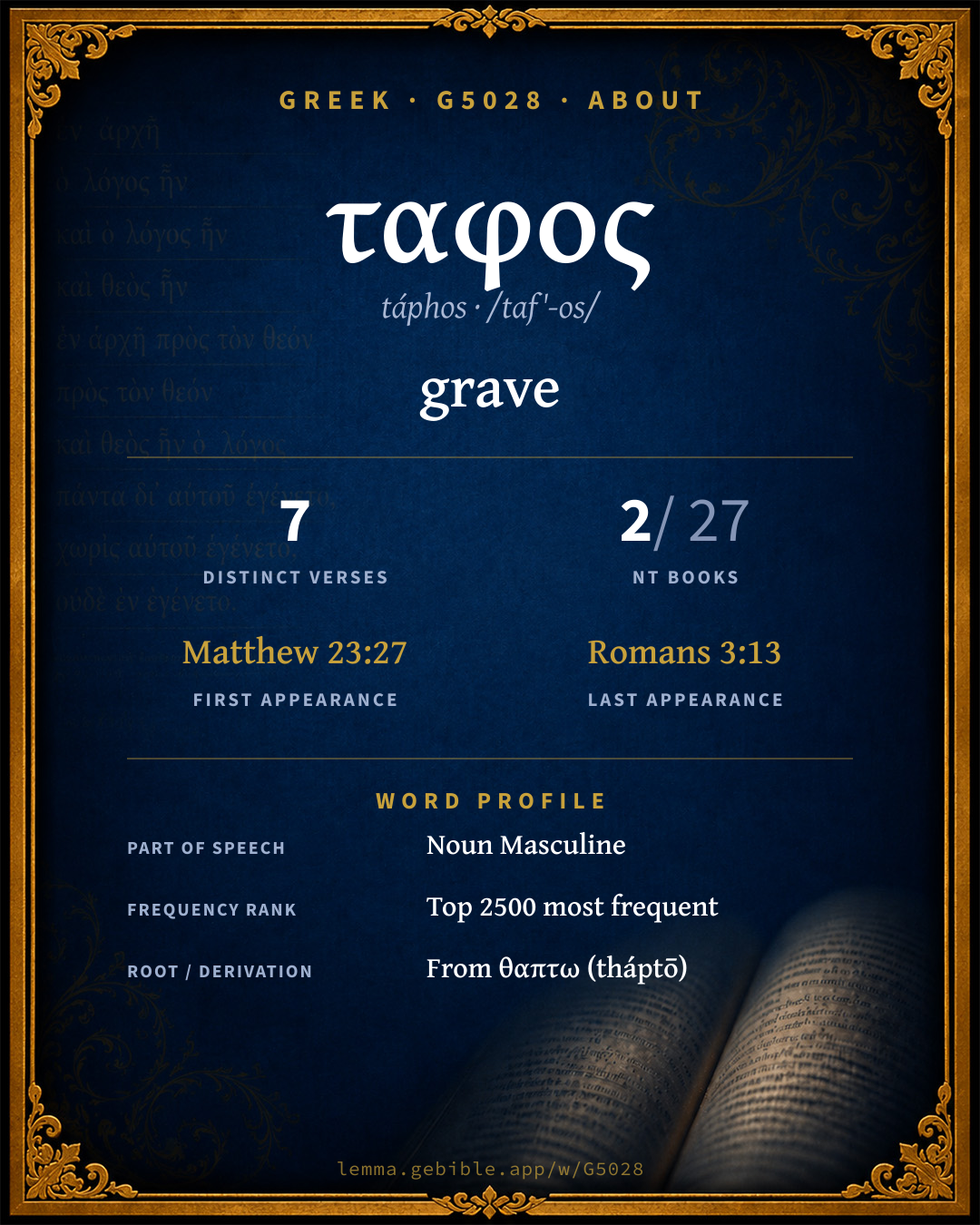
τάφος
grave
‘grave’ is one of 2 main senses fuller range ↓
Full lexicon entry — Thayer's Greek Lexicon
From Thayer's Greek Lexicon
Where this word appears
See every Accusative-case word in the Greek New Testament →
Grammar key — what these labels mean
Part of speech
- Noun
- A naming word — a person, place, thing, or idea.
Case
- Accusative
- The case of the direct object and of extent.
- Dative
- The case of the indirect object, means, or location — “to / for / with / in.”
- Genitive
- The case of source, possession, or “of” — answers “whose / from what.”
- Nominative
- The case of the subject (and the predicate nominative).
Gender
- Masculine
- Grammatically masculine.
Number
- Singular
- One.
- Plural
- More than one.
4 verses where G5028 appears in the Accusative case in the Book of Matthew. Filtered view — show all forms. Click any verse to open its interlinear word-by-word view. Verse text shown in the World English Bible for context — . Each verse’s Greek form is shown with its reference; the English is not keyword-highlighted, since the data carries no word-level English alignment. Use “Compare translations” on any verse to read it across multiple English versions. This concordance covers the Greek New Testament; Septuagint (Greek Old Testament) occurrences of this word are not indexed here.
Matthew
- Matthew 23:29 τάφους n acc pl masc "Woe to you, scribes and Pharisees, hypocrites! For you build the tombs of the prophets, and decorate the tombs of the righteous,
- Matthew 27:64 τάφον n acc sg masc Command therefore that the tomb be made secure until the third day, lest perhaps his disciples come at night and steal him away, and tell the people, 'He is risen from the dead;' and the last deception will be worse than the first."
- Matthew 27:66 τάφον n acc sg masc So they went with the guard and made the tomb secure, sealing the stone.
- Matthew 28:1 τάφον n acc sg masc Now after the Sabbath, as it began to dawn on the first day of the week, Mary Magdalene and the other Mary came to see the tomb.
About this entry
At a glance — auto-summarized from this page’s data, not written by a person. Every figure links to its source below. This summary describes the numbers; it doesn’t interpret them.
ταφος — transliterated táphos — is a Greek noun carrying the sense “grave.” More than three-quarters of its appearances fall in Matthew. It appears 7 verses across 2 books of the Greek New Testament, among its uncommon vocabulary. Debuting at Matthew 23:27, it then recurs through the corpus. Its lexical range runs to 2 senses. See the sense tree, 7-verse concordance, and the renderings breakdown below.
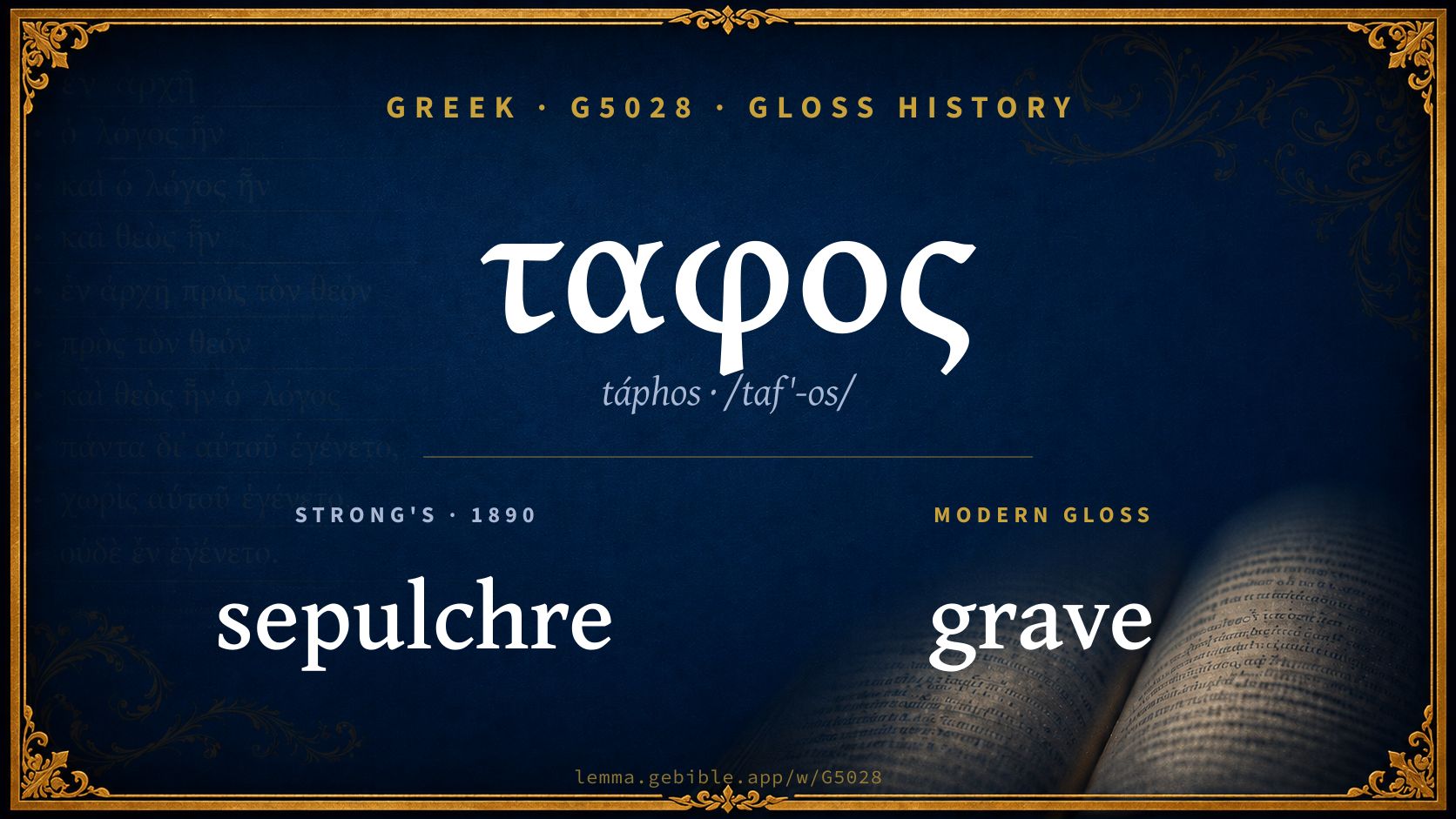
Gloss history
Strong's 1890 vs modern scholarship
About this word
Strong's G5028 catalogs a Greek word from the Greek New Testament.
These counts are not copied from any lexicon or concordance. They are computed here, from the morphology-tagged Greek New Testament. What Lemma adds →
- 7
- distinct verses
- The word appears in 7 distinct verses.
- 2 / 27
- NT books
- The word appears in 2 of 27 New Testament books.
- #1,358
- by frequency
- Top 2500 most frequent Greek words (rank 1,358 of 5,347 Greek words by occurrence).
View all 7 occurrences in the concordance →
By traditional corpus
Conventional, traditional groupings — biblical authorship is debated, so this is a traditional corpus grouping, not an authorship claim. Some books belong to more than one corpus (Luke is in both the Gospels and the Lukan corpus, and so on), so these shares overlap and need not total 100%. Each figure is a share of the word’s 7 distinct verses.
- Gospels 6 verses · 86%
- Pauline corpus 1 verse · 14%
How translations render this word
Counts come from each version’s own published word-to-Strong’s tagging or interlinear alignment — an approximate guide to how each version renders this word, not a word-level alignment the data otherwise carries. Because each total is that version’s own tagged count, the per-version totals vary from one another and need not match the appearance or distinct-verse counts above. These counts may also differ from a printed concordance because Lemma counts each distinctly tagged rendering and does not collapse phrase taggings into a single head-word total. This is a fixed set of word-tagged versions (KJV, ASV, BSB, ULT) and does not change with the reading translation you choose elsewhere. Each version’s license is shown beside its name below (and on Sources).
- King James Version: Sepulchre 5×
- American Standard Version: Sepulchre 5×, Sepulchres 2×
- Berean Standard Bible: Tomb 3×, Tombs 2×
- unfoldingWord Literal Text: Tomb 4×, Tombs 2×
King James Version Public Domain
Renders G5028 across 7 tagged occurrences — most commonly:
Plus 2 renderings that appear only once — usually multi-word phrases or single function words the recovered tagging swept in, not distinct renderings.
American Standard Version Public Domain
Renders G5028 across 7 tagged occurrences — most commonly:
Berean Standard Bible Public Domain
Renders G5028 across 6 tagged occurrences — most commonly:
Plus 1 rendering that appears only once — usually multi-word phrases or single function words the recovered tagging swept in, not distinct renderings.
unfoldingWord Literal Text CC BY-SA 4.0
Renders G5028 across 8 tagged occurrences — most commonly:
Plus 2 renderings that appear only once — usually multi-word phrases or single function words the recovered tagging swept in, not distinct renderings.
Senses in Thayer's
The 2 senses Thayer's distinguishes for this word, in lexicon order (not ranked by frequency or importance). The full entry — with sub-senses — is in the Lexicon Entry tab.
- burial
- a grave, a sepulchre
Word origin
Derived from θαπτω (tháptō) (G2290) — to bury.
Masculine from G2290 ; a grave (the place of interment): - sepulchre tomb.
— Strong’s Exhaustive Concordance (1890), public domain.
Forms in the corpus
The 5 distinct written forms G5028 takes in the Greek New Testament, most frequent first — each parse links to that case’s occurrences in the concordance.
| Form | Parsing | Example | Uses |
|---|---|---|---|
| τάφον táphon | Noun, Accusative, Singular, Masculine | Matthew 27:64 | 3 |
| τάφοις táphois | Noun, Dative, Plural, Masculine | Matthew 23:27 | 1 |
| τάφος táphos | Noun, Nominative, Singular, Masculine | Romans 3:13 | 1 |
| τάφου táphou | Noun, Genitive, Singular, Masculine | Matthew 27:61 | 1 |
| τάφους táphous | Noun, Accusative, Plural, Masculine | Matthew 23:29 | 1 |
Same root — word family
Other Thayer's entries built from the same root as G5028, grouped by Strong’s listed origin. These share a root / origin per the lexicon — not necessarily a shared meaning. Each links to that word’s own entry.
Derives from
Shares the same root
Compare all same-root words → They share a root, not necessarily a meaning.
Septuagint usage
The same Greek word ταφος appears 43 times in the Greek Old Testament (Septuagint), across 40 verses in 13 books.
- 43
- LXX occurrences
- Tagged occurrences of this Greek word in the Septuagint.
- 40
- verses
- Distinct Septuagint verses containing this word.
- 13 / 39
- OT books
- The word appears in 13 of the 39 Old Testament books.
Sample Septuagint occurrences
- Genesis 23:4 τάφος
- Judges 8:32 τάφος
- 1 Samuel 10:2 τάφος
- 2 Samuel 2:32 τάφος
- 1 Kings 13:22 τάφος
- 2 Kings 9:28 τάφος
- 2 Chronicles 21:20 τάφος
- Ezra 13:16 τάφος
- Job 5:26 τάφος
- Psalms 5:10 τάφος
- Ecclesiastes 8:10 τάφος
- Jeremiah 8:1 τάφος
Septuagint occurrences (same lexeme)
Every verse where the same Strong’s number (G5028) appears in the Greek Septuagint. Verse text shown in the World English Bible for context; the Greek form is the matched word — the English is not keyword-highlighted.
- Genesis 23:4 τάφος "I am a stranger and a foreigner living with you. Give me a possession of a burying-place with you, that I may bury my dead out of my sight."
- Genesis 23:20 τάφος The field, and the cave that is therein, were made sure to Abraham for a possession of a burying place by the children of Heth.
- Genesis 47:30 τάφος but when I sleep with my fathers, you shall carry me out of Egypt, and bury me in their burying place." He said, "I will do as you have said."
- Judges 8:32 τάφος Gideon the son of Joash died in a good old age, and was buried in the tomb of Joash his father, in Ophrah of the Abiezrites.
- Judges 16:31 τάφος Then his brothers and all the house of his father came down, and took him, and brought him up, and buried him between Zorah and Eshtaol in the burying-place of Manoah his father. He judged Israel twenty years.
- 1 Samuel 10:2 τάφος When you are departed from me today, then you shall find two men by Rachel's tomb, in the border of Benjamin at Zelzah; and they will tell you, The donkeys which you went to seek are found; and, behold, your father has left off caring for the donkeys, and is anxious for you, saying, What shall I do for my son?
- 2 Samuel 2:32 τάφος They took up Asahel, and buried him in the tomb of his father, which was in Bethlehem. Joab and his men went all night, and the day broke on them at Hebron.
- 2 Samuel 3:32 τάφος They buried Abner in Hebron: and the king lifted up his voice, and wept at the grave of Abner; and all the people wept.
- 2 Samuel 4:12 τάφος David commanded his young men, and they killed them, and cut off their hands and their feet, and hanged them up beside the pool in Hebron. But they took the head of Ish-bosheth, and buried it in the grave of Abner in Hebron.
- 2 Samuel 17:23 τάφος When Ahithophel saw that his counsel was not followed, he saddled his donkey, and arose, and got him home, to his city, and set his house in order, and hanged himself; and he died, and was buried in the tomb of his father.
- 2 Samuel 19:38 τάφος The king answered, Chimham shall go over with me, and I will do to him that which shall seem good to you: and whatever you shall require of me, that will I do for you.
- 2 Samuel 21:14 τάφος They buried the bones of Saul and Jonathan his son in the country of Benjamin in Zela, in the tomb of Kish his father: and they performed all that the king commanded. After that God was entreated for the land.
- 1 Kings 13:22 τάφος but came back, and have eaten bread and drunk water in the place of which he said to you, Eat no bread, and drink no water; your body shall not come to the tomb of your fathers.
- 1 Kings 13:30 τάφος He laid his body in his own grave; and they mourned over him, [saying], Alas, my brother!
- 1 Kings 13:31 τάφος It happened, after he had buried him, that he spoke to his sons, saying, When I am dead, then bury me in the tomb in which the man of God is buried; lay my bones beside his bones.
- 2 Kings 9:28 τάφος His servants carried him in a chariot to Jerusalem, and buried him in his tomb with his fathers in the city of David.
- 2 Kings 13:21 τάφος It happened, as they were burying a man, that behold, they spied a band; and they cast the man into the tomb of Elisha: and as soon as the man touched the bones of Elisha, he revived, and stood up on his feet.
- 2 Kings 21:26 τάφος He was buried in his tomb in the garden of Uzza: and Josiah his son reigned in his place.
- 2 Kings 22:20 τάφος Therefore, behold, I will gather you to your fathers, and you shall be gathered to your grave in peace, neither shall your eyes see all the evil which I will bring on this place. They brought the king word again.
- 2 Kings 23:6 τάφος He brought out the Asherah from the house of Yahweh, outside of Jerusalem, to the brook Kidron, and burned it at the brook Kidron, and beat it to dust, and cast the dust of it on the graves of the common people.
- 2 Kings 23:16 τάφος As Josiah turned himself, he spied the tombs that were there in the mountain; and he sent, and took the bones out of the tombs, and burned them on the altar, and defiled it, according to the word of Yahweh which the man of God proclaimed, who proclaimed these things.
- 2 Kings 23:30 τάφος His servants carried him in a chariot dead from Megiddo, and brought him to Jerusalem, and buried him in his own tomb. The people of the land took Jehoahaz the son of Josiah, and anointed him, and made him king in his father's place.
- 2 Chronicles 21:20 τάφος Thirty-two years old was he when he began to reign, and he reigned in Jerusalem eight years: and he departed without being desired; and they buried him in the city of David, but not in the tombs of the kings.
- 2 Chronicles 24:25 τάφος When they were departed for him (for they left him very sick), his own servants conspired against him for the blood of the sons of Jehoiada the priest, and killed him on his bed, and he died; and they buried him in the city of David, but they didn't bury him in the tombs of the kings.
- 2 Chronicles 28:27 τάφος Ahaz slept with his fathers, and they buried him in the city, even in Jerusalem; for they didn't bring him into the tombs of the kings of Israel: and Hezekiah his son reigned in his place.
- 2 Chronicles 32:33 τάφος Hezekiah slept with his fathers, and they buried him in the ascent of the tombs of the sons of David: and all Judah and the inhabitants of Jerusalem did him honor at his death. Manasseh his son reigned in his place.
- Ezra 13:16 τάφος
- Job 5:26 τάφος You shall come to your grave in a full age, Like a shock of grain comes in its season.
- Job 6:10 τάφος Be it still my consolation, Yes, let me exult in pain that doesn't spare, That I have not denied the words of the Holy One.
- Job 21:32 τάφος Yet shall he be borne to the grave, Men shall keep watch over the tomb.
- Psalms 5:10 τάφος Hold them guilty, God. Let them fall by their own counsels; Thrust them out in the multitude of their transgressions, For they have rebelled against you.
- Psalms 13:3 τάφος Behold, and answer me, Yahweh, my God. Give light to my eyes, lest I sleep in death;
- Psalms 48:12 τάφος Walk about Zion, and go around her. Number its towers;
- Psalms 67:7 τάφος God will bless us. All the ends of the earth shall fear him.
- Psalms 87:6 τάφος Yahweh will count, when he writes up the peoples, "This one was born there." Selah.
- Psalms 87:12 τάφος
- Ecclesiastes 8:10 τάφος So I saw the wicked buried. Indeed they came also from holiness. They went and were forgotten in the city where they did this. This also is vanity.
- Jeremiah 8:1 τάφος At that time, says Yahweh, they shall bring out the bones of the kings of Judah, and the bones of his princes, and the bones of the priests, and the bones of the prophets, and the bones of the inhabitants of Jerusalem, out of their graves;
- Jeremiah 20:17 τάφος because he didn't kill me from the womb; and so my mother would have been my grave, and her womb always great.
- Ezekiel 37:13 τάφος You shall know that I am Yahweh, when I have opened your graves, and caused you to come up out of your graves, my people.
These are occurrences of the same Greek lexeme (G5028) in the Septuagint — not a translation of any one Hebrew word. The store carries no word-level Hebrew↔Greek alignment, so no Hebrew original is asserted here. Counts come from the recovered LXX Strong's tagging — high-frequency vocabulary is well covered, while rare or late forms may be untagged — so they reflect tagged occurrences and may slightly undercount.