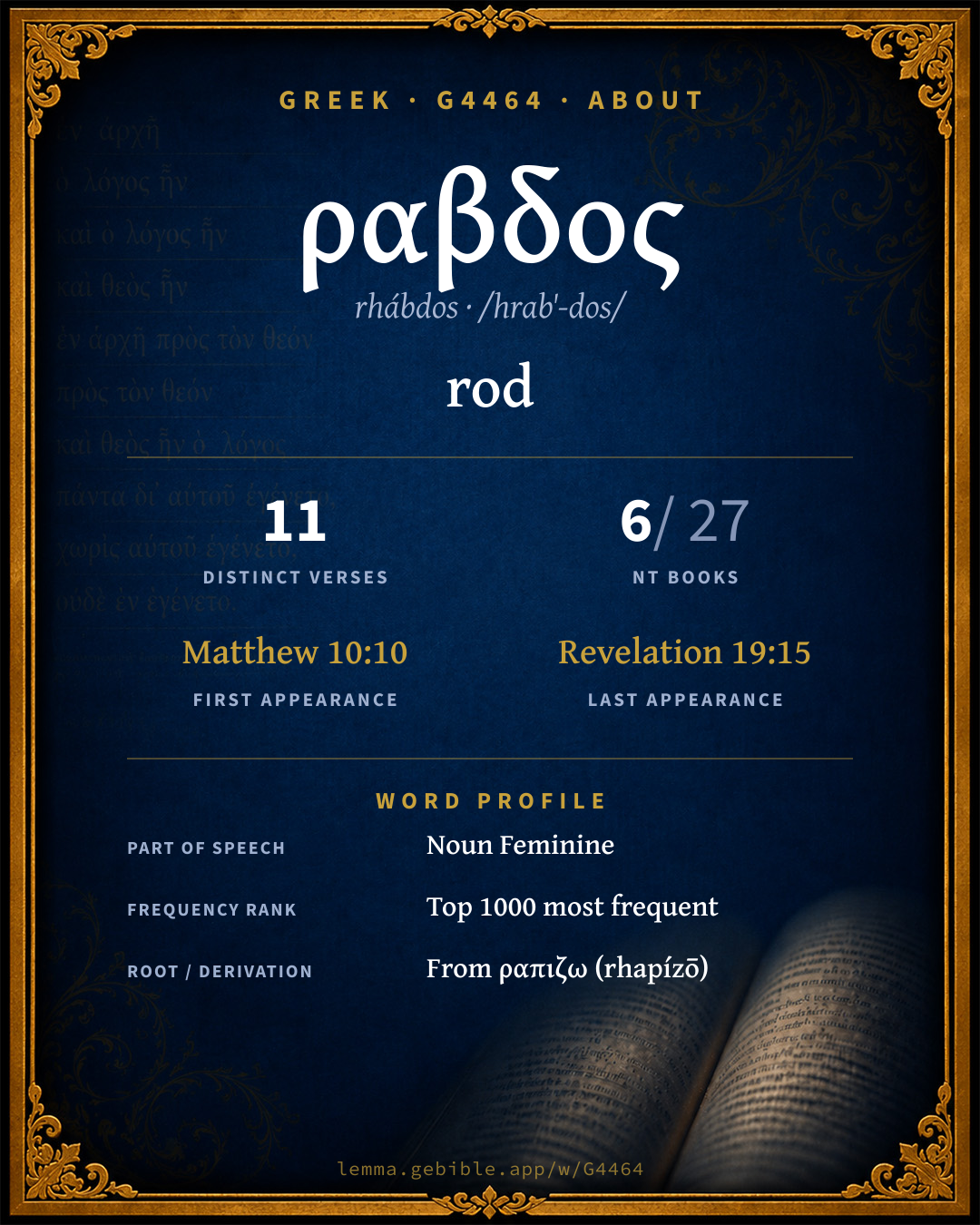
ῥάβδος
rod
also: a staff, a walking stick, a twig, branch fuller range ↓
Full lexicon entry — Thayer's Greek Lexicon
From Thayer's Greek Lexicon
Where this word appears
See every Nominative-case word in the Greek New Testament →
Grammar key — what these labels mean
Part of speech
- Noun
- A naming word — a person, place, thing, or idea.
Case
- Dative
- The case of the indirect object, means, or location — “to / for / with / in.”
- Accusative
- The case of the direct object and of extent.
- Nominative
- The case of the subject (and the predicate nominative).
- Genitive
- The case of source, possession, or “of” — answers “whose / from what.”
Gender
- Feminine
- Grammatically feminine.
Number
- Singular
- One.
2 verses where G4464 appears in the Nominative case in the Book of Hebrews. Filtered view — show all forms. Click any verse to open its interlinear word-by-word view. Verse text shown in the World English Bible for context — . Each verse’s Greek form is shown with its reference; the English is not keyword-highlighted, since the data carries no word-level English alignment. Use “Compare translations” on any verse to read it across multiple English versions. This concordance covers the Greek New Testament; Septuagint (Greek Old Testament) occurrences of this word are not indexed here.
Hebrews
- Hebrews 1:8 ῥάβδος ῥάβδος n nom sg fem n nom sg fem but of the Son he says, "Your throne, O God, is forever and ever; The scepter of uprightness is the scepter of your Kingdom.
- Hebrews 9:4 ῥάβδος n nom sg fem having a golden altar of incense, and the ark of the covenant overlaid on all sides with gold, in which was a golden pot holding the manna, Aaron's rod that budded, and the tables of the covenant;
About this entry
At a glance — auto-summarized from this page’s data, not written by a person. Every figure links to its source below. This summary describes the numbers; it doesn’t interpret them.
“rod” is the headline sense of the Greek noun ραβδος (rhábdos). Lexicons map it across 4 senses — beyond “rod” it also covers “a staff”, “a walking stick”, and “a twig”. The Greek New Testament uses it across 11 verses — uncommon. More than a third of its appearances fall in Revelation. Its earliest occurrence is Matthew 10:10. See the sense tree, 11-verse concordance, and the renderings breakdown below.
Gloss history
Strong's 1890 vs modern scholarship
About this word
Strong's G4464 catalogs a Greek word from the Greek New Testament.
These counts are not copied from any lexicon or concordance. They are computed here, from the morphology-tagged Greek New Testament. What Lemma adds →
- 11
- distinct verses
- The word appears in 11 distinct verses.
- 6 / 27
- NT books
- The word appears in 6 of 27 New Testament books.
- #904
- by frequency
- Top 1000 most frequent Greek words (rank 904 of 5,347 Greek words by occurrence).
View all 11 occurrences in the concordance →
Most concentrated in
- Revelation 4 verses 36%
- Hebrews 3 verses 27%
- Matthew 1 verse 9%
By section of the New Testament
By traditional corpus
Conventional, traditional groupings — biblical authorship is debated, so this is a traditional corpus grouping, not an authorship claim. Some books belong to more than one corpus (Luke is in both the Gospels and the Lukan corpus, and so on), so these shares overlap and need not total 100%. Each figure is a share of the word’s 11 distinct verses.
- Johannine 4 verses · 36%
- Revelation 4 verses · 36%
- Gospels 3 verses · 27%
- Hebrews 3 verses · 27%
- Lukan (Luke–Acts) 1 verse · 9%
- Pauline corpus 1 verse · 9%
How translations render this word
Counts come from each version’s own published word-to-Strong’s tagging or interlinear alignment — an approximate guide to how each version renders this word, not a word-level alignment the data otherwise carries. Because each total is that version’s own tagged count, the per-version totals vary from one another and need not match the appearance or distinct-verse counts above. These counts may also differ from a printed concordance because Lemma counts each distinctly tagged rendering and does not collapse phrase taggings into a single head-word total. This is a fixed set of word-tagged versions (KJV, ASV, BSB, ULT) and does not change with the reading translation you choose elsewhere. Each version’s license is shown beside its name below (and on Sources).
- King James Version: Rod 6×, Staff 2×, Staves 2×
- American Standard Version: Rod 5×, Staff 4×
- Berean Standard Bible: Staff 6×, Scepter 4×
- unfoldingWord Literal Text: Staff 4×, An 3×, Scepter 3×
King James Version Public Domain
Renders G4464 across 12 tagged occurrences — most commonly:
Plus 2 renderings that appear only once — usually multi-word phrases or single function words the recovered tagging swept in, not distinct renderings.
American Standard Version Public Domain
Renders G4464 across 13 tagged occurrences — most commonly:
Plus 4 renderings that appear only once — usually multi-word phrases or single function words the recovered tagging swept in, not distinct renderings.
Berean Standard Bible Public Domain
Renders G4464 across 11 tagged occurrences — most commonly:
Plus 1 rendering that appears only once — usually multi-word phrases or single function words the recovered tagging swept in, not distinct renderings. Not rendered by a distinct English word in 1 further occurrence.
unfoldingWord Literal Text CC BY-SA 4.0
Renders G4464 across 16 tagged occurrences — most commonly:
Plus 4 renderings that appear only once — usually multi-word phrases or single function words the recovered tagging swept in, not distinct renderings.
Senses in Thayer's
The 4 senses Thayer's distinguishes for this word, in lexicon order (not ranked by frequency or importance). The full entry — with sub-senses — is in the Lexicon Entry tab.
- a staff, a walking stick, a twig, rod, branch
- a rod with which one is beaten
- as used on a journey, or to lean upon, or by shepherds
- when applied to kings
Word origin
Derived from ραπιζω (rhapízō) (G4474) — to strike.
From the base of G4474 ; a stick or wand (as a cudgel a cane or a baton of royalty): - rod sceptre staff.
— Strong’s Exhaustive Concordance (1890), public domain.
Forms in the corpus
The 4 distinct written forms G4464 takes in the Greek New Testament, most frequent first — each parse links to that case’s occurrences in the concordance.
| Form | Parsing | Example | Uses |
|---|---|---|---|
| ῥάβδῳ rhábdō | Noun, Dative, Singular, Feminine | 1 Corinthians 4:21 | 5 |
| ῥάβδον rhábdon | Noun, Accusative, Singular, Feminine | Matthew 10:10 | 3 |
| ῥάβδος rhábdos | Noun, Nominative, Singular, Feminine | Hebrews 1:8 | 3 |
| ῥάβδου rhábdou | Noun, Genitive, Singular, Feminine | Hebrews 11:21 | 1 |
Same root — word family
Other Thayer's entries built from the same root as G4464, grouped by Strong’s listed origin. These share a root / origin per the lexicon — not necessarily a shared meaning. Each links to that word’s own entry.
Derives from
Shares the same root
Derived from this word
Compare all same-root words → Showing 4 of 6 — not the complete family. They share a root, not necessarily a meaning.
Septuagint usage
The same Greek word ραβδος appears 112 times in the Greek Old Testament (Septuagint), across 93 verses in 21 books.
- 112
- LXX occurrences
- Tagged occurrences of this Greek word in the Septuagint.
- 93
- verses
- Distinct Septuagint verses containing this word.
- 21 / 39
- OT books
- The word appears in 21 of the 39 Old Testament books.
Sample Septuagint occurrences
- Genesis 30:37 ῥάβδος
- Exodus 4:2 ῥάβδος
- Leviticus 27:32 ῥάβδος
- Numbers 17:17 ῥάβδος
- Judges 5:14 ῥάβδος
- 1 Samuel 17:23 ῥάβδος
- 2 Samuel 7:14 ῥάβδος
- 2 Kings 18:21 ῥάβδος
- 1 Chronicles 11:23 ῥάβδος
- Esther 4:11 ῥάβδος
- Job 9:34 ῥάβδος
- Psalms 2:9 ῥάβδος
Septuagint occurrences (same lexeme)
Every verse where the same Strong’s number (G4464) appears in the Greek Septuagint — showing the first 50 of 93. Verse text shown in the World English Bible for context; the Greek form is the matched word — the English is not keyword-highlighted.
- Genesis 30:37 ῥάβδος Jacob took to himself rods of fresh poplar, almond, plane tree, peeled white streaks in them, and made the white appear which was in the rods.
- Genesis 30:38 ῥάβδος He set the rods which he had peeled opposite the flocks in the gutters in the watering-troughs where the flocks came to drink. They conceived when they came to drink.
- Genesis 30:39 ῥάβδος The flocks conceived before the rods, and the flocks brought forth streaked, speckled, and spotted.
- Genesis 30:41 ῥάβδος It happened, whenever the stronger of the flock conceived, that Jacob laid the rods before the eyes of the flock in the gutters, that they might conceive among the rods;
- Genesis 32:11 ῥάβδος Please deliver me from the hand of my brother, from the hand of Esau: for I fear him, lest he come and strike me, and the mothers with the children.
- Genesis 38:18 ῥάβδος He said, "What pledge will I give you?" She said, "Your signet and your cord, and your staff that is in your hand." He gave them to her, and came in to her, and she conceived by him.
- Genesis 38:25 ῥάβδος When she was brought forth, she sent to her father-in-law, saying, "By the man, whose these are, I am with child." She also said, "Please discern whose are these-- the signet, and the cords, and the staff."
- Genesis 47:31 ῥάβδος He said, "Swear to me," and he swore to him. Israel bowed himself on the bed's head.
- Exodus 4:2 ῥάβδος Yahweh said to him, "What is that in your hand?" He said, "A rod."
- Exodus 4:4 ῥάβδος Yahweh said to Moses, "Put forth your hand, and take it by the tail." He put forth his hand, and laid hold of it, and it became a rod in his hand.
- Exodus 4:17 ῥάβδος You shall take this rod in your hand, with which you shall do the signs."
- Exodus 4:20 ῥάβδος Moses took his wife and his sons, and set them on a donkey, and he returned to the land of Egypt. Moses took God's rod in his hand.
- Exodus 7:9 ῥάβδος "When Pharaoh speaks to you, saying, 'Perform a miracle!' then you shall tell Aaron, 'Take your rod, and cast it down before Pharaoh, that it become a serpent.'"
- Exodus 7:10 ῥάβδος Moses and Aaron went in to Pharaoh, and they did so, as Yahweh had commanded: and Aaron cast down his rod before Pharaoh and before his servants, and it became a serpent.
- Exodus 7:12 ῥάβδος For they cast down every man his rod, and they became serpents: but Aaron's rod swallowed up their rods.
- Exodus 7:15 ῥάβδος Go to Pharaoh in the morning. Behold, he goes out to the water; and you shall stand by the river's bank to meet him; and the rod which was turned to a serpent you shall take in your hand.
- Exodus 7:17 ῥάβδος Thus says Yahweh, "In this you shall know that I am Yahweh. Behold, I will strike with the rod that is in my hand on the waters which are in the river, and they shall be turned to blood.
- Exodus 7:19 ῥάβδος Yahweh said to Moses, "Tell Aaron, 'Take your rod, and stretch out your hand over the waters of Egypt, over their rivers, over their streams, and over their pools, and over all their ponds of water, that they may become blood; and there shall be blood throughout all the land of Egypt, both in vessels of wood and in vessels of stone.'"
- Exodus 7:20 ῥάβδος Moses and Aaron did so, as Yahweh commanded; and he lifted up the rod, and struck the waters that were in the river, in the sight of Pharaoh, and in the sight of his servants; and all the waters that were in the river were turned to blood.
- Exodus 8:1 ῥάβδος Yahweh spoke to Moses, Go in to Pharaoh, and tell him, "This is what Yahweh says, 'Let my people go, that they may serve me.
- Exodus 8:12 ῥάβδος Moses and Aaron went out from Pharaoh, and Moses cried to Yahweh concerning the frogs which he had brought on Pharaoh.
- Exodus 8:13 ῥάβδος Yahweh did according to the word of Moses, and the frogs died out of the houses, out of the courts, and out of the fields.
- Exodus 10:13 ῥάβδος Moses stretched forth his rod over the land of Egypt, and Yahweh brought an east wind on the land all that day, and all the night; and when it was morning, the east wind brought the locusts.
- Exodus 14:16 ῥάβδος Lift up your rod, and stretch out your hand over the sea, and divide it: and the children of Israel shall go into the midst of the sea on dry ground.
- Exodus 17:5 ῥάβδος Yahweh said to Moses, "Walk on before the people, and take the elders of Israel with you, and take the rod in your hand with which you struck the Nile, and go.
- Exodus 17:9 ῥάβδος Moses said to Joshua, "Choose men for us, and go out, fight with Amalek. Tomorrow I will stand on the top of the hill with God's rod in my hand."
- Exodus 21:19 ῥάβδος if he rises again and walks around with his staff, then he who struck him shall be cleared: only he shall pay for the loss of his time, and shall provide for his healing until he is thoroughly healed.
- Exodus 21:20 ῥάβδος "If a man strikes his servant or his maid with a rod, and he dies under his hand, he shall surely be punished.
- Leviticus 27:32 ῥάβδος All the tithe of the herds or the flocks, whatever passes under the rod, the tenth shall be holy to Yahweh.
- Numbers 17:17 ῥάβδος
- Numbers 17:18 ῥάβδος
- Numbers 17:20 ῥάβδος
- Numbers 17:21 ῥάβδος
- Numbers 17:22 ῥάβδος
- Numbers 17:23 ῥάβδος
- Numbers 17:24 ῥάβδος
- Numbers 17:25 ῥάβδος
- Numbers 20:8 ῥάβδος Take the rod, and assemble the congregation, you, and Aaron your brother, and speak you to the rock before their eyes, that it give forth its water; and you shall bring forth to them water out of the rock; so you shall give the congregation and their cattle drink.
- Numbers 20:9 ῥάβδος Moses took the rod from before Yahweh, as he commanded him.
- Numbers 20:11 ῥάβδος Moses lifted up his hand, and struck the rock with his rod twice: and water came forth abundantly, and the congregation drank, and their cattle.
- Numbers 22:23 ῥάβδος The donkey saw the angel of Yahweh standing in the way, with his sword drawn in his hand; and the donkey turned aside out of the way, and went into the field: and Balaam struck the donkey, to turn her into the way.
- Numbers 22:27 ῥάβδος The donkey saw the angel of Yahweh, and she lay down under Balaam: and Balaam's anger was kindled, and he struck the donkey with his staff.
- Judges 5:14 ῥάβδος Out of Ephraim [came down] they whose root is in Amalek; After you, Benjamin, among your peoples; Out of Machir came down governors, Out of Zebulun those who handle the marshal's staff.
- Judges 6:21 ῥάβδος Then the angel of Yahweh put forth the end of the staff that was in his hand, and touched the flesh and the unleavened cakes; and there went up fire out of the rock, and consumed the flesh and the unleavened cakes; and the angel of Yahweh departed out of his sight.
- 1 Samuel 17:23 ῥάβδος As he talked with them, behold, there came up the champion, the Philistine of Gath, Goliath by name, out of the ranks of the Philistines, and spoke according to the same words: and David heard them.
- 2 Samuel 7:14 ῥάβδος I will be his father, and he shall be my son: if he commit iniquity, I will chasten him with the rod of men, and with the stripes of the children of men;
- 2 Samuel 23:21 ῥάβδος He killed an Egyptian, a goodly man: and the Egyptian had a spear in his hand; but he went down to him with a staff, and plucked the spear out of the Egyptian's hand, and killed him with his own spear.
- 2 Kings 18:21 ῥάβδος Now, behold, you trust on the staff of this bruised reed, even on Egypt; whereon if a man lean, it will go into his hand, and pierce it: so is Pharaoh king of Egypt to all who trust on him.
- 1 Chronicles 11:23 ῥάβδος He killed an Egyptian, a man of great stature, five cubits high; and in the Egyptian's hand was a spear like a weaver's beam; and he went down to him with a staff, and plucked the spear out of the Egyptian's hand, and killed him with his own spear.
- Esther 4:11 ῥάβδος All the king's servants, and the people of the king's provinces, do know, that whoever, whether man or woman, shall come to the king into the inner court, who is not called, there is one law for him, that he be put to death, except those to whom the king shall hold out the golden scepter, that he may live: but I have not been called to come in to the king these thirty days.
These are occurrences of the same Greek lexeme (G4464) in the Septuagint — not a translation of any one Hebrew word. The store carries no word-level Hebrew↔Greek alignment, so no Hebrew original is asserted here. Counts come from the recovered LXX Strong's tagging — high-frequency vocabulary is well covered, while rare or late forms may be untagged — so they reflect tagged occurrences and may slightly undercount.