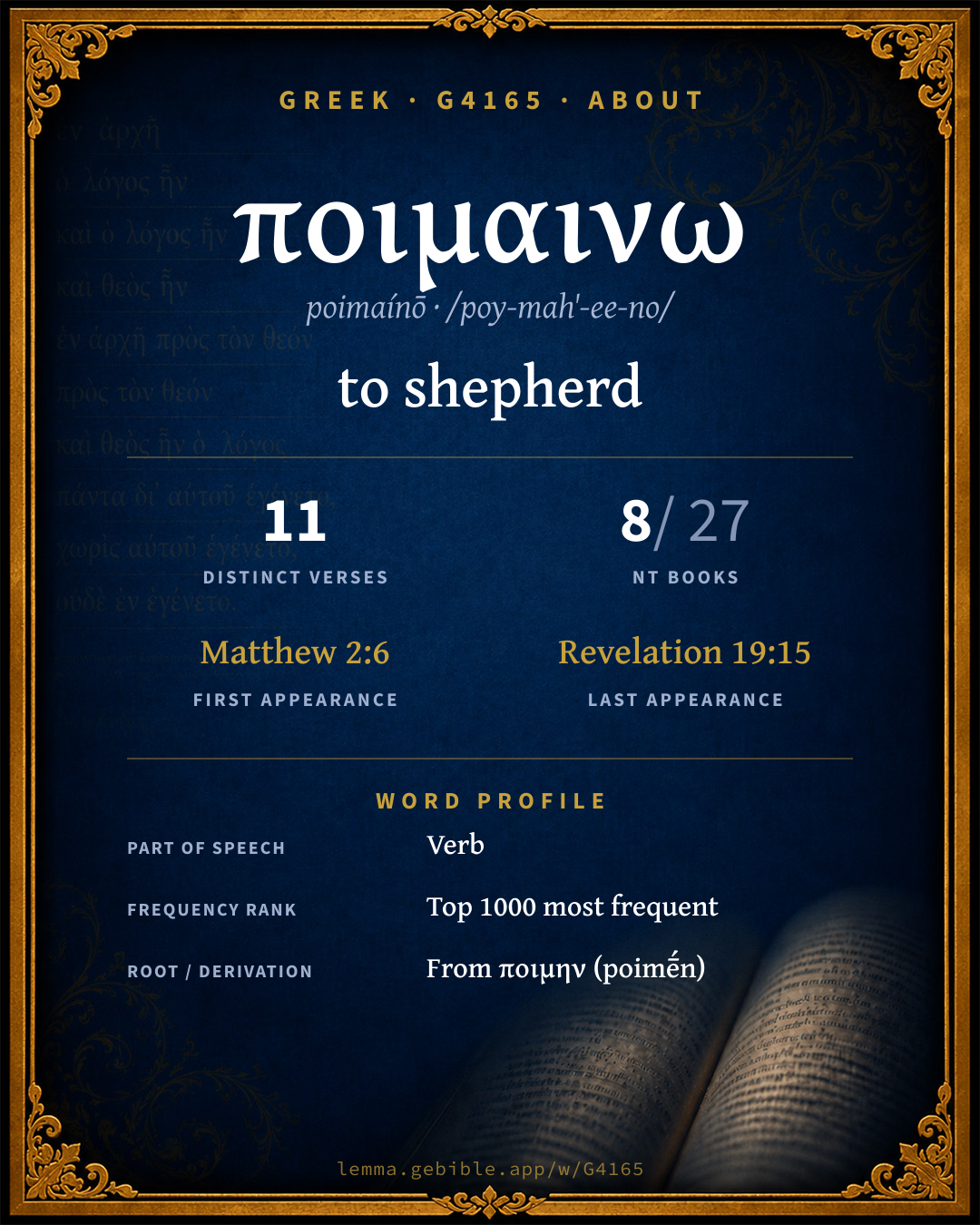
ποιμαίνω
to shepherd
Full lexicon entry — Thayer's Greek Lexicon
From Thayer's Greek Lexicon
Where this word appears
See every Future-tense verb in the Greek New Testament →
Grammar key — what these labels mean
Part of speech
- Verb
- An action or state-of-being word.
Tense
- Future
- Action expected in future time.
- Present
- Ongoing or general action in present time (imperfective aspect).
- Aorist
- Action viewed as a simple whole, without regard to duration — often past (perfective aspect).
Voice
- Active
- The subject performs the action.
Mood
- Indicative
- States a fact or asks a factual question (the mood of reality).
- Infinitive
- A verbal noun (“to write”), unmarked for person or number.
- Imperative
- Expresses a command or request.
- Participle
- A verbal adjective (“writing,” “having written”).
Case
- Accusative
- The case of the direct object and of extent.
- Nominative
- The case of the subject (and the predicate nominative).
Person
- 3rd person
- The one spoken about (“he / she / it / they”).
- 2nd person
- The one addressed (“you”).
Gender
- Masculine
- Grammatically masculine.
Number
- Singular
- One.
- Plural
- More than one.
1 verse where G4165 appears in the Present tense in the Book of Revelation. Filtered view — show all forms. Click any verse to open its interlinear word-by-word view. Verse text shown in the World English Bible for context — . Each verse’s Greek form is shown with its reference; the English is not keyword-highlighted, since the data carries no word-level English alignment. Use “Compare translations” on any verse to read it across multiple English versions. This concordance covers the Greek New Testament; Septuagint (Greek Old Testament) occurrences of this word are not indexed here.
Revelation
About this entry
At a glance — auto-summarized from this page’s data, not written by a person. Every figure links to its source below. This summary describes the numbers; it doesn’t interpret them.
At its core, ποιμαινω (poimaínō) means “to shepherd.” First canonically at Matthew 2:6, it enters the text early. It appears 11 verses across 8 books of the Greek New Testament, among its uncommon vocabulary. The word gravitates to Revelation (36%), then Matthew and Luke. It shares a root with ποιμην and ποιμνη. Each statement above links to its evidence; the full detail follows below.
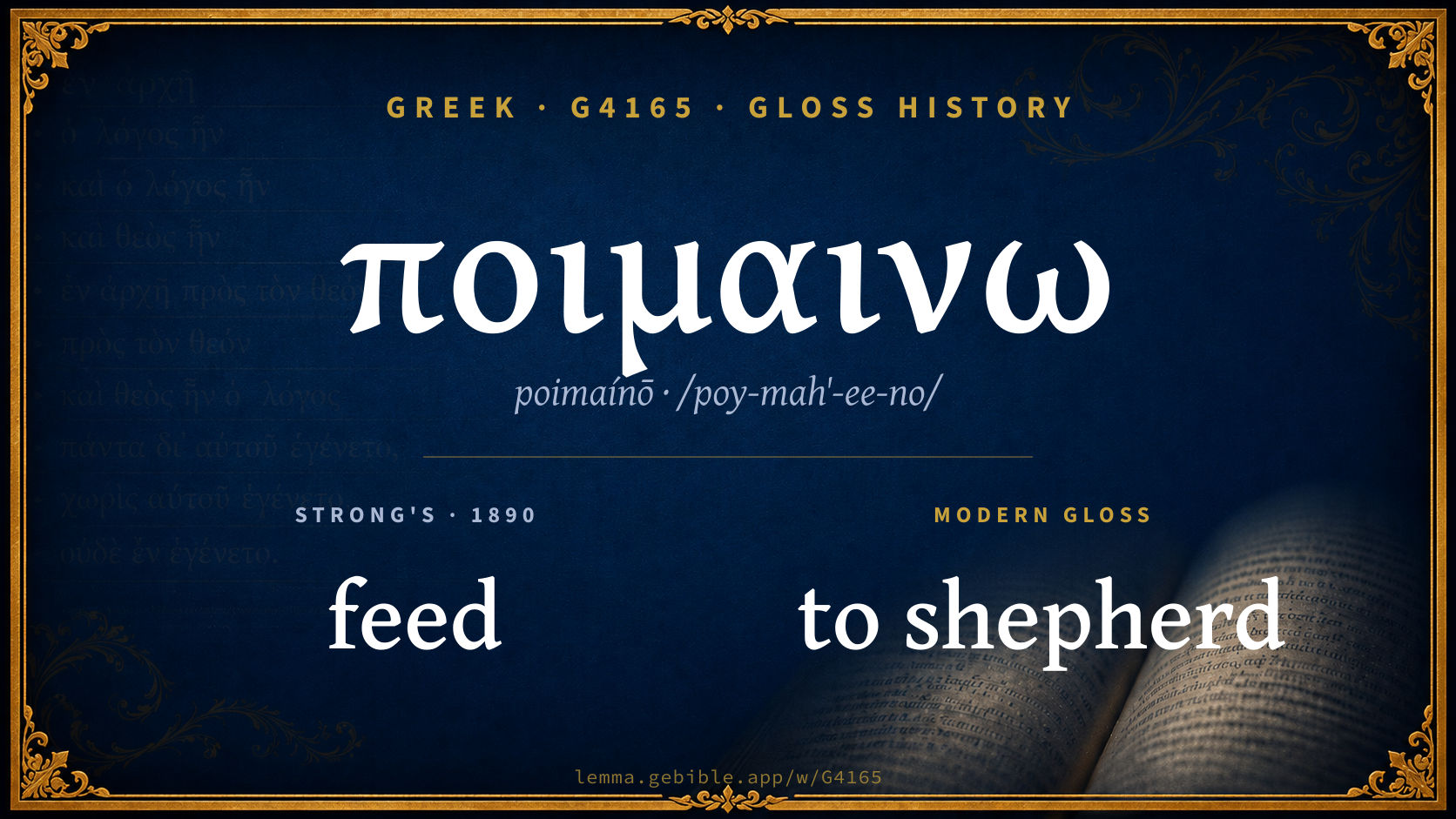
Gloss history
Strong's 1890 vs modern scholarship
About this word
Strong's G4165 catalogs a Greek word from the Greek New Testament.
These counts are not copied from any lexicon or concordance. They are computed here, from the morphology-tagged Greek New Testament. What Lemma adds →
- 11
- distinct verses
- The word appears in 11 distinct verses.
- 8 / 27
- NT books
- The word appears in 8 of 27 New Testament books.
- #978
- by frequency
- Top 1000 most frequent Greek words (rank 978 of 5,347 Greek words by occurrence).
View all 11 occurrences in the concordance →
Most concentrated in
- Revelation 4 verses 36%
- Matthew 1 verse 9%
- Luke 1 verse 9%
By section of the New Testament
By traditional corpus
Conventional, traditional groupings — biblical authorship is debated, so this is a traditional corpus grouping, not an authorship claim. Some books belong to more than one corpus (Luke is in both the Gospels and the Lukan corpus, and so on), so these shares overlap and need not total 100%. Each figure is a share of the word’s 11 distinct verses.
- Johannine 5 verses · 45%
- Revelation 4 verses · 36%
- Gospels 3 verses · 27%
- Lukan (Luke–Acts) 2 verses · 18%
- General (Catholic) Epistles 2 verses · 18%
- Pauline corpus 1 verse · 9%
How translations render this word
Counts come from each version’s own published word-to-Strong’s tagging or interlinear alignment — an approximate guide to how each version renders this word, not a word-level alignment the data otherwise carries. Because each total is that version’s own tagged count, the per-version totals vary from one another and need not match the appearance or distinct-verse counts above. These counts may also differ from a printed concordance because Lemma counts each distinctly tagged rendering and does not collapse phrase taggings into a single head-word total. This is a fixed set of word-tagged versions (KJV, ASV, BSB, ULT) and does not change with the reading translation you choose elsewhere. Each version’s license is shown beside its name below (and on Sources).
- King James Version: Feed 3×, Shall rule 2×
- American Standard Version: Feed 2×, Tend 2×
- Berean Standard Bible: Be shepherds 2×, Shepherding 2×
- unfoldingWord Literal Text: Shepherd 2×, Will shepherd 2×
King James Version Public Domain
Renders G4165 across 11 tagged occurrences — most commonly:
Plus 6 renderings that appear only once — usually multi-word phrases or single function words the recovered tagging swept in, not distinct renderings.
American Standard Version Public Domain
Renders G4165 across 11 tagged occurrences — most commonly:
Plus 7 renderings that appear only once — usually multi-word phrases or single function words the recovered tagging swept in, not distinct renderings.
Berean Standard Bible Public Domain
Renders G4165 across 11 tagged occurrences — most commonly:
Plus 7 renderings that appear only once — usually multi-word phrases or single function words the recovered tagging swept in, not distinct renderings.
unfoldingWord Literal Text CC BY-SA 4.0
Renders G4165 across 11 tagged occurrences — most commonly:
Plus 7 renderings that appear only once — usually multi-word phrases or single function words the recovered tagging swept in, not distinct renderings.
Senses in Thayer's
The 1 sense Thayer's distinguishes for this word, in lexicon order (not ranked by frequency or importance). The full entry — with sub-senses — is in the Lexicon Entry tab.
- to feed, to tend a flock, keep sheep
Word origin
Derived from ποιμην (poimḗn) (G4166) — shepherd.
From G4166 ; to tend as a shepherd (or figuratively superviser ): - feed (cattle) rule.
— Strong’s Exhaustive Concordance (1890), public domain.
Forms in the corpus
The 7 distinct written forms G4165 takes in the Greek New Testament, most frequent first — each parse links to that tense’s occurrences in the concordance.
| Form | Parsing | Example | Uses |
|---|---|---|---|
| ποιμανεῖ poimaneî | Verb, Future, Active, Indicative, 3rd person, Singular | Matthew 2:6 | 4 |
| ποιμαίνειν poimaínein | Verb, Present, Active, Infinitive | Acts 20:28 | 2 |
| ποίμαινε poímaine | Verb, Present, Active, Imperative, 2nd person, Singular | John 21:16 | 1 |
| ποιμάνατε poimánate | Verb, Aorist, Active, Imperative, 2nd person, Plural | 1 Peter 5:2 | 1 |
| ποιμαίνει poimaínei | Verb, Present, Active, Indicative, 3rd person, Singular | 1 Corinthians 9:7 | 1 |
| ποιμαίνοντα poimaínonta | Verb, Present, Active, Participle, Accusative, Singular, Masculine | Luke 17:7 | 1 |
| ποιμαίνοντες poimaínontes | Verb, Present, Active, Participle, Nominative, Plural, Masculine | Jude 1:12 | 1 |
Same root — word family
Other Thayer's entries built from the same root as G4165, grouped by Strong’s listed origin. These share a root / origin per the lexicon — not necessarily a shared meaning. Each links to that word’s own entry.
Derives from
Derived from this word
Compare all same-root words → They share a root, not necessarily a meaning.
Septuagint usage
The same Greek word ποιμαινω appears 52 times in the Greek Old Testament (Septuagint), across 50 verses in 14 books.
- 52
- LXX occurrences
- Tagged occurrences of this Greek word in the Septuagint.
- 50
- verses
- Distinct Septuagint verses containing this word.
- 14 / 39
- OT books
- The word appears in 14 of the 39 Old Testament books.
Sample Septuagint occurrences
- Genesis 30:31 ποιμαίνω
- Exodus 2:16 ποιμαίνω
- 1 Samuel 16:11 ποιμαίνω
- 2 Samuel 5:2 ποιμαίνω
- 1 Chronicles 11:2 ποιμαίνω
- Psalms 2:9 ποιμαίνω
- Proverbs 9:12 ποιμαίνω
- Song of Solomon 1:7 ποιμαίνω
- Isaiah 40:11 ποιμαίνω
- Jeremiah 3:15 ποιμαίνω
- Ezekiel 34:10 ποιμαίνω
- Hosea 13:5 ποιμαίνω
Septuagint occurrences (same lexeme)
Every verse where the same Strong’s number (G4165) appears in the Greek Septuagint. Verse text shown in the World English Bible for context; the Greek form is the matched word — the English is not keyword-highlighted.
- Genesis 30:31 ποιμαίνω He said, "What shall I give you?" Jacob said, "You shall not give me anything. If you will do this thing for me, I will again feed your flock and keep it.
- Genesis 30:36 ποιμαίνω He set three days' journey between himself and Jacob, and Jacob fed the rest of Laban's flocks.
- Genesis 37:2 ποιμαίνω This is the history of the generations of Jacob. Joseph, being seventeen years old, was feeding the flock with his brothers. He was a boy with the sons of Bilhah and Zilpah, his father's wives. Joseph brought an evil report of them to their father.
- Genesis 37:13 ποιμαίνω Israel said to Joseph, "Aren't your brothers feeding the flock in Shechem? Come, and I will send you to them." He said to him, "Here I am."
- Exodus 2:16 ποιμαίνω Now the priest of Midian had seven daughters. They came and drew water, and filled the troughs to water their father's flock.
- Exodus 3:1 ποιμαίνω Now Moses was keeping the flock of Jethro, his father-in-law, the priest of Midian, and he led the flock to the back of the wilderness, and came to God's mountain, to Horeb.
- 1 Samuel 16:11 ποιμαίνω Samuel said to Jesse, Are here all your children? He said, There remains yet the youngest, and, behold, he is keeping the sheep. Samuel said to Jesse, Send and get him; for we will not sit down until he come here.
- 1 Samuel 17:14 ποιμαίνω David was the youngest; and the three eldest followed Saul.
- 1 Samuel 25:16 ποιμαίνω they were a wall to us both by night and by day, all the while we were with them keeping the sheep.
- 2 Samuel 5:2 ποιμαίνω In times past, when Saul was king over us, it was you who led out and brought in Israel: and Yahweh said to you, You shall be shepherd of my people Israel, and you shall be prince over Israel.
- 2 Samuel 7:7 ποιμαίνω In all places in which I have walked with all the children of Israel, spoke I a word with any of the tribes of Israel, whom I commanded to be shepherd of my people Israel, saying, Why have you not built me a house of cedar?
- 1 Chronicles 11:2 ποιμαίνω In times past, even when Saul was king, it was you who led out and brought in Israel: and Yahweh your God said to you, You shall be shepherd of my people Israel, and you shall be prince over my people Israel.
- 1 Chronicles 17:6 ποιμαίνω In all places in which I have walked with all Israel, spoke I a word with any of the judges of Israel, whom I commanded to be shepherd of my people, saying, Why have you not built me a house of cedar?
- Psalms 2:9 ποιμαίνω You shall break them with a rod of iron. You shall dash them in pieces like a potter's vessel."
- Psalms 22:1 ποιμαίνω My God, my God, why have you forsaken me? Why are you so far from helping me, and from the words of my groaning?
- Psalms 27:9 ποιμαίνω Don't hide your face from me. Don't put your servant away in anger. You have been my help. Don't abandon me, Neither forsake me, God of my salvation.
- Psalms 36:3 ποιμαίνω The words of his mouth are iniquity and deceit. He has ceased to be wise and to do good.
- Psalms 47:15 ποιμαίνω
- Psalms 48:15 ποιμαίνω
- Psalms 77:71 ποιμαίνω
- Psalms 77:72 ποιμαίνω
- Psalms 79:2 ποιμαίνω They have given the dead bodies of your servants to be food for the birds of the sky, The flesh of your saints to the animals of the earth.
- Psalms 151:1 ποιμαίνω
- Proverbs 9:12 ποιμαίνω If you are wise, you are wise for yourself. If you mock, you alone will bear it.
- Proverbs 22:11 ποιμαίνω He who loves purity of heart and speaks gracefully Is the king's friend.
- Proverbs 28:7 ποιμαίνω Whoever keeps the law is a wise son; But he who is a companion of gluttons shames his father.
- Proverbs 29:3 ποιμαίνω Whoever loves wisdom brings joy to his father; But a companion of prostitutes squanders his wealth.
- Song of Solomon 1:7 ποιμαίνω Tell me, you whom my soul loves, Where you graze your flock, Where you rest them at noon; For why should I be as one who is veiled Beside the flocks of your companions? Lover
- Song of Solomon 1:8 ποιμαίνω If you don't know, most beautiful among women, Follow the tracks of the sheep. Graze your young goats beside the shepherds' tents.
- Song of Solomon 2:16 ποιμαίνω My beloved is mine, and I am his. He browses among the lilies.
- Song of Solomon 6:2 ποιμαίνω My beloved has gone down to his garden, To the beds of spices, To feed in the gardens, and to gather lilies.
- Song of Solomon 6:3 ποιμαίνω I am my beloved's, and my beloved is mine. He browses among the lilies,
- Isaiah 40:11 ποιμαίνω He will feed his flock like a shepherd, he will gather the lambs in his arm, and carry them in his bosom, [and] will gently lead those who have their young.
- Isaiah 61:5 ποιμαίνω Strangers shall stand and feed your flocks, and foreigners shall be your plowmen and your vine-dressers.
- Jeremiah 3:15 ποιμαίνω and I will give you shepherds according to my heart, who shall feed you with knowledge and understanding.
- Jeremiah 6:3 ποιμαίνω Shepherds with their flocks shall come to her; they shall pitch their tents against her round about; they shall feed everyone in his place.
- Jeremiah 6:18 ποιμαίνω Therefore hear, you nations, and know, congregation, what is among them.
- Jeremiah 22:22 ποιμαίνω The wind shall feed all your shepherds, and your lovers shall go into captivity: surely then shall you be ashamed and confounded for all your wickedness.
- Jeremiah 23:2 ποιμαίνω Therefore thus says Yahweh, the God of Israel, against the shepherds who feed my people: You have scattered my flock, and driven them away, and have not visited them; behold, I will visit on you the evil of your doings, says Yahweh.
- Jeremiah 23:4 ποιμαίνω I will set up shepherds over them, who shall feed them; and they shall fear no more, nor be dismayed, neither shall any be lacking, says Yahweh.
- Ezekiel 34:10 ποιμαίνω Thus says the Lord Yahweh: Behold, I am against the shepherds; and I will require my sheep at their hand, and cause them to cease from feeding the sheep; neither shall the shepherds feed themselves any more; and I will deliver my sheep from their mouth, that they may not be food for them.
- Ezekiel 34:23 ποιμαίνω I will set up one shepherd over them, and he shall feed them, even my servant David; he shall feed them, and he shall be their shepherd.
- Hosea 13:5 ποιμαίνω I knew you in the wilderness, In the land of great drought.
- Micah 5:3 ποιμαίνω Therefore he will abandon them until the time that she who is in labor gives birth. Then the rest of his brothers will return to the children of Israel.
- Micah 5:5 ποιμαίνω He will be our peace when Assyria invades our land, And when he marches through our fortresses, Then we will raise against him seven shepherds, And eight leaders of men.
- Micah 7:14 ποιμαίνω Shepherd your people with your staff, The flock of your heritage, Who dwell by themselves in a forest, In the midst of fertile pasture land, let them feed; In Bashan and Gilead, as in the days of old.
- Zechariah 11:4 ποιμαίνω Thus says Yahweh my God: "Feed the flock of slaughter.
- Zechariah 11:7 ποιμαίνω So I fed the flock of slaughter, especially the oppressed of the flock. I took for myself two staffs. The one I called "Favor," and the other I called "Union," and I fed the flock.
- Zechariah 11:9 ποιμαίνω Then I said, "I will not feed you. That which dies, let it die; and that which is to be cut off, let it be cut off; and let those who are left eat each other's flesh."
- Zechariah 11:17 ποιμαίνω Woe to the worthless shepherd who leaves the flock! The sword will be on his arm, and on his right eye. His arm will be completely withered, and his right eye will be totally blinded!"
These are occurrences of the same Greek lexeme (G4165) in the Septuagint — not a translation of any one Hebrew word. The store carries no word-level Hebrew↔Greek alignment, so no Hebrew original is asserted here. Counts come from the recovered LXX Strong's tagging — high-frequency vocabulary is well covered, while rare or late forms may be untagged — so they reflect tagged occurrences and may slightly undercount.