
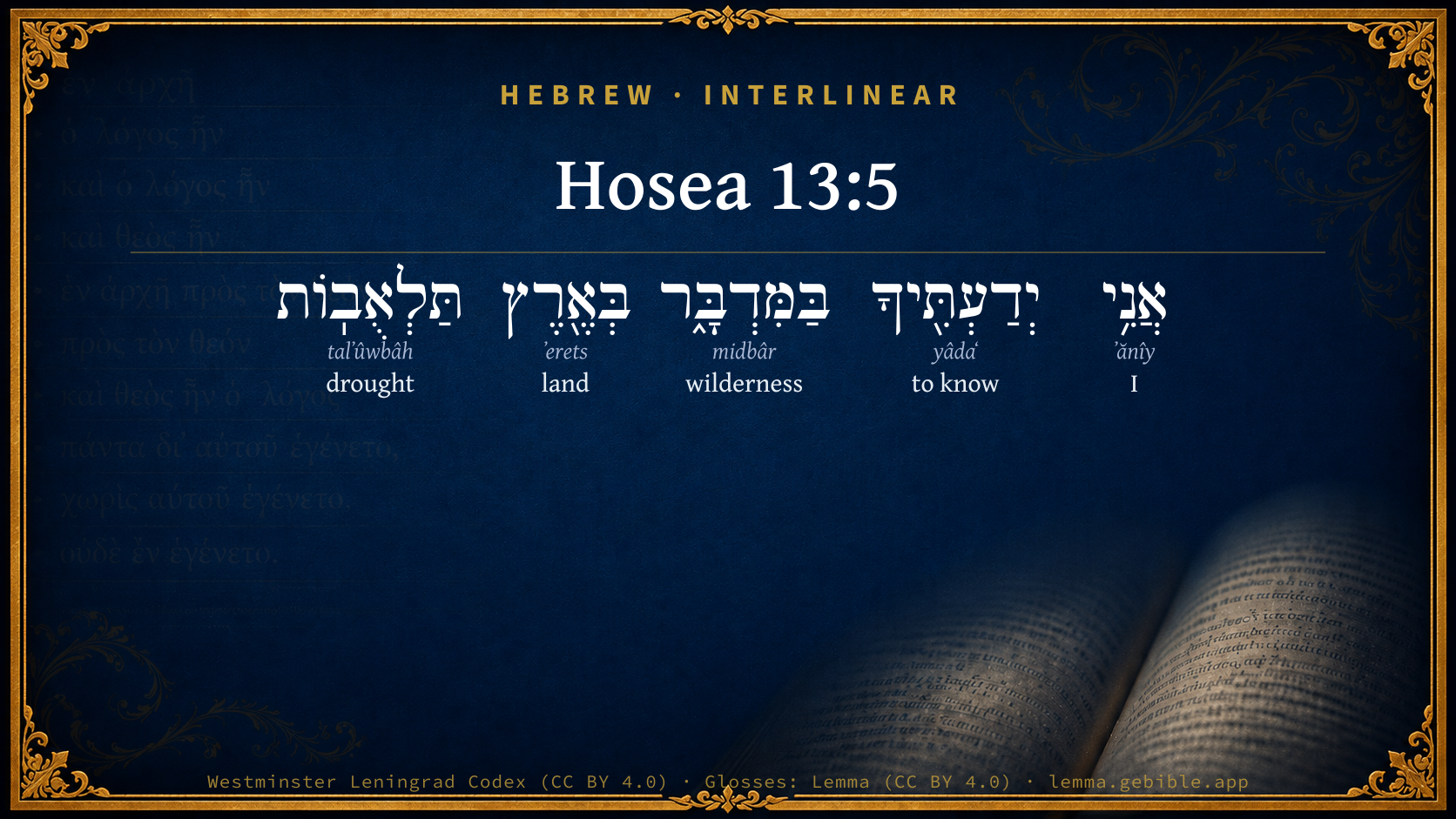
Hosea 13:5

Hebrew (Westminster Leningrad Codex) Hosea 13:5 appears in the Hebrew Old Testament. The text above is from the Westminster Leningrad Codex. Each word links to its Strong’s number, a concise gloss, and parsing drawn from the Open Scriptures Hebrew Bible morphology. Click any word for its full Brown-Driver-Briggs (BDB) entry.
Download image
Cite this verse

Hosea 13:5 (World English Bible). Public Domain. Lemma interlinear Bible study tool, https://lemma.gebible.app/v/hosea/13/5.

Show BibTeX & RIS
BibTeX
RIS
English Translation
I knew you in the wilderness, In the land of great drought.
World English Bible · Public Domain
Highlights
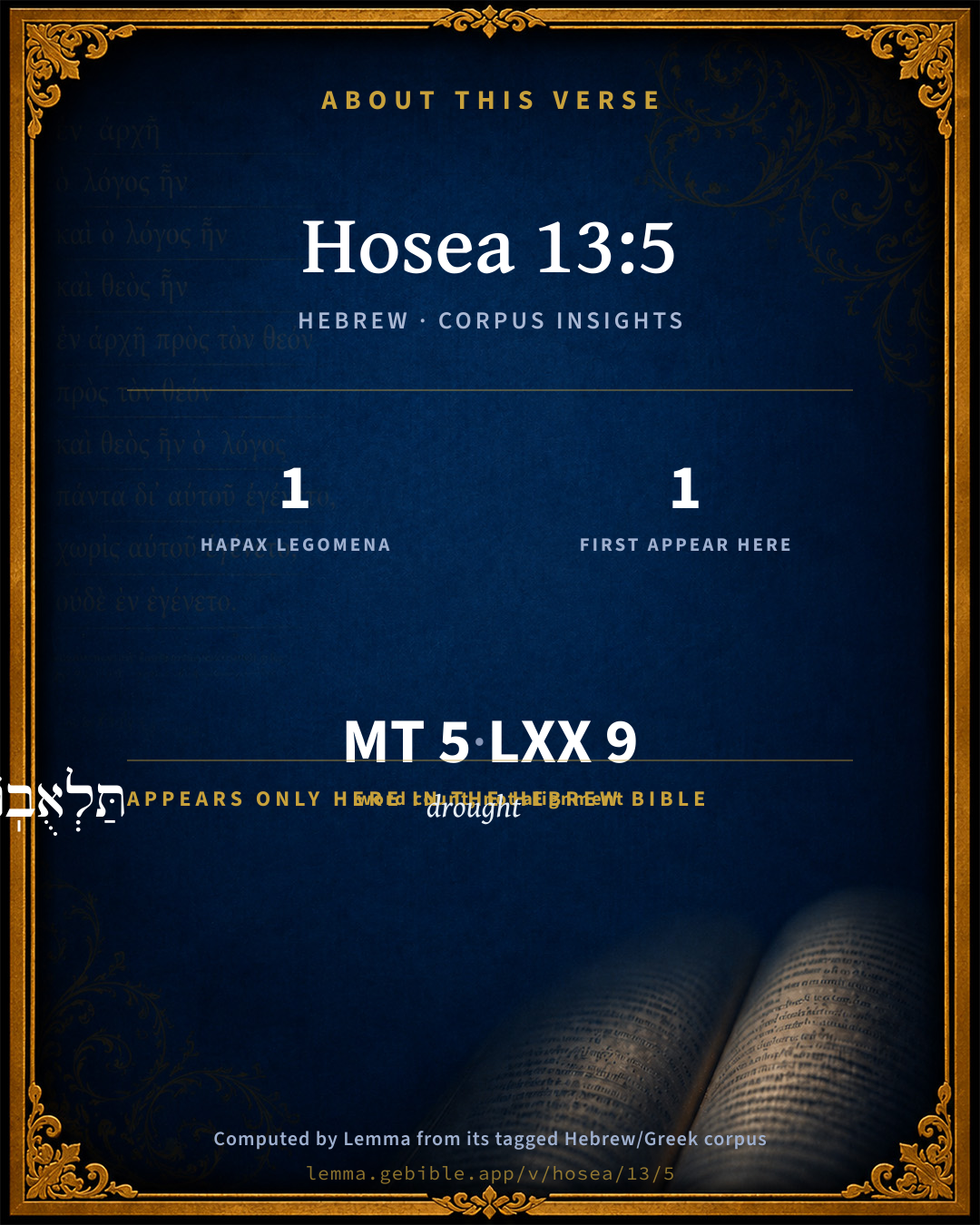
  • 1 hapax legomenon — only here in the Hebrew Bible
  • 1 first appearance in the Hebrew Bible
Full analysis ↓
Download a study sheet

One document with this verse’s original text, its word-by-word gloss line, the meaning frame, cross-references with their text, attributed commentary, and full source and license credits — printable, and it pastes into notes with its structure intact.

This verse Autodidact and up

Study sheet (.html) Plain text (.txt)

A passage Seminary Student

Up to 50 verses in one chapter. A passage sheet keeps up to 6 commentary sources and 12 cross-references per verse, in the order this page ranks them, and says so on the sheet whenever that leaves anything out. Ask for a single verse and you get the Autodidact verse sheet above.

Everything on this page stays free to read, with no account — the sheet is a download of what is already on screen, not access to it.

Want to remove ads? Support Godless Engineer
Compare translations 3

The same verse in 3 English versions, stacked beneath the original-language interlinear above. Click any original word for its lexicon entry.

Each is an independent rendering of the whole verse — the interlinear is not word-aligned to these translations.

Highlighted words mark where these versions differ — a whole-verse word diff, not a word-by-word alignment.

  • World English Bible Public Domain
    I knew you in the wilderness, In the land of great drought.
  • King James Version Public Domain
    I did know thee in the wilderness, in the land of great drought.
  • unfoldingWord Literal Text CC BY-SA 4.0
    I, I knew you in the wilderness, in the land of drought.

unfoldingWord Literal Text — © unfoldingWord, licensed CC BY-SA 4.0. Word-aligned USFM3 via Door43 (git.door43.org/unfoldingWord/en_ult).

Versions to compare (up to 4)

3 of 4 selected

Show all 18 translations

Every available English version of this verse, each an independent rendering of the whole verse.

  • World English Bible Public Domain
    I knew you in the wilderness, In the land of great drought.
  • Berean Standard Bible Public Domain
    I knew you in the wilderness, in the land of drought.
  • Majority Standard Bible Public Domain
    I knew you in the wilderness, in the land of drought.
  • King James Version Public Domain
    I did know thee in the wilderness, in the land of great drought.
  • American Standard Version (1901) Public Domain
    I did know thee in the wilderness, in the land of great drought.
  • Revised Version (1885) Public Domain
    I did know thee in the wilderness, in the land of great drought.
  • Geneva Bible (1599) Public Domain
    I did knowe thee in the wildernesse, in the land of drought.
  • Douay-Rheims (1899) Public Domain
    I knew thee in the desert, in the land of the wilderness.
  • Young's Literal Translation Public Domain
    I -- I have known thee in a wilderness, In a land of droughts.
  • Literal Standard Version CC BY-SA 4.0
    I have known you in a wilderness, || In a land of droughts.
  • Unlocked Literal Bible CC BY-SA 4.0
    I knew you in the wilderness, in the land of great dryness.
  • unfoldingWord Literal Text CC BY-SA 4.0
    I, I knew you in the wilderness, in the land of drought.
  • Darby Bible Public Domain
    I knew thee in the wilderness, in the land of drought.
  • World Messianic Bible Public Domain
    I knew you in the wilderness, in the land of great drought.
  • Webster's Bible Public Domain
    I did know thee in the wilderness, in the land of great drouth.
  • Free Bible Version CC BY-SA 4.0
    I looked after you in the wilderness; in that dry desert land it was like pasture to them
  • Bible in Basic English Public Domain
    I had knowledge of you in the waste land where no water was.
  • JPS Tanakh (1917) Public Domain
    I did know thee in the wilderness, in the land of great drought.

Literal Standard Version (2020), Covenant Press — licensed CC BY-SA 4.0. Text via the HelloAO Bible API (eBible.org). Unlocked Literal Bible (unfoldingWord) — licensed CC BY-SA 4.0. Text via the HelloAO Bible API (eBible.org). unfoldingWord Literal Text — © unfoldingWord, licensed CC BY-SA 4.0. Word-aligned USFM3 via Door43 (git.door43.org/unfoldingWord/en_ult). Free Bible Version, Dr. Jonathan Gallagher — licensed CC BY-SA 4.0. Text via the HelloAO Bible API (eBible.org).

Word by word

More ways to search: Search by grammar → Find every occurrence → Compare this word →

Practice this passage: Drill this verse → Learn its vocabulary →

About this verse

These counts appear in no published source. They are computed here, from the morphology-tagged text and Lemma’s own curated glosses. What Lemma adds →

5
words
5
distinct lemmas
Prophets
section

Notable vocabulary

1 hapax legomenon — a word that appears only here in the entire Hebrew Bible:

  • תַּלְאֻבֽוֹת drought H8514

First appearance in Scripture

This word makes its first canonical appearance in the Hebrew Bible here:

  • תַּלְאֻבֽוֹת drought H8514

Grammatical profile

  • 1 verb
  • 3 nouns
  • 1 pronoun

Verb forms

  • יְדַעְתִּ֖יךָ Qal · Perfect

Hebrew & Septuagint length

In English translation the verse runs 12 words from the Hebrew and 13 from the Septuagint (LXX English) — closely comparable.

A rough comparison of the two English renderings, which tokenize alike — not a word-level alignment.

Word counts can differ between the Hebrew and the Greek without any difference in meaning — e.g. the Hebrew direct-object marker אֵת has no separate Greek word, and Greek often adds the article ὁ.

In the original languages it is 5 Hebrew tokens and 9 Greek tokens — but the two are counted differently (Hebrew bundles its prefixes and suffixes into one token; the Greek is in lemma form), so that isn’t a like-for-like length.

Cross-references

13

Topical passages linked to Hosea 13:5 in the Treasury of Scripture Knowledge — connected by theme and wording, ordered by reader-vote popularity; previews shown in the World English Bible.

  • Deuteronomy 32:10 He found him in a desert land, In the waste howling wilderness; He compassed him about, he cared for him, He kept him as the apple of his eye.
  • Deuteronomy 2:7 For Yahweh your God has blessed you in all the work of your hand; he has known your walking through this great wilderness: these forty years Yahweh your God has been with you; you have lacked nothing.
  • Deuteronomy 8:15 who led you through the great and terrible wilderness, [in which were] fiery serpents and scorpions, and thirsty ground where was no water; who brought you forth water out of the rock of flint;
  • Psalms 142:3 When my spirit was overwhelmed within me, You knew my path. In the way in which I walk, They have hidden a snare for me.
  • Galatians 4:9 But now that you have come to know God, or rather to be known by God, why do you turn back again to the weak and miserable elements, to which you desire to be in bondage all over again?
  • Exodus 2:25 God saw the children of Israel, and God was concerned about them.
  • Psalms 63:1 God, you are my God. I will earnestly seek you. My soul thirsts for you, My flesh longs for you, In a dry and weary land, where there is no water.
  • Nahum 1:7 Yahweh is good, a stronghold in the day of trouble; and he knows those who take refuge in him.
  • Psalms 1:6 For Yahweh knows the way of the righteous, But the way of the wicked shall perish.
  • Psalms 31:7 I will be glad and rejoice in your loving kindness, For you have seen my affliction. You have known my soul in adversities.
  • Jeremiah 2:2 Go, and cry in the ears of Jerusalem, saying, Thus says Yahweh, I remember for you the kindness of your youth, the love of your weddings; how you went after me in the wilderness, in a land that was not sown.
  • Jeremiah 2:6 Neither said they, Where is Yahweh who brought us up out of the land of Egypt, who led us through the wilderness, through a land of deserts and of pits, through a land of drought and of the shadow of death, through a land that none passed through, and where no man lived?
  • 1 Corinthians 8:3 But if anyone loves God, the same is known by him.

Cross-references courtesy of OpenBible.info (CC BY 4.0).

Hebrew and Greek witnesses Masoretic Hebrew ↔ Greek Septuagint

The same verse in the two great witnesses to the Old Testament, shown verse-for-verse.

These are two independent witnesses, not word-aligned to each other, and the Septuagint is shown in lemma (dictionary) form.

Hebrew Hosea 13:5 Masoretic · Westminster Leningrad Codex

אֲנִ֥י יְדַעְתִּ֖יךָ בַּמִּדְבָּ֑ר בְּאֶ֖רֶץ תַּלְאֻבֽוֹת

I knew you in the wilderness, In the land of great drought.

World English Bible · Public Domain

Greek LXX Hosea 13:5 Septuagint · lemma form

ἐγώ ποιμαίνω σύ ἐν ὁ ἔρημος ἐν γῆ ἀοίκητος

I tended you as a shepherd in the wilderness, in an uninhabited land.

LXX2012 (modern English Septuagint) · Public Domain

Hebrew: Westminster Leningrad Codex (CC BY 4.0). Greek: Septuagint (public domain); English from LXX2012 (modern English Septuagint) (Public Domain). How the Septuagint differs from the Hebrew →

Targum (Aramaic paraphrase)

1

The Targum is the ancient Jewish Aramaic paraphrase of the Hebrew Scriptures — an interpretive translation, not the Hebrew text itself. Onkelos (literal) and Pseudo-Jonathan (expansive) render the Torah, and Jonathan the Prophets. Coverage is partial: where no permissively-licensed English translation exists for a verse, only the Aramaic is shown. This is verse-level text, not a word-by-word alignment to the Hebrew.

  1. Targum Jonathan Prophets (Joshua–Malachi)
    אֲנָא סוֹפְקֵית צוֹרְכֵיכוֹן בְּמַדְבְּרָא בְּאַרְעָא דַהֲוֵיתוּן תָּאֲבִין בָּהּ לְכָל מִדָעַם:

    (no public-domain English translation for this verse)

    Targum Jonathan — Aramaic: “Mikraot Gedolot” (public domain). English: “Sefaria Community Translation” (CC0 1.0 (public-domain dedication)); “London "Chaldee Paraphrase," 1871” (public domain). Text via Sefaria.

Commentary

Notes on Hosea 13:5 from classic Christian and Jewish commentators (each source and its license shown beneath its notes). The classic Christian expositions comment on the surrounding passage and are grouped to its opening verse, so a note may address several verses; the Jewish commentaries on the Tanakh (Rashi and others) are per-verse, so they appear only where the commentator wrote on this verse.

Lemma curates 59 commentaries, every one of them public domain or Creative Commons licensed, each selected and text-cleaned for this edition rather than reprinted as found. About our sources →

Matthew Henry's Commentary

We may observe here, 1. The plentiful provision God had made for Israel and the seasonable supplies he had blessed them with (Hos 13:5): "I did know thee in the wilderness, took cognizance of thy case and made provision for thee, even in a land of great drought, when thou wast in extreme distress, and when no relief was to be had in an ordinary way." See a description of this wilderness, Deu 8:15, Jer 2:6, and say, The God that knew them, and owned them, and fed them there, was a friend indeed, for he was a friend at need and an all-sufficient friend, that could victual so vast an army when all ordinary ways of provision were cut off, and where, if miracles had not been their daily bread, they must all have perished. Note, Help at an exigency lays under peculiar obligations and must never be forgotten. 2. Their unworthy ungrateful abuse of God's favour to them. God not only took care of them in the wilderness, but put them in possession of Canaan, a good land, a large and fat pasture. And (Hos 13:6) according to their pasture so were they filled. God gave them both plenty and dainties, and they did not spare it, but, having been long confined to manna, when they came into Canaan they fed themselves to the full. And this was no hopeful presage; it would have looked better, and promised better, if they had been more modest and moderate in the use of their plenty, and had learned to deny themselves; but what was the effect of it? They were filled, and their heart was exalted. Their luxury and sensuality made them proud, insolent, and secure. The best comment upon this is that of Moses, Deu 32:13-15. But Jeshurun waxed fat and kicked. When the body was stuffed up with plenty the soul was puffed up with pride. Then they began to think their religion a thing below them, and they could not persuade themselves to stoop to the services of it. The wicked, through the pride of his countenance, will not seek after God. When they were poor and lame in the wilderness they thought it was necessary for them to keep in with God; but when they were replenished and established in Canaan they began to think they had no further need of him: Their heart was exalted, therefore have they forgotten me. Note, Worldly prosperity, when it feeds men's pride, makes them forgetful of God; for they remember him only when they want him. When Israel was filled, what more could the Almighty do for them? And therefore they said to him, Depart from us, Job 22:17. It is sad that those favours which ought to make us mindful of God, and studious what we shall render to him, should make us unmindful of him, and regardless what we do against him. We ought to know that we live upon God when we live upon common providence, though we do not, as Israel in the wilderness, live upon miracles. 3. God's just resentment of their base ingratitude, Hos 13:7, Hos 13:8. The judgments threatened (Hos 13:3) intimated the departure of all good from them. The threatenings here go further, and intimate the breaking in of all evils upon them; for God, who had so much befriended them, now turns to be their enemy and fights against them, which is expressed here very terribly: I will be unto them as a lion and as a leopard. The lion is strong, and there is no resisting him. The leopard is here taken notice of to be crafty and vigilant: As a leopard by the way will I observe them. As that beast of prey lies in wait by the road-side to catch travellers, and devour them, so will God by his judgments watch over them to do them hurt, as he had watched over them to do them good, Jer 44:27. No opportunity shall be let slip that may accelerate or aggravate their ruin (Jer 5:6): A leopard shall watch over their cities. A lynx, or spotted beast (and such the leopard is), is noted for quicksightedness above any creature (lynx visu - the eyes of a lynx), and so it intimates that not only the power, but the wisdom of God is engaged against those whom he has a controversy with. Some read it (and the original will bear it), I will be as a leopard in the way of Assyria. The judgments of God shall surprise them just when they are going to the Assyrians to seek for protection and help from them. It is added, I will meet them as a bear that is bereaved, and thereby exasperated and made more cruel (Sa2 17:8, Pro 28:15), which intimates how highly God was provoked, and he would make them feel it: He will rend the caul of their heart. The lion is observed to aim at the heart of the beasts he preys upon, and thus will God devour them like a lion. He will send such judgments upon them as shall prey upon their spirits and consume their vitals. Their heart was exalted (Hos 13:6), but God will take an effectual course to bring it down: The wild beast shall tear them; not only God will be as a lion and leopard to them, but the metaphor shall be fulfilled in the letter, for noisome beasts are one of the four sore judgments with which God will destroy a provoking people, Eze 14:15.

Now all this teaches us, 1. That abused goodness turns into the greater severity. Those who despise God and affront him, when he is to them as a careful tender shepherd, shall find he will be even to his own flock as the beasts of prey are. Those whom God has in vain endured with much long-suffering, and invited with much affection, in them he will show his wrath and make them vessels of it, Rom 9:22. Patientia laesa fit furor - Despised patience will turn into fury. 2. That the judgments of God, when they come with commission against impenitent sinners, will be irresistible and very terrible. They will rend the caul of the heart, will fill the soul with confusion, and tear that in pieces; and we are as unable to grapple with them as a lamb is to make his part good against a roaring lion, for who knows the power of God's anger? Knowing therefore the terror of the Lord, let us be persuaded to make peace with him; for are we stronger then he?

Matthew Henry's Commentary on the Whole Bible (1708–1710) — public domain (CC PDM 1.0). Text via the HelloAO Bible API.

Trapp's Complete Commentary

John Trapp

Hos 13:5 I did know thee in the wilderness, in the land of great drought.

Ver. 5. I knew thee in the wilderness, in a place of great drought] In terra torridissima, where I gave thee pluviam escatilem et petram aquatilem, as Tertullian phraseth it, where I gave thee bread from heaven, set the flint abroach, kept thy clothes whole and fit, kept back thine enemies, led thee by a pillar of cloud, sent thee in flesh at even and bread in the morning, served thee as never prince was served in his greatest pomp, Psa 78:20; Psa 78:24. And wilt thou yet kiss the calf, qui te nec servat, nec satiat, ut ego? who neither saveth thee, nor satisfieth thee, as I have done? not suffering thee to lack anything, Deu 2:7, but crowning thee with lovingkindness and tender mercies; insomuch as Moses stands amazed at it, and cries out, "Happy art thou, O Israel: who is like unto thee, O people saved of the Lord?" Deu 33:29.

John Trapp, A Commentary or Exposition upon All the Books of the Old and New Testament (1647–1656) — public domain. Text from a community e-Sword module.

The Biblical Illustrator

Joseph S. Exell

Hos_13:5-9

I did know thee in the wilderness, in the land of great drought.

Wilderness-knowledge

God knows His people where nobody else will take any notice of them. You do not know a man until you know him in the wilderness. There is but little revelation of character in laughter. So long as a man is living in rioting and wantonness, in great abundance and prosperity, having only to lift his hand to command a regiment of servants, you cannot really tell what his true quality is. Men show themselves in the darkness; men cry out of their hearts when they are in distress; it is in the nighttime of lifes bitter sorrows that mens true quality is revealed. God never forsakes His people in wilderness and in desert places; He is more God and Father to them there than ever. No man knows God who only knows Him theologically. It is impossible to read much about God; you must read the writing in your own heart The world is within you; you carry the universe in your own bosom. Unless you have the faculty and genius of introspection, and the power to read the small print that is being daily typed upon your inmost life, you can never be scholars in the sanctuary of Christ, you can never attain to high degrees of wisdom in the school of heaven. Men seek God in the wilderness. The wilderness is the school of discipline. In the Bible there lies one great desert land, and it is called that great and terrible wilderness. There could not be two such in any globe; there could not be a duplicate experience in any life. Some things can be done only once; no man can be twice in Gethsemane; no man can be twice crucified. There are acts in life which, having been accomplished, enable the sufferer to say, The bitterness of death is passed; come what will now, it is but a days march into heaven. (Joseph Parker, D. D.)

Known in time of distress

God knew Israel in the wilderness--

(1) In respect of their sin, which He visited.

(2) In regard of their wants, which He provided for.

Observe--

1. Mans wickedness strangely contrasts with Gods goodness; God knew their sin and yet destroyed them not; they receive mercies, and yet sin.

2. It is a great mercy for God to know a man in time of distress. This is Gods way. Men know in prosperity; but let us make God our friend, He will be a friend otherwise than men win he.

3. We should not be dejected in times of trouble; that is the time for God to know thee: be willing to follow God in any estate.

4. Gods knowing us in distress is a mighty engagement. Let us look back to the times when we were in trouble.

5. Let us know Gods cause when it suffers, and know our brethren in their sufferings.

6. Gods knowledge is operative and working; it does us good. Our knowledge of God should be so too. To sin against our knowledge of God is evil, but to sin against Gods knowledge of us is worse. (Jeremiah Burroughs.)

God present with His people in the wilderness

I. The low and wilderness state of Gods people.

1. It refers to their spiritual wants, weaknesses, and troubles. In their first convictions of sin. In their first, beginning to walk in the ways of the Lord. In after temptations. In seasons of dejection.

2. To their temporal wants, weaknesses, and troubles. In poverty and want; in pain and sickness; in the dangers of life.

II. What kind of knowledge or notice is it that God takes of his people in that state?

1. It is with pity and compassion.

2. So as to manifest His love to them.

3. So as to bestow His comforts on them.

4. He grants His presence to them.

5. He affords them help.

III. Lay down the proof and evidence of this.

1. The Word of the Lord often declares it.

2. Gods dealings with His people in all ages further confirm it, e.g., Jacob, Joseph, Moses, David, Jonah, Hezekiah, ancient Israel.

Application--

1. Let us be concerned to have this God for our God.

2. When in a wilderness state, let us trust in our God.

3. Remember Gods kindness in appearing for you.

4. Despise not those who are in a wilderness state, but weep with those who weep, etc. (T. Hannam.)

The Biblical Illustrator, edited by Joseph S. Exell (c. 1880s–1900s) — public domain. Text from a community e-Sword module.

The Preacher's Complete Homiletical Commentary

Joseph S. Exell (gen. ed.)

CRITICAL NOTES.]

Hos_13:5. Know] i.e. cared for them, and loved them as his own (Psa_144:3; Amo_3:2).

Hos_13:6.] A reproof from cattle growing wanton in abundant pasture; the very thing against which they were warned (Deu_8:11; Deu_32:15).

Hos_13:7. Therefore] Israel, the flock in the field, shall be devoured by wild beasts, fierce as a lion, swift as a leopard, and savage as a bear robbed of her whelps (1Sa_17:34; 2Sa_17:8).

HELP IN THE EXIGENCIES OF LIFE.—Hos_13:5

God loved and provided for his people in the wilderness. “In the land of great drought” and danger he never forsook them. Hence they should know and follow him. God is with his children now in the exigencies of life.

I. Our sinful condition is a wilderness. A barren and unfruitful land, where no water is. Without God the sinner is destitute of happiness and hope. He can neither quench his thirst nor satisfy his desires in sin. But God leads his people from sin to Christ. He knows the anguish and despair of the penitent, and gives joy and peace in believing.

II. Our outward circumstances are a wilderness. What uncertainty and change! What disappointment and sorrows! We are often led into solitude and distress, and have to cry unto God. We are often thrown into danger and surrounded by enemies. “They wandered in the wilderness in a solitary way: they found no city to dwell in. Hungry and thirsty, their soul fainted in them. Then they cried unto the Lord in their trouble, and he delivered them out of their distresses.”

III. Our inward experience is a wilderness. We are not self-sufficient. We do not carry our own resources within us. We have neither power to defend nor wisdom to guide us. Day by day we depend upon God, and have to live by faith, hope, and obedience. But God knows our emptiness, and sends manna from heaven. His presence is continually with us, and he provides a table in the wilderness. We are brought safely “through a land of deserts and of pits; through a land of drought and of the shadow of death; through a land that no man passed through, and where no man dwelt.” “Happy art thou, O Israel; who is like unto thee, O people saved of the Lord?” God’s goodness forms a marked contrast to the conduct of our fellow-creatures. We should show pity to one another. But, alas! we scarcely know a friend in trouble! God’s goodness should lead us to know and love him. Does God know that we are weaned from the world—in love with the means of grace, and ready to follow and seek him at all times?

DIVINE GOODNESS TURNED INTO DIVINE WRATH.—Hos_13:5-8

God knew and loved Israel in the wilderness, commended them in their low estate, but complained of them in their prosperity. When they were delivered from the privations and hardships of the desert, fixed in the land of vineyards and fig-trees, they forgot God in prosperity and pride, and brought upon them righteous displeasure.

I. Goodness displayed to the helpless. “I did know thee in the wilderness.” When Israel were a helpless and dependent people, they often cried to God in distress, and he heard and helped them. Their situation yielded no supplies, but God permitted them to want no good thing. He gave them water from the rock and bread from heaven; suffered not their raiment to wax old upon them, nor their foot to swell in travelling; sent them his Holy Spirit to instruct, and ordinances to bless them. “He hath not dealt so with any nation.” We are under the immediate care of God, who provides for us and defends us. Some one says, “Life is a great want, and therefore should be one continual prayer.”

II. Goodness displayed to the ungrateful. “Therefore have they forgotten me” (Hos_13:6). Their luxury, sensuality, and pride, made them insolent and secure. Worldly prosperity often feeds men’s pride, and makes them forget the giver of it. They remember God in want and sickness, but forsake him in plenty and ease. “Jeshurun waxed fat and kicked” (Deu_32:15; Deu_32:18). Men seek pasture, self-gratification, and not God. They abuse every gift, because their hearts are exalted against him. Prosperity, which ought to draw them to him, alienates them from him. They are ungrateful in proportion as they should love and praise him. Thus selfishness ever tends to hardness of heart and ingratitude. “If a man lacks gratitude,” says Pitt, “when there is infinite obligations to excite and quicken it, he will be likely to want all other virtues towards his fellow-creatures, whose utmost gifts are poor compared with those he daily receives from his never-failing Almighty Friend.” “Then beware lest thou forget the Lord which brought thee forth out of the land of Egypt, from the house of bondage.”

III. Goodness turned to wrath. “Therefore I will be unto them as a lion,” &c. Those who forget God in the gifts of his providence, wax fat and get proud in their prosperity, only prepare themselves a prey to retribution. Ingratitude at all times is most base. Capt. Speke found in the natives of central Africa the belief that “ingratitude, or neglecting to thank a person for a benefit conferred, is punishable.” If ingratitude from man to man be odious, in the sight of God it is without excuse and despicable. Its guilt is increased in a fourfold proportion, and must be estimated by the greatness of the giver, the unworthiness of the receiver, and by the number and excellency of the blessings bestowed. The ungrateful are “a generation of vipers,” who sting the bosom in which they have been nursed. How “sharper than a serpent’s tooth” is an ungrateful child!

1. Wrath most severe. “I will meet them as a bear that is bereaved of her whelps.” God is not overcome and carried away by passion as men. He is not vindictive in feeling, and unjust in his proceedings. But these figures set forth his determined opposition to wickedness, and the righteous visitation of judgment upon those who turn mercy into wrath. His anger will be fierce as a leopard watching by the way to seize upon travellers; furious as a bear enraged by the loss of her young; strong as a lion, the most terrible beast of the forest.

2. Wrath most destructive. The very vitals are destroyed. “Rend the caul,” devour them “and tear them.” The indignation, the punishment, seems almost beyond description. God can torture the soul, and cause his anger to burn against the sinner. “Who knoweth the power of his wrath?” He should be feared according to his anger, and praised for his goodness (Psa_90:11). His mercy should lead us to repentance and gratitude. Those who despise “the riches of his goodness, and forbearance, and long-suffering,” treasure up unto themselves “wrath against the day of wrath, and the revelation of the righteous judgment of God.”

HOMILETIC HINTS AND OUTLINES

Hos_13:6. Therefore have they forgotten me. Ingratitude.

1. A common sin.

2. Most unnatural.

3. Most unreasonable.

4. Most dangerous. “How shall I pardon thee for this? thy children have forsaken me, and sworn by them that are no gods: when I fed them to the full they committed adultery” (Jer_5:7). Forgotten me. Forgotten their dependence upon me; their relationship to me; their duties to me. If not theoretically, men practically forget God (Psa_10:4). Sins often connected with ingratitude, pride, hard-heartedness, selfishness, and idolatry. If men take gifts and feed upon them, in forgetfulness of the Giver, it need not be thought strange if God withholds them. Prosperity abused will be taken away. “When God gives thee prosperity, do thou enjoy it with a cheerful and thankful heart,” says Bp Reynolds. “In all time of our wealth, good Lord, deliver us,” is a prayer never out of season in times of ease and plenty.

First—Selfish indulgence. “According to their pasture, so were they filled.” God “giveth us richly all things to enjoy.” But the enjoyment of Christians differs from the excess of the sensual. We are not to feast without fear; to make provision for the flesh, to fulfil the lusts thereof. Many mistake and suppose everything their own. They are only stewards. The first lesson in the school of Christ is self-denial. Where does this appear in the lives of some? Temperance is one of the graces of the spirit. This consists not only in avoiding drunkenness and gluttony, but in not “filling ourselves according to our pasture.”

Secondly—Pride. “They were filled, and their heart was exalted.” Hezekiah rendered not according to the benefits received; for “his heart was lifted up.” The apostle charges them that are rich in the world not “to trust in uncertain riches,” and shows the tendency there always is in worldly success to gender vanity and false confidence. Hence it is said, “Pride compasseth them about as a chain; violence covereth them as a garment.” They think highly of their understanding, as if wisdom grew with wealth. They speak with authority, and answer roughly.

Thirdly—Unmindfulness of God. “Therefore have they forgotten me.” How common for men in the midst of their sufficiency to lose the sense of their obligations to God, dependence upon and need of him! Hence the prayer of Agar against being rich, “Lest I should be full and deny thee, and say, Who is the Lord?” Hence the caution to the Jews when they entered Canaan, “Lest thou forget the Lord which brought thee forth out of the land of Egypt.” The admonition was unavailable. This gives us a very humbling view of human nature. View it, not in the dregs of society, but as seen in common and reputable life. It will not appear so innocent, so amiable so noble as some represent it to be. Lord, what is man, that thou art mindful of him? Let the fact arouse us to caution and circumspection, if Providence smiles upon us, and we are placed in easy and comfortable circumstances. Watch and pray, lest ye enter into temptation. Seek grace which only can help to manage a full estate properly, so as to elude its snares and discharge its duties. It was said of Vespasian, that he was even a better man for being an emperor. So the prosperity of some, instead of destroying them, displays and increases their excellency; they are rich, not only in temporal things, but in faith and good works [Jay].

ILLUSTRATIONS TO CHAPTER 13

Hos_13:5. Know thee. This cannot mean a mere acquaintance with their condition and circumstances; for what can be hid from him whose understanding is infinite? But it intends two things. First: He knew them so as to provide for them. Secondly: He knew them so as to approve of them and acknowledge them. The word know has this meaning often. “The Lord knoweth the way of the righteous” [Jay].

Hos_13:6. Pastures. A curious instance of a change of instinct is mentioned by Darwin. The bees carried to Barbadoes and the Western Islands ceased to lay up honey after the first year. They found the weather so fine, and the materials for honey so plentiful, that they became exceedingly profligate, and ate up their capital, worked no more, and amused themselves by flying about the sugar-houses and stinging the negroes [Bib. Treasury].

Hos_13:8. Bear. When the female is robbed of her whelps she is said to be more fierce than any other animal; hence many sayings refer to her rage, and are applied to the fury of violent men. “I will tear thee to pieces as a bear which has cubbed;” “Begone, or I will jump upon thee as a bear.” When a termagant goes with her children to scold, it is said, “There goes the she-bear and her whelps” [Roberts]

The Preacher's Complete Homiletical Commentary (gen. ed. Joseph S. Exell; Funk & Wagnalls, c. 1892) — public domain (pre-1929). A full-Bible homiletical/sermon-outline anthology covering 65 of 66 books (2 John is absent from the source module). Text from a community e-Sword module.

Jamieson, Fausset & Brown

Robert Jamieson, A. R. Fausset & David Brown

I did know thee--did acknowledge thee as Mine, and so took care of thee (Psa 144:3; Amo 3:2). As I knew thee as Mine, so thou shouldest know no God but Me (Hos 13:4).

in . . . land of . . . drought-- (Deu 8:15).

Jamieson, Fausset & Brown — Commentary Critical and Explanatory on the Whole Bible (1871) — public domain (CC PDM 1.0). Text via the HelloAO Bible API.

Adam Clarke's Commentary

Verse 5. I did know thee] I approved of thee; I loved thee; and by miraculously providing for thee in that land of drought, I demonstrated my love.

Adam Clarke's Commentary on the Bible (1810–1826) — public domain. Text from a community e-Sword/MySword module.

John Calvin's Commentaries

He afterwards adds Thee I knew in the desert, in the land of droughts God here confirms the truth that the Israelites had acted very absurdly in having turned their minds to other gods, for he himself had known them. The knowledge here mentioned is twofold, that of men, and that of God. God declares that he had a care for the people when they were in the desert; and he designates his paternal solicitude by the term, knowledge: I knew thee; that is, “I then chose thee a people for myself, and familiarly manifested myself to thee, as if thou were a near friend to me. But then it was necessary that I should have been also known by thee.” This is the knowledge of men. Now when men are known by God, why do they not apply all their faculties, so that they may remain fixed on him? For when they divert them to other objects, they extinguish, as much as they can, this benefit of God. So also Paul speaks to the Galatians,

‘After ye have known God, or rather after ye are known by him,’ (Galatians 4:9.)

In the first clause, he shows that they had done very wickedly in retaking themselves to various devices after the light of the gospel had been offered to them: but he increases their sin by the next clause, when he says, ‘Rather after ye are known by him;’ as though he said, “God has anticipated you by his gratuitous goodness. Since, then, God has thus first known you, and first favoured you with his grace, how great and how shameful is now your ingratitude in not seeking to know him in return?” We now then see why the Prophet added that the Israelites had been known by God in the desert, in the land of droughts

And there is an express mention made of the desert: for it was then necessary for the people to be sustained miraculously by the Lord; for except God had rained manna from heaven, and had also given water for drink, the people must have miserably perished. Since, then God had thus supported the people contrary to the usual course of nature, so that without his paternal care there could have been no hope of life, the Prophet now rightly adds, In the desert, in the land of droughts; that is, in that dry solitude, where not a grain of corn grew, so that the people could not live except God had, as it were, with his own hand, given them meat, and put it in their mouth. We now see that the extreme impiety of the people is here manifestly proved; for having been taught in God’s law, and been encouraged by so many benefits, they yet went astray after profane superstitions. And the Prophet, at the same time, adds —

John Calvin's Commentaries (1540-1563) — public domain. Text from the Calvin Translation Society English edition (1840s-50s) via the Christian Classics Ethereal Library (ccel.org). Calvin's coverage is partial (roughly two-thirds of the Bible); uncommented books and verses are honest gaps, never fabricated. The 19th-century editor's footnotes and remarks are omitted so the notes are faithfully Calvin's own voice.

The Cambridge Bible for Schools and Colleges

gen. ed. J. J. S. Perowne

5. I did know, &c.] Better, It was I that knew, &c. ‘To know’=‘to take favourable notice of’, as Psa_1:6 and often.

in the land of great drought] Or, ‘of burning thirst’ (the word occurs nowhere else). Comp. the description in Hos_2:3.

The Cambridge Bible for Schools and Colleges (gen. ed. J. J. S. Perowne; Cambridge University Press, 1878–1918) — public domain. Text from a community e-Sword module.

John Gill's Exposition

I did know thee in the wilderness,.... Where there were no food nor drink, where were scorpions, serpents, and beasts of prey; there the Lord knew them, owned them, and showed a fatherly affection for them, and care of them; and fed them with manna and quails, and guided and directed them in the way, and protected and preserved them from their enemies, and from all hurt and danger. So the Targum explains it,

"I sufficiently supplied their necessities in the wilderness:''

in the land of great drought; or, "of droughts" (c); the word is only used in this place; and is by Aben Ezra interpreted a dry and thirsty land; and so he says it signifies in the Arabic language and the same is observed by the father of Kimchi, and by R. Jonah (d); but is by some rendered "torrid" (e), or "inflamed", as if it had the signification of a Hebrew word which signifies a flame: and the Targum takes it to be akin to another, which signifies to "desire", rendering it,

"in a land in which thou desirest everything;''

that is, wants everything. The first seems best, and is a fit a description of the wilderness, which was a place of drought, wherein was no water, Deu 8:15.

(c) "an terra siccitatum", Vatablus, Drusius, Schmidt. (d) Apud R. Sol. Urbin. Ohel Moed. fol. 35. 1. (e) "In terra torridonum locorum", Montanus; "torridissima", Junius & Tremellius, Heb. "infammationum", Piscator.

John Gill's Exposition of the Whole Bible (1746–1763) — public domain (CC PDM 1.0). Text via the HelloAO Bible API.

Albert Barnes' Notes on the Bible

I did know thee in the wilderness - “God so knew them, as to deserve to be known by them. By “knowing” them, He shewed how He ought to be acknowledged by them.” “As we love God, because He first loved us,” so we come to know and own God, having first been owned and known of Him. God showed His knowledge of them, by knowing and providing for their needs; He knew them “in the wilderness, in the land of great drought,” where the land yielded neither food nor water. He supplied them with the “bread from heaven” and with “water from the flinty rock.” He knew and owned them all by His providence; He knew in approbation and love, and fed in body and soul those who, having been known by Him, knew and owned Him. : “No slight thing is it, that He, who knoweth all things and men, should, by grace, know us with that knowledge according to which He says to that one true Israelite, Moses, “thou hast found grace in My sight, and I know thee by name” Exo 33:17. This we read to have been said to that one; but what He says to one, He says to all, whom now, before or since that time, He has chosen, being foreknown and predestinate, for He wrote the names of all in the book of life. All these elect are “known in the wilderness,” in the land of loneliness, in the wilderness of this world, where no one ever saw God, in the solitude of the heart and the secret of hidden knowledge, where God alone, beholding the soul tried by temptations, exercises and proves it, and accounting it, when “running lawfully,” worthy of His knowledge, professes that He “knew it.” To those so known, or named, He Himself saith in the Gospel, “rejoice, because your names are written in heaven” Luk 10:20.

Albert Barnes' Notes on the Bible (1834–1885) — public domain. Text from a community e-Sword/MySword module.

Haydock's Catholic Bible Commentary

Knew: treated thee with kindness, or tried thee. (Calmet)

George Leo Haydock (1774–1849), Haydock's Catholic Family Bible and Commentary, 1859 edition — public domain. Excludes Psalms (Douay-Rheims chapter numbering differs from Protestant) and Deuterocanonical books (Catholic canon only).

Matthew Poole's English Annotations

I did know, owned, took care of, guided, and supplied, thee, O Israel, in thy fathers,

in the wilderness; through which for forty years together thou wast moving, and foundest nothing for thy sustenance but what my miraculous goodness and power gave thee; through those many deserts thou never didst want.

In the land of great drought; in the parched sands, where were no refreshing showers, no rivers or springs of water, to suffice so many cattle and men; where thou wentest as it were through flames and on sands, scorching as embers of a fire, a place fit for none but fiery serpents, or salamanders (if any such).

Matthew Poole's English Annotations on the Holy Bible (1683–1685) — public domain. Text from a community e-Sword/MySword module.

Whedon's Commentary on the Bible

Daniel D. Whedon

5. The loving care of Jehovah manifested itself in a special manner during the wanderings in the desert, when hunger and thirst threatened to destroy them.

I did know — The Hebrew is more emphatic: “It was I (not some other god) who knew thee.” See on Hos_8:4; here in a favorable sense — care, protect (Psa_1:6). Some of the ancient versions read, “I shepherded thee,” which is in accord with the figure in Hos_13:6,

Land of great drought — Or, of burning thirst (Deu_8:15; Exo_17:1 ff.; etc.).

Daniel D. Whedon (gen. ed.), Commentary on the Old and New Testaments (1874–1909) — public domain. Text from a community e-Sword module.

The Pulpit Commentary

I did know thee in the wilderness. The pronoun at the beginning of the verse is emphatic: As for me; or, I it was that knew thee. The meaning of the sentiment is: I acknowledged thee with kindness, with paternal care and kind providence watching over thee. "Thou shouldest gratefully acknowledge me," is the comment of Kimchi, "because I knew thee in the wilderness, and cared for thy necessity in the wilderness, in which there were no means of livelihood." In the land of great drought. The root of the word tboWalT is bal, unused in Hebrew, but signifying, in Arabic, "to burn, dry, be dry," akin to bjl. Aben Ezra correctly explains it to be "a dry and thirsty laud, and so in the Arabic language; and (that it is so called) on account of all hardships being in it, is the allegorical explanation and not the literal sense." Instead of a lengthened enumeration of all God"s loving-kindnesses to Israel at the Exodus and during the desert wanderings, the prophet sums up all in the expressive, "the Lord thy God from the land of Egypt;" and "I it was that did know thee in the wilderness." It is as though he had said, "I pitied thee in the bondage and among the brick-kilns of Egypt; I brought thee forth with a strong hand and outstretched arm; I led thee through the wilderness; I relieved thee in thy straits; I gave thee bread from heaven to satisfy thy hunger, and water from the rock to quench thy thirst; I defended thee from enemies; nor did I relax my care till I gave thee the goodly laud of promise.

Remembrance in the wilderness.

No more signal instance of Divine interposition is recorded, even in the wonderful history of Israel, than the care and guidance and protection vouchsafed to the chosen people in their desert-wanderings. No wonder that the inspired prophets should again and again refer to this marvelous record of Divine regard, remembrance, and assistance.

I THE OCCASION OF DIVINE REMEMBRANCE.

1. To Israel and to humanity (for of the race at large was the chosen people a type) God reveals himself when help is sorely needed. In the wilderness the people hungered; they thirsted; they were in danger from many perils of the way; they were opposed and harassed by many foes; they were beset by frequent perplexities; they were cast down by many fears. Similarly, this race of mankind was without any supply for its sorest needs, without any deliverance from direst dangers and mightiest and most malignant foes, when the eternal Father "remembered us in our low estate.

2. It was an occasion when all other resource and hope were vain. In this respect the tribes in the desert were representative of humanity. "I looked, and there was no helper.

II THE FRUITS OF DIVINE REMEMBRANCE.

1. The thoughtfulness of God supplies his people"s wants. Israel"s hunger was met by manna; Israel"s thirst by water from the rock, etc. So "the Lord hath been mindful of us." Every spiritual want is supplied in the gospel, where is living water, heavenly bread, etc.

2. Adversaries are overcome by the interposition of the Most High. He who vanquished Israel"s foes led captivity captive, and secured salvation for all who trust in him.

3. Difficulties are removed by Divine intervention.

4. Courage and hope are inspired in the breasts of the timid and downcast.

5. Gratitude, piety, and devotion are enkindled in the souls of those who are set free and rescued by the interposition of a merciful and mighty Savior.

APPLICATION. The gracious knowledge and remembrance of God, leading to merciful interposition on our behalf, should incite us to think upon and to remember him "who led his people through the wilderness; for his mercy endureth forever. T.

Vers. 5-8. Mercy in beneficent action and in retributive displeasure.

"I did know thee in the wilderness, in the land of great drought," etc. Mercy is the subject of these words; and mercy, like the mystic pillar that guided the Israelites in the wilderness, has two sides a bright one to guide and cheer, and a dark one to confound and destroy. In these two aspects the text presents it.

I Here is mercy IN BENEFICENT ACTION. "I did know thee in the wilderness, in the land of great drought. According to their pasture, so were they filled." What mercy did the great Father show the Israelites in the wilderness! The wilderness was a trying region. (Deu_8:15 Jer_2:6) How constantly the Almighty interposed on behalf of his people! He gave them water from the rock and manna from the clouds. He fought their battles, guided them through perplexities, and helped them in every exigency and trial. The hand of mercy was ever outstretched on their behalf, supplying them with all that they required. In truth, mercy gave them, not only necessities, but luxuries. "Jeshurun waxed fat, and kicked." Thus mercy is treating us now, giving us "all things richly to enjoy" in nature, and offering to us all spiritual blessings in Christ Jesus. The bright side of mercy gleams on us in this life, lights up our path and cheers us on the way.

II Here is mercy IN RIGHTEOUS DISPLEASURE. "They were filled, and their heart was exalted; therefore have they forgotten me." Observe:

1. The cause of the indignation. "They have forgotten me." They abused his mercy. His mercy led them to self-indulgence, the pampering of their appetites, the gratification of their lusts, and the fostering of indolence and pride. Alas! how often the mercies of God in providence are abused I Whilst they should lead men to repentance and to a higher life, they lead them to worldliness and impiety. Because of this, mercy becomes indignant, the oil breaks into flame.

2. The severity of the indignation. "Therefore I will be unto them as a lion: as a leopard by the way will I observe them: I will meet them as a bear that is bereaved of her whelps, and will rend the caul of their heart, and there will I devour them like a lion: the wild beast shall tear them." What terrible words are these! As a lion, savage and strong; a "leopard," crafty and vigilant, watching an opportunity to wreak destruction; a "bear," bereaved of her whelps, terribly exasperated and heartless; he will rend the caul of their heart." It is said the lion always aims at the heart of the beast he falls upon. "Devour them like a lion; the wild beast shall tear them." What does all this mean? It does not mean that the Almighty is carried away by a savage impulse, that he has, in fact, aught of passion in him. No, but it means that after his mercy has been abused it will assuredly become the destroyer. Mercy abused becomes a determined, resistless destroyer. A plant that is not strengthened by the sunbeam is scorched; the soul that is not saved by mercy is damned, Thy mercy, Lord, is like the morning sun, Whose beams undo what sable night had done; Or like a stream, the current of whose course, Restrained awhile, runs with a swifter force. Oh I let me glow beneath those sacred beams; After, bathe me in those silver streams. To thee alone my sorrows shall appeal; Hath earth a wound too hard for Heaven to heal? (Francis Quarles.) D.T.

Vers. 5-8. Self-exaltation.

As Moses had foretold, (Deu_8:10-18 Deu_32:15) when Israel became prosperous, he forgot God, and lightly esteemed the rock of his salvation. The exaltation of Baal was itself an act of self-will a species of self-exaltation. The egoistic principle, however, had more direct manifestations. We have in these verses

I GOD KNOWN IN ADVERSITY. "I did know thee in the wilderness, in the land of great drought" (ver. 5).

1. God knew Israel, in the great care he exercised over the nation, leading it, providing for its wants, protecting it, and showing it manifold tokens of his goodness.

2. Israel knew God. The nation was never nearer to its God than during these years of severe trial and hourly dependence. It believed in him, waited on him, trusted him, and was at least latterly willing to serve him. Adversity had its uses. It did the people good, It made a strong nation of them, fit to conquer and occupy Canaan.

II GOD FORGOTTEN IN PROSPERITY. (Ver. 6) As the people grew prosperous, they forgot God. The stages are:

1. Sense of repletion. "They were filled." Satisfied with the good things of earth, they did not feel the same need of God"s blessing. They had not the same sense of dependence.

2. Uplifting of heart. "Their heart was exalted." Prosperity tends in this direction. It uplifts the heart. It makes the possessor of wealth proud, self-sufficient, arrogant.

3. Forgetfulness of God. "Therefore have they forgotten me." This was their base ingratitude. Yet the sin is common. The more we receive from God so perverse and prone to depart are we the more ready we are to forget him. We feel as if we were independent. We are full. We reign as kings without him.

III THE PENALTY OF SELF-EXALTATION. (Vers. 7, 8) Pride in the creature is the sin which more than any other provokes God to wrath. The Greeks, with just discrimination, viewed the gods as specially wroth with the man who unduly exalted himself. Ubriv never failed to bring down on the unhappy mortal who was guilty of the sin "swift destruction." God here likens himself to the wild beasts that tear the flock so fierce and unsparing is his anger. He will be "as a lion," "a leopard," "a bear bereaved of her whelps." Strange images to apply to him whose name is Love! But love, outraged and grieved, is the most vehement and fierce of all passions. God"s love, because it is intense and real, is not to be trifled with, and, when roused to anger, is terrible to encounter. Better meet wild beasts of the forest than fall into the hands of the living God. J.O.

The Pulpit Commentary (1880–1919), ed. H.D.M. Spence-Jones & Joseph S. Exell — public domain. Text from a community e-Sword module.

John Wesley's Explanatory Notes

I did know - Owned, took care of, guided and supplied.

John Wesley, Explanatory Notes Upon the Whole Bible (1754–1765) — public domain. Text via the GEBible commentary corpus.

Rashi

Rabbi Shlomo Yitzchaki (Rashi)

I knew you I set My heart to know your necessity, and I provided you.

deprivation Heb. תַלְאוּבֹת. There is no similarity to this in Scripture, and its interpretation is, according to the context, תֵּל, a heap, שֶאוֹבִין, where they long for all good and do not find it.

Rashi on the Tanakh — English translations: “The Judaica Press complete Tanach with Rashi, translated by A. J. Rosenberg” (CC BY 4.0); “Pentateuch with Rashi's commentary by M. Rosenbaum and A.M. Silbermann, 1929-1934” (public domain); “The Metsudah Tanach series, Lakewood, N.J” (CC BY 4.0); and “The Book of Joshua, Metsudah Publications, 1997” (CC BY 4.0). Text via Sefaria.

Lesson kit

Teaching starters — assembled from the data on this page, not authored interpretation. Every prompt links to the verse data it draws on. Edit before teaching.

Hosea, in the Prophets, opens this verse with 5 words (5 distinct Hebrew lemmas). Its most distinctive word is talʼûwbâh (“drought”). A historical commentator’s framing appears above. Read the whole chapter for the surrounding context.

Discussion questions

  1. What does “drought” (talʼûwbâh) contribute to the verse as a whole?
  2. 1 word here appears nowhere else in the Hebrew Bible. Why might the author reach for such rare wording?
  3. This is the first place “drought” appears in Scripture (first appears here). What does its debut here establish?
  4. How does Deuteronomy 32:10, which shares this passage’s theme, read alongside this verse?
  5. These translations render this verse differently; the difference is in the English rendering, not the original. What questions does that raise?
  6. «יְדַעְתִּ֖יךָ» is a Qal Perfect verb. How does that grammatical form shape the action described?
  7. Compare how Matthew Henry's Commentary and Trapp's Complete Commentary read this verse. Where do they agree or differ?

Things to notice

Reading settings

Reading text

Shown beneath each verse's original-language words.

Old Testament
Old Testament edition

Read the OT as the Masoretic Hebrew (MT) or the Greek Septuagint (LXX).

English shown for the Greek Septuagint (in the Hebrew ↔ Greek comparison).

Comparing translations? Open the Compare panel on any verse page to stack up to four side by side.