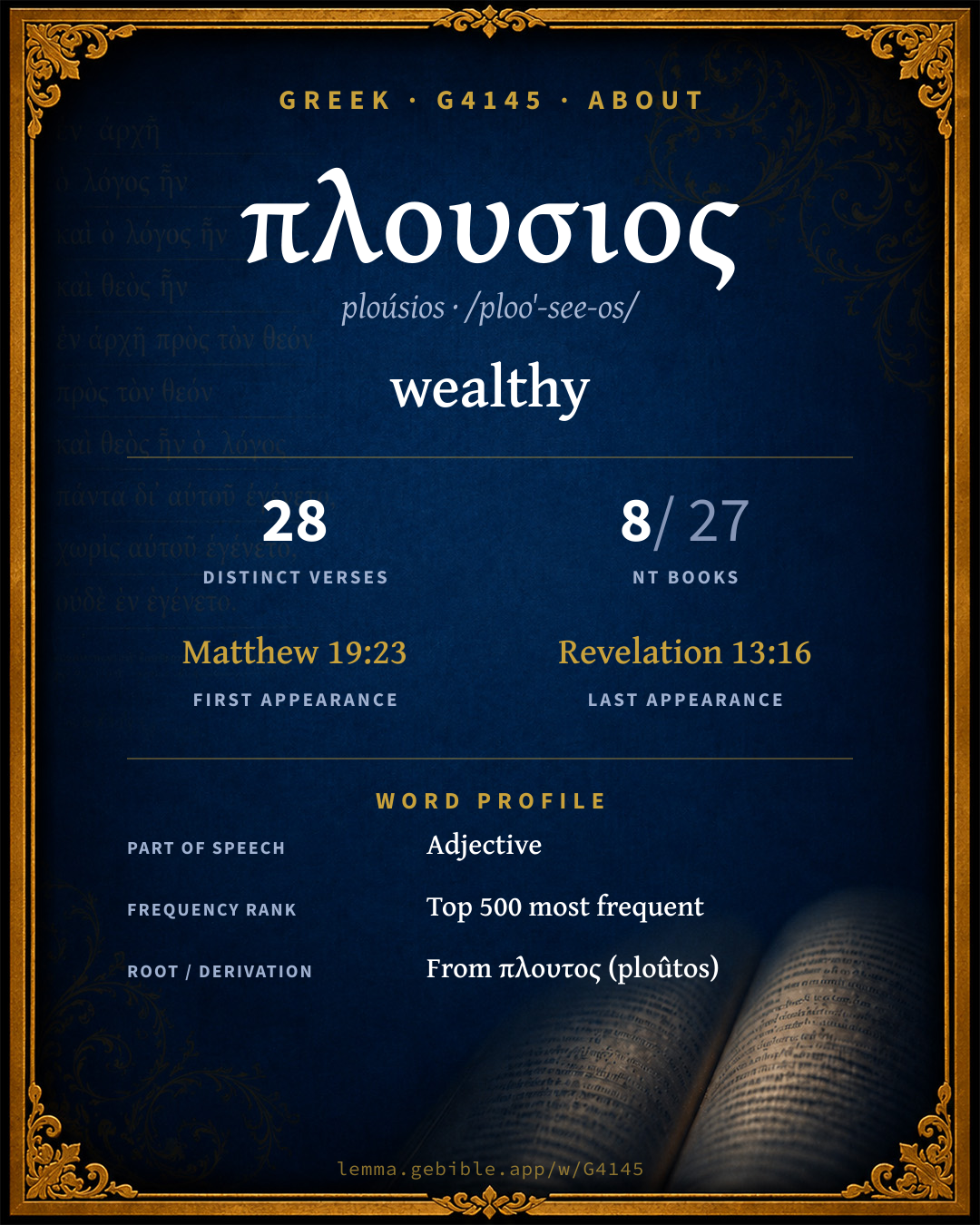
πλούσιος
wealthy
‘wealthy’ is one of 2 main senses fuller range ↓
Full lexicon entry — Thayer's Greek Lexicon
From Thayer's Greek Lexicon
Where this word appears
See every Nominative-case word in the Greek New Testament →
Grammar key — what these labels mean
Part of speech
- Adjective
- A word that describes or qualifies a noun.
Case
- Nominative
- The case of the subject (and the predicate nominative).
- Accusative
- The case of the direct object and of extent.
- Dative
- The case of the indirect object, means, or location — “to / for / with / in.”
- Genitive
- The case of source, possession, or “of” — answers “whose / from what.”
Gender
- Masculine
- Grammatically masculine.
Number
- Singular
- One.
- Plural
- More than one.
17 distinct verses where G4145 appears in the Nominative case, across 7 books. Filtered view — show all forms. Click any verse to open its interlinear word-by-word view. Verse text shown in the World English Bible for context — . Each verse’s Greek form is shown with its reference; the English is not keyword-highlighted, since the data carries no word-level English alignment. Use “Compare translations” on any verse to read it across multiple English versions. This concordance covers the Greek New Testament; Septuagint (Greek Old Testament) occurrences of this word are not indexed here.
Matthew 2 verses
- Matthew 19:23 πλούσιος adj nom sg masc Jesus said to his disciples, "Most assuredly I say to you, a rich man will enter into the Kingdom of Heaven with difficulty.
- Matthew 27:57 πλούσιος adj nom sg masc When evening had come, a rich man from Arimathaea, named Joseph, who himself was also Jesus' disciple came.
Mark 1 verse
Luke 5 verses
- Luke 16:1 πλούσιος adj nom sg masc He also said to his disciples, "There was a certain rich man who had a manager. An accusation was made to him that this man was wasting his possessions.
- Luke 16:19 πλούσιος adj nom sg masc "Now there was a certain rich man, and he was clothed in purple and fine linen, living in luxury every day.
- Luke 16:22 πλούσιος adj nom sg masc It happened that the beggar died, and that he was carried away by the angels to Abraham's bosom. The rich man also died, and was buried.
- Luke 18:23 πλούσιος adj nom sg masc But when he heard these things, he became very sad, for he was very rich.
- Luke 19:2 πλούσιος adj nom sg masc There was a man named Zacchaeus. He was a chief tax collector, and he was rich.
2 Corinthians 1 verse
Ephesians 1 verse
James 4 verses
- James 1:10 πλούσιος adj nom sg masc and the rich, in that he is made humble, because like the flower in the grass, he will pass away.
- James 1:11 πλούσιος adj nom sg masc For the sun arises with the scorching wind, and withers the grass, and the flower in it falls, and the beauty of its appearance perishes. So also will the rich man fade away in his pursuits.
- James 2:6 πλούσιοι adj nom pl masc But you have dishonored the poor man. Don't the rich oppress you, and personally drag you before the courts?
- James 5:1 πλούσιοι adj nom pl masc Come now, you rich, weep and howl for your miseries that are coming on you.
Revelation 3 verses
- Revelation 2:9 πλούσιος adj nom sg masc "I know your works, oppression, and your poverty (but you are rich), and the blasphemy of those who say they are Jews, and they are not, but are a synagogue of Satan.
- Revelation 3:17 πλούσιός adj nom sg masc Because you say, 'I am rich, and have gotten riches, and have need of nothing;' and don't know that you are the wretched one, miserable, poor, blind, and naked;
- Revelation 6:15 πλούσιοι adj nom pl masc The kings of the earth, the princes, the commanding officers, the rich, the strong, and every slave and free person, hid themselves in the caves and in the rocks of the mountains.
About this entry
At a glance — auto-summarized from this page’s data, not written by a person. Every figure links to its source below. This summary describes the numbers; it doesn’t interpret them.
πλουσιος — transliterated ploúsios — is a Greek adjective carrying the sense “wealthy.” It first appears in Matthew 19:23. The Greek New Testament uses it across 28 verses — moderately common. More than a third of its appearances fall in Luke. Its lexical range runs to 2 senses. See the sense tree, 28-verse concordance, and the renderings breakdown below.
Gloss history
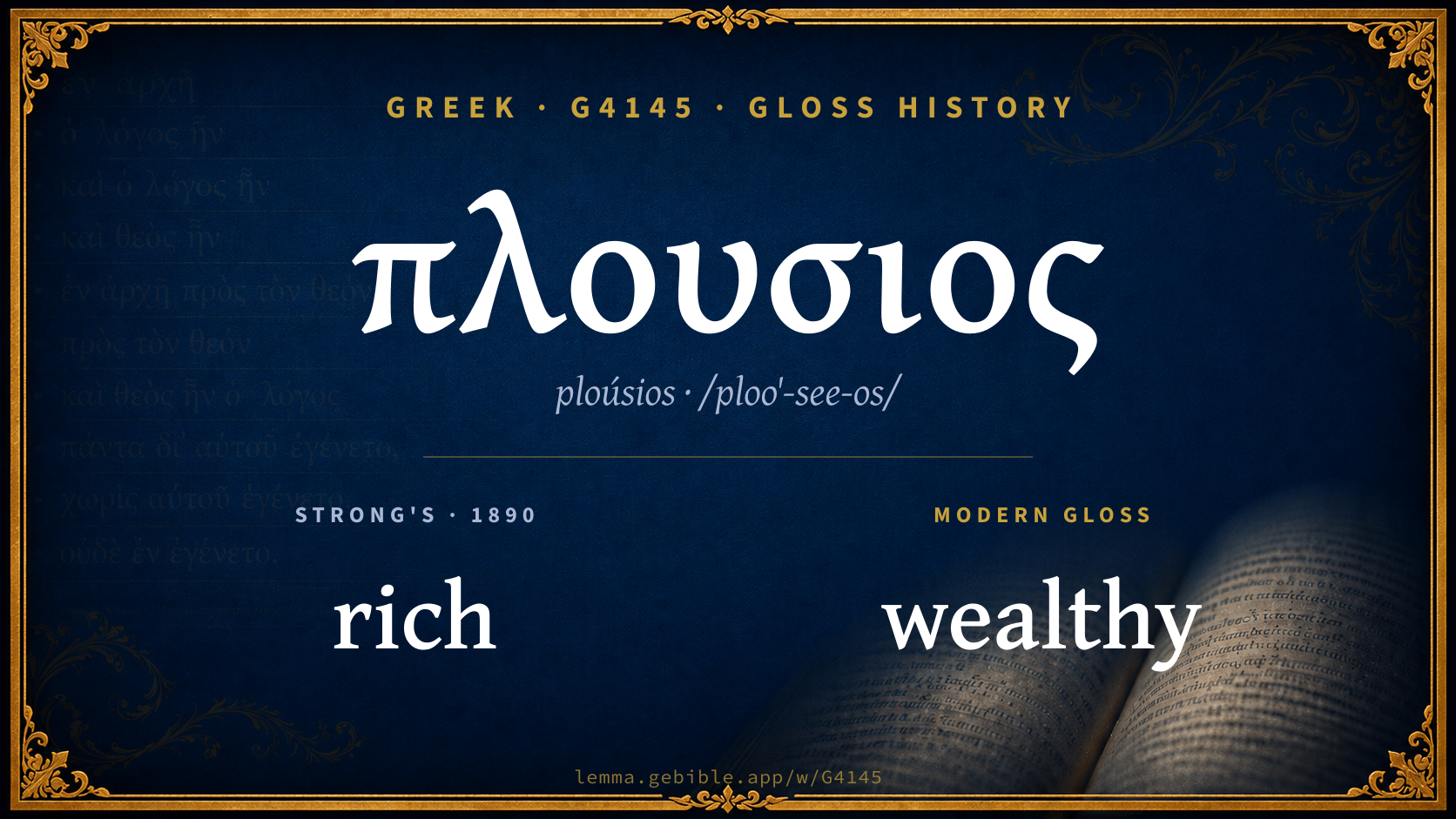
Strong's 1890 vs modern scholarship
About this word
Strong's G4145 catalogs a Greek word from the Greek New Testament.
These counts are not copied from any lexicon or concordance. They are computed here, from the morphology-tagged Greek New Testament. What Lemma adds →
- 28
- distinct verses
- The word appears in 28 distinct verses.
- 8 / 27
- NT books
- The word appears in 8 of 27 New Testament books.
- #485
- by frequency
- Top 500 most frequent Greek words (rank 485 of 5,347 Greek words by occurrence).
View all 28 occurrences in the concordance →
Most concentrated in
- Luke 11 verses 39%
- James 5 verses 18%
- Revelation 4 verses 14%
By section of the New Testament
By traditional corpus
Conventional, traditional groupings — biblical authorship is debated, so this is a traditional corpus grouping, not an authorship claim. Some books belong to more than one corpus (Luke is in both the Gospels and the Lukan corpus, and so on), so these shares overlap and need not total 100%. Each figure is a share of the word’s 28 distinct verses.
- Gospels 16 verses · 57%
- Lukan (Luke–Acts) 11 verses · 39%
- General (Catholic) Epistles 5 verses · 18%
- Johannine 4 verses · 14%
- Revelation 4 verses · 14%
- Pauline corpus 3 verses · 11%
How translations render this word
Counts come from each version’s own published word-to-Strong’s tagging or interlinear alignment — an approximate guide to how each version renders this word, not a word-level alignment the data otherwise carries. Because each total is that version’s own tagged count, the per-version totals vary from one another and need not match the appearance or distinct-verse counts above. These counts may also differ from a printed concordance because Lemma counts each distinctly tagged rendering and does not collapse phrase taggings into a single head-word total. This is a fixed set of word-tagged versions (KJV, ASV, BSB, ULT) and does not change with the reading translation you choose elsewhere. Each version’s license is shown beside its name below (and on Sources).
- King James Version: Rich 14×, Rich man 6×, Rich men 3×
- American Standard Version: Rich 15×, Rich man 7×, Are rich 2×
- Berean Standard Bible: Rich 20×, Rich man 5×
- unfoldingWord Literal Text: Rich 24×, Person 4×, Rich man 2×
King James Version Public Domain
Renders G4145 across 28 tagged occurrences — most commonly:
Plus 3 renderings that appear only once — usually multi-word phrases or single function words the recovered tagging swept in, not distinct renderings.
American Standard Version Public Domain
Renders G4145 across 28 tagged occurrences — most commonly:
Plus 4 renderings that appear only once — usually multi-word phrases or single function words the recovered tagging swept in, not distinct renderings.
Berean Standard Bible Public Domain
Renders G4145 across 28 tagged occurrences — most commonly:
Plus 3 renderings that appear only once — usually multi-word phrases or single function words the recovered tagging swept in, not distinct renderings.
unfoldingWord Literal Text CC BY-SA 4.0
Renders G4145 across 32 tagged occurrences — most commonly:
Plus 2 renderings that appear only once — usually multi-word phrases or single function words the recovered tagging swept in, not distinct renderings.
Senses in Thayer's
The 2 senses Thayer's distinguishes for this word, in lexicon order (not ranked by frequency or importance). The full entry — with sub-senses — is in the Lexicon Entry tab.
- wealthy, abounding in material resources
- metaph. abounding, abundantly supplied
Word origin
Derived from πλουτος (ploûtos) (G4149) — riches.
From G4149 ; wealthy ; figuratively abounding with : - rich.
— Strong’s Exhaustive Concordance (1890), public domain.
Forms in the corpus
The 7 distinct written forms G4145 takes in the Greek New Testament, most frequent first — each parse links to that case’s occurrences in the concordance.
| Form | Parsing | Example | Uses |
|---|---|---|---|
| πλούσιος ploúsios | Adjective, Nominative, Singular, Masculine | Matthew 19:23 | 12 |
| πλουσίους plousíous | Adjective, Accusative, Plural, Masculine | Luke 14:12 | 4 |
| πλούσιοι ploúsioi | Adjective, Nominative, Plural, Masculine | Mark 12:41 | 4 |
| πλούσιον ploúsion | Adjective, Accusative, Singular, Masculine | Matthew 19:24 | 3 |
| πλουσίοις plousíois | Adjective, Dative, Plural, Masculine | Luke 6:24 | 2 |
| πλουσίου plousíou | Adjective, Genitive, Singular, Masculine | Luke 12:16 | 2 |
| πλούσιός ploúsiós | Adjective, Nominative, Singular, Masculine | Revelation 3:17 | 1 |
Same root — word family
Other Thayer's entries built from the same root as G4145, grouped by Strong’s listed origin. These share a root / origin per the lexicon — not necessarily a shared meaning. Each links to that word’s own entry.
Derives from
Shares the same root
Derived from this word
Compare all same-root words → They share a root, not necessarily a meaning.
Septuagint usage
The same Greek word πλουσιος appears 31 times in the Greek Old Testament (Septuagint), across 31 verses in 11 books.
- 31
- LXX occurrences
- Tagged occurrences of this Greek word in the Septuagint.
- 31
- verses
- Distinct Septuagint verses containing this word.
- 11 / 39
- OT books
- The word appears in 11 of the 39 Old Testament books.
Sample Septuagint occurrences
- Genesis 13:2 πλούσιος
- Ruth 3:10 πλούσιος
- 1 Samuel 2:10 πλούσιος
- 2 Samuel 12:1 πλούσιος
- Esther 1:20 πλούσιος
- Job 27:19 πλούσιος
- Psalms 9:29 πλούσιος
- Proverbs 10:15 πλούσιος
- Ecclesiastes 10:6 πλούσιος
- Isaiah 5:14 πλούσιος
- Jeremiah 9:22 πλούσιος
Septuagint occurrences (same lexeme)
Every verse where the same Strong’s number (G4145) appears in the Greek Septuagint. Verse text shown in the World English Bible for context; the Greek form is the matched word — the English is not keyword-highlighted.
- Genesis 13:2 πλούσιος Abram was very rich in cattle, in silver, and in gold.
- Ruth 3:10 πλούσιος He said, Blessed are you by Yahweh, my daughter: you have shown more kindness in the latter end than at the beginning, inasmuch as you didn't follow young men, whether poor or rich.
- 1 Samuel 2:10 πλούσιος Those who strive with Yahweh shall be broken to pieces; Against them will he thunder in the sky: Yahweh will judge the ends of the earth; He will give strength to his king, Exalt the horn of his anointed.
- 2 Samuel 12:1 πλούσιος Yahweh sent Nathan to David. He came to him, and said to him, "There were two men in one city; the one rich, and the other poor.
- 2 Samuel 12:2 πλούσιος The rich man had very many flocks and herds,
- 2 Samuel 12:4 πλούσιος A traveler came to the rich man, and he spared to take of his own flock and of his own herd, to dress for the wayfaring man who had come to him, but took the poor man's lamb, and dressed it for the man who had come to him."
- Esther 1:20 πλούσιος When the king's decree which he shall make shall be published throughout all his kingdom (for it is great), all the wives will give to their husbands honor, both to great and small.
- Job 27:19 πλούσιος He lies down rich, but he shall not do so again. He opens his eyes, and he is not.
- Psalms 9:29 πλούσιος
- Psalms 33:11 πλούσιος The counsel of Yahweh stands fast forever, The thoughts of his heart to all generations.
- Psalms 44:13 πλούσιος You make us a reproach to our neighbors, A scoffing and a derision to those who are around us.
- Psalms 48:3 πλούσιος God has shown himself in her citadels as a refuge.
- Proverbs 10:15 πλούσιος The rich man's wealth is his strong city. The destruction of the poor is their poverty.
- Proverbs 14:20 πλούσιος The poor person is shunned even by his own neighbor, But the rich person has many friends.
- Proverbs 18:11 πλούσιος The rich man's wealth is his strong city, Like an unscalable wall in his own imagination.
- Proverbs 19:22 πλούσιος That which makes a man to be desired is his kindness. A poor man is better than a liar.
- Proverbs 22:2 πλούσιος The rich and the poor have this in common: Yahweh is the maker of them all.
- Proverbs 22:7 πλούσιος The rich rule over the poor. The borrower is servant to the lender.
- Proverbs 22:16 πλούσιος Whoever oppresses the poor for his own increase and whoever gives to the rich, Both come to poverty.
- Proverbs 23:4 πλούσιος Don't weary yourself to be rich. In your wisdom, show restraint.
- Proverbs 28:6 πλούσιος Better is the poor who walks in his integrity, Than he who is perverse in his ways, and he is rich.
- Proverbs 28:11 πλούσιος The rich man is wise in his own eyes; But the poor who has understanding sees through him.
- Ecclesiastes 10:6 πλούσιος Folly is set in great dignity, and the rich sit in a low place.
- Ecclesiastes 10:20 πλούσιος Don't curse the king, no, not in your thoughts; And don't curse the rich in your bedchamber: For a bird of the sky may carry your voice, And that which has wings may tell the matter.
- Isaiah 5:14 πλούσιος Therefore Sheol has enlarged its desire, And opened its mouth without measure; And their glory, their multitude, their pomp, and he who rejoices among them, descend into it.
- Isaiah 32:9 πλούσιος Rise up, you women who are at ease, [and] hear my voice; you careless daughters, give ear to my speech.
- Isaiah 32:13 πλούσιος On the land of my people shall come up thorns and briers; yes, on all the houses of joy in the joyous city.
- Isaiah 33:20 πλούσιος Look on Zion, the city of our solemnities: your eyes shall see Jerusalem a quiet habitation, a tent that shall not be removed, the stakes of it shall never be plucked up, neither shall any of the cords of it be broken.
- Isaiah 53:9 πλούσιος They made his grave with the wicked, and with a rich man in his death; although he had done no violence, neither was any deceit in his mouth.
- Jeremiah 9:22 πλούσιος Speak, Thus says Yahweh, The dead bodies of men shall fall as dung on the open field, and as the handful after the harvester; and none shall gather [them].
- Jeremiah 24:1 πλούσιος Yahweh shown me, and, behold, two baskets of figs set before the temple of Yahweh, after that Nebuchadrezzar king of Babylon had carried away captive Jeconiah the son of Jehoiakim, king of Judah, and the princes of Judah, with the craftsmen and smiths, from Jerusalem, and had brought them to Babylon.
These are occurrences of the same Greek lexeme (G4145) in the Septuagint — not a translation of any one Hebrew word. The store carries no word-level Hebrew↔Greek alignment, so no Hebrew original is asserted here. Counts come from the recovered LXX Strong's tagging — high-frequency vocabulary is well covered, while rare or late forms may be untagged — so they reflect tagged occurrences and may slightly undercount.