
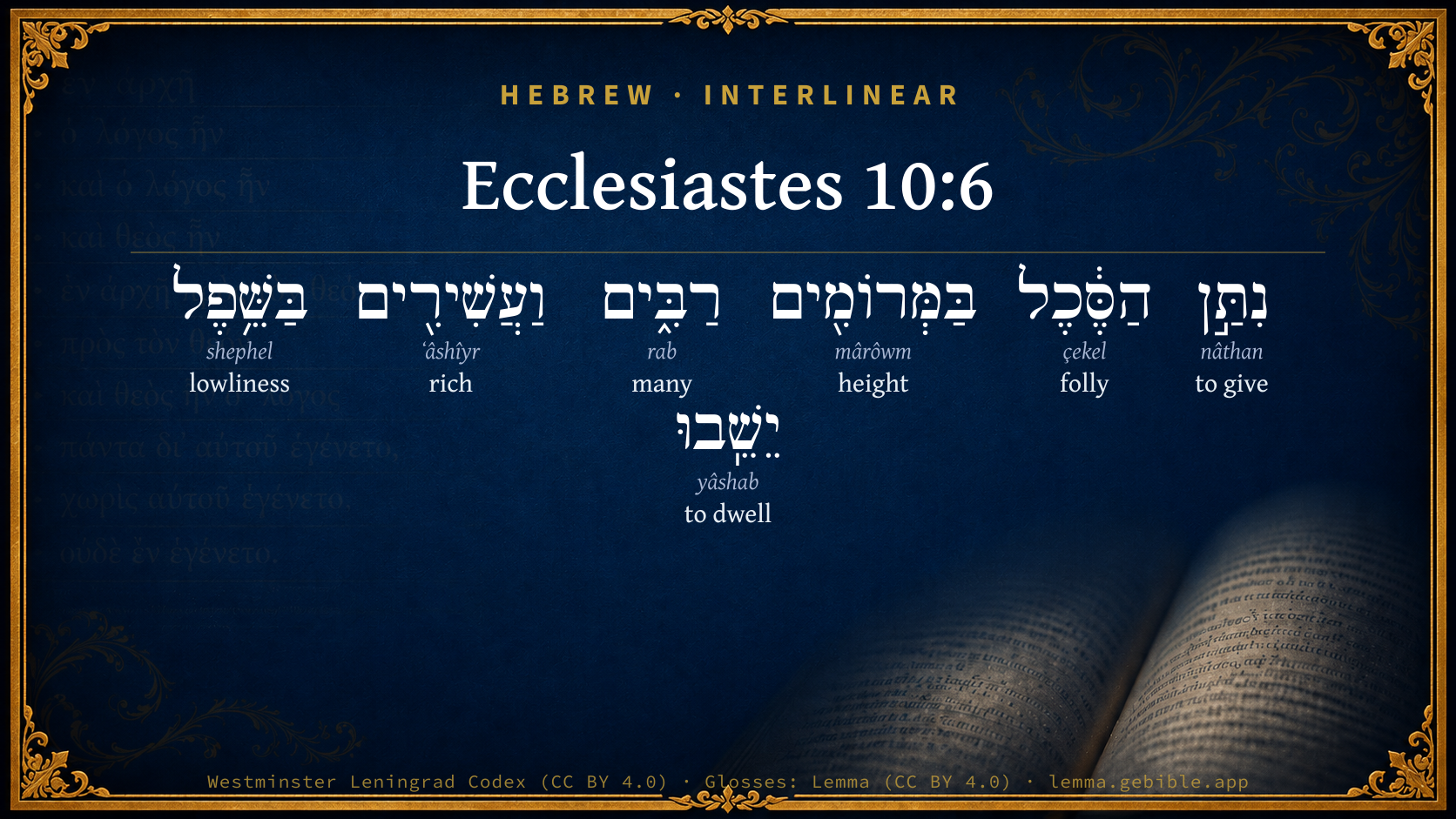
Ecclesiastes 10:6

Hebrew (Westminster Leningrad Codex) Ecclesiastes 10:6 appears in the Hebrew Old Testament. The text above is from the Westminster Leningrad Codex. Each word links to its Strong’s number, a concise gloss, and parsing drawn from the Open Scriptures Hebrew Bible morphology. Click any word for its full Brown-Driver-Briggs (BDB) entry.
Download image
Cite this verse

Ecclesiastes 10:6 (World English Bible). Public Domain. Lemma interlinear Bible study tool, https://lemma.gebible.app/v/ecclesiastes/10/6.

Show BibTeX & RIS
BibTeX
RIS
English Translation
Folly is set in great dignity, and the rich sit in a low place.
World English Bible · Public Domain
Highlights
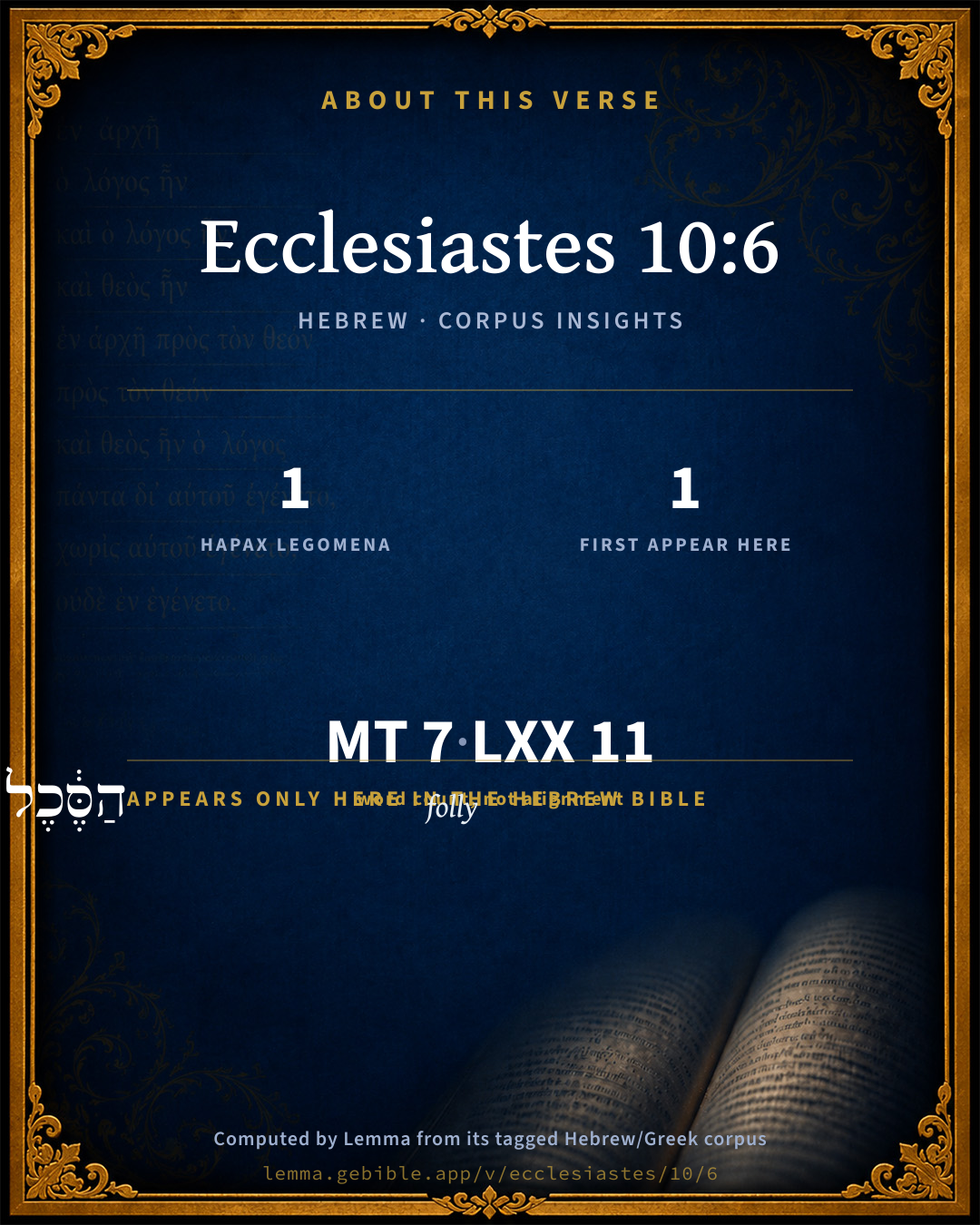
  • 1 hapax legomenon — only here in the Hebrew Bible
  • 1 first appearance in the Hebrew Bible
Full analysis ↓
Download a study sheet

One document with this verse’s original text, its word-by-word gloss line, the meaning frame, cross-references with their text, attributed commentary, and full source and license credits — printable, and it pastes into notes with its structure intact.

This verse Autodidact and up

Study sheet (.html) Plain text (.txt)

A passage Seminary Student

Up to 50 verses in one chapter. A passage sheet keeps up to 6 commentary sources and 12 cross-references per verse, in the order this page ranks them, and says so on the sheet whenever that leaves anything out. Ask for a single verse and you get the Autodidact verse sheet above.

Everything on this page stays free to read, with no account — the sheet is a download of what is already on screen, not access to it.

Want to remove ads? Support Godless Engineer
Compare translations 3

The same verse in 3 English versions, stacked beneath the original-language interlinear above. Click any original word for its lexicon entry.

Each is an independent rendering of the whole verse — the interlinear is not word-aligned to these translations.

Highlighted words mark where these versions differ — a whole-verse word diff, not a word-by-word alignment.

  • World English Bible Public Domain
    Folly is set in great dignity, and the rich sit in a low place.
  • King James Version Public Domain
    Folly is set in great dignity, and the rich sit in low place.
  • unfoldingWord Literal Text CC BY-SA 4.0
    Folly is placed into many high places, and rich sit in the lowly place.

unfoldingWord Literal Text — © unfoldingWord, licensed CC BY-SA 4.0. Word-aligned USFM3 via Door43 (git.door43.org/unfoldingWord/en_ult).

Versions to compare (up to 4)

3 of 4 selected

Show all 18 translations

Every available English version of this verse, each an independent rendering of the whole verse.

  • World English Bible Public Domain
    Folly is set in great dignity, and the rich sit in a low place.
  • Berean Standard Bible Public Domain
    Folly is appointed to great heights, but the rich sit in lowly positions.
  • Majority Standard Bible Public Domain
    Folly is appointed to great heights, but the rich sit in lowly positions.
  • King James Version Public Domain
    Folly is set in great dignity, and the rich sit in low place.
  • American Standard Version (1901) Public Domain
    folly is set in great dignity, and the rich sit in a low place.
  • Revised Version (1885) Public Domain
    folly is set in great dignity, and the rich sit in low place.
  • Geneva Bible (1599) Public Domain
    Follie is set in great excellencie, and the riche set in the lowe place.
  • Douay-Rheims (1899) Public Domain
    A fool set in high dignity, and the rich sitting beneath.
  • Young's Literal Translation Public Domain
    He hath set the fool in many high places, And the rich in a low place do sit.
  • Literal Standard Version CC BY-SA 4.0
    He has set the fool in many high places, || And the rich sits in a low place.
  • Unlocked Literal Bible CC BY-SA 4.0
    Fools are given leadership positions, while successful men are given low positions.
  • unfoldingWord Literal Text CC BY-SA 4.0
    Folly is placed into many high places, and rich sit in the lowly place.
  • Darby Bible Public Domain
    folly is set in great dignities, but the rich sit in a low place.
  • World Messianic Bible Public Domain
    Folly is set in great dignity, and the rich sit in a low place.
  • Webster's Bible Public Domain
    Folly is set in great dignity, and the rich sit in low place.
  • Free Bible Version CC BY-SA 4.0
    when they put fools in high positions, while those who are richly qualified are put in low positions.
  • Bible in Basic English Public Domain
    The foolish are placed in high positions, but men of wealth are kept low.
  • JPS Tanakh (1917) Public Domain
    Folly is set on great heights, and the rich sit in low place.

Literal Standard Version (2020), Covenant Press — licensed CC BY-SA 4.0. Text via the HelloAO Bible API (eBible.org). Unlocked Literal Bible (unfoldingWord) — licensed CC BY-SA 4.0. Text via the HelloAO Bible API (eBible.org). unfoldingWord Literal Text — © unfoldingWord, licensed CC BY-SA 4.0. Word-aligned USFM3 via Door43 (git.door43.org/unfoldingWord/en_ult). Free Bible Version, Dr. Jonathan Gallagher — licensed CC BY-SA 4.0. Text via the HelloAO Bible API (eBible.org).

Word by word

More ways to search: Search by grammar → Find every occurrence → Compare this word →

Practice this passage: Drill this verse → Learn its vocabulary →

About this verse

These counts appear in no published source. They are computed here, from the morphology-tagged text and Lemma’s own curated glosses. What Lemma adds →

7
words
7
distinct lemmas
Wisdom
section

Notable vocabulary

1 hapax legomenon — a word that appears only here in the entire Hebrew Bible:

  • הַסֶּ֔כֶל folly H5529

First appearance in Scripture

This word makes its first canonical appearance in the Hebrew Bible here:

  • הַסֶּ֔כֶל folly H5529

Shared distinctive vocabulary

בַּשֵּׁ֥פֶל lowliness H8216 occurs in 2 verses of the Hebrew Bible. Also found in:

Grammatical profile

  • 2 verbs
  • 3 nouns
  • 2 adjectives

Verb forms

  • נִתַּ֣ן Niphal · Perfect
  • יֵשֵֽׁבוּ Qal · Imperfect

Hebrew & Septuagint length

In English translation the verse runs 14 words from the Hebrew and 18 from the Septuagint (LXX English) — closely comparable.

A rough comparison of the two English renderings, which tokenize alike — not a word-level alignment.

Word counts can differ between the Hebrew and the Greek without any difference in meaning — e.g. the Hebrew direct-object marker אֵת has no separate Greek word, and Greek often adds the article ὁ.

In the original languages it is 7 Hebrew tokens and 11 Greek tokens — but the two are counted differently (Hebrew bundles its prefixes and suffixes into one token; the Greek is in lemma form), so that isn’t a like-for-like length.

Cross-references

8

Topical passages linked to Ecclesiastes 10:6 in the Treasury of Scripture Knowledge — connected by theme and wording, ordered by reader-vote popularity; previews shown in the World English Bible.

  • Proverbs 28:12 When the righteous triumph, there is great glory; But when the wicked rise, men hide themselves.
  • Proverbs 29:2 When the righteous thrive, the people rejoice; But when the wicked rule, the people groan.
  • Esther 3:1 After these things did king Ahasuerus promote Haman the son of Hammedatha the Agagite, and advanced him, and set his seat above all the princes who were with him.
  • Psalms 12:8 The wicked walk on every side, When what is vile is exalted among the sons of men.
  • Judges 9:14–20 Then said all the trees to the bramble, Come you, and reign over us.
  • 1 Kings 12:13–14 The king answered the people roughly, and forsook the counsel of the old men which they had given him,
  • Proverbs 28:28 When the wicked rise, men hide themselves; But when they perish, the righteous thrive.
  • James 2:3–5 and you pay special attention to him who wears the fine clothing, and say, "Sit here in a good place;" and you tell the poor man, "Stand there," or "Sit by my footstool;"

Cross-references courtesy of OpenBible.info (CC BY 4.0).

Hebrew and Greek witnesses Masoretic Hebrew ↔ Greek Septuagint

The same verse in the two great witnesses to the Old Testament, shown verse-for-verse.

These are two independent witnesses, not word-aligned to each other, and the Septuagint is shown in lemma (dictionary) form.

Hebrew Ecclesiastes 10:6 Masoretic · Westminster Leningrad Codex

נִתַּ֣ן הַסֶּ֔כֶל בַּמְּרוֹמִ֖ים רַבִּ֑ים וַעֲשִׁירִ֖ים בַּשֵּׁ֥פֶל יֵשֵֽׁבוּ

Folly is set in great dignity, and the rich sit in a low place.

World English Bible · Public Domain

Greek LXX Ecclesiastes 10:6 Septuagint · lemma form

δίδωμι ὁ ἄφρων ἐν ὕψος μέγας καί πλούσιος ἐν ταπεινός καταἵημι

The fool has been set in very high places, while rich men would sit in a low one.

LXX2012 (modern English Septuagint) · Public Domain

On this verse, The Pulpit Commentary discusses the Septuagint’s reading. Read the note in Commentary ↓

Hebrew: Westminster Leningrad Codex (CC BY 4.0). Greek: Septuagint (public domain); English from LXX2012 (modern English Septuagint) (Public Domain). How the Septuagint differs from the Hebrew →

Commentary

Notes on Ecclesiastes 10:6 from classic Christian and Jewish commentators (each source and its license shown beneath its notes). The classic Christian expositions comment on the surrounding passage and are grouped to its opening verse, so a note may address several verses; the Jewish commentaries on the Tanakh (Rashi and others) are per-verse, so they appear only where the commentator wrote on this verse.

Lemma curates 59 commentaries, every one of them public domain or Creative Commons licensed, each selected and text-cleaned for this edition rather than reprinted as found. About our sources →

Trapp's Complete Commentary

John Trapp

Ecc 10:6 Folly is set in great dignity, and the rich sit in low place.

Ver. 6. Folly is set in great dignity.] Sedes prima et vita ima, {a} these suit not. Dignitas in indigno est ornamentum in luto. Royalty itself, without righteousness, is but eminent dishonour. When a fool is set in dignity, it is, saith one, {b} as when a handful of hay is set up to give light, which with smoke and smell offendeth all that are near. When as the worthy sit in low place, it is as when a goodly candle (that on a table would give a comfortable and comely light) is put under a bushel.

And the rich in low place,] i.e., The wise, as appears by the opposition, who, in true account, are the only rich, {Jas 2:5} "rich in faith," {1Ti 6:18} "rich in good works," {Luk 12:21} rich to Godward, who hath highly honoured and advanced them, though vilipended and underrated by men; digni etiam qui ditentur, worthy they are also to be set in highest places, as being drained from the dregs, and sifted from the brans of the common sort of people. Dignity should wait upon desert, as it did here in England, in King Edward VI’s days, that aureum saeculum, in quo honores melioribus dabantur, as Seneca {c} hath it, that golden age in which honours were bestowed on those that best deserved them. But in case it prove otherwise, as it often doth - the golden bishopric of Carthage fell to the lot of leaden Aurelius, and little Hippo to great St Augustine; Damasus, the scholar, was advanced to the see of Rome when Jerome, his master, ended his days in his cell at Bethlehem - yet virtue is its own competent encouragement, and will rather choose to lie in the dust than to rise by wickedness. Cato said he had rather men should question why he had no statue or monument erected in honour of him, than why he had. The wise historian observed that the statues of Brutus and Cassius, eo praefulgebant quod non visebantur, {d} were the more glorious and illustrious, because they were not brought out with other images in a solemn procession at the funeral of Germanicus. God pleaseth himself, saith Basil, in beholding a hidden pearl in a disrespected body. {e} A rich stone is of no less worth when locked up in a wicker casket, than when it is set in a royal diadem.

{a} Salvian.

{b} Cartwright.

{c} Sen. Epist., 91.

{d} Tacit. Annal.

{e} Abstrusum in despecto corpore margaritum conspicatus.

John Trapp, A Commentary or Exposition upon All the Books of the Old and New Testament (1647–1656) — public domain. Text from a community e-Sword module.

Geneva Bible (1599)

Geneva Bible translators

They that are rich in wisdom and virtue.

Geneva Bible (1599) marginal notes — public domain. Text via Bolls.life.

Jamieson, Fausset & Brown

Robert Jamieson, A. R. Fausset & David Brown

rich--not in mere wealth, but in wisdom, as the antithesis to "folly" (for "foolish men") shows. So Hebrew, rich, equivalent to "liberal," in a good sense (Isa 32:5). Mordecai and Haman (Est 3:1-2; Est 6:6-11).

Jamieson, Fausset & Brown — Commentary Critical and Explanatory on the Whole Bible (1871) — public domain (CC PDM 1.0). Text via the HelloAO Bible API.

The Cambridge Bible for Schools and Colleges

gen. ed. J. J. S. Perowne

6. Folly is set in great dignity, and the rich sit in low place] For “great dignity,” literally great heights. The “rich” here are those who by birth and station are looked on as the natural rulers of mankind. Such men, like the ἀρχαιόπλουτοι (the “men of ancestral wealth”) of Greek political writers, (Aristot. Rhet. ii. 9; Aesch. Agam. 1043) a wise ruler associates with himself as counsellors. The tyrant, on the other hand, like Louis XI. exalts the baseborn to the place of honour, or like Edward II. or James I. of England, or Henry III. of France, lavishes dignities on his minions. So the writer may have seen Agathoclea and her brother; all-powerful, as mistress and favourite, in the court of Ptolemy Philopator (Justin xxx. 1).

The Cambridge Bible for Schools and Colleges (gen. ed. J. J. S. Perowne; Cambridge University Press, 1878–1918) — public domain. Text from a community e-Sword module.

John Gill's Exposition

Folly is set in great dignity,.... Or "in great heights" (q); in high places of honour and truest; even foolish and wicked men; men of poor extraction, of low life, and of mean abilities and capacities; and, which is worse, men vile and vicious, as Doeg the Edomite, Haman the Amalekite, and others;

and the rich sit in low places; men not only of fortune and estates, and above doing mean and little actions, and so more fit for such high places; but men rich in wisdom and knowledge, of large capacities and of great endowments of mind, and so abundantly qualified for posts in the administration of government; and, above all, men rich in grace, fearing God, and hating coveteousness, as rulers ought to be, Exo 18:21; and yet these sometimes are neglected, live in obscurity, who might otherwise be very useful in public life. The Targum interprets this and the following verse of the Israelites in exile and poverty among the Gentiles for their sins; so Jarchi.

(q) , Sept. "in celsitudinibus amplis", Piscator, Amama, Gejerus; "in sublimitatibus amplis", Cocceius; "in altitudinibus magnis", Rambachius; "in great height", Broughton.

John Gill's Exposition of the Whole Bible (1746–1763) — public domain (CC PDM 1.0). Text via the HelloAO Bible API.

Albert Barnes' Notes on the Bible

The “evil” of Ecc 10:5 is here specified as that caprice of a king by which an unworthy favorite of low origin is promoted to successive dignities, while a noble person is degraded or neglected.

Albert Barnes' Notes on the Bible (1834–1885) — public domain. Text from a community e-Sword/MySword module.

Haydock's Catholic Bible Commentary

Rich. Such were chosen magistrates, Exodus xviii. 21., and Proverbs xxviii. 16., and xxx. 21.

George Leo Haydock (1774–1849), Haydock's Catholic Family Bible and Commentary, 1859 edition — public domain. Excludes Psalms (Douay-Rheims chapter numbering differs from Protestant) and Deuterocanonical books (Catholic canon only).

Matthew Poole's English Annotations

Folly is set in great dignity; foolish and unworthy persons are frequently advanced by the favour or humour of princes into places of highest trust and dignity, which is a great reproach and mischief to the prince, and a sore calamity to all his people. The rich; wise and worthy men, as is evident, because these are opposed to fools in the former clause; such as are rich in endowments of mind. The ground of the expression may be this, that rich men are capable of all the advantages of men or books for the attainment of wisdom, and therefore are supposed to be wise in some measure.

Sit in low place; neglected and despised, or removed from those high places to which their merits had raised them.

Matthew Poole's English Annotations on the Holy Bible (1683–1685) — public domain. Text from a community e-Sword/MySword module.

Whedon's Commentary on the Bible

Daniel D. Whedon

6. Folly — That is, the foolish man.

Great dignity — Hebrew, Many high stations. The Roman emperors and the kings of France, as well as eastern rulers, have promoted worthless favourites to the most important offices, leaving the wise and good in obscurity.

Daniel D. Whedon (gen. ed.), Commentary on the Old and New Testaments (1874–1909) — public domain. Text from a community e-Sword module.

The Pulpit Commentary

Folly is set in great dignity, and the rich sit in low place. This is an instance of the error intimated in the preceding verse. A tyrannical ruler exalts incompetent persons, unworthy favorites, to "great heights" (ejn oyesi megaloiv, Septuagint), as it is literally puts them into eminent positions. "Folly" is abstract for concrete, "fools." And the rich sit in low place. "The rich" (ushirim) are not simply those who have wealth, however obtained, but men of noble birth; ajrcaioploutoi, as Plumptre appositely notes, persons of ancestral wealth, who from natural position might be looked upon as rulers of men. Such men would seek eminent stations, not from base motives of gain, but from an honorable ambition, and yet they are often slighted by unworthy princes and kept in low estate. (comp. 1Sa_2:7, 1Sa_2:8; Pro_19:10; Ecc_11:5, Ecc_11:6) The experience mentioned in this and the following verses could scarcely have been Solomon"s, though it has been always common enough in the East, where the most startling changes have been made, the lowest persons have been suddenly raised to eminence, mistresses and favorites loaded with dignities, and oppression of the rich has been systematically pursued.

The Pulpit Commentary (1880–1919), ed. H.D.M. Spence-Jones & Joseph S. Exell — public domain. Text from a community e-Sword module.

John Wesley's Explanatory Notes

The rich - Wise and worthy men, rich in endowments of mind.

John Wesley, Explanatory Notes Upon the Whole Bible (1754–1765) — public domain. Text via the GEBible commentary corpus.

Keil & Delitzsch

C. F. Keil & F. Delitzsch

"Folly is set on great heights, and the rich must sit in lowliness. I have seen servants upon horses, and princes like servants walking on foot." The word הסּכל (with double seghol, Aram. סכלוּ) is used here instead of those in whom it is personified. Elsewhere a multiplicity of things great, such as עמּים, מים, and the like, is heightened by רבּים (cf. e.g., Psa 18:17); here "great heights" are such as are of a high, or the highest degree; rabbim, instead of harabbim, is more appos. than adject. (cf. Gen 43:14; Psa 68:28; Psa 143:10; Jer 2:21), in the sense of "many" (e.g., Ginsburg: "in many high positions") it mixes with the poetry of the description dull prose.

(Note: Luzz. reads נתן: "Folly brings many into high places." The order of the words, however, does not favour this.)

'Ashirim also is peculiarly used: divites = nobiles (cf. שׁוע, Isa 32:5), those to whom their family inheritance gives a claim to a high station, who possess the means of training themselves for high offices, which they regard as places of honour, not as sources of gain. Regibus multis, Grotius here remarks, quoting from Sallust and Tacitus, suspecti qui excellunt sive sapientia sive nobilitate aut opibus. Hence it appears that the relation of slaves and princes to each other is suggested; hoc discrimen, says Justin, 41:3, of the Parthians, inter servos liberosque est quod servi pedibus, liberi nonnisi equis incedunt; this distinction is set aside, princes must walk 'al-haarěts, i.e., beregel (beraglēhěm), and in their stead (Jer 17:25) slaves sit high on horseback, and rule over them (the princes), - an offensive spectacle, Pro 19:10. The eunuch Bagoas, long all-powerful at the Persian Court, is an example of the evil consequences of this reversal of the natural relations of men.

Keil & Delitzsch — Biblical Commentary on the Old Testament (1861–1891) — public domain (CC PDM 1.0). Text via the HelloAO Bible API. (Old Testament only.)

Rashi

Rabbi Shlomo Yitzchaki (Rashi)

Folly was set at great heights This is the evil that is like an error which goes forth from before the ruler: that folly and wickedness are set at the loftiest heights, for the Holy One, blessed be He, raised the fools and the wicked, for I see with the holy spirit, that they are destined to stretch out a hand upon His Temple and to make their signs for signs.” (Psalms 74:4; see also Gittin 56b.)

and the rich sit in a low place Israel, for despite all the greatness and honor that they have now in my days, they are destined to sit in a low place, as it is said (Lam. 2:10): “sit on the ground in silence.”

Rashi on the Tanakh — English translations: “The Judaica Press complete Tanach with Rashi, translated by A. J. Rosenberg” (CC BY 4.0); “Pentateuch with Rashi's commentary by M. Rosenbaum and A.M. Silbermann, 1929-1934” (public domain); “The Metsudah Tanach series, Lakewood, N.J” (CC BY 4.0); and “The Book of Joshua, Metsudah Publications, 1997” (CC BY 4.0). Text via Sefaria.

Lesson kit

Teaching starters — assembled from the data on this page, not authored interpretation. Every prompt links to the verse data it draws on. Edit before teaching.

Ecclesiastes, in the Wisdom, opens this verse with 7 words (7 distinct Hebrew lemmas). Its most distinctive word is çekel (“folly”). A historical commentator’s framing appears above. Read the whole chapter for the surrounding context.

Discussion questions

  1. What does “folly” (çekel) contribute to the verse as a whole?
  2. 1 word here appears nowhere else in the Hebrew Bible. Why might the author reach for such rare wording?
  3. This is the first place “folly” appears in Scripture (first appears here). What does its debut here establish?
  4. How does Psalms 136:23, which shares the word «lowliness», read alongside this verse?
  5. These translations render this verse differently. What is at stake in choosing one wording over another?
  6. «נִתַּ֣ן» is a Niphal Perfect verb. How does that grammatical form shape the action described?
  7. Compare how Trapp's Complete Commentary and Geneva Bible (1599) read this verse. Where do they agree or differ?

Things to notice

Reading settings

Reading text

Shown beneath each verse's original-language words.

Old Testament
Old Testament edition

Read the OT as the Masoretic Hebrew (MT) or the Greek Septuagint (LXX).

English shown for the Greek Septuagint (in the Hebrew ↔ Greek comparison).

Comparing translations? Open the Compare panel on any verse page to stack up to four side by side.