
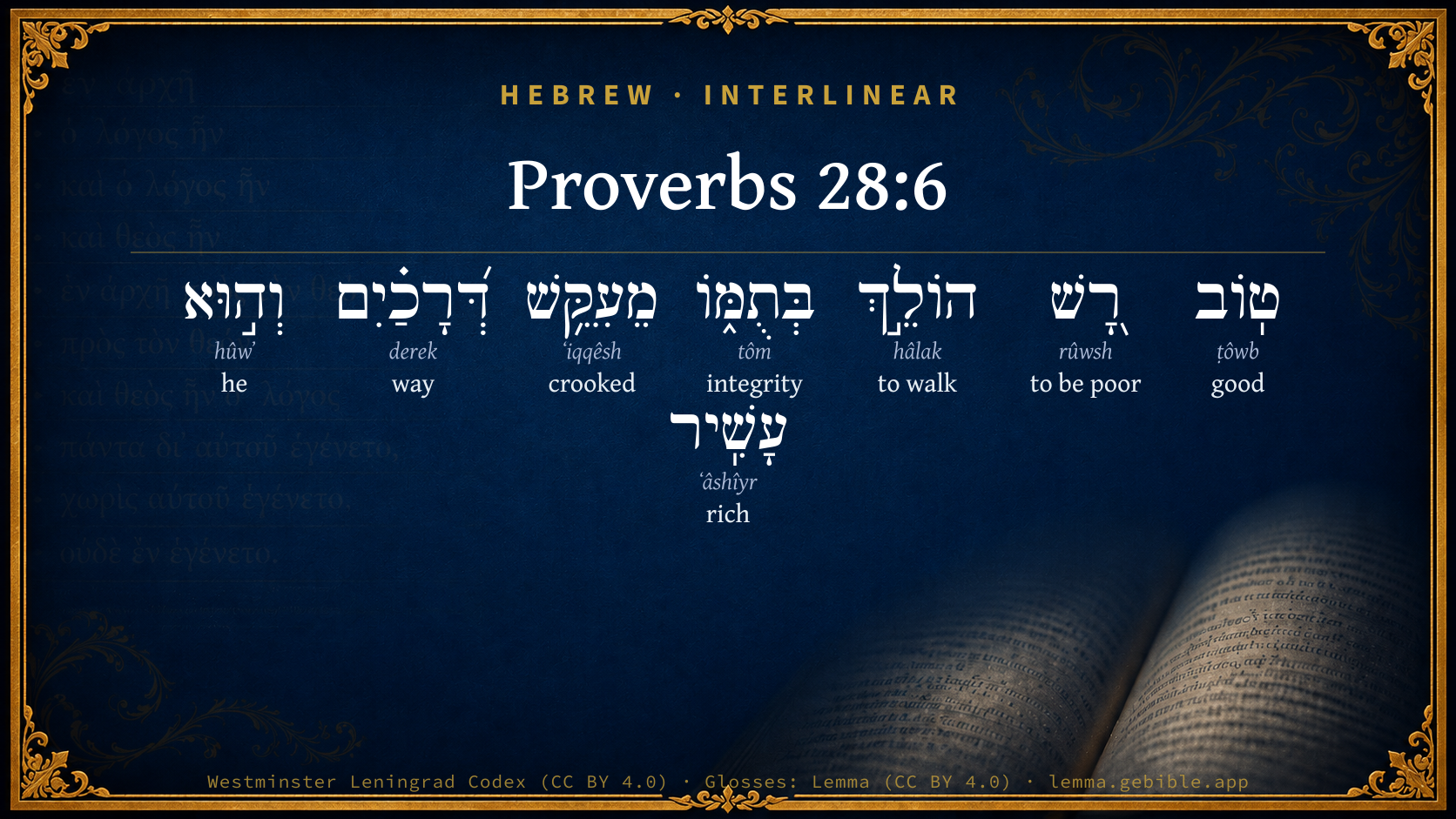
Proverbs 28:6

Hebrew (Westminster Leningrad Codex) Proverbs 28:6 appears in the Hebrew Old Testament. The text above is from the Westminster Leningrad Codex. Each word links to its Strong’s number, a concise gloss, and parsing drawn from the Open Scriptures Hebrew Bible morphology. Click any word for its full Brown-Driver-Briggs (BDB) entry.
Download image
Cite this verse

Proverbs 28:6 (World English Bible). Public Domain. Lemma interlinear Bible study tool, https://lemma.gebible.app/v/proverbs/28/6.

Show BibTeX & RIS
BibTeX
RIS
English Translation
Better is the poor who walks in his integrity, Than he who is perverse in his ways, and he is rich.
World English Bible · Public Domain
Download a study sheet

One document with this verse’s original text, its word-by-word gloss line, the meaning frame, cross-references with their text, attributed commentary, and full source and license credits — printable, and it pastes into notes with its structure intact.

This verse Autodidact and up

Study sheet (.html) Plain text (.txt)

A passage Seminary Student

Up to 50 verses in one chapter. A passage sheet keeps up to 6 commentary sources and 12 cross-references per verse, in the order this page ranks them, and says so on the sheet whenever that leaves anything out. Ask for a single verse and you get the Autodidact verse sheet above.

Everything on this page stays free to read, with no account — the sheet is a download of what is already on screen, not access to it.

Want to remove ads? Support Godless Engineer
Compare translations 3

The same verse in 3 English versions, stacked beneath the original-language interlinear above. Click any original word for its lexicon entry.

Each is an independent rendering of the whole verse — the interlinear is not word-aligned to these translations.

Highlighted words mark where these versions differ — a whole-verse word diff, not a word-by-word alignment.

  • World English Bible Public Domain
    Better is the poor who walks in his integrity, Than he who is perverse in his ways, and he is rich.
  • King James Version Public Domain
    Better is the poor that walketh in his uprightness, than he that is perverse in his ways, though he be rich.
  • unfoldingWord Literal Text CC BY-SA 4.0
    Better one who is poor who walks in his integrity than one crooked of ways, yet he rich.

unfoldingWord Literal Text — © unfoldingWord, licensed CC BY-SA 4.0. Word-aligned USFM3 via Door43 (git.door43.org/unfoldingWord/en_ult).

Versions to compare (up to 4)

3 of 4 selected

Show all 18 translations

Every available English version of this verse, each an independent rendering of the whole verse.

  • World English Bible Public Domain
    Better is the poor who walks in his integrity, Than he who is perverse in his ways, and he is rich.
  • Berean Standard Bible Public Domain
    Better a poor man who walks with integrity than a rich man whose ways are perverse.
  • Majority Standard Bible Public Domain
    Better a poor man who walks with integrity than a rich man whose ways are perverse.
  • King James Version Public Domain
    Better is the poor that walketh in his uprightness, than he that is perverse in his ways, though he be rich.
  • American Standard Version (1901) Public Domain
    Better is the poor that walketh in his integrity, Than he that is perverse in `his' ways, though he be rich.
  • Revised Version (1885) Public Domain
    Better is the poor that walketh in his integrity, than he that is perverse in his ways, though he be rich.
  • Geneva Bible (1599) Public Domain
    Better is the poore that walketh in his vprightnesse, then hee that peruerteth his wayes, though he be riche.
  • Douay-Rheims (1899) Public Domain
    Better is the poor man walking in his simplicity, than the rich in crooked ways.
  • Young's Literal Translation Public Domain
    Better `is' the poor walking in his integrity, Than the perverse of ways who is rich.
  • Literal Standard Version CC BY-SA 4.0
    Better [is] the poor walking in his integrity, || Than the perverse of ways who is rich.
  • Unlocked Literal Bible CC BY-SA 4.0
    It is better for a poor person who walks in his integrity, than for a rich person who is crooked in his ways.
  • unfoldingWord Literal Text CC BY-SA 4.0
    Better one who is poor who walks in his integrity than one crooked of ways, yet he rich.
  • Darby Bible Public Domain
    Better is the poor that walketh in his integrity, than he that is perverse, double in ways, though he be rich.
  • World Messianic Bible Public Domain
    Better is the poor who walks in his integrity than he who is perverse in his ways, and he is rich.
  • Webster's Bible Public Domain
    Better is the poor that walketh in his uprightness, than he that is perverse in his ways, though he is rich.
  • Free Bible Version CC BY-SA 4.0
    Better to be poor and have integrity than to be devious and rich.
  • Bible in Basic English Public Domain
    Better is the poor man whose ways are upright, than the man of wealth whose ways are not straight.
  • JPS Tanakh (1917) Public Domain
    Better is the poor that walketh in his integrity, than he that is perverse in his ways, though he be rich.

Literal Standard Version (2020), Covenant Press — licensed CC BY-SA 4.0. Text via the HelloAO Bible API (eBible.org). Unlocked Literal Bible (unfoldingWord) — licensed CC BY-SA 4.0. Text via the HelloAO Bible API (eBible.org). unfoldingWord Literal Text — © unfoldingWord, licensed CC BY-SA 4.0. Word-aligned USFM3 via Door43 (git.door43.org/unfoldingWord/en_ult). Free Bible Version, Dr. Jonathan Gallagher — licensed CC BY-SA 4.0. Text via the HelloAO Bible API (eBible.org).

Word by word

More ways to search: Search by grammar → Find every occurrence → Compare this word →

Practice this passage: Drill this verse → Learn its vocabulary →

מֵעִקֵּ֥שׁ
ʻiqqêsh
H6141
“from · crooked of”
Preposition + Adjective, Adjective, Masculine, Singular, Construct
Part of Speech
Preposition + Adjective
Type
Adjective
Gender
Masculine
Number
Singular
State
Construct
Full BDB Definition

Origin: from H6140

TWOT: 1684a

twisted, distorted, crooked, perverse, perverted
  1. טֽוֹב ṭôwb H2896 “good” Adjective, Adjective, Masculine, Singular, Absolute
  2. רָ֭שׁ rûwsh H7326 “being poor” Verb, Qal, Participle Active, Masculine, Singular, Absolute
  3. הוֹלֵ֣ךְ hâlak H1980 “walking” Verb, Qal, Participle Active, Masculine, Singular, Absolute
  4. בְּתֻמּ֑וֹ tôm H8537 “in/at · integrity · his” Preposition + Noun, Common, Masculine, Singular, Construct + Suffix, Personal, 3rd Person, Masculine, Singular
  5. דְּ֝רָכַ֗יִם derek H1870 “ways” Noun, Common, Both, Dual, Absolute
  6. וְה֣וּא hûwʼ H1931 “and · he” Conjunction + Pronoun, Personal, 3rd Person, Masculine, Singular
  7. עָשִֽׁיר ʻâshîyr H6223 “rich” Adjective, Adjective, Masculine, Singular, Absolute

About this verse

These counts appear in no published source. They are computed here, from the morphology-tagged text and Lemma’s own curated glosses. What Lemma adds →

8
words
8
distinct lemmas
Wisdom
section

Notable vocabulary

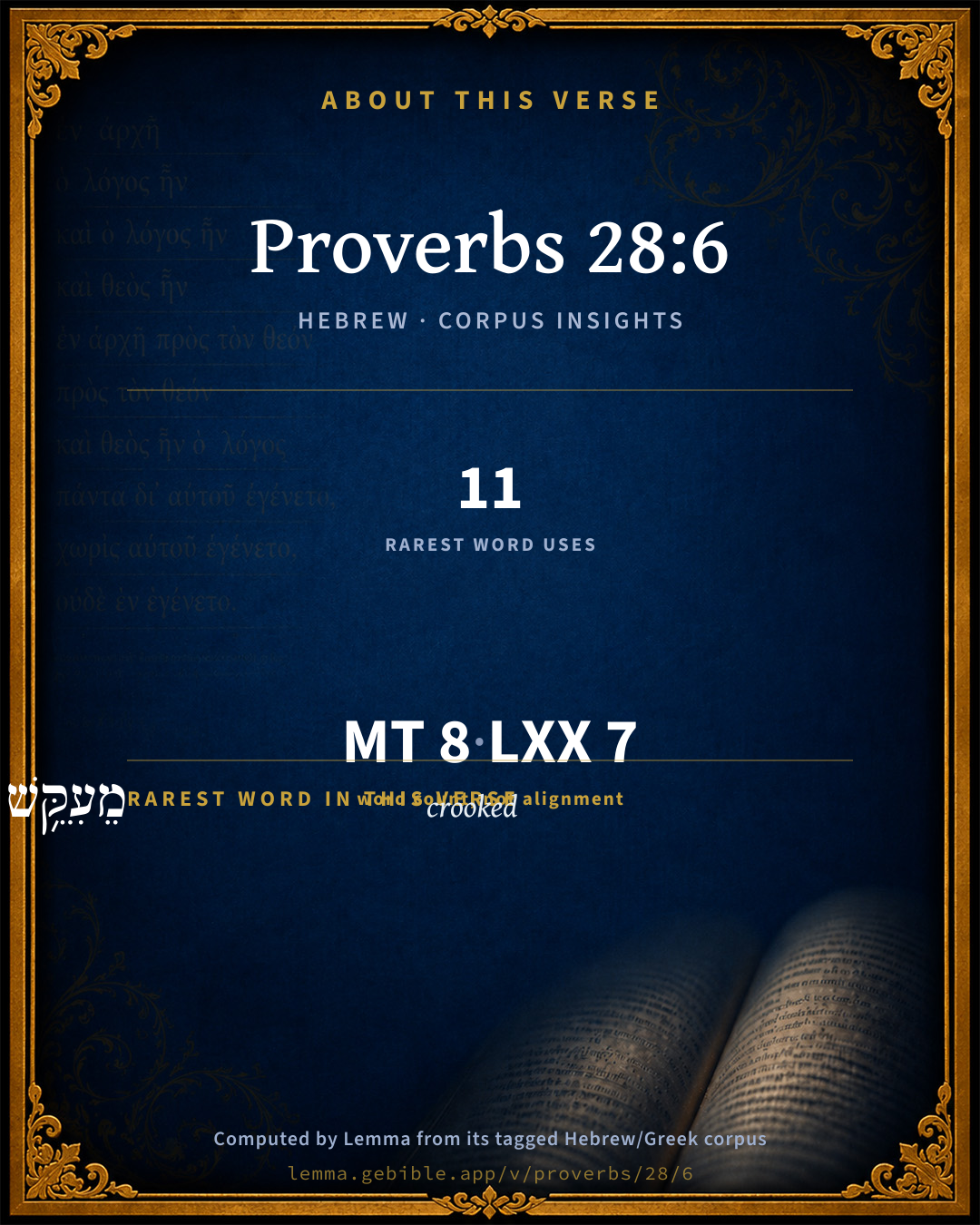
The rarest word here is מֵעִקֵּ֥שׁ crooked H6141 — appearing just 11 times in the whole Hebrew Bible.

Shared distinctive vocabulary

מֵעִקֵּ֥שׁ crooked H6141 occurs in 11 verses of the Hebrew Bible. Also found in:

Grammatical profile

  • 2 verbs
  • 2 nouns
  • 3 adjectives
  • 1 pronoun

Verb forms

  • רָ֭שׁ Qal · Participle Active
  • הוֹלֵ֣ךְ Qal · Participle Active

Hebrew & Septuagint length

In English translation the verse runs 21 words from the Hebrew and 12 from the Septuagint (LXX English) — the Septuagint runs noticeably shorter here. See the side-by-side →

A rough comparison of the two English renderings, which tokenize alike — not a word-level alignment.

Word counts can differ between the Hebrew and the Greek without any difference in meaning — e.g. the Hebrew direct-object marker אֵת has no separate Greek word, and Greek often adds the article ὁ.

In the original languages it is 8 Hebrew tokens and 7 Greek tokens — but the two are counted differently (Hebrew bundles its prefixes and suffixes into one token; the Greek is in lemma form), so that isn’t a like-for-like length.

Cross-references

6

Topical passages linked to Proverbs 28:6 in the Treasury of Scripture Knowledge — connected by theme and wording, ordered by reader-vote popularity; previews shown in the World English Bible.

  • Proverbs 19:1 Better is the poor who walks in his integrity Than he who is perverse in his lips and is a fool.
  • Proverbs 28:18 Whoever walks blamelessly is kept safe; But one with perverse ways will fall suddenly.
  • Luke 16:19–23 "Now there was a certain rich man, and he was clothed in purple and fine linen, living in luxury every day.
  • Proverbs 19:22 That which makes a man to be desired is his kindness. A poor man is better than a liar.
  • Proverbs 16:8 Better is a little with righteousness, Than great revenues with injustice.
  • Acts 24:24–27 But after some days, Felix came with Drusilla, his wife, who was a Jewess, and sent for Paul, and heard him concerning the faith in Christ Jesus.

Cross-references courtesy of OpenBible.info (CC BY 4.0).

Hebrew and Greek witnesses Masoretic Hebrew ↔ Greek Septuagint

The same verse in the two great witnesses to the Old Testament, shown verse-for-verse.

Here the Septuagint runs noticeably shorter than the Hebrew — LXX2012 (modern English Septuagint) 12 words vs World English Bible 21. A rough length comparison of the two English translations, not a word-level alignment — read both below.

These are two independent witnesses, not word-aligned to each other, and the Septuagint is shown in lemma (dictionary) form.

Hebrew Proverbs 28:6 Masoretic · Westminster Leningrad Codex

טֽוֹב רָ֭שׁ הוֹלֵ֣ךְ בְּתֻמּ֑וֹ מֵעִקֵּ֥שׁ דְּ֝רָכַ֗יִם וְה֣וּא עָשִֽׁיר

Better is the poor who walks in his integrity, Than he who is perverse in his ways, and he is rich.

World English Bible · Public Domain

Greek LXX Proverbs 28:6 Septuagint · lemma form

κρείσσων πτωχός πορεύομαι ἐν ἀλήθεια πλούσιος ψευδής

A poor man walking in truth is better than a rich liar.

LXX2012 (modern English Septuagint) · Public Domain

On this verse, Bridges on Proverbs discusses the Septuagint’s reading. Read the note in Commentary ↓

Hebrew: Westminster Leningrad Codex (CC BY 4.0). Greek: Septuagint (public domain); English from LXX2012 (modern English Septuagint) (Public Domain). How the Septuagint differs from the Hebrew →

Commentary

Notes on Proverbs 28:6 from classic Christian and Jewish commentators (each source and its license shown beneath its notes). The classic Christian expositions comment on the surrounding passage and are grouped to its opening verse, so a note may address several verses; the Jewish commentaries on the Tanakh (Rashi and others) are per-verse, so they appear only where the commentator wrote on this verse.

Lemma curates 59 commentaries, every one of them public domain or Creative Commons licensed, each selected and text-cleaned for this edition rather than reprinted as found. About our sources →

Trapp's Complete Commentary

John Trapp

Pro 28:6 Better [is] the poor that walketh in his uprightness, than [he that is] perverse [in his] ways, though he [be] rich.

Ver. 6. Better is the poor, &c.] See Pro 19:1.

John Trapp, A Commentary or Exposition upon All the Books of the Old and New Testament (1647–1656) — public domain. Text from a community e-Sword module.

The Biblical Illustrator

Joseph S. Exell

Pro_28:6

Better is the poor that walketh in his uprightness, than he that is perverse in his ways, though he be rich.

Christianity, the health of a people

The poor man who walks in his integrity, must be supposed to possess that practical wisdom so much spoken of in this book. The rich man who is perverse in his ways is destitute of this wisdom. The presumed difference between the poor man and the rich is in the possession of true religious principle.

I. The influence which true religion exerts in reference to the duties of life. There has been a tendency to speak of useful knowledge as if it did not include religious knowledge. Useful knowledge must be that which equips man for immortality. If a man is imbued with the fear of God, he has a principle which must accompany him into all the intercourse of life, and exert an influence over each portion of his conduct.

II. The influence which true religion exerts in reference to the trials of life. The poor cottager finds in the promises of Scripture a mighty counterpoise to all the troubles by which he is oppressed. Christianity does not diminish labour or prevent sorrow or death, but it does give strength, and cheer, and hope. Religion has such a power of softening what is rugged, enlightening what is dark, sustaining under the heaviest pressure, and encouraging in the most perplexed circumstances, that as nothing can supply its place, so its possession more than compensates every other want. (H. Melvill, B.D.)

The Biblical Illustrator, edited by Joseph S. Exell (c. 1880s–1900s) — public domain. Text from a community e-Sword module.

Joseph Benson's Commentary

Pro 28:6. Better is the poor — In a much safer and happier condition; that walketh in his uprightness — That sincerely desires and endeavours to walk in all well pleasing before God; than he that is perverse in his ways — Hebrew, דרכים, in two ways, that is, halting in two ways, pretending to virtue, but practising vice; or covering his wicked designs with good pretences; or sometimes erring on one hand, and sometimes on the other, as wicked men commonly do.

Joseph Benson's Commentary on the Old and New Testaments (1811–1818) — public domain. Text from a community e-Sword module.

Bridges on Proverbs

Charles Bridges

This Proverb is repeated†1 for its valuable instruction. One part of the comparison, implied before, is here expressed — though he be rich. Before, he was described as perverse in is lips. A deeper trait of character is here given — perverse in his ways, or his principles. This is one of those paradoxes, that sometimes stumble the feet even of God’s children. (Psa 73:2-16 .) A man may walk in his uprightness, and yet be poor. He may be perverse in his ways, and be rich. And yet the poor man, with all his external disadvantages, is better; more honorable, more happy, more useful than the rich, with all his earthly splendor.†2

To come to a solid scriptural decision on this point is of great practical moment. For if we are dazzled with the glitter of this world’s glory, we shall reverse the golden rule (Mat 6:33 ); and "seek" first the world as our grand object: and "the kingdom of God," the interests of the soul, the stake of eternity, will occupy only the second place; that is — virtually they will be thrust out.

This is a just balance, however counter it may be to common opinion. Dishonesty is the besetting temptation of the poor. (Pro 30:9 .) Yet in despite of this temptation, he walks in his uprightness. Is there not a glory around his poverty, infinitely beyond the vain show of this world? The rich man is perverse in his ways; "a double-minded man," endeavoring to walk in two ways;†3 outwardly following godliness, inwardly deceit; pretending to go one way, walking in another. Who can trust him?

So far then as concerns character, the comparison is in favor of the poor. As regards condition — Who would not prefer the lot of Elijah, subsisting upon his barrel of meal, to Ahab in all the glory of his throne?†4 Who does not see a dignity in Paul standing at the bar, that throws the worldly rank of his judges into utter insignificance?†5

But the truth is of general application. Outward superiority only affects our state before God, as increasing proportionably our responsibilities. (Luk 12:48 .) How many will wish, that they had lived and died in obscure poverty, with "a conscience void of offense toward God and toward man" (Act 24:16 ); rather than have been entrusted with riches; only in the perverseness of their ways to embolden them to sin with a high hand against God and their own souls!

Footnotes:

†1 Pro 19:1. The LXX. translation of this verse, 28:6, is — ’A poor man is better than a rich lie’ — the abstract for the concrete. Compare Pro 19:22 . Psa 62:9 .

†2 There is a fine passage from Cicero, which it is difficult to translate without losing much of its spirit — ’A contented mind is as good as an estate. Frugality is itself a revenue. To be satisfied with one’s lot is to be really and infallibly rich. If landed possessions are most highly valued by shrewd judges of human affairs, as a property, which is least liable to injury; how inestimably precious must true virtue, which cannot be snatched from us by force or by fraud; which cannot be damaged by shipwreck or by fire; which no tempests or political disturbances can change! They alone, who are endowed with this treasure, can be said to be truly rich. They alone possess what is fruitful and durable. What is allotted to them they deem sufficient. They covet nothing. They really want nothing. They require nothing. The wicked and the avaricious, on the contrary, so far from being rich, are in reality miserably poor; inasmuch as they have no certain treasure, and are always impatient for some addition to their stores, never satisfied with their present possessions.’ — Paradox, vi. 3.

†3 Heb. perverse in two ways, Jas 1:8 .

†4 1Ki 17:13-15, with 1Ki 21:1-4, 1Ki 21:19 .

†5 Act 24:24-26; Act 26:27-29 . 2Ti 4:16-17 .

Charles Bridges, An Exposition of the Book of Proverbs (1846) — public domain. Text from a community e-Sword module.

Tyndale Open Study Notes

Tyndale Open Resources

28:6 Virtue is more valuable than material wealth. This proverb is repeated with a slightly different conclusion in 19:1.

Tyndale Open Study Notes — © Tyndale Open Resources, licensed CC BY-SA 4.0. Text via the HelloAO Bible API.

Matthew Henry's Commentary

Here, 1. It is supposed that a man may walk in his uprightness and yet be poor in this world, which is a temptation to dishonesty, and yet may resist the temptation and continue to walk in his uprightness - also that a man may be perverse in his ways, injurious to God and man, and yet be rich, and prosper in the world, for a while, may be rich, and so lie under great obligations and have great opportunities to do good, and yet be perverse in his ways and do a great deal of hurt. 2. It is maintained as a paradox to a blind world that an honest, godly, poor man, is better than a wicked, ungodly, rich man, has a better character, is in a better condition, has more comfort in himself, is a greater blessing to the world, and is worthy of much more honour and respect. It is not only certain that his case will be better at death, but it is better in life. When Aristides was by a rich man upbraided with his poverty he answered, Thy riches do thee more hurt than my poverty does me.

Matthew Henry's Commentary on the Whole Bible (1708–1710) — public domain (CC PDM 1.0). Text via the HelloAO Bible API.

Jamieson, Fausset & Brown

Robert Jamieson, A. R. Fausset & David Brown

(Compare Pro 10:6). Riches cannot compensate for sin, nor the want of them affect integrity.

Jamieson, Fausset & Brown — Commentary Critical and Explanatory on the Whole Bible (1871) — public domain (CC PDM 1.0). Text via the HelloAO Bible API.

Ellicott's Commentary for English Readers

(6) Better is the poor that walketh . . .—A variation of Pro_19:1.

Perverse in his ways.—According to the pointing of the text the words signify, “perverse in two ways.” That is, the sinner tries to “go two ways” (Sir_2:12); to follow his own way without entirely deserting God’s; to “serve God and mammon;” he is “double-minded” (Jas_1:8), instead of setting before himself God’s will as the guide of his life.

A Bible Commentary for English Readers, edited by Charles John Ellicott (1878–1897) — public domain. Text from a community e-Sword module.

The Cambridge Bible for Schools and Colleges

gen. ed. J. J. S. Perowne

6. The first half of the proverb occurs in Pro_19:1.

perverse in his ways] Lit. perverse of two ways: i.e. in double-dealing. Comp. “Woe … to the sinner that goeth two ways!” Sir_2:12; ἀνὴρ δίψυχος ἀκατάστατος ἐν πάσαις ταις ὁδοῖς αὐτοῦ, Jas_1:8.

The Cambridge Bible for Schools and Colleges (gen. ed. J. J. S. Perowne; Cambridge University Press, 1878–1918) — public domain. Text from a community e-Sword module.

John Gill's Exposition

Better is the poor that walketh in his uprightness,.... See Gill on Pro 19:1;

than he that is perverse in his ways, though he be rich; or, "in his two ways" (c): that halts between two ways, or makes use of both; sometimes turns to the one, to the right hand, and sometimes to the other, to the left hand; or that pretends to the one, and walks in the other; would be thought to be a virtuous and religious man, and to walk in the paths of righteousness and truth, when he walks in those of sin and wickedness. And now a poor man that walks evenly and uprightly, according to the word of God and truth of the Gospel, in the commandments and ordinances of the Lord, and in the paths of faith and holiness, is better than he; more honourable, more comfortable, and happy in life and in death; he has grace now, and will have glory hereafter.

(c) Heb. "duabus viis", Piscator, Cocceius; "pervertens duas vias", Baynus; "duplici via", Michaelis; "gemina via", Schultens, so Ben Melech.

John Gill's Exposition of the Whole Bible (1746–1763) — public domain (CC PDM 1.0). Text via the HelloAO Bible API.

Albert Barnes' Notes on the Bible

Perverse in his ways - literally, “Perverse in his double ways.” Compare Ecclesiasticus 2:12 and Jam 1:8.

Albert Barnes' Notes on the Bible (1834–1885) — public domain. Text from a community e-Sword/MySword module.

Matthew Poole's English Annotations

Better; in a much safer and happier condition.

In his ways, Heb. in two ways; halting between two ways, pretending to virtue, but practising vice; or covering his wicked designs with good pretences; or sometimes erring on one hand, and sometimes on the other, as wicked men commonly do.

Matthew Poole's English Annotations on the Holy Bible (1683–1685) — public domain. Text from a community e-Sword/MySword module.

Whedon's Commentary on the Bible

Daniel D. Whedon

6. Better — More esteemed and better off.

In his ways — According to the Hebrew points, in his double ways, double dealing or duplicity of conduct. Riches, like every other good thing, commands respect and deference for their possessor. But let us never forget that it is better to be poor and upright — erect and straight — than rich and perverse, that is, morally crooked. Comp. Pro_19:1; Jas_1:8.

Daniel D. Whedon (gen. ed.), Commentary on the Old and New Testaments (1874–1909) — public domain. Text from a community e-Sword module.

The Pulpit Commentary

This is almost the same as Pro_19:1, but varies a little in the second hemistich: than he that is perverse in his ways, though he be rich. The Hebrew literally is, perverse of two ways; i.e. who, going one way, pretends to go another; the "two ways" being the evil which he really pursues, and the good which he feigns to follow. Delitzsch calls him "a double-going deceiver." So Siracides imprecates, "Woe to the sinner that goeth two ways" (Ecc_2:12). "A double-minded man," says St James, (Jam_1:8) "is unstable in all his ways." It is not the endeavouring to serve God and mammon at the same time that is meant, but putting on the appearance of religion to mask wicked designs in the present case in order to gain wealth. Septuagint, "A poor man walking in truth is better than a rich liar.

Vers. 6-12. The moral quality of life.

Nothing we can touch, no relation we can enter into or observe, but has its moral bearing. This, indeed, is the great lesson, in hundredfold iteration, of this book.

I POVERTY WITH INNOCENCE, WEALTH WITH PERVERSITY. (Ver. 6) Whatever be the compensations of poverty in a lower point of view, most men would vote for riches if they had the opportunity at the price of all its inconveniences, and we need to be reminded that he who would sell his peace of conscience for wealth does but "gain a loss." Better go to heaven in rags than to hell in embroidery. Better God than gold; better be poor and live, than rich and perish.

II A MAN IS KNOWN BY THE COMPANY HE KEEPS. (Ver. 7) The first example is that of the man whose delight is in the Law, who is in fellowship with the truth, and who is therefore a companion "of all them that fear God and keep his precepts." The second is that of one who keeps company with the dissipated, stains his name, and brings dishonour on his family. In society lie the greatest perils and the greatest safeguards. The Christian Church is the Divine society which aims at the true and holy ideal of living. As with books, so with men; the rule is keep company only with the best.

III ILL-GOTTEN WEALTH DWINDLES. (Ver. 8) Wealth is not his who gets it, but his who enjoys it. And if gotten by ill means, it cannot be enjoyed; and "Ill got, ill spent," says the proverb. Wealth, diverted by force or fraud from its natural channels flows back by a law of economic gravitation. A man labours for himself with selfishness and wickedness, and the harvest falls into better hands; "not intending it of himself; but it is so done through God"s secret providence.

IV PRAYERS ARE VITIATED BY INJUSTICE. (Ver. 9) They are tainted by a horrible lie. In prayer the goodness, the moral perfection, of God is assumed; and prayer implies that the holy will ought to be done. Yet how great the contradiction between such prayers on the lips and the heart bent upon defeating that will! "Just reason that God shall refuse to hear him who refuses to hear God." Without the "ceasing to do evil, and the learning to do well," sacrifices are vain oblations, and incense is an abomination to God. (Isa_1:11-15)

V THE SEDUCER IS SELF-SEDUCED. (Ver. 10) So the snare of Balaam, laid for Israel, became the cause of his own ruin. If the retribution is not visible, it is a fact in the soul. Among the ingredients of remorse, none is more bitter than the recollection of having led youth and innocence astray. It is a sin most difficult of self-forgiveness. But the righteous inherit salvation. There is a real sense in which men should seek to realize the character of "just men that need no repentance." There is no salvation in selfishness none which does not imply a regeneration of the social consciousness.

VI POVERTY AND RICHES HAVE THEIR COMPENSATION. (Ver. 11) Confidence in riches begins in illusory self-confidence; and there is much to abet and foster it in the opinion of the multitude; for, as the old saying runs, "Rich men have no faults." But the poor man, endued with sense and with religion, sees through these false estimates; knows that the rich feel misfortunes which pass over his own head; that they pay a tax of constant care and anxiety; and that it is ever better to fare hard with good men than to feast with bad.

VII "THE VOICE OF THE PEOPLE THE VOICE OF GOD." (Ver. 12) Whatever be the love of greatness and splendour, of rank and position, in the common mind, the people cannot but rejoice in good rulers, and be depressed under evil. A generous acclamation breaks from the popular heart when good men are raised to honour. "When Mordecai went out from the presence of the king in the king"s royal apparel,...the city of Shushan rejoiced and was glad. The Jews had light, and gladness, and joy, and honour; in every province...a feast and a good day". J. (Est_8:15-17)

The Pulpit Commentary (1880–1919), ed. H.D.M. Spence-Jones & Joseph S. Exell — public domain. Text from a community e-Sword module.

John Wesley's Explanatory Notes

Better - In a much happier condition.

John Wesley, Explanatory Notes Upon the Whole Bible (1754–1765) — public domain. Text via the GEBible commentary corpus.

Keil & Delitzsch

C. F. Keil & F. Delitzsch

What is stated in this proverb is a conclusion from the preceding, with which it is also externally connected, for רשׁ (= ראשׁ), רשׁע, רע, and now רשׁ, follow each other:

Better a poor man who walketh in his innocence,

Than a double-going deceiver who is rich thereby.

A variation of Pro 19:1. Stainlessness, integritas vitae, as a consequence of unreserved devotion to God, gives to a man with poverty a higher worth and nobility than riches connected with falsehood which "halts between two opinions" (Kg1 18:21), and appears to go one way, while in reality it goes another. The two ways דּדכים (cf. Sir. 2:12, οὐαί ἁμαρτωλῷ ... ἐπιβαίνοντι ἐπὶ δύο τρίβους) are, as Pro 28:18, not ways going aside to the right or to the left of the right way, but the evil way which the deceiver truly walks in, and the good way which he pretends to walk in (Fleischer); the two ways of action placed over against one another, by one of which he masks the other.

Keil & Delitzsch — Biblical Commentary on the Old Testament (1861–1891) — public domain (CC PDM 1.0). Text via the HelloAO Bible API. (Old Testament only.)

Rashi

Rabbi Shlomo Yitzchaki (Rashi)

A poor man...is better Even one who is poor in Torah.

who walks innocently with good deeds.

Rashi on the Tanakh — English translations: “The Judaica Press complete Tanach with Rashi, translated by A. J. Rosenberg” (CC BY 4.0); “Pentateuch with Rashi's commentary by M. Rosenbaum and A.M. Silbermann, 1929-1934” (public domain); “The Metsudah Tanach series, Lakewood, N.J” (CC BY 4.0); and “The Book of Joshua, Metsudah Publications, 1997” (CC BY 4.0). Text via Sefaria.

Lesson kit

Teaching starters — assembled from the data on this page, not authored interpretation. Every prompt links to the verse data it draws on. Edit before teaching.

Proverbs, in the Wisdom, opens this verse with 8 words (8 distinct Hebrew lemmas). Its most distinctive word is ʻiqqêsh (“crooked”). The Greek Septuagint runs shorter here. A historical commentator’s framing appears above. Read the whole chapter for the surrounding context.

Discussion questions

  1. What does “crooked” (ʻiqqêsh) contribute to the verse as a whole?
  2. How does Deuteronomy 32:5, which shares the word «crooked», read alongside this verse?
  3. The Septuagint runs shorter here than the Hebrew. What might account for the difference?
  4. These translations render this verse differently. What is at stake in choosing one wording over another?
  5. «רָ֭שׁ» is a Qal Participle Active verb. How does that grammatical form shape the action described?
  6. Compare how Trapp's Complete Commentary and The Biblical Illustrator read this verse. Where do they agree or differ?

Things to notice

Reading settings

Reading text

Shown beneath each verse's original-language words.

Old Testament
Old Testament edition

Read the OT as the Masoretic Hebrew (MT) or the Greek Septuagint (LXX).

English shown for the Greek Septuagint (in the Hebrew ↔ Greek comparison).

Comparing translations? Open the Compare panel on any verse page to stack up to four side by side.