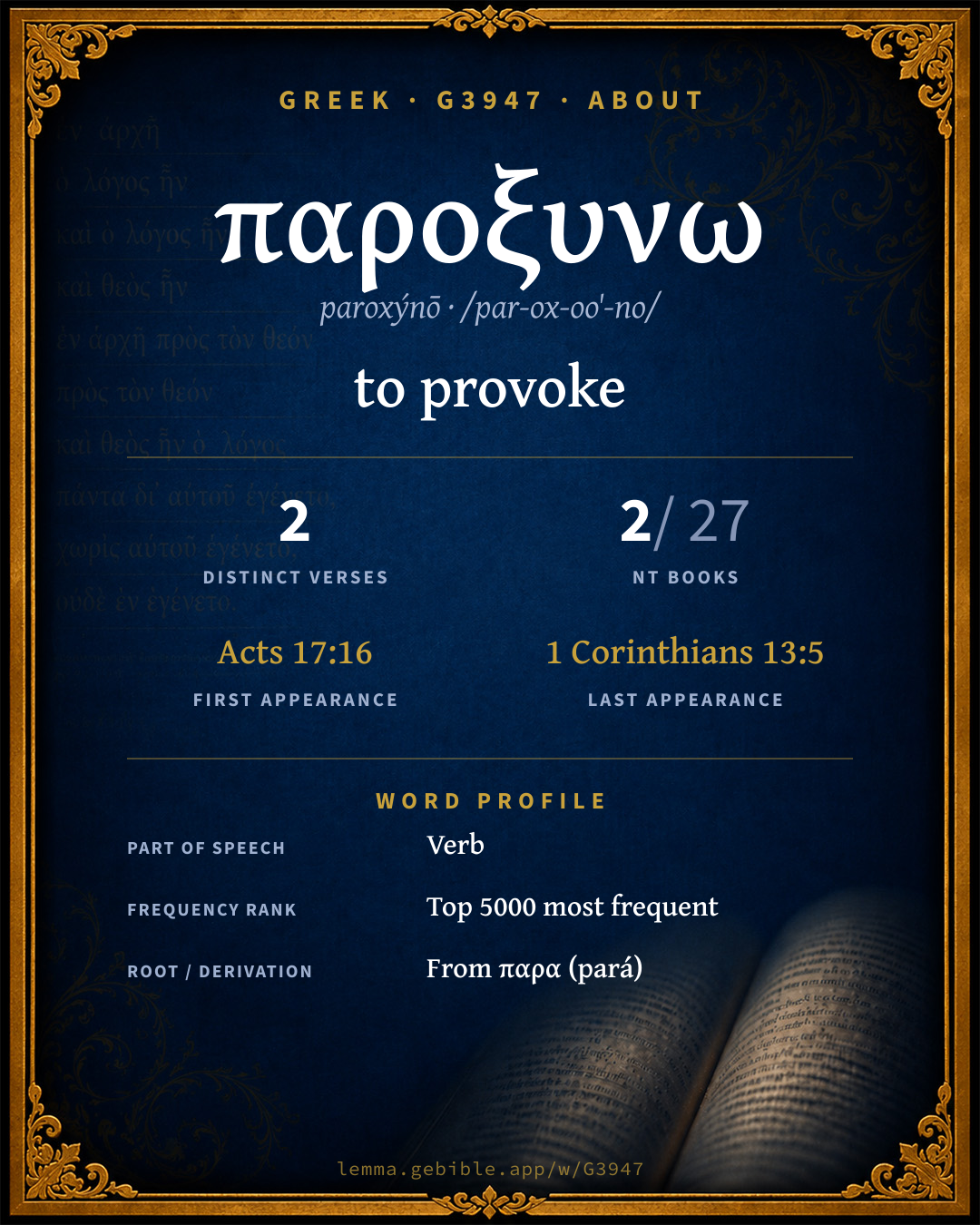
παροξύνω
to provoke
‘to provoke’ is one of 2 main senses fuller range ↓
Full lexicon entry — Thayer's Greek Lexicon
From Thayer's Greek Lexicon
Where this word appears
Grammar key — what these labels mean
Part of speech
- Verb
- An action or state-of-being word.
Tense
- Imperfect
- Continuous or repeated action in past time (“was writing”).
- Present
- Ongoing or general action in present time (imperfective aspect).
Voice
- Passive
- The subject receives the action.
Mood
- Indicative
- States a fact or asks a factual question (the mood of reality).
Person
- 3rd person
- The one spoken about (“he / she / it / they”).
Number
- Singular
- One.
Every verse where G3947 appears in the Book of 1 Corinthians — 1 distinct verse. Click any verse to open its interlinear word-by-word view. Verse text shown in the World English Bible for context — . Each verse’s Greek form is shown with its reference; the English is not keyword-highlighted, since the data carries no word-level English alignment. Use “Compare translations” on any verse to read it across multiple English versions. This concordance covers the Greek New Testament; Septuagint (Greek Old Testament) occurrences of this word are not indexed here.
1 Corinthians
About this entry
At a glance — auto-summarized from this page’s data, not written by a person. Every figure links to its source below. This summary describes the numbers; it doesn’t interpret them.
παροξυνω — transliterated paroxýnō — is a Greek verb carrying the sense “to provoke.” With only 2 verses it sits in the long tail of Greek New Testament vocabulary. Its uses cluster heavily in Acts (50% of all occurrences). Its earliest occurrence is Acts 17:16. Thayer's distinguishes 2 senses for it. See the sense tree, 2-verse concordance, and the renderings breakdown below.
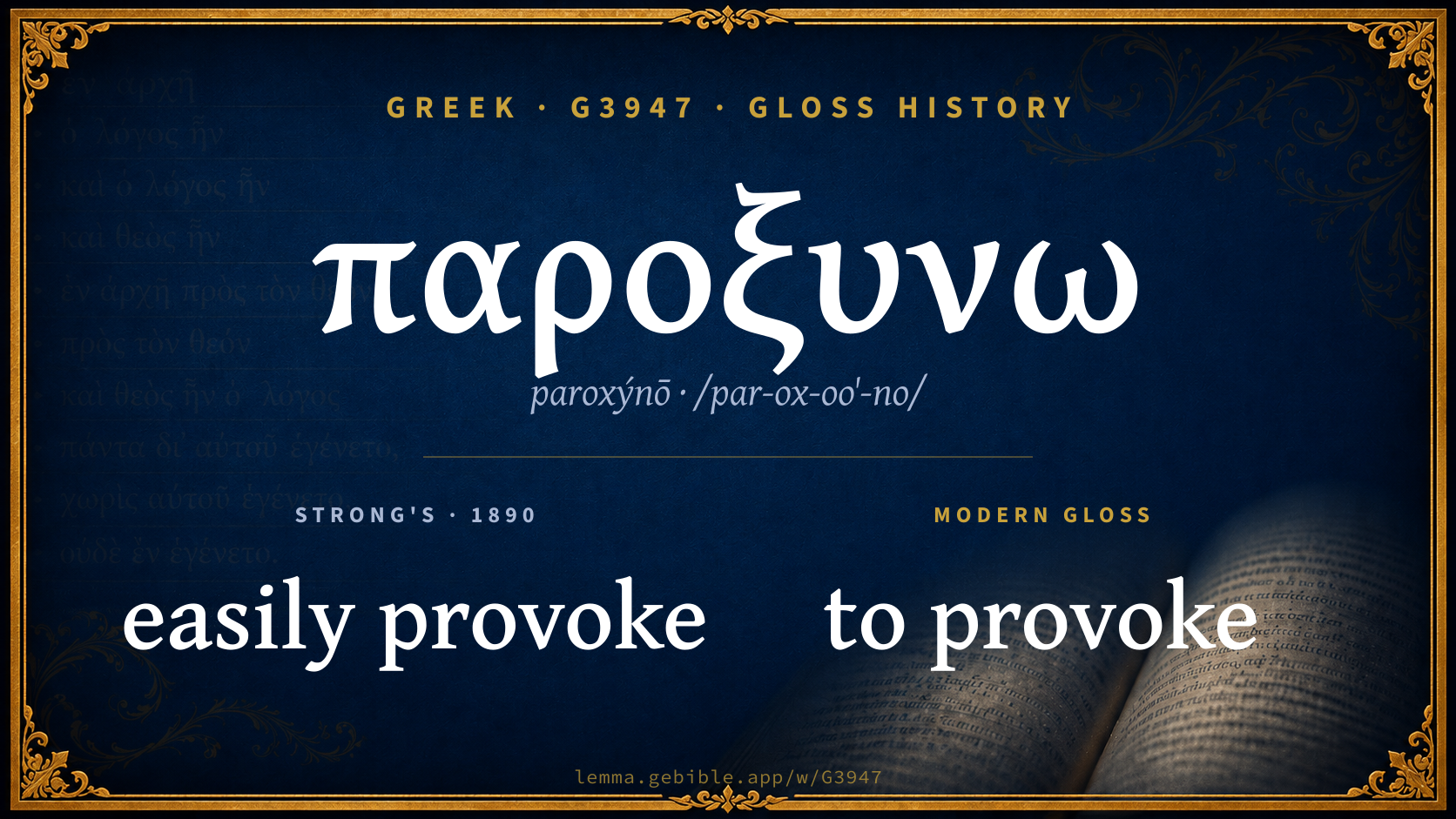
Gloss history
Strong's 1890 vs modern scholarship
About this word
Strong's G3947 catalogs a Greek word from the Greek New Testament.
These counts are not copied from any lexicon or concordance. They are computed here, from the morphology-tagged Greek New Testament. What Lemma adds →
- 2
- distinct verses
- The word appears in 2 distinct verses.
- 2 / 27
- NT books
- The word appears in 2 of 27 New Testament books.
- #2,678
- by frequency
- Top 5000 most frequent Greek words (rank 2,678 of 5,347 Greek words by occurrence).
View all 2 occurrences in the concordance →
Most concentrated in
- Acts 1 verse 50%
- 1 Corinthians 1 verse 50%
By section of the New Testament
By traditional corpus
Conventional, traditional groupings — biblical authorship is debated, so this is a traditional corpus grouping, not an authorship claim. Some books belong to more than one corpus (Luke is in both the Gospels and the Lukan corpus, and so on), so these shares overlap and need not total 100%. Each figure is a share of the word’s 2 distinct verses.
- Lukan (Luke–Acts) 1 verse · 50%
- Pauline corpus 1 verse · 50%
How translations render this word
Counts come from each version’s own published word-to-Strong’s tagging or interlinear alignment — an approximate guide to how each version renders this word, not a word-level alignment the data otherwise carries. Because each total is that version’s own tagged count, the per-version totals vary from one another and need not match the appearance or distinct-verse counts above. These counts may also differ from a printed concordance because Lemma counts each distinctly tagged rendering and does not collapse phrase taggings into a single head-word total. This is a fixed set of word-tagged versions (KJV, ASV, BSB, ULT) and does not change with the reading translation you choose elsewhere. Each version’s license is shown beside its name below (and on Sources).
- King James Version: Easily provoked 1×, Is 1×, Was stirred 1×
- American Standard Version: Is 1×, Provoked 1×, Was provoked 1×
- Berean Standard Bible: He was deeply disturbed 1×, Is not easily angered 1×
- unfoldingWord Literal Text: Easily angered 1×, Is 1×, Was being provoked 1×
King James Version Public Domain
Renders G3947 across 3 tagged occurrences — most commonly:
American Standard Version Public Domain
Renders G3947 across 3 tagged occurrences — most commonly:
Berean Standard Bible Public Domain
Renders G3947 across 2 tagged occurrences — most commonly:
unfoldingWord Literal Text CC BY-SA 4.0
Renders G3947 across 3 tagged occurrences — most commonly:
Senses in Thayer's
The 2 senses Thayer's distinguishes for this word, in lexicon order (not ranked by frequency or importance). The full entry — with sub-senses — is in the Lexicon Entry tab.
- to stimulate, spur on, urge
- to irritate, provoke, arouse to anger
Word origin
Derived from παρα (pará) (G3844) — from.
Forms in the corpus
The 2 distinct written forms G3947 takes in the Greek New Testament, most frequent first — each parse links to that tense’s occurrences in the concordance.
| Form | Parsing | Example | Uses |
|---|---|---|---|
| παροξύνεται paroxýnetai | Verb, Present, Passive, Indicative, 3rd person, Singular | 1 Corinthians 13:5 | 1 |
| παρωξύνετο parōxýneto | Verb, Imperfect, Passive, Indicative, 3rd person, Singular | Acts 17:16 | 1 |
Same root — word family
Other Thayer's entries built from the same root as G3947, grouped by Strong’s listed origin. These share a root / origin per the lexicon — not necessarily a shared meaning. Each links to that word’s own entry.
Derives from
Shares the same root
- παραβαινω parabaínō G3845 to neglect
- παραβαλλω parabállō G3846 to place beside
- παραβιαζομαι parabiázomai G3849 to compel
- παραβουλευομαι parabouleúomai G3851 to consult wrongly
- παραγγελλω parangéllō G3853 to announce
- παραγινομαι paragínomai G3854 to appear
- παραγω parágō G3855 to pass by
- παραδειγματιζω paradeigmatízō G3856 to make example
- παραδεχομαι paradéchomai G3858 to receive
- παραδιατριβη paradiatribḗ G3859 empty business
- παραδιδωμι paradídōmi G3860 to deliver
- παραδοξος parádoxos G3861 strange
- παραζηλοω parazēlóō G3863 to provoke
- παραθαλασσιος parathalássios G3864 by the sea
- παραθεωρεω paratheōréō G3865 to compare
- παραινεω parainéō G3867 to exhort
- παραιτεομαι paraitéomai G3868 to beg pardon
- παρακαθιζω parakathízō G3869 to sit beside
- παρακαλεω parakaléō G3870 to call beside
- παρακαλυπτω parakalýptō G3871 to cover up
- παρακαταθηκη parakatathḗkē G3872 deposit
- παρακειμαι parákeimai G3873 to lie beside
- παρακολουθεω parakolouthéō G3877 to follow after
- παρακουω parakoúō G3878 to disobey
+51 more words share this root (not shown).
Derived from this word
Proper names from this root
People and places named from this root — a name, not an additional meaning of the word.
Compare all same-root words → Showing 4 of 79 — not the complete family. 1 of the same-root words is a proper name (a person or place). They share a root, not necessarily a meaning.
Septuagint usage
The same Greek word παροξυνω appears 47 times in the Greek Old Testament (Septuagint), across 45 verses in 13 books.
- 47
- LXX occurrences
- Tagged occurrences of this Greek word in the Septuagint.
- 45
- verses
- Distinct Septuagint verses containing this word.
- 13 / 39
- OT books
- The word appears in 13 of the 39 Old Testament books.
Sample Septuagint occurrences
- Numbers 14:11 παραὀξύνω
- Deuteronomy 1:34 παραὀξύνω
- 2 Samuel 12:14 παραὀξύνω
- Ezra 9:14 παραὀξύνω
- Psalms 9:25 παραὀξύνω
- Proverbs 6:3 παραὀξύνω
- Isaiah 5:24 παραὀξύνω
- Jeremiah 22:15 παραὀξύνω
- Lamentations 2:6 παραὀξύνω
- Daniel 11:10 παραὀξύνω
- Hosea 8:5 παραὀξύνω
- Zechariah 10:3 παραὀξύνω
Septuagint occurrences (same lexeme)
Every verse where the same Strong’s number (G3947) appears in the Greek Septuagint. Verse text shown in the World English Bible for context; the Greek form is the matched word — the English is not keyword-highlighted.
- Numbers 14:11 παραὀξύνω Yahweh said to Moses, How long will this people despise me? and how long will they not believe in me, for all the signs which I have worked among them?
- Numbers 14:23 παραὀξύνω surely they shall not see the land which I swore to their fathers, neither shall any of those who despised me see it:
- Numbers 15:30 παραὀξύνω But the soul who does anything with a high hand, whether he is home-born or a foreigner, the same blasphemes Yahweh; and that soul shall be cut off from among his people.
- Numbers 16:30 παραὀξύνω But if Yahweh make a new thing, and the ground open its mouth, and swallow them up, with all that appertain to them, and they go down alive into Sheol; then you shall understand that these men have despised Yahweh.
- Numbers 20:24 παραὀξύνω Aaron shall be gathered to his people; for he shall not enter into the land which I have given to the children of Israel, because you rebelled against my word at the waters of Meribah.
- Deuteronomy 1:34 παραὀξύνω Yahweh heard the voice of your words, and was angry, and swore, saying,
- Deuteronomy 9:7 παραὀξύνω Remember, don't forget, how you provoked Yahweh your God to wrath in the wilderness: from the day that you went forth out of the land of Egypt, until you came to this place, you have been rebellious against Yahweh.
- Deuteronomy 9:8 παραὀξύνω Also in Horeb you provoked Yahweh to wrath, and Yahweh was angry with you to destroy you.
- Deuteronomy 9:18 παραὀξύνω I fell down before Yahweh, as at the first, forty days and forty nights; I did neither eat bread nor drink water; because of all your sin which you sinned, in doing that which was evil in the sight of Yahweh, to provoke him to anger.
- Deuteronomy 9:19 παραὀξύνω For I was afraid of the anger and hot displeasure, with which Yahweh was angry against you to destroy you. But Yahweh listened to me that time also.
- Deuteronomy 9:22 παραὀξύνω At Taberah, and at Massah, and at Kibroth-hattaavah, you provoked Yahweh to wrath.
- Deuteronomy 31:20 παραὀξύνω For when I shall have brought them into the land which I swore to their fathers, flowing with milk and honey, and they shall have eaten and filled themselves, and grown fat; then will they turn to other gods, and serve them, and despise me, and break my covenant.
- Deuteronomy 32:16 παραὀξύνω They moved him to jealousy with strange [gods]; With abominations provoked they him to anger.
- Deuteronomy 32:19 παραὀξύνω Yahweh saw [it], and abhorred [them], Because of the provocation of his sons and his daughters.
- Deuteronomy 32:41 παραὀξύνω If I whet my glittering sword, My hand take hold on judgment; I will render vengeance to my adversaries, Will recompense those who hate me.
- 2 Samuel 12:14 παραὀξύνω However, because by this deed you have given great occasion to Yahweh's enemies to blaspheme, the child also who is born to you shall surely die."
- Ezra 9:14 παραὀξύνω shall we again break your commandments, and join in affinity with the peoples that do these abominations? would not you be angry with us until you had consumed us, so that there should be no remnant, nor any to escape?
- Psalms 9:25 παραὀξύνω
- Psalms 9:34 παραὀξύνω
- Psalms 73:10 παραὀξύνω Therefore their people return to them, And they drink up waters of abundance.
- Psalms 73:18 παραὀξύνω Surely you set them in slippery places. You throw them down to destruction.
- Psalms 77:41 παραὀξύνω
- Psalms 105:29 παραὀξύνω He turned their waters into blood, And killed their fish.
- Psalms 106:11 παραὀξύνω The waters covered their adversaries. There was not one of them left.
- Proverbs 6:3 παραὀξύνω Do this now, my son, and deliver yourself, Seeing you have come into the hand of your neighbor. Go, humble yourself. Press your plea with your neighbor.
- Proverbs 14:31 παραὀξύνω He who oppresses the poor shows contempt for his Maker, But he who is kind to the needy honors him.
- Proverbs 17:5 παραὀξύνω Whoever mocks the poor reproaches his Maker. He who is glad at calamity shall not be unpunished.
- Proverbs 20:2 παραὀξύνω The terror of a king is like the roaring of a lion: He who provokes him to anger forfeits his own life.
- Proverbs 27:17 παραὀξύνω Iron sharpens iron; So a man sharpens his friend's countenance.
- Isaiah 5:24 παραὀξύνω Therefore as the tongue of fire devours the stubble, And as the dry grass sinks down in the flame, So their root shall be as rottenness, And their blossom shall go up as dust; Because they have rejected the law of Yahweh of Hosts, And despised the word of the Holy One of Israel.
- Isaiah 5:25 παραὀξύνω Therefore Yahweh's anger burns against his people, And he has stretched out his hand against them, and has struck them. The mountains tremble, And their dead bodies are as refuse in the midst of the streets. For all this, his anger is not turned away, But his hand is still stretched out.
- Isaiah 14:16 παραὀξύνω Those who see you shall gaze at you, they shall consider you, [saying], "Is this the man who made the earth to tremble, who shook kingdoms;
- Isaiah 23:11 παραὀξύνω He has stretched out his hand over the sea, he has shaken the kingdoms: Yahweh has given commandment concerning Canaan, to destroy the strongholds of it.
- Isaiah 37:23 παραὀξύνω Whom have you defied and blasphemed? and against whom have you exalted your voice and lifted up your eyes on high? [even] against the Holy One of Israel.
- Isaiah 47:6 παραὀξύνω I was angry with my people, I profaned my inheritance, and gave them into your hand: you did show them no mercy; on the aged have you very heavily laid your yoke.
- Isaiah 60:14 παραὀξύνω The sons of those who afflicted you shall come bending to you; and all those who despised you shall bow themselves down at the soles of your feet; and they shall call you The city of Yahweh, The Zion of the Holy One of Israel.
- Isaiah 63:10 παραὀξύνω But they rebelled, and grieved his holy Spirit: therefore he was turned to be their enemy, [and] himself fought against them.
- Isaiah 65:3 παραὀξύνω a people who provoke me to my face continually, sacrificing in gardens, and burning incense on bricks;
- Jeremiah 22:15 παραὀξύνω Shall you reign, because you strive to excel in cedar? Didn't your father eat and drink, and do justice and righteousness? then it was well with him.
- Jeremiah 27:34 παραὀξύνω
- Lamentations 2:6 παραὀξύνω He has violently taken away his tent, as if it were of a garden; he has destroyed his place of assembly: Yahweh has caused solemn assembly and Sabbath to be forgotten in Zion, Has despised in the indignation of his anger the king and the priest.
- Daniel 11:10 παραὀξύνω His sons shall war, and shall assemble a multitude of great forces, which shall come on, and overflow, and pass through; and they shall return and war, even to his fortress.
- Hosea 8:5 παραὀξύνω Let Samaria throw out his calf-idol! My anger burns against them! How long will it be before the are capable of purity?
- Zechariah 10:3 παραὀξύνω My anger is kindled against the shepherds, And I will punish the male goats; For Yahweh of Hosts has visited his flock, the house of Judah, And will make them as his horse in the battle that he is proud of.
- Malachi 2:17 παραὀξύνω You have wearied Yahweh with your words. Yet you say, 'How have we wearied him?' In that you say, 'Everyone who does evil is good in the sight of Yahweh, and he delights in them;' or 'Where is the God of justice?'
These are occurrences of the same Greek lexeme (G3947) in the Septuagint — not a translation of any one Hebrew word. The store carries no word-level Hebrew↔Greek alignment, so no Hebrew original is asserted here. Counts come from the recovered LXX Strong's tagging — high-frequency vocabulary is well covered, while rare or late forms may be untagged — so they reflect tagged occurrences and may slightly undercount.