
Proverbs 30:32

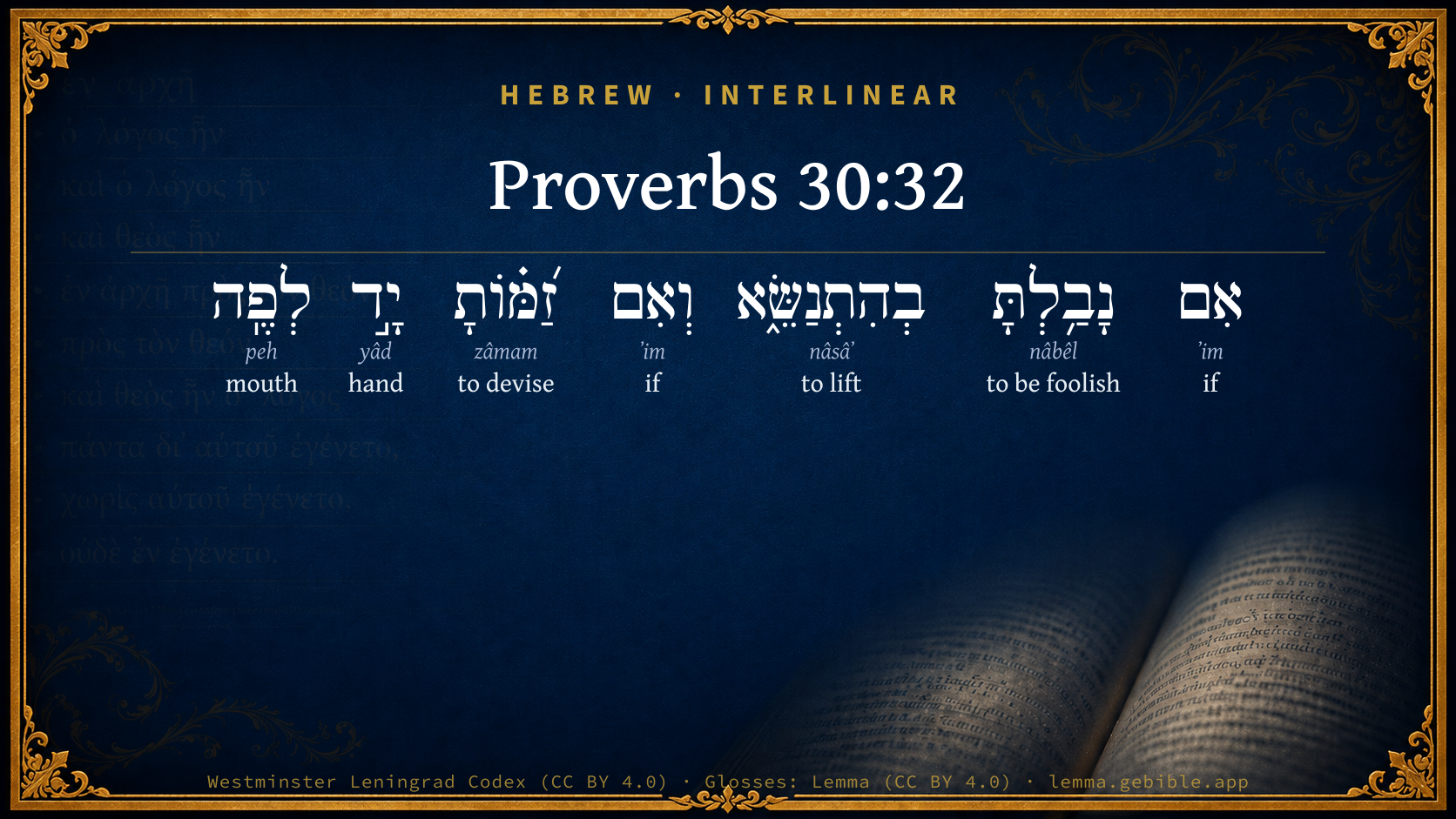
Hebrew (Westminster Leningrad Codex) Proverbs 30:32 appears in the Hebrew Old Testament. The text above is from the Westminster Leningrad Codex. Each word links to its Strong’s number, a concise gloss, and parsing drawn from the Open Scriptures Hebrew Bible morphology. Click any word for its full Brown-Driver-Briggs (BDB) entry.
Download image
Cite this verse

Proverbs 30:32 (World English Bible). Public Domain. Lemma interlinear Bible study tool, https://lemma.gebible.app/v/proverbs/30/32.

Show BibTeX & RIS
BibTeX
RIS
English Translation
"If you have done foolishly in lifting up yourself, Or if you have thought evil, Put your hand over your mouth.
World English Bible · Public Domain
Download a study sheet

One document with this verse’s original text, its word-by-word gloss line, the meaning frame, cross-references with their text, attributed commentary, and full source and license credits — printable, and it pastes into notes with its structure intact.

This verse Autodidact and up

Study sheet (.html) Plain text (.txt)

A passage Seminary Student

Up to 50 verses in one chapter. A passage sheet keeps up to 6 commentary sources and 12 cross-references per verse, in the order this page ranks them, and says so on the sheet whenever that leaves anything out. Ask for a single verse and you get the Autodidact verse sheet above.

Everything on this page stays free to read, with no account — the sheet is a download of what is already on screen, not access to it.

Want to remove ads? Support Godless Engineer
Compare translations 3

The same verse in 3 English versions, stacked beneath the original-language interlinear above. Click any original word for its lexicon entry.

Each is an independent rendering of the whole verse — the interlinear is not word-aligned to these translations.

Highlighted words mark where these versions differ — a whole-verse word diff, not a word-by-word alignment.

  • World English Bible Public Domain
    "If you have done foolishly in lifting up yourself, Or if you have thought evil, Put your hand over your mouth.
  • King James Version Public Domain
    If thou hast done foolishly in lifting up thyself, or if thou hast thought evil, lay thine hand upon thy mouth.
  • unfoldingWord Literal Text CC BY-SA 4.0
    If you have been foolish by lifting up yourself, or if you have schemed, a hand to mouth!

unfoldingWord Literal Text — © unfoldingWord, licensed CC BY-SA 4.0. Word-aligned USFM3 via Door43 (git.door43.org/unfoldingWord/en_ult).

Versions to compare (up to 4)

3 of 4 selected

Show all 18 translations

Every available English version of this verse, each an independent rendering of the whole verse.

  • World English Bible Public Domain
    "If you have done foolishly in lifting up yourself, Or if you have thought evil, Put your hand over your mouth.
  • Berean Standard Bible Public Domain
    If you have foolishly exalted yourself or if you have plotted evil, put your hand over your mouth.
  • Majority Standard Bible Public Domain
    If you have foolishly exalted yourself or if you have plotted evil, put your hand over your mouth.
  • King James Version Public Domain
    If thou hast done foolishly in lifting up thyself, or if thou hast thought evil, lay thine hand upon thy mouth.
  • American Standard Version (1901) Public Domain
    If thou hast done foolishly in lifting up thyself, Or if thou hast thought evil, `Lay' thy hand upon thy mouth.
  • Revised Version (1885) Public Domain
    If thou hast done foolishly in lifting up thyself, or if thou hast thought evil, lay thine hand upon thy mouth.
  • Geneva Bible (1599) Public Domain
    If thou hast bene foolish in lifting thy selfe vp, and if thou hast thought wickedly, lay thine hand vpon thy mouth.
  • Douay-Rheims (1899) Public Domain
    There is that hath appeared a fool after he was lifted up on high: for if he had understood, he would have laid his hand upon his mouth.
  • Young's Literal Translation Public Domain
    If thou hast been foolish in lifting up thyself, And if thou hast devised evil -- hand to mouth!
  • Literal Standard Version CC BY-SA 4.0
    If you have been foolish in lifting yourself up, || And if you have devised evil—hand to mouth!
  • Unlocked Literal Bible CC BY-SA 4.0
    If you have been foolish, exalting yourself, or if you have been devising evil— put your hand over your mouth.
  • unfoldingWord Literal Text CC BY-SA 4.0
    If you have been foolish by lifting up yourself, or if you have schemed, a hand to mouth!
  • Darby Bible Public Domain
    If thou hast done foolishly in lifting up thyself, or if thou hast thought evil, [lay] the hand upon thy mouth.
  • World Messianic Bible Public Domain
    “If you have done foolishly in lifting up yourself, or if you have thought evil, put your hand over your mouth.
  • Webster's Bible Public Domain
    If thou hast done foolishly in lifting up thyself, or if thou hast thought evil, lay thy hand upon thy mouth.
  • Free Bible Version CC BY-SA 4.0
    If you have been foolishly boasting about yourself, or if you've been planning to do something wrong, stop and put your hand over your mouth.
  • Bible in Basic English Public Domain
    If you have done foolishly in lifting yourself up, or if you have had evil designs, put your hand over your mouth.
  • JPS Tanakh (1917) Public Domain
    If thou hast done foolishly in lifting up thyself, or if thou hast planned devices, lay thy hand upon thy mouth.

Literal Standard Version (2020), Covenant Press — licensed CC BY-SA 4.0. Text via the HelloAO Bible API (eBible.org). Unlocked Literal Bible (unfoldingWord) — licensed CC BY-SA 4.0. Text via the HelloAO Bible API (eBible.org). unfoldingWord Literal Text — © unfoldingWord, licensed CC BY-SA 4.0. Word-aligned USFM3 via Door43 (git.door43.org/unfoldingWord/en_ult). Free Bible Version, Dr. Jonathan Gallagher — licensed CC BY-SA 4.0. Text via the HelloAO Bible API (eBible.org).

Word by word

More ways to search: Search by grammar → Find every occurrence → Compare this word →

Practice this passage: Drill this verse → Learn its vocabulary →

About this verse

These counts appear in no published source. They are computed here, from the morphology-tagged text and Lemma’s own curated glosses. What Lemma adds →

7
words
6
distinct lemmas
Wisdom
section

Notable vocabulary

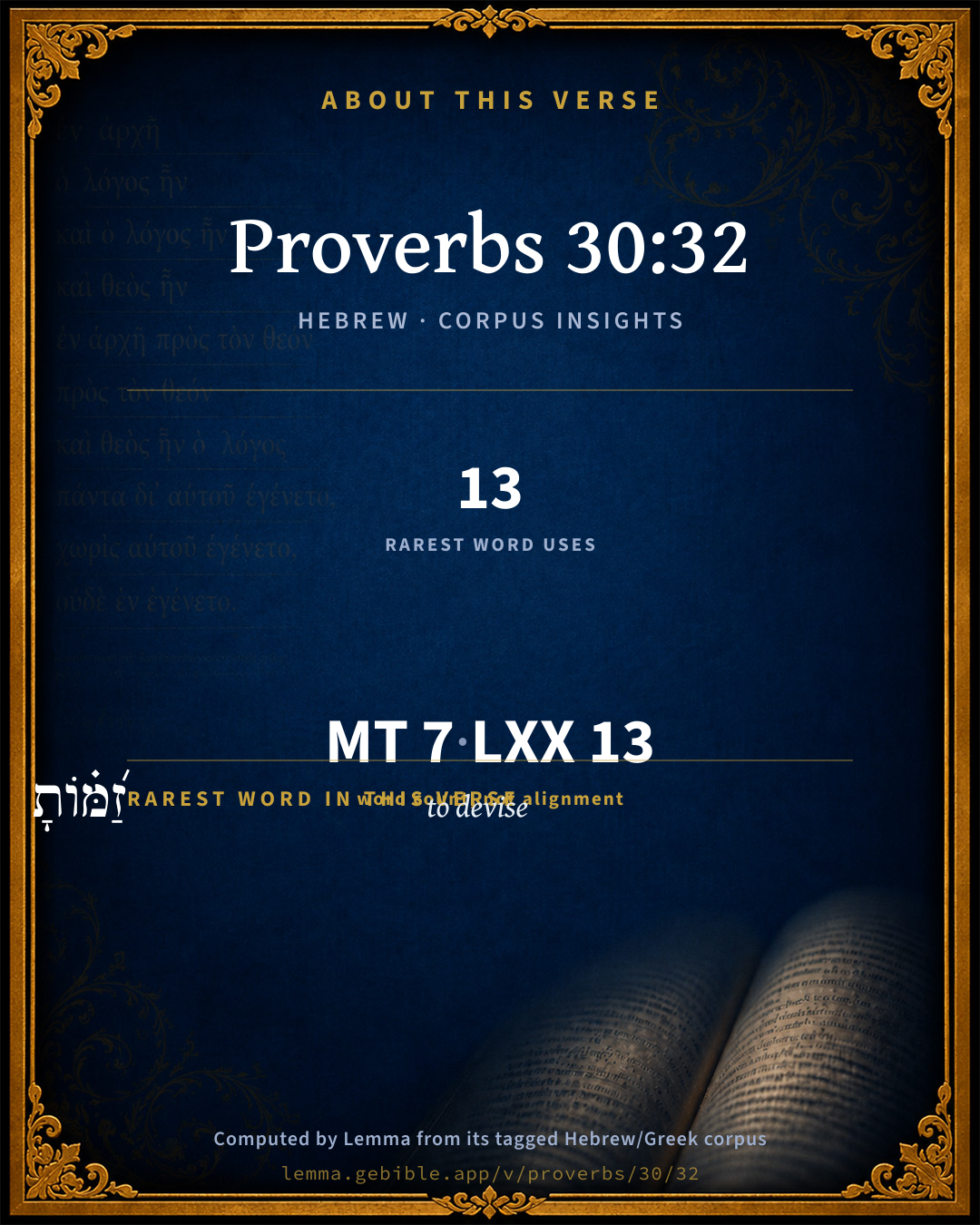
The rarest word here is זַ֝מּ֗וֹתָ to devise H2161 — appearing just 13 times in the whole Hebrew Bible.

Shared distinctive vocabulary

זַ֝מּ֗וֹתָ to devise H2161 occurs in 13 verses of the Hebrew Bible. Also found in:

Grammatical profile

  • 3 verbs
  • 2 nouns
  • 2 conjunctions

Verb forms

  • נָבַ֥לְתָּ Qal · Perfect
  • בְהִתְנַשֵּׂ֑א Hithpael · Infinitive Construct
  • זַ֝מּ֗וֹתָ Qal · Perfect

Repetition

A word recurs within this verse — often emphatic in Hebrew:

  • אִם if H518 ×2

Hebrew & Septuagint length

In English translation the verse runs 21 words from the Hebrew and 18 from the Septuagint (LXX English) — closely comparable.

A rough comparison of the two English renderings, which tokenize alike — not a word-level alignment.

Word counts can differ between the Hebrew and the Greek without any difference in meaning — e.g. the Hebrew direct-object marker אֵת has no separate Greek word, and Greek often adds the article ὁ.

In the original languages it is 7 Hebrew tokens and 13 Greek tokens — but the two are counted differently (Hebrew bundles its prefixes and suffixes into one token; the Greek is in lemma form), so that isn’t a like-for-like length.

Cross-references

7

Topical passages linked to Proverbs 30:32 in the Treasury of Scripture Knowledge — connected by theme and wording, ordered by reader-vote popularity; previews shown in the World English Bible.

  • Job 21:5 Look at me, and be astonished. Lay your hand on your mouth.
  • Job 40:4 "Behold, I am of small account. What shall I answer you? I lay my hand on my mouth.
  • Proverbs 26:12 Do you see a man wise in his own eyes? There is more hope for a fool than for him.
  • Micah 7:16–17 The nations will see and be ashamed of all their might. They will lay their hand on their mouth. Their ears will be deaf.
  • Romans 3:19 Now we know that whatever things the law says, it speaks to those who are under the law, that every mouth may be closed, and all the world may be brought under the judgment of God.
  • Proverbs 17:28 Even a fool, when he keeps silent, is counted wise. When he shuts his lips, he is thought to be discerning.
  • Ecclesiastes 8:3–4 Don't be hasty to go out of his presence. Don't persist in an evil thing, for he does whatever pleases him,

Cross-references courtesy of OpenBible.info (CC BY 4.0).

Hebrew and Greek witnesses Masoretic Hebrew ↔ Greek Septuagint

The same verse in the two great witnesses to the Old Testament, shown verse-for-verse.

These are two independent witnesses, not word-aligned to each other, and the Septuagint is shown in lemma (dictionary) form.

Hebrew Proverbs 30:32 Masoretic · Westminster Leningrad Codex

אִם נָבַ֥לְתָּ בְהִתְנַשֵּׂ֑א וְאִם זַ֝מּ֗וֹתָ יָ֣ד לְפֶֽה

"If you have done foolishly in lifting up yourself, Or if you have thought evil, Put your hand over your mouth.

World English Bible · Public Domain

Greek LXX Proverbs 30:32 Septuagint · lemma form

ἐάν προεἰμί σεαυτοῦ εἰς εὐφροσύνη καί ἐκτείνω ὁ χείρ σύ μετά μάχη ἀτιμάζω

If you abandon yourself to mirth, and stretch forth your hand in a quarrel, you shall be disgraced.

LXX2012 (modern English Septuagint) · Public Domain

On this verse, The Pulpit Commentary discusses the Septuagint’s reading. Read the note in Commentary ↓

Hebrew: Westminster Leningrad Codex (CC BY 4.0). Greek: Septuagint (public domain); English from LXX2012 (modern English Septuagint) (Public Domain). How the Septuagint differs from the Hebrew →

Commentary

Notes on Proverbs 30:32 from classic Christian and Jewish commentators (each source and its license shown beneath its notes). The classic Christian expositions comment on the surrounding passage and are grouped to its opening verse, so a note may address several verses; the Jewish commentaries on the Tanakh (Rashi and others) are per-verse, so they appear only where the commentator wrote on this verse.

Lemma curates 59 commentaries, every one of them public domain or Creative Commons licensed, each selected and text-cleaned for this edition rather than reprinted as found. About our sources →

Trapp's Complete Commentary

John Trapp

Pro 30:32 If thou hast done foolishly in lifting up thyself, or if thou hast thought evil, [lay] thine hand upon thy mouth.

Ver. 32. Lay thy hand upon thy mouth.] That is, Better examine thyself, commune with thine own heart and be still. Repent thee, as Job did in like case. {Job 42:1-6} Quem poenitet peccasse, pene est innocens. {a} It is not the falling into the water that drowns one, but the lying in it.

{a} Senec., Agram.

John Trapp, A Commentary or Exposition upon All the Books of the Old and New Testament (1647–1656) — public domain. Text from a community e-Sword module.

Joseph Benson's Commentary

Pro 30:32. If thou hast done foolishly — “If thy pride or thy passion hath engaged thee in some foolish action, whereby thou hast disgraced thyself; or made thee contrive and endeavour any thing that is unwarrantable, do not add one fault to another, by excusing it, or blaming any body but thyself for it, much less by quarrelling at those that admonish thee of it, and reprehend thee for it; but stop at the first motion to this, and silently acknowledge thy error.” — Bishop Patrick.

Joseph Benson's Commentary on the Old and New Testaments (1811–1818) — public domain. Text from a community e-Sword module.

Keil & Delitzsch

C. F. Keil & F. Delitzsch

Another proverb, the last of Agur's "Words" which exhorts to thoughtful, discreet demeanour, here follows the proverb of self-conscious, grave deportment:

32 If thou art foolish in that thou exaltest thyself,

Or in devising, - put thy hand to thy mouth!

33 For the pressure on milk bringeth forth butter,

And pressure on the nose bringeth forth blood,

And pressure on sensibility bringeth forth altercation.

Lwenstein translates Pro 30:32 :

Art thou despicable, it is by boasting;

Art thou prudent, then hold thy hand on thy mouth.

But if זמם denotes reflection and deliberation, then נבל, as its opposite, denotes unreflecting, foolish conduct. Then בּהתנשּׂא ne by boasting is not to be regarded as a consequent (thus it happens by lifting thyself up; or: it is connected with boasting); by this construction also, אם־נבלתּ must be accented with Dechi, not with Tarcha. Otherwise Euchel:

Hast thou become offensive through pride,

Or seems it so to thee, - lay thy hand to thy mouth.

The thought is appropriate,

(Note: Yet the Talmud, Nidda 27a, derives another moral rule from this proverb, for it interprets זמם in the sense of זמם = חסם, to tie up, to bridle, to shut up, but אם נבלת in the sense of "if thou hast made thyself despicable," as Lwenstein has done.)

but נבלתּ for נבּלתּ is more than improbable; נבל, thus absolutely taken in an ethical connection, is certainly related to נבל, as כּסל, Jer 10:8, to כּסיל. The prevailing mode of explanation is adopted by Fleischer: si stulta arrogantia elatus fueris et si quid durius (in alios) mente conceperis, manum ori impone; i.e., if thou arrogantly, and with offensive words, wilt strive with others, then keep thyself back, and say not what thou hast in thy mind. But while מזמּה and מזמּות denote intrigues, Pro 14:17, as well as plans and considerations, זמם has never by itself alone the sense of meditari mala; at Psa 37:12, also with ל of the object at which the evil devices aim. Then for ואם ... אם (Arab. ân ... wân) there is the supposition of a correlative relation, as e.g., Kg1 20:18; Ecc 11:3, by which at the same time זמּות is obviously thought of as a contrast to נבלתּ. This contrast excludes

(Note: The Arab. signification, to become proud, is a nance of the primary signification, to hold erect - viz. the head - as when the rider draws up the head of a camel by means of the halter (Arab. zamam).)

for זמות not only the sense of mala moliri (thus e.g., also Mhlau), but also the sense of the Arab. zamm, superbire (Schultens). Hitzig has the right determination of the relation of the members of the sentence and the ideas: if thou art irrational in ebullition of temper and in thought - thy hand to thy mouth! But התנשּׂא has neither here nor elsewhere the meaning of התעבּר (to be out of oneself with anger); it signifies everywhere to elevate or exalt oneself, i.e., rightly or wrongly to make much of oneself. There are cases where a man, who raises himself above others, appears as a fool, and indeed acts foolishly; but there are also other cases, when the despised has a reason and an object for vindicating his superiority, his repute, his just claim: when, as we say, he places himself in his right position, and assumes importance; the poet here recommends, to the one as well as to the other, silence. The rule that silence is gold has its exceptions, but here also it is held valid as a rule. Luther and others interpret the perfecta as looking back: "hast thou become a fool and ascended too high and intended evil, then lay thy hand on thy mouth." But the reason in Pro 30:33 does not accord with this rendering, for when that has been done, the occasion for hatred is already given; but the proverb designs to warn against the stirring up of hatred by the reclaiming of personal pretensions. The perfecta, therefore, are to be interpreted as at Deu 32:29; Job 9:15, as the expression of the abstract present; or better, as at Job 9:16, as the expression of the fut. exactum: if thou wouldest have acted foolishly, since thou walkest proudly, or if thou hadst (before) thought of it (Aquila, Theodotion: καὶ ἐὰν ἐννοηθῇς) - the hand on thy mouth, i.e., let it alone, be silent rather (expression as Pro 11:24; Jdg 18:19; Job 40:4). The Venet. best: εἴπερ ἐμώρανας ἐν τῷ ἐπαίρεσθαι καὶ εἴπερ ἐλογίσω, χεὶρ τῷ στόματι. When we have now interpreted התנשׂא, not of the rising up of anger, we do not also, with Hitzig, interpret the dual of the two snorting noses - viz. of the double anger, that of him who provokes to anger, and that of him who is made angry - but אפּים denotes the two nostrils of one and the same person, and, figuratively, snorting or anger. Pressure against the nose is designated ומיץ־אף, ἐκμύζησις (ἐκπίεσις) μυκτῆρος (write ומיץ־אף, with Metheg, with the long tone, after Metheg-Setzung, 11, 9, 12), and מיץ אפּים, ἐκμύζησις θυμοῦ (Theodotion), with reference to the proper meaning of אפים, pressure to anger, i.e., to the stirring up and strengthening of anger. The nose of him who raises himself up comes into view, in so far as, with such self-estimation, sneering, snuffling scorn (μυκτηρίζειν) easily connects itself; but this view of מתנשׂא is not here spoken of.

Keil & Delitzsch — Biblical Commentary on the Old Testament (1861–1891) — public domain (CC PDM 1.0). Text via the HelloAO Bible API. (Old Testament only.)

Geneva Bible (1599)

Geneva Bible translators

Make a stay, and continue not in doing evil.

Geneva Bible (1599) marginal notes — public domain. Text via Bolls.life.

Jamieson, Fausset & Brown

Robert Jamieson, A. R. Fausset & David Brown

As none can hope, successfully, to resist such a king, suppress even the thought of an attempt.

lay . . . hand upon thy mouth--"lay" is well supplied (Jdg 18:19; Job 29:9; Job 40:4).

Jamieson, Fausset & Brown — Commentary Critical and Explanatory on the Whole Bible (1871) — public domain (CC PDM 1.0). Text via the HelloAO Bible API.

Adam Clarke's Commentary

Verse 32. If thou hast done foolishly] And who has not, at one time or other of his life?

Lay thine hand upon thy mouth.] Like the leper; and cry to God, Unclean! unclean! and keep silence to all besides. God will blot out thy offence, and neither the world nor the Church ever know it, for he is merciful; and man is rarely able to pass by a sin committed by his fellows, especially if it be one to which himself is by nature not liable or inclined.

Adam Clarke's Commentary on the Bible (1810–1826) — public domain. Text from a community e-Sword/MySword module.

Ellicott's Commentary for English Readers

(32) Lay thine hand upon thy mouth—i.e., be silent. Agur deprecates two things which may easily lead to a quarrel, arrogance and malice. He explains this in the next verse.

A Bible Commentary for English Readers, edited by Charles John Ellicott (1878–1897) — public domain. Text from a community e-Sword module.

The Cambridge Bible for Schools and Colleges

gen. ed. J. J. S. Perowne

32. done foolishly … thought evil] Whether the evil has passed already into outward exhibition, or is still only in thought, check it promptly.

Lay thine hand upon thy mouth] Comp. Job_21:5; Job_29:9; Job_40:4, in all which places it denotes “a gesture of awe-struck silence.” Here it rather denotes severe self-restraint.

32, 33. The oracle of the sage closes with a practical admonition against strife and contention.

The Cambridge Bible for Schools and Colleges (gen. ed. J. J. S. Perowne; Cambridge University Press, 1878–1918) — public domain. Text from a community e-Sword module.

John Gill's Exposition

If thou hast done foolishly in lifting up thyself,.... Against a king, against whom there is no rising up; by speaking evil of him, or rebelling against him; which is acting a foolish part, since it brings a man into troubles and difficulties inextricable; or by self-commendation, which is the height of folly, and the fruit of pride; or carried it in such a haughty and overbearing manner to others, as to provoke to wrath and anger;

or if thou hast thought evil; purposed and designed it, and contrived the scheme of doing it, though not yet put in execution; though folly is not actually committed, yet since the thought of it is rain, care should be taken to prevent it;

lay thine hand upon thy mouth: think again before the thing resolved on is done; as studious and thoughtful men put their hand to their mouth, when they are deeply considering any affair before them: or put a stop to the design, let it go no further; what has been thought of in the mind, let it never come out of the mouth, nor be carried into execution; stifle it in the first motion: or if this respects a foolish action done, as it also may, since it stands connected with both clauses, then the sense is, be silent; do not pretend to deny the action, nor to excuse it; nor to say one word in the defence of it; nor to lay the blame upon others; and much less to calumniate and reproach such who faithfully reprove for it; take shame to thyself in silence, and repent of the iniquity done. Aben Ezra thinks these words are said to Ithiel and Ucal; but rather, to any and everyone, to all that should hear and read these proverbs. The Targum is,

"do not lift up thyself, lest thou be foolish; and do not stretch out thine hand to thy mouth.''

John Gill's Exposition of the Whole Bible (1746–1763) — public domain (CC PDM 1.0). Text via the HelloAO Bible API.

Albert Barnes' Notes on the Bible

Lay thine hand upon thy mouth - The act expresses the silence of humiliation and repentance after the sin has been committed, and that of self-restraint, which checks the haughty or malignant thought before it has passed even into words.

Albert Barnes' Notes on the Bible (1834–1885) — public domain. Text from a community e-Sword/MySword module.

Haydock's Catholic Bible Commentary

Mouth. Fools ought not to govern. (Worthington) --- Many might have been deemed wise, if they had continued in a lower station. (Calmet) --- Hebrew, "If thou hast acted foolishly in raising thyself, and if thou hast entertained evil thoughts, put thy hand to thy mouth." (Haydock) --- Chaldean, "put not thy," &c. Give not way to pride, or to insolent language. (Calmet)

George Leo Haydock (1774–1849), Haydock's Catholic Family Bible and Commentary, 1859 edition — public domain. Excludes Psalms (Douay-Rheims chapter numbering differs from Protestant) and Deuterocanonical books (Catholic canon only).

Matthew Poole's English Annotations

In lifting up thyself; either,

1. By rebellion or sedition against the king last mentioned. Or,

2. By anger or wrath, of which he speaks in the next verse. But this verse hath no necessary dependence either upon the foregoing or following verse. Or,

3. Through thy pride, which makes men carry themselves very foolishly, and scornfully, and injuriously, and is the root of contention, as was observed, Pro 13:10.

Thought evil, i.e. designed any mischief or injury against thy neighbour.

Lay thine hand upon thy mouth, to wit, to shut it. Be silent, as this phrase is used, Job 21:5; 29:9. Restrain thyself, do not speak one word, much less do any thing tending to the accomplishment of it; do not open thy mouth to justify or excuse it, but silently and seriously consider the evil of it, and repent of it, and do so no more.

Matthew Poole's English Annotations on the Holy Bible (1683–1685) — public domain. Text from a community e-Sword/MySword module.

Whedon's Commentary on the Bible

Daniel D. Whedon

32. Done foolishly, etc. — Variously rendered: “If thou hast played the fool in exalting thyself; or if thou hast craftily devised with thy hand to thy mouth.” — Stuart. This gives us a protasis in two members, but no apodosis, which he thinks may be mentally supplied, thus: Thou hast acted wickedly. The last clause is elliptical; literally, hand to mouth! and, as Conant observes, this spirited expression should not be toned down to common place tameness, by supplying lay, or put, as is sometimes done. Hand to mouth! Confess, leper-like, thine uncleanness!

Daniel D. Whedon (gen. ed.), Commentary on the Old and New Testaments (1874–1909) — public domain. Text from a community e-Sword module.

The Pulpit Commentary

Vers. 32, 33. Agur"s last proverb, exhorting to discreet demeanour.

If thou hast done foolishly in lifting up thyself. (Num_16:3) If thou hast had the folly to be arrogant, proud, and overbearing in conduct. Or if thou hast thought evil, lay thine hand upon thy mouth. The verb zamam, though possibly used in a bad sense, "to devise evil," is more suitably rendered "to meditate," "purpose;" so here it is the thought of lifting up one"s self that is censured, the act and the thought being contrasted. Hast thou acted arrogantly, or even only meditated doing so, restrain yourself, keep silence. (Job_21:5 Job_40:4) St. Jerome gives a different rendering, enforcing another lesson, "There is one who shows himself a fool after he is raised to high position; if he had had understanding, he would have laid his hand on his mouth." Septuagint, "If thou give thyself up to mirth, and stretch forth thy hand in a quarrel, thou wilt be dishonoured." Insensate mirth and a quarrelsome disposition alike lead to disgrace. St. Gregory ("Moral.," 30:10) applies the Vulgate rendering to antichrist, "For he in truth will be lifted up on high, when he will feign that he is God. But he will appear a fool when lifted up on high, because he will fail in his very loftiness through the coming of the true Judge. But if he had understood this, he would have laid his hand on his mouth; that is, if he had foreseen his punishment, when he began to be proud, having been once fashioned aright, he would not have been raised up to the boastfulness of such great pride" (Oxford transl.). Self-suppression.

I WHEN SELF-SUPPRESSION IS NEEDED. It is not always equally demanded of us. There are times for expression, times when we should break reserve and give forth freely the thoughts and purposes of our souls. But other times demand peculiar self-suppression.

1. In rebuke of foolish vanity. "If thou hast done foolishly in lifting up thyself." A magnified image of self needs to be reduced. Too much pretension must be humbled. Selfish ambition must be cast down.

2. In restraint of evil thinking. "Or if thou hast thought evil." Jesus Christ has taught us that evil thinking is sin. (Mat_5:28) But the sooner the sin is checked the better, and it can be best checked before it has emerged in word or deed. Expression emphasizes an evil thought. A publication of it makes it hurtful to others. The viper brood should be scotched in the nest.

II WHAT SELF-SUPPRESSION WILL EFFECT.

1. It will prevent future evil. We cannot undo the past; we cannot deny our inner self. But at least we may seek for grace that the sin may proceed no further.

2. It will prepare for better conduct. In itself it is but negative. It has the merit of silence, it is a "masterly inactivity." We must stop before we can turn back. There is therefore a moment of silence, cessation, even death, in the act of conversion. We cannot proceed at once from evil living to good service. St. Paul had his period of silence in Arabia. It would be an immense gain in this noisy age if we could practise more of the golden virtue.

III HOW SELF-SUPPRESSION MAY BE ATTAINED. "Lay thine hand upon thy mouth." To the noisy and expressive this is no more easy than it is for the glutton to "put a knife to" his "throat" when he is eating "with a ruler". (Pro_23:1, Pro_23:2) Frank and open natures are not able readily to recognize the merits of reticence, while, on the other hand, reserved and secretive natures shrink from a requisite confession.

1. There must be a perception of the evil of giving unrestrained went to ones thoughts and desires. Many people do not perceive the dangers of speech. They blurt out the most unseemly things where the sensitive shrink into silence. But a horror of the harm that may be done by heedless words will assist in the cultivation of a habit of self-restraint.

2. There must be energy of will. The unrestrained nature that is a victim to every rousing impression is no better than an unwalled city open to the invasion of the first chance foe. (Pro_25:28) Now, it is a work of Divine grace to strengthen the will so that the weak may acquire more control over themselves. At the first blush of it there seems to be more energy in noisy, bustling restlessness, while quiet self-restraint appears inert. But this results from a very superficial view of life. Nothing less than Heaven-sent grace can make us strong enough to keep silent under great provocation or to be still when the heart is boiling over with passion.

Vers. 32, 33. Moral prudence.

I IT TEACHES THE CONTROL OF THE TONGUE. The folly and pride of the heart may be choked, if expression is denied them on the tongue. No evil or foolish thought is full born till it is clothed in words. Give no formula to the momentary impulse of wrath or other passion, and the soul of evil will perish if it find no body to inhabit.

II IT POINTS TO CONSEQUENCES. The quaint illustrations of Agur exhibit the certainty of evil consequences to evil thoughts and desires. As certain as any of the physical sequences mentioned, is the metaphysical sequence, the moral or immoral consequences of passion. Therefore, obsta principiis, resist the beginnings, "seal up the avenues of ill. J.

The Pulpit Commentary (1880–1919), ed. H.D.M. Spence-Jones & Joseph S. Exell — public domain. Text from a community e-Sword module.

John Wesley's Explanatory Notes

Thought - Designed any injury against thy neighbour. Lay thine hand - Do not open thy mouth to excuse it, but repent of it, and do so no more.

John Wesley, Explanatory Notes Upon the Whole Bible (1754–1765) — public domain. Text via the GEBible commentary corpus.

Bridges on Proverbs

Charles Bridges

32 If thou hast done foolishly in lifting up thyself, or if thou hast thought evil, lay thine hand upon thy mouth. 33 Surely the churning of milk bringeth forth butter, and the wringing of the nose bringeth forth blood: so the forcing of wrath bringeth forth strife.†a

This evidently applies to the preceding illustration — a king, against whom there is no rising. But if thou hast lifted up thyself in despising his authority (Rom 13:1-2 ); or even if thou hast but thought evil; lay thine hand upon thy mouth, restraining the ebullition in silent and humble submission.†1 As a general rule, however, we may be thankful for the caution. If we have done foolishly by provoking irritation, in lifting up ourselves, even in some evil thought, against a brother; quench the rising spark, ere it kindle into a flame. "The thought of foolishness is sin."†2 Yet it is more sinful, when it forces its passage to the mouth. Words increase the sin, shew more of its power, and are more hurtful to others. Obviously it is wise to lay our hand upon our mouth, and to restrain the expression, when we cannot prevent the thought. Better to keep in the infirmity, than to give it vent. But when, instead of the hand laid upon the mouth, there is no discipline, guard, or restraint; "the mouth of the fool poureth out foolishness,"†3 overflowing at the lips, and bringing a flood of trouble upon the soul.†4

How much more, when the lying, heartless, proud worm lifts up itself against the Great King! The foolishness even of an evil thought against him is such, as no tongue can express. The Lord humble us in a tender sensibility of this sin! "Behold! I am vile: what shall I answer thee? I will lay mine hand upon my mouth." (Job 40:4-5 .)

Towards man however it is often the forcing of wrath, not natural irritation. A peaceable man may be goaded to anger;†5 as the violent shaking of the milk in the churn bringeth forth butter; or the wringing of the nose bringeth blood. The action of force works, that would not otherwise have been done. But fearful is the strife of this forced wrath. Sihon thus provoked his own ruin;†6 the Ephraimites stirred up a murderous strife;†7 Asahel sharpened Abner’s spear by his willful waywardness;†8 Amaziah plunged into destruction by the strife of the forced wrath of Joash, who was disposed to peace and quietness.†9 How multiplied are the sources of misery — the fruit of ungovernable temper and self-will! "Only by pride cometh contention" (Pro 13:10 ); and where that contention may end, who can say? ’I am, and profess to be’ — said the godly Bishop Hall — ’as the terms stand, on neither, and yet on both, parts; for the peace of both; for the humor of neither.’

An humble heart will repress the sparks of this unholy fire. A sorrowful spirit for the evil of our thoughts is a component part of the cure. (Ecc 7:4 .) We should not readily indulge the sin, for which we had been truly humbled before our God. Whereas in the want of this genuine spirit, how reluctant we are to acknowledge our offense towards each other! We can always find some good reason for lifting up ourselves, or for thinking evil. And how hard it goes with our proud tempers to be the first to lay our hands upon our mouths! How much more ready are we to open our mouths in self-justification, than in self-abasement. Thus, instead of quenching, we force, wrath. Instead of the "meekness of wisdom," there "is envy and strife, confusion, and every evil work" (Jas 3:13, Jas 3:16 ); enmity between nominal professors of the gospel, and distance even between those, who believe themselves to be members of the same body, heirs of the same inheritance,†10 and bound by the same obligation to love one another.†11 Oh! hasten the blessed time, when the Church shall be fully transformed into the image of her Divine Lord; when it shall be a Church of perfect love in a world of love!

Footnotes:

†a ’Whoso chyrneth mylck maketh butter; he that rubbeth his nose maketh it blede, and he that causeth wrath bryngeth forth strife.’ - Bp. Coverdale.

†1 Pro 17:28. Job 21:5 .

†2 Pro 24:9. Jer 4:14 .

†3 Pro 15:2.

†4 Pro 15:18; Pro 16:28-29 ; Pro 17:14 ; Pro 18:7 .

†5 Pro 15:1; Pro 26:21 ; Pro 29:22 .

†6 Num 21:23-24.

†7 Jdg 12:1-6.

†8 2Sa 2:22-23 .

†9 2Ch 25:17-23 .

†10 Eph 4:4-6.

†11 Joh 13:34-35.

Charles Bridges, An Exposition of the Book of Proverbs (1846) — public domain. Text from a community e-Sword module.

unfoldingWord translationNotes

Door43 World Missions Community

churning

strongly stirring

butter

Animal milk that someone has stirred and made thick.

translationWords

fool

exalt

evil

anger

unfoldingWord translationNotes — © Distant Shores Media and the Door43 World Missions Community, licensed CC BY-SA 4.0. Source: git.door43.org/Door43/en_tn.

Rashi

Rabbi Shlomo Yitzchaki (Rashi)

If you have been put to shame, you will be in your ascendency If you were put to shame through your speech, that you derided yourself, you will ultimately ascend in the matter.

and if you thought evil in your heart to quarrel, put your hand onto your mouth and remain silent.

Rashi on the Tanakh — English translations: “The Judaica Press complete Tanach with Rashi, translated by A. J. Rosenberg” (CC BY 4.0); “Pentateuch with Rashi's commentary by M. Rosenbaum and A.M. Silbermann, 1929-1934” (public domain); “The Metsudah Tanach series, Lakewood, N.J” (CC BY 4.0); and “The Book of Joshua, Metsudah Publications, 1997” (CC BY 4.0). Text via Sefaria.

Lesson kit

Teaching starters — assembled from the data on this page, not authored interpretation. Every prompt links to the verse data it draws on. Edit before teaching.

Proverbs, in the Wisdom, opens this verse with 7 words (6 distinct Hebrew lemmas). Its most distinctive word is zâmam (“to devise”). A historical commentator’s framing appears above. Read the whole chapter for the surrounding context.

Discussion questions

  1. The word zâmam carries the sense “to devise.” How does it shape the verse?
  2. How does Genesis 11:6, which shares the word «to devise», read alongside this verse?
  3. What does the repetition of “if” (2× in this one verse) do in this verse?
  4. These translations render this verse differently; the difference is in the English rendering, not the original. What questions does that raise?
  5. «נָבַ֥לְתָּ» is a Qal Perfect verb. How does that grammatical form shape the action described?
  6. Compare how Trapp's Complete Commentary and Joseph Benson's Commentary read this verse. Where do they agree or differ?

Things to notice

Reading settings

Reading text

Shown beneath each verse's original-language words.

Old Testament
Old Testament edition

Read the OT as the Masoretic Hebrew (MT) or the Greek Septuagint (LXX).

English shown for the Greek Septuagint (in the Hebrew ↔ Greek comparison).

Comparing translations? Open the Compare panel on any verse page to stack up to four side by side.