
Job 3:7

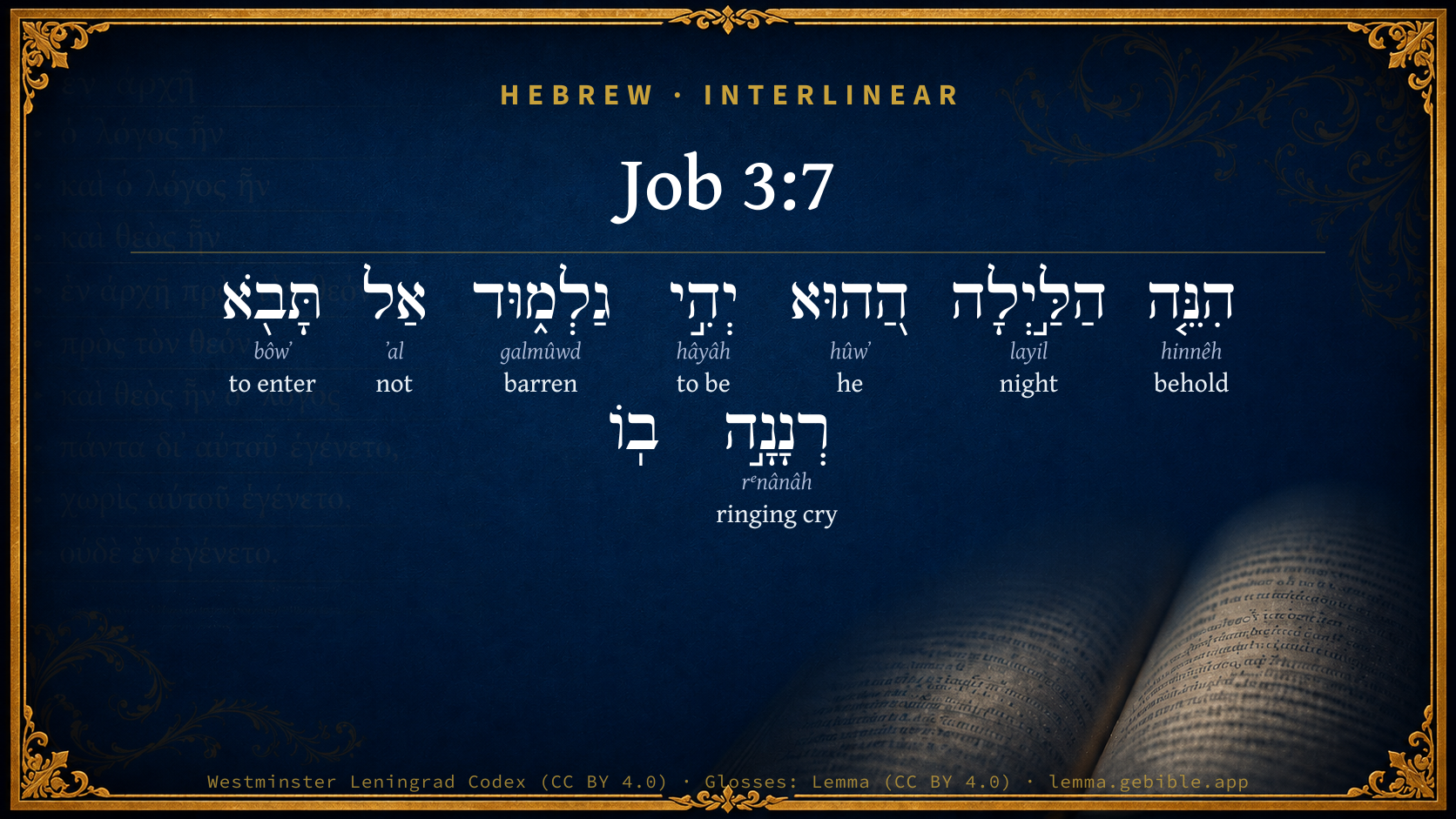
Hebrew (Westminster Leningrad Codex) Job 3:7 appears in the Hebrew Old Testament. The text above is from the Westminster Leningrad Codex. Each word links to its Strong’s number, a concise gloss, and parsing drawn from the Open Scriptures Hebrew Bible morphology. Click any word for its full Brown-Driver-Briggs (BDB) entry.
Download image
Cite this verse

Job 3:7 (World English Bible). Public Domain. Lemma interlinear Bible study tool, https://lemma.gebible.app/v/job/3/7.

Show BibTeX & RIS
BibTeX
RIS
English Translation
Behold, let that night be barren. Let no joyful voice come therein.
World English Bible · Public Domain
Highlights
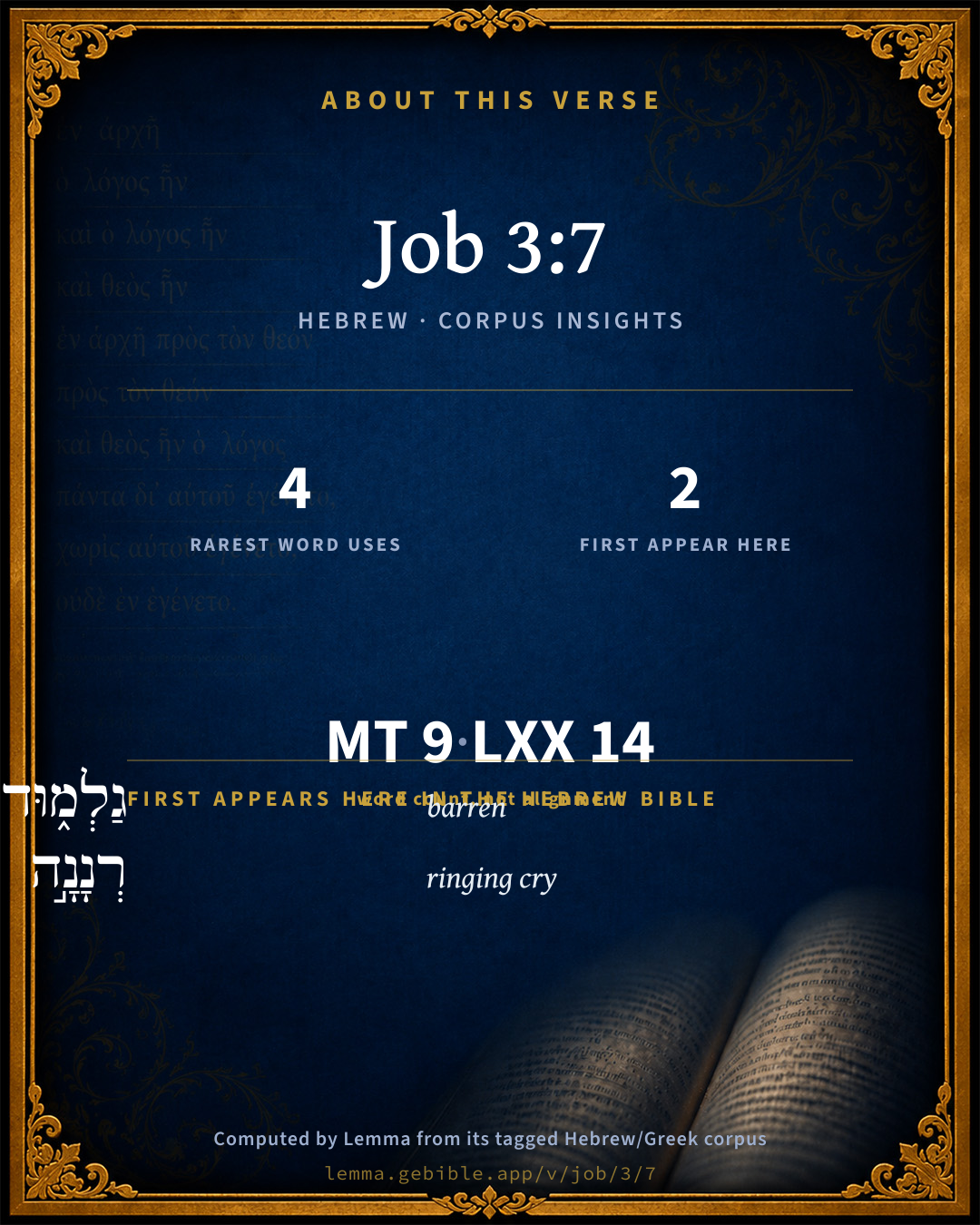
  • 2 first appearances in the Hebrew Bible
Full analysis ↓
Download a study sheet

One document with this verse’s original text, its word-by-word gloss line, the meaning frame, cross-references with their text, attributed commentary, and full source and license credits — printable, and it pastes into notes with its structure intact.

This verse Autodidact and up

Study sheet (.html) Plain text (.txt)

A passage Seminary Student

Up to 50 verses in one chapter. A passage sheet keeps up to 6 commentary sources and 12 cross-references per verse, in the order this page ranks them, and says so on the sheet whenever that leaves anything out. Ask for a single verse and you get the Autodidact verse sheet above.

Everything on this page stays free to read, with no account — the sheet is a download of what is already on screen, not access to it.

Want to remove ads? Support Godless Engineer
Compare translations 3

The same verse in 3 English versions, stacked beneath the original-language interlinear above. Click any original word for its lexicon entry.

Each is an independent rendering of the whole verse — the interlinear is not word-aligned to these translations.

Highlighted words mark where these versions differ — a whole-verse word diff, not a word-by-word alignment.

  • World English Bible Public Domain
    Behold, let that night be barren. Let no joyful voice come therein.
  • King James Version Public Domain
    Lo, let that night be solitary, let no joyful voice come therein.
  • unfoldingWord Literal Text CC BY-SA 4.0
    Behold: That night—may it be barren! May a joyful shout not come into it.

unfoldingWord Literal Text — © unfoldingWord, licensed CC BY-SA 4.0. Word-aligned USFM3 via Door43 (git.door43.org/unfoldingWord/en_ult).

Versions to compare (up to 4)

3 of 4 selected

Show all 18 translations

Every available English version of this verse, each an independent rendering of the whole verse.

  • World English Bible Public Domain
    Behold, let that night be barren. Let no joyful voice come therein.
  • Berean Standard Bible Public Domain
    Behold, may that night be barren; may no joyful voice come into it.
  • Majority Standard Bible Public Domain
    Behold, may that night be barren; may no joyful voice come into it.
  • King James Version Public Domain
    Lo, let that night be solitary, let no joyful voice come therein.
  • American Standard Version (1901) Public Domain
    Lo, let that night be barren; Let no joyful voice come therein.
  • Revised Version (1885) Public Domain
    Lo, let that night be barren; let no joyful voice come therein.
  • Geneva Bible (1599) Public Domain
    Yea, desolate be that night, and let no ioy be in it.
  • Douay-Rheims (1899) Public Domain
    Let that night be solitary, and not worthy of praise.
  • Young's Literal Translation Public Domain
    Lo! that night -- let it be gloomy, Let no singing come into it.
  • Literal Standard Version CC BY-SA 4.0
    Behold! That night—let it be barren, || Let no singing come into it.
  • Unlocked Literal Bible CC BY-SA 4.0
    See, may that night be barren; may no joyful voice come into it.
  • unfoldingWord Literal Text CC BY-SA 4.0
    Behold: That night—may it be barren! May a joyful shout not come into it.
  • Darby Bible Public Domain
    Behold, let that night be barren; let no joyful sound come therein;
  • World Messianic Bible Public Domain
    Behold, let that night be barren. Let no joyful voice come therein.
  • Webster's Bible Public Domain
    Lo, let that night be solitary, let no joyful voice come therein.
  • Free Bible Version CC BY-SA 4.0
    Let that night be childless, with no sounds of happiness heard.
  • Bible in Basic English Public Domain
    As for that night, let it have no fruit; let no voice of joy be sounded in it;
  • JPS Tanakh (1917) Public Domain
    Lo, let that night be desolate; let no joyful voice come therein.

Literal Standard Version (2020), Covenant Press — licensed CC BY-SA 4.0. Text via the HelloAO Bible API (eBible.org). Unlocked Literal Bible (unfoldingWord) — licensed CC BY-SA 4.0. Text via the HelloAO Bible API (eBible.org). unfoldingWord Literal Text — © unfoldingWord, licensed CC BY-SA 4.0. Word-aligned USFM3 via Door43 (git.door43.org/unfoldingWord/en_ult). Free Bible Version, Dr. Jonathan Gallagher — licensed CC BY-SA 4.0. Text via the HelloAO Bible API (eBible.org).

Word by word

More ways to search: Search by grammar → Find every occurrence → Compare this word →

Practice this passage: Drill this verse → Learn its vocabulary →

About this verse

These counts appear in no published source. They are computed here, from the morphology-tagged text and Lemma’s own curated glosses. What Lemma adds →

9
words
8
distinct lemmas
Wisdom
section

Notable vocabulary

The rarest word here is גַלְמ֑וּד barren H1565 — appearing just 4 times in the whole Hebrew Bible.

First appearance in Scripture

These words make their first canonical appearance in the Hebrew Bible here:

  • גַלְמ֑וּד barren H1565
  • רְנָנָ֣ה ringing cry H7445

Shared distinctive vocabulary

גַלְמ֑וּד barren H1565 occurs in 4 verses of the Hebrew Bible. Also found in:

Grammatical profile

  • 2 verbs
  • 2 nouns
  • 1 adjective
  • 1 pronoun
  • 1 preposition
  • 2 particles

Verb forms

  • יְהִ֣י Qal · Jussive
  • תָּבֹ֖א Qal · Jussive

Hebrew & Septuagint length

In English translation the verse runs 12 words from the Hebrew and 15 from the Septuagint (LXX English) — closely comparable.

A rough comparison of the two English renderings, which tokenize alike — not a word-level alignment.

Word counts can differ between the Hebrew and the Greek without any difference in meaning — e.g. the Hebrew direct-object marker אֵת has no separate Greek word, and Greek often adds the article ὁ.

In the original languages it is 9 Hebrew tokens and 14 Greek tokens — but the two are counted differently (Hebrew bundles its prefixes and suffixes into one token; the Greek is in lemma form), so that isn’t a like-for-like length.

Cross-references

4

Topical passages linked to Job 3:7 in the Treasury of Scripture Knowledge — connected by theme and wording, ordered by reader-vote popularity; previews shown in the World English Bible.

  • Isaiah 13:20–22 It shall never be inhabited, neither shall it be lived in from generation to generation: neither shall the Arabian pitch tent there; neither shall shepherds make their flocks to lie down there.
  • Isaiah 24:8 The mirth of tambourines ceases, the noise of those who rejoice ends, the joy of the harp ceases.
  • Jeremiah 7:34 Then will I cause to cease from the cities of Judah, and from the streets of Jerusalem, the voice of mirth and the voice of gladness, the voice of the bridegroom and the voice of the bride; for the land shall become a waste.
  • Revelation 18:22–23 The voice of harpists, minstrels, flute players, and trumpeters will be heard no more at all in you. No craftsman, of whatever craft, will be found any more at all in you. The sound of a mill will be heard no more at all in you.

Cross-references courtesy of OpenBible.info (CC BY 4.0).

Hebrew and Greek witnesses Masoretic Hebrew ↔ Greek Septuagint

The same verse in the two great witnesses to the Old Testament, shown verse-for-verse.

These are two independent witnesses, not word-aligned to each other, and the Septuagint is shown in lemma (dictionary) form.

Hebrew Job 3:7 Masoretic · Westminster Leningrad Codex

הִנֵּ֤ה הַלַּ֣יְלָה הַ֭הוּא יְהִ֣י גַלְמ֑וּד אַל תָּבֹ֖א רְנָנָ֣ה בֽוֹ

Behold, let that night be barren. Let no joyful voice come therein.

World English Bible · Public Domain

Greek LXX Job 3:7 Septuagint · lemma form

ἀλλά ὁ νύξ ἐκεῖνος εἰμί ὀδύνη καί μή ἔρχομαι ἐπί αὐτός εὐφροσύνη μηδέ χαρμονή

But let that night be pain, and let not mirth come upon it, nor joy.

LXX2012 (modern English Septuagint) · Public Domain

On this verse, Adam Clarke's Commentary discusses the Septuagint’s reading. Read the note in Commentary ↓

Hebrew: Westminster Leningrad Codex (CC BY 4.0). Greek: Septuagint (public domain); English from LXX2012 (modern English Septuagint) (Public Domain). How the Septuagint differs from the Hebrew →

Commentary

Notes on Job 3:7 from classic Christian and Jewish commentators (each source and its license shown beneath its notes). The classic Christian expositions comment on the surrounding passage and are grouped to its opening verse, so a note may address several verses; the Jewish commentaries on the Tanakh (Rashi and others) are per-verse, so they appear only where the commentator wrote on this verse.

Lemma curates 59 commentaries, every one of them public domain or Creative Commons licensed, each selected and text-cleaned for this edition rather than reprinted as found. About our sources →

Trapp's Complete Commentary

John Trapp

Job 3:7 Lo, let that night be solitary, let no joyful voice come therein.

Ver. 7. Lo, let that night be solitary] And so consequently sorrowful; for aloneness is comfortless, et optimum solatium sodalitium. There is a desirable solitariness, such as was that of Isaac, Gen 24:63, of Jacob, Gen 32:24, of Christ, Mar 1:35, of Peter, Act 10:9, to talk with God and with themselves. But usually to sit solitary is a misery, Lam 1:1 (for Satan is readiest to assault when none is by to assist), neither is there a greater tie to constancy than the society of saints. This the heathen persecutors perceived, and therefore banished and confined the Christian confessors to isles and mines; where they could not come together for mutual edification and comfort. There is a woe to him that is alone, and good reason showed for it by Solomon, Ecc 4:9-12. Let no man sty up himself, or affect solitariness; but make conscience of fellowship in the gospel, as the Philippiaus did from the first day of their conversion to Christ, Php 1:5, accounting, that communion of saints is a point of practice, as well as an article of belief.

And no joyful voice come therein] That is, saith one, no pleasing stillness (as in other nights there is), to invite the melody of music. Or, let there be no merry meetings, feastings, and jollities, as was usual in the night season. Let not so much as the voice of the cock be heard that night (so the Chaldee here paraphraseth), but the doleful ditties of screech owls, and other inauspicate creatures. Let no traveller, that is then benighted, solace himself with sweet songs, or musicians play from house to house, as minstrels do.

John Trapp, A Commentary or Exposition upon All the Books of the Old and New Testament (1647–1656) — public domain. Text from a community e-Sword module.

Joseph Benson's Commentary

Job 3:7. Let that night be solitary — Destitute of all society of men, meeting and feasting together. Let it afford no entertainment or pleasure of any kind; let no joyful voice come therein — No music, no harmony of sound be heard, no cheerful or pleasing voice admitted! Let no expressions of joy be so much as once attempted, however engaging and affecting they may be.

Joseph Benson's Commentary on the Old and New Testaments (1811–1818) — public domain. Text from a community e-Sword module.

Jamieson, Fausset & Brown

Robert Jamieson, A. R. Fausset & David Brown

solitary--rather, "unfruitful." "Would that it had not given birth to me."

Jamieson, Fausset & Brown — Commentary Critical and Explanatory on the Whole Bible (1871) — public domain (CC PDM 1.0). Text via the HelloAO Bible API.

Adam Clarke's Commentary

Verse 7. Lo, let that night be solitary] The word הנה hinneh, behold, or lo, is wanting in one of De Rossi's MSS., nor is it expressed in the Septuagint, Vulgate, Syriac, or Arabic.

The word גלמוד galmud, which we translate solitary, is properly Arabic. From [Arabic] ghalama or jalama, signifying to cut off, make bare, amputate, comes [Arabic] jalmud, a rock, a great stone; and [Arabic] jalameedet, weight, a burden, trouble, from which we may gather Job's meaning: "Let that night be grievous, oppressive, as destitute of good as a bare rock is of verdure." The Targum gives the sense, In that night let there be tribulation.

Let no joyful voice come therein.] Let there be no choirs of singers; no pleasant music heard; no dancing or merriment. The word רננה renanah signifies any brisk movement, such as the vibration of the rays of light, or the brisk modulation of the voice in a cheerful ditty. The Targum has, Let not the crowing of the rural or wild cock resound in it. Let all work be intermitted; let there be no sportive exercises, and let all animals be totally silent.

Adam Clarke's Commentary on the Bible (1810–1826) — public domain. Text from a community e-Sword/MySword module.

The Cambridge Bible for Schools and Colleges

gen. ed. J. J. S. Perowne

7. be solitary] Rather perhaps, barren, as Isa_49:21. Let it not experience a parent’s joy, and le nought that lives date its birth from it.

no joyful voice] of birthday rejoicing.

The Cambridge Bible for Schools and Colleges (gen. ed. J. J. S. Perowne; Cambridge University Press, 1878–1918) — public domain. Text from a community e-Sword module.

John Gill's Exposition

Lo, let that night be solitary,.... Let there be no company for journeys, or doing any business; no meetings of friends, neighbours, or relations on it, for refreshment, pleasure, and recreation, after the business of the day is over, as is frequently done; let there be no associations of this kind, or any other: in the night it was usual to have feasts on various accounts, and especially on account of marriage; but now let there be none, let there be as profound a silence as if all creatures, men and beasts, were dead, and removed from off the face of the earth, and nothing to be heard and seen on it: or, "let it be barren" or "desolate" (e), so R. Simeon bar Tzemach interprets it, and refers to Isa 49:21; that is, let no children be born in it, and so no occasion for any joy on that account, as follows; let it be as barren as a flint (f):

let no joyful voice come therein; which some even carry to the nocturnal singing of saints in private or in public assemblies, and to the songs of angels, those morning stars in heaven; but it seems rather to design natural or civil joy, or singing on civil accounts; as on account of marriage, and particularly on account of the birth of a child, and especially his own birth, and even any expressions of joy on any account; and that there might not be so much as the crowing of a cock heard, as the Targum has it.

(e) "orba", Syr. "desolata", Ar. "vasta", Schmidt. (f) "Sterilis", Schultens; "effoetus", apud Arab. in ib. See Hottinger. Smegma Orientale, l. 1. c. 7. p. 136.

John Gill's Exposition of the Whole Bible (1746–1763) — public domain (CC PDM 1.0). Text via the HelloAO Bible API.

Albert Barnes' Notes on the Bible

Lo, let that night be solitary - Dr. Good, “O! that night! Let it be a barren rock!” Noyes, “O let that night be unfruitful!” Herder, “Let that night be set apart by itself.” The Hebrew word used here גלמוּד galmûd means properly “hard;” then sterile, barren, as of a hard and rocky soil. It does not mean properly solitary, but that which is unproductive and unfruitful. It is used of a woman who is barren, Isa 49:21, and also of that which is lean, famished, emaciated with hunger; Job 15:34; Job 30:3. According to this it means that that should be a night in which none would be born - a night of loneliness and desolation. According to Jerome, it means that the night should be solitary, lonely, and gloomy; a night in which no one would venture forth to make a journey, and in which none would come together to rejoice. Thus interpreted the night would resemble that which is so beautifully describe by Virgil, Aeneid vi. 268:

Ibant obscuri sola sub nocte per umbras,

Perque domos Ditis vacuas et inania regna.

It is probable, however, that the former is the correct interpretation.

Let no joyful voice come therein - Let there be no sound of praise and rejoicing. The Chaldee paraphrases this,” Let not the crowing of a cock be heard in it.” The sense of the whole is, that Job wished that night to be wholly desolate. He wished there might be no assembling for amusement, congratulation, or praise, no marriage festivals, and no rejoicing at the birth of children; he would have it as noiseless, solitary, and sad, as if all animals and human beings were dead, and no voice were heard. It was a night hateful to him, and he would have it in no way remembered.

Albert Barnes' Notes on the Bible (1834–1885) — public domain. Text from a community e-Sword/MySword module.

Haydock's Catholic Bible Commentary

Praise, by the appearance of the stars, chap. xxxviii. 7. (Calmet)

George Leo Haydock (1774–1849), Haydock's Catholic Family Bible and Commentary, 1859 edition — public domain. Excludes Psalms (Douay-Rheims chapter numbering differs from Protestant) and Deuterocanonical books (Catholic canon only).

Matthew Poole's English Annotations

Solitary, i.e. destitute of all society of men meeting and feasting together, which commonly was done at night, suppers being the most solemn meals among divers ancient nations. See Mar 6:21; Luk 14:16; Joh 12:2; Rev 19:9,17.

Let no joyful voice; neither of the bride and bridegroom, nor any that celebrate their nuptials, or any other merry solemnity.

Matthew Poole's English Annotations on the Holy Bible (1683–1685) — public domain. Text from a community e-Sword/MySword module.

Whedon's Commentary on the Bible

Daniel D. Whedon

7. Solitary — גלמוד, barren, as in Isa_49:21. “It is a metaphor,” says Gesenius, “taken from the hard, sterile, and stony soil.” Let it be not only a night without Job’s birth, but without any births. With the Arab the birth of male children was celebrated by feasts, dances, and songs. — POCOCKE, ibid., p. 160. That night, with the ancient curse of barrenness upon it, is to sit solitary and alone, in unbroken silence, in the everlasting darkness.

Daniel D. Whedon (gen. ed.), Commentary on the Old and New Testaments (1874–1909) — public domain. Text from a community e-Sword module.

The Pulpit Commentary

Lo, let that night be solitary; or, sterile; "let no one be born in it." Lot no joyful voice come therein; literally, no song. Perhaps the moaning is, "Let no such joyful announcement be made," as that mentioned in ver. 3.

The Pulpit Commentary (1880–1919), ed. H.D.M. Spence-Jones & Joseph S. Exell — public domain. Text from a community e-Sword module.

Rashi

Rabbi Shlomo Yitzchaki (Rashi)

lonely Alone and lacking any man or creature.

Rashi on the Tanakh — English translations: “The Judaica Press complete Tanach with Rashi, translated by A. J. Rosenberg” (CC BY 4.0); “Pentateuch with Rashi's commentary by M. Rosenbaum and A.M. Silbermann, 1929-1934” (public domain); “The Metsudah Tanach series, Lakewood, N.J” (CC BY 4.0); and “The Book of Joshua, Metsudah Publications, 1997” (CC BY 4.0). Text via Sefaria.

Lesson kit

Teaching starters — assembled from the data on this page, not authored interpretation. Every prompt links to the verse data it draws on. Edit before teaching.

Job, in the Wisdom, opens this verse with 9 words (8 distinct Hebrew lemmas). Its most distinctive word is galmûwd (“barren”). A historical commentator’s framing appears above. Read the whole chapter for the surrounding context.

Discussion questions

  1. How does “barren” (galmûwd) shape what this verse is saying?
  2. 2 words make their first appearance in Scripture here. What does this debut establish?
  3. How does Job 15:34, which shares the word «barren», read alongside this verse?
  4. These translations render this verse differently; the difference is in the English rendering, not the original. What questions does that raise?
  5. «יְהִ֣י» is a Qal Jussive verb. How does that grammatical form shape the action described?
  6. Compare how Trapp's Complete Commentary and Joseph Benson's Commentary read this verse. Where do they agree or differ?

Things to notice

Reading settings

Reading text

Shown beneath each verse's original-language words.

Old Testament
Old Testament edition

Read the OT as the Masoretic Hebrew (MT) or the Greek Septuagint (LXX).

English shown for the Greek Septuagint (in the Hebrew ↔ Greek comparison).

Comparing translations? Open the Compare panel on any verse page to stack up to four side by side.