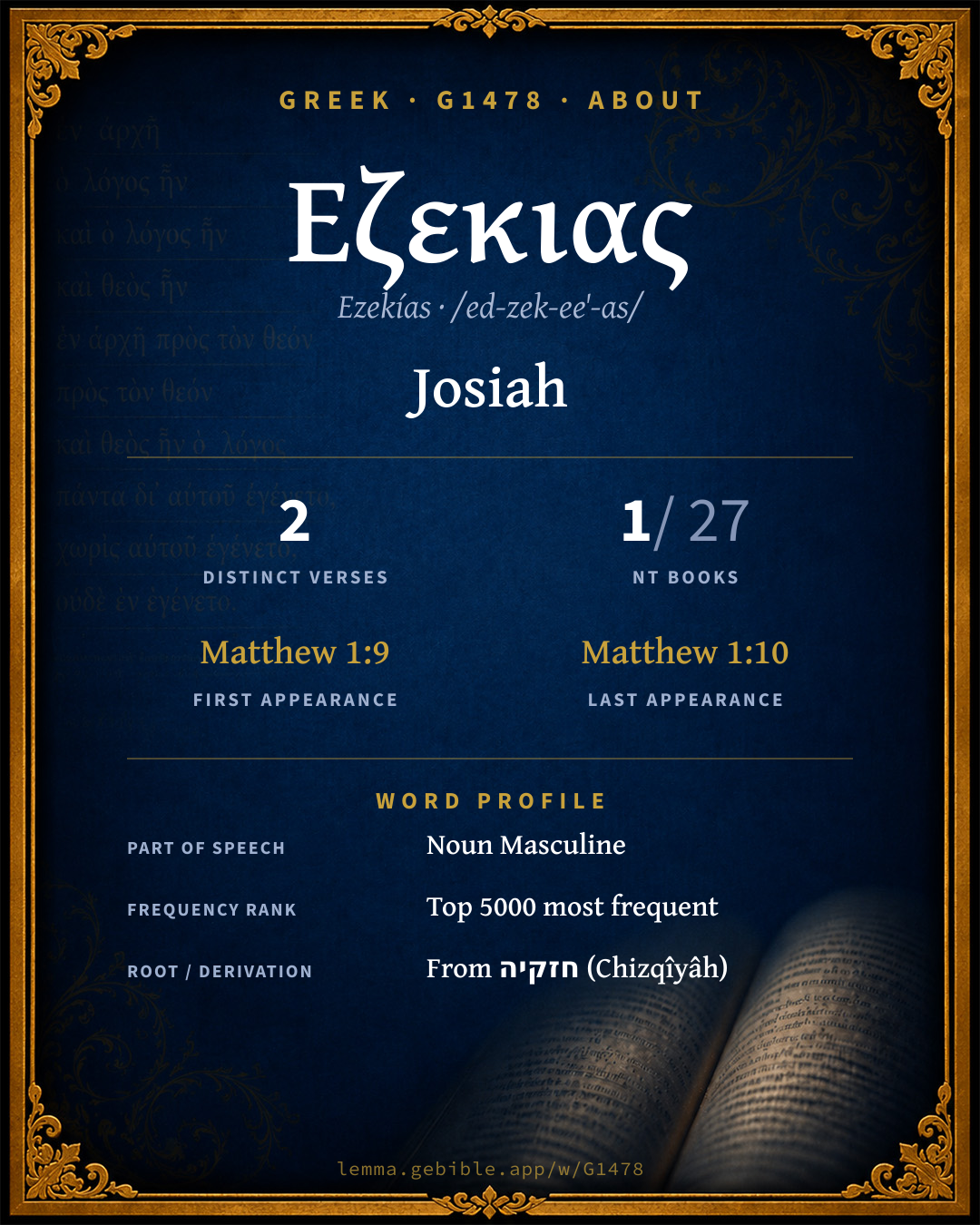
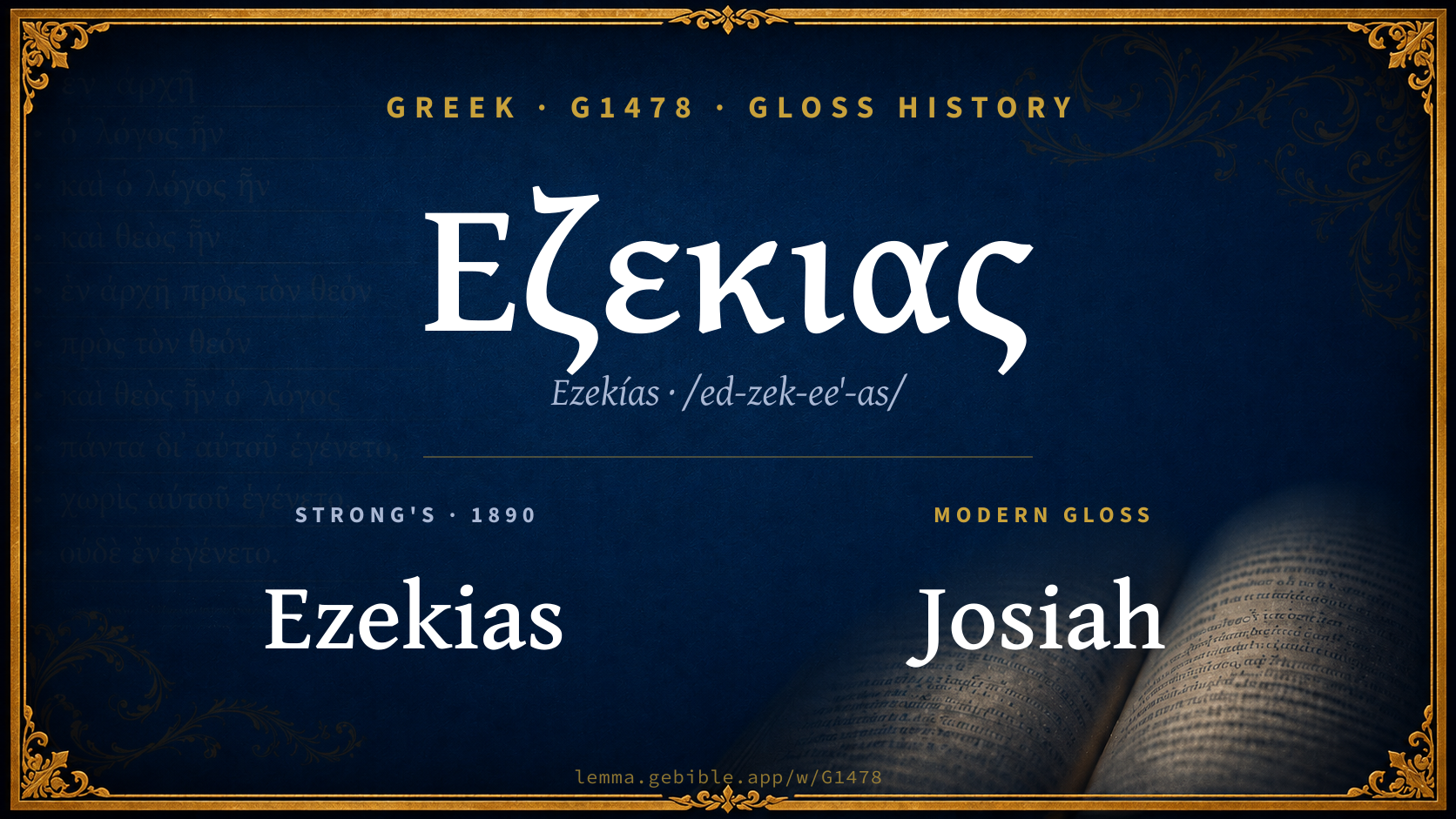
Ἐζεκίας
Josiah
Thayer's lists 2 entries for ‘Josiah’ fuller range ↓
Full lexicon entry — Thayer's Greek Lexicon
From Thayer's Greek Lexicon
Where this word appears
See every Accusative-case word in the Greek New Testament →
Grammar key — what these labels mean
Part of speech
- Noun
- A naming word — a person, place, thing, or idea.
Case
- Accusative
- The case of the direct object and of extent.
- Nominative
- The case of the subject (and the predicate nominative).
Gender
- Masculine
- Grammatically masculine.
Number
- Singular
- One.
1 distinct verse where G1478 appears in the Accusative case, across 1 book. Filtered view — show all forms. Click any verse to open its interlinear word-by-word view. Verse text shown in the World English Bible for context — . Each verse’s Greek form is shown with its reference; the English is not keyword-highlighted, since the data carries no word-level English alignment. Use “Compare translations” on any verse to read it across multiple English versions. This concordance covers the Greek New Testament; Septuagint (Greek Old Testament) occurrences of this word are not indexed here.
Matthew 1 verse
About this entry
At a glance — auto-summarized from this page’s data, not written by a person. Every figure links to its source below. This summary describes the numbers; it doesn’t interpret them.
The Greek name Εζεκιας centers on the idea of “Josiah.” A scarce word — 2 verses in all of the Greek New Testament. Matthew dominates its distribution — 2 of 2 verses. Debuting at Matthew 1:9, it then recurs through the corpus. For the data behind this summary, explore 2-verse concordance and the renderings breakdown below.
Gloss history
Strong's 1890 vs modern scholarship
About this word
Strong's G1478 catalogs a Greek word from the Greek New Testament.
These counts are not copied from any lexicon or concordance. They are computed here, from the morphology-tagged Greek New Testament. What Lemma adds →
- 2
- distinct verses
- The word appears in 2 distinct verses.
- 1 / 27
- NT books
- The word appears in 1 of 27 New Testament books.
- #2,678
- by frequency
- Top 5000 most frequent Greek words (rank 2,678 of 5,347 Greek words by occurrence).
View all 2 occurrences in the concordance →
Most concentrated in
- Matthew 2 verses 100%
By section of the New Testament
By traditional corpus
Conventional, traditional groupings — biblical authorship is debated, so this is a traditional corpus grouping, not an authorship claim. Some books belong to more than one corpus (Luke is in both the Gospels and the Lukan corpus, and so on), so these shares overlap and need not total 100%. Each figure is a share of the word’s 2 distinct verses.
- Gospels 2 verses · 100%
How translations render this word
Counts come from each version’s own published word-to-Strong’s tagging or interlinear alignment — an approximate guide to how each version renders this word, not a word-level alignment the data otherwise carries. Because each total is that version’s own tagged count, the per-version totals vary from one another and need not match the appearance or distinct-verse counts above. These counts may also differ from a printed concordance because Lemma counts each distinctly tagged rendering and does not collapse phrase taggings into a single head-word total. This is a fixed set of word-tagged versions (KJV, ASV, BSB, ULT) and does not change with the reading translation you choose elsewhere. Each version’s license is shown beside its name below (and on Sources).
- King James Version: Ezekias 2×
- American Standard Version: Hezekiah 2×
- Berean Standard Bible: Hezekiah 2×
- unfoldingWord Literal Text: Hezekiah 2×
King James Version Public Domain
Renders G1478 across 2 tagged occurrences — most commonly:
American Standard Version Public Domain
Renders G1478 across 2 tagged occurrences — most commonly:
Berean Standard Bible Public Domain
Renders G1478 across 2 tagged occurrences — most commonly:
unfoldingWord Literal Text CC BY-SA 4.0
Renders G1478 across 2 tagged occurrences — most commonly:
Senses in Thayer's
The 2 senses Thayer's distinguishes for this word, in lexicon order (not ranked by frequency or importance). The full entry — with sub-senses — is in the Lexicon Entry tab.
- Hezekiah = "the might of Jehovah"
- the twelfth king of Judah
Word origin
Derived from חזקיה (Chizqîyâh) (H2396) — Hezekiah.
Of hebrew origin [ H2396 ]; Ezekias (that is hezekiah ) an Israelite : - Ezekias.
— Strong’s Exhaustive Concordance (1890), public domain.
Forms in the corpus
The 2 distinct written forms G1478 takes in the Greek New Testament, most frequent first — each parse links to that case’s occurrences in the concordance.
| Form | Parsing | Example | Uses |
|---|---|---|---|
| Ἑζεκίαν Hezekían | Noun, Accusative, Singular, Masculine | Matthew 1:9 | 1 |
| Ἑζεκίας Hezekías | Noun, Nominative, Singular, Masculine | Matthew 1:10 | 1 |
Bible dictionary
Public-domain dictionary articles matched to this entry by name (Josiah). A biblical name can be shared by more than one person or place, so an article may treat several.
Easton's Bible Dictionary · M. G. Easton, 1897
Healed by Jehovah, or Jehovah will support. The son of Amon, and his successor on the throne of Judah (2 Kings 22:1; 2 Chr. 34:1). His history is contained in 2 Kings 22, 23. He stands foremost among all the kings of the line of David for unswerving loyalty to Jehovah (23:25). He "did that which was right in the sight of the Lord, and walked in all the way of David his father." He ascended the throne at the early age of eight years, and it appears that not till eight years afterwards did he begin "to seek after the God of David his father." At that age he devoted himself to God. He distinguished himself by beginning a war of extermination against the prevailing idolatry, which had practically been the state religion for some seventy years (2 Chr. 34:3; comp. Jer. 25:3, 11, 29).
In the eighteenth year of his reign he proceeded to repair and beautify the temple, which by time and violence had become sorely dilapidated (2 Kings 22:3, 5, 6; 23:23; 2 Chr. 34:11). While this work was being carried on, Hilkiah, the high priest, discovered a roll, which was probably the original copy of the law, the entire Pentateuch, written by Moses.
When this book was read to him, the king was alarmed by the things it contained, and sent for Huldah, the "prophetess," for her counsel. She spoke to him words of encouragement, telling him that he would be gathered to his fathers in peace before the threatened days of judgment came. Josiah immediately gathered the people together, and engaged them in a renewal of their ancient national covenant with God. The Passover was then celebrated, as in the days of his great predecessor, Hezekiah, with unusual magnificence. Nevertheless, "the Lord turned not from the fierceness of his great wrath wherewith his anger was kindled against Judah" (2 Kings 22:3-20; 23:21-27; 2 Chr. 35:1-19). During the progress of this great religious revolution Jeremiah helped it on by his earnest exhortations.
Soon after this, Pharaoh-Necho II. (q.v.), king of Egypt, in an expedition against the king of Assyria, with the view of gaining possession of Carchemish, sought a passage through the territory of Judah for his army. This Josiah refused to permit. He had probably entered into some new alliance with the king of Assyria, and faithful to his word he sought to oppose the progress of Necho.
The army of Judah went out and encountered that of Egypt at Megiddo, on the verge of the plain of Esdraelon. Josiah went into the field in disguise, and was fatally wounded by a random arrow. His attendants conveyed him toward Jerusalem, but had only reached Hadadrimmon, a few miles south of Megiddo, when he died (2 Kings 23:28, 30; comp. 2 Chr. 35:20-27), after a reign of thirty-one years. He was buried with the greatest honours in fulfilment of Huldah's prophecy (2 Kings 22:20; comp. Jer. 34:5). Jeremiah composed a funeral elegy on this the best of the kings of Israel (Lam. 4:20; 2 Chr. 35:25). The outburst of national grief on account of his death became proverbial (Zech. 12:11; comp. Rev. 16:16).
Smith's Bible Dictionary · William Smith, 1863
(whom Jehovah heals).
+ The son of Amon and Jedidah, succeeded his father B.C. 641, in the eighty years of his age, and reigned 31 years. His history is contained in (2 Kings 22:1; 2 Kings 24:30; 2 Chronicles 34:1; 2 Chronicles 35:1) ... and the first twelve chapters of Jeremiah throw much light upon the general character of the Jews in his day. He began in the eighth year of his reign to seek the Lord; and in his twelfth year, and for six years afterward, in a personal progress throughout all the land of Judah and Israel, he destroyed everywhere high places, groves, images and all outward signs and relics of idolatry. The temple was restored under a special commission; and in the course of the repairs Hilkiah the priest found that book of the law of the Lord which quickened so remarkably the ardent zeal of the king. He was aided by Jeremiah the prophet in spreading through his kingdom the knowledge and worship of Jehovah. The great day of Josiah's life was the day of the passover in the eighteenth year of his reign. After this his endeavors to abolish every trace of idolatry and superstition were still carried on; but the time drew near which had been indicated by Huldah. (2 Kings 22:20) When Pharaoh-necho went from Egypt to Carchemish to carry on his war along the seacoast. Necho reluctantly paused and gave him battle in the valley of Esdraelon. Josiah was mortally wounded, and died before he could reach Jerusalem. He was buried with extraordinary honors. + The son of Zephaniah, at whose house took place the solemn and symbolical crowning of Joshua the high priest. (Zechariah 6:10) (B.C. about 1520.)
Hitchcock's Bible Names Dictionary · Roswell D. Hitchcock, 1869
the Lord burns; the fire of the Lord
Classic public-domain reference works; full attribution on Sources.
Septuagint usage
The same Greek word Εζεκιας appears 120 times in the Greek Old Testament (Septuagint), across 110 verses in 9 books.
- 120
- LXX occurrences
- Tagged occurrences of this Greek word in the Septuagint.
- 110
- verses
- Distinct Septuagint verses containing this word.
- 9 / 39
- OT books
- The word appears in 9 of the 39 Old Testament books.
Sample Septuagint occurrences
- 2 Kings 16:20 εζεκιας
- 1 Chronicles 3:13 εζεκιας
- 2 Chronicles 28:12 εζεκιας
- Proverbs 25:1 εζεκιας
- Isaiah 36:1 εζεκιας
- Jeremiah 15:4 εζεκιας
- Hosea 1:1 εζεκιας
- Micah 1:1 εζεκιας
- Zephaniah 1:1 εζεκιας
Septuagint occurrences (same lexeme)
Every verse where the same Strong’s number (G1478) appears in the Greek Septuagint — showing the first 50 of 110. Verse text shown in the World English Bible for context; the Greek form is the matched word — the English is not keyword-highlighted.
- 2 Kings 16:20 εζεκιας Ahaz slept with his fathers, and was buried with his fathers in the city of David: and Hezekiah his son reigned in his place.
- 2 Kings 18:1 εζεκιας Now it happened in the third year of Hoshea son of Elah king of Israel, that Hezekiah the son of Ahaz king of Judah began to reign.
- 2 Kings 18:9 εζεκιας It happened in the fourth year of king Hezekiah, which was the seventh year of Hoshea son of Elah king of Israel, that Shalmaneser king of Assyria came up against Samaria, and besieged it.
- 2 Kings 18:10 εζεκιας At the end of three years they took it: in the sixth year of Hezekiah, which was the ninth year of Hoshea king of Israel, Samaria was taken.
- 2 Kings 18:13 εζεκιας Now in the fourteenth year of king Hezekiah did Sennacherib king of Assyria come up against all the fortified cities of Judah, and took them.
- 2 Kings 18:14 εζεκιας Hezekiah king of Judah sent to the king of Assyria to Lachish, saying, I have offended; return from me: that which you put on me will I bear. The king of Assyria appointed to Hezekiah king of Judah three hundred talents of silver and thirty talents of gold.
- 2 Kings 18:15 εζεκιας Hezekiah gave [him] all the silver that was found in the house of Yahweh, and in the treasures of the king's house.
- 2 Kings 18:16 εζεκιας At that time did Hezekiah cut off [the gold from] the doors of the temple of Yahweh, and [from] the pillars which Hezekiah king of Judah had overlaid, and gave it to the king of Assyria.
- 2 Kings 18:17 εζεκιας The king of Assyria sent Tartan and Rabsaris and Rabshakeh from Lachish to king Hezekiah with a great army to Jerusalem. They went up and came to Jerusalem. When they were come up, they came and stood by the conduit of the upper pool, which is in the highway of the fuller's field.
- 2 Kings 18:18 εζεκιας When they had called to the king, there came out to them Eliakim the son of Hilkiah, who was over the household, and Shebnah the scribe, and Joah the son of Asaph the recorder.
- 2 Kings 18:19 εζεκιας Rabshakeh said to them, Say you now to Hezekiah, Thus says the great king, the king of Assyria, What confidence is this in which you trust?
- 2 Kings 18:22 εζεκιας But if you tell me, We trust in Yahweh our God; isn't that he whose high places and whose altars Hezekiah has taken away, and has said to Judah and to Jerusalem, You shall worship before this altar in Jerusalem?
- 2 Kings 18:29 εζεκιας Thus says the king, Don't let Hezekiah deceive you; for he will not be able to deliver you out of his hand:
- 2 Kings 18:30 εζεκιας neither let Hezekiah make you trust in Yahweh, saying, Yahweh will surely deliver us, and this city shall not be given into the hand of the king of Assyria.
- 2 Kings 18:31 εζεκιας Don't listen to Hezekiah: for thus says the king of Assyria, Make your peace with me, and come out to me; and eat you everyone of his vine, and everyone of his fig tree, and everyone drink the waters of his own cistern;
- 2 Kings 18:32 εζεκιας Until I come and take you away to a land like your own land, a land of grain and new wine, a land of bread and vineyards, a land of olive trees and of honey, that you may live, and not die: and don't listen to Hezekiah, when he persuades you, saying, Yahweh will deliver us.
- 2 Kings 18:37 εζεκιας Then came Eliakim the son of Hilkiah, who was over the household, and Shebna the scribe, and Joah the son of Asaph the recorder, to Hezekiah with their clothes torn, and told him the words of Rabshakeh.
- 2 Kings 19:1 εζεκιας It happened, when king Hezekiah heard it, that he tore his clothes, and covered himself with sackcloth, and went into the house of Yahweh.
- 2 Kings 19:3 εζεκιας They said to him, Thus says Hezekiah, This day is a day of trouble, and of rebuke, and of rejection; for the children are come to the birth, and there is not strength to bring forth.
- 2 Kings 19:5 εζεκιας So the servants of king Hezekiah came to Isaiah.
- 2 Kings 19:9 εζεκιας When he heard say of Tirhakah king of Ethiopia, Behold, he is come out to fight against you, he sent messengers again to Hezekiah, saying,
- 2 Kings 19:14 εζεκιας Hezekiah received the letter from the hand of the messengers, and read it; and Hezekiah went up to the house of Yahweh, and spread it before Yahweh.
- 2 Kings 19:20 εζεκιας Then Isaiah the son of Amoz sent to Hezekiah, saying, Thus says Yahweh, the God of Israel, Whereas you have prayed to me against Sennacherib king of Assyria, I have heard [you].
- 2 Kings 20:1 εζεκιας In those days was Hezekiah sick to death. Isaiah the prophet the son of Amoz came to him, and said to him, Thus says Yahweh, Set your house in order: for you shall die, and not live.
- 2 Kings 20:2 εζεκιας Then he turned his face to the wall, and prayed to Yahweh, saying,
- 2 Kings 20:3 εζεκιας Remember now, Yahweh, I beg you, how I have walked before you in truth and with a perfect heart, and have done that which is good in your sight. Hezekiah wept sore.
- 2 Kings 20:8 εζεκιας Hezekiah said to Isaiah, What shall be the sign that Yahweh will heal me, and that I shall go up to the house of Yahweh the third day?
- 2 Kings 20:10 εζεκιας Hezekiah answered, It is a light thing for the shadow to decline ten steps: nay, but let the shadow return backward ten steps.
- 2 Kings 20:12 εζεκιας At that time Berodach-baladan the son of Baladan, king of Babylon, sent letters and a present to Hezekiah; for he had heard that Hezekiah had been sick.
- 2 Kings 20:13 εζεκιας Hezekiah listened to them, and shown them all the house of his precious things, the silver, and the gold, and the spices, and the precious oil, and the house of his armor, and all that was found in his treasures: there was nothing in his house, nor in all his dominion, that Hezekiah didn't show them.
- 2 Kings 20:14 εζεκιας Then came Isaiah the prophet to king Hezekiah, and said to him, What said these men? and from whence came they to you? Hezekiah said, They are come from a far country, even from Babylon.
- 2 Kings 20:16 εζεκιας Isaiah said to Hezekiah, Hear the word of Yahweh.
- 2 Kings 20:19 εζεκιας Then said Hezekiah to Isaiah, Good is the word of Yahweh which you have spoken. He said moreover, Isn't it so, if peace and truth shall be in my days?
- 2 Kings 20:20 εζεκιας Now the rest of the acts of Hezekiah, and all his might, and how he made the pool, and the conduit, and brought water into the city, aren't they written in the book of the chronicles of the kings of Judah?
- 2 Kings 20:21 εζεκιας Hezekiah slept with his fathers; and Manasseh his son reigned in his place.
- 2 Kings 21:3 εζεκιας For he built again the high places which Hezekiah his father had destroyed; and he reared up altars for Baal, and made an Asherah, as did Ahab king of Israel, and worshiped all the host of the sky, and served them.
- 1 Chronicles 3:13 εζεκιας Ahaz his son, Hezekiah his son, Manasseh his son,
- 1 Chronicles 4:41 εζεκιας These written by name came in the days of Hezekiah king of Judah, and struck their tents, and the Meunim who were found there, and destroyed them utterly to this day, and lived in their place; because there was pasture there for their flocks.
- 2 Chronicles 28:12 εζεκιας Then certain of the heads of the children of Ephraim, Azariah the son of Johanan, Berechiah the son of Meshillemoth, and Jehizkiah the son of Shallum, and Amasa the son of Hadlai, stood up against those who came from the war,
- 2 Chronicles 28:27 εζεκιας Ahaz slept with his fathers, and they buried him in the city, even in Jerusalem; for they didn't bring him into the tombs of the kings of Israel: and Hezekiah his son reigned in his place.
- 2 Chronicles 29:1 εζεκιας Hezekiah began to reign when he was twenty-five years old; and he reigned twenty-nine years in Jerusalem: and his mother's name was Abijah, the daughter of Zechariah.
- 2 Chronicles 29:18 εζεκιας Then they went in to Hezekiah the king within [the palace], and said, We have cleansed all the house of Yahweh, and the altar of burnt offering, with all the vessels of it, and the table of show bread, with all the vessels of it.
- 2 Chronicles 29:20 εζεκιας Then Hezekiah the king arose early, and gathered the princes of the city, and went up to the house of Yahweh.
- 2 Chronicles 29:27 εζεκιας Hezekiah commanded to offer the burnt offering on the altar. When the burnt offering began, the song of Yahweh began also, and the trumpets, together with the instruments of David king of Israel.
- 2 Chronicles 29:30 εζεκιας Moreover Hezekiah the king and the princes commanded the Levites to sing praises to Yahweh with the words of David, and of Asaph the seer. They sang praises with gladness, and they bowed their heads and worshiped.
- 2 Chronicles 29:31 εζεκιας Then Hezekiah answered, Now you have consecrated yourselves to Yahweh; come near and bring sacrifices and thank-offerings into the house of Yahweh. The assembly brought in sacrifices and thank-offerings; and as many as were of a willing heart [brought] burnt offerings.
- 2 Chronicles 29:36 εζεκιας Hezekiah rejoiced, and all the people, because of that which God had prepared for the people: for the thing was done suddenly.
- 2 Chronicles 30:1 εζεκιας Hezekiah sent to all Israel and Judah, and wrote letters also to Ephraim and Manasseh, that they should come to the house of Yahweh at Jerusalem, to keep the Passover to Yahweh, the God of Israel.
- 2 Chronicles 30:18 εζεκιας For a multitude of the people, even many of Ephraim and Manasseh, Issachar and Zebulun, had not cleansed themselves, yet did they eat the Passover otherwise than it is written. For Hezekiah had prayed for them, saying, The good Yahweh pardon everyone
- 2 Chronicles 30:20 εζεκιας Yahweh listened to Hezekiah, and healed the people.
These are occurrences of the same Greek lexeme (G1478) in the Septuagint — not a translation of any one Hebrew word. The store carries no word-level Hebrew↔Greek alignment, so no Hebrew original is asserted here. Counts come from the recovered LXX Strong's tagging — high-frequency vocabulary is well covered, while rare or late forms may be untagged — so they reflect tagged occurrences and may slightly undercount.