
2 Kings 19:5

Hebrew (Westminster Leningrad Codex) 2 Kings 19:5 appears in the Hebrew Old Testament. The text above is from the Westminster Leningrad Codex. Each word links to its Strong’s number, a concise gloss, and parsing drawn from the Open Scriptures Hebrew Bible morphology. Click any word for its full Brown-Driver-Briggs (BDB) entry.
Download image
Cite this verse

2 Kings 19:5 (World English Bible). Public Domain. Lemma interlinear Bible study tool, https://lemma.gebible.app/v/2-kings/19/5.

Show BibTeX & RIS
BibTeX
RIS
English Translation
So the servants of king Hezekiah came to Isaiah.
World English Bible · Public Domain
Download a study sheet

One document with this verse’s original text, its word-by-word gloss line, the meaning frame, cross-references with their text, attributed commentary, and full source and license credits — printable, and it pastes into notes with its structure intact.

This verse Autodidact and up

Study sheet (.html) Plain text (.txt)

A passage Seminary Student

Up to 50 verses in one chapter. A passage sheet keeps up to 6 commentary sources and 12 cross-references per verse, in the order this page ranks them, and says so on the sheet whenever that leaves anything out. Ask for a single verse and you get the Autodidact verse sheet above.

Everything on this page stays free to read, with no account — the sheet is a download of what is already on screen, not access to it.

Want to remove ads? Support Godless Engineer
Compare translations 3

The same verse in 3 English versions, stacked beneath the original-language interlinear above. Click any original word for its lexicon entry.

Each is an independent rendering of the whole verse — the interlinear is not word-aligned to these translations.

Highlighted words mark where these versions differ — a whole-verse word diff, not a word-by-word alignment.

  • World English Bible Public Domain
    So the servants of king Hezekiah came to Isaiah.
  • King James Version Public Domain
    So the servants of king Hezekiah came to Isaiah.
  • unfoldingWord Literal Text CC BY-SA 4.0
    And the servants of King Hezekiah came to Isaiah,

unfoldingWord Literal Text — © unfoldingWord, licensed CC BY-SA 4.0. Word-aligned USFM3 via Door43 (git.door43.org/unfoldingWord/en_ult).

Versions to compare (up to 4)

3 of 4 selected

Show all 18 translations

Every available English version of this verse, each an independent rendering of the whole verse.

  • World English Bible Public Domain
    So the servants of king Hezekiah came to Isaiah.
  • Berean Standard Bible Public Domain
    So the servants of King Hezekiah went to Isaiah,
  • Majority Standard Bible Public Domain
    So the servants of King Hezekiah went to Isaiah,
  • King James Version Public Domain
    So the servants of king Hezekiah came to Isaiah.
  • American Standard Version (1901) Public Domain
    So the servants of king Hezekiah came to Isaiah.
  • Revised Version (1885) Public Domain
    So the servants of king Hezekiah came to Isaiah.
  • Geneva Bible (1599) Public Domain
    So the seruants of King Hezekiah came to Isaiah.
  • Douay-Rheims (1899) Public Domain
    So the servants of king Ezechias came to Isaias.
  • Young's Literal Translation Public Domain
    And the servants of king Hezekiah come in unto Isaiah,
  • Literal Standard Version CC BY-SA 4.0
    And the servants of King Hezekiah come to Isaiah,
  • Unlocked Literal Bible CC BY-SA 4.0
    So the servants of King Hezekiah came to Isaiah,
  • unfoldingWord Literal Text CC BY-SA 4.0
    And the servants of King Hezekiah came to Isaiah,
  • Darby Bible Public Domain
    And the servants of king Hezekiah came to Isaiah.
  • World Messianic Bible Public Domain
    So the servants of King Hezekiah came to Isaiah.
  • Webster's Bible Public Domain
    So the servants of king Hezekiah came to Isaiah.
  • Free Bible Version CC BY-SA 4.0
    After Hezekiah's officials delivered his message to Isaiah,
  • Bible in Basic English Public Domain
    So the servants of King Hezekiah came to Isaiah.
  • JPS Tanakh (1917) Public Domain
    So the servants of king Hezekiah came to Isaiah.

Literal Standard Version (2020), Covenant Press — licensed CC BY-SA 4.0. Text via the HelloAO Bible API (eBible.org). Unlocked Literal Bible (unfoldingWord) — licensed CC BY-SA 4.0. Text via the HelloAO Bible API (eBible.org). unfoldingWord Literal Text — © unfoldingWord, licensed CC BY-SA 4.0. Word-aligned USFM3 via Door43 (git.door43.org/unfoldingWord/en_ult). Free Bible Version, Dr. Jonathan Gallagher — licensed CC BY-SA 4.0. Text via the HelloAO Bible API (eBible.org).

Word by word

More ways to search: Search by grammar → Find every occurrence → Compare this word →

Practice this passage: Drill this verse → Learn its vocabulary →

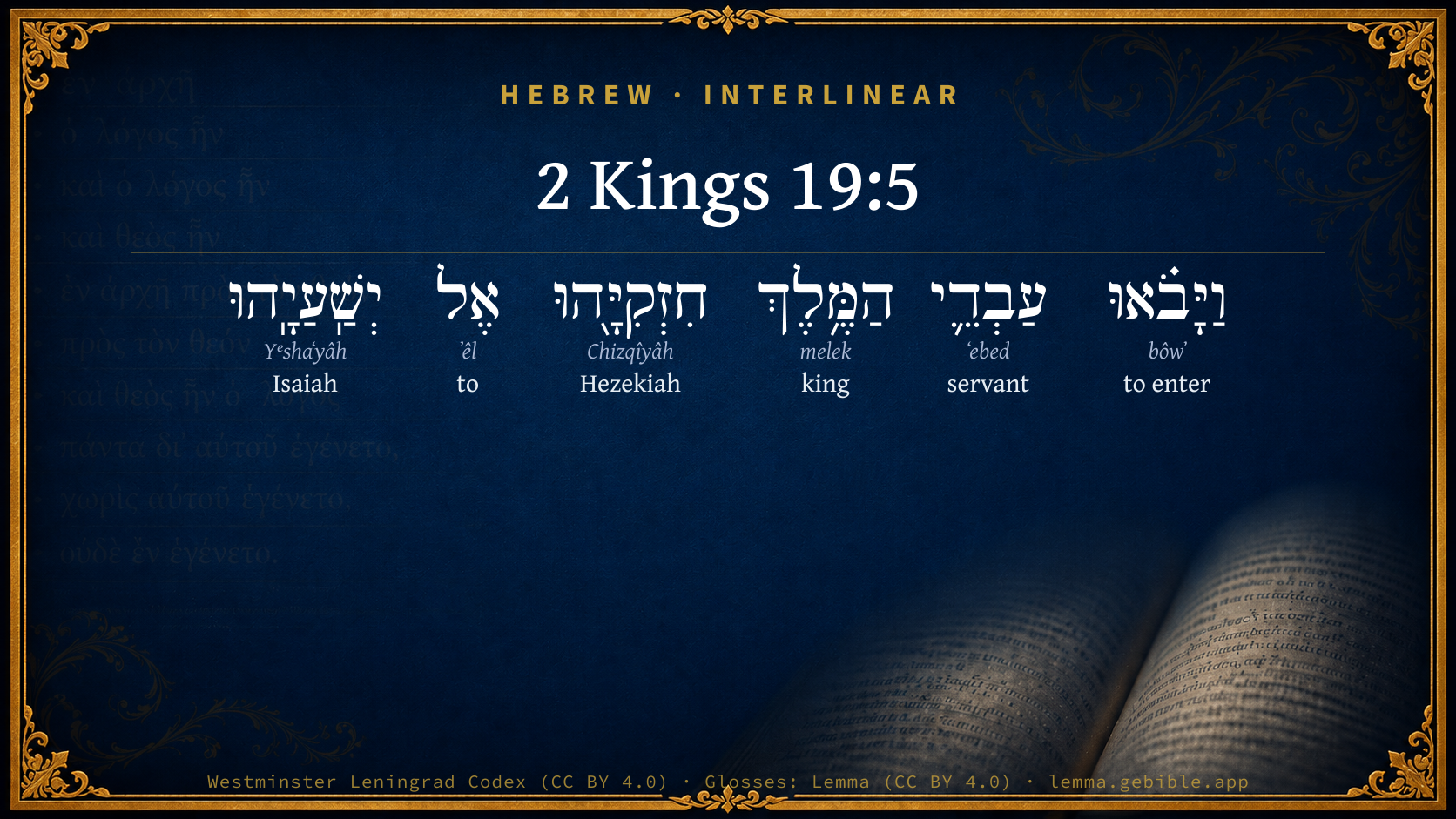
יְשַֽׁעַיָֽהוּ
Yᵉshaʻyâh
H3470
“Isaiah”
Noun, Proper
Part of Speech
Noun
Type
Proper
Full BDB Definition

Origin: from H3467 and H3050

TWOT: None

Isaiah or Jesaiah or Jeshaiah = "Jehovah has saved" - the major prophet, son of Amoz, who prophesied concerning Judah and Jerusalem during the days of kings Uzziah, Jotham, Ahaz, and Hezekiah of Judah; author of the prophetic book by his name; tradition has it that he was sawn asunder in the trunk of a carob tree by king Manasseh and that this is the incident referred to in Heb 11:37 - son of Hananiah, brother of Pelatiah, and grandson of Zerubbabel - a Benjamite - one of the 6 sons of Jeduthun - son of Rehabiah, a descendant of Moses through Gershom, and an ancestor of a Levite treasurer in the time of David - son of Athaliah and chief of the house of Elam who returned with Ezra - a chief of the descendants of Merari who returned with Ezra
  1. וַיָּבֹ֗אוּ bôwʼ H935 “and · to enter” Conjunction + Verb, Qal, Sequential Imperfect, 3rd Person, Masculine, Plural
  2. עַבְדֵ֛י ʻebed H5650 “servants of” Noun, Common, Masculine, Plural, Construct
  3. הַמֶּ֥לֶךְ melek H4428 “the · king” Particle, Definite Article + Noun, Common, Masculine, Singular, Absolute
  4. חִזְקִיָּ֖הוּ Chizqîyâh H2396 “Hezekiah” Noun, Proper
  5. אֶל ʼêl H413 “to” Preposition

About this verse

These counts appear in no published source. They are computed here, from the morphology-tagged text and Lemma’s own curated glosses. What Lemma adds →

6
words
6
distinct lemmas
Historical
section

Shared distinctive vocabulary

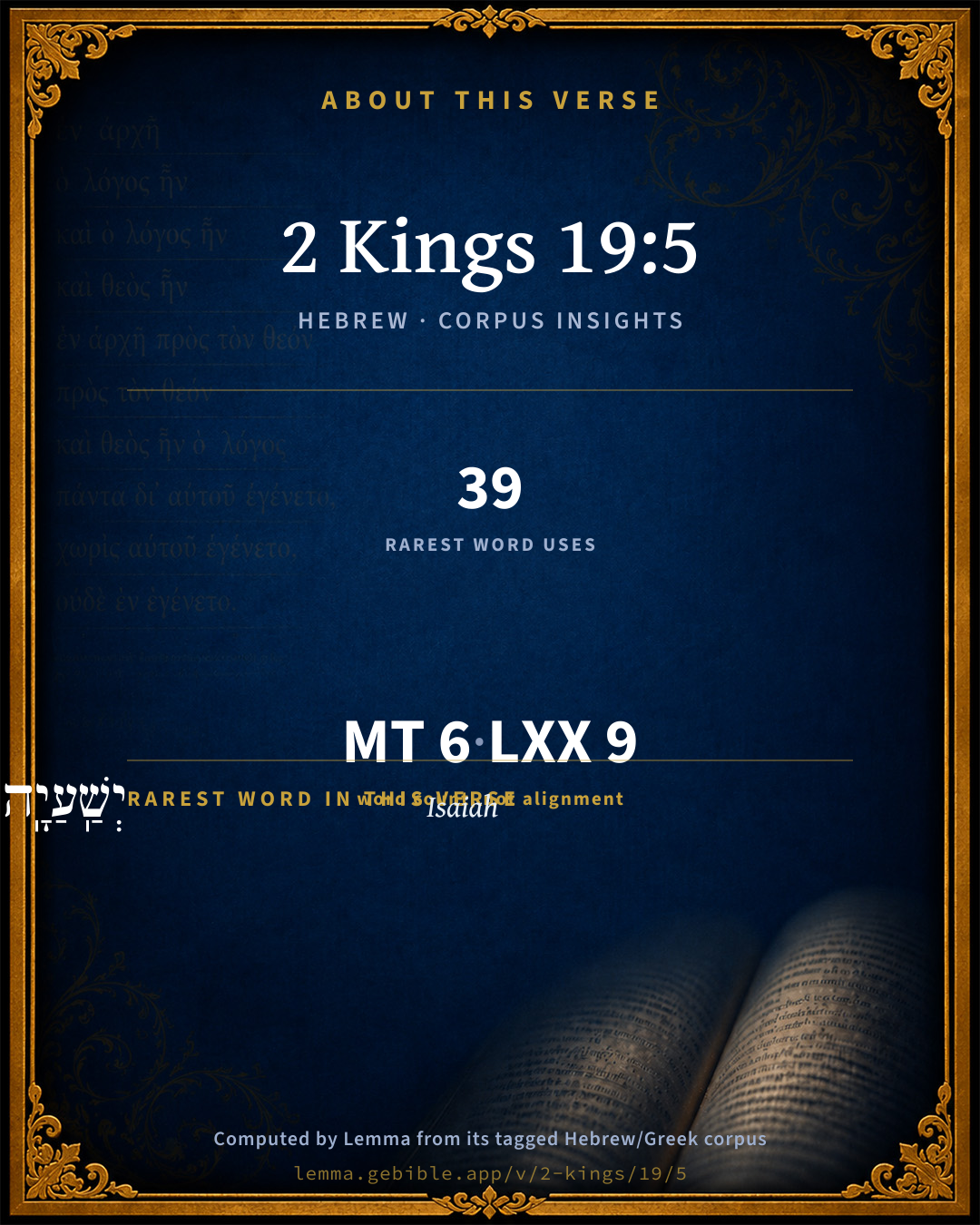
יְשַֽׁעַיָֽהוּ Isaiah H3470 occurs in 39 verses of the Hebrew Bible. Also found in:

Grammatical profile

  • 1 verb
  • 4 nouns
  • 1 preposition

Verb forms

  • וַיָּבֹ֗אוּ Qal · Sequential Imperfect

Hebrew & Septuagint length

In English translation the verse runs 9 words from the Hebrew and 9 from the Septuagint (LXX English) — the same length.

A rough comparison of the two English renderings, which tokenize alike — not a word-level alignment.

Word counts can differ between the Hebrew and the Greek without any difference in meaning — e.g. the Hebrew direct-object marker אֵת has no separate Greek word, and Greek often adds the article ὁ.

In the original languages it is 6 Hebrew tokens and 9 Greek tokens — but the two are counted differently (Hebrew bundles its prefixes and suffixes into one token; the Greek is in lemma form), so that isn’t a like-for-like length.

Hebrew and Greek witnesses Masoretic Hebrew ↔ Greek Septuagint

The same verse in the two great witnesses to the Old Testament, shown verse-for-verse.

These are two independent witnesses, not word-aligned to each other, and the Septuagint is shown in lemma (dictionary) form.

Hebrew 2 Kings 19:5 Masoretic · Westminster Leningrad Codex

וַיָּבֹ֗אוּ עַבְדֵ֛י הַמֶּ֥לֶךְ חִזְקִיָּ֖הוּ אֶל יְשַֽׁעַיָֽהוּ

So the servants of king Hezekiah came to Isaiah.

World English Bible · Public Domain

Greek LXX 2 Kings 19:5 Septuagint · lemma form

καί ἔρχομαι ὁ παῖς ὁ βασιλεύς εζεκιας πρός ησαιας

So the servants of king Ezekias came to Esaias.

LXX2012 (modern English Septuagint) · Public Domain

Hebrew: Westminster Leningrad Codex (CC BY 4.0). Greek: Septuagint (public domain); English from LXX2012 (modern English Septuagint) (Public Domain). How the Septuagint differs from the Hebrew →

Targum (Aramaic paraphrase)

1

The Targum is the ancient Jewish Aramaic paraphrase of the Hebrew Scriptures — an interpretive translation, not the Hebrew text itself. Onkelos (literal) and Pseudo-Jonathan (expansive) render the Torah, and Jonathan the Prophets. Coverage is partial: where no permissively-licensed English translation exists for a verse, only the Aramaic is shown. This is verse-level text, not a word-by-word alignment to the Hebrew.

  1. Targum Jonathan Prophets (Joshua–Malachi)
    וַאֲתוֹ עַבְדֵי מַלְכָא חִזְקִיָהוּ לְוַת יְשַׁעְיָהוּ:

    (no public-domain English translation for this verse)

    Targum Jonathan — Aramaic: “Mikraot Gedolot” (public domain). English: “Sefaria Community Translation” (CC0 1.0 (public-domain dedication)); “London "Chaldee Paraphrase," 1871” (public domain). Text via Sefaria.

Commentary

Notes on 2 Kings 19:5 from classic Christian and Jewish commentators (each source and its license shown beneath its notes). The classic Christian expositions comment on the surrounding passage and are grouped to its opening verse, so a note may address several verses; the Jewish commentaries on the Tanakh (Rashi and others) are per-verse, so they appear only where the commentator wrote on this verse.

Lemma curates 59 commentaries, every one of them public domain or Creative Commons licensed, each selected and text-cleaned for this edition rather than reprinted as found. About our sources →

Trapp's Complete Commentary

John Trapp

2Ki 19:5 So the servants of king Hezekiah came to Isaiah.

Ver. 5. So the servants of Hezekiah came.] They came, and did their master’s message. Acta legatorum laconice uno verbo (venerunt) proponuntur.

John Trapp, A Commentary or Exposition upon All the Books of the Old and New Testament (1647–1656) — public domain. Text from a community e-Sword module.

Ellicott's Commentary for English Readers

(5) So the servants . . .—This verse merely resumes the narrative in a somewhat simple and artless fashion.

A Bible Commentary for English Readers, edited by Charles John Ellicott (1878–1897) — public domain. Text from a community e-Sword module.

Whedon's Commentary on the Bible

Daniel D. Whedon

ISAIAH’S REPLY, 2Ki_19:6-7.

7. I will send a blast upon him — The translators here evidently meant by blast some destructive plague or pestilence. The Hebrew is, literally, Behold, I put in him a spirit. Some understand by spirit the destroying angel mentioned in 2Ki_19:35, but it is better to understand it of a Divine impulse that is to seize him, and hurry him blindly on, so that as soon as he hears a certain rumour of approaching hosts, he will hasten a retreat to his own land, namely, Assyria. The rumour, here mentioned seems most naturally to refer to the report of the approach of the king of Ethiopia to fight against him. 2Ki_19:9. Others understand it of the report of the destruction of his army by the angel of the Lord; but it does not appear from 2Ki_19:35 that he was absent from his army when the destroying angel smote it. We take it that when the rumour of Tirhakah’s approach reached him, he was seized with sudden alarm. He first sends Rab-shakeh to demand again the surrender of Jerusalem, hoping, in case of its surrender, to be able to resist the forces of Egypt. But meantime Jerusalem disdains an answer, the angel suddenly smites his army, and under the impulse of a spirit of alarm and terror he returns to Nineveh.

Fall by the sword — See the fulfilment of this prediction recorded in 2Ki_19:37.

Daniel D. Whedon (gen. ed.), Commentary on the Old and New Testaments (1874–1909) — public domain. Text from a community e-Sword module.

The Pulpit Commentary

So the servants of King Hezekiah came to Isaiah. Superfluous, according to modern notions, but rounding off the paragraph commenced with ver. 2.

The Pulpit Commentary (1880–1919), ed. H.D.M. Spence-Jones & Joseph S. Exell — public domain. Text from a community e-Sword module.

Keil & Delitzsch

C. F. Keil & F. Delitzsch

Isaiah replied with this comforting promise: Hezekiah was not to be afraid of the blasphemous words of the Assyrian king; the Lord would frighten him with a report, so that he would return to his own land, and there would He cause him to fall by the sword. מלך א נערי, the servants or young men of the Assyrian king, is a derogatory epithet applied to the officials of Assyria. "Behold, I put a spirit into him, so that he shall hear a report and return into his own land." שׁמוּעה does not refer to the report of the destruction of his army (Kg2 19:35), as Thenius supposes, for Sennacherib did not hear of this through the medium of an army, but was with the army himself at the time when it was smitten by the angel of the Lord; it refers to the report mentioned in Kg2 19:9. For even if he made one last attempt to secure the surrender of Jerusalem immediately upon hearing this report, yet after the failure of this attempt to shake the firmness of Hezekiah his courage must have failed him, and the thought of return must have suggested itself, so that this was only accelerated by the blow which fell upon the army. For, as O. v. Gerlach has correctly observed, "the destruction of the army would hardly have produced any decisive effect without the approach of Tirhakah, since the great power of the Assyrian king, especially in relation to the small kingdom of Judah, was not broken thereby. But at the prayer of the king the Lord added this miracle to the other, which His providence had already brought to pass. - For the fulfilment of the prophecy of Sennacherib's death, see Kg2 19:37.

Keil & Delitzsch — Biblical Commentary on the Old Testament (1861–1891) — public domain (CC PDM 1.0). Text via the HelloAO Bible API. (Old Testament only.)

unfoldingWord translationNotes

Door43 World Missions Community

I will put a spirit in him, and he will hear a certain report and go back to his own land

"I will control the attitude of the king of Assyria, so when he hears a report, he will want to return to his own country"

I will put a spirit in him

"I will influence his thinking" or "I will cause him to think differently." Here "spirit" probably refers to his attitude and thoughts, rather than to a spirit being.

I will cause him to fall by the sword

"Fall by the sword" is metonymy for being killed. AT: "I will cause him to die by the sword" or "I will cause some men to kill him with a sword" (See: Metonymy)

translationWords

servant

fear

spirit

report

sword

unfoldingWord translationNotes — © Distant Shores Media and the Door43 World Missions Community, licensed CC BY-SA 4.0. Source: git.door43.org/Door43/en_tn.

Lesson kit

Teaching starters — assembled from the data on this page, not authored interpretation. Every prompt links to the verse data it draws on. Edit before teaching.

2 Kings, in the Historical, opens this verse with 6 words (6 distinct Hebrew lemmas). Its most distinctive word is Yᵉshaʻyâh (“Isaiah”). A historical commentator’s framing appears above. Read the whole chapter for the surrounding context.

Discussion questions

  1. The word Yᵉshaʻyâh carries the sense “Isaiah.” How does it shape the verse?
  2. How does 2 Kings 19:2, which shares the word «Isaiah», read alongside this verse?
  3. «וַיָּבֹ֗אוּ» is a Qal Sequential Imperfect verb. How does that grammatical form shape the action described?
  4. Compare how Trapp's Complete Commentary and Ellicott's Commentary for English Readers read this verse. Where do they agree or differ?

Things to notice

Reading settings

Reading text

Shown beneath each verse's original-language words.

Old Testament
Old Testament edition

Read the OT as the Masoretic Hebrew (MT) or the Greek Septuagint (LXX).

English shown for the Greek Septuagint (in the Hebrew ↔ Greek comparison).

Comparing translations? Open the Compare panel on any verse page to stack up to four side by side.