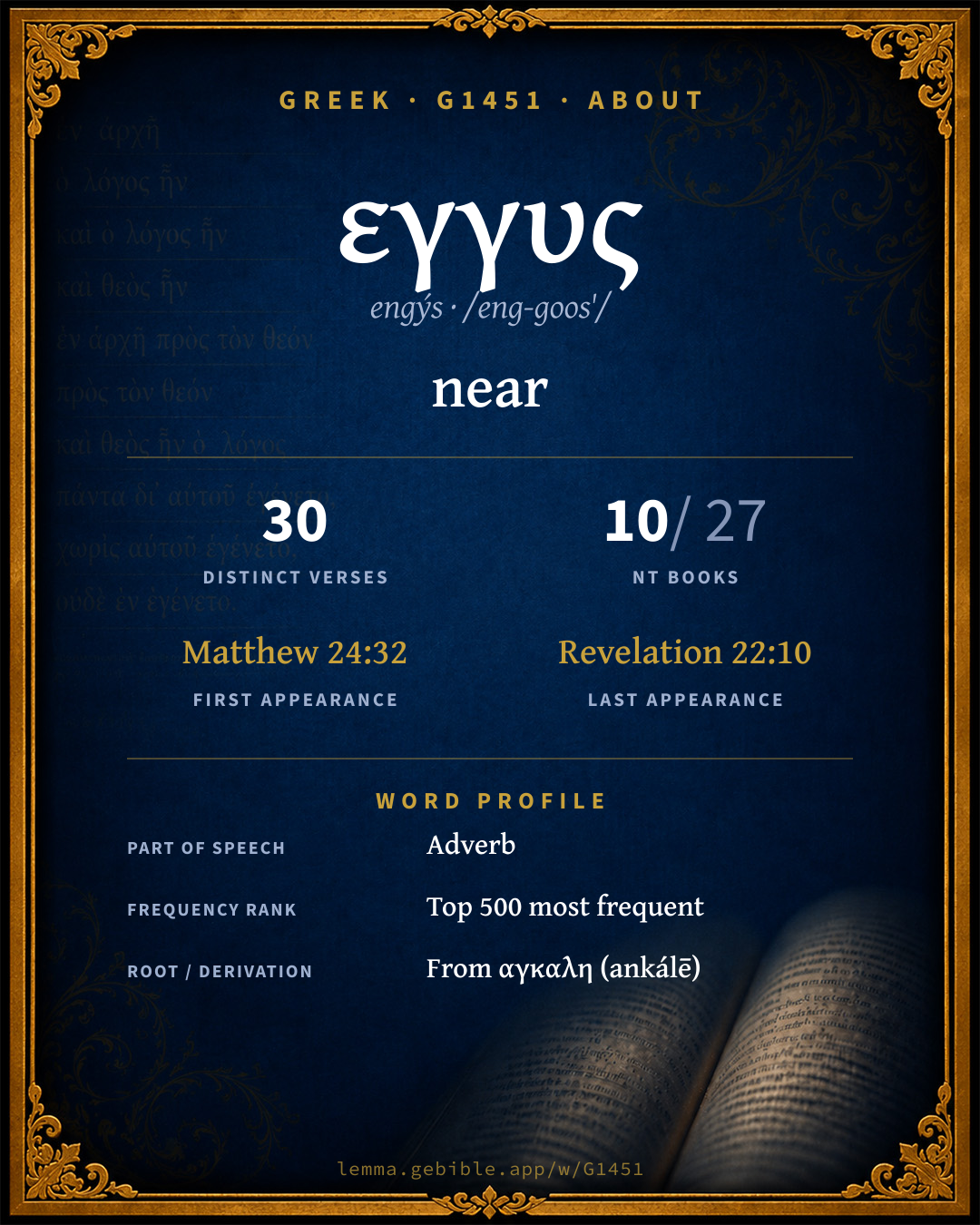
ἐγγύς
near
‘near’ is one of 2 main senses fuller range ↓
Full lexicon entry — Thayer's Greek Lexicon
From Thayer's Greek Lexicon
Where this word appears
Grammar key — what these labels mean
Part of speech
- Adverb
- A word that modifies a verb, adjective, or other adverb.
Every verse where G1451 appears in the Book of Ephesians — 2 distinct verses. Click any verse to open its interlinear word-by-word view. Verse text shown in the World English Bible for context — . Each verse’s Greek form is shown with its reference; the English is not keyword-highlighted, since the data carries no word-level English alignment. Use “Compare translations” on any verse to read it across multiple English versions. This concordance covers the Greek New Testament; Septuagint (Greek Old Testament) occurrences of this word are not indexed here.
Ephesians
About this entry
At a glance — auto-summarized from this page’s data, not written by a person. Every figure links to its source below. This summary describes the numbers; it doesn’t interpret them.
“near” is the headline sense of the Greek verb εγγυς (engýs). Translators differ — “nigh” in the King James Version, then “near” (Berean Standard Bible), as the renderings breakdown shows. With 30 verses in 10 books, it is a moderately common word in the Greek New Testament. It concentrates in John, which alone accounts for 37% of its uses. Lexicons map it across 2 senses. The sections below give every sense, occurrence, and version rendering.
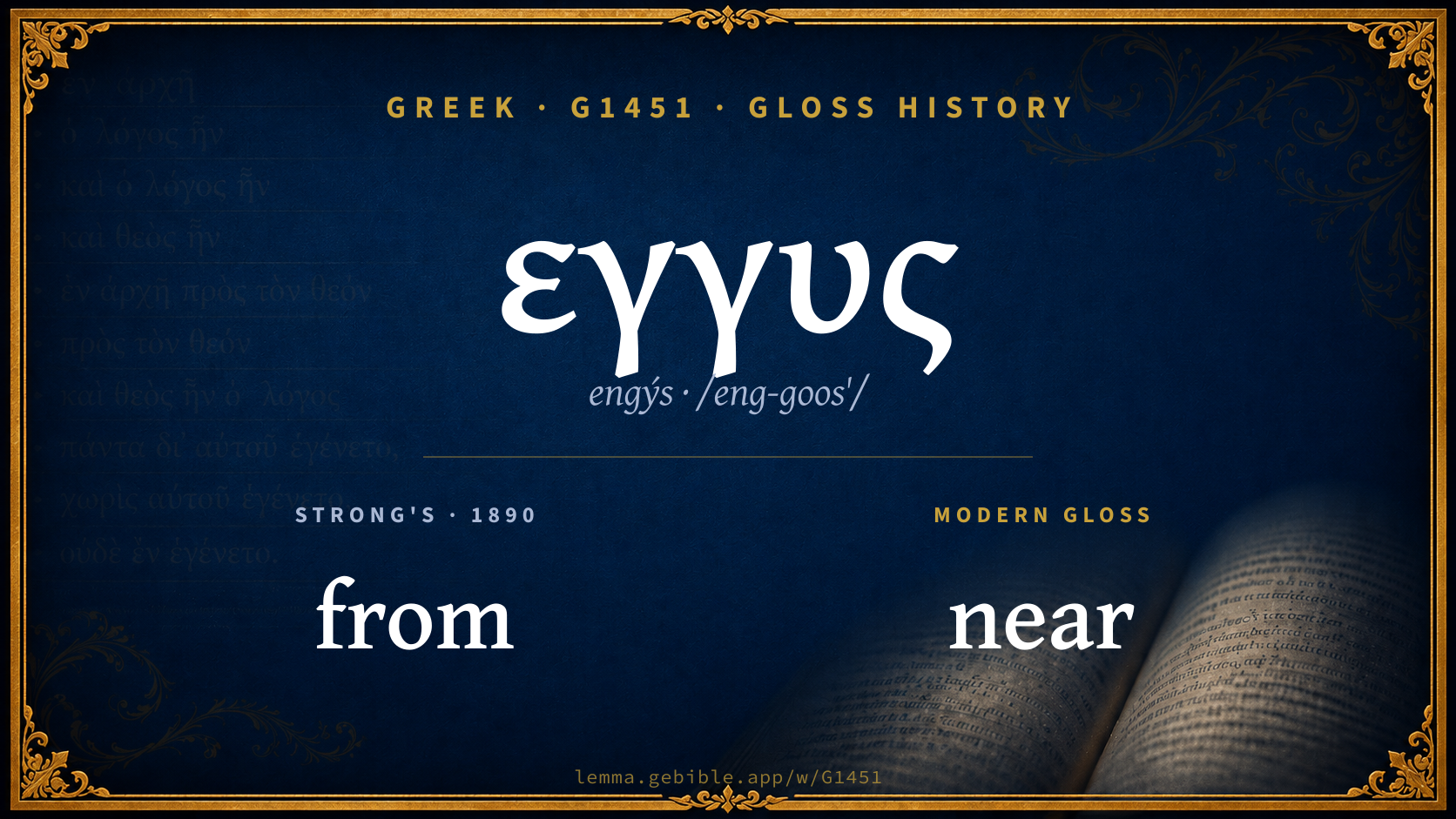
Gloss history
Strong's 1890 vs modern scholarship
About this word
Strong's G1451 catalogs a Greek word from the Greek New Testament.
These counts are not copied from any lexicon or concordance. They are computed here, from the morphology-tagged Greek New Testament. What Lemma adds →
- 30
- distinct verses
- The word appears in 30 distinct verses.
- 10 / 27
- NT books
- The word appears in 10 of 27 New Testament books.
- #463
- by frequency
- Top 500 most frequent Greek words (rank 463 of 5,347 Greek words by occurrence).
View all 30 occurrences in the concordance →
By section of the New Testament
By traditional corpus
Conventional, traditional groupings — biblical authorship is debated, so this is a traditional corpus grouping, not an authorship claim. Some books belong to more than one corpus (Luke is in both the Gospels and the Lukan corpus, and so on), so these shares overlap and need not total 100%. Each figure is a share of the word’s 30 distinct verses.
- Gospels 19 verses · 63%
- Johannine 13 verses · 43%
- Lukan (Luke–Acts) 6 verses · 20%
- Pauline corpus 4 verses · 13%
- Hebrews 2 verses · 7%
- Revelation 2 verses · 7%
How translations render this word
Counts come from each version’s own published word-to-Strong’s tagging or interlinear alignment — an approximate guide to how each version renders this word, not a word-level alignment the data otherwise carries. Because each total is that version’s own tagged count, the per-version totals vary from one another and need not match the appearance or distinct-verse counts above. These counts may also differ from a printed concordance because Lemma counts each distinctly tagged rendering and does not collapse phrase taggings into a single head-word total. This is a fixed set of word-tagged versions (KJV, ASV, BSB, ULT) and does not change with the reading translation you choose elsewhere. Each version’s license is shown beside its name below (and on Sources).
- King James Version: Nigh 10×, Hand 4×, Near 4×
- American Standard Version: Nigh 12×, Hand 6×, Nigh unto 3×
- Berean Standard Bible: Near 26×
- unfoldingWord Literal Text: Near 23×, Is near 4×, Close to 2×
King James Version Public Domain
Renders G1451 across 30 tagged occurrences — most commonly:
Plus 4 renderings that appear only once — usually multi-word phrases or single function words the recovered tagging swept in, not distinct renderings.
American Standard Version Public Domain
Renders G1451 across 29 tagged occurrences — most commonly:
Plus 4 renderings that appear only once — usually multi-word phrases or single function words the recovered tagging swept in, not distinct renderings.
Berean Standard Bible Public Domain
Renders G1451 across 29 tagged occurrences — most commonly:
Plus 3 renderings that appear only once — usually multi-word phrases or single function words the recovered tagging swept in, not distinct renderings. Not rendered by a distinct English word in 1 further occurrence.
unfoldingWord Literal Text CC BY-SA 4.0
Renders G1451 across 30 tagged occurrences — most commonly:
Plus 1 rendering that appears only once — usually multi-word phrases or single function words the recovered tagging swept in, not distinct renderings.
Senses in Thayer's
The 2 senses Thayer's distinguishes for this word, in lexicon order (not ranked by frequency or importance). The full entry — with sub-senses — is in the Lexicon Entry tab.
- near, of place and position
- of times imminent and soon to come pass
Word origin
Derived from αγκαλη (ankálē) (G43) — arm.
From a primary verb ἄγχω agchō (to squeeze or throttle ; akin to the base of G43 ); near (literally or figuratively of place or time): - from at hand near nigh (at hand unto) ready.
— Strong’s Exhaustive Concordance (1890), public domain.
Forms in the corpus
The 2 distinct written forms G1451 takes in the Greek New Testament, most frequent first — each parse links to that case’s occurrences in the concordance.
| Form | Parsing | Example | Uses |
|---|---|---|---|
| ἐγγὺς engỳs | Adverb | Matthew 24:32 | 20 |
| ἐγγύς engýs | Adverb | Matthew 24:33 | 10 |
Same root — word family
Other Thayer's entries built from the same root as G1451, grouped by Strong’s listed origin. These share a root / origin per the lexicon — not necessarily a shared meaning. Each links to that word’s own entry.
Derives from
Shares the same root
- αγανακτεω aganaktéō G23 to be indignant
- αγγειον angeîon G30 vessel
- αγκιστρον ánkistron G44 fish hook
- αγκυρα ánkyra G45 anchor
- ογκος ónkos G3591 bulk
Derived from this word
Compare all same-root words → Showing 4 of 10 — not the complete family. They share a root, not necessarily a meaning.
Septuagint usage
The same Greek word εγγυς appears 48 times in the Greek Old Testament (Septuagint), across 47 verses in 21 books.
- 48
- LXX occurrences
- Tagged occurrences of this Greek word in the Septuagint.
- 47
- verses
- Distinct Septuagint verses containing this word.
- 21 / 39
- OT books
- The word appears in 21 of the 39 Old Testament books.
Sample Septuagint occurrences
- Genesis 19:20 ἐγγύς
- Exodus 13:17 ἐγγύς
- Leviticus 21:2 ἐγγύς
- Numbers 27:11 ἐγγύς
- Deuteronomy 2:19 ἐγγύς
- Judges 3:20 ἐγγύς
- Ruth 3:12 ἐγγύς
- 1 Kings 8:46 ἐγγύς
- 2 Chronicles 6:36 ἐγγύς
- Esther 1:14 ἐγγύς
- Job 6:15 ἐγγύς
- Psalms 14:3 ἐγγύς
Septuagint occurrences (same lexeme)
Every verse where the same Strong’s number (G1451) appears in the Greek Septuagint. Verse text shown in the World English Bible for context; the Greek form is the matched word — the English is not keyword-highlighted.
- Genesis 19:20 ἐγγύς See now, this city is near to flee to, and it is a little one. Oh let me escape there (isn't it a little one?), and my soul will live."
- Genesis 45:10 ἐγγύς You shall dwell in the land of Goshen, and you will be near to me, you, your children, your children's children, your flocks, your herds, and all that you have.
- Exodus 13:17 ἐγγύς It happened, when Pharaoh had let the people go, that God didn't lead them by the way of the land of the Philistines, although that was near; for God said, "Lest perhaps the people change their minds when they see war, and they return to Egypt;"
- Exodus 32:27 ἐγγύς He said to them, "Thus says Yahweh, the God of Israel, 'Every man put his sword on his thigh, and go back and forth from gate to gate throughout the camp, and every man kill his brother, and every man his companion, and every man his neighbor."
- Leviticus 21:2 ἐγγύς except for his relatives that are near to him: for his mother, for his father, for his son, for his daughter, for his brother,
- Leviticus 25:25 ἐγγύς "'If your brother becomes poor, and sells some of his possessions, then his kinsman who is next to him shall come, and redeem that which his brother has sold.
- Numbers 27:11 ἐγγύς If his father have no brothers, then you shall give his inheritance to his kinsman who is next to him of his family, and he shall possess it: and it shall be to the children of Israel a statute [and] ordinance, as Yahweh commanded Moses.
- Deuteronomy 2:19 ἐγγύς and when you come near over against the children of Ammon, don't bother them, nor contend with them; for I will not give you of the land of the children of Ammon for a possession; because I have given it to the children of Lot for a possession.
- Deuteronomy 4:46 ἐγγύς beyond the Jordan, in the valley over against Beth Peor, in the land of Sihon king of the Amorites, who lived at Heshbon, whom Moses and the children of Israel struck, when they came forth out of Egypt.
- Deuteronomy 30:14 ἐγγύς But the word is very near to you, in your mouth, and in your heart, that you may do it.
- Deuteronomy 32:35 ἐγγύς Vengeance is mine, and recompense, At the time when their foot shall slide: For the day of their calamity is at hand, The things that are to come on them shall make haste.
- Deuteronomy 34:6 ἐγγύς He buried him in the valley in the land of Moab over against Beth Peor: but no man knows of his tomb to this day.
- Judges 3:20 ἐγγύς Ehud came to him; and he was sitting by himself alone in the cool upper room. Ehud said, I have a message from God to you. He arose out of his seat.
- Ruth 3:12 ἐγγύς Now it is true that I am a near kinsman; however there is a kinsman nearer than I.
- 1 Kings 8:46 ἐγγύς If they sin against you (for there is no man who doesn't sin), and you are angry with them, and deliver them to the enemy, so that they carry them away captive to the land of the enemy, far off or near;
- 2 Chronicles 6:36 ἐγγύς If they sin against you (for there is no man who doesn't sin), and you are angry with them, and deliver them to the enemy, so that they carry them away captive to a land far off or near;
- Esther 1:14 ἐγγύς and the next to him were Carshena, Shethar, Admatha, Tarshish, Meres, Marsena, and Memucan, the seven princes of Persia and Media, who saw the king's face, and sat first in the kingdom),
- Esther 9:20 ἐγγύς Mordecai wrote these things, and sent letters to all the Jews who were in all the provinces of the king Ahasuerus, both near and far,
- Job 6:15 ἐγγύς My brothers have dealt deceitfully as a brook, As the channel of brooks that pass away;
- Job 13:18 ἐγγύς See now, I have set my cause in order. I know that I am righteous.
- Job 17:12 ἐγγύς They change the night into day, Saying 'The light is near' in the presence of darkness.
- Job 19:14 ἐγγύς My relatives have gone away. My familiar friends have forgotten me.
- Psalms 14:3 ἐγγύς They have all gone aside. They have together become corrupt. There is none who does good, no, not one.
- Psalms 21:12 ἐγγύς For you will make them turn their back, When you aim drawn bows at their face.
- Psalms 33:19 ἐγγύς To deliver their soul from death, To keep them alive in famine.
- Psalms 84:10 ἐγγύς For a day in your courts is better than a thousand. I would rather be a doorkeeper in the house of my God, Than to dwell in the tents of wickedness.
- Psalms 118:151 ἐγγύς
- Psalms 144:18 ἐγγύς
- Proverbs 27:10 ἐγγύς Don't forsake your friend and your father's friend. Don't go to your brother's house in the day of your disaster: Better is a neighbor who is near than a distant brother.
- Ecclesiastes 4:17 ἐγγύς
- Isaiah 13:6 ἐγγύς Wail; for the day of Yahweh is at hand; as destruction from the Almighty shall it come.
- Isaiah 57:19 ἐγγύς I create the fruit of the lips: Peace, peace, to him who is far off and to him who is near, says Yahweh; and I will heal him.
- Jeremiah 12:2 ἐγγύς You have planted them, yes, they have taken root; they grow, yes, they bring forth fruit: you are near in their mouth, and far from their heart.
- Jeremiah 31:16 ἐγγύς Thus says Yahweh: Refrain your voice from weeping, and your eyes from tears; for your work shall be rewarded, says Yahweh; and they shall come again from the land of the enemy.
- Jeremiah 31:24 ἐγγύς Judah and all the cities of it shall dwell therein together, the farmers, and those who go about with flocks.
- Jeremiah 32:13 ἐγγύς I charged Baruch before them, saying,
- Jeremiah 42:4 ἐγγύς Then Jeremiah the prophet said to them, I have heard you; behold, I will pray to Yahweh your God according to your words; and it shall happen that whatever thing Yahweh shall answer you, I will declare it to you; I will keep nothing back from you.
- Ezekiel 6:12 ἐγγύς He who is far off shall die of the pestilence; and he who is near shall fall by the sword; and he who remains and is besieged shall die by the famine: thus will I accomplish my wrath on them.
- Ezekiel 23:12 ἐγγύς She doted on the Assyrians, governors and rulers, [her] neighbors, clothed most gorgeously, horsemen riding on horses, all of them desirable young men.
- Ezekiel 30:3 ἐγγύς For the day is near, even the day of Yahweh is near; it shall be a day of clouds, a time of the nations.
- Daniel 9:7 ἐγγύς Lord, righteousness belongs to you, but to us confusion of face, as at this day; to the men of Judah, and to the inhabitants of Jerusalem, and to all Israel, who are near, and who are far off, through all the countries where you have driven them, because of their trespass that they have trespassed against you.
- Joel 1:15 ἐγγύς Alas for the day! For the day of Yahweh is at hand, And it will come as destruction from the Almighty.
- Joel 2:1 ἐγγύς Blow you the trumpet in Zion, And sound an alarm in my holy mountain! Let all the inhabitants of the land tremble, For the day of Yahweh comes, For it is close at hand:
- Joel 4:14 ἐγγύς
- Obadiah 1:15 ἐγγύς For the day of Yahweh is near all the nations! As you have done, it will be done to you. Your deeds will return upon your own head.
- Zephaniah 1:7 ἐγγύς Be silent at the presence of the Lord Yahweh, for the day of Yahweh is at hand. For Yahweh has prepared a sacrifice. He has consecrated his guests.
- Zephaniah 1:14 ἐγγύς The great day of Yahweh is near. It is near, and hurries greatly, the voice of the day of Yahweh. The mighty man cries there bitterly.
These are occurrences of the same Greek lexeme (G1451) in the Septuagint — not a translation of any one Hebrew word. The store carries no word-level Hebrew↔Greek alignment, so no Hebrew original is asserted here. Counts come from the recovered LXX Strong's tagging — high-frequency vocabulary is well covered, while rare or late forms may be untagged — so they reflect tagged occurrences and may slightly undercount.