
Isaiah 13:6

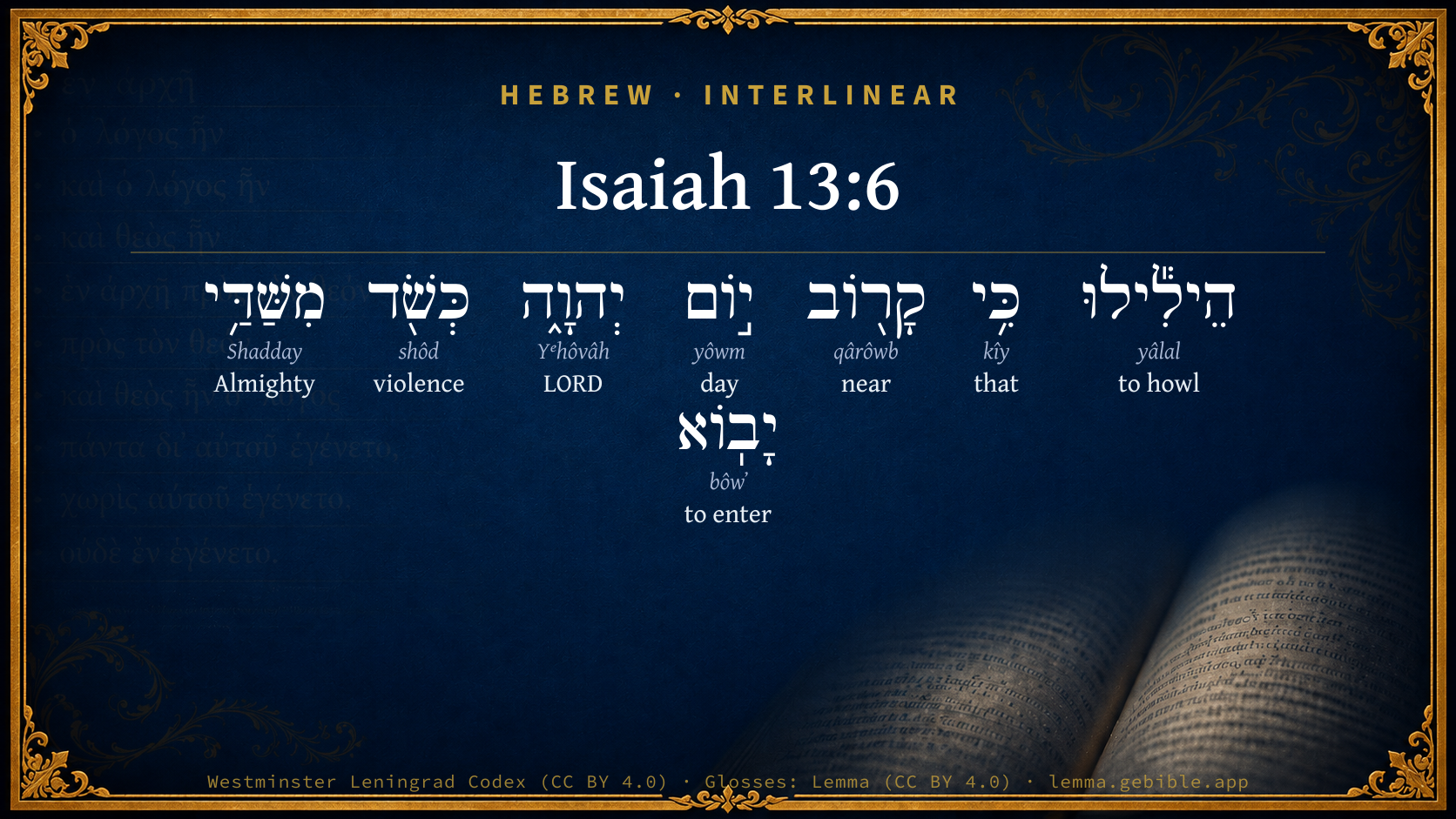
Hebrew (Westminster Leningrad Codex) Isaiah 13:6 appears in the Hebrew Old Testament. The text above is from the Westminster Leningrad Codex. Each word links to its Strong’s number, a concise gloss, and parsing drawn from the Open Scriptures Hebrew Bible morphology. Click any word for its full Brown-Driver-Briggs (BDB) entry.
Download image
Cite this verse

Isaiah 13:6 (World English Bible). Public Domain. Lemma interlinear Bible study tool, https://lemma.gebible.app/v/isaiah/13/6.

Show BibTeX & RIS
BibTeX
RIS
English Translation
Wail; for the day of Yahweh is at hand; as destruction from the Almighty shall it come.
World English Bible · Public Domain
Highlights
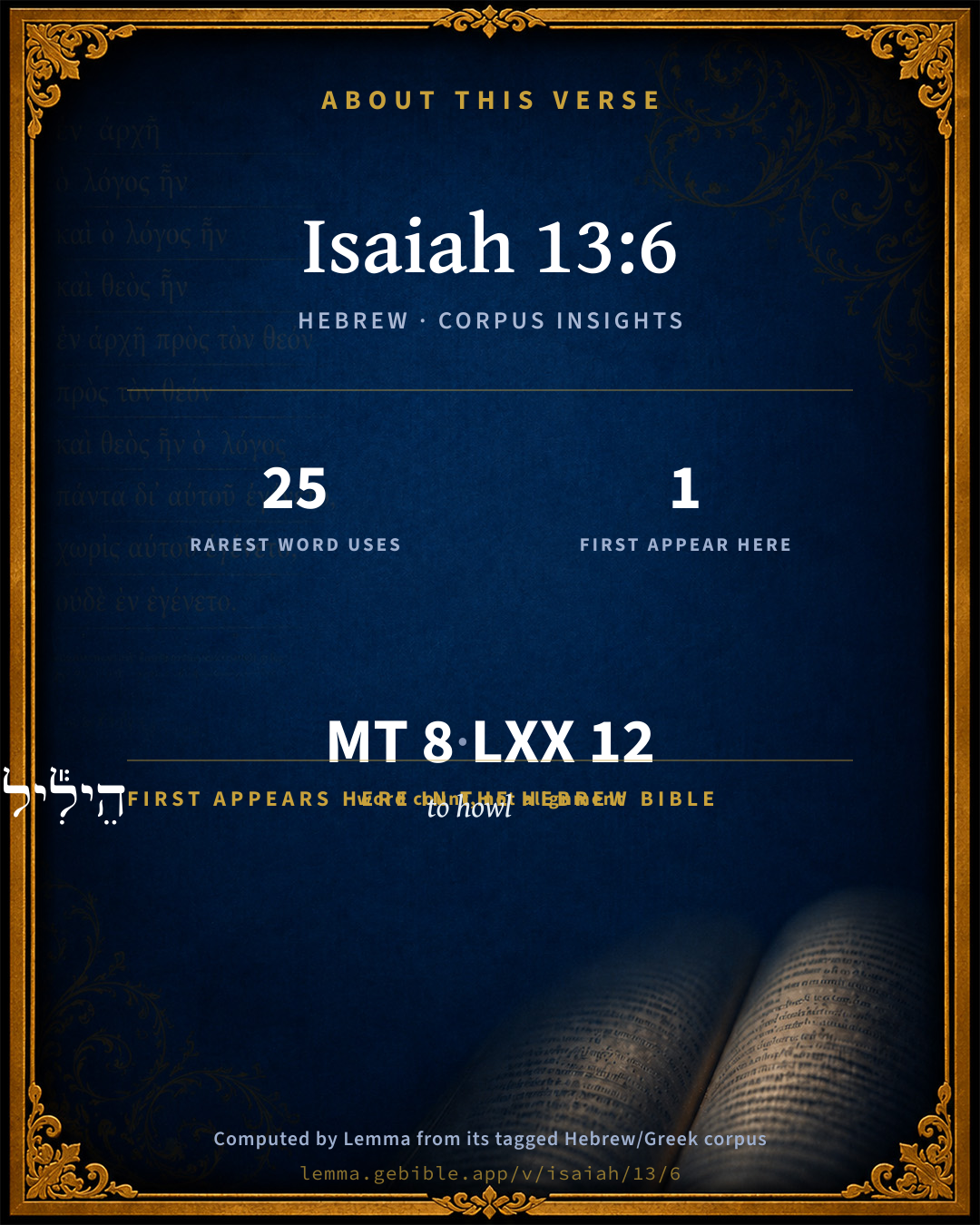
  • 1 first appearance in the Hebrew Bible
Full analysis ↓
Download a study sheet

One document with this verse’s original text, its word-by-word gloss line, the meaning frame, cross-references with their text, attributed commentary, and full source and license credits — printable, and it pastes into notes with its structure intact.

This verse Autodidact and up

Study sheet (.html) Plain text (.txt)

A passage Seminary Student

Up to 50 verses in one chapter. A passage sheet keeps up to 6 commentary sources and 12 cross-references per verse, in the order this page ranks them, and says so on the sheet whenever that leaves anything out. Ask for a single verse and you get the Autodidact verse sheet above.

Everything on this page stays free to read, with no account — the sheet is a download of what is already on screen, not access to it.

Want to remove ads? Support Godless Engineer
Compare translations 3

The same verse in 3 English versions, stacked beneath the original-language interlinear above. Click any original word for its lexicon entry.

Each is an independent rendering of the whole verse — the interlinear is not word-aligned to these translations.

Highlighted words mark where these versions differ — a whole-verse word diff, not a word-by-word alignment.

  • World English Bible Public Domain
    Wail; for the day of Yahweh is at hand; as destruction from the Almighty shall it come.
  • King James Version Public Domain
    Howl ye; for the day of the LORD is at hand; it shall come as a destruction from the Almighty.
  • unfoldingWord Literal Text CC BY-SA 4.0
    Wail, for the day of Yahweh near; it will come like destruction from Shaddai.

unfoldingWord Literal Text — © unfoldingWord, licensed CC BY-SA 4.0. Word-aligned USFM3 via Door43 (git.door43.org/unfoldingWord/en_ult).

Versions to compare (up to 4)

3 of 4 selected

Show all 18 translations

Every available English version of this verse, each an independent rendering of the whole verse.

  • World English Bible Public Domain
    Wail; for the day of Yahweh is at hand; as destruction from the Almighty shall it come.
  • Berean Standard Bible Public Domain
    Wail, for the Day of the LORD is near; it will come as destruction from the Almighty.
  • Majority Standard Bible Public Domain
    Wail, for the Day of the LORD is near; it will come as destruction from the Almighty.
  • King James Version Public Domain
    Howl ye; for the day of the LORD is at hand; it shall come as a destruction from the Almighty.
  • American Standard Version (1901) Public Domain
    Wail ye; for the day of Jehovah is at hand; as destruction from the Almighty shall it come.
  • Revised Version (1885) Public Domain
    Howl ye; for the day of the LORD is at hand; as destruction from the Almighty shall it come.
  • Geneva Bible (1599) Public Domain
    Howle you, for the day of the Lord is at hande: it shall come as a destroier from the Almightie.
  • Douay-Rheims (1899) Public Domain
    Howl ye, for the day of the Lord is near: it shall come as a destruction from the Lord.
  • Young's Literal Translation Public Domain
    Howl ye, for near `is' the day of Jehovah, As destruction from the Mighty it cometh.
  • Literal Standard Version CC BY-SA 4.0
    Howl, for the Day of YHWH [is] near, || It comes as destruction from the Mighty.
  • Unlocked Literal Bible CC BY-SA 4.0
    Howl, for the day of Yahweh is near; it comes with destruction from the Almighty.
  • unfoldingWord Literal Text CC BY-SA 4.0
    Wail, for the day of Yahweh near; it will come like destruction from Shaddai.
  • Darby Bible Public Domain
    Howl, for the day of Jehovah is at hand; it cometh as destruction from the Almighty.
  • World Messianic Bible Public Domain
    Wail, for the LORD’s day is at hand! It will come as destruction from the Almighty.
  • Webster's Bible Public Domain
    Howl ye; for the day of the LORD is at hand; it shall come as a destruction from the Almighty.
  • Free Bible Version CC BY-SA 4.0
    Howl in fear, for the day of the Lord is approaching—the time when the Almighty destroys.
  • Bible in Basic English Public Domain
    Send out a cry of grief; for the day of the Lord is near; it comes as destruction from the Most High.
  • JPS Tanakh (1917) Public Domain
    Howl ye; for the day of the LORD is at hand; as destruction from the Almighty shall it come.

Literal Standard Version (2020), Covenant Press — licensed CC BY-SA 4.0. Text via the HelloAO Bible API (eBible.org). Unlocked Literal Bible (unfoldingWord) — licensed CC BY-SA 4.0. Text via the HelloAO Bible API (eBible.org). unfoldingWord Literal Text — © unfoldingWord, licensed CC BY-SA 4.0. Word-aligned USFM3 via Door43 (git.door43.org/unfoldingWord/en_ult). Free Bible Version, Dr. Jonathan Gallagher — licensed CC BY-SA 4.0. Text via the HelloAO Bible API (eBible.org).

Word by word

More ways to search: Search by grammar → Find every occurrence → Compare this word →

Practice this passage: Drill this verse → Learn its vocabulary →

About this verse

These counts appear in no published source. They are computed here, from the morphology-tagged text and Lemma’s own curated glosses. What Lemma adds →

8
words
8
distinct lemmas
Prophets
section

Notable vocabulary

The rarest word here is כְּשֹׁ֖ד violence H7701 — appearing just 25 times in the whole Hebrew Bible.

First appearance in Scripture

This word makes its first canonical appearance in the Hebrew Bible here:

  • הֵילִ֕ילוּ to howl H3213

Shared distinctive vocabulary

כְּשֹׁ֖ד violence H7701 occurs in 24 verses of the Hebrew Bible. Also found in:

Grammatical profile

  • 2 verbs
  • 4 nouns
  • 1 adjective
  • 1 conjunction

Verb forms

  • הֵילִ֕ילוּ Hiphil · Imperative
  • יָבֽוֹא Qal · Imperfect

Hebrew & Septuagint length

In English translation the verse runs 17 words from the Hebrew and 16 from the Septuagint (LXX English) — closely comparable.

A rough comparison of the two English renderings, which tokenize alike — not a word-level alignment.

Word counts can differ between the Hebrew and the Greek without any difference in meaning — e.g. the Hebrew direct-object marker אֵת has no separate Greek word, and Greek often adds the article ὁ.

In the original languages it is 8 Hebrew tokens and 12 Greek tokens — but the two are counted differently (Hebrew bundles its prefixes and suffixes into one token; the Greek is in lemma form), so that isn’t a like-for-like length.

Cross-references

27

Topical passages linked to Isaiah 13:6 in the Treasury of Scripture Knowledge — connected by theme and wording, ordered by reader-vote popularity; previews shown in the World English Bible.

  • Joel 1:15 Alas for the day! For the day of Yahweh is at hand, And it will come as destruction from the Almighty.
  • Isaiah 13:9 Behold, the day of Yahweh comes, cruel, with wrath and fierce anger; to make the land a desolation, and to destroy the sinners of it out of it.
  • Ezekiel 30:2–3 Son of man, prophesy, and say, Thus says the Lord Yahweh: Wail, Alas for the day!
  • Amos 5:18 "Woe to you who desire the day of Yahweh! Why do you long for the day of Yahweh? It is darkness, And not light.
  • Zephaniah 1:7 Be silent at the presence of the Lord Yahweh, for the day of Yahweh is at hand. For Yahweh has prepared a sacrifice. He has consecrated his guests.
  • 1 Thessalonians 5:2–3 For you yourselves know well that the day of the Lord comes like a thief in the night.
  • Isaiah 2:12 For there will be a day of Yahweh of Hosts for all that is proud and haughty, And for all that is lifted up; And it shall be brought low:
  • Isaiah 34:8 For Yahweh has a day of vengeance, a year of recompense for the cause of Zion.
  • Jeremiah 51:8 Babylon is suddenly fallen and destroyed: wail for her; take balm for her pain, if so be she may be healed.
  • Joel 2:11 Yahweh thunders his voice before his army; For his forces are very great; For he is strong who obeys his command; For the day of Yahweh is great and very awesome, And who can endure it?
  • Zephaniah 1:14 The great day of Yahweh is near. It is near, and hurries greatly, the voice of the day of Yahweh. The mighty man cries there bitterly.
  • Revelation 18:10 standing far away for the fear of her torment, saying, 'Woe, woe, the great city, Babylon, the strong city! For your judgment has come in one hour.'
  • Job 31:23 For calamity from God is a terror to me, By reason of his majesty I can do nothing.
  • Isaiah 14:31 Howl, gate; cry, city; you are melted away, Philistia, all of you; for there comes a smoke out of the north, and there is no straggler in his ranks.
  • Joel 1:5 Wake up, you drunkards, and weep! Wail, all you drinkers of wine, because of the sweet wine; For it is cut off from your mouth.
  • Joel 1:13 Put on sackcloth and mourn, you priests! Wail, you ministers of the altar. Come, lie all night in sackcloth, you ministers of my God, For the meal offering and the drink offering are withheld from your God's house.
  • Joel 2:31 The sun will be turned into darkness, And the moon into blood, Before the great and terrible day of Yahweh comes.
  • Zephaniah 2:2–3 before the appointed time when the day passes as the chaff, before the fierce anger of Yahweh comes on you, before the day of Yahweh's anger comes on you.
  • Malachi 4:5 Behold, I will send you Elijah the prophet before the great and terrible day of Yahweh comes.
  • James 5:1 Come now, you rich, weep and howl for your miseries that are coming on you.
  • Isaiah 23:1 The burden of Tyre. Howl, you ships of Tarshish; for it is laid waste, so that there is no house, no entering in: from the land of Kittim it is revealed to them.
  • Isaiah 52:5 Now therefore, what do I here, says Yahweh, seeing that my people is taken away for nothing? those who rule over them do howl, says Yahweh, and my name continually all the day is blasphemed.
  • Isaiah 65:14 behold, my servants shall sing for joy of heart, but you shall cry for sorrow of heart, and shall wail for vexation of spirit.
  • Jeremiah 49:3 Wail, Heshbon, for Ai is laid waste; cry, you daughters of Rabbah, gird you with sackcloth: lament, and run back and forth among the fences; for Malcam shall go into captivity, his priests and his princes together.
  • Ezekiel 21:12 Cry and wail, son of man; for it is on my people, it is on all the princes of Israel: they are delivered over to the sword with my people; strike therefore on your thigh.
  • Joel 1:11 Be confounded, you farmers! Wail, you vineyard keepers; For the wheat and for the barley; For the harvest of the field has perished.
  • Jeremiah 25:34 Wail, you shepherds, and cry; and wallow [in ashes], you principal of the flock; for the days of your slaughter and of your dispersions are fully come, and you shall fall like a goodly vessel.

Cross-references courtesy of OpenBible.info (CC BY 4.0).

Hebrew and Greek witnesses Masoretic Hebrew ↔ Greek Septuagint

The same verse in the two great witnesses to the Old Testament, shown verse-for-verse.

These are two independent witnesses, not word-aligned to each other, and the Septuagint is shown in lemma (dictionary) form.

Hebrew Isaiah 13:6 Masoretic · Westminster Leningrad Codex

הֵילִ֕ילוּ כִּ֥י קָר֖וֹב י֣וֹם יְהוָ֑ה כְּשֹׁ֖ד מִשַּׁדַּ֥י יָבֽוֹא

Wail; for the day of Yahweh is at hand; as destruction from the Almighty shall it come.

World English Bible · Public Domain

Greek LXX Isaiah 13:6 Septuagint · lemma form

ὀλολύζω ἐγγύς γάρ ὁ ἡμέρα κύριος καί συντριβή παρά ὁ θεός ἥκω

Howl you⌃, for the day of the Lord is near, and destruction from God shall arrive.

LXX2012 (modern English Septuagint) · Public Domain

On this verse, Matthew Poole's English Annotations discusses the Septuagint’s reading. Read the note in Commentary ↓

Hebrew: Westminster Leningrad Codex (CC BY 4.0). Greek: Septuagint (public domain); English from LXX2012 (modern English Septuagint) (Public Domain). How the Septuagint differs from the Hebrew →

Targum (Aramaic paraphrase)

1

The Targum is the ancient Jewish Aramaic paraphrase of the Hebrew Scriptures — an interpretive translation, not the Hebrew text itself. Onkelos (literal) and Pseudo-Jonathan (expansive) render the Torah, and Jonathan the Prophets. Coverage is partial: where no permissively-licensed English translation exists for a verse, only the Aramaic is shown. This is verse-level text, not a word-by-word alignment to the Hebrew.

  1. Targum Jonathan Prophets (Joshua–Malachi)
    אַיְלִילוּ אֲרֵי קָרִיב יוֹמָא דַעֲתִיד לְמֵיתֵי מִן קֳדָם יְיָ כְּבִיזָא מִן קֳדָם שַׁדַי יֵיתִי:

    Howl ye, for nigh is the day, ready to come from before the Lord; like spoil from before the Almighty it shall come.

    Targum Jonathan — Aramaic: “Mikraot Gedolot” (public domain). English: “Sefaria Community Translation” (CC0 1.0 (public-domain dedication)); “London "Chaldee Paraphrase," 1871” (public domain). Text via Sefaria.

Commentary

Notes on Isaiah 13:6 from classic Christian and Jewish commentators (each source and its license shown beneath its notes). The classic Christian expositions comment on the surrounding passage and are grouped to its opening verse, so a note may address several verses; the Jewish commentaries on the Tanakh (Rashi and others) are per-verse, so they appear only where the commentator wrote on this verse.

Lemma curates 59 commentaries, every one of them public domain or Creative Commons licensed, each selected and text-cleaned for this edition rather than reprinted as found. About our sources →

Matthew Henry's Commentary

We have here a very elegant and lively description of the terrible confusion and desolation which should be made in Babylon by the descent which the Medes and Persians should make upon it. Those that were now secure and easy were bidden to howl and make sad lamentation; for,

I. God was about to appear in wrath against them, and it is a fearful thing to fall into his hands: The day of the Lord is at hand (Isa 13:6), a little day of judgment, when God will act as a just avenger of his own and his people's injured cause. And there are those who will have reason to tremble when that day is at hand. The day of the Lord cometh, Isa 13:9. Men have their day now, and they think to carry the day; but God laughs at them, for he sees that his day is coming, Psa 37:13. Fury is not with God, and yet his day of reckoning with the Babylonians is said to be cruel with wrath and fierce anger. God will deal in severity with them for the severities they exercised upon God's people; with the froward, with the cruel, he will show himself froward, will show himself cruel, and give the blood-thirsty blood to drink.

II. Their hearts shall fail them, and they shall have neither courage nor comfort left; they shall not be able either to resist the judgment coming or to bear up under it, either to oppose the enemy or to support themselves, Isa 13:7, Isa 13:8. Those that in the day of their peace were proud, and haughty, and terrible (Isa 13:11), shall, when trouble comes, be quite dispirited and at their wits' end: All hands shall be faint, and unable to hold a weapon, and every man's heart shall melt, so that they shall be ready to die for fear. The pangs of their fear shall be like those of a woman in hard labour, and they shall be amazed one at another. In frightening themselves, they shall frighten one another; they shall wonder to see those tremble that used to be bold and daring; or they shall be amazed looking one at another, as men at a loss, Gen 42:1. Their faces shall be as flames, pale as flames, through fear (so some), or red as flames sometimes are, blushing at their own cowardice; or their faces shall be as faces scorched with the flame, or as theirs that labour in the fire, their visage blacker than a coal, or like a bottle in the smoke, Psa 119:83.

III. All comfort and hope shall fail them (Isa 13:10): The stars of heaven shall not give their light, but shall be clouded and overcast; the sun shall be darkened in his going forth, rising bright, but lost again, a certain sign of foul weather. They shall be as men in distress at sea, when neither sun nor stars appear, Act 27:20. It shall be as dreadful a time with them as it would be with the earth if all the heavenly luminaries were turned into darkness, a resemblance of the day of judgment, when the sun shall be turned into darkness. The heavens frowning thus is an indication of the displeasure of the God of heaven. When things look dark on earth, yet it is well enough if all be clear upwards; but, if we have no comfort thence, wherewith shall we be comforted?

IV. God will visit them for their iniquity; and all this is intended for the punishment of sin, and particularly the sin of pride, Isa 13:11. This puts wormwood and gall into the affliction and misery, 1. That sin must now have its punishment. Though Babylon be a little world, yet, being a wicked world, it shall not go unpunished. Sin brings desolation on the world of the ungodly; and when the kingdoms of the earth are quarrelling with one another it is the fruit of God's controversy with them all. 2. That pride must now have its fall: The haughtiness of the terrible must now be laid low, particularly of Nebuchadnezzar and his son Belshazzar, who had, in their pride, trampled upon, and made themselves very terrible to, the people of God. A man's pride will bring him low.

V. There shall be so great a slaughter as will produce a scarcity of men (Isa 13:12): I will make a man more precious than fine gold. You could not have a man to be employed in any of the affairs of state, not a man to be enlisted in the army, not a man to match a daughter to, for the building up of a family, if you would give any money for one. The troops of the neighbouring nations would not be hired into the service of the king of Babylon, because they saw every thing go against him. Populous countries are soon depopulated by war. And God can soon make a kingdom that has been courted and admired to be dreaded and shunned by all, as a house that is falling, or a ship that is sinking.

VI. There shall be a universal confusion and consternation, such a confusion of their affairs that it shall be like the shaking of the heavens with dreadful thunders and the removing of the earth by no less dreadful earthquakes. All shall go to rack and ruin in the day of the wrath of the Lord of hosts, Isa 13:13. And such a consternation shall seize their spirits that Babylon, which used to be like a roaring lion and a raging bear to all about her, shall become as a chased roe and as a sheep that no man takes up, Isa 13:14. The army they shall bring into the field, consisting of troops of divers nations (as great armies usually do), shall be so dispirited by their own apprehensions and so dispersed by their enemies' sword that they shall turn every man to his own people; each man shall shift for his own safety; the men of might shall not find their hands (Psa 76:5), but take to their heels.

VII. There shall be a general scene of blood and horror, as is usual where the sword devours. No wonder that every one makes the best of his way, since the conqueror gives no quarter, but puts all to the sword, and not those only that are found in arms, as is usual with us even in the most cruel slaughters (Isa 13:15): Every one that is found alive shall be run through, as soon as ever it appears that he is a Babylonian. Nay, because the sword devours one as well as another, every one that is joined to them shall fall by the sword; those of other nations that come in to their assistance shall be cut off with them. It is dangerous being in bad company, and helping those whom God is about to destroy. Those particularly that join themselves to Babylon must expect to share in her plagues, Rev 18:4. And, since the most sacred laws of nature, and of humanity itself, are silenced by the fury of war (though they cannot be cancelled), the conquerors shall, in the most barbarous brutish manner, dash the children to pieces, and ravish the wives. Jusque datum sceleri - Wickedness shall have free course, Isa 13:16. They had thus dealt with God's people (Lam 5:11), and now they shall be paid in their own coin, Rev 13:10. It was particularly foretold (Psa 137:9) that the little ones of Babylon should be dashed against the stones. How cruel soever and unjust those were that did it, God was righteous who suffered it to be done, and to be done before their eyes, to their greater terror and vexation. It was just also that the houses which they had filled with the spoil of Israel should be spoiled and plundered. What is got by rapine is often lost in the same manner.

VIII. The enemy that God will send against them shall be inexorable, probably being by some provocation or other more than ordinarily exasperated against them; or, in whatever way it may be brought about, God himself will stir up the Medes to use this severity with the Babylonians. He will not only serve his own purposes by their dispositions and designs, but will put it into their hearts to make this attempt upon Babylon, and suffer them to prosecute it with all this fury. God is not the author of sin, but he would not permit it if he did not know how to bring glory to himself out of it. These Medes, in conjunction with the Persians, shall make thorough work of it; for, 1. They shall take no bribes, Isa 13:17. All that men have they would give for their lives, but the Medes shall not regard silver; it is blood they thirst for, not gold; no man's riches shall with them be the ransom of his life. 2. They shall show no pity (Isa 13:18), not to the young men that are in the prime of their time - they shall shoot them through with their bows, and then dash them to pieces; not to the age of innocency - they shall have no pity on the fruit of the womb, nor spare little children, whose cries and frights one would think should make even marble eyes to weep, and hearts of adamant to relent. Pause a little here and wonder, (1.) That men should be thus cruel and inhuman, and so utterly divested of all compassion; and in it see how corrupt and degenerate the nature of man has become. (2.) That the God of infinite mercy should suffer it, nay, and should make it to be the execution of his justice, which shows that, though he is gracious, yet he is the God to whom vengeance belongs. (3.) That little infants, who have never been guilty of any actual sin, should be thus abused, which shows that there is an original guilt by which life is forfeited as soon as it is had.

Matthew Henry's Commentary on the Whole Bible (1708–1710) — public domain (CC PDM 1.0). Text via the HelloAO Bible API.

Trapp's Complete Commentary

John Trapp

Isa 13:6 Howl ye; for the day of the LORD [is] at hand; it shall come as a destruction from the Almighty.

Ver. 6. Howl ye.] "For the evils that are coming upon you" (as in Jas 5:1). We may well say the same to mystical Babylon.

For the day of the Lord is at hand.] And yet it came not till over two hundred years after. Think the same of the day of judgment, and reckon that a thousand years with God is but as one day.

It shall come as a destruction from the Almighty.] Heb., Cleshod Mishaddai, an elegance that cannot be translated. Shaddai (God’s name) signifieth a conqueror, say some; a destroyer, say others, which a conqueror must needs be, - Eundem victorem et vastatorem esse oportet. Here is threatened a devastation from the devastator.

John Trapp, A Commentary or Exposition upon All the Books of the Old and New Testament (1647–1656) — public domain. Text from a community e-Sword module.

Joseph Benson's Commentary

Isa 13:6-8. Howl ye — We have here a very elegant and lively description of the terrible confusion and desolation which should be made in Babylon by the attack which the Medes and Persians should make upon it. They who were now at ease and secure are premonished to howl, and make sad lamentation, 1st, Because God was about to appear in wrath against them, and it is a fearful thing to fall into his hands. And, 2d, Because their hearts would fail them, and they would have neither courage nor comfort left them; would neither be able to resist the judgment coming, nor bear up under it; neither to oppose the enemy nor to support themselves. For the day of the Lord is at hand — A day of judgment and recompense, when God would act as a just avenger of his own and his people’s injured cause, and severely chastise the Babylonians for their pride and luxury, their inhumanity and cruelty, their idolatry and superstition, and, above all, their sins against the people of God, his religion and sanctuary, and so against God himself: see Jer 50:31. It shall come as a destruction — Or, rather, A destruction shall it come, not merely as, or like a destruction, but such in reality, and that most awful, as being from the Almighty, whose power is irresistible, and wrath intolerable. “The prophet begins here to describe the calamity coming upon them, but in figures, according to his manner, grand, and adapted to raise a terrible image of it.” All hands shall be faint — Hebrew, תרפינה, shall fall down, and be unable to hold a weapon; and every man’s heart shall melt — So that they shall be ready to die with fear. God often strikes a terror into those whom he designs for destruction. Pangs, &c., shall take hold of them — The pangs of their fear shall be like those of a woman in hard labour. They shall be amazed one at another — To see such a populous, and, apparently, impregnable city, so easily and unexpectedly taken. Their faces shall be as flames — Hebrew, shall be faces of flames; either pale with fear, or inflamed with rage and torment, as men in great misery often are. Bishop Lowth renders it, Their countenances shall be like flames of fire.

Joseph Benson's Commentary on the Old and New Testaments (1811–1818) — public domain. Text from a community e-Sword module.

The Preacher's Complete Homiletical Commentary

Joseph S. Exell (gen. ed.)

THE DAY OF THE LORD

Isa_13:6. Howl ye, for the day of the Lord is at hand.

Sad and unnatural is the condition of those to whom the coming of “the day of the Lord” is a cause for dismay. But this is the condition of the wicked. They can think of God prevailing and asserting Himself only with dread. Dread must take possession of them whenever they think of the future, for the profoundest and most ineradicable instincts of their nature assure them that the “day of the Lord”—a day of judgment and retribution—must come.

Thus far all is plain. But when we read and think about what is to take place on “the day of the Lord” (Isa_13:7-8; Isa_13:15-16; Isa_13:18), astonishment takes possession of us, and we feel disposed to call it “the day of the devil.” How can a day like this be called “the day of the Lord”? Note—

1. That all the cruelties here described were inflicted by men.

2. That these men were moved to inflict these cruelties by their own passions; that they acted as free agents, and without any thought of fulfilling a Divine purpose.

3. That the supreme passion by which they were moved was the passion of revenge—of revenge for cruelties equally frightful inflicted by the sufferers of that day. Nothing can exceed in horror the picture which the Babylonians themselves drew of the enormities perpetrated by them on conquered nations.

4. That, consequently, the Babylonians were reaping as they had sown. The day that was coming upon them was a day of retribution, and in this sense emphatically “a day of the Lord.” As a matter of fact, retribution is one of the laws under which we live (H. E. I., 4609, 4611, 4612), and it is a Divine law, a law worthy of God. It is an ordinance of mercy, for the tendency of it is to restrain men from sin. By their knowledge of its existence and the certainty of its operation (P. D., 2995), wicked men are undoubtedly greatly restrained from wickedness. Were it not for the days when it is manifestly seen in operation, when great transgressors are overwhelmed with great sufferings, atheism would prevail; a reign of terror and of unrestrained cruelty would begin, and every day would be a day of the devil.

5. This day, with all its horrors, was an essential preliminary to the accomplishment of God’s purposes of mercy in regard to His people. For them it was emphatically “a day of the Lord,” for it was the day of their deliverance from bondage, a day of exultant thanksgiving that the power of their relentless oppressors was for ever broken (chap. Isa_14:1-6). In the history of our race there have been many such days, e.g., the French Revolution of 1789, the American Civil War; days when the worst passions of humanity were manifested without restraint; but days when the wisdom of God was displayed in bringing good out of evil, in punishing the iniquities of the past, in ushering in a brighter and better era of freedom and justice.

The record of such “days of the Lord” should be eminently instructive to us.

1. They should teach us the true characters of those statesmen who use national power for purposes of unrighteous national aggrandisement. They are patriots but traitors, rendering inevitable a bitter harvest of national shame and sorrow.

2. They show the folly of supposing that the great power of any nation justifies it in the hope that it may safely deal unjustly with other and weaker nations. Guilty nations set in operation forces mightier and surer in their operation than any they can command—those forming the instrumentality by which God governs the earth, and in spite of human passions, maintains the existence and carries forward the development of the human race; these, combining, bring on a “day of the Lord,” in which, by the overthrow of the haughtiest wrongdoers, His existence and authority, and the folly of the practical atheism to which great nations are prone, are demonstrated (P. D., 2544).

The Preacher's Complete Homiletical Commentary (gen. ed. Joseph S. Exell; Funk & Wagnalls, c. 1892) — public domain (pre-1929). A full-Bible homiletical/sermon-outline anthology covering 65 of 66 books (2 John is absent from the source module). Text from a community e-Sword module.

Tyndale Open Study Notes

Tyndale Open Resources

13:6 When pronouncing judgment that is still in the future, the prophets sometimes spoke as though it had already arrived. This emphasized the urgency of turning back to God (Ezek 30:3; Joel 1:15; 3:14; Obad 1:15; Zeph 1:7).

Tyndale Open Study Notes — © Tyndale Open Resources, licensed CC BY-SA 4.0. Text via the HelloAO Bible API.

Geneva Bible (1599)

Geneva Bible translators

Ye Babylonians.

Geneva Bible (1599) marginal notes — public domain. Text via Bolls.life.

Jamieson, Fausset & Brown

Robert Jamieson, A. R. Fausset & David Brown

day of the Lord--day of His vengeance on Babylon (Isa 2:12). Type of the future "day of wrath" (Rev 6:17).

destruction--literally, "a devastating tempest."

from the Almighty--not from mere man; therefore irresistible. "Almighty," Hebrew, Shaddai.

Jamieson, Fausset & Brown — Commentary Critical and Explanatory on the Whole Bible (1871) — public domain (CC PDM 1.0). Text via the HelloAO Bible API.

Ellicott's Commentary for English Readers

(6) Howl ye; for the day of the Lord is at hand.—The verse is an almost verbal reproduction of Joe_1:15. On the “day of Jehovah,” see Note on Isa_2:12.

As a destruction from the Almighty.—The Hebrew shodmish-Shaddai comes with the emphasis of assonance, possibly coupled with that of etymology, the Hebrew Shaddai being derived by many scholars from the verb Shadad =to destroy. On this assumption, “destruction from the destroyer” would be a fair equivalent. The name, occurring frequently in the earlier books of the Old Testament (twenty-three times in Job and eight in the Pentateuch), was characteristic of the pre-Mosaic creed of Israel (Exo_6:3), and occurs but seldom in the prophets: here, and in Joe_1:15; Eze_1:24; Eze_10:5.

A Bible Commentary for English Readers, edited by Charles John Ellicott (1878–1897) — public domain. Text from a community e-Sword module.

The Cambridge Bible for Schools and Colleges

gen. ed. J. J. S. Perowne

6. The verse is almost identical with Joe_1:15. On the “day of Jehovah” see on ch. Isa_2:12.

as a destruction from the Almighty] The Heb. phrase contains an alliteration which cannot be easily reproduced in English. The Germans render “wie Gewalt vom Gewaltigen.” The word for “Almighty” is the Divine name Shaddai (see Exo_6:3), but its etymology is doubtful. According to one derivation it comes from the same root as the word for “destruction,” so that we might almost venture to translate “like destruction from the Destroyer.” This verse, however, can hardly be appealed to in support of that view, since it may imply nothing beyond the mere play upon words. (See further Robertson Smith, Old Test. in Jewish Church, pp. 423 f.)

The Cambridge Bible for Schools and Colleges (gen. ed. J. J. S. Perowne; Cambridge University Press, 1878–1918) — public domain. Text from a community e-Sword module.

John Gill's Exposition

Howl ye, for the day of the Lord is at hand,.... These words are an address to the Babylonians, who instead of rejoicing and feasting, as Belshazzar and his nobles were the night that Babylon was taken, had reason to howl and lament; seeing the day that the Lord had fixed for their destruction was very near, and he was just about to come forth as a judge to take vengeance on them; for though it was about two hundred and fifty years from the time of this prophecy, to the taking of Babylon, yet it is represented as at hand, to show the certainty of it, both for the comfort of the Jewish captives, when they should be in it, and for the awakening of the sluggish inhabitants, who were secure, and thought themselves out of danger:

it shall come as a destruction from the Almighty: suddenly, swiftly, and irresistibly: there is a beautiful paronomasia in the Hebrew text, "ceshod mishaddai" (c); as destruction from the destroyer; from God, who is able to save, and to destroy; he is almighty and all sufficient, so some render the word; the hand of God was visible in it.

(c) .

John Gill's Exposition of the Whole Bible (1746–1763) — public domain (CC PDM 1.0). Text via the HelloAO Bible API.

Albert Barnes' Notes on the Bible

Howl ye - Ye inhabitants of Babylon, in view of the approaching destruction.

The day of the Lord - The time when Yahweh will inflict vengeance on you draws near (see the note at Isa 2:12; compare Isa 13:9).

As a destruction from the Almighty - Not as a desolation from man, but as destruction sent from him who has all power in heaven and on earth. Destruction meditated by man might be resisted; but destruction that should come from the Almighty must be final and irresistible. The word ‘Almighty’ שׁדי shadday, one of the names given to God in the Scriptures, denotes, properly, “one who is mighty,” or who has all power; and is correctly rendered Almighty, or Omnipotent; Gen 17:1; Gen 28:3; Gen 48:3; Exo 6:3; Rth 1:20; Job 5:17; Job 6:4, Job 6:14; Job 8:3, Job 8:5; Job 11:7; Job 13:4; Job 15:25. In the Hebrew here, there is a paronomasia or “pun” - a figure of speech quite common in the Scriptures, which cannot be retained in the translation - ‘It shall come as a destruction (כשׁד keshod) from the Almighty (משׁדי mı̂shadday).’

Albert Barnes' Notes on the Bible (1834–1885) — public domain. Text from a community e-Sword/MySword module.

Haydock's Catholic Bible Commentary

CHAPTER XIII.

Near. Though one hundred and seventy-two years distant.

George Leo Haydock (1774–1849), Haydock's Catholic Family Bible and Commentary, 1859 edition — public domain. Excludes Psalms (Douay-Rheims chapter numbering differs from Protestant) and Deuterocanonical books (Catholic canon only).

Matthew Poole's English Annotations

It shall come as a destruction; or rather, a destruction or devastation shall come, as the LXX. and vulgar Latin render it. For this was not

as a destruction, but was a destruction indeed. And the particle as is not seldom used to express, not the likeness, but the reality of the thing, as Joh 1:14.

From the Almighty; who fighteth for your adversaries, and against you, and therefore your destruction is unavoidable.

Matthew Poole's English Annotations on the Holy Bible (1683–1685) — public domain. Text from a community e-Sword/MySword module.

Whedon's Commentary on the Bible

Daniel D. Whedon

6. Howl ye — Ye Babylonians.

Day of the Lord — See Isa_2:12; also Joe_1:15.

At hand — Soon to befall; also, to be of long continuance; this from the perspective nature of the prophecy.

As a destruction — The fall of Babylon was a judgment, and was accompanied with judgments upon all thereafter through the ages under Babylonian rule.

From the Almighty — Hebrew, Shaddai; most powerful, omnipotent: an epithet of Jehovah, used by the prophets only here and Eze_1:24; Eze_10:5; and Joe_1:15.

Daniel D. Whedon (gen. ed.), Commentary on the Old and New Testaments (1874–1909) — public domain. Text from a community e-Sword module.

The Pulpit Commentary

Howl ye; for the day of the Lord is at hand; (comp. Joe_1:15) literally, the expression used in both passages is a day of Jehovah. The idiom would not, however, allow the use of the article, so that the phrase is ambiguous. "The day of Jehovah" is properly "that crisis in the history of the world when Jehovah will interpose to rectify the evils of the present, bringing joy and glory to the humble believer, and misery and shame to the proud and disobedient" (Cheyne). But any great occasion when God passes judgment on a nation is called in Scripture "a day of the Lord." "a coming of Christ." And so here the day of the judgment upon Babylon seems to be intended. It shall come as a destruction from the Almighty. Isaiah is thought to quote from Joel (Joe_1:15) here; but perhaps both prophets quoted from an earlier author. Shaddai (equivalent to "Almighty") is an ancient name of God, most rarely used by the prophetical writers, (only here, and in Eze_1:24 Eze_10:5 Joe_1:15) and never elsewhere by either Isaiah or Joel. It has generally been said to mean "the Strong One;" but recently the theory has found favor that it meant originally "the Sender of storms," from the Arabic sh"da jecit, effudit. However this may be, the word is certainly used in the later times mainly to express God"s power to visit and punish, and the present passage might perhaps be best translated, "It shall come as a destruction from the Destroyer (kshod mish-Shaddai yabo").

"The day of the Lord.

We may truly speak of every day as a "day of the Lord." For when does the morning come on which we cannot say, "This is the day which the Lord has made"? (Psa_118:24) Every day brings with it fresh tokens of his presence, new proofs of his power. The refreshment and invigoration of sleep, the provisions of the table, the enjoyment of the hearth, the activities of outward life, the continuance of mental power, etc., do not all these daily mercies make each returning portion or" our time a "day of the Lord?" But there is a peculiar sense in which the time of special visitation is to be so regarded. For that is the day on which

I GOD REVEALS HIS NEARNESS TO US AND HIS INTEREST IN US. We are in danger of imagining that God has withdrawn into a remote solitude, in which he takes no heed of the passing events of his outlying creation; that he is too great and high to concern himself with our "poor affairs." It is a conception unworthy of him and most injurious to us. When God "arises to judgment," so that it is as if all visible nature were disturbed and disordered (vers. 10, 13), and the hearts of men are filled with consternation (vers. 7, 8), "in the day of his fierce anger" (ver. 13), these false imaginings are scattered, and God is found and is felt to be a God at hand and not afar off a God who has much to do with us, and with whom we have everything to do. (Heb_4:13)

II GOD REVEALS HIS RIGHTEOUSNESS TO US. Such events as these (vers. 9-11) are "terrible things in righteousness." The anger or "wrath" of the Lord (vers. 9, 13) is thus revealed against all unrighteousness". (Rom_1:18) God is "destroying the sinners" (ver. 9) in order that he may set his seal against the sin which they have committed; he is humbling the proud that their arrogancy may cease" (ver. 11), and that human haughtiness may receive his powerful condemnation. In such a day" as this, the Lord is making his thought concerning iniquity very clear to the children of men.

III GOD MANIFESTS HIS POWER TO US. Sin is apt to think itself triumphant; it is arrogant, haughty (ver. 11); it says, Who is the Lord?" (Exo_5:2) it says, How does God know?"; (Psa_73:11) it says, Let us break asunder the bands of the Lord". (Psa_2:3) In the day of the Lord," the nation, the confederacy, the individual man, sees that human bands are nothing but thinnest thread in the hands of almighty power. Then man knows his nothingness in the presence of his Maker; his spirit is subdued (ver. 8), and he acknowledges that God is greater than he. (Dan_6:26)

IV GOD ATTESTS HIS FAITHFULNESS AND HIS GOODNESS. God has given many promises to his people that he will appear some day on their behalf. Often his coming seems to be long delayed. (Rev_6:10) But "in the day of the Lord" this his Divine word is redeemed; then the enslaved nation is freed from its bondage; then the persecuted Church is delivered from its oppressor; then the wronged family or the injured man is saved from the wrong-doer, and walks in peace and in prosperity. Hence the many utterances of thanksgiving for the "judgments" of the Lord. The outpouring of his wrath, which seems "cruel" (ver. 9) to the guilty, shows itself to his suffering people as the long-awaited proof of his fidelity to his word and pity for his people.

1. Let the afflicted wait in hope; their cause will be espoused, their prayers heard and answered.

2. Let the guilty tremble; the day of the Lord will come, a day of darkness and confusion, a day of terror and overthrow for them; even when they may be most confident of continuance in power and sin, the coming of God in judgment may be "at hand. C.

"The day of the Lord.

This expression is employed for that crisis in the history of the world when Jehovah will interpose to correct the evils of the present. Such great crises are called "days" in antithesis to the ages of Divine long-suffering. In Christian thought the term is associated with the coming day or time of judgment, and mainly with that in view we dwell on the words. Isaiah was one of a class of prophets to whom God disclosed, in visions, the scenes of the ever-nearing future. Maybe in the quietness of their homes, as they meditated on the condition of the world, and the purposes of God concerning men, they were rapt in vision, and, with various degrees of dimness or of dearness, they saw pass before their entranced view, now the scenes of battle and bloodshed, now the scenes of famine and pestilence; now they beheld the desolation of those nations that oppressed their own people Nineveh and Babylon buried out of sight, Tyre a place for the fisher"s nets; and now they seemed to hear the wild shout of the foes of Israel, as they burst through into the sacred city; and soon, in smoke and flames, they watched her very temple perish. And yet again, in dimmer lines, as though further on in the march of ages, they seemed to see the last great scene of human history a world arraigned, the thrones set, the books opened. These visions often prostrated those prophets in the intensity of excitement; but they were given to them that they might set them on record, for the sake of their own people and the whole Church of the redeemed, that we all might learn to live in the view of that future, with the infallible decisions of the future ever in our thought, and reminding us that "he which soweth to the flesh shall of the flesh reap corruption, but he that soweth to the Spirit shall of the Spirit reap life everlasting." There is much that is most solemnizing in the expression, "the day of the Lord," if we read it from the Christian standpoint, and see it to mean the day of the Lord Jesus.

I Our LORD has HAD:

1. His day of humiliation, when he stepped down from his heavenly throne, laid aside "his most Divine array," and entered our world as the poor man"s babe, born in a stable, laid in a manger, because there was no room for him in the inn.

2. He has had many a day of toil, and patience, and pleading, and prayer among men. Year after year he tarried in the flesh, proving his Divine power to save, and winning men to himself by the tender sacrificings of his love.

3. He has had a day of suffering and anguish for men. "Behold, and see if there ever was sorrow like unto his sorrow, wherewith the Lord hath afflicted him" for our sakes.

4. He has had many a day of inviting grace, when, in the power of his Spirit, he has called us to yield ourselves unto him; when, in the leadings of his providence and the ministry of his Word, he has cried, "My son, give me thy heart;" "Come unto me... and I will give you rest." He has had many a day of patience, of waiting, of long-suffering to us-ward, not willing that any should perish.

II BUT THE DAY OF THE LORD, THE DAY OF DAYS, IS YET TO COME.

1. The day of the Lord"s glory, when the multitudes of the redeemed shall crown him with many crowns shall crown him Lord of all.

2. The day of the Lord"s vindication, when he shall break down the rebellion of lost souls with the proofs of his forbearance and the memory of his repeated calls.

3. The day when the "wrath of the Lamb" must be revealed, and he shall come in flaming fire, taking vengeance on them that know not God, and that obey not the gospel of his Son. There must be an end of this dispensation of redemption, there must be a closing up of it; there must be the "day of the Lord." For us all that day cometh as a thief in the night.

III THE DECISIONS OF THE DAY OF THE LORD. The Scriptures do not satisfy our questionings upon the terms of decision on that day. So far as we can gather, there will be a general term, and a more particular one. The more general term may be thus expressed: "No condemnation to them who are in Christ Jesus." "Condemned already," because ye believe not on the Son of God. The more particular term is thus expressed: "We must all appear before the judgment-seat of Christ, that every one may receive the things done in his body, according to that he hath done, whether it be good or bad." How these are to fit into each other it is beyond any human power to explain, because the Bible does not afford us the means of explanation. We can, however, settle two separate facts very clearly. Our life, in its minutest acts, carries eternal issues. Everything we do, beyond its bearing on our present character, has its bearing on our eternal destiny, because on our eternal character. And we are tested by our relation to Christ. The test of the great coming day is first this In Christ, or out of Christ. The answer to that settles all else whether you shall be in the fold or out of it, in the everlasting peace or out of it, in heaven or out of it. R.T.

God as El Shaddai.

It will at once come to mind that this is the name used for God by John Bunyan in his "Holy War," but it is an unfamiliar one, and one that needs explanation. It is translated in Scripture by the term "the Almighty," but that properly represents the Hebrew El Gibbor. Cheyne says, "Wherever it occurs, (Joe_1:15 Eze_1:24 Eze_10:5) it appears to express the more severe and awful side of the Divine nature. Though used as a mere synonym for El, or Elohim, it must at least be clear that force, and specially force as exhibited in a dangerous aspect in some natural phenomena, is the original meaning of the word, a meaning suitable enough to the earliest stage of biblical religion." (see Exo_6:3) Gesenius thinks that, originally, before it was adopted into biblical religion, Shaddai meant, "God the Sender of storms." The connection of this physical figure with the term "Almighty" is very plain, for the Controller of the heavenly forces can surely do everything: the greater implies the less, and the great of which we know is so great that the mastery of it assures to us that there must be ability to master what we do not know.

I THE TERM "MOST MIGHTY" AS APPLIED TO EARTHLY KINGS. It is quite the usual form in which the worth-ship of subjects is presented, and it was especially used of the monarchs of vast Eastern kingdoms, who ruled by an absolute authority. It was not, however, a mere high-sounding title; it gathered up the very various sides of kingly greatness, and put them into a single term. We may illustrate how it found expression for

(1) supreme rank,

(2) exalted dignity,

(3) vast extent of dominion,

(4) ready and hearty allegiance of subjects,

(5) strength of forces,

(6) and absoluteness of will.

It may also have embraced administration of august character.

II THE TERM "ALL-MIGHTY" AS APPLIED TO THE KING OF KINGS. The term "almighty" rises above "most mighty," and can be truly applied to God alone. The above divisions may be taken, in which great earthly kings are said to be most mighty," and, as applied to God, they may help us to realize the senses in which he is "all-mighty." And occasion may be made for urging the reverence which is due to him; the awe he claims, which should make "all the earth keep silence before him." It may be well also to meet the difficulty, that God cannot do absolutely everything, by showing that he can do everything which is not, under the conditions of human thought, absurd in the statement, such as make two straight lines enclose a space, or two and two count five. R.T.

The Pulpit Commentary (1880–1919), ed. H.D.M. Spence-Jones & Joseph S. Exell — public domain. Text from a community e-Sword module.

Keil & Delitzsch

C. F. Keil & F. Delitzsch

Then all sink into anxious and fearful trembling. "Howl; for the day of Jehovah is near; like a destructive force from the Almighty it comes. Therefore all arms hang loosely down, and every human heart melts away. And they are troubled: they fall into cramps and pangs; like a woman in labour they twist themselves: one stares at the other; their faces are faces of flame." The command הילילוּ (not written defectively, הלילוּ) is followed by the reason for such a command, viz., "the day of Jehovah is near," the watchword of prophecy from the time of Joel downwards. The Caph in ceshod is the so-called Caph veritatis, or more correctly, the Caph of comparison between the individual and its genus. It is destruction by one who possesses unlimited power to destroy (shōd, from shâdad, from which we have shaddai, after the form chaggai, the festive one, from châgag). In this play upon the words, Isaiah also repeats certain words of Joel (Joe 1:15). Then the heads hang down from despondency and helplessness, and the heart, the seat of lift, melts (Isa 19:1) in the heat of anguish. Universal consternation ensues. This is expressed by the word venibhâlu, which stands in half pause; the word has shalsheleth followed by psik (pasek), an accent which only occurs in seven passages in the twenty-one prose books of the Old Testament, and always with this dividing stroke after it.

(Note: For the seven passages, see Ewald, Lehrbuch (ed. 7), p. 224.)

Observe also the following fut. paragogica, which add considerably to the energy of the description by their anapaestic rhythm. The men (subj.) lay hold of cramps and pangs (as in Job 18:20; Job 21:6), the force of the events compelling them to enter into such a condition. Their faces are faces of flames. Knobel understands this as referring to their turning pale, which is a piece of exegetical jugglery. At the same time, it does not suggest mere redness, nor a convulsive movement; but just as a flame alternates between light and darkness, so their faces become alternately flushed and pale, as the blood ebbs and flows, as it were, being at one time driven with force into their faces, and then again driven back to the heart, so as to leave deadly paleness, in consequence of their anguish and terror.

Keil & Delitzsch — Biblical Commentary on the Old Testament (1861–1891) — public domain (CC PDM 1.0). Text via the HelloAO Bible API. (Old Testament only.)

J. A. Alexander on Isaiah

Joseph Addison Alexander

“Howl (ye Babylonians, with distress and fear), for the day of Jehovah (his appointed time of judgment) is near. Like might (i.e., a mighty stroke or desolation) from the Almighty it shall come.” A destruction as complete and overwhelming as if it were an act of reckless violence. This ‘day’ is said to be near, not absolutely with respect to the date of the prediction, but relatively, either with respect to the perceptions of the Prophet, or with respect to what had gone before. For ages Babylon might be secure; but after the premonitory signs just mentioned should be seen, there would be no delay. The words of the verse are supposed to be uttered in the midst of the tumult and alarm of the invasion.

Joseph Addison Alexander, The Prophecies of Isaiah (1846–1847; New York: Scribner, 1870–1878) — public domain. Text from a community e-Sword module.

unfoldingWord translationNotes

Door43 World Missions Community

Howl

cry out loud. The word is usually used of an animal making a sound because it is in pain.

the day of Yahweh is near

Something that is about to happen soon is spoken of as if it is coming near. AT: "the day of Yahweh will happen soon" (See: Metaphor)

it comes with destruction from the Almighty

The word "it" refers to the day of Yahweh. "It comes with destruction" means that destruction will happen on that day. "Destruction from the Almighty" means that the Almighty will destroy them. AT: "on that day, the Almighty God will destroy them" (See: Metaphor and Abstract Nouns)

all hands hang limp

This shows that all the people are very weak and unable to do anything.

every heart melts

People being terribly afraid is spoken of as if their hearts melt. AT: "everyone is terribly afraid" (See: Metaphor)

pain and agony will seize them

People suddenly feeling terrible pain and sorrow is spoken of as if the pains and sorrows were people who grab them. AT: "they will suddenly feel terrible pain and agony" (See: Personification)

like a woman in labor

Being in labor represents giving birth to a baby. AT: "like a woman giving birth to a baby" or "like the pain of a woman who is giving birth to a baby" (See: Metaphor)

their faces will be aflame

Their faces being hot and red is spoken of as if they were burning. Possible reasons for their faces being hot are 1) the people are very afraid or 2) the people feel ashamed or 3) the people cry. AT: "their faces will be hot and red" (See: Metaphor)

translationWords

day of the Lord

Almighty

heart

seize

labor pains

amazed

face

unfoldingWord translationNotes — © Distant Shores Media and the Door43 World Missions Community, licensed CC BY-SA 4.0. Source: git.door43.org/Door43/en_tn.

Rashi

Rabbi Shlomo Yitzchaki (Rashi)

like a raid Like a day of plunder, from the Holy One, blessed be He, it shall come.

Rashi on the Tanakh — English translations: “The Judaica Press complete Tanach with Rashi, translated by A. J. Rosenberg” (CC BY 4.0); “Pentateuch with Rashi's commentary by M. Rosenbaum and A.M. Silbermann, 1929-1934” (public domain); “The Metsudah Tanach series, Lakewood, N.J” (CC BY 4.0); and “The Book of Joshua, Metsudah Publications, 1997” (CC BY 4.0). Text via Sefaria.

Ibn Ezra

Rabbi Abraham ibn Ezra

משדי From the Almighty. This destruction shall come from the Almighty, and who shall be able to prevent it? According to others: From a destroying hero (שודד ═ שדי), but the former explanation is the right one.

Ibn Ezra on the Tanakh — English translations: “Sefaria Community Translation” (CC0 1.0 (public-domain dedication)); “Yalkut, Sifsei Chachomim Chumash, Metsudah Publications, 2009” (CC BY 4.0); and “Commentary of Ibn Ezra on Isaiah - trans. by M. Friedlander, 1873” (public domain). Text via Sefaria.

Lesson kit

Teaching starters — assembled from the data on this page, not authored interpretation. Every prompt links to the verse data it draws on. Edit before teaching.

Isaiah, in the Prophets, opens this verse with 8 words (8 distinct Hebrew lemmas). Its most distinctive word is shôd (“violence”). A historical commentator’s framing appears above. Read the whole chapter for the surrounding context.

Discussion questions

  1. The word shôd carries the sense “violence.” How does it shape the verse?
  2. This is the first place “to howl” appears in Scripture (first appears here). What does its debut here establish?
  3. How does Job 5:21, which shares the word «violence», read alongside this verse?
  4. The translations on this page render this verse differently — a whole-verse word diff, not a word-by-word alignment. What might account for the different wordings?
  5. «הֵילִ֕ילוּ» is a Hiphil Imperative verb. How does that grammatical form shape the action described?
  6. Compare how Matthew Henry's Commentary and Trapp's Complete Commentary read this verse. Where do they agree or differ?

Things to notice

Reading settings

Reading text

Shown beneath each verse's original-language words.

Old Testament
Old Testament edition

Read the OT as the Masoretic Hebrew (MT) or the Greek Septuagint (LXX).

English shown for the Greek Septuagint (in the Hebrew ↔ Greek comparison).

Comparing translations? Open the Compare panel on any verse page to stack up to four side by side.