Ephesians 2:17

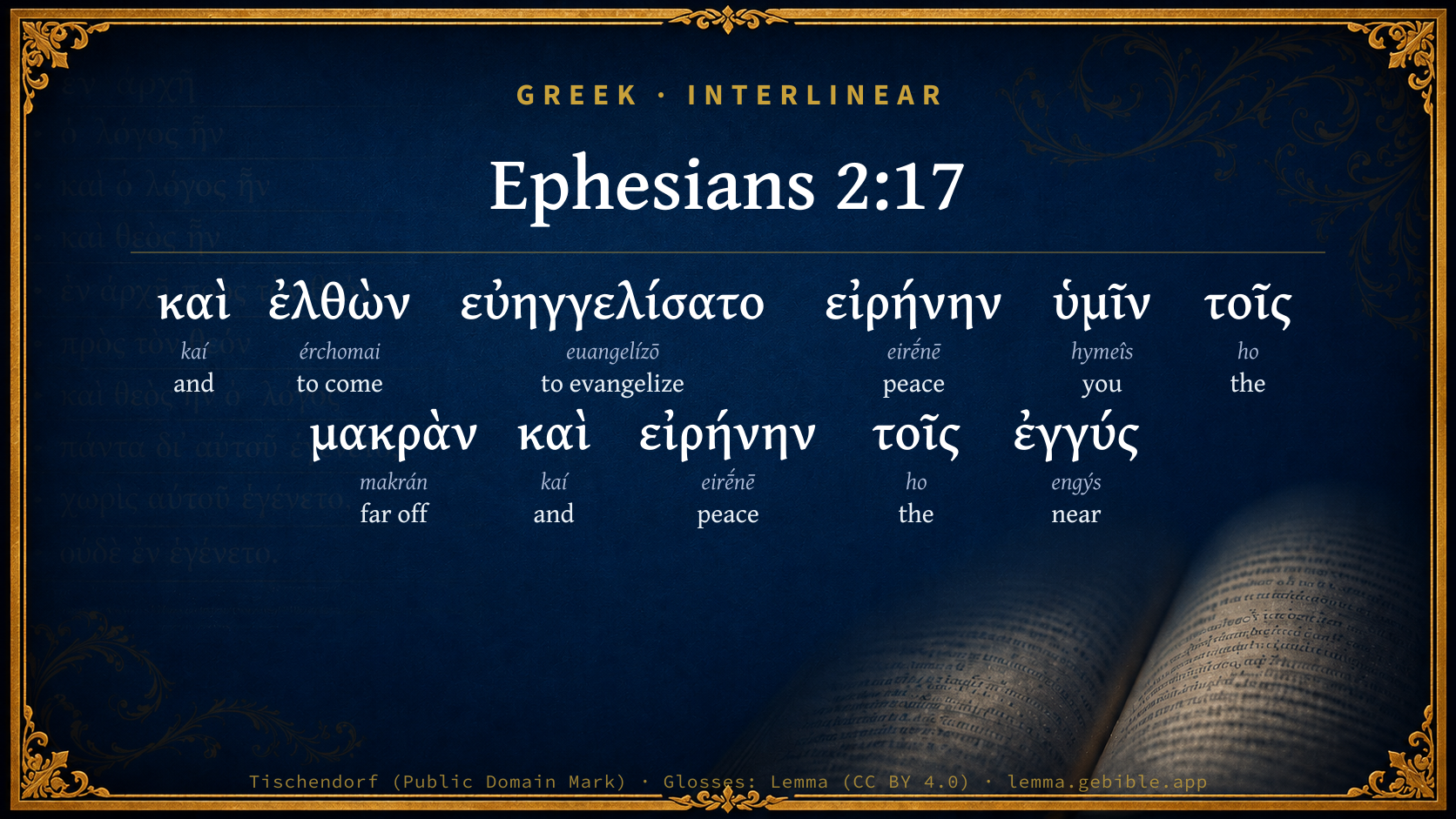
Greek (Tischendorf 8th ed.) Ephesians 2:17 appears in the Greek New Testament. The text above is from the Tischendorf 8th edition. Each word links to its Strong’s number and a concise gloss. Click any word for its full Thayer’s Greek Lexicon entry.
Download image
Cite this verse

Ephesians 2:17 (World English Bible). Public Domain. Lemma interlinear Bible study tool, https://lemma.gebible.app/v/ephesians/2/17.

Show BibTeX & RIS
BibTeX
RIS
English Translation
He came and preached peace to you who were far off and to those who were near.
World English Bible · Public Domain
Download a study sheet

One document with this verse’s original text, its word-by-word gloss line, the meaning frame, cross-references with their text, attributed commentary, and full source and license credits — printable, and it pastes into notes with its structure intact.

This verse Autodidact and up

Study sheet (.html) Plain text (.txt)

A passage Seminary Student

Up to 50 verses in one chapter. A passage sheet keeps up to 6 commentary sources and 12 cross-references per verse, in the order this page ranks them, and says so on the sheet whenever that leaves anything out. Ask for a single verse and you get the Autodidact verse sheet above.

Everything on this page stays free to read, with no account — the sheet is a download of what is already on screen, not access to it.

Want to remove ads? Support Godless Engineer
Compare translations 3

The same verse in 3 English versions, stacked beneath the original-language interlinear above. Click any original word for its lexicon entry.

Each is an independent rendering of the whole verse — the interlinear is not word-aligned to these translations.

Highlighted words mark where these versions differ — a whole-verse word diff, not a word-by-word alignment.

  • World English Bible Public Domain
    He came and preached peace to you who were far off and to those who were near.
  • King James Version Public Domain
    And came and preached peace to you which were afar off, and to them that were nigh.
  • unfoldingWord Literal Text CC BY-SA 4.0
    And he came proclaimed peace to you, the ones far away and peace to the ones near,

unfoldingWord Literal Text — © unfoldingWord, licensed CC BY-SA 4.0. Word-aligned USFM3 via Door43 (git.door43.org/unfoldingWord/en_ult).

Versions to compare (up to 4)

3 of 4 selected

Show all 19 translations

Every available English version of this verse, each an independent rendering of the whole verse.

  • World English Bible Public Domain
    He came and preached peace to you who were far off and to those who were near.
  • Berean Standard Bible Public Domain
    He came and preached peace to you who were far away and peace to those who were near.
  • Majority Standard Bible Public Domain
    He came and preached peace to you who were far away and to those who were near.
  • King James Version Public Domain
    And came and preached peace to you which were afar off, and to them that were nigh.
  • American Standard Version (1901) Public Domain
    and he came and preached peace to you that were far off, and peace to them that were nigh:
  • Revised Version (1885) Public Domain
    and he came and preached peace to you that were far off, and peace to them that were nigh:
  • Geneva Bible (1599) Public Domain
    And came, and preached peace to you which were afarre off, and to them that were neere.
  • Douay-Rheims (1899) Public Domain
    And coming, he preached peace to you that were afar off, and peace to them that were nigh.
  • Young's Literal Translation Public Domain
    and having come, he did proclaim good news -- peace to you -- the far-off and the nigh,
  • Literal Standard Version CC BY-SA 4.0
    and having come, He proclaimed good news—peace to you—the far-off and the near,
  • Unlocked Literal Bible CC BY-SA 4.0
    Jesus came and proclaimed peace to you who were far away and peace to those who were near.
  • unfoldingWord Literal Text CC BY-SA 4.0
    And he came proclaimed peace to you, the ones far away and peace to the ones near,
  • Darby Bible Public Domain
    and, coming, he has preached the glad tidings of peace to you who [were] afar off, and [the glad tidings of] peace to those [who were] nigh.
  • World Messianic Bible Public Domain
    He came and preached peace to you who were far off and to those who were near.
  • Webster's Bible Public Domain
    And came and preached peace to you who were afar off, and to them that were nigh.
  • Free Bible Version CC BY-SA 4.0
    He came and shared the good news of peace with those of you who were far away, and those who were nearby,
  • Bible in Basic English Public Domain
    And he came preaching peace to you who were far off, and to those who were near;
  • Text-Critical English NT CC BY 4.0
    He came and preached the good news of peace to you who were far away and to those who were near.
  • Tyndale New Testament (1534) Public Domain
    and came and preached peace to you which were afarre of and to them that were nye.

Literal Standard Version (2020), Covenant Press — licensed CC BY-SA 4.0. Text via the HelloAO Bible API (eBible.org). Unlocked Literal Bible (unfoldingWord) — licensed CC BY-SA 4.0. Text via the HelloAO Bible API (eBible.org). unfoldingWord Literal Text — © unfoldingWord, licensed CC BY-SA 4.0. Word-aligned USFM3 via Door43 (git.door43.org/unfoldingWord/en_ult). Free Bible Version, Dr. Jonathan Gallagher — licensed CC BY-SA 4.0. Text via the HelloAO Bible API (eBible.org).

Word by word

More ways to search: Search by grammar → Find every occurrence → Compare this word →

Practice this passage: Drill this verse → Learn its vocabulary →

About this verse

These counts appear in no published source. They are computed here, from the morphology-tagged text and Lemma’s own curated glosses. What Lemma adds →

11
words
8
distinct lemmas
Pauline Epistles
section

Notable vocabulary

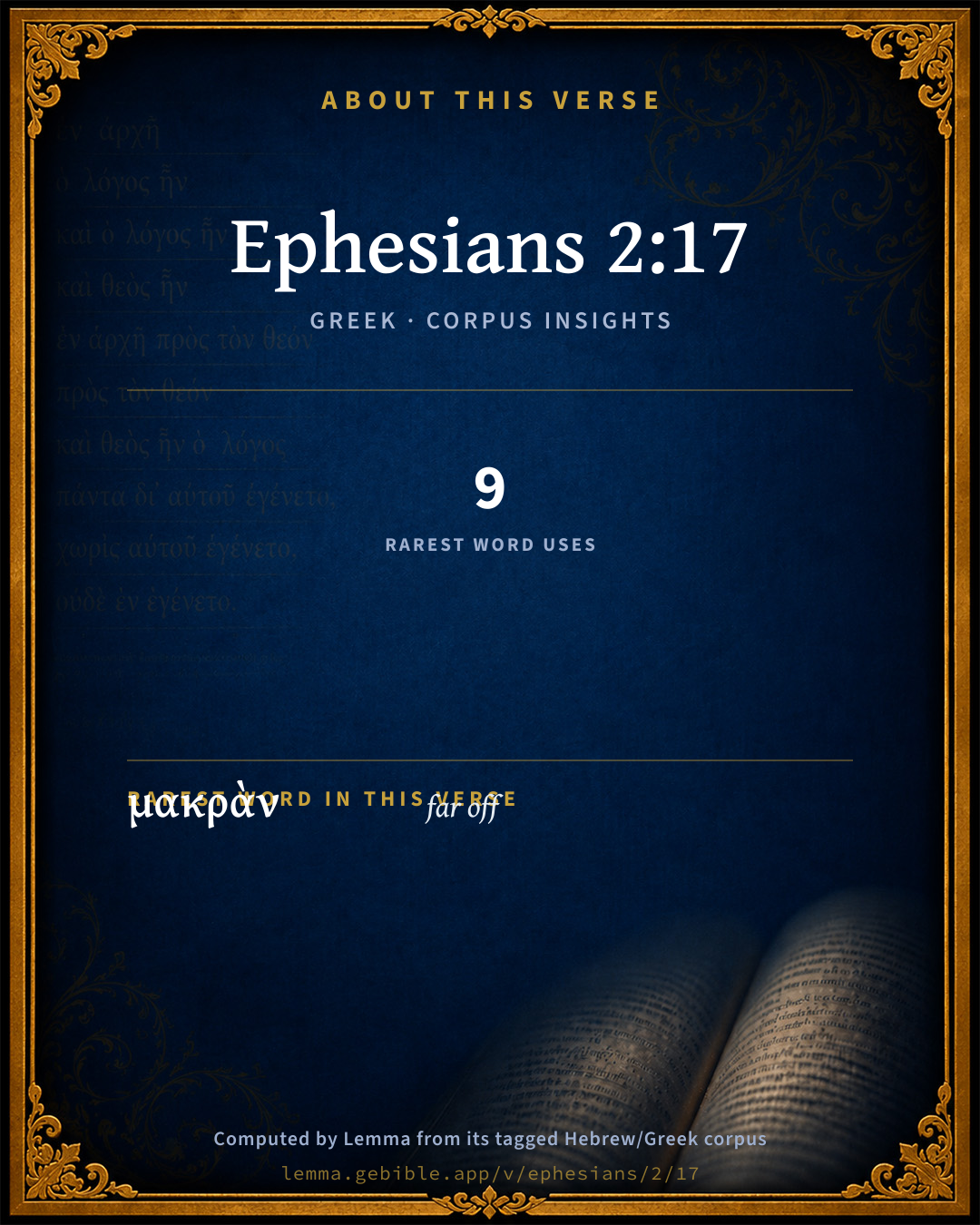
The rarest word here is μακρὰν far off G3112 — appearing just 9 times in the whole Greek New Testament.

Shared distinctive vocabulary

μακρὰν far off G3112 occurs in 9 verses of the Greek New Testament. Also found in:

Repetition

Words recur within this verse:

  • εἰρήνην peace G1515 ×2
  • καὶ and G2532 ×2
  • τοῖς the G3588 ×2

Cross-references

19

Topical passages linked to Ephesians 2:17 in the Treasury of Scripture Knowledge — connected by theme and wording, ordered by reader-vote popularity; previews shown in the World English Bible.

  • Isaiah 57:19–21 I create the fruit of the lips: Peace, peace, to him who is far off and to him who is near, says Yahweh; and I will heal him.
  • Acts 10:36 The word which he sent to the children of Israel, preaching good news of peace by Jesus Christ--he is Lord of all--
  • Romans 5:1 Being therefore justified by faith, we have peace with God through our Lord Jesus Christ;
  • Acts 2:39 For to you is the promise, and to your children, and to all who are far off, even as many as the Lord our God will call to himself."
  • Deuteronomy 4:7 For what great nation is there, that has a god so near to them, as Yahweh our God is whenever we call on him?
  • Psalms 148:14 He has lifted up the horn of his people, The praise of all his saints; Even of the children of Israel, a people near to him. Praise Yah!
  • Ephesians 2:13–14 But now in Christ Jesus you who once were far off are made near in the blood of Christ.
  • Zechariah 9:10 I will cut off the chariot from Ephraim, And the horse from Jerusalem; And the battle bow will be cut off; And he will speak peace to the nations: And his dominion will be from sea to sea, And from the River to the ends of the earth.
  • Psalms 147:19–20 He shows his word to Jacob; His statutes and his ordinances to Israel.
  • Isaiah 52:7 How beautiful on the mountains are the feet of him who brings good news, who publishes peace, who brings good news of good, who publishes salvation, who says to Zion, Your God reigns!
  • 2 Corinthians 5:20 We are therefore ambassadors on behalf of Christ, as though God were entreating by us. We beg you on behalf of Christ, be reconciled to God.
  • Psalms 75:1 We give thanks to you, God, We give thanks, for your Name is near. Men tell about your wondrous works.
  • Psalms 76:1–2 In Judah, God is known. His name is great in Israel.
  • Psalms 85:10 Mercy and truth meet together. Righteousness and peace have kissed each other.
  • Isaiah 27:5 Or else let him take hold of my strength, that he may make peace with me; [yes], let him make peace with me.
  • Matthew 10:13 If the household is worthy, let your peace come on it, but if it isn't worthy, let your peace return to you.
  • Luke 2:14 "Glory to God in the highest, On earth peace, good will toward men."
  • Luke 10:9–11 Heal the sick who are therein, and tell them, 'The Kingdom of God has come near to you.'
  • Luke 15:5–6 When he has found it, he carries it on his shoulders, rejoicing.

Cross-references courtesy of OpenBible.info (CC BY 4.0).

Commentary

Notes on Ephesians 2:17 from classic Christian and Jewish commentators (each source and its license shown beneath its notes). The classic Christian expositions comment on the surrounding passage and are grouped to its opening verse, so a note may address several verses; the Jewish commentaries on the Tanakh (Rashi and others) are per-verse, so they appear only where the commentator wrote on this verse.

Lemma curates 59 commentaries, every one of them public domain or Creative Commons licensed, each selected and text-cleaned for this edition rather than reprinted as found. About our sources →

The Biblical Illustrator

Joseph S. Exell

Eph_2:17

And came and preached peace to you which were afar off.

Christ preaching peace

This refers not merely to the time Christ lived as a Man upon earth, but also to His preaching through the Spirit in all after ages.

1. Christ is so absent from us, that He has not quite forsaken us. Whenever His Word is effectual, that is the entrance of Christ into the heart.

2. What Christ purchased for us on the Cross, He applies to us by the ministry of the Word. To enjoy Christ, make much of the gospel, which is news from heaven touching righteousness and life eternal.

3. Christ is present, and has a part in preaching even when men preach.

4. Christ preaches to all, whether Jew or Gentile, to the end of the world.

5. After the death of Christ all are preached to.

6. The gospel of Christ, which He and His ministers preach, is a gospel of peace. (Paul Bayne.)

Peace with God

When after His death on the Cross, by which He made peace between God and man, and prepared the way for peace between man and God and man and man, did our blessed Saviour come and preach peace? He came by His Holy Spirit as on the day of Pentecost. So that we have within the limits of this text, with the light shed on it by the immediate context--

I. Christ the procurer of peace with the Father. He is our peace (Eph_2:14).

1. By the removal of hindrances to our salvation. His atonement breaks down the middle wall of partition between God and man, and thus also between Jew and Gentile. Christs reconciliation is a scriptural fact.

2. By the removal of the enmity of the carnal mind if God is reconciled to man, man must be reconciled to God. The love of Christ effects this.

3. By the substitution of a new law for the law of commandments in ordinances. This new law is the all-inclusive law of love.

II. The Spirit the preacher of peace with God.

1. By His own immediate action on the soul of the child and of the man.

2. By His mediate action through the truths of the gospel. We are witnesses of these things, and so also is the Holy Ghost.

III. Man--whether jew or gentile--the obtainer of peace with God. We both have our access, etc.

1. By personal trust in the merits of Christ.

2. By daily approach through Christ by one Spirit. This describes the method of prayer. (Clerical World.)

The Great Preacher

The peculiar force of this reference to the preaching of peace will be perceived as we mark who the Preacher was. The Preacher to whom Paul in these words referred was God.

I. First of all, let us notice how the purpose of the message of the Great Preacher is here put--He preached peace. The purpose of it was then what it is now, and will continue to be as long as there are ambassadors for Christ in the world. That peace which is the great need of earth is the actual possession of heaven. Yonder in the realms of bliss and order and perfection, there is, even amidst ceaseless activity, serene unbroken peace--the peace of those who have found their true centre and move in their proper orbits. It is what rests upon everlasting foundations. It stands out in contrast to all counterfeit appearances that raise men with bright expectations for a while, and then leave them in the end blasted with disappointment--as we are told was the experience of a great man, a German poet, who lived some years ago to old age, laden with honours and earthly blessings that rarely fall to the lot of men, but who confessed that, looking back on his past life, he could not remember a day in which he had found real happiness or true peace. That a mind wondrously gifted with the power of rising to some of the loftiest conceptions of what is noble and divine, should have been compelled at last to utter this terrible confession, is indeed striking evidence of the need of a Divine provision for mans peace.

II. Observe, in the second place, where lay the special force and efficacy of the Preachers message; it was in this--that He Himself embodied His own message. His own Person and work were its theme. This gave it a reality and power which characterise the preaching of no other messenger ever heard on earth. He came and preached. And from whence, over what vast distance did He come? If a narrative of travel from one who has explored an unknown country brings before you the scenes through which he has passed with a vivid effect which it is impossible for any other person to convey, how much more should the testimony of one who has come from another world arrest your attention, and be in awful power and import (as the words of Jesus were) unparalleled and alone. He preached peace because He was--as He is--our peace. The angels at His birth had so proclaimed Him in their song. But let us notice a little more closely that Jesus embodied His own message by being Himself our peace with God. Not only was He Gods peace with us, but from what He is, and by what He did for us, there is exactly that which can make the peace already on Gods side available to us.

III. This brings us to notice, in the third place, the prominence here given to preaching, as the channel through which Gods peace reaches us. The Saviour has not deemed it enough for Him to do His work, and then allow it to speak for itself, and appeal in silence to the consciences of men. No. He accompanies His work with words--with a message designed to bring out His work in all His bearings; to interpret the signs, and trace the issues of it; to unfold its preciousness, and make unceasing application of it to the heart, according to the daily wants, and the endless variety of the different circumstances of mans lot. Preaching, therefore, is the necessary accompaniment of Gods work. He came and preached peace.

IV. The urgent need of those to whom the message was addressed--to you which were afar off, and to them that were nigh.

1. To you which were afar off. And afar off indeed were these Ephesians when the message reached them, even in such hopeless estrangements from God, as described in verses 11 and 12. The change was something much more than a social transformation, a mere improvement in outward aspect and manners. Even their escape from all the fascinations and enchantments of idol worship at Ephesus would have availed them nothing had they not also been brought nigh to God by the blood of Christ. To them the vastness of the change was m a changed eternity--a glorious futurity as fellow citizens with the saints and of the household of God. It was marked at the same time by such a change of heart as had turned their desires toward Him who had come near to save, and had set their affections and hopes on things above. But not merely to heathen converts do these words apply. To converted souls in every age--to you, believing Christians, this message comes with the same force now as it conveyed in the days of Paul.

2. It was preached also to them that were nigh--to Israel whom the ancient psalm called a people near unto Him. So nigh in virtue of external privilege, that., to them belonged the adoption and the glory, and the covenants, and the giving of the law, and the service of God, and the promises, whose are the fathers, and of whom as concerning the flesh, Christ came, who is over all, God blessed forever. And yet when He came, where were they? He came unto His own, and His own received Him not. He was near in their mouth, but far from their reins.

3. Preached to them that were nigh, the message must have included the true Israel of God, who were nigh in the real and vital sense of the term. Is it then to be preached still to those who are now at peace with God? Is there any point in their journey at which they can afford to let this part of the gospel drop in order to go on unto perfection through other truths, or by the use, it may be, of other means than those of the gospel? Never with safety or continued health to their own souls. Never, but by some subtle wile of the enemy, who, as an angel of light, would seduce them from the continuance of their faith in this one secret of their true peace in which their great strength lies. (R. S. Muir.)

Mercy waiting for applicants

Abraham Lincolns doorkeeper had standing orders from him, that no matter how great might be the throng, if either senators or representatives had to wait, or to be turned away without an audience, he must see, before the day closed, every messenger who came to him with a petition for the saving of life. (Littles Historical Lights.)

The gospel preached

A band of missionaries and native teachers spent a night on Darnley Island, when a project was formed to establish a mission on Murray Island. Some of the natives of this island seemed specially intent on intimidating the teachers, and convincing them that a mission there was perfectly hopeless. There are alligators there, said they, and snakes and centipedes. Hold! said Tepeso, one of the teachers, are there men there? Oh yes, was the reply, there are men, but they are such dreadful savages that it is no use your thinking of living among them. That will do, responded Tepeso. Wherever there are men missionaries are bound to go. (W. Baxendale.)

Peace through Christ

In the reign of Henry VIII there was a young student at Cambridge, named Bilney. He became deeply anxious about his soul. The priests prescribed fast, penance, and other observances, but he grew worse and worse. He ultimately became possessed of a copy of the New Testament, and shut himself up in his room to study it. As he read the book he came to the words, This is a faithful saying, and worthy of all acceptation, that Christ Jesus came into the world to save sinners. He laid down the book, to think on what he had read. He thus states the result:--This one sentence, through Gods inward teaching, did so rejoice my heart, being before almost in despair, that I soon found peace. Jesus Christ saves! he cried; yes, Jesus Christ saves! From that time he became a preacher of those glad tidings, and at last he suffered martyrdom.

True peace only in Christ

Your peace, sinner, is that terribly prophetic calm which the traveller occasionally perceives upon the higher Alps. Everything is still. The birds suspend their notes, fly low, and cower down with fear. The hum of bees among the flowers is hushed. A horrible stillness rules the hour, as if death had silenced all things by stretching over them his awful sceptre. Perceive ye not what is surely at hand? The tempest is preparing, the lightning will soon cast abroad its flames of fire. Earth will rock with thunder blasts; granite peaks will be dissolved; all nature will tremble beneath the fury of the storm. Yours is that solemn calm today, sinner. Rejoice not in it, for the hurricane of wrath is coming, the whirlwind and the tribulation which shall sweep you away and utterly destroy you. (C. H. Spurgeon.)

The Biblical Illustrator, edited by Joseph S. Exell (c. 1880s–1900s) — public domain. Text from a community e-Sword module.

Tyndale Open Study Notes

Tyndale Open Resources

2:17 far away . . . near: This verse possibly alludes to Isa 57:19. • The Greek text lacks the words Gentiles and Jews, but they are implied (see Eph 2:13; see also study note on 1:12-13).

Tyndale Open Study Notes — © Tyndale Open Resources, licensed CC BY-SA 4.0. Text via the HelloAO Bible API.

Bengel's Gnomon

Johann Albrecht Bengel

Eph 2:17. Ἐλθὼν, having come) from death, from His descent into hell, and from His resurrection, He, Himself a joyful conqueror, spontaneously[34] preached. A remarkable expression; 2Ti 1:10; Joh 14:18.—ΕὐΗΓΓΕΛΊΣΑΤΟ, preached) The verb for the participle; comp. ποιήσας, Eph 2:14. He announced peace with His own mouth to the apostles, Luk 24:36; Joh 20:19; Joh 20:21; Joh 20:26; and by them to others.—εἰρήνην ὑμῖν τοῖς μακρὰν, Κ.Τ.Λ.) Act 2:39, note.—ΚΑῚ ΤΟῖς) There is great elegance in mentioning ΕἸΡΉΝΗΝ, peace, only once in this passage. The peace of both is undivided.

[34] Implied in ἐλθὼν.—ED.

Bengel's Gnomon of the New Testament — English translation (T&T Clark, Edinburgh, 1860) — public domain. Text from a community e-Sword module.

Meyer's Critical & Exegetical Commentary

Heinrich August Wilhelm Meyer

Eph_2:17. After Christ has established peace, He has come and has also proclaimed it, to the Gentiles and the Jews. This proclamation, namely, cannot be regarded as preceding the fact by which the peace was established, so that ἐλθών would apply to the bodily advent of Christ upon earth (Chrysostom, Anselm, Estius, Holzhausen, Matthies, Harless), and the connection with Eph_2:14 would be: Christ is peace in deed (Eph_2:14) and word (Eph_2:17); He not only is peace, but He proclaimed it Himself at His appearing on earth, Harless. For, when it is said in Eph_2:14, αὐτὸς γάρ ἐστιν ἡ εἰρήνη ἡμῶν, the time thought of is, as Eph_2:14-16 show, the time after the crucifixion of Christ, through which and since which He is our peace, so that καὶ ἐλθὼν κ.τ.λ. does not merely attach itself to αὐτὸς γάρ ἐστιν ἡ εἰρήνη ἡμῶν and leave all that intervenes out of view; but, on the contrary, this intervening matter is so essentially bound up with αὐτὸς γ. ἐ. ἡ εἰρ. ἡμ., that now καὶ ἐλθὼν κ.τ.λ. can introduce not a πρότερον, but only a ὕστερον of the crucifixion, annexing as it does the further course of the matter. Rightly, therefore, most expositors have understood in ἐλθών an advent following the crucifixion of Christ, in connection with which either the resurrection of Christ has been thought of (Bengel, Rückert), or His having come in His Spirit (Olshausen), or in the preaching that took place through the apostles (so most), in which latter view ἐλθών is wrongly by many, as Raphel, Grotius, Wolf, Zachariae, Koppe, Rosenmüller (comp. Meier), regarded as without significance; it is in truth an insigne verbum, Bengel. The correct explanation (comp. Eph_2:18) is given by Olshausen; comp. Baumgarten-Crusius and de Wette, also Hofmann, Schriftbew. II. 1, p. 475, and Bleek. In the Holy Spirit, namely, not only according to John (Joh_14:18, al.), but also according to Paul, Christ Himself has come (in so far as it is Christs Spirit) from heaven to those who have received the Spirit, and dwells and rules in them (Rom_8:9-10; 2Co_3:17; 2Co_13:5; Gal_2:20), and this proclamation has taken place at the instance of the Spirit (Rom_8:16), and through the Spirit Himself (Rom_15:18; comp. 2Co_13:3). The point of time expressed by εὐηγγελίσατο is the conversion of the persons concerned, at which they received the Spirit (Gal_3:2; Eph_1:13). Accordingly the apostle could, without writing at variance with history, name first the readers as original Gentiles (ὑμῖν τοῖς μακράν), and then the Jews; for when the Ephesians became Christians, there had already long since been converted not merely Jews, but Gentiles and Jews. Had he, on the other hand, meant the actual coming of Christ upon earth and His oral preaching, the historical necessity would have presented itself of mentioning first those that were near and then those that were afar off.

We may add that the concrete and vividly depicting expression ἐλθὼν εὐηγγ., can the less occasion surprise, as the whole passage bears the impress of emotion. Comp. also Act_26:23.

εἰρήνην] has been, from the time of Chrysostom, ordinarily explained of peace with God, while only a few, as Estius and Koppe, suppose peace with each other to be included; but Olshausen rightly understands the latter alone, as does also Bleek. Only this is in keeping with the whole connection (see, moreover, the immediately preceding ἀποκτ. τὴν ἔχθραν, and comp. Eph_2:19), and, moreover, has Eph_2:18 not against it, but in its favour (see on Eph_2:18).

ὑμῖν τοῖς μακράν and τοῖς ἐγγύς] (both to be explained in accordance with Eph_2:12, and comp. Isa_57:19) are dependent on εὐηγγελίσατο,the view which immediately and most naturally suggests itself. Harless would attach both very closely to εἰρήνην,a course to which he was impelled by his explanation of ἐλθὼν εὐηγγ., in order not to present the apostle as saying what is inconsistent with history (Mat_15:24, comp. Mat_10:5 f.; Joh_10:16; Mat_21:43, al.). But the inconsistency with history would still remain.[156]

The repetition of εἰρήνην (see the critical remarks) has rhetorical emphasis, Joh_14:27; Buttm. neut. Gr. p. 341 [E. T. 398]. This ἐπιμονή of the expression, however (Nägelsbach on Hom. Il. i. 436), excludes the view of Wieseler, p. 444, that τοῖς ἐγγύς also is in apposition to ὑμῖν, and means specially the Jewish-Christians in Ephesus.

[156] If Paul had understood ἐλθ. εὐηγγ. in the sense of Harless, he must at all events have written εἰρ. τοῖς ἐγγὺς κ. εἰρ. ὑμῖν τοῖς μακράν. Harless himself has paraphrased (comp. Erasm. Paraphr.): The contents of his message was a peace which availed for all, Jews as well as Gentiles. Evidently under an involuntary sense of the historical relation, but in opposition to the words, according to which Harless ought to have paraphrased: availed for all, Gentiles as well as Jews.

Meyer — Critical and Exegetical Commentary on the New Testament — English translation by Peter Christie, edited by Frederick Crombie (T&T Clark, 1880) — public domain. Text from a community e-Sword module.

Expositor's Greek Testament

ed. W. Robertson Nicoll

Eph 2:17 . καὶ ἐλθὼν εὐηγγελίσατο εἰρήνην ὑμῖν τοῖς μακρὰν καὶ εἰρήνην τοῖς ἐγγύς : and He came and preached peace to you that were far off, and peace to them that were nigh . The TR reads simply καὶ τοῖς ἐγγύς (with [168] [169] , the mass of cursives, the Syr., etc.). The primary uncials and other important authorities ( [170] [171] [172] [173] 17, Vulg., etc.) insert εἰρήνην (so LTTrWHRV). The repetition has rhetorical force. The καί , again, does not merely connect this statement with the former. It adds to the thought. Not only did Christ effect the reconciliation, but He also came and preached the glad tidings of it, and that not to one class but to both. The aor. partic. has probably its proper force of priority in relation to the def. aor. εὐηγγελίσατο . The coming in question preceded the preaching. The best rendering, therefore, will be neither “coming” (Eadie), nor “came and preached” (AV and RV), but “having come” (Mey., Ell., etc.). But to what coming does the ἐλθών refer? Not to the incarnation (Chrys., Anselm, Harl., etc.); for the preceding sentences, which speak of His blood and of the peace effected through His cross, make it clear that the time in view is not before the crucifixion but after it. Nor can the reference well be to the event of His Resurrection, nor even to His own direct teaching during the forty days (Beng.). What is in view is rather His coming in His Spirit ( cf. Joh 14:18 ; Act 26:23 , etc.). That the idea of His spiritual Advent in the Holy Ghost which is prominent in the Fourth Gospel is not a Johannine idea only, but one entirely consistent with Paul’s teaching, appears from the Pauline doctrine of the dwelling of Christ Himself or His Spirit in the believer (Rom 8:9-10 ; 2Co 12:17 ; 2Co 13:5 ; Gal 2:20 ); as also from the relation of the Holy Ghost to the Apostle’s preaching (Rom 15:18 ), etc. The preaching meant by the εὐηγγελίσατο , therefore, is Christ’s mediate preaching through His Apostles and others, especially that declaration of His truth which made these Gentiles Christians. Those “afar off” are mentioned first, as the Gentiles in the persons of these Ephesians and other Asiatics were the writer’s immediate concern.

[168] Codex Mosquensis (sæc. ix.), edited by Matthæi in 1782.

[169] Codex Angelicus (sæc. ix.), at Rome, collated by Tischendorf and others.

[170] Codex Vaticanus (sæc. iv.), published in photographic facsimile in 1889 under the care of the Abbate Cozza-Luzi.

[171] Codex Sinaiticus (sæc. iv.), now at St. Petersburg, published in facsimile type by its discoverer, Tischendorf, in 1862.

[172] Codex Alexandrinus (sæc. v.), at the British Museum, published in photographic facsimile by Sir E. M. Thompson (1879).

[173] Codex Claromontanus (sæc. vi.), a Græco-Latin MS. at Paris, edited by Tischendorf in 1852.

The Expositor's Greek Testament, edited by W. Robertson Nicoll (1897–1910) — public domain. Text from a community e-Sword module.

Hodge's Commentary on Romans, Ephesians & First Corinthians

Charles Hodge

Eph_2:17

And having come, he preached peace,‹8› for you afar off, and peace for those near. The connection is not with Eph_2:14, but with Eph_2:14-16. Christ having effected peace, announced it. This is the burden of the Gospel, Peace on earth, and good-will toward man. God is reconciled. Being justified by faith we have peace with God. Christ having redeemed us from the curse of the law; having reconciled us to God by his death, came and preached peace. To what preaching does the apostle refer? Some say to Christs personal preaching while here on earth. Having come, i.e. in the flesh, he preached. This supposes the connection is not with what immediately precedes, but with Eph_2:14. He is our peace, and having come into the world he preached peace. But this breaks the concatenation of the ideas. The reconciliation is represented as preceding the annunciation of it. Having died, he came and preached. The preaching is, therefore, the annunciation of the favor of God, made by Christ, either in person, or through his apostles and his Spirit. Having come, ἐλθὼν, is not redundant, nor does it refer to his coming into the world, but to that reappearing which took place after his resurrection, which was temporarily in person and continuous in his Spirit. He is with the church always, even to the end of the world; and it is his annunciation of peace which is made, by the word and Spirit, through the church. The peace meant, according to one interpretation, is peace between Jews and Gentiles, according to another, peace with God. The decision between the two depends on the view taken of the context. If the interpretation given above of the preceding verses be correct, then the peace here mentioned can only be peace with God. The dative ὑμῖν does not depend immediately on the verb, and point out the object to which the preaching was directed. It indicates those for whose benefit this peace has been procured. Christ announced that peace with God had, by the cross, been secured for those afar off, viz. the Gentiles, as well as for the Jews, or those who were nigh.

Charles Hodge — Commentary on Romans (1835), First Corinthians (1857), and Ephesians (1856) — public domain. Text from a community e-Sword module.

Geneva Bible (1599)

Geneva Bible translators

The preaching of the Gospel is an effectual instrument of this grace, common as well to the Jews as to the Gentiles.

Geneva Bible (1599) marginal notes — public domain. Text via Bolls.life.

Jamieson, Fausset & Brown

Robert Jamieson, A. R. Fausset & David Brown

Translate, "He came and announced glad tidings of peace." "He came" of His own free love, and "announced peace" with His own mouth to the apostles (Luk 24:36; Joh 20:19, Joh 20:21, Joh 20:26); and by them to others, through His Spirit present in His Church (Joh 14:18). Act 26:23 is strictly parallel; after His resurrection "He showed light to the people ('them that were nigh') and to the Gentiles ('you that were afar off')," by His Spirit in His ministers (compare Pe1 3:19).

and to them--The oldest manuscripts insert "peace" again: "And peace to them." The repetition implies the joy with which both alike would dwell again and again upon the welcome word "peace." So Isa 57:19.

Jamieson, Fausset & Brown — Commentary Critical and Explanatory on the Whole Bible (1871) — public domain (CC PDM 1.0). Text via the HelloAO Bible API.

Adam Clarke's Commentary

Verse 17. And came and preached peace] Proclaimed the readiness of God to forgive and save both Jews and Gentiles. See Clarke on Eph 2:13.

Adam Clarke's Commentary on the Bible (1810–1826) — public domain. Text from a community e-Sword/MySword module.

John Calvin's Commentaries

17. And came and preached peace. All that Christ had done towards effecting a reconciliation would have been of no service, if it had not been proclaimed by the gospel; and therefore he adds, that the fruit of this peace has now been offered both to Jews and to Gentiles. Hence it follows, that to save Gentiles as well as Jews was the design of our Savior’s coming, as the preaching of the gospel, which is addressed indiscriminately to both, makes abundantly manifest. The same order is followed in the second Epistle to the Corinthians.

“He hath committed to us the word of reconciliation. Now, then, we are ambassadors for Christ. For he hath made him to be sin for us who knew no sin.” (2 Corinthians 5:18-21.)

Salvation through the death of Christ is first announced, and a description is afterwards given of the manner in which Christ communicates to us himself and the benefit of his death. But here Paul dwells chiefly on this circumstance, that Gentiles are united with Jews in the Kingdom of God. Having already represented Christ as a Savior common to both, he now speaks of them as companions in the gospel. The Jews, though they possessed the law, needed the gospel also; and God had bestowed upon the Gentiles equal grace. Those therefore whom

“God hath joined together, let no man put asunder.” (Matthew 19:6.)

No reference to distance of place is conveyed by the words afar off and nigh. The Jews, in respect of the covenant, were nigh to God. The Gentiles, so long as they had no promise of salvation, were afar off— were banished from the kingdom of God.

And preached peace; not indeed by his own lips, but by the apostles. It was necessary that Christ should rise from the dead, before the Gentiles were called to the fellowship of grace. Hence that saying of our Lord,

“I am not sent but to the lost sheep of the house of Israel.” (Matthew 15:24.)

The apostles were forbidden, while he was still in the world, to carry their first embassy to the Gentiles.

“Go not into the way of the Gentiles, and into any city of the Samaritans, enter ye not. But go rather to the lost sheep of the house of Israel.” (Matthew 10:5,6,)

His apostles were afterwards employed as trumpets for proclaiming the gospel to the Gentiles. What they did, not only in his name, and by his command, but as it were in his own person, is justly ascribed to none other than himself. We too speak as if Christ himself exhorted you by us. (2 Corinthians 5:20) The faith of the gospel would be weak indeed, were we to look no higher than to men. Its whole authority is derived from viewing men as God’s instruments, and hearing Christ speak to us by their mouth. Observe here, the gospel is the message of peace, by which God declares himself to be reconciled to us, and makes known his paternal love. Take away the gospel, and war and enmity continue to subsist between God and men; and, on the other hand, the native tendency of the gospel is, to give peace and calmness to the conscience, which would otherwise be tormented by distressing alarm.

John Calvin's Commentaries (1540-1563) — public domain. Text from the Calvin Translation Society English edition (1840s-50s) via the Christian Classics Ethereal Library (ccel.org). Calvin's coverage is partial (roughly two-thirds of the Bible); uncommented books and verses are honest gaps, never fabricated. The 19th-century editor's footnotes and remarks are omitted so the notes are faithfully Calvin's own voice.

Ellicott's Commentary for English Readers

(17) And came and preached peace.—The word “came” certainly carries back our thoughts to our Lord’s own preaching, when, after the Resurrection, He came “and stood in the midst of them, and said, Peace be unto you” (Luk_24:36; Joh_20:19; Joh_20:21). But we note that at that very time He repeated the salutation “Peace be unto you,” with the expressive addition, “As my Father hath sent Me, even so send I you,” and with the charge, “Receive ye the Holy Ghost,” for the future mission “to remit or retain sins.” In the same connection we have in Joh_14:25-28, the promise of the Comforter, and the words “Peace I leave with you; My peace I give unto you. . . . I go away and come again to you.” Hence we cannot limit His “coming” to the appearance after the Resurrection. At all times through the witness of the Holy Spirit, whether with or without the preaching of His servants (Joh_15:27), He “stands at the door and knocks” (Rev_3:20) with the message of peace. For since the “peacemakers” are “called the children of God,” He, the Son of God, must be emphatically the Peacemaker.

To you which were afar off, and to them that were nigh.—As the enmity was the enmity with God, so the peace is peace with God; but still the Apostle, having the idea of reunion between Jew and Gentile present to his mind, cannot refrain from bringing out clearly the call of both to one peace, and therefore to unity with one another. The passage is a quotation from Isa_57:19.

A Bible Commentary for English Readers, edited by Charles John Ellicott (1878–1897) — public domain. Text from a community e-Sword module.

The Cambridge Bible for Schools and Colleges

gen. ed. J. J. S. Perowne

17. and came] from the work of the Cross, from the Grave. “Peace” was His first word in Resurrection-life to His gathered Church (Joh_20:19); and that Church was then, and not till then, sent to the world, “far off” as well as “nigh,” to be an “ambassador on behalf of Christ” (2Co_5:20), representing Him in His preaching ministry of peace. Thus vicariously, but really, had He “come” to the Ephesians among others.—Cp. Act_3:26; “God, having raised up His Son Jesus, sent Him to bless you;” and, for the phrase “preaching peace,” Act_10:36.

peace] The word and thought still, as before, refer immediately to the inner harmony of the New Israel, ultimately to that Israel’s “peace with God.” The next verse suggests this double reference; (1) “we both have access &c.;” (2) “we have access unto the Father.”

to you … nigh] See on Eph_2:13. The whole phrase is from Isa_57:19, “Peace, peace, to him that is far off and to him that is near, saith the Lord” (LXX., “to them that are far off &c.”). The Apostle implicitly claims the Prophet as foretelling (whether he knew it or not) peace in and to the New Israel.—The best reading here repeats “peace;” “and peace to them that were nigh.”

The Cambridge Bible for Schools and Colleges (gen. ed. J. J. S. Perowne; Cambridge University Press, 1878–1918) — public domain. Text from a community e-Sword module.

John Gill's Exposition

And came and preached peace to you which were afar off,.... Which is to be understood not of Christ's coming in the flesh; for when he came in the flesh, he came only to the Jews that were nigh, and preached the Gospel in his own personal ministry to them, and not to the Gentiles, who are the persons afar off; Eph 2:12 but of his coming by his Spirit in the ministry of his apostles, to whom he gave a commission after he had made peace and reconciliation by the blood of his cross, to go into all the world and preach the Gospel to the Gentiles in the furthest parts of the earth; and on whom he bestowed gifts, qualifying them for such service, and succeeded them in it by his power and grace: and the subject of their ministry was peace, Christ who is our peace, and peace made by his blood, and the Gospel of peace, which declares both these; and it is the means of making persons of peaceable dispositions; its doctrines and promises, when powerfully applied, give peace to distressed minds, and quiet to doubting saints; and it shows the way to eternal peace:

and to them that were nigh; to the Jews, to whom the Gospel of peace was preached in the first place, not only by Christ and his apostles, before his death; but by his apostles after his resurrection, and after the commission was given to preach it to the Gentiles; though they are mentioned last, because the apostle was speaking to Gentiles; and this also verifies what Christ says, the first shall be last, and the last first: the Alexandrian copy, some others, and the Vulgate Latin and Ethiopic versions, read "peace", in this clause, as in the former; the apostle seems to have respect to Isa 57:19 a like description and distinction of Jews and Gentiles may be observed in the writings of the Jews (h); so they say,

"the Israelites are near unto the holy King, and the rest of the nations are far from him.''

(h) Zohar in Numb. fol. 89. 3.

John Gill's Exposition of the Whole Bible (1746–1763) — public domain (CC PDM 1.0). Text via the HelloAO Bible API.

Trapp's Complete Commentary

John Trapp

17 And came and preached peace to you which were afar off, and to them that were nigh.

Ver. 17. To them that were nigh] That is, "the children of Israel, a people near unto him," Psa 148:14.

John Trapp, A Commentary or Exposition upon All the Books of the Old and New Testament (1647–1656) — public domain. Text from a community e-Sword module.

Albert Barnes' Notes on the Bible

And came and preached peace - That is, the system of religion which he proclaimed, was adapted to produce peace with God. This he preached personally to those who “were nigh,” that is, the Jews; to those who were “afar off “ - the Gentiles - he preached it by his apostles. He was the author of the system which proclaimed salvation to both.

The word “peace” here refers to reconciliation with God.

To you which were afar off, ... - see the notes at Eph 2:13; compare the notes at Act 2:39.

Albert Barnes' Notes on the Bible (1834–1885) — public domain. Text from a community e-Sword/MySword module.

Matthew Poole's English Annotations

And came; partly in his own person, as to the Jews, and partly by his apostles, whom he appointed to preach the gospel to the Gentiles: so 2Co 13:3.

And preached peace to you which were afar off; far from the knowledge of the truth, from Christ, and salvation by him, as Eph 3:13.

And to them that were nigh; nigh in comparison of the Gentiles, nigh by the knowledge of God and his law, and the promises of the Messiah: see Isa 57:19.

Matthew Poole's English Annotations on the Holy Bible (1683–1685) — public domain. Text from a community e-Sword/MySword module.

Whedon's Commentary on the Bible

Daniel D. Whedon

17. And came—From heaven to earth at his first advent, announced by angels with “on earth peace.” His personal preaching, though limited to Jews, announced peace to all and for all.

And preached—He first made Palestine his school for teaching this peace; he performed the great work of slaying the enmity by the cross; and then through his apostles, inspired by the Spirit, he proclaimed peace to “all nations.”

Daniel D. Whedon (gen. ed.), Commentary on the Old and New Testaments (1874–1909) — public domain. Text from a community e-Sword module.

The Pulpit Commentary

And having come, he preached peace to you that were far off, and peace to these that were nigh. The coming denoted by ejlqwn is subsequent to the transactions of the cross. It cannot denote what Christ did personally, but what he did by sending his Spirit to the apostles and other early preachers. It was only after the cross and after the resurrection that peace could be proclaimed on the footing of faith in a Savior who had died and was alive. And only in the sense of having sent his preachers and given them his Spirit could Jesus be said to have preached to the Ephesians. The repetition of the word "peace" in the R.V is expressive; if the subject had been merely peace between the two classes of men, we should not have had the repetition; the repetition denotes peace between each of the two classes and a third party, viz. God. It is remarkable that the Gentiles, "those that were far off," are mentioned here before the Jews, "those that were nigh." In point of chronology, the Jews came first; but the order is here transposed, probably to emphasize the offer of the gospel to the Gentries, and to show that spiritually they were as near as the Jews.

The proclamation of peace.

I HE WHO IS OUR PEACE IS THE PUBLISHER OF PEACE. "And came and preached peace." He came as the Prince of peace, spoke of peace before his death as his parting legacy to the Church, and after his ascension to heaven sent forth his ambassadors with the gospel of peace to say, "We pray you in Christ"s stead be ye reconciled to God". (2Co_5:20) What Christ does by the apostles he does by himself.

II THE BURDEN OF THE GOSPEL PEACE. The first word of the angelic annunciation was, "Peace on earth.

1. It is peace through the blood of Christ, which thus speaketh better things than that of Abel.

2. It is peace through the righteousness of Christ: "Therefore, being justified by faith, we have peace with God through our Lord Jesus Christ". (Rom_5:1)

1. It is the staple of the gospel, which is a gospel of peace proclaimed by ministers who are the publishers of peace.

2. It introduces sinners into the covenant of peace, which cannot be removed.

3. It has peace for its fruits, for believers have "joy and peace in believing;" "Great peace, have they that love thy Law;" "To be spiritually minded is life and peace;" "They that trust in the Lord are kept in perfect peace;" "They dwell in peaceable habitations, in quiet resting-places.

III THE PERSONS TO WHOM PEACE IS PREACHED. "To you that are afar off and to them that are nigh." There was peace for both Jew and Gentile. It was peace for the world. There is no restriction upon the message of peace. "The Lord shall bless his people with peace". (Psa_29:11) "Great shall be the peace of thy children." The proof that the peace has this wide and blessed efficacy is our free access to the Father by Jesus Christ. T.C.

The Pulpit Commentary (1880–1919), ed. H.D.M. Spence-Jones & Joseph S. Exell — public domain. Text from a community e-Sword module.

John Wesley's Explanatory Notes

And he came - After his resurrection. And preached peace - By his ministers and his Spirit. To you - Gentiles. That were afar off - At the utmost distance from God. And to them that were nigh - To the Jews, who were comparatively nigh, being his visible church.

John Wesley, Explanatory Notes Upon the Whole Bible (1754–1765) — public domain. Text via the GEBible commentary corpus.

Godbey's Commentary on the New Testament

William B. Godbey

ARGUMENT 10

THE CROSS SETTLES EVERYTHING

From these inspired statements we have the clear and unequivocal revelation that when Christ died on the cross, he utterly destroyed human depravity (i.e., made ample provisions for its total extermination), eternally nullifying all human authority, as involved in the word “ordinances,” which does not mean Divine ordinances, but human creeds, decrees, opinions, and authorities, which have put a thousand heavy yokes of spiritual tyranny and despotism on the necks of all ages and nations.

The cross of Christ not only redeems the world from all sin, which is the devil’s yoke of bondage, but from all human usurpations, institutions, and authorities, sweeping forever from the field of controversy every autocrat, whether human or diabolical, and thus completely and eternally emancipating every human being in every land and climate. Therefore, there is nothing left for the vilest reprobate and the most menial vassal of Satan’s drudgery and the most cringing servitor of ecclesiastical despotism, but to look up to the cross, claim your freedom, and raise the shout of victory. There is nothing left for you to do but shout, since your Omnipotent Christ has heroically done everything else. He has braved the storms of earth and hell, conquered sin, Satan, men, and devils, leaving nothing for you to do but accept the victory and raise the shout.

17,18. We see here that the Jews, though sunk deep in dead formality and hollow hypocrisy, were nearer God than the heathen world. Though the popular Churches of the present day are in the same awful dilemma, they are nearer God and more accessible to the truth than the infidel, pleasure- seeking, worldly rabble. “Through him we both have access by one Spirit to the Father.” The Holy Ghost is the Divine personality of God on the earth, sent forth by the Father sitting on the throne of the universe, and the Son encumbering the mediatorial kingdom. He alone can reveal the Son, and through him give us access to the Father. Hence, in the nature of the Divine economy, the rejection of the Holy Ghost is the awful finale, out of which there is no retreat; i.e., the unpardonable sin.

William B. Godbey, Commentary on the New Testament (1896–1900) — public domain. Text from a community e-Sword module.

The People's New Testament

B. W. Johnson

17. Preached peace … afar off … were nigh. The Gentiles were “afar off;” the Jews, “nigh.” To both Christ preached with each other and with God.

B. W. Johnson's The People's New Testament with Notes (1889–1891) — public domain. Electronic text from the Christian Classics Ethereal Library (CCEL) ThML edition.

unfoldingWord translationNotes

Door43 World Missions Community

Connecting Statement:

Paul tells the Ephesian believers that present Gentile believers are also now made one with the Jewish apostles and prophets; they are a temple for God in the Spirit.

proclaimed peace

"announced the gospel of peace" or "declared the gospel of peace"

you who were far away

This refers to the Gentiles or non-Jews.

those who were near

This refers to the Jews.

For through Jesus we both have access

Here "we both" refers to Paul, the believing Jews, and the believing non-Jews. (See: Inclusive "We")

in one Spirit

All believers, both Jewish and Gentile, are given the right to enter into the presence of God the Father by the same Holy Spirit.

translationWords

preach

Holy Spirit

God the Father

unfoldingWord translationNotes — © Distant Shores Media and the Door43 World Missions Community, licensed CC BY-SA 4.0. Source: git.door43.org/Door43/en_tn.

Cambridge Greek Testament for Schools and Colleges

17. ἐλθὼν κ.τ.λ. The glad tidings of peace are the fruits of the Passion. So the ‘coming’ can only refer to the appearances after the Resurrection (so Bengel). The aorists (both ἐλθὼν and εὐηγγελίσατο) suggest a reference to a period now closed. It can hardly therefore refer primarily to the present work of the exalted Christ through the Spirit. εἰρήνη ὑμῖν was the Risen Lord’s greeting to His Apostles on the first Easter evening (Joh 20:19); and the commission to preach remission of sins in His Name to all nations beginning from Jerusalem, recorded by St Luke (Luk 24:47), exactly satisfies St Paul’s language here. It is worth notice that the same passage from Isa 57:19 is referred to by St Peter on the day of Pentecost (Act 2:39). ἔρχομαι is used by our Lord of His own return from the grave (Joh 14:18 f.).

Cambridge Greek Testament for Schools and Colleges (Cambridge University Press, 1896; 21 vols, various authors incl. Carr, Maclear, Plummer, Farrar, Lumby, Moule, M. R. James, Simcox) — public domain. Text from a community e-Sword module.

International Critical Commentary

17. καὶ ἐλθὼν εὐηγγελίσατο εἰρήνην. “And He came and preached good tidings of peace.” The preceding verses showed how Christ secured peace; this, how He proclaimed it. This, therefore, is posterior, and hence cannot refer to His life on earth, as Harless, following Chrysostom, understands it. Bengel interprets the “coming and preaching,” as that of Christ personally after the resurrection, “veniens a morte, profectione ad inferos, resurrectione victor laetus ipse ultro nuntiavit.” But it is much better to understand the words of Christ preaching by His Spirit in the apostles and other messengers of His. Not that εὐηγγ. means “caused to be preached” (as Harless objects), for what is thus done by Christ’s Spirit is properly said to be done by Him; nor is ἐλθών superfluous, but, on the contrary, important as expressing the spiritual coming referred to in Joh 14:18, ἔρχομαι πρὸς ὑμᾶς, and in Act 26:23, (Χριστὸς) πρῶτος ἐξ ἀναστάσεως νεκρῶν φῶς μέλλει καταγγέλλειν τῷ τε λαῷ καὶ τοῖς ἔθνεσι.

ὑμῖν τοῖς μακρὰν καὶ εἰρήνην τοῖς ἐγγύς. The second εἰρήνην has preponderant authority in its favour, א A B D G P, 17, Vulg. and other versions except Syr. Contra, K L, most cursives, Syr. The repetition is highly emphatic.

The datives depend on εὐηγγελίσατο. τοῖς μακράν comes first, because it is these that are addressed, and are chiefly in view in the whole passage. This also agrees with the view that it is not Christ’s personal preaching that is intended, since that would have required τοῖς ἐγγύς to come first. The repetition of εἰρήνην excludes the interpretation of τοῖς ἐγγύς as in apposition with ὑμῖν, and so = the Jewish Christians in Ephesus.

International Critical Commentary — older volumes (1896–1929), various authors — public domain. Text from a community e-Sword module.

Lesson kit

Teaching starters — assembled from the data on this page, not authored interpretation. Every prompt links to the verse data it draws on. Edit before teaching.

Ephesians, in the Pauline Epistles, opens this verse with 11 words (8 distinct Greek lemmas). Its most distinctive word is makrán (“far off”). A historical commentator’s framing appears above. Read the whole chapter for the surrounding context.

Discussion questions

  1. The word makrán carries the sense “far off.” How does it shape the verse?
  2. Matthew 8:30 shares the word «far off» with this verse. How do the two illuminate each other?
  3. “peace” occurs 2× in this one verse. What is the effect of the repetition?
  4. These translations render this verse differently. What is at stake in choosing one wording over another?
  5. Reading how The Biblical Illustrator and Tyndale Open Study Notes read this verse, where do the two commentators agree and where do they part?

Things to notice

  • These translations choose different wording for 11 words in this verse.
  • “peace” occurs 2× in this single verse.
  • 8 distinct Greek lemmas span 11 words in this verse.

Reading settings

Reading text

Shown beneath each verse's original-language words.

Old Testament
Old Testament edition

Read the OT as the Masoretic Hebrew (MT) or the Greek Septuagint (LXX).

English shown for the Greek Septuagint (in the Hebrew ↔ Greek comparison).

Comparing translations? Open the Compare panel on any verse page to stack up to four side by side.