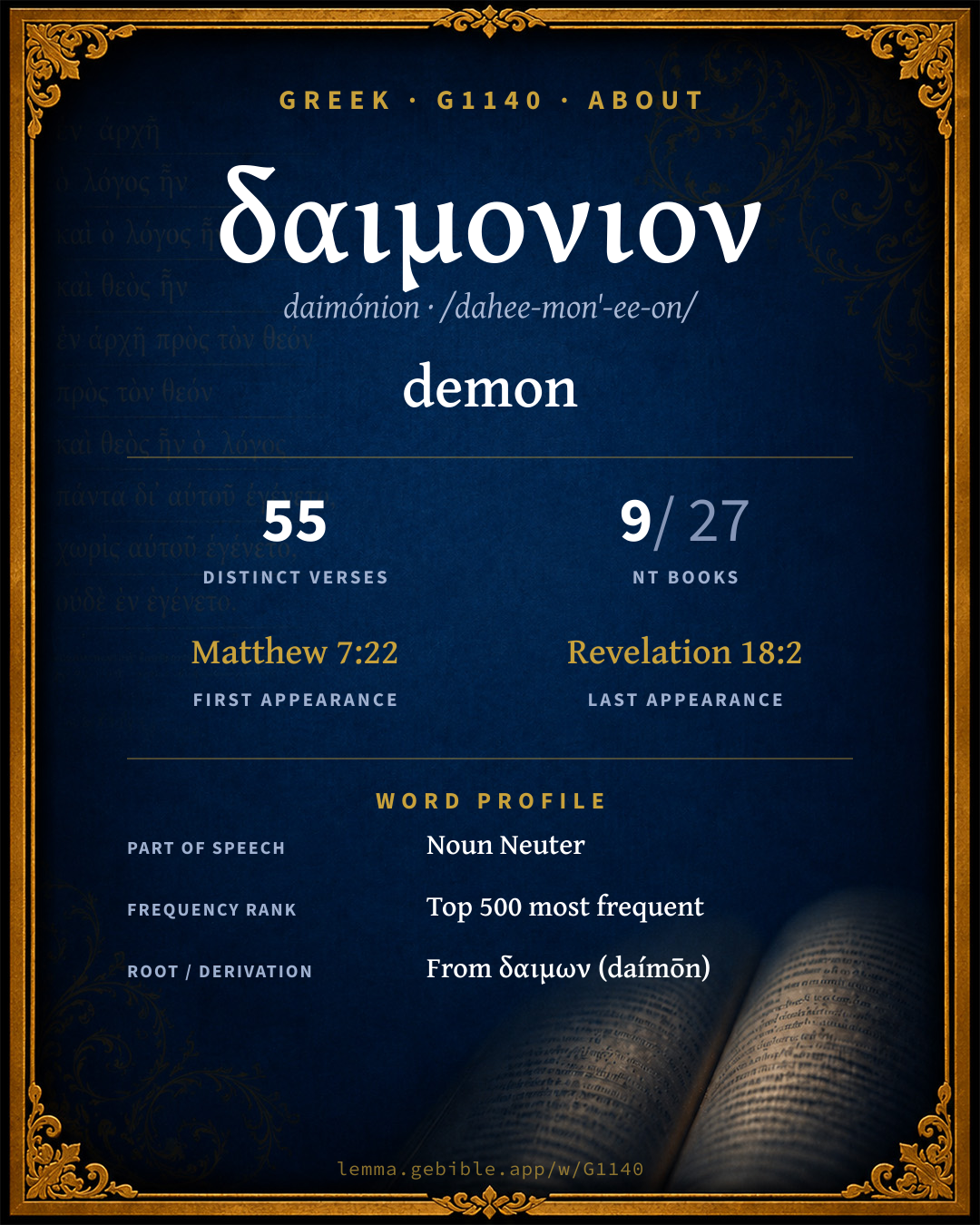
δαιμόνιον
demon
‘demon’ is one of 3 main senses fuller range ↓
Full lexicon entry — Thayer's Greek Lexicon
From Thayer's Greek Lexicon
Where this word appears
See every Accusative-case word in the Greek New Testament →
Grammar key — what these labels mean
Part of speech
- Noun
- A naming word — a person, place, thing, or idea.
Case
- Accusative
- The case of the direct object and of extent.
- Genitive
- The case of source, possession, or “of” — answers “whose / from what.”
- Nominative
- The case of the subject (and the predicate nominative).
- Dative
- The case of the indirect object, means, or location — “to / for / with / in.”
Gender
- Neuter
- Grammatically neuter.
Number
- Plural
- More than one.
- Singular
- One.
Grammatical forms
- Noun, Accusative, Plural, Neuter 24 times (38%)
- Noun, Genitive, Plural, Neuter 11 times (17%)
- Noun, Accusative, Singular, Neuter 9 times (14%)
- Noun, Nominative, Plural, Neuter 8 times (13%)
- Noun, Nominative, Singular, Neuter 6 times (10%)
- Noun, Genitive, Singular, Neuter 4 times (6%)
- Noun, Dative, Plural, Neuter 1 time (2%)
Parsed forms decoded from the imported morphology (Robinson–Tischendorf, public domain), counted across 63 parsed occurrences — not distinct verses.
Every verse where G1140 appears — 55 distinct verses across 9 books. Click any verse to open its interlinear word-by-word view. Verse text shown in the World English Bible for context — . Each verse’s Greek form is shown with its reference; the English is not keyword-highlighted, since the data carries no word-level English alignment. Use “Compare translations” on any verse to read it across multiple English versions. This concordance covers the Greek New Testament; Septuagint (Greek Old Testament) occurrences of this word are not indexed here.
Matthew 9 verses
- Matthew 7:22 δαιμόνια n acc pl neut Many will tell me in that day, 'Lord, Lord, didn't we prophesy in your name, in your name cast out demons, and in your name do many mighty works?'
- Matthew 9:33 δαιμονίου n gen sg neut When the demon was cast out, the mute man spoke. The multitudes marveled, saying, "Nothing like this has ever been seen in Israel!"
- Matthew 9:34 δαιμονίων δαιμόνια n gen pl neut n acc pl neut But the Pharisees said, "By the prince of the demons, he casts out demons."
- Matthew 10:8 δαιμόνια n acc pl neut Heal the sick, cleanse the lepers, and cast out demons. Freely you received, so freely give.
- Matthew 11:18 δαιμόνιον n acc sg neut For John came neither eating nor drinking, and they say, 'He has a demon.'
- Matthew 12:24 δαιμόνια δαιμονίων n acc pl neut n gen pl neut But when the Pharisees heard it, they said, "This man does not cast out demons, except by Beelzebul, the prince of the demons."
- Matthew 12:27 δαιμόνια n acc pl neut If I by Beelzebul cast out demons, by whom do your children cast them out? Therefore they will be your judges.
- Matthew 12:28 δαιμόνια n acc pl neut But if I by the Spirit of God cast out demons, then the Kingdom of God has come upon you.
- Matthew 17:18 δαιμόνιον n nom sg neut Jesus rebuked him, the demon went out of him, and the boy was cured from that hour.
Mark 11 verses
- Mark 1:34 δαιμόνια δαιμόνια n acc pl neut n acc pl neut He healed many who were sick with various diseases, and cast out many demons. He didn't allow the demons to speak, because they knew him.
- Mark 1:39 δαιμόνια n acc pl neut He went into their synagogues throughout all Galilee, preaching and casting out demons.
- Mark 3:15 δαιμόνια n acc pl neut and to have authority to heal sicknesses and to cast out demons:
- Mark 3:22 δαιμονίων δαιμόνια n gen pl neut n acc pl neut The scribes who came down from Jerusalem said, "He has Beelzebul," and, "By the prince of the demons he casts out the demons."
- Mark 6:13 δαιμόνια n acc pl neut They cast out many demons, and anointed many with oil who were sick, and healed them.
- Mark 7:26 δαιμόνιον n acc sg neut Now the woman was a Greek, a Syrophoenician by race. She begged him that he would cast the demon out of her daughter.
- Mark 7:29 δαιμόνιον n nom sg neut He said to her, "For this saying, go your way. The demon has gone out of your daughter."
- Mark 7:30 δαιμόνιον n nom sg neut She went away to her house, and found the child having been laid on the bed, with the demon gone out.
- Mark 9:38 δαιμόνια n acc pl neut John said to him, "Teacher, we saw someone who doesn't follow us casting out demons in your name; and we forbade him, because he doesn't follow us."
- Mark 16:9 δαιμόνια n acc pl neut Now when he had risen early on the first day of the week, he appeared first to Mary Magdalene, from whom he had cast out seven demons.
- Mark 16:17 δαιμόνια n acc pl neut These signs will accompany those who believe: in my name they will cast out demons; they will speak with new languages;
Luke 21 verses
- Luke 4:33 δαιμονίου n gen sg neut In the synagogue there was a man who had a spirit of an unclean demon, and he cried out with a loud voice,
- Luke 4:35 δαιμόνιον n nom sg neut Jesus rebuked him, saying, "Be silent, and come out of him!" When the demon had thrown him down in their midst, he came out of him, having done him no harm.
- Luke 4:41 δαιμόνια n nom pl neut Demons also came out from many, crying out, and saying, "You are the Christ, the Son of God!" Rebuking them, he didn't allow them to speak, because they knew that he was the Christ.
- Luke 7:33 δαιμόνιον n acc sg neut For John the Baptizer came neither eating bread nor drinking wine, and you say, 'He has a demon.'
- Luke 8:2 δαιμόνια n nom pl neut and certain women who had been healed of evil spirits and infirmities: Mary who was called Magdalene, from whom seven demons had gone out;
- Luke 8:27 δαιμόνια n acc pl neut When Jesus stepped ashore, a certain man out of the city who had demons for a long time met him. He wore no clothes, and didn't live in a house, but in the tombs.
- Luke 8:29 δαιμονίου n gen sg neut For Jesus was commanding the unclean spirit to come out of the man. For the unclean spirit had often seized the man. He was kept under guard, and bound with chains and fetters. Breaking the bands apart, he was driven by the demon into the desert.
- Luke 8:30 δαιμόνια n nom pl neut Jesus asked him, "What is your name?" He said, "Legion," for many demons had entered into him.
- Luke 8:33 δαιμόνια n nom pl neut The demons came out from the man, and entered into the pigs, and the herd rushed down the steep bank into the lake, and were drowned.
- Luke 8:35 δαιμόνια n nom pl neut People went out to see what had happened. They came to Jesus, and found the man from whom the demons had gone out, sitting at Jesus' feet, clothed and in his right mind; and they were afraid.
- Luke 8:38 δαιμόνια n nom pl neut But the man from whom the demons had gone out begged him that he might go with him, but Jesus sent him away, saying,
- Luke 9:1 δαιμόνια n acc pl neut He called the twelve together, and gave them power and authority over all demons, and to cure diseases.
- Luke 9:42 δαιμόνιον n nom sg neut While he was still coming, the demon threw him down and convulsed him violently. But Jesus rebuked the unclean spirit, and healed the boy, and gave him back to his father.
- Luke 9:49 δαιμόνια n acc pl neut John answered, "Master, we saw someone casting out demons in your name, and we forbade him, because he doesn't follow with us."
- Luke 10:17 δαιμόνια n nom pl neut The seventy returned with joy, saying, "Lord, even the demons are subject to us in your name!"
- Luke 11:14 δαιμόνιον δαιμονίου n acc sg neut n gen sg neut He was casting out a demon, and it was mute. It happened, when the demon had gone out, the mute man spoke; and the multitudes marveled.
- Luke 11:15 δαιμονίων δαιμόνια n gen pl neut n acc pl neut But some of them said, "He casts out demons by Beelzebul, the prince of the demons."
- Luke 11:18 δαιμόνια n acc pl neut If Satan also is divided against himself, how will his kingdom stand? For you say that I cast out demons by Beelzebul.
- Luke 11:19 δαιμόνια n acc pl neut But if I cast out demons by Beelzebul, by whom do your children cast them out? Therefore will they be your judges.
- Luke 11:20 δαιμόνια n acc pl neut But if I by the finger of God cast out demons, then the Kingdom of God has come to you.
- Luke 13:32 δαιμόνια n acc pl neut He said to them, "Go and tell that fox, 'Behold, I cast out demons and perform cures today and tomorrow, and the third day I complete my mission.
John 6 verses
- John 7:20 δαιμόνιον n acc sg neut The multitude answered, "You have a demon! Who seeks to kill you?"
- John 8:48 δαιμόνιον n acc sg neut Then the Jews answered him, "Don't we say well that you are a Samaritan, and have a demon?"
- John 8:49 δαιμόνιον n acc sg neut Jesus answered, "I don't have a demon, but I honor my Father, and you dishonor me.
- John 8:52 δαιμόνιον n acc sg neut Then the Jews said to him, "Now we know that you have a demon. Abraham died, and the prophets; and you say, 'If a man keeps my word, he will never taste of death.'
- John 10:20 δαιμόνιον n acc sg neut Many of them said, "He has a demon, and is insane! Why do you listen to him?"
- John 10:21 δαιμόνιον n nom sg neut Others said, "These are not the sayings of one possessed by a demon. It isn't possible for a demon to open the eyes of the blind, is it?"
Acts 1 verse
1 Corinthians 2 verses
- 1 Corinthians 10:20 δαιμονίοις δαιμονίων n dat pl neut n gen pl neut But I say that the things which the Gentiles sacrifice, they sacrifice to demons, and not to God, and I don't desire that you would have communion with demons.
- 1 Corinthians 10:21 δαιμονίων δαιμονίων n gen pl neut n gen pl neut You can't both drink the cup of the Lord and the cup of demons. You can't both partake of the table of the Lord, and of the table of demons.
1 Timothy 1 verse
James 1 verse
Revelation 3 verses
- Revelation 9:20 δαιμόνια n acc pl neut The rest of mankind, who were not killed with these plagues, didn't repent of the works of their hands, that they wouldn't worship demons, and the idols of gold, and of silver, and of brass, and of stone, and of wood; which can neither see, nor hear, nor walk.
- Revelation 16:14 δαιμονίων n gen pl neut for they are spirits of demons, performing signs; which go forth to the kings of the whole inhabited earth, to gather them together for the war of that great day of God, the Almighty.
- Revelation 18:2 δαιμονίων n gen pl neut He cried with a mighty voice, saying, "Fallen, fallen is Babylon the great, and she has become a habitation of demons, a prison of every unclean spirit, and a prison of every unclean and hateful bird!
About this entry
At a glance — auto-summarized from this page’s data, not written by a person. Every figure links to its source below. This summary describes the numbers; it doesn’t interpret them.
δαιμονιον — transliterated daimónion — is a Greek noun carrying the sense “demon.” The King James Version usually renders it “devils,” while modern versions prefer “demons” (Berean Standard Bible) — see the renderings breakdown. With 55 verses in 9 books, it is a moderately common word in the Greek New Testament. Its uses concentrate in Luke (38% of all occurrences). Thayer's distinguishes 3 senses for it. Each statement above links to its evidence; the full detail follows below.
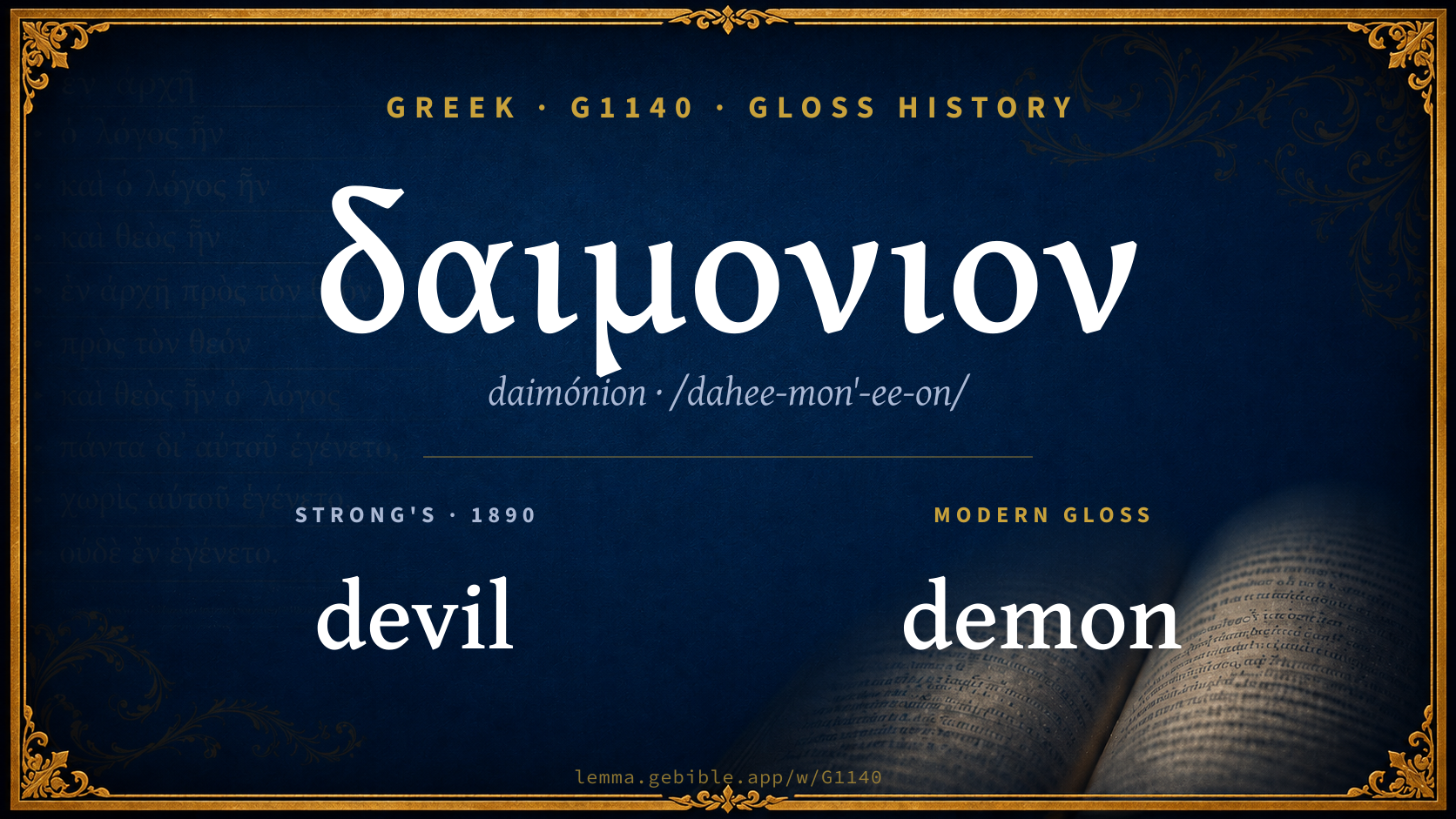
Gloss history
Strong's 1890 vs modern scholarship
About this word
Strong's G1140 catalogs a Greek word from the Greek New Testament.
These counts are not copied from any lexicon or concordance. They are computed here, from the morphology-tagged Greek New Testament. What Lemma adds →
- 55
- distinct verses
- The word appears in 55 distinct verses.
- 9 / 27
- NT books
- The word appears in 9 of 27 New Testament books.
- #259
- by frequency
- Top 500 most frequent Greek words (rank 259 of 5,347 Greek words by occurrence).
View all 55 occurrences in the concordance →
By section of the New Testament
By traditional corpus
Conventional, traditional groupings — biblical authorship is debated, so this is a traditional corpus grouping, not an authorship claim. Some books belong to more than one corpus (Luke is in both the Gospels and the Lukan corpus, and so on), so these shares overlap and need not total 100%. Each figure is a share of the word’s 55 distinct verses.
- Gospels 47 verses · 85%
- Lukan (Luke–Acts) 22 verses · 40%
- Johannine 9 verses · 16%
- Pauline corpus 3 verses · 5%
- Revelation 3 verses · 5%
- General (Catholic) Epistles 1 verse · 2%
How translations render this word
Counts come from each version’s own published word-to-Strong’s tagging or interlinear alignment — an approximate guide to how each version renders this word, not a word-level alignment the data otherwise carries. Because each total is that version’s own tagged count, the per-version totals vary from one another and need not match the appearance or distinct-verse counts above. These counts may also differ from a printed concordance because Lemma counts each distinctly tagged rendering and does not collapse phrase taggings into a single head-word total. This is a fixed set of word-tagged versions (KJV, ASV, BSB, ULT) and does not change with the reading translation you choose elsewhere. Each version’s license is shown beside its name below (and on Sources).
- King James Version: Devils 41×, Devil 18×
- American Standard Version: Demons 40×, Demon 17×
- Berean Standard Bible: Demons 40×, Demon 17×, Demon-possessed 2×
- unfoldingWord Literal Text: Demons 43×, Demon 19×
King James Version Public Domain
Renders G1140 across 60 tagged occurrences — most commonly:
Plus 1 rendering that appears only once — usually multi-word phrases or single function words the recovered tagging swept in, not distinct renderings.
American Standard Version Public Domain
Renders G1140 across 58 tagged occurrences — most commonly:
Plus 1 rendering that appears only once — usually multi-word phrases or single function words the recovered tagging swept in, not distinct renderings.
Berean Standard Bible Public Domain
Renders G1140 across 62 tagged occurrences — most commonly:
Plus 3 renderings that appear only once — usually multi-word phrases or single function words the recovered tagging swept in, not distinct renderings. Not rendered by a distinct English word in 1 further occurrence.
unfoldingWord Literal Text CC BY-SA 4.0
Renders G1140 across 66 tagged occurrences — most commonly:
Plus 4 renderings that appear only once — usually multi-word phrases or single function words the recovered tagging swept in, not distinct renderings.
Senses in Thayer's
The 3 senses Thayer's distinguishes for this word, in lexicon order (not ranked by frequency or importance). The full entry — with sub-senses — is in the Lexicon Entry tab.
- the divine power, deity, divinity
- a spirit, a being inferior to God, superior to men
- evil spirits or the messengers and ministers of the devil
Word origin
Derived from δαιμων (daímōn) (G1142) — demon.
Neuter of a derivative of G1142 ; a daemonic being ; by extension a deity : - devil god.
— Strong’s Exhaustive Concordance (1890), public domain.
Forms in the corpus
The 5 distinct written forms G1140 takes in the Greek New Testament, most frequent first — each parse links to that case’s occurrences in the concordance.
| Form | Parsing | Example | Uses |
|---|---|---|---|
| δαιμόνια daimónia | Noun, Accusative, Plural, Neuter | Matthew 7:22 | 32 |
| δαιμόνιον daimónion | Noun, Accusative, Singular, Neuter | Matthew 11:18 | 15 |
| δαιμονίων daimoníōn | Noun, Genitive, Plural, Neuter | Matthew 9:34 | 11 |
| δαιμονίου daimoníou | Noun, Genitive, Singular, Neuter | Matthew 9:33 | 4 |
| δαιμονίοις daimoníois | Noun, Dative, Plural, Neuter | 1 Corinthians 10:20 | 1 |
Same root — word family
Other Thayer's entries built from the same root as G1140, grouped by Strong’s listed origin. These share a root / origin per the lexicon — not necessarily a shared meaning. Each links to that word’s own entry.
Derives from
Shares the same root
Derived from this word
Compare all same-root words → They share a root, not necessarily a meaning.
Septuagint usage
The same Greek word δαιμονιον appears 7 times in the Greek Old Testament (Septuagint), across 7 verses in 3 books.
- 7
- LXX occurrences
- Tagged occurrences of this Greek word in the Septuagint.
- 7
- verses
- Distinct Septuagint verses containing this word.
- 3 / 39
- OT books
- The word appears in 3 of the 39 Old Testament books.
Sample Septuagint occurrences
- Deuteronomy 32:17 δαιμόνιον
- Psalms 90:6 δαιμόνιον
- Isaiah 13:21 δαιμόνιον
Septuagint occurrences (same lexeme)
Every verse where the same Strong’s number (G1140) appears in the Greek Septuagint. Verse text shown in the World English Bible for context; the Greek form is the matched word — the English is not keyword-highlighted.
- Deuteronomy 32:17 δαιμόνιον They sacrificed to demons, [which were] no God, To gods that they didn't know, To new [gods] that came up of late, Which your fathers didn't dread.
- Psalms 90:6 δαιμόνιον In the morning it sprouts and springs up. By evening, it is withered and dry.
- Psalms 95:5 δαιμόνιον The sea is his, and he made it. His hands formed the dry land.
- Psalms 105:37 δαιμόνιον He brought them forth with silver and gold. There was not one feeble person among his tribes.
- Isaiah 13:21 δαιμόνιον But wild animals of the desert shall lie there; and their houses shall be full of doleful creatures; and ostriches shall dwell there, and wild goats shall dance there.
- Isaiah 34:14 δαιμόνιον The wild animals of the desert shall meet with the wolves, and the wild goat shall cry to his fellow; yes, the night-monster shall settle there, and shall find her a place of rest.
- Isaiah 65:3 δαιμόνιον a people who provoke me to my face continually, sacrificing in gardens, and burning incense on bricks;
These are occurrences of the same Greek lexeme (G1140) in the Septuagint — not a translation of any one Hebrew word. The store carries no word-level Hebrew↔Greek alignment, so no Hebrew original is asserted here. Counts come from the recovered LXX Strong's tagging — high-frequency vocabulary is well covered, while rare or late forms may be untagged — so they reflect tagged occurrences and may slightly undercount.