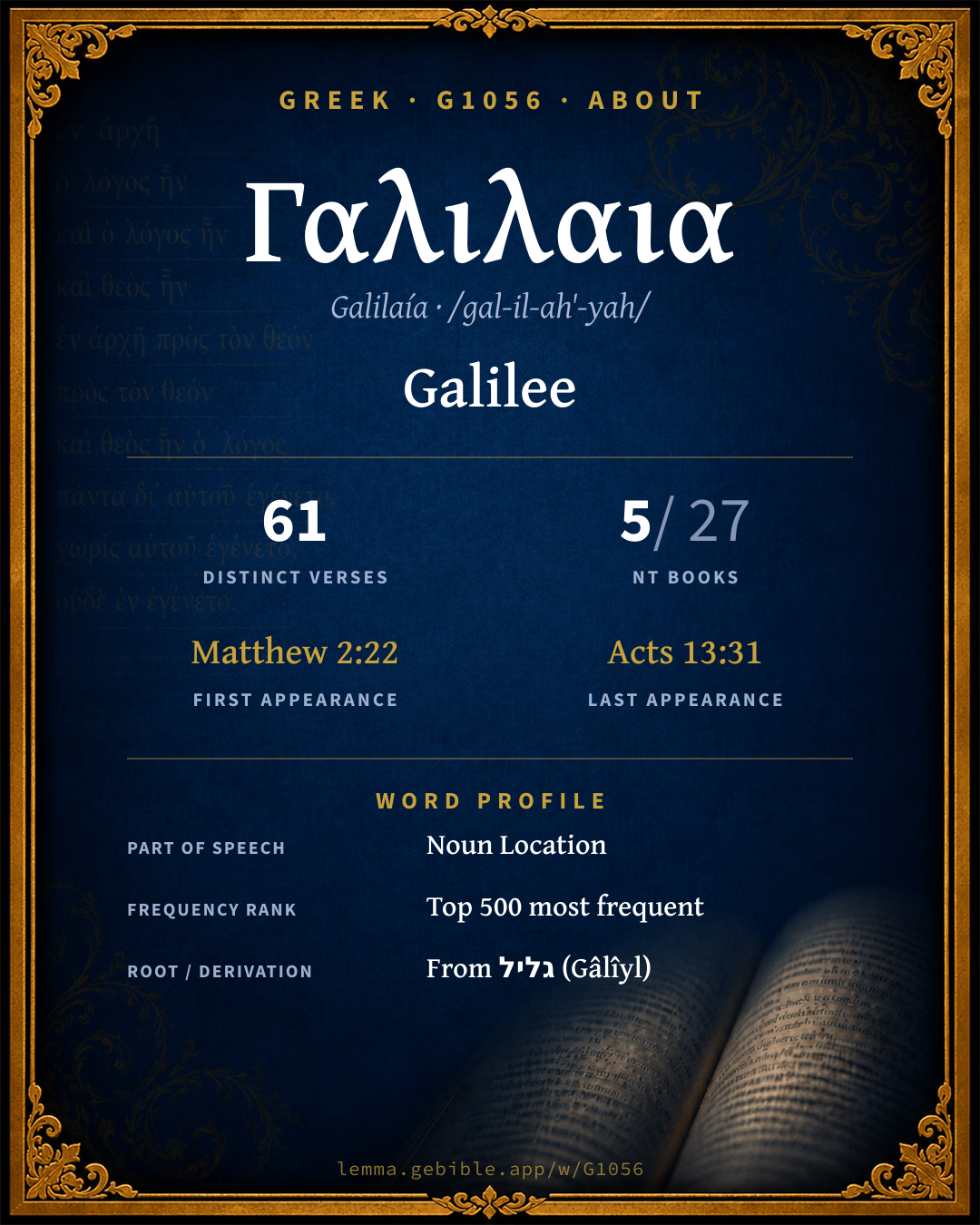
Γαλιλαία
Galilee
Full lexicon entry — Thayer's Greek Lexicon
From Thayer's Greek Lexicon
Where this word appears
See every Genitive-case word in the Greek New Testament →
Grammar key — what these labels mean
Part of speech
- Noun
- A naming word — a person, place, thing, or idea.
Case
- Genitive
- The case of source, possession, or “of” — answers “whose / from what.”
- Accusative
- The case of the direct object and of extent.
- Dative
- The case of the indirect object, means, or location — “to / for / with / in.”
- Vocative
- The case of direct address (“O Lord”).
Gender
- Feminine
- Grammatically feminine.
Number
- Singular
- One.
Grammatical forms
- Noun, Genitive, Singular, Feminine 38 times (61%)
- Noun, Accusative, Singular, Feminine 17 times (27%)
- Noun, Dative, Singular, Feminine 6 times (10%)
- Noun, Vocative, Singular, Feminine 1 time (2%)
Parsed forms decoded from the imported morphology (Robinson–Tischendorf, public domain), counted across 62 parsed occurrences — not distinct verses.
Every verse where G1056 appears — 61 distinct verses across 5 books. Click any verse to open its interlinear word-by-word view. Verse text shown in the World English Bible for context — . Each verse’s Greek form is shown with its reference; the English is not keyword-highlighted, since the data carries no word-level English alignment. Use “Compare translations” on any verse to read it across multiple English versions. This concordance covers the Greek New Testament; Septuagint (Greek Old Testament) occurrences of this word are not indexed here.
Matthew 16 verses
- Matthew 2:22 Γαλιλαίας n gen sg fem But when he heard that Archelaus was reigning over Judea in the place of his father, Herod, he was afraid to go there. Being warned in a dream, he withdrew into the region of Galilee,
- Matthew 3:13 Γαλιλαίας n gen sg fem Then Jesus came from Galilee to the Jordan to John, to be baptized by him.
- Matthew 4:12 Γαλιλαίαν n acc sg fem Now when Jesus heard that John was delivered up, he withdrew into Galilee.
- Matthew 4:15 Γαλιλαία n voc sg fem "The land of Zebulun and the land of Naphtali, Toward the sea, beyond the Jordan, Galilee of the Gentiles,
- Matthew 4:18 Γαλιλαίας n gen sg fem Walking by the sea of Galilee, he saw two brothers: Simon, who is called Peter, and Andrew, his brother, casting a net into the sea; for they were fishermen.
- Matthew 4:23 Γαλιλαίᾳ n dat sg fem Jesus went about in all Galilee, teaching in their synagogues, preaching the Gospel of the Kingdom, and healing every disease and every sickness among the people.
- Matthew 4:25 Γαλιλαίας n gen sg fem Great multitudes from Galilee, Decapolis, Jerusalem, Judea and from beyond the Jordan followed him.
- Matthew 15:29 Γαλιλαίας n gen sg fem Jesus departed there, and came near to the sea of Galilee; and he went up into the mountain, and sat there.
- Matthew 17:22 Γαλιλαίᾳ n dat sg fem While they were staying in Galilee, Jesus said to them, "The Son of Man is about to be delivered up into the hands of men,
- Matthew 19:1 Γαλιλαίας n gen sg fem It happened when Jesus had finished these words, he departed from Galilee, and came into the borders of Judea beyond the Jordan.
- Matthew 21:11 Γαλιλαίας n gen sg fem The multitudes said, "This is the prophet, Jesus, from Nazareth of Galilee."
- Matthew 26:32 Γαλιλαίαν n acc sg fem But after I am raised up, I will go before you into Galilee."
- Matthew 27:55 Γαλιλαίας n gen sg fem Many women were there watching from afar, who had followed Jesus from Galilee, serving him.
- Matthew 28:7 Γαλιλαίαν n acc sg fem Go quickly and tell his disciples, 'He has risen from the dead, and behold, he goes before you into Galilee; there you will see him.' Behold, I have told you."
- Matthew 28:10 Γαλιλαίαν n acc sg fem Then Jesus said to them, "Don't be afraid. Go tell my brothers that they should go into Galilee, and there they will see me."
- Matthew 28:16 Γαλιλαίαν n acc sg fem But the eleven disciples went into Galilee, to the mountain where Jesus had sent them.
Mark 12 verses
- Mark 1:9 Γαλιλαίας n gen sg fem It happened in those days, that Jesus came from Nazareth of Galilee, and was baptized by John in the Jordan.
- Mark 1:14 Γαλιλαίαν n acc sg fem Now after John was taken into custody, Jesus came into Galilee, preaching the Gospel of the Kingdom of God,
- Mark 1:16 Γαλιλαίας n gen sg fem Passing along by the sea of Galilee, he saw Simon and Andrew the brother of Simon casting a net in the sea, for they were fishermen.
- Mark 1:28 Γαλιλαίας n gen sg fem The report of him went out immediately everywhere into all the region of Galilee and its surrounding area.
- Mark 1:39 Γαλιλαίαν n acc sg fem He went into their synagogues throughout all Galilee, preaching and casting out demons.
- Mark 3:7 Γαλιλαίας n gen sg fem Jesus withdrew to the sea with his disciples, and a great multitude followed him from Galilee, from Judea,
- Mark 6:21 Γαλιλαίας n gen sg fem Then a convenient day came, that Herod on his birthday made a supper for his nobles, the high officers, and the chief men of Galilee.
- Mark 7:31 Γαλιλαίας n gen sg fem Again he departed from the borders of Tyre and Sidon, and came to the sea of Galilee, through the midst of the region of Decapolis.
- Mark 9:30 Γαλιλαίας n gen sg fem They went out from there, and passed through Galilee. He didn't want anyone to know it.
- Mark 14:28 Γαλιλαίαν n acc sg fem However, after I am raised up, I will go before you into Galilee."
- Mark 15:41 Γαλιλαίᾳ n dat sg fem who, when he was in Galilee, followed him, and served him; and many other women who came up with him to Jerusalem.
- Mark 16:7 Γαλιλαίαν n acc sg fem But go, tell his disciples and Peter, 'He goes before you into Galilee. There you will see him, as he said to you.'"
Luke 14 verses
- Luke 1:26 Γαλιλαίας n gen sg fem Now in the sixth month, the angel Gabriel was sent from God to a city of Galilee, named Nazareth,
- Luke 2:4 Γαλιλαίας n gen sg fem Joseph also went up from Galilee, out of the city of Nazareth, into Judea, to the city of David, which is called Bethlehem, because he was of the house and family of David;
- Luke 2:39 Γαλιλαίαν n acc sg fem When they had accomplished all things that were according to the law of the Lord, they returned into Galilee, to their own city, Nazareth.
- Luke 3:1 Γαλιλαίας n gen sg fem Now in the fifteenth year of the reign of Tiberius Caesar, Pontius Pilate being governor of Judea, and Herod being tetrarch of Galilee, and his brother Philip tetrarch of the region of Ituraea and Trachonitis, and Lysanias tetrarch of Abilene,
- Luke 4:14 Γαλιλαίαν n acc sg fem Jesus returned in the power of the Spirit into Galilee, and news about him spread through all the surrounding area.
- Luke 4:31 Γαλιλαίας n gen sg fem He came down to Capernaum, a city of Galilee. He was teaching them on the Sabbath day,
- Luke 4:44 Γαλιλαίας n gen sg fem He was preaching in the synagogues of Galilee.
- Luke 5:17 Γαλιλαίας n gen sg fem It happened on one of those days, that he was teaching; and there were Pharisees and teachers of the law sitting by, who had come out of every village of Galilee, Judea, and Jerusalem. The power of the Lord was with him to heal them.
- Luke 8:26 Γαλιλαίας n gen sg fem They arrived at the country of the Gadarenes, which is opposite Galilee.
- Luke 17:11 Γαλιλαίας n gen sg fem It happened as he was on his way to Jerusalem, that he was passing along the borders of Samaria and Galilee.
- Luke 23:5 Γαλιλαίας n gen sg fem But they insisted, saying, "He stirs up the people, teaching throughout all Judea, beginning from Galilee even to this place."
- Luke 23:49 Γαλιλαίας n gen sg fem All his acquaintances, and the women who followed with him from Galilee, stood at a distance, watching these things.
- Luke 23:55 Γαλιλαίας n gen sg fem The women, who had come with him out of Galilee, followed after, and saw the tomb, and how his body was laid.
- Luke 24:6 Γαλιλαίᾳ n dat sg fem He isn't here, but is risen. Remember what he told you when he was still in Galilee,
John 16 verses
- John 1:44 Γαλιλαίαν n acc sg fem Now Philip was from Bethsaida, of the city of Andrew and Peter.
- John 2:1 Γαλιλαίας n gen sg fem The third day, there was a marriage in Cana of Galilee. Jesus' mother was there.
- John 2:11 Γαλιλαίας n gen sg fem This beginning of his signs Jesus did in Cana of Galilee, and revealed his glory; and his disciples believed in him.
- John 4:3 Γαλιλαίαν n acc sg fem he left Judea, and departed into Galilee.
- John 4:43 Γαλιλαίαν n acc sg fem After the two days he went out from there and went into Galilee.
- John 4:45 Γαλιλαίαν n acc sg fem So when he came into Galilee, the Galileans received him, having seen all the things that he did in Jerusalem at the feast, for they also went to the feast.
- John 4:46 Γαλιλαίας n gen sg fem Jesus came therefore again to Cana of Galilee, where he made the water into wine. There was a certain nobleman whose son was sick at Capernaum.
- John 4:47 Γαλιλαίαν n acc sg fem When he heard that Jesus had come out of Judea into Galilee, he went to him, and begged him that he would come down and heal his son, for he was at the point of death.
- John 4:54 Γαλιλαίαν n acc sg fem This is again the second sign that Jesus did, having come out of Judea into Galilee.
- John 6:1 Γαλιλαίας n gen sg fem After these things, Jesus went away to the other side of the sea of Galilee, which is also called the Sea of Tiberias.
- John 7:1 Γαλιλαίᾳ n dat sg fem After these things, Jesus was walking in Galilee, for he wouldn't walk in Judea, because the Jews sought to kill him.
- John 7:9 Γαλιλαίᾳ n dat sg fem Having said these things to them, he stayed in Galilee.
- John 7:41 Γαλιλαίας n gen sg fem Others said, "This is the Christ." But some said, "What, does the Christ come out of Galilee?
- John 7:52 Γαλιλαίας Γαλιλαίας n gen sg fem n gen sg fem They answered him, "Are you also from Galilee? Search, and see that no prophet has arisen out of Galilee."
- John 12:21 Γαλιλαίας n gen sg fem These, therefore, came to Philip, who was from Bethsaida of Galilee, and asked him, saying, "Sir, we want to see Jesus."
- John 21:2 Γαλιλαίας n gen sg fem Simon Peter, Thomas called Didymus, Nathanael of Cana in Galilee, and the sons of Zebedee, and two others of his disciples were together.
Acts 3 verses
- Acts 9:31 Γαλιλαίας n gen sg fem So the assemblies throughout all Judea and Galilee and Samaria had peace, and were built up. They were multiplied, walking in the fear of the Lord and in the comfort of the Holy Spirit.
- Acts 10:37 Γαλιλαίας n gen sg fem that spoken word you yourselves know, which was proclaimed throughout all Judea, beginning from Galilee, after the baptism which John preached;
- Acts 13:31 Γαλιλαίας n gen sg fem and he was seen for many days by those who came up with him from Galilee to Jerusalem, who are his witnesses to the people.
About this entry
At a glance — auto-summarized from this page’s data, not written by a person. Every figure links to its source below. This summary describes the numbers; it doesn’t interpret them.
The Greek name Γαλιλαια centers on the idea of “Galilee.” Its earliest occurrence is Matthew 2:22. Spanning 61 verses in 5 books, it ranks among the moderately common words of the Greek New Testament. Matthew dominates its distribution — 16 of 61 verses. For the data behind this summary, explore 61-verse concordance and the renderings breakdown below.
Gloss history
Strong's 1890 vs modern scholarship
About this word
Strong's G1056 catalogs a Greek word from the Greek New Testament.
These counts are not copied from any lexicon or concordance. They are computed here, from the morphology-tagged Greek New Testament. What Lemma adds →
- 61
- distinct verses
- The word appears in 61 distinct verses.
- 5 / 27
- NT books
- The word appears in 5 of 27 New Testament books.
- #262
- by frequency
- Top 500 most frequent Greek words (rank 262 of 5,347 Greek words by occurrence).
View all 61 occurrences in the concordance →
By section of the New Testament
By traditional corpus
Conventional, traditional groupings — biblical authorship is debated, so this is a traditional corpus grouping, not an authorship claim. Some books belong to more than one corpus (Luke is in both the Gospels and the Lukan corpus, and so on), so these shares overlap and need not total 100%. Each figure is a share of the word’s 61 distinct verses.
- Gospels 58 verses · 95%
- Lukan (Luke–Acts) 17 verses · 28%
- Johannine 16 verses · 26%
How translations render this word
Counts come from each version’s own published word-to-Strong’s tagging or interlinear alignment — an approximate guide to how each version renders this word, not a word-level alignment the data otherwise carries. Because each total is that version’s own tagged count, the per-version totals vary from one another and need not match the appearance or distinct-verse counts above. These counts may also differ from a printed concordance because Lemma counts each distinctly tagged rendering and does not collapse phrase taggings into a single head-word total. This is a fixed set of word-tagged versions (KJV, ASV, BSB, ULT) and does not change with the reading translation you choose elsewhere. Each version’s license is shown beside its name below (and on Sources).
- King James Version: Galilee 62×
- American Standard Version: Galilee 60×
- Berean Standard Bible: Galilee 60×
- unfoldingWord Literal Text: Galilee 61×
King James Version Public Domain
Renders G1056 across 63 tagged occurrences — most commonly:
Plus 1 rendering that appears only once — usually multi-word phrases or single function words the recovered tagging swept in, not distinct renderings.
American Standard Version Public Domain
Renders G1056 across 63 tagged occurrences — most commonly:
Plus 3 renderings that appear only once — usually multi-word phrases or single function words the recovered tagging swept in, not distinct renderings.
Berean Standard Bible Public Domain
Renders G1056 across 60 tagged occurrences — most commonly:
Not rendered by a distinct English word in 1 further occurrence.
unfoldingWord Literal Text CC BY-SA 4.0
Renders G1056 across 61 tagged occurrences — most commonly:
Senses in Thayer's
The 1 sense Thayer's distinguishes for this word, in lexicon order (not ranked by frequency or importance). The full entry — with sub-senses — is in the Lexicon Entry tab.
- Galilee = "Circuit"
Word origin
Derived from גליל (Gâlîyl) (H1551) — Galilee.
Of hebrew origin [ H1551 ]; Galilaea (that is the heathen circle ) a region of Palestine : - Galilee.
— Strong’s Exhaustive Concordance (1890), public domain.
Forms in the corpus
The 4 distinct written forms G1056 takes in the Greek New Testament, most frequent first — each parse links to that case’s occurrences in the concordance.
| Form | Parsing | Example | Uses |
|---|---|---|---|
| Γαλιλαίας Galilaías | Noun, Genitive, Singular, Feminine | Matthew 2:22 | 38 |
| Γαλιλαίαν Galilaían | Noun, Accusative, Singular, Feminine | Matthew 4:12 | 17 |
| Γαλιλαίᾳ Galilaía | Noun, Dative, Singular, Feminine | Matthew 4:23 | 6 |
| Γαλιλαία Galilaía | Noun, Vocative, Singular, Feminine | Matthew 4:15 | 1 |
Same root — word family
Other Thayer's entries built from the same root as G1056, grouped by Strong’s listed origin. These share a root / origin per the lexicon — not necessarily a shared meaning. Each links to that word’s own entry.
Derives from
Proper names from this root
People and places named from this root — a name, not an additional meaning of the word.
Compare all same-root words → 2 of the same-root words are proper names (people or places). They share a root, not necessarily a meaning.
Bible dictionary
Public-domain dictionary articles matched to this entry by name (Galilee). A biblical name can be shared by more than one person or place, so an article may treat several.
Easton's Bible Dictionary · M. G. Easton, 1897
Circuit. Solomon rewarded Hiram for certain services rendered him by the gift of an upland plain among the mountains of Naphtali. Hiram was dissatisfied with the gift, and called it "the land of Cabul" (q.v.). The Jews called it Galil. It continued long to be occupied by the original inhabitants, and hence came to be called "Galilee of the Gentiles" (Matt. 4:15), and also "Upper Galilee," to distinguish it from the extensive addition afterwards made to it toward the south, which was usually called "Lower Galilee." In the time of our Lord, Galilee embraced more than one-third of Western Palestine, extending "from Dan on the north, at the base of Mount Hermon, to the ridges of Carmel and Gilboa on the south, and from the Jordan valley on the east away across the splendid plains of Jezreel and Acre to the shores of the Mediterranean on the west." Palestine was divided into three provinces, Judea, Samaria, and Galilee, which comprehended the whole northern section of the country (Acts 9:31), and was the largest of the three.
It was the scene of some of the most memorable events of Jewish history. Galilee also was the home of our Lord during at least thirty years of his life. The first three Gospels are chiefly taken up with our Lord's public ministry in this province. "The entire province is encircled with a halo of holy associations connected with the life, works, and teachings of Jesus of Nazareth." "It is noteworthy that of his thirty-two beautiful parables, no less than ninteen were spoken in Galilee. And it is no less remarkable that of his entire thirty-three great miracles, twenty-five were wrought in this province. His first miracle was wrought at the wedding in Cana of Galilee, and his last, after his resurrection, on the shore of Galilee's sea. In Galilee our Lord delivered the Sermon on The Mount, and the discourses on The Bread of Life,' on Purity,' on 'Forgiveness,' and on Humility.' In Galilee he called his first disciples; and there occurred the sublime scene of the Transfiguration" (Porter's Through Samaria).
When the Sanhedrin were about to proceed with some plan for the condemnation of our Lord (John 7:45-52), Nicodemus interposed in his behalf. (Comp. Deut. 1:16, 17; 17:8.) They replied, "Art thou also of Galilee?.... Out of Galilee ariseth no prophet." This saying of theirs was "not historically true, for two prophets at least had arisen from Galilee, Jonah of Gath-hepher, and the greatest of all the prophets, Elijah of Thisbe, and perhaps also Nahum and Hosea. Their contempt for Galilee made them lose sight of historical accuracy" (Alford, Com.).
The Galilean accent differed from that of Jerusalem in being broader and more guttural (Mark 14:70).
Smith's Bible Dictionary · William Smith, 1863
(circuit). This name, which in the Roman age was applied to a large province, seems to have been originally confined to a little "circuit" of country round Kedesh-Naphtali, in which were situated the twenty towns given by Solomon to Hiram king of Tyre as payment for his work in conveying timber from Lebanon to Jerusalem. (Joshua 20:7; 1 Kings 9:11) In the time of our Lord all Palestine was divided into three provinces, Judea, Samaria and Galilee. (Luke 17:11; Acts 9:31) Joseph. B.J. iii. 3. The latter included the whole northern section of the country, including the ancient territories of Issachar, Zebulun, Asher and Naphtali. On the west it was bounded by the territory of Ptolemais, which probably included the whole plain of Akka to the foot of Carmel. The southern border ran along the base of Carmel and of the hills of Samaria to Mount Gilboa, and then descended the valley of Jezreel by Scythopolis to the Jordan. The river Jordan, the Sea of Galilee, and the upper Jordan to the fountain at Dan, formed the eastern border; and the northern ran from Dan westward across the mountain ridge till it touched the territory of the Phoenicians. Galilee was divided into two sections, "Lower" and "Upper." Lower Galilee included the great plain of Esdraelon with its offshoots, which ran down to the Jordan and the Lake of Tiberias, and the whole of the hill country adjoining it on the north to the foot of the mountain range. It was thus one of the richest and most beautiful sections of Pales-tine. Upper Galilee embraced the whole mountain range lying between the upper Jordan and Phoenicia. To this region the name "Galilee of the Gentiles" is given in the Old and New Testaments. (Isaiah 9:1; Matthew 4:16) Galilee was the scene of the greater part of our Lord's private life and public acts. It is a remarkable fact that the first three Gospels are chiefly taken up with our Lord's ministrations in this province, while the Gospel of John dwells more upon those in Judea. (Galilee in the time of Christ .--From Rev. Selah Merrill's late book (1881) with this title, we glean the following facts: Size .--It is estimated that of the 1000 square miles in Palestine west of the Jordan, nearly one-third, almost 2000 square miles, belongs to Galilee. Population--The population is between 2,000,000 and 3,000,000. Dr. Merrill argues for the general correctness of Josephus' estimates, who says there were 204 cities and villages in Galilee, the smallest of which numbered 15,000 inhabitants. Character of the country . Galilee was a region of great natural fertility. Such is the fertility of the soil that it rejects no plant, for the air is so genial that it suits every variety. The walnut, which delights above other trees in a wintry climate, grows here luxuriantly together with the palm tree, which is flourished by heat. It not only possesses the extraordinary virtue of nourishing fruits of opposite climes, but also maintains a continual supply of them. Here were found all the productions which made Italy rich and beautiful. Forests covered its mountains and hills, while its uplands, gentle slopes and broader valleys were rich in pasture, meadows, cultivated fields, vineyards, olive groves and fruit trees of every kind. Character of the Galileans .--They were thoroughly a Jewish people. With few exceptions they were wealthy and in general an influential class. If one should say the Jews were bigoted in religion, he should remember at the same time that in regard to social, commercial and political relations none were more cosmopolitan in either sentiment or practice than they. The Galileans had many manufactures, fisheries, some commerce, but were chiefly an agricultural people. They were eminent for patriotism and courage, as were their ancestors, with great respect for law and order.--ED.)
Hitchcock's Bible Names Dictionary · Roswell D. Hitchcock, 1869
wheel; revolution
Classic public-domain reference works; full attribution on Sources.
Septuagint usage
The same Greek word Γαλιλαια appears 11 times in the Greek Old Testament (Septuagint), across 11 verses in 7 books.
- 11
- LXX occurrences
- Tagged occurrences of this Greek word in the Septuagint.
- 11
- verses
- Distinct Septuagint verses containing this word.
- 7 / 39
- OT books
- The word appears in 7 of the 39 Old Testament books.
Sample Septuagint occurrences
- Joshua 12:23 γαλιλαία
- 1 Kings 9:11 γαλιλαία
- 2 Kings 15:29 γαλιλαία
- 1 Chronicles 6:61 γαλιλαίᾳ
- Isaiah 8:23 γαλιλαία
- Ezekiel 47:8 γαλιλαία
- Joel 4:4 γαλιλαία
Septuagint occurrences (same lexeme)
Every verse where the same Strong’s number (G1056) appears in the Greek Septuagint. Verse text shown in the World English Bible for context; the Greek form is the matched word — the English is not keyword-highlighted.
- Joshua 12:23 γαλιλαία the king of Dor in the height of Dor, one; the king of Goiim in Gilgal, one;
- Joshua 20:4 γαλιλαία He shall flee to one of those cities, and shall stand at the entrance of the gate of the city, and declare his cause in the ears of the elders of that city; and they shall take him into the city to them, and give him a place, that he may dwell among them.
- Joshua 21:32 γαλιλαία Out of the tribe of Naphtali, Kedesh in Galilee with its suburbs, the city of refuge for the manslayer, and Hammothdor with its suburbs, and Kartan with its suburbs; three cities.
- 1 Kings 9:11 γαλιλαία (now Hiram the king of Tyre had furnished Solomon with cedar trees and fir trees, and with gold, according to all his desire), that then king Solomon gave Hiram twenty cities in the land of Galilee.
- 1 Kings 9:12 γαλιλαία Hiram came out from Tyre to see the cities which Solomon had given him; and they didn't please him.
- 2 Kings 15:29 γαλιλαία In the days of Pekah king of Israel came Tiglath Pileser king of Assyria, and took Ijon, and Abel Beth Maacah, and Janoah, and Kedesh, and Hazor, and Gilead, and Galilee, all the land of Naphtali; and he carried them captive to Assyria.
- 1 Chronicles 6:61 γαλιλαίᾳ To the rest of the sons of Kohath [were given] by lot, out of the family of the tribe, out of the half-tribe, the half of Manasseh, ten cities.
- Isaiah 8:23 γαλιλαία
- Isaiah 33:9 γαλιλαία The land mourns and languishes; Lebanon is confounded and withers away; Sharon is like a desert; and Bashan and Carmel shake off [their leaves].
- Ezekiel 47:8 γαλιλαία Then said he to me, These waters issue forth toward the eastern region, and shall go down into the Arabah; and they shall go toward the sea; into the sea [shall the waters go] which were made to issue forth; and the waters shall be healed.
- Joel 4:4 γαλιλαία
These are occurrences of the same Greek lexeme (G1056) in the Septuagint — not a translation of any one Hebrew word. The store carries no word-level Hebrew↔Greek alignment, so no Hebrew original is asserted here. Counts come from the recovered LXX Strong's tagging — high-frequency vocabulary is well covered, while rare or late forms may be untagged — so they reflect tagged occurrences and may slightly undercount.