
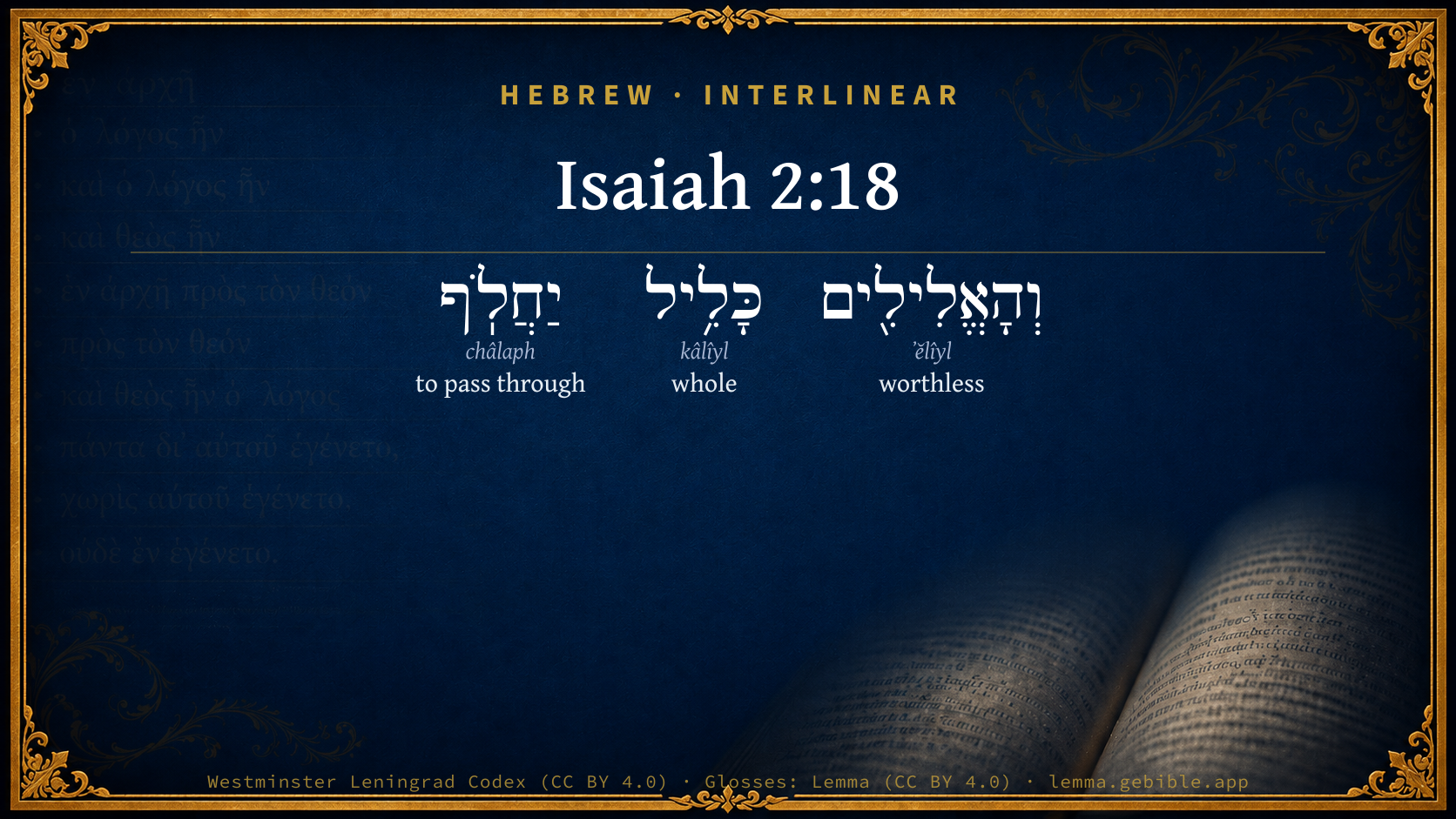
Isaiah 2:18

Hebrew (Westminster Leningrad Codex) Isaiah 2:18 appears in the Hebrew Old Testament. The text above is from the Westminster Leningrad Codex. Each word links to its Strong’s number, a concise gloss, and parsing drawn from the Open Scriptures Hebrew Bible morphology. Click any word for its full Brown-Driver-Briggs (BDB) entry.
Download image
Cite this verse

Isaiah 2:18 (World English Bible). Public Domain. Lemma interlinear Bible study tool, https://lemma.gebible.app/v/isaiah/2/18.

Show BibTeX & RIS
BibTeX
RIS
English Translation
The idols shall utterly pass away.
World English Bible · Public Domain
Download a study sheet

One document with this verse’s original text, its word-by-word gloss line, the meaning frame, cross-references with their text, attributed commentary, and full source and license credits — printable, and it pastes into notes with its structure intact.

This verse Autodidact and up

Study sheet (.html) Plain text (.txt)

A passage Seminary Student

Up to 50 verses in one chapter. A passage sheet keeps up to 6 commentary sources and 12 cross-references per verse, in the order this page ranks them, and says so on the sheet whenever that leaves anything out. Ask for a single verse and you get the Autodidact verse sheet above.

Everything on this page stays free to read, with no account — the sheet is a download of what is already on screen, not access to it.

Want to remove ads? Support Godless Engineer
Compare translations 3

The same verse in 3 English versions, stacked beneath the original-language interlinear above. Click any original word for its lexicon entry.

Each is an independent rendering of the whole verse — the interlinear is not word-aligned to these translations.

Highlighted words mark where these versions differ — a whole-verse word diff, not a word-by-word alignment.

  • World English Bible Public Domain
    The idols shall utterly pass away.
  • King James Version Public Domain
    And the idols he shall utterly abolish.
  • unfoldingWord Literal Text CC BY-SA 4.0
    And the idols will completely pass away.

unfoldingWord Literal Text — © unfoldingWord, licensed CC BY-SA 4.0. Word-aligned USFM3 via Door43 (git.door43.org/unfoldingWord/en_ult).

Versions to compare (up to 4)

3 of 4 selected

Show all 18 translations

Every available English version of this verse, each an independent rendering of the whole verse.

  • World English Bible Public Domain
    The idols shall utterly pass away.
  • Berean Standard Bible Public Domain
    and the idols will vanish completely.
  • Majority Standard Bible Public Domain
    and the idols will vanish completely.
  • King James Version Public Domain
    And the idols he shall utterly abolish.
  • American Standard Version (1901) Public Domain
    And the idols shall utterly pass away.
  • Revised Version (1885) Public Domain
    And the idols shall utterly pass away.
  • Geneva Bible (1599) Public Domain
    And the idoles will he vtterly destroy.
  • Douay-Rheims (1899) Public Domain
    And idols shall be utterly destroyed.
  • Young's Literal Translation Public Domain
    And the idols -- they completely pass away.
  • Literal Standard Version CC BY-SA 4.0
    And the idols—they completely pass away.
  • Unlocked Literal Bible CC BY-SA 4.0
    The idols will completely pass away.
  • unfoldingWord Literal Text CC BY-SA 4.0
    And the idols will completely pass away.
  • Darby Bible Public Domain
    and the idols shall utterly pass away.
  • World Messianic Bible Public Domain
    The idols shall utterly pass away.
  • Webster's Bible Public Domain
    And the idols he will utterly abolish.
  • Free Bible Version CC BY-SA 4.0
    Idols will completely vanish away.
  • Bible in Basic English Public Domain
    And the images will never be seen again.
  • JPS Tanakh (1917) Public Domain
    And the idols shall utterly pass away.

Literal Standard Version (2020), Covenant Press — licensed CC BY-SA 4.0. Text via the HelloAO Bible API (eBible.org). Unlocked Literal Bible (unfoldingWord) — licensed CC BY-SA 4.0. Text via the HelloAO Bible API (eBible.org). unfoldingWord Literal Text — © unfoldingWord, licensed CC BY-SA 4.0. Word-aligned USFM3 via Door43 (git.door43.org/unfoldingWord/en_ult). Free Bible Version, Dr. Jonathan Gallagher — licensed CC BY-SA 4.0. Text via the HelloAO Bible API (eBible.org).

Word by word

More ways to search: Search by grammar → Find every occurrence → Compare this word →

Practice this passage: Drill this verse → Learn its vocabulary →

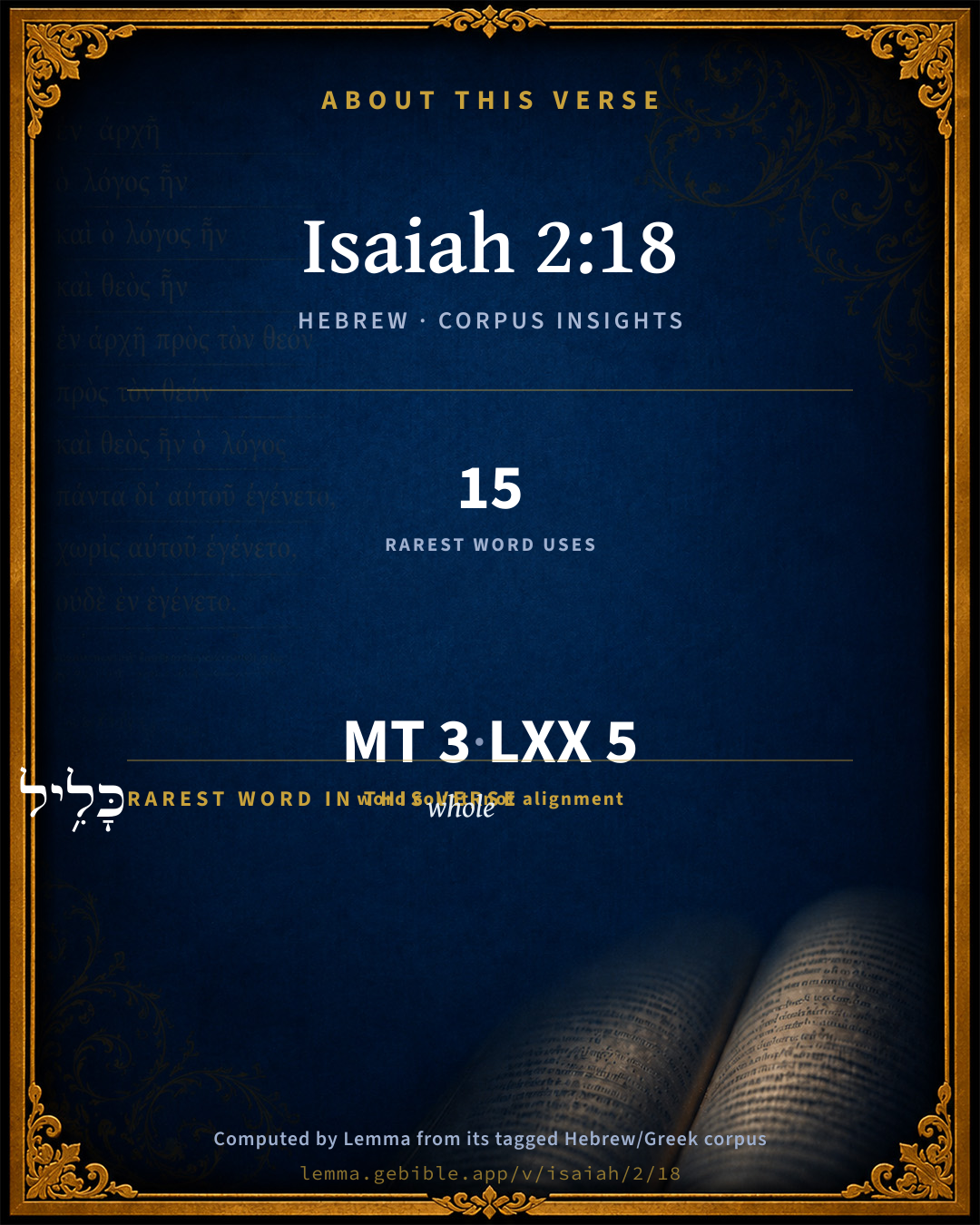
About this verse

These counts appear in no published source. They are computed here, from the morphology-tagged text and Lemma’s own curated glosses. What Lemma adds →

3
words
3
distinct lemmas
Prophets
section

Notable vocabulary

The rarest word here is כָּלִ֥יל whole H3632 — appearing just 15 times in the whole Hebrew Bible.

Shared distinctive vocabulary

כָּלִ֥יל whole H3632 occurs in 15 verses of the Hebrew Bible. Also found in:

Grammatical profile

  • 1 verb
  • 1 noun
  • 1 adjective

Verb forms

  • יַחֲלֹֽף Qal · Imperfect

Hebrew & Septuagint length

In English translation the verse runs 6 words from the Hebrew and 9 from the Septuagint (LXX English) — closely comparable.

A rough comparison of the two English renderings, which tokenize alike — not a word-level alignment.

Word counts can differ between the Hebrew and the Greek without any difference in meaning — e.g. the Hebrew direct-object marker אֵת has no separate Greek word, and Greek often adds the article ὁ.

In the original languages it is 3 Hebrew tokens and 5 Greek tokens — but the two are counted differently (Hebrew bundles its prefixes and suffixes into one token; the Greek is in lemma form), so that isn’t a like-for-like length.

Cross-references

7

Topical passages linked to Isaiah 2:18 in the Treasury of Scripture Knowledge — connected by theme and wording, ordered by reader-vote popularity; previews shown in the World English Bible.

  • Isaiah 21:9 and, behold, here comes a troop of men, horsemen in pairs. He answered, Fallen, fallen is Babylon; and all the engraved images of her gods are broken to the ground.
  • Isaiah 27:9 Therefore by this shall the iniquity of Jacob be forgiven, and this is all the fruit of taking away his sin: that he makes all the stones of the altar as chalk stones that are beaten in sunder, [so that] the Asherim and the sun-images shall rise no more.
  • Ezekiel 36:25 I will sprinkle clean water on you, and you shall be clean: from all your filthiness, and from all your idols, will I cleanse you.
  • Ezekiel 37:23 neither shall they defile themselves any more with their idols, nor with their detestable things, nor with any of their transgressions; but I will save them out of all their dwelling-places, in which they have sinned, and will cleanse them: so shall they be my people, and I will be their God.
  • Hosea 14:8 Ephraim, what have I to do any more with idols? I answer, and will take care of him. I am like a green fir tree; From me your fruit is found."
  • Zephaniah 1:3 I will sweep away man and animal. I will sweep away the birds of the sky, the fish of the sea, and the heaps of rubble with the wicked. I will cut off man from the surface of the earth, says Yahweh.
  • Zechariah 13:2 It will come to pass in that day, says Yahweh of Hosts, that I will cut off the names of the idols out of the land, and they will no more be remembered; and also I will cause the prophets and the spirit of impurity to pass out of the land.

Cross-references courtesy of OpenBible.info (CC BY 4.0).

Hebrew and Greek witnesses Masoretic Hebrew ↔ Greek Septuagint

The same verse in the two great witnesses to the Old Testament, shown verse-for-verse.

These are two independent witnesses, not word-aligned to each other, and the Septuagint is shown in lemma (dictionary) form.

Hebrew Isaiah 2:18 Masoretic · Westminster Leningrad Codex

וְהָאֱלִילִ֖ים כָּלִ֥יל יַחֲלֹֽף

The idols shall utterly pass away.

World English Bible · Public Domain

Greek LXX Isaiah 2:18 Septuagint · lemma form

καί ὁ χειροποίητος πᾶς κατακρύπτω

And they shall hide all idols made with hands,

LXX2012 (modern English Septuagint) · Public Domain

Hebrew: Westminster Leningrad Codex (CC BY 4.0). Greek: Septuagint (public domain); English from LXX2012 (modern English Septuagint) (Public Domain). How the Septuagint differs from the Hebrew →

Targum (Aramaic paraphrase)

1

The Targum is the ancient Jewish Aramaic paraphrase of the Hebrew Scriptures — an interpretive translation, not the Hebrew text itself. Onkelos (literal) and Pseudo-Jonathan (expansive) render the Torah, and Jonathan the Prophets. Coverage is partial: where no permissively-licensed English translation exists for a verse, only the Aramaic is shown. This is verse-level text, not a word-by-word alignment to the Hebrew.

  1. Targum Jonathan Prophets (Joshua–Malachi)
    וְטַעֲוָתָא גְמִירָא יְסוּפוּן:

    And the idols shall utterly come to an end.

    Targum Jonathan — Aramaic: “Mikraot Gedolot” (public domain). English: “Sefaria Community Translation” (CC0 1.0 (public-domain dedication)); “London "Chaldee Paraphrase," 1871” (public domain). Text via Sefaria.

Commentary

Notes on Isaiah 2:18 from classic Christian and Jewish commentators (each source and its license shown beneath its notes). The classic Christian expositions comment on the surrounding passage and are grouped to its opening verse, so a note may address several verses; the Jewish commentaries on the Tanakh (Rashi and others) are per-verse, so they appear only where the commentator wrote on this verse.

Lemma curates 59 commentaries, every one of them public domain or Creative Commons licensed, each selected and text-cleaned for this edition rather than reprinted as found. About our sources →

Trapp's Complete Commentary

John Trapp

Isa 2:18 And the idols he shall utterly abolish.

Ver. 18. And the idols he shall utterly abolish.] Their names shall be cut off out of the land, and they shall no more be remembered, {Zec 13:2} unless it be with shame and detestation. {Eze 16:61 Psa 16:4 Hos 14:8 Isa 30:22}

John Trapp, A Commentary or Exposition upon All the Books of the Old and New Testament (1647–1656) — public domain. Text from a community e-Sword module.

The Biblical Illustrator

Joseph S. Exell

Isa_2:18

And the idols He shall utterly abolish

The cessation of idolatry

In heathen systems of religion, God and nature are not kept distinct.

His personality, also, is confounded. The fears and hopes of idolaters are projected into deities. Two things are necessary to destroy idolatry in this its grossest form.

I. THE PREVALENCE OF THE WORD OF GOD.

1. Within its pages God and nature are carefully distinguished and separated.

2. Here His personality is clearly presented.

3. Here commands against idolatry are fully and solemnly promulgated.

4. Here the true God is set forth in all the glorious attributes that constitute His character, allegiance is commanded, service demanded, and every soul held to a strict accountability.

II. THE PREVALENCE OF THE CHRISTIAN CIVILISATION.

1. The Bible is indispensable. Heathen science is insufficient to deliver men from idolatry, as witness Rome and Greece.

2. Mere science is in danger of becoming materialistic or agnostic.

3. Science needs to be vitalised by the Bible, the moral law, and conscience.

Reflections--

1. Science is the handmaid of the Bible.

2. There can be no contradiction between the work of God and the Word of God.

3. It is the duty of every Christian to assist in the circulation of the Bible, to the end that every idol on the face of the earth may be speedily destroyed. (Homiletic Review.)

The evils of idolatry and the means of its abolition

The progress of Christianity in the world has already been so great and wonderful as to carry evidence of its Divine original, and of its promised final triumph over every false religion.

I. THE EVIL TO BE ABOLISHED. Idolatry. It has been commonly and very properly distinguished as of two kinds, literal and spiritual. Spiritual idolatry is an evil which, by the apostasy of our nature, attaches to all mankind, whether inhabiting Christian or pagan regions, except those individuals whose hearts have experienced a renovation by the Spirit of God. It is to literal idolatry that the prophet refers in the text--this the connection shows, where mention is made of those idols of silver and gold which the converted idolaters would cast away. The progress of Christianity was, from the first, marked by the cessation of idol worship. There are two principal points of view in which we may regard the evil nature and effects of idolatry--its aspect toward God and its aspect toward man. In the former aspect, it appears as a crime; in the latter as a calamity: thus contemplated, it appears as an evil destructive equally to the Divine glory and to human happiness. Man naturally tends to this evil; and one generation after another gradually accumulated the follies of superstition, till it reached the monstrous extreme of gross idolatry.

1. The Word of God everywhere reprobates idolatry as an abominable thing which the soul of God abhors. To provide against it was the principal object in the political and municipal department of the Mosaic law. It is expressly prohibited by the first and second commandments of the moral law. The golden calf was intended as a representative of the God of Israel; and the calves set up by Jeroboam were the same: yet the worship of the golden calf occasioned the slaughter, by the Divine command, of three thousand persons; and the executioners of Divine vengeance were extolled for having forgotten the feelings of nature toward their nearest kindred: every man was commanded to slay his brother or his son, and so to consecrate himself to the Lord. Where the honour of God was so deeply concerned, men were to lose sight of common humanity. When the Israelites were tempted by the artifices of Balaam to commit idolatry at Baal Peer, twenty-four thousand were slain at once; the memory of Phinehas was immortalised on account of the holy zeal he displayed in the destruction of certain conspicuous offenders; and the Moabites were devoted to extermination, because, in this respect, they had proved a snare to Israel. Idolatry is, with respect to the government of God, what treason or rebellion is with respect to civil government. It is the setting up of an idol in the place of the supreme Power; an affront offered to that Majesty, in which all order and authority is combined and concentred, and which is the fountain of all social blessings. Idolatry is an evil which taints every apparent virtue; because it destroys the soul of duty, which is conformity to the Divine command.

2. But we turn to contemplate idolatry on another side; in its aspect toward man, its influence on society. The apostle Paul informs us (Rom_1:19-25) that God hath shown to men what may be known concerning Himself; that His invisible Being, His eternal power and Godhead, may be clearly seen and understood by the works of creation; so that those are without excuse who have changed the glory of the incorruptible God into an image in the likeness of corruptible man, of birds and beasts and reptiles. They are without excuse; their conduct admits of no apology. The origin of all the atrocities they committed is to be found in aversion to God; dislike of the spirituality and purity of His character; a desire, like Cain, to retire from the presence of their Maker; a wish to forget a Being whose character they knew to be utterly uncongenial with their own. This disposition originally led men to substitute idols for God. Those idols would, of course, be conceived of a character unlike that of God.

II. We must now advert to a brighter scene, presented by the prophet, when he assures us that JESUS CHRIST (of whom he is speaking) WILL UTTERLY ABOLISH IDOLATRY, and sweep it from the face of the earth with the besom of destruction In sending the Gospel to the heathen, you offer, as it were, the holy incense, like Moses, when he interposed between God and the perishing Israelites: you stand, like him, between the dead and the living,--the dead and the living for eternity!--and you stay the plague! No sooner did Christianity appear, than its formidable power, as the opponent of idolatry, was felt and manifested. Preaching, an instrument so unpromising in the view of carnal reason, has been the chief instrument employed in producing these moral revolutions. (Robt. Hall.)

The downfall of idolatry

I wish to invite your attention to some of the reasons which induce me to believe that the heathen kingdoms of this world are to become the kingdoms of our God and of His Christ.

I. Consider, in the first place, THE LIGHT IN WHICH IDOLATRY IS REGARDED BY GOD. I am sometimes asked, Why do you unsettle the religious convictions of a highly civilised people like the Chinese? Is not the Supreme Governor of the universe pleased with the homage of His rational creatures when proceeding from sincere devotion, whether according to the one mode or the other, of the various religions which He has permitted to be published? Lord Macartney, the first ambassador to China, in writing to the Chinese emperor, gave this as a reason why the English never attempted to dispute or disturb the worship of others. But in whatever light idolatry is regarded by man, we know that it is a thing on which God cannot look with indifference. When we see idolatry associated with immorality and inhumanity, our instincts are naturally shocked, but where such is not the case, even the missionary finds it difficult to think and feel rightly in regard to it. The spiritual idolatry within us has so distorted our intellectual vision and perverted our spiritual taste that it requires an effort to see the literal idolatry in all its hideous deformity and feel towards it as we ought. The whole of heathendom is under the dominion of the prince of this world, and he and his angels are the powers worshipped by the heathen, however little they themselves may be aware of the fact. The whole fabric of heathenism has been reared under the inspiration of the spirit of darkness, and it is he that sits as God in that vast temple, calling himself God, and receiving oblations, sacrifice, and adoration from his deluded votaries. God sees in idolatry not weakness only, but also sin, positive sin, in its nature God-opposing and soul-destroying. It is an attempt to rob Him of that glory, which is peculiarly His own, and to confer it on the creature. But if this is the light in which God regards idolatry, we may rationally infer that the abomination will not be permitted to pollute the world forever.

II. My faith in THE FINAL TRIUMPH OF TRUTH in the progress of the race tends to produce this conviction in my mind. At the commencement of the Christian era the Sun of Righteousness began to scatter the thick darkness with His beams. For some time it rose higher and higher, and thousands were rejoicing in the Divine light which promised speedily to fill the whole earth with life and gladness. But these hopes were no sooner raised than dashed to the ground. Two dark clouds rose between the nations and the sun, which, lowering and spreading, enveloped them in more than Egyptian darkness. These were the Papacy and Mohammedanism. It is estimated that more than eight hundred millions, or about two-thirds of the human family, are idolaters today. But matters shall not remain in this state forever. The light is greater than the darkness; the truth of heaven is mightier than the falsehood of hell, and God is infinitely stronger than the devil. There may be occasionally something like a retrograde movement; the retrogression is only in appearance. The onward course of the race has been compared to that of a ship making way against the breeze; it consists of a series of movements, each of which seems to bear her away from the true direction, yet, in fact, brings her nearer and nearer to the destined haven. But if the race is progressing, and is ultimately to realise the object of its existence, idolatry must pass away. You cannot conceive of such a thing as the progress of the race along with the existence of idolatry. (Griffith John.)

The gods and goddesses of mythology

Homer, the first who appears to have composed a regular picture of idolatry, paints his Jupiter, or supreme deity, as deficient in every Divine attribute; in omnipotence, in justice, and even in domestic peace. He paints Juno as the victim of eternal jealousy; and with good reason for her jealousy, when the earth was peopled, according to Homey, with the illegitimate progeny of Jupiter, to whom almost every hero traced his pedigree. Mars was the personification of rage and violence; Mercury, the patron of artifice and them. How far such a mythology influenced the character of its votaries, it is perhaps impossible for us to know: nothing could be more curious than to look into the mind of a heathen. But it is certain that the mind must have been exceedingly corrupted by the influence of such a creed: and probably each individual idolater would be influenced by the deity whose character happened to be most accommodated to his own peculiar passions. Achilles would emulate Mars in ferocity and deeds of blood; Ulysses would be like Mercury in craft and stratagem; While the ambitious mind of Alexander or Julius Caesar would aspire to act a Jupiter on earth. What a state of society must that be, in which no vice, no crime could be perpetrated that was not sanctioned by the very objects of religious worship! What a religion that which exerted an antagonist force against conscience itself!--a religion which silenced or perverted the dictates of the moral sense, the thoughts that should either accuse or excuse us within! The temples of Venus, we are informed, wore crowded by a thousand prostitutes, as servants and representatives of that licentious goddess; the very places of their worship were the scenes of their vices, and seemed as if they were designed to consecrate the worst part of their conduct! (Robt. Hall.)

Destroying an idol

Two young men owned and supported a Hindu temple in a village named Rammakal Cooke. Both, becoming Christians, determined after much prayer to destroy the idol which had previously been worshipped in the temple. When they went to carry out their intention, a vast concourse assembled to hinder them. One of them brought out the idol, and lifting it up, asked if anyone would maintain its cause. The bold words awed the crowd, and then was heard the voice of a woman, saying, Victory, victory to Jesus Christ. Others took up the cry. The idol was broken, the temple destroyed. (J. Vaughan.)

J.G. Patons success among idol worshippers

After the sinking of the well by Paten on Aniwa, and the discovery of water in answer to prayer, the chief, Namakei, in a striking address, declared for Jehovah. That very afternoon he and several others brought their idols to the mission house. Intense excitement followed. For weeks, company after company came, and, with tears, sobs, or shouts, laid down their cherished idols in heaps, again and again repeating, Jehovah! (Sunday School Chronicle.)

The Biblical Illustrator, edited by Joseph S. Exell (c. 1880s–1900s) — public domain. Text from a community e-Sword module.

The Preacher's Complete Homiletical Commentary

Joseph S. Exell (gen. ed.)

THE GREAT DETHRONEMENT

Isa_2:18. And the idols He shall utterly abolish.

There are a great number of things which would be incredible if they had not actually happened! Men who, like ourselves, boasted of “reason” and “common sense,” sought to settle their disputes and to vindicate their honour by the duel; they have stoutly believed in witchcraft, in “touching for the king’s evil,” and in other absurdities. But surely the supreme folly of which men have been guilty is idolatry. That men should fashion an idol of wood or stone, and then bow down to worship it, what absurdity is this! Yet

I. The idols have had a long reign in the earth. Trace human history back as far as all extant records will enable you to do so, and you will find idols enthroned in the affections of men. That they should ever have been set up there must be regarded as one of Satan’s subtlest and greatest triumphs. The instincts that lead men to worship are so strong, that his only hope of preventing fallen men from returning to their allegiance to God lay in persuading them to worship some other thing or being. His difficulty and his device were those of Jeroboam (1Ki_12:26-28). He seems to have led men down step by step: stars, images as their respresentatives, then the images themselves: first, natural principles, then living creatures in which these principles were supposed to be embodied, then the living creatures themselves. To have begun at the end would have been too great a shock; the absurdity as well as the wickedness of such worship would have been too obvious. Thus was the empire of the idols founded, and it continues to this day.

II. The empire of the idols has been world-wide. It might have been supposed to be a folly that could be imposed only on a few barbarous tribes, and that all civilised nations would have rejected it with disdain; but as a matter of fact, it is precisely among these nations (Egypt, Greece, Rome, Judæa, India) that idolatry flourished most and in its basest forms. Hence the empire of idolatry was co-extensive with the globe. In Elijah’s time even God thought it a great thing that He would assure His prophet that there were seven thousand who had not bowed the knee to Baal (1Ki_19:18).

III. The idols have been served with passionate devotion. In almost all ages worshippers of idols have put to shame the worshippers of God, by their fidelity to their convictions, the scrupulousness of their observance of the rites which they have esteemed religious, and the greatness of the cost at which they have done honour to their gods.

IV. The idols have had for their allies the most influential of social and moral forces. Their priests and dependents (Act_19:25) have jealously watched every encroachment on the empire of their gods. Rulers, for political reasons, have strenuously endeavoured to uphold the national faiths. Custom and fashion have wrought in the same direction But, above all, the idols have had their most powerful allies in the human breast—in the instinct of worship, and the craving for sensual indulgences. Idolatry has combined these most powerful of all cravings—has provided deities in whose worship the worst passions of man’s animal nature have been gratified.

V. Nevertheless the empire of idolatry shall be utterly destroyed. It shall vanish as utterly as the great empire of Assyria. “The idols He shall utterly abolish.” Already that empire has been overthrown where it seemed most firmly established, and the complete fulfilment of the prediction of our text is obviously now only a question of time. Even in heathen countries, men are becoming ashamed of their idols, and are representing them as merely the media of worship. The victory of Christianity over idolatry is already assured. The struggles that are yet to shake the world will be, not between Christianity and idolatry; not even between Christianity and atheism, for atheism is necessarily merely a brief episode in human experience; but between Christianity and other forms of monotheism.

APPLICATION.

1. In the wide-spread and long-continued empire of the idols we have a conclusive proof of man’s need of a Divine revelation. The natural progress of fallen man is not to light, but to darkness (Rom_1:21-23; 1Co_1:21).

2. In the prediction of our text, we have a conclusive proof of that in the Bible we have such a revelation. Consider the circumstances of the prophet: idolatry on every hand, corrupting even His own people. It was contrary to all experience; it must have seemed to many who first heard it as the ravings of a lunatic. Such a prediction, already so marvellously fulfilled, came from God!

3. In the approaching complete fulfilment of the prediction of our text, let us rejoice. And let us labour as well as pray, that the time may be hastened when by idolatry God shall be no longer dishonoured nor man degraded.

The Preacher's Complete Homiletical Commentary (gen. ed. Joseph S. Exell; Funk & Wagnalls, c. 1892) — public domain (pre-1929). A full-Bible homiletical/sermon-outline anthology covering 65 of 66 books (2 John is absent from the source module). Text from a community e-Sword module.

Jamieson, Fausset & Brown

Robert Jamieson, A. R. Fausset & David Brown

idols--literally, "vain things," "nothings" (Co1 8:4). Fulfilled to the letter. Before the Babylonian captivity the Jews were most prone to idolatry; in no instance, ever since. For the future fulfilment, see Zac 13:2; Rev 13:15; Rev 19:20.

Jamieson, Fausset & Brown — Commentary Critical and Explanatory on the Whole Bible (1871) — public domain (CC PDM 1.0). Text via the HelloAO Bible API.

Adam Clarke's Commentary

Verse 18. Shall utterly abolish - "Shall disappear"] The ancient versions and an ancient MS. read יחלפו yachalpu, plural. One of my MSS. reads יחלוף yachaloph, probably a mistake for יחלפו yachalpu.

Adam Clarke's Commentary on the Bible (1810–1826) — public domain. Text from a community e-Sword/MySword module.

Ellicott's Commentary for English Readers

(18) And the idols.—Better, The no-gods shall pass away. The seven words of the English answer to three in the Hebrew. As with a profound sense, conscious or unconscious, of the power of rhythm, the prophet first condenses the judgment that is coming on the no-gods, and then expands it.

A Bible Commentary for English Readers, edited by Charles John Ellicott (1878–1897) — public domain. Text from a community e-Sword module.

The Cambridge Bible for Schools and Colleges

gen. ed. J. J. S. Perowne

18. And the idols … abolish] Rather, and as for the idols—they shall completely pass away (cf. R.V.). If the text be right this is the sense. But the extreme shortness of the verse, together with some grammatical anomalies, suggest that the text may have suffered mutilation in the course of transmission.

18–21. A special feature of the judgment will be the extinction of idolatry everywhere.

The Cambridge Bible for Schools and Colleges (gen. ed. J. J. S. Perowne; Cambridge University Press, 1878–1918) — public domain. Text from a community e-Sword module.

John Gill's Exposition

In that day a man shall cast his idols of silver, and his idols o gold,.... Being frightened at the terrible shaking of the earth, and at the glory and majesty of Christ, which will be seen in his witnesses and people, at the time of his spiritual coming, and the destruction of antichrist; insomuch that they shall cast away their idols, and relinquish their idolatrous practices, and give glory to the God of heaven, Rev 11:11,

which they made each one for himself to worship; everyone having their peculiar idol, the work of their own hands; which shows their gross ignorance and wretched stupidity:

to the moles, and to the bats; that is, either they shall leave them to persons as blind and ignorant as moles and bats; or rather they shall cast them into the holes which moles make, and bats have recourse unto. The Targum makes these the objects of worship, rendering the words,

"that they may worship the idols and images;''

and the Jewish writers interpret them of images worshipped in the form of moles and bats; though we never read of those creatures being worshipped, Moles were sacrificed to Neptune (w). Kimchi refers this text to the times of the Messiah; and some of their ancient writers (x) apply it to the Messiah, and to his arising and appearing in the land of Galilee.

(w) Phurnutus de Natura Deorum, p. 59. (x) Zohar in Exod. fol. 3. 3. &. in Numb. fol. 99. 3.

John Gill's Exposition of the Whole Bible (1746–1763) — public domain (CC PDM 1.0). Text via the HelloAO Bible API.

Albert Barnes' Notes on the Bible

And the idols - Note, Isa 2:8.

Abolish - Hebrew, ‘Cause to pass away or disappear.’ He shall entirely cause their worship to cease. This prediction was most remarkably fulfilled. Before the captivity at Babylon, the Jews were exceedingly prone to idolatry. It is a remarkable fact that no such propensity was ever evinced “after” that. In their own land they were entirely free from it; and scattered as they have been into all lands, they have in every age since kept clear from idolatry. Not an instance, probably, has been known of their relapsing into this sin; and no temptation, or torture, has been sufficient to induce them to bow down and worship an idol. This is one of the few instances that have occurred where affliction and punishment have “completely” answered their design.

Albert Barnes' Notes on the Bible (1834–1885) — public domain. Text from a community e-Sword/MySword module.

Haydock's Catholic Bible Commentary

Destroyed. This was verified by the establishment of Christianity. And by this and other texts of the like nature, the wild system of some modern sectaries is abundantly confuted, who charge the whole Christian Church with worshipping idols, for many ages. (Challoner) --- Yea, for above a thousand years, while she still professed the name of Christ. (Worthington)

George Leo Haydock (1774–1849), Haydock's Catholic Family Bible and Commentary, 1859 edition — public domain. Excludes Psalms (Douay-Rheims chapter numbering differs from Protestant) and Deuterocanonical books (Catholic canon only).

Matthew Poole's English Annotations

God will discover the impotency of idols to succour their worshippers, and thereby destroy their worship in the world.

Matthew Poole's English Annotations on the Holy Bible (1683–1685) — public domain. Text from a community e-Sword/MySword module.

Whedon's Commentary on the Bible

Daniel D. Whedon

18. The idols… abolish — As for them, they all shall pass away. Emphatic and sarcastic; a prediction fulfilled to the letter, by the captivity at Babylon. Before this event the Jews were madly prone to idolatry — but never since. Zec_13:2. Query: In the line of what natural causation did the Almighty Providence effect such an utter change?

Daniel D. Whedon (gen. ed.), Commentary on the Old and New Testaments (1874–1909) — public domain. Text from a community e-Sword module.

The Pulpit Commentary

And the idols he shall utterly abolish; rather, and the idols shall utterly pass away. While the visitation shall fall only partially on the other objects precious to Israel the cedars, the oaks, the terraced mountains and hills, the strongholds, the ships, and the works of art the idols shall be wholly swept away by it. It is impossible to say what visitation exactly was in the prophet"s mind; but if we may suppose that the Babylonian captivity came within the range of the prophetic vision, we must pronounce the prediction to have received a very remarkable fulfillment in this matter, since that calamity did put an entire end to the idolatry of the nation.

The Pulpit Commentary (1880–1919), ed. H.D.M. Spence-Jones & Joseph S. Exell — public domain. Text from a community e-Sword module.

Keil & Delitzsch

C. F. Keil & F. Delitzsch

The closing refrain of the next two strophes is based upon the concluding clause of Isa 2:10. The proclamation of judgment turns now to the elilim, which, as being at the root of all the evil, occupied the lowest place in the things of which the land was full (Isa 2:7, Isa 2:8). In a short v. of one clause consisting of only three words, their future is declared as it were with a lightning-flash. "And the idols utterly pass away." The translation shows the shortness of the verse, but not the significant synallage numeri. The idols are one and all a mass of nothingness, which will be reduced to absolute annihilation: they will vanish Câlil, i.e., either "they will utterly perish" (funditus peribunt), or, as Câlil is not used adverbially in any other passage, "they will all perish" (tota peribunt, Jdg 20:40) - their images, their worship, even their names and their memory (Zac 13:2).

Keil & Delitzsch — Biblical Commentary on the Old Testament (1861–1891) — public domain (CC PDM 1.0). Text via the HelloAO Bible API. (Old Testament only.)

J. A. Alexander on Isaiah

Joseph Addison Alexander

To the humiliation of all lofty things the Prophet now adds the entire disappearance of their idols. “And the idols (as for the idols) the whole shall pass away.” The brevity of this verse, consisting of a single clause, has been commonly regarded as highly emphatic and, as some think, sarcastic.

Joseph Addison Alexander, The Prophecies of Isaiah (1846–1847; New York: Scribner, 1870–1878) — public domain. Text from a community e-Sword module.

Rashi

Rabbi Shlomo Yitzchaki (Rashi)

shall completely pass away They will all pass away; they will all vanish.

Rashi on the Tanakh — English translations: “The Judaica Press complete Tanach with Rashi, translated by A. J. Rosenberg” (CC BY 4.0); “Pentateuch with Rashi's commentary by M. Rosenbaum and A.M. Silbermann, 1929-1934” (public domain); “The Metsudah Tanach series, Lakewood, N.J” (CC BY 4.0); and “The Book of Joshua, Metsudah Publications, 1997” (CC BY 4.0). Text via Sefaria.

Ibn Ezra

Rabbi Abraham ibn Ezra

יחלוף He shall abolish. Comp. בני חלוף the afflicted (Prov. 31:5), to whom death is imminent; this root has a similar meaning in חלף it is over (Song 2:11).

כליל. This word remains the same in the masculine and feminine, singular and plural; it means all (comp. Exod. 28:31; Lev. 6:16).

He shall abolish. The third person refers to God.

Ibn Ezra on the Tanakh — English translations: “Sefaria Community Translation” (CC0 1.0 (public-domain dedication)); “Yalkut, Sifsei Chachomim Chumash, Metsudah Publications, 2009” (CC BY 4.0); and “Commentary of Ibn Ezra on Isaiah - trans. by M. Friedlander, 1873” (public domain). Text via Sefaria.

Lesson kit

Teaching starters — assembled from the data on this page, not authored interpretation. Every prompt links to the verse data it draws on. Edit before teaching.

Isaiah, in the Prophets, opens this verse with 3 words (3 distinct Hebrew lemmas). Its most distinctive word is kâlîyl (“whole”). A historical commentator’s framing appears above. Read the whole chapter for the surrounding context.

Discussion questions

  1. How does “whole” (kâlîyl) shape what this verse is saying?
  2. Exodus 28:31 shares the word «whole» with this verse. How do the two illuminate each other?
  3. These translations render this verse differently. What is at stake in choosing one wording over another?
  4. The verb «יַחֲלֹֽף» is Qal Imperfect. How does its form color the action?
  5. Reading how Trapp's Complete Commentary and The Biblical Illustrator read this verse, where do the two commentators agree and where do they part?

Things to notice

Reading settings

Reading text

Shown beneath each verse's original-language words.

Old Testament
Old Testament edition

Read the OT as the Masoretic Hebrew (MT) or the Greek Septuagint (LXX).

English shown for the Greek Septuagint (in the Hebrew ↔ Greek comparison).

Comparing translations? Open the Compare panel on any verse page to stack up to four side by side.