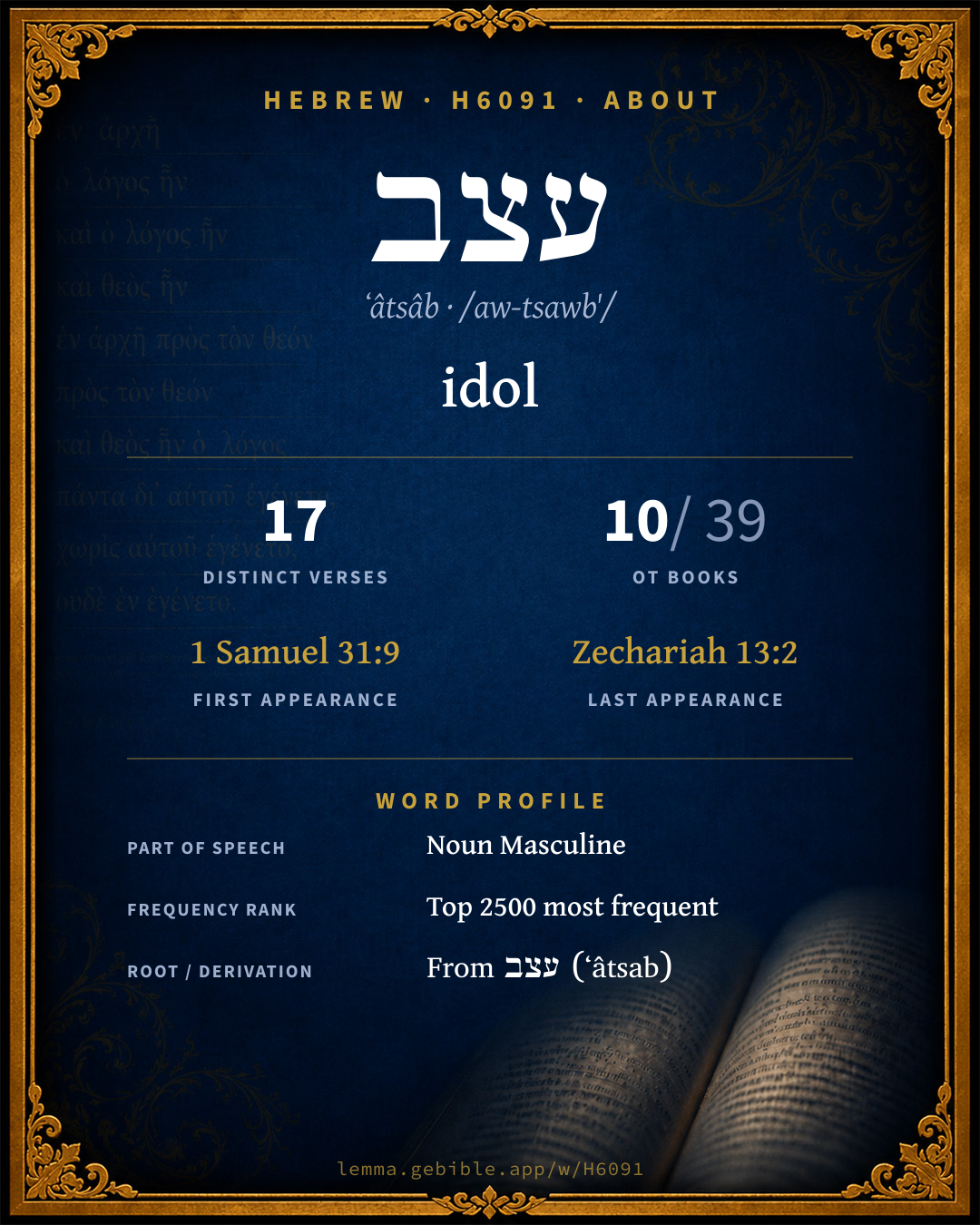
עָצָב
idol
Full lexicon entry — Brown-Driver-Briggs (BDB)
From Brown-Driver-Briggs (BDB)
Where this word appears
See every Construct-state word in the Hebrew Bible →
Grammar key — what these labels mean
Part of speech
- Noun
- A naming word — a person, place, thing, or idea.
Noun type
- Common
- A common noun — a general class of person, place, or thing (“king,” “city,” “water”), not a specific name.
State
- Construct
- A noun bound to a following noun in a possessive / “of” relationship (the construct chain).
- Absolute
- The independent form of a noun, not bound to a following word.
Gender
- Masculine
- Grammatically masculine.
Number
- Plural
- More than one (in Hebrew, generally three or more).
Grammatical forms
- Noun, Common, Masculine, Plural, Construct 11 times (65%)
- Noun, Common, Masculine, Plural, Absolute 6 times (35%)
Parsed forms decoded from the imported morphology (morphhb / Westminster Leningrad Codex — WLC text public domain, morphhb tagging CC BY 4.0), counted across 17 parsed occurrences — not distinct verses.
Every verse where H6091 appears — 17 distinct verses across 10 books. Click any verse to open its interlinear word-by-word view. Verse text shown in the World English Bible for context — . Each verse’s Hebrew form is shown with its reference; the English is not keyword-highlighted, since the data carries no word-level English alignment. Use “Compare translations” on any verse to read it across multiple English versions. This concordance covers the Hebrew Bible; Septuagint (Greek Old Testament) occurrences are not indexed here.
1 Samuel 1 verse
2 Samuel 1 verse
1 Chronicles 1 verse
2 Chronicles 1 verse
Psalms 4 verses
- Psalms 106:36 עֲצַבֵּי/הֶ֑ם n c mp cs + sfx pers 3mp They served their idols, Which became a snare to them.
- Psalms 106:38 לַ/עֲצַבֵּ֣י prep + n c mp cs They shed innocent blood, Even the blood of their sons and of their daughters, Whom they sacrificed to the idols of Canaan. The land was polluted with blood.
- Psalms 115:4 עֲֽ֭צַבֵּי/הֶם n c mp cs + sfx pers 3mp Their idols are silver and gold, The work of men's hands.
- Psalms 135:15 עֲצַבֵּ֣י n c mp cs The idols of the nations are silver and gold, The work of men's hands.
Isaiah 2 verses
- Isaiah 10:11 וְ/לַ/עֲצַבֶּֽי/הָ conj + prep + n c mp cs + sfx pers 3fs shall I not, as I have done to Samaria and her idols, so do to Jerusalem and her idols?
- Isaiah 46:1 עֲצַבֵּי/הֶ֔ם n c mp cs + sfx pers 3mp Bel bows down, Nebo stoops; their idols are on the animals, and on the cattle: the things that you carried about are made a load, a burden to the weary [animal].
Jeremiah 1 verse
Hosea 4 verses
- Hosea 4:17 עֲצַבִּ֛ים n c mp Ephraim is joined to idols. Leave him alone!
- Hosea 8:4 עֲצַבִּ֔ים n c mp They have set up kings, but not by me. They have made princes, and I didn't approve. Of their silver and their gold they have made themselves idols, That they may be cut off.
- Hosea 13:2 עֲצַבִּ֔ים n c mp Now they sin more and more, And have made themselves molten images of their silver, Even idols according to their own understanding, All of them the work of the craftsmen. They say of them, "They offer human sacrifice and kiss the calves."
- Hosea 14:8 לָֽ/עֲצַבִּ֑ים prep det + n c mp Ephraim, what have I to do any more with idols? I answer, and will take care of him. I am like a green fir tree; From me your fruit is found."
Micah 1 verse
Zechariah 1 verse
About this entry
At a glance — auto-summarized from this page’s data, not written by a person. Every figure links to its source below. This summary describes the numbers; it doesn’t interpret them.
The Hebrew noun עצב centers on the idea of “idol.” Its earliest occurrence is 1 Samuel 31:9. The Hebrew Bible uses it across 17 verses — uncommon. Sharing its root, it stands alongside עצב, מעצבה and עצב. Dig into 17-verse concordance and the renderings breakdown below.
Gloss history
Strong's 1890 vs modern scholarship
About this word
Strong's H6091 catalogs a Hebrew word from the Hebrew Old Testament.
These counts are not copied from any lexicon or concordance. They are computed here, from the morphology-tagged Hebrew Old Testament. What Lemma adds →
- 17
- distinct verses
- The word appears in 17 distinct verses.
- 10 / 39
- OT books
- The word appears in 10 of 39 Old Testament books.
- #1,671
- by frequency
- Top 2500 most frequent Hebrew words (rank 1,671 of 8,640 Hebrew words by occurrence).
View all 17 occurrences in the concordance →
By section of the Old Testament
By traditional corpus
Conventional, traditional groupings — biblical authorship is debated, so this is a traditional corpus grouping, not an authorship claim. Each share is this word’s portion of its verses in that division of the Hebrew canon. Each figure is a share of the word’s 17 distinct verses.
- Prophets (Nevi'im) 11 verses · 65%
- Writings (Ketuvim) 6 verses · 35%
How translations render this word
Counts come from each version’s own published word-to-Strong’s tagging or interlinear alignment — an approximate guide to how each version renders this word, not a word-level alignment the data otherwise carries. Because each total is that version’s own tagged count, the per-version totals vary from one another and need not match the appearance or distinct-verse counts above. These counts may also differ from a printed concordance because Lemma counts each distinctly tagged rendering and does not collapse phrase taggings into a single head-word total. This is a fixed set of word-tagged versions (KJV, ASV, BSB, ULT) and does not change with the reading translation you choose elsewhere. Each version’s license is shown beside its name below (and on Sources).
- King James Version: Idols 14×
- American Standard Version: Idols 13×, Images 2×
- Berean Standard Bible: Idols 16×
- unfoldingWord Literal Text: Idols 13×, Idols of 2×
King James Version Public Domain
Renders H6091 across 17 tagged occurrences — most commonly:
Plus 3 renderings that appear only once — usually multi-word phrases or single function words the recovered tagging swept in, not distinct renderings.
American Standard Version Public Domain
Renders H6091 across 17 tagged occurrences — most commonly:
Plus 2 renderings that appear only once — usually multi-word phrases or single function words the recovered tagging swept in, not distinct renderings.
Berean Standard Bible Public Domain
Renders H6091 across 17 tagged occurrences — most commonly:
Plus 1 rendering that appears only once — usually multi-word phrases or single function words the recovered tagging swept in, not distinct renderings.
unfoldingWord Literal Text CC BY-SA 4.0
Renders H6091 across 17 tagged occurrences — most commonly:
Plus 2 renderings that appear only once — usually multi-word phrases or single function words the recovered tagging swept in, not distinct renderings.
Senses in BDB
The 1 sense BDB distinguishes for this word, in lexicon order (not ranked by frequency or importance). The full entry — with sub-senses — is in the Lexicon Entry tab.
- idol, image
Word origin
Derived from עצב (ʻâtsab) (H6087) — to pain.
Jastrow Dictionary
A second Hebrew/Aramaic lexicon for comparison, covering Aramaic and post-biblical (Talmudic, Targumic, Midrashic) usage that the biblical-Hebrew BDB does not. Matched by lemma rather than by Strong’s number, so a lemma may carry more than one Jastrow headword (shown separately below), and the entries cover usage well beyond the Bible.
עָצַב
- (b. h.)
- 1. to cut, form, shape.
- 2. (cmp. יָגָה a. יָגוֹן) to cut, grieve, pain.
- to shape, handle, esp. to straighten an infant’s body by manipulation. Sabb. XXII, 6 אין מְעַצְּבִין את הקטן you must not manipulate a child (on the Sabbath), expl. ib. 147ᵇ בחומרי שדרה straightening the vertebra (v. לְפַף). Tosef. Kel. B. Mets. II, 9 שהוא מְעַצֵּב עליה וכ׳ because he (the surgeon) manipulates children thereon.
- to grieve. Gen. R. s. 44 (ref. to Ps. CXXXIX, 24) אם עתיד … (ו)להַעֲצִיבְךָ וכ׳ if it be my destiny to rear children who are to grieve thee, it is better that thou shouldst lead me in the way of the world (death); (Yalk. Ps. 888 ולהכעיסך). e.g. Psalms 139:24
- to be grieved, mourn. Snh. 38ᵇ שמח בתורתו ונ׳ במיתתו he rejoiced over his (R. ‘Ăkiba’s) learning, and mourned over his death (predestined martyrdom).
עֲצַב
- ; (intr.) to be grieved. Targ. Ps. XXXIV, 6 (v. חֲסַד II).—Part. pass. עָצֵב, עָצִיב; f. עֲצִיבָא; pl. עֲצִיבֵי grieved, sad. Targ. Esth. IV, 1; Targ. Y. Ex. XII, 31 קל ע׳ the voice of a mourner.—Bets. 16ᵇ חזייה דהוה ע׳ he saw that he looked down-hearted; אמאי עֲצִיבַת why art thou grieved? Taan. 25ᵃ. Ib. 22ᵃ מבדחינן ע׳, v. בָּדוֹחָא; a. fr.
- to be grieved. Ber. 31ᵃ ואִעֲצִיבוּ and they grew sad; Yalk. Ps. 881 ואִיעֲ׳.
עָצָב
- 1. form, esp. idol.—Pl. עֲצַבִּים. Sifra K’dosh., beg. ע׳ על שם שנעשו פרקים פרקים idols are called ‘forms’, because they are made limb by limb; Mekh. Mishp. s. 20; Ab. d’R. N. ch. XXXIV.—Snh. 63ᵇ ועושין דמות עֲצַבֵּיהֶם (not עצבים, v. Rabb. D. S. a. l. note 1) they made an image of their (the rich men’s) figures; Yalk. Hos. 529.
עֶצֶב
- 2. trouble, toil; that which is acquired through toil.—Pl. עֲצָבִים. Num. R. s. 9 (ref. to ועצביך, Prov. V, 10) אין עֲצָבֶיךָ אלא בנים (ed. Wil. עֲצִיבָה וכ׳) ‘thy toils’ means thy children (with ref. to Gen. III, 16); ע׳ זו יגיעת הארץ ‘thy toils’ means painful labor in the field (with ref. to ib. 17). e.g. Proverbs 5:10
עָצֵב
- preced.) sad, grief-stricken. Pes. 119ᵃ מלך בו"ד מנצחין אותו וע׳ וכ׳ a human King grieves when he is defeated, but the Lord &c.; (Midr. Till. to Ps. IV כועס), v. נָצַח. Ber. 5ᵃ מוכר ע׳ ולוקח שמח the seller grieves (because he has to part with a dear possession), and the buyer is glad; a. e.—Pl. עֲצֵבִים, עֲצֵבִין; עֲצֵבוֹת, עֲצֵי׳. Yoma 21ᵇ. Ib. 67ᵃ; a. e.—Trnsf. (of the fingers of the hand) pressed together, narrow, opp. שׂוֹחֵק. Erub. 3ᵇ, a. e., v. אַמָּה.
עָצֵב ²
- ch., v. עֲצַב
A Dictionary of the Targumim, the Talmud Babli and Yerushalmi, and the Midrashic Literature (Marcus Jastrow; London, Luzac, 1903) — Public Domain. Digitized via Sefaria. Digitized via Sefaria. Full attribution on Sources.
Forms in the corpus
The 14 distinct written forms H6091 takes in the Hebrew Bible, most frequent first — each parse links to that state’s occurrences in the concordance. Hebrew forms include their vowel points and cantillation, so a single lemma takes many written forms.
Same root — word family
Other BDB entries built from the same root as H6091, grouped by Strong’s listed origin. These share a root / origin per the lexicon — not necessarily a shared meaning. Each links to that word’s own entry.
Derives from
Shares the same root
- מעצבה maʻătsêbâh H4620 place of grief
- עצב ʻătsab H6088 pained
- עצב ʻetseb H6089 pain
- עצב ʻâtsêb H6092 labourer
- עצבון ʻitstsâbôwn H6093 toil
- עצבת ʻatstsebeth H6094 sorrow
Compare all same-root words → Showing 4 of 8 — not the complete family. They share a root, not necessarily a meaning.
Septuagint verse parallels
This word appears in 17 verses that also exist in the Greek Old Testament (Septuagint), out of the 17 Hebrew verses it occurs in. You can read those verses in Greek by switching the Old Testament edition to the Septuagint.
Read these verses in the Septuagint
- 1 Samuel 31:9
- 2 Samuel 5:21
- 1 Chronicles 10:9
- 2 Chronicles 24:18
- Psalms 106:36
- Isaiah 10:11
- Jeremiah 50:2
- Hosea 4:17
- Micah 1:7
- Zechariah 13:2
This is a verse-level parallel only — the same verses exist in both the Hebrew and Greek Old Testaments. No word-level Hebrew↔Greek correspondence is claimed: the data carries no such alignment, so no Greek word is shown as this Hebrew word’s translation. Coverage is not total — the Septuagint omits the deuterocanon and renumbers the Psalms, so some Hebrew verses have no direct Greek parallel.