
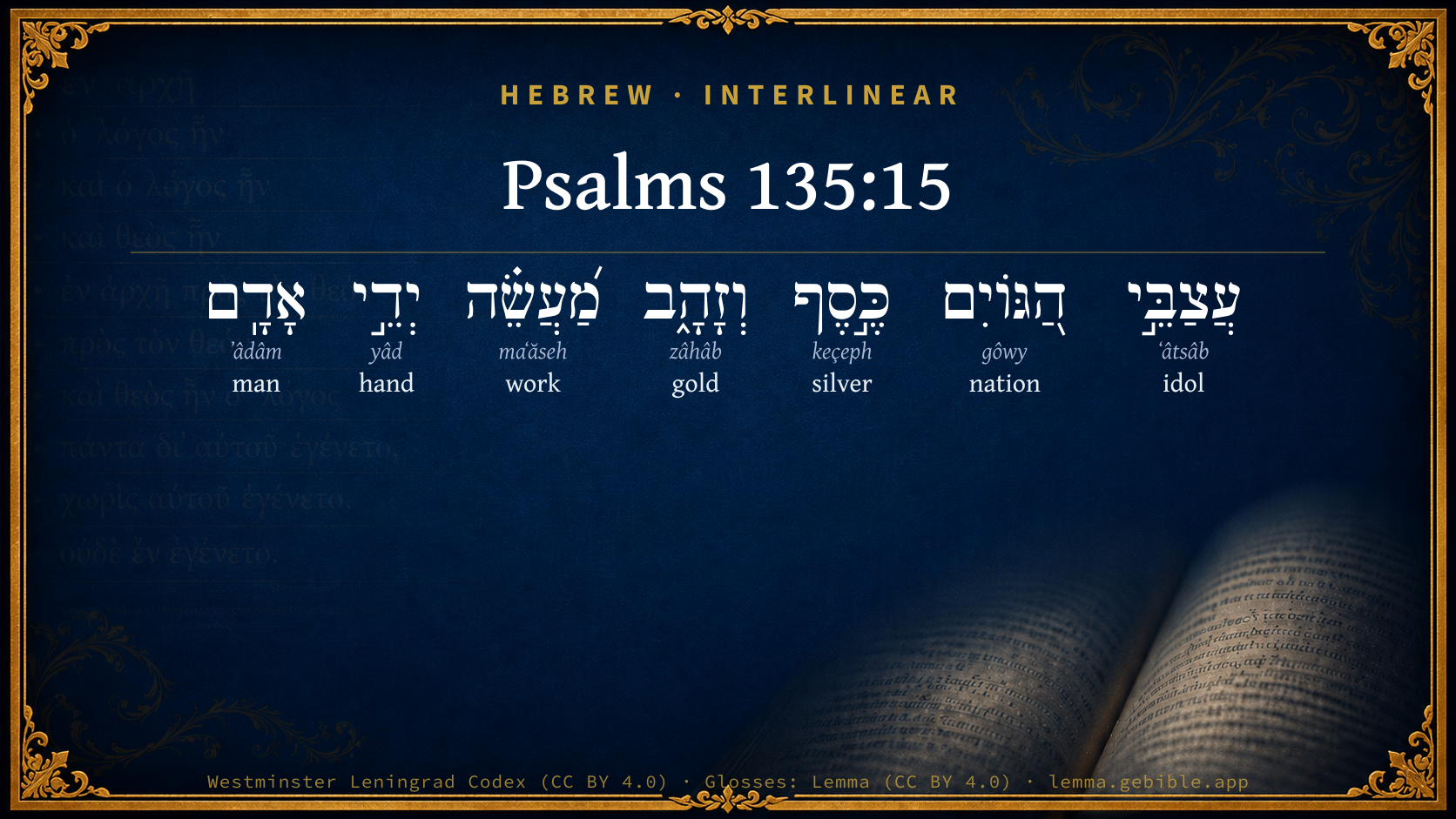
Psalms 135:15

Hebrew (Westminster Leningrad Codex) Psalms 135:15 appears in the Hebrew Old Testament. The text above is from the Westminster Leningrad Codex. Each word links to its Strong’s number, a concise gloss, and parsing drawn from the Open Scriptures Hebrew Bible morphology. Click any word for its full Brown-Driver-Briggs (BDB) entry.
Download image
Cite this verse

Psalms 135:15 (World English Bible). Public Domain. Lemma interlinear Bible study tool, https://lemma.gebible.app/v/psalms/135/15.

Show BibTeX & RIS
BibTeX
RIS
English Translation
The idols of the nations are silver and gold, The work of men's hands.
World English Bible · Public Domain
Download a study sheet

One document with this verse’s original text, its word-by-word gloss line, the meaning frame, cross-references with their text, attributed commentary, and full source and license credits — printable, and it pastes into notes with its structure intact.

This verse Autodidact and up

Study sheet (.html) Plain text (.txt)

A passage Seminary Student

Up to 50 verses in one chapter. A passage sheet keeps up to 6 commentary sources and 12 cross-references per verse, in the order this page ranks them, and says so on the sheet whenever that leaves anything out. Ask for a single verse and you get the Autodidact verse sheet above.

Everything on this page stays free to read, with no account — the sheet is a download of what is already on screen, not access to it.

Want to remove ads? Support Godless Engineer
Compare translations 3

The same verse in 3 English versions, stacked beneath the original-language interlinear above. Click any original word for its lexicon entry.

Each is an independent rendering of the whole verse — the interlinear is not word-aligned to these translations.

Highlighted words mark where these versions differ — a whole-verse word diff, not a word-by-word alignment.

  • World English Bible Public Domain
    The idols of the nations are silver and gold, The work of men's hands.
  • King James Version Public Domain
    The idols of the heathen are silver and gold, the work of men's hands.
  • unfoldingWord Literal Text CC BY-SA 4.0
    The idols of the nations silver and gold, the work of the hands of man.

unfoldingWord Literal Text — © unfoldingWord, licensed CC BY-SA 4.0. Word-aligned USFM3 via Door43 (git.door43.org/unfoldingWord/en_ult).

Versions to compare (up to 4)

3 of 4 selected

Show all 17 translations

Every available English version of this verse, each an independent rendering of the whole verse.

  • World English Bible Public Domain
    The idols of the nations are silver and gold, The work of men's hands.
  • Berean Standard Bible Public Domain
    The idols of the nations are silver and gold, made by the hands of men.
  • Majority Standard Bible Public Domain
    The idols of the nations are silver and gold, made by the hands of men.
  • King James Version Public Domain
    The idols of the heathen are silver and gold, the work of men's hands.
  • American Standard Version (1901) Public Domain
    The idols of the nations are silver and gold, The work of men's hands.
  • Revised Version (1885) Public Domain
    The idols of the nations are silver and gold, the work of men’s hands.
  • Geneva Bible (1599) Public Domain
    The idoles of the heathen are siluer and golde, euen the worke of mens handes.
  • Young's Literal Translation Public Domain
    The idols of the nations `are' silver and gold, Work of the hands of man.
  • Literal Standard Version CC BY-SA 4.0
    The idols of the nations [are] silver and gold, || Work of the hands of man.
  • Unlocked Literal Bible CC BY-SA 4.0
    The nations' idols are silver and gold, the work of men's hands.
  • unfoldingWord Literal Text CC BY-SA 4.0
    The idols of the nations silver and gold, the work of the hands of man.
  • Darby Bible Public Domain
    The idols of the nations are silver and gold, the work of men's hands:
  • World Messianic Bible Public Domain
    The idols of the nations are silver and gold, the work of men’s hands.
  • Webster's Bible Public Domain
    The idols of the heathen are silver and gold, the work of men's hands.
  • Free Bible Version CC BY-SA 4.0
    The idols of the foreign nations are only objects of silver and gold, made by human hands.
  • Bible in Basic English Public Domain
    The images of the nations are silver and gold, the work of men's hands.
  • JPS Tanakh (1917) Public Domain
    The idols of the nations are silver and gold, the work of men's hands.

Literal Standard Version (2020), Covenant Press — licensed CC BY-SA 4.0. Text via the HelloAO Bible API (eBible.org). Unlocked Literal Bible (unfoldingWord) — licensed CC BY-SA 4.0. Text via the HelloAO Bible API (eBible.org). unfoldingWord Literal Text — © unfoldingWord, licensed CC BY-SA 4.0. Word-aligned USFM3 via Door43 (git.door43.org/unfoldingWord/en_ult). Free Bible Version, Dr. Jonathan Gallagher — licensed CC BY-SA 4.0. Text via the HelloAO Bible API (eBible.org).

Word by word

More ways to search: Search by grammar → Find every occurrence → Compare this word →

Practice this passage: Drill this verse → Learn its vocabulary →

About this verse

These counts appear in no published source. They are computed here, from the morphology-tagged text and Lemma’s own curated glosses. What Lemma adds →

7
words
7
distinct lemmas
Wisdom
section

Notable vocabulary

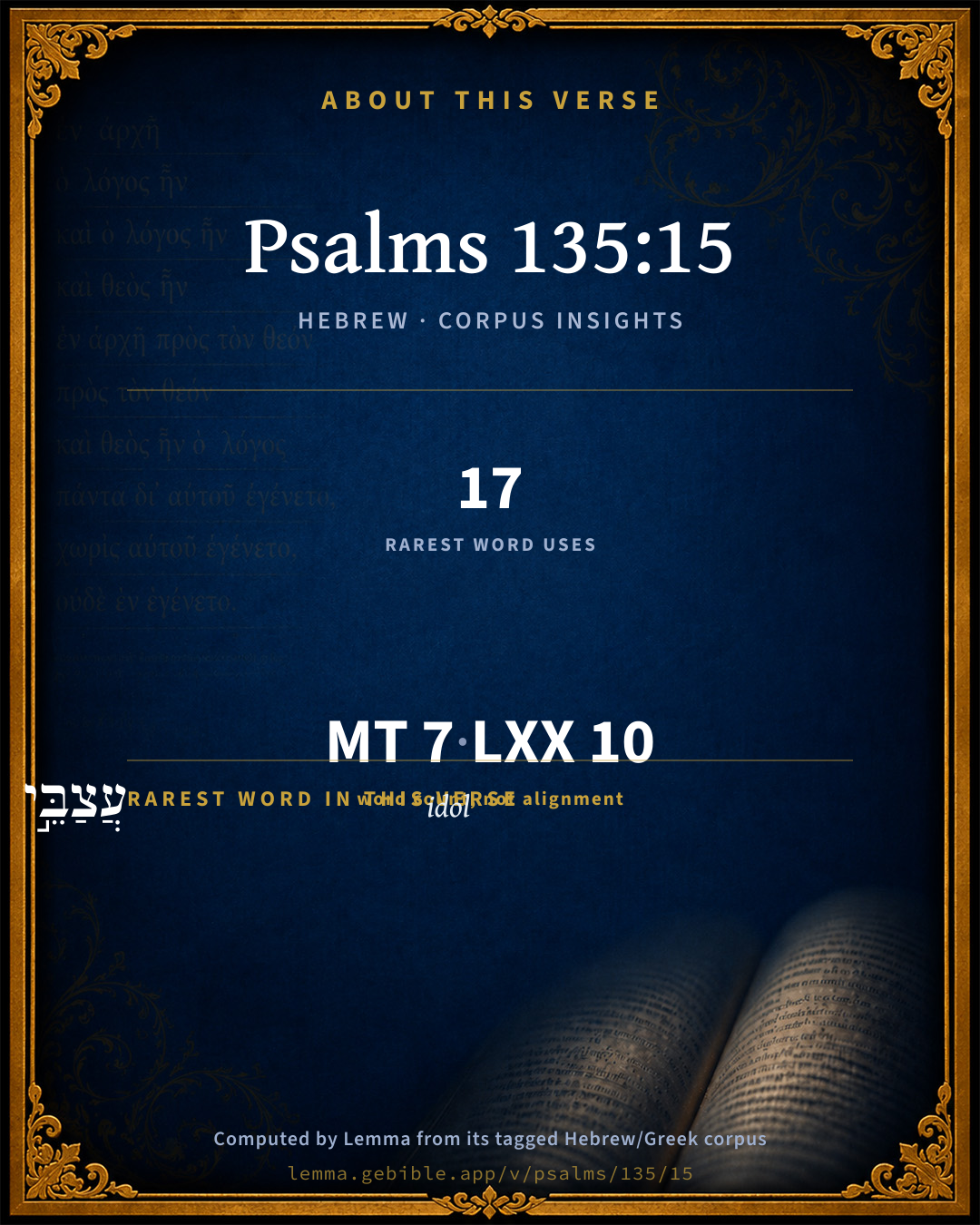
The rarest word here is עֲצַבֵּ֣י idol H6091 — appearing just 17 times in the whole Hebrew Bible.

Shared distinctive vocabulary

עֲצַבֵּ֣י idol H6091 occurs in 17 verses of the Hebrew Bible. Also found in:

Grammatical profile

  • 7 nouns

Hebrew & Septuagint length

In English translation the verse runs 14 words from the Hebrew and 14 from the Septuagint (LXX English) — the same length.

A rough comparison of the two English renderings, which tokenize alike — not a word-level alignment.

Word counts can differ between the Hebrew and the Greek without any difference in meaning — e.g. the Hebrew direct-object marker אֵת has no separate Greek word, and Greek often adds the article ὁ.

In the original languages it is 7 Hebrew tokens and 10 Greek tokens — but the two are counted differently (Hebrew bundles its prefixes and suffixes into one token; the Greek is in lemma form), so that isn’t a like-for-like length.

Cross-references

9

Topical passages linked to Psalms 135:15 in the Treasury of Scripture Knowledge — connected by theme and wording, ordered by reader-vote popularity; previews shown in the World English Bible.

  • Psalms 115:4–8 Their idols are silver and gold, The work of men's hands.
  • Isaiah 37:19 and have cast their gods into the fire: for they were no gods, but the work of men's hands, wood and stone; therefore they have destroyed them.
  • Jeremiah 10:3–11 For the customs of the peoples are vanity; for one cuts a tree out of the forest, the work of the hands of the workman with the axe.
  • Habakkuk 2:18–19 "What value does the engraved image have, that its maker has engraved it; the molten image, even the teacher of lies, that he who fashions its form trusts in it, to make mute idols?
  • Acts 17:29 Being then the offspring of God, we ought not to think that the Divine Nature is like gold, or silver, or stone, engraved by art and design of man.
  • Isaiah 44:9–20 Those who fashion an engraved image are all of them vanity; and the things that they delight in shall not profit; and their own witnesses don't see, nor know: that they may be disappointed.
  • Isaiah 46:6–7 Some pour out gold from the bag, and weigh silver in the balance. They hire a goldsmith, and he makes it a god. They fall down--yes, they worship.
  • Deuteronomy 4:28 There you shall serve gods, the work of men's hands, wood and stone, which neither see, nor hear, nor eat, nor smell.
  • Isaiah 40:19–20 The image, a workman has cast [it], and the goldsmith overlays it with gold, and casts [for it] silver chains.

Cross-references courtesy of OpenBible.info (CC BY 4.0).

Hebrew and Greek witnesses Masoretic Hebrew ↔ Greek Septuagint

The same verse in the two great witnesses to the Old Testament, shown verse-for-verse.

You’re reading Greek Psalm 134 (Hebrew Psalm 135). The Septuagint counts the superscription, so verse numbers can differ from the Hebrew — chapter-level alignment, not verse-by-verse. Numbering follows Rahlfs.

These are two independent witnesses, not word-aligned to each other, and the Septuagint is shown in lemma (dictionary) form.

Hebrew Psalms 135:15 Masoretic · Westminster Leningrad Codex

עֲצַבֵּ֣י הַ֭גּוֹיִם כֶּ֣סֶף וְזָהָ֑ב מַ֝עֲשֵׂ֗ה יְדֵ֣י אָדָֽם

The idols of the nations are silver and gold, The work of men's hands.

World English Bible · Public Domain

Greek LXX Greek Psalm 134:15 Septuagint · lemma form

ὁ εἴδωλον ὁ ἔθνος ἀργύριον καί χρυσίον ἔργον χείρ ἄνθρωπος

The idols of the heathen are silver and gold, the works of men's hands.

LXX2012 (modern English Septuagint) · Public Domain

Hebrew: Westminster Leningrad Codex (CC BY 4.0). Greek: Septuagint (public domain); English from LXX2012 (modern English Septuagint) (Public Domain). How the Septuagint differs from the Hebrew →

Commentary

Notes on Psalms 135:15 from classic Christian and Jewish commentators (each source and its license shown beneath its notes). The classic Christian expositions comment on the surrounding passage and are grouped to its opening verse, so a note may address several verses; the Jewish commentaries on the Tanakh (Rashi and others) are per-verse, so they appear only where the commentator wrote on this verse.

Lemma curates 59 commentaries, every one of them public domain or Creative Commons licensed, each selected and text-cleaned for this edition rather than reprinted as found. About our sources →

Adam Clarke's Commentary

Verse 15. The idols of the heathen] This verse and the following, to the end of the 18th, Ps 135:15-18 are almost word for word the same as verses 4-8 of Psalm cxv., where see the notes. Ps 115:4-8

Adam Clarke's Commentary on the Bible (1810–1826) — public domain. Text from a community e-Sword/MySword module.

Trapp's Complete Commentary

John Trapp

Psa 135:15 The idols of the heathen [are] silver and gold, the work of men’s hands.

Ver. 15. The idols of the heathen] See Psa 115:4-6, &c.

John Trapp, A Commentary or Exposition upon All the Books of the Old and New Testament (1647–1656) — public domain. Text from a community e-Sword module.

Joseph Benson's Commentary

Psa 135:15-18. The idols of the heathen are silver and gold — Here he sets forth the difference between the God of Israel and the idols of the nations, as also between the worshippers of each, all tending to confirm the truth of what was asserted, Psa 135:5, I know that the Lord is great, and that our Lord is above all gods. Of these verses, see the notes on Psa 115:4-5.

Joseph Benson's Commentary on the Old and New Testaments (1811–1818) — public domain. Text from a community e-Sword module.

J. A. Alexander on Psalms

Joseph Addison Alexander

15. (Psa 135:15) The idols of the nations (are) silver and gold, works of the hands of man. The divine perfection of the Lord is now exhibited in contrast with the impotence and nullity of idols. The terms of the comparison are borrowed, with several variations, from Psa 115:4-8.

Joseph Addison Alexander, The Psalms Translated and Explained (1850) — public domain. Text from a community e-Sword module.

Tyndale Open Study Notes

Tyndale Open Resources

135:15-20 This entire section is repeated in 115:4-11.

135:15-18 Idols corrupt the thinking because they are merely things made by humans; they cannot speak, see, hear, or breathe (Isa 41:22-24; 44:9, 18; Rom 1:21-23).

Tyndale Open Study Notes — © Tyndale Open Resources, licensed CC BY-SA 4.0. Text via the HelloAO Bible API.

Geneva Bible (1599)

Geneva Bible translators

By showing what punishment God appointeth for the heathen idolaters, he warneth his people to beware the like offenses, seeing that idols have neither power nor life, and that their deliverance came not by idols, but by the mighty power of God, read Ps. 115:4.

Geneva Bible (1599) marginal notes — public domain. Text via Bolls.life.

Matthew Henry's Commentary

The design of these verses is,

I. To arm the people of God against idolatry and all false worship, by showing what sort of gods they were that the heathen worshipped, as we had it before, Psa 115:4, etc. 1. They were gods of their own making; being so, they could have no power but what their makers gave them, and then what power could their makers receive from them? The images were the work of men's hands, and the deities that were supposed to inform them were as much the creatures of men's fancy and imagination. 2. They had the shape of animals, but could not perform the least act, no, not of the animal life. They could neither see, nor hear, nor speak, nor so much as breathe; and therefore to make them with eyes, and ears, and mouths, and nostrils, was such a jest that one would wonder how reasonable creatures could suffer themselves to be so imposed upon as to expect any good from such mock-deities. 3. Their worshippers were therefore as stupid and senseless as they were, both those that made them to be worshipped and those that trusted in them when they were made, Psa 135:18. The worshipping of such gods as were the objects of sense, and senseless, made the worshippers sensual and senseless. Let our worshipping a God that is a Spirit make us spiritual and wise.

II. To stir up the people of God to true devotion in the worship of the true God, Psa 135:19-21. The more deplorable the condition of the Gentile nations that worship idols is the more are we bound to thank God that we know better. Therefore, 1. Let us set ourselves about the acts of devotion, and employ ourselves in them: Bless the Lord, and again and again, bless the Lord. In the parallel place (Psa 115:9-11), by way of inference from the impotency of idols, the duty thus pressed upon us is to trust in the Lord; here to bless him; by putting our trust in God we give glory to him, and those that depend upon God shall not want matter of thanksgiving to him. All persons that knew God are here called to praise him - the house of Israel (the nation in general), the house of Aaron and the house of Levi (the Lord's ministers that attended in his sanctuary), and all others that feared the Lord, though they were not of the house of Israel. 2. Let God have the glory of all: Blessed be the Lord. The tribute of praise arises out of Zion. All God's works do praise him, but his saints bless him; and they need not go far to pay their tribute, for he dwells in Jerusalem, in his church, which they are members of, so that he is always nigh unto them to receive their homage. The condescensions of his grace, in dwelling with men upon the earth, call for our grateful and thankful returns, and our repeated Hallelujahs.

Matthew Henry's Commentary on the Whole Bible (1708–1710) — public domain (CC PDM 1.0). Text via the HelloAO Bible API.

John Calvin's Commentaries

15. The images of the nations, etc. As the whole of this part of the Psalm has been explained elsewhere, it is needless to insist upon it, and repetition might be felt irksome by the reader. I shall only in a few words, therefore, show what is the scope of the Psalmist. In upbraiding the stupidity of the heathen, who thought that they could not have God near them in any other way than by resorting to idol worship, he reminds the Israelites of the signal mercy which they had enjoyed, and would have them abide the more deliberately by the simplicity and purity of God’s worship, and avoid profane superstitions. He declares, that idolaters only draw down heavier judgments upon themselves, the more zealous they are in the service of their idols. And there is no doubt, that, in denouncing the awful judgments which must fall upon the worshippers of false gods, it is his object to deter such as had been brought up under the word of God from following their example. In Psalm 115 the exhortation given is to trust or hope in the Lord; here, to bless him. The Levites are mentioned in addition to the house of Aaron, there being two orders of priesthood. Every thing else in the two Psalms is the same, except that, in the last verse:, the Psalmist here joins himself, along with the rest of the Lord’s people, in blessing God. He says, out of Zion, for when God promised to hear their prayers from that place, and to communicate from it the rich display of his favor, he thereby gave good ground why they should praise him from it. “Quant et quant aussi il donnoit occasion et matiere de luy chanter louanges.” — Fr.

John Calvin's Commentaries (1540-1563) — public domain. Text from the Calvin Translation Society English edition (1840s-50s) via the Christian Classics Ethereal Library (ccel.org). Calvin's coverage is partial (roughly two-thirds of the Bible); uncommented books and verses are honest gaps, never fabricated. The 19th-century editor's footnotes and remarks are omitted so the notes are faithfully Calvin's own voice.

Ellicott's Commentary for English Readers

(15, 16) With slight variations from Psa_115:4-8.

A Bible Commentary for English Readers, edited by Charles John Ellicott (1878–1897) — public domain. Text from a community e-Sword module.

The Cambridge Bible for Schools and Colleges

gen. ed. J. J. S. Perowne

15–18. Taken with some alterations from Psa_115:4-8. The nonentity of the heathen gods is contrasted with the sovereignty of Jehovah.

The Cambridge Bible for Schools and Colleges (gen. ed. J. J. S. Perowne; Cambridge University Press, 1878–1918) — public domain. Text from a community e-Sword module.

John Gill's Exposition

They have mouths, but they speak not,.... Return no answer to the request and petition of their votaries; See Gill on Psa 115:5;

eyes have they, but they see not; the same is observed in the above place, which see.

John Gill's Exposition of the Whole Bible (1746–1763) — public domain (CC PDM 1.0). Text via the HelloAO Bible API.

Albert Barnes' Notes on the Bible

The idols of the heathen are silver and gold ... - To show more fully the propriety of praising God, and him alone as God, the psalmist instituted a comparison between him and idols, showing that the gods worshipped by the pagan lacked every ground of claim to divine worship and homage. They were, after all that could be done to fashion, to decorate, and to adorn them, nothing but silver and gold, and could have no better claim to worship than silver and gold as such. They had, indeed, mouths, eyes, ears, but they could neither speak, see, hear, nor breathe. The passage here is substantially the same as in Psa 115:4-8; and the one was evidently copied from the other, though in the latter the description is in some respects amplified; but which was the original it is impossible to determine. See the notes at that passage.

Albert Barnes' Notes on the Bible (1834–1885) — public domain. Text from a community e-Sword/MySword module.

Matthew Poole's English Annotations

Of this and the following verses, See Poole "Psa 115:4", See Poole "Psa 115:5", &c.

Matthew Poole's English Annotations on the Holy Bible (1683–1685) — public domain. Text from a community e-Sword/MySword module.

The Treasury of David

Charles H. Spurgeon

Ver. 15. The idols of the heathen are silver and gold, the work of men's hands. Their essential material is dead metal, their attributes are but the qualities of senseless substances, and what of form and fashion they exhibit they derive from the skill and labour of those who worship them. It is the height of insanity to worship metallic manufactures. Though silver and gold are useful to us when we rightly employ them, there is nothing about them which can entitle them to reverence and worship. If we did not know the sorrowful fact to be indisputable, it would seem to be impossible that intelligent beings could bow down before substances which they must themselves refine from the ore, and fashion into form. One would think it less absurd to worship one's own hands than to adore that which those hands have made. What great works can these mock deities perform for man when they are themselves the works of man? Idols are fitter to be played with, like dolls by babes, than to be adored by grown up men. Hands are better used in breaking than in making objects which can be put to such an idiotic use. Yet the heathen love their abominable deities better than silver and gold: it were well if we could say that some professed believers in the Lord had as much love for him.

Ver. 15. The work of men's hands. Therefore they should rather, if it were possible, worship man, as their creator and lord, than be worshipped by him. Matthew Pool, 1624-1679.

Ver. 15-17. The Rev. John Thomas, a missionary in India, was one day travelling alone through the country, when he saw a great number of people waiting near an idol temple. He went up to them, and as soon as the doors were opened, he walked into the temple. Seeing an idol raised above the people, he walked boldly up to it, held up his hand, and asked for silence. He then put his fingers on its eyes, and said, "It has eyes, but it cannot see! It has ears, but it cannot hear! It has a nose, but it cannot smell! It has hands, but it cannot handle! It has a mouth, but it cannot speak! Neither is there any breath in it!" Instead of doing injury to him for affronting their god and themselves, the natives were all surprised; and an old Brahmin was so convinced of his folly by what Mr. Thomas said, that he also cried out, "It has feet, but cannot run away!" The people raised a shout, and being ashamed of their stupidity, they left the temple, and went to their homes. From "The New Cyclopcedia of Illustrative Anecdote", 1875.

Ver. 15. Silver and gold. These are idols in our own land, among worldlings, and with some professors. Show the folly and wickedness of loving riches, and the evils which come of it.

Psalms 135:16*

Charles H. Spurgeon's The Treasury of David (1869–1885) — public domain. Psalms only. Text from a community e-Sword/MySword module.

Whedon's Commentary on the Bible

Daniel D. Whedon

15-18. A repetition, with some verbal alterations, of Psa_115:4-8, which see.

Daniel D. Whedon (gen. ed.), Commentary on the Old and New Testaments (1874–1909) — public domain. Text from a community e-Sword module.

The Pulpit Commentary

Vers. 15-18. The idols of the heathen are silver and gold, the work of men"s hands. They have mouths, but they speak not; eyes have they, but they see not. They have ears, but they hear not; neither is there any breath in their mouths. They that make them are like unto them: so is every one that trusteth in them. A condensed recitation of Psa_115:4-8. (comp. Jer_10:3-5) In its present place it is a sort of exposition of ver. 5b.

Vers. 15-17. Irresponsible idols. (See Psa_115:4-8)

As a psalm of the restored nation, this expresses the strong feeling cherished concerning the idols of surrounding small kingdoms; and the feeling was all the more bitter because those kingdoms were distressing the returned exiles by their active enmity. In denouncing their gods, the exiles intended covertly to denounce them. The following sentences are found in the Koran (2:2): "The unbelievers are like unto one who crieth aloud to that which heareth not so much as (his) calling or the sound of (his) voice. (They are) deaf, dumb, blind, therefore do they not understand." In a Chinese village, in a time of drought, a missionary saw a row of idols put out in the hottest and dustiest part of the road. He inquired the reason, and the natives answered, "We prayed our gods to send us rain, and they won"t, so we"ve put them out to see how they like the heat and the dryness.

I THE MATERIAL FIGURES THAT CANNOT RESPOND. It is not easy to speak with proper care and precision in relation to the figures which men make to represent their gods. To the Israelites those figures were their gods, and from their point of view they were quite right in vigorously denouncing their helplessness. But to those who made the figures they were but sensible realizations of abstract ideas, imprisonments in form of spiritual conceptions. And yet we are compelled to admit that the figures were only this to the thoughtful, to the philosophic mind. To the mass of men idols, that is, figures of gods, practically take the place of the gods whom they really represent. The plea of the psalm, that idols are helpless, is effective against the sentiment of the ordinary idol-worshipper; but the reflective idolater regards it as altogether beside the mark, because the figures are but the reminders of some incarnation of his spiritual deity.

II THE IMMATERIAL REALITY BEHIND THE FIGURES THAT CAN RESPOND. Let the figures be the agency we use for our dealing with the unseen One; then, though still we may not think of bodily organs or senses, we can be sure of response in the spiritual, and, if necessary, also in the material spheres. We also have the figure of the human Christ to help us to realize the eternal Father, who is the Hearer and Answerer of prayer. R.T.

The Pulpit Commentary (1880–1919), ed. H.D.M. Spence-Jones & Joseph S. Exell — public domain. Text from a community e-Sword module.

Keil & Delitzsch

C. F. Keil & F. Delitzsch

For the good of His proved church He ever proves Himself to be the Living God, whereas idols and idol-worshippers are vain - throughout following Psa 115:4-8, but with some abridgments. Here only the אף used as a particle recalls what is said there of the organ of smell (אף) of the idols that smells not, just as the רוּח which is here (as in Jer 10:14) denied to the idols recalls the הריח denied to them there. It is to be rendered: also there is not a being of breath, i.e., there is no breath at all, not a trace thereof, in their mouth. It is different in Sa1 21:9, where אין ישׁ (not אין) is meant to be equivalent to the Aramaic אין אית, num (an) est; אין is North-Palestinian, and equivalent to the interrogatory אם (after which the Targum renders אלּוּ אית).

Keil & Delitzsch — Biblical Commentary on the Old Testament (1861–1891) — public domain (CC PDM 1.0). Text via the HelloAO Bible API. (Old Testament only.)

unfoldingWord translationNotes

Door43 World Missions Community

Those who make them are like them

Being ignorant and powerless is spoken of as being like idols, which cannot speak, see, hear, or breathe. AT: "Those who make them are stupid and powerless like their idols" (See: Simile)

as is everyone who trusts in them

"and so are those who trust in the idols"

translationWords

nation

false god

silver

gold

works

trust

unfoldingWord translationNotes — © Distant Shores Media and the Door43 World Missions Community, licensed CC BY-SA 4.0. Source: git.door43.org/Door43/en_tn.

Lesson kit

Teaching starters — assembled from the data on this page, not authored interpretation. Every prompt links to the verse data it draws on. Edit before teaching.

Psalms, in the Wisdom, opens this verse with 7 words (7 distinct Hebrew lemmas). Its most distinctive word is ʻâtsâb (“idol”). A historical commentator’s framing appears above. Read the whole chapter for the surrounding context.

Discussion questions

  1. What does “idol” (ʻâtsâb) contribute to the verse as a whole?
  2. How does 1 Samuel 31:9, which shares the word «idol», read alongside this verse?
  3. These translations render this verse differently; the difference is in the English rendering, not the original. What questions does that raise?
  4. Compare how Adam Clarke's Commentary and Trapp's Complete Commentary read this verse. Where do they agree or differ?

Things to notice

Reading settings

Reading text

Shown beneath each verse's original-language words.

Old Testament
Old Testament edition

Read the OT as the Masoretic Hebrew (MT) or the Greek Septuagint (LXX).

English shown for the Greek Septuagint (in the Hebrew ↔ Greek comparison).

Comparing translations? Open the Compare panel on any verse page to stack up to four side by side.