
Micah 3:6

Hebrew (Westminster Leningrad Codex) Micah 3:6 appears in the Hebrew Old Testament. The text above is from the Westminster Leningrad Codex. Each word links to its Strong’s number, a concise gloss, and parsing drawn from the Open Scriptures Hebrew Bible morphology. Click any word for its full Brown-Driver-Briggs (BDB) entry.
Download image
Cite this verse

Micah 3:6 (World English Bible). Public Domain. Lemma interlinear Bible study tool, https://lemma.gebible.app/v/micah/3/6.

Show BibTeX & RIS
BibTeX
RIS
English Translation
"Therefore night is over you, with no vision, And it is dark to you, that you may not divine; And the sun will go down on the prophets, And the day will be black over them.
World English Bible · Public Domain
Download a study sheet

One document with this verse’s original text, its word-by-word gloss line, the meaning frame, cross-references with their text, attributed commentary, and full source and license credits — printable, and it pastes into notes with its structure intact.

This verse Autodidact and up

Study sheet (.html) Plain text (.txt)

A passage Seminary Student

Up to 50 verses in one chapter. A passage sheet keeps up to 6 commentary sources and 12 cross-references per verse, in the order this page ranks them, and says so on the sheet whenever that leaves anything out. Ask for a single verse and you get the Autodidact verse sheet above.

Everything on this page stays free to read, with no account — the sheet is a download of what is already on screen, not access to it.

Want to remove ads? Support Godless Engineer
Compare translations 3

The same verse in 3 English versions, stacked beneath the original-language interlinear above. Click any original word for its lexicon entry.

Each is an independent rendering of the whole verse — the interlinear is not word-aligned to these translations.

Highlighted words mark where these versions differ — a whole-verse word diff, not a word-by-word alignment.

  • World English Bible Public Domain
    "Therefore night is over you, with no vision, And it is dark to you, that you may not divine; And the sun will go down on the prophets, And the day will be black over them.
  • King James Version Public Domain
    Therefore night shall be unto you, that ye shall not have a vision; and it shall be dark unto you, that ye shall not divine; and the sun shall go down over the prophets, and the day shall be dark over them.
  • unfoldingWord Literal Text CC BY-SA 4.0
    Therefore, night for you without vision, and it will be dark for you without divining. And the sun will go down on the prophets, and the day will become dark over them.

unfoldingWord Literal Text — © unfoldingWord, licensed CC BY-SA 4.0. Word-aligned USFM3 via Door43 (git.door43.org/unfoldingWord/en_ult).

Versions to compare (up to 4)

3 of 4 selected

Show all 18 translations

Every available English version of this verse, each an independent rendering of the whole verse.

  • World English Bible Public Domain
    "Therefore night is over you, with no vision, And it is dark to you, that you may not divine; And the sun will go down on the prophets, And the day will be black over them.
  • Berean Standard Bible Public Domain
    Therefore night will come over you without visions, and darkness without divination. The sun will set on these prophets, and the daylight will turn black over them.
  • Majority Standard Bible Public Domain
    Therefore night will come over you without visions, and darkness without divination. The sun will set on these prophets, and the daylight will turn black over them.
  • King James Version Public Domain
    Therefore night shall be unto you, that ye shall not have a vision; and it shall be dark unto you, that ye shall not divine; and the sun shall go down over the prophets, and the day shall be dark over them.
  • American Standard Version (1901) Public Domain
    Therefore it shall be night unto you, that ye shall have no vision; and it shall be dark unto you, that ye shall not divine; and the sun shall go down upon the prophets, and the day shall be black over them.
  • Revised Version (1885) Public Domain
    Therefore it shall be night unto you, that ye shall have no vision; and it shall be dark unto you, that ye shall not divine; and the sun shall go down upon the prophets, and the day shall be black over them.
  • Geneva Bible (1599) Public Domain
    Therefore night shalbe vnto you for a vision, and darkenesse shalbe vnto you for a diuination, and the sunne shall goe downe ouer the prophets, and the day shalbe darke ouer them.
  • Douay-Rheims (1899) Public Domain
    Therefore night shall be to you instead of vision, and darkness to you instead of divination; and the sun shall go down upon the prophets, and the day shall be darkened over them.
  • Young's Literal Translation Public Domain
    Therefore a night ye have without vision, And darkness ye have without divination, And gone in hath the sun on the prophets, And black over them hath been the day.
  • Literal Standard Version CC BY-SA 4.0
    “Therefore you have a night without vision, || And you have darkness without divination, || And the sun has gone in on the prophets, || And the day has been black over them.
  • Unlocked Literal Bible CC BY-SA 4.0
    Therefore, it will be night for you with no vision for you; it will be dark so that you will do no divination. The sun will go down on the prophets, and the day will be dark on them.
  • unfoldingWord Literal Text CC BY-SA 4.0
    Therefore, night for you without vision, and it will be dark for you without divining. And the sun will go down on the prophets, and the day will become dark over them.
  • Darby Bible Public Domain
    therefore ye shall have night without a vision; and it shall be dark unto you, without divination; and the sun shall go down upon the prophets, and the day shall be black over them.
  • World Messianic Bible Public Domain
    “Therefore night is over you, with no vision, and it is dark to you, that you may not divine; and the sun will go down on the prophets, and the day will be black over them.
  • Webster's Bible Public Domain
    Therefore night shall be to you, that ye shall not have a vision; and it shall be dark to you, that ye shall not divine; and the sun shall go down over the prophets, and the day shall be dark over them.
  • Free Bible Version CC BY-SA 4.0
    Therefore it will be like night for you, with no visions; dark, with no predictions. The sun will set on these prophets; their day will end in darkness.
  • Bible in Basic English Public Domain
    For this cause it will be night for you, without a vision; and it will be dark for you, without knowledge of the future; the sun will go down over the prophets, and the day will be black over them.
  • JPS Tanakh (1917) Public Domain
    Therefore it shall be night unto you, that ye shall have no vision; and it shall be dark unto you, that ye shall not divine; and the sun shall go down upon the prophets, and the day shall be black over them.

Literal Standard Version (2020), Covenant Press — licensed CC BY-SA 4.0. Text via the HelloAO Bible API (eBible.org). Unlocked Literal Bible (unfoldingWord) — licensed CC BY-SA 4.0. Text via the HelloAO Bible API (eBible.org). unfoldingWord Literal Text — © unfoldingWord, licensed CC BY-SA 4.0. Word-aligned USFM3 via Door43 (git.door43.org/unfoldingWord/en_ult). Free Bible Version, Dr. Jonathan Gallagher — licensed CC BY-SA 4.0. Text via the HelloAO Bible API (eBible.org).

Word by word

More ways to search: Search by grammar → Find every occurrence → Compare this word →

Practice this passage: Drill this verse → Learn its vocabulary →

וְקָדַ֥ר
qâdar
H6937
“and · to mourn”
Conjunction + Verb, Qal, Sequential Perfect, 3rd Person, Masculine, Singular
Part of Speech
Conjunction + Verb
Stem
Qal
Form
Sequential Perfect
Person
3rd Person
Gender
Masculine
Number
Singular
Full BDB Definition

Origin: a primitive root

TWOT: 1989

to mourn, be dark - (Qal) to be dark - (Hiphil) - to darken - to cause to mourn - (Hithpael) to grow dark
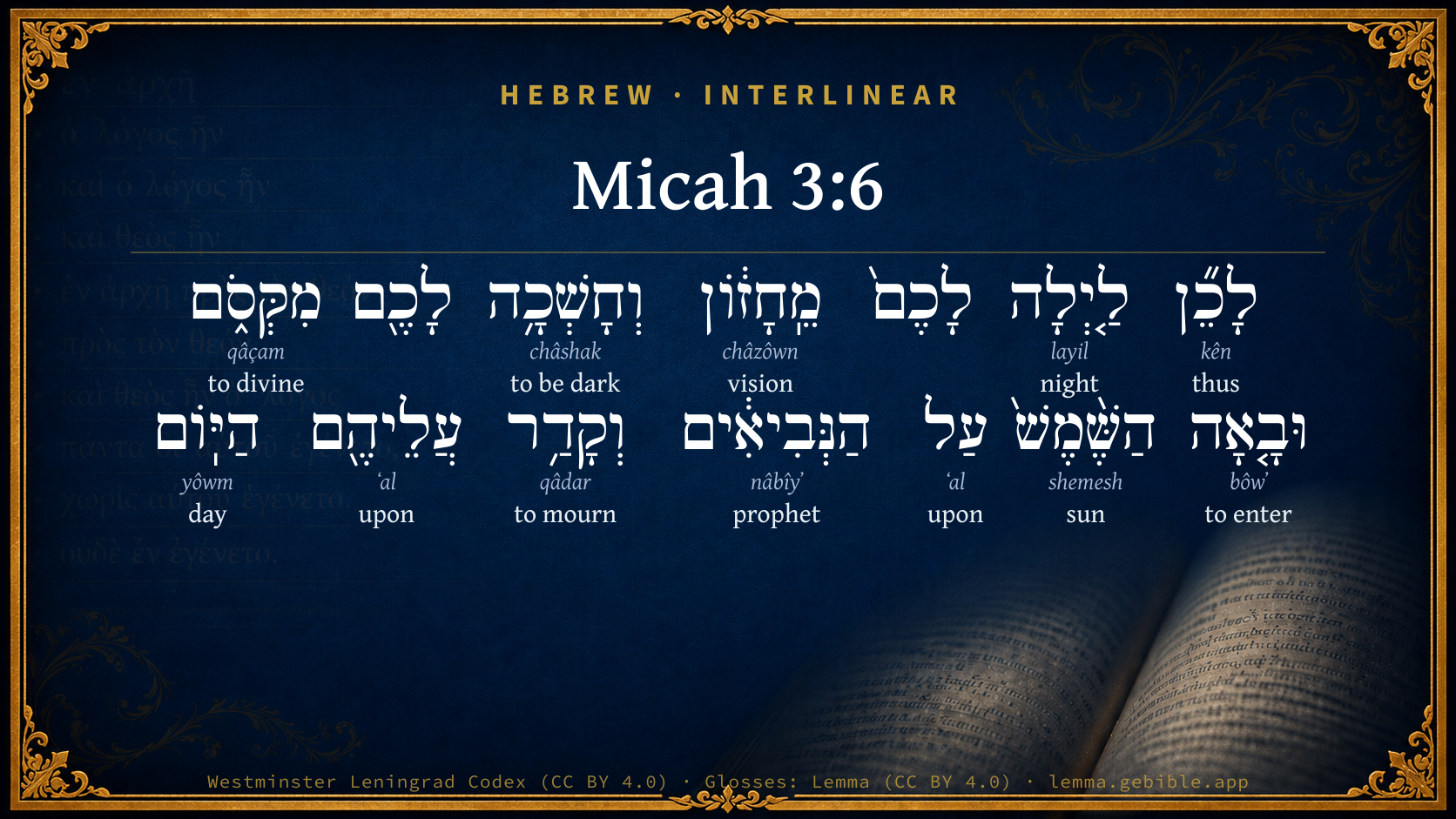
  1. לָכֵ֞ן kên H3651 “to/for · thus” Preposition + Adverb
  2. לַ֤יְלָה layil H3915 “night” Noun, Common, Masculine, Singular, Absolute
  3. מֵֽחָז֔וֹן châzôwn H2377 “from · vision” Preposition + Noun, Common, Masculine, Singular, Absolute
  4. וְחָשְׁכָ֥ה châshak H2821 “and · to be dark” Conjunction + Verb, Qal, Sequential Perfect, 3rd Person, Feminine, Singular
  5. מִקְּסֹ֑ם qâçam H7080 “from · to divine” Preposition + Verb, Qal, Infinitive Construct
  6. וּבָ֤אָה bôwʼ H935 “and · to enter” Conjunction + Verb, Qal, Sequential Perfect, 3rd Person, Feminine, Singular
  7. הַשֶּׁ֨מֶשׁ֙ shemesh H8121 “the · sun” Particle, Definite Article + Noun, Common, Both, Singular, Absolute
  8. עַל ʻal H5921 “upon” Preposition
  9. הַנְּבִיאִ֔ים nâbîyʼ H5030 “the · prophets” Particle, Definite Article + Noun, Common, Masculine, Plural, Absolute
  10. עֲלֵיהֶ֖ם ʻal H5921 “upon · them” Preposition + Suffix, Personal, 3rd Person, Masculine, Plural
  11. הַיּֽוֹם yôwm H3117 “the · day” Particle, Definite Article + Noun, Common, Masculine, Singular, Absolute

About this verse

These counts appear in no published source. They are computed here, from the morphology-tagged text and Lemma’s own curated glosses. What Lemma adds →

14
words
11
distinct lemmas
Prophets
section

Notable vocabulary

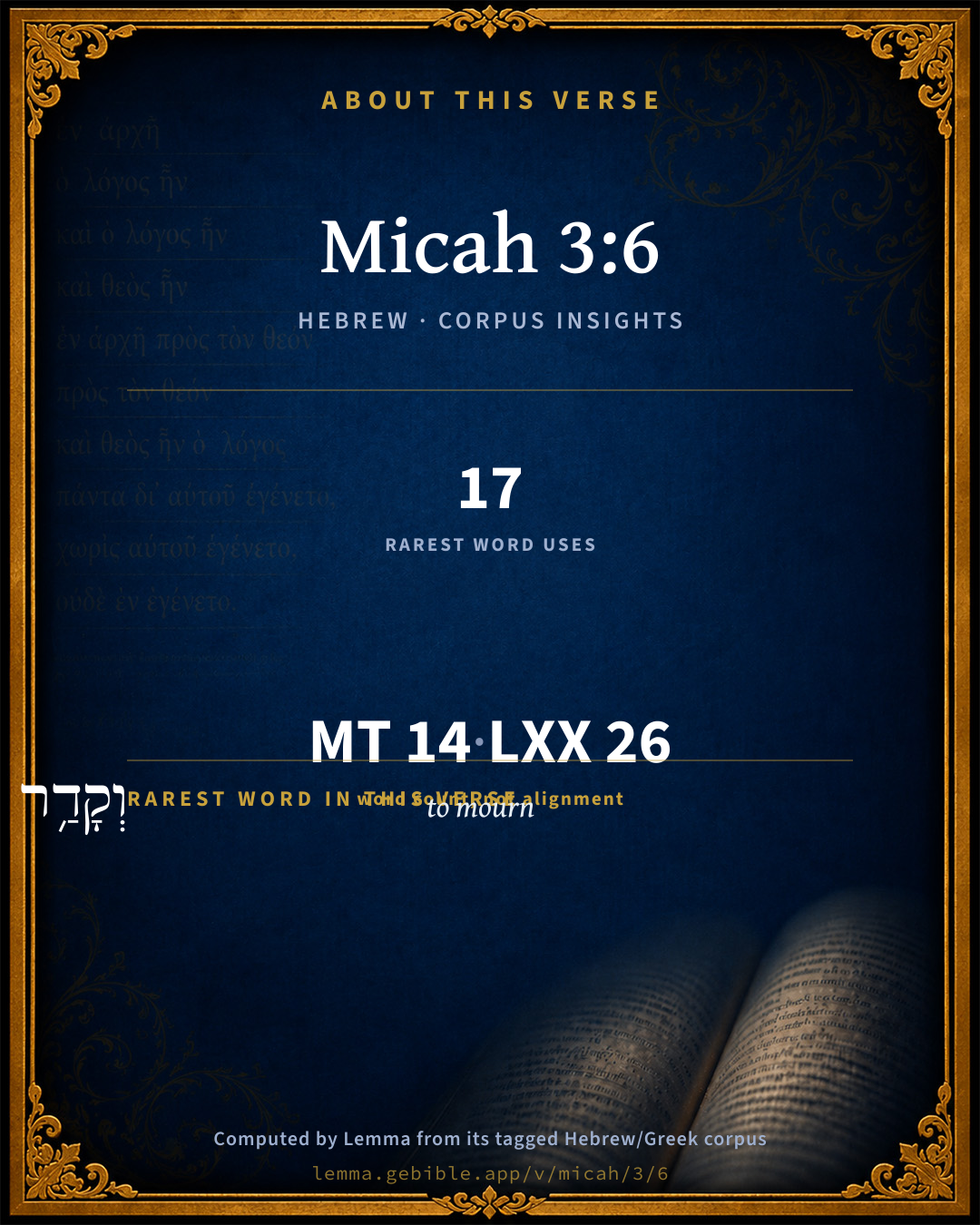
The rarest word here is וְקָדַ֥ר to mourn H6937 — appearing just 17 times in the whole Hebrew Bible.

Shared distinctive vocabulary

וְקָדַ֥ר to mourn H6937 occurs in 17 verses of the Hebrew Bible. Also found in:

Grammatical profile

  • 4 verbs
  • 5 nouns
  • 4 prepositions
  • 1 adverb

Verb forms

  • וְחָשְׁכָ֥ה Qal · Sequential Perfect
  • מִקְּסֹ֑ם Qal · Infinitive Construct
  • וּבָ֤אָה Qal · Sequential Perfect
  • וְקָדַ֥ר Qal · Sequential Perfect

Repetition

A word recurs within this verse — often emphatic in Hebrew:

Hebrew & Septuagint length

In English translation the verse runs 36 words from the Hebrew and 38 from the Septuagint (LXX English) — closely comparable.

A rough comparison of the two English renderings, which tokenize alike — not a word-level alignment.

Word counts can differ between the Hebrew and the Greek without any difference in meaning — e.g. the Hebrew direct-object marker אֵת has no separate Greek word, and Greek often adds the article ὁ.

In the original languages it is 14 Hebrew tokens and 26 Greek tokens — but the two are counted differently (Hebrew bundles its prefixes and suffixes into one token; the Greek is in lemma form), so that isn’t a like-for-like length.

Cross-references

9

Topical passages linked to Micah 3:6 in the Treasury of Scripture Knowledge — connected by theme and wording, ordered by reader-vote popularity; previews shown in the World English Bible.

  • Isaiah 8:20–22 To the law and to the testimony! if they don't speak according to this word, surely there is no morning for them.
  • Isaiah 29:10 For Yahweh has poured out on you the spirit of deep sleep, and has closed your eyes, the prophets; and your heads, the seers, has he covered.
  • Amos 8:9–10 "It will happen in that day," says the Lord Yahweh, "That I will cause the sun to go down at noon, And I will darken the earth in the clear day.
  • Isaiah 59:10 We grope for the wall like the blind; yes, we grope as those who have no eyes: we stumble at noonday as in the twilight; among those who are lusty we are as dead men.
  • Psalms 74:9 We see no miraculous signs. There is no longer any prophet, Neither is there among us anyone who knows how long.
  • Jeremiah 13:16 Give glory to Yahweh your God, before he cause darkness, and before your feet stumble on the dark mountains, and, while you look for light, he turn it into the shadow of death, and make it gross darkness.
  • Jeremiah 15:9 She who has borne seven languishes; she has given up the spirit; her sun is gone down while it was yet day; she has been disappointed and confounded: and the residue of them will I deliver to the sword before their enemies, says Yahweh.
  • Ezekiel 13:22–23 Because with lies you have grieved the heart of the righteous, whom I have not made sad; and strengthened the hands of the wicked, that he should not return from his wicked way, and be saved alive:
  • Zechariah 13:2–4 It will come to pass in that day, says Yahweh of Hosts, that I will cut off the names of the idols out of the land, and they will no more be remembered; and also I will cause the prophets and the spirit of impurity to pass out of the land.

Cross-references courtesy of OpenBible.info (CC BY 4.0).

Hebrew and Greek witnesses Masoretic Hebrew ↔ Greek Septuagint

The same verse in the two great witnesses to the Old Testament, shown verse-for-verse.

These are two independent witnesses, not word-aligned to each other, and the Septuagint is shown in lemma (dictionary) form.

Hebrew Micah 3:6 Masoretic · Westminster Leningrad Codex

לָכֵ֞ן לַ֤יְלָה לָכֶם֙ מֵֽחָז֔וֹן וְחָשְׁכָ֥ה לָכֶ֖ם מִקְּסֹ֑ם וּבָ֤אָה הַשֶּׁ֨מֶשׁ֙ עַל הַנְּבִיאִ֔ים וְקָדַ֥ר עֲלֵיהֶ֖ם הַיּֽוֹם

"Therefore night is over you, with no vision, And it is dark to you, that you may not divine; And the sun will go down on the prophets, And the day will be black over them.

World English Bible · Public Domain

Greek LXX Micah 3:6 Septuagint · lemma form

διά οὗτος νύξ σύ εἰμί ἐκ ὅρασις καί σκοτία σύ εἰμί ἐκ μαντεία καί δύω ὁ ἥλιος ἐπί ὁ προφήτης καί συνσκοτάζω ἐπί αὐτός ὁ ἡμέρα

therefore there shall be night to you instead of a vision, and there shall be to you darkness instead of prophecy; and the sun shall go down upon the prophets, and the day shall be dark upon them.

LXX2012 (modern English Septuagint) · Public Domain

On this verse, The Pulpit Commentary discusses the Septuagint’s reading. Read the note in Commentary ↓

Hebrew: Westminster Leningrad Codex (CC BY 4.0). Greek: Septuagint (public domain); English from LXX2012 (modern English Septuagint) (Public Domain). How the Septuagint differs from the Hebrew →

Targum (Aramaic paraphrase)

1

The Targum is the ancient Jewish Aramaic paraphrase of the Hebrew Scriptures — an interpretive translation, not the Hebrew text itself. Onkelos (literal) and Pseudo-Jonathan (expansive) render the Torah, and Jonathan the Prophets. Coverage is partial: where no permissively-licensed English translation exists for a verse, only the Aramaic is shown. This is verse-level text, not a word-by-word alignment to the Hebrew.

  1. Targum Jonathan Prophets (Joshua–Malachi)
    בְּכֵן תִּבְהֲתוּן מִלְאִתְנַבָּאָה וְתִתְכַּנְעוּן מִלְאַלָפָא וְתַחֲפֵי עֲקָא בְּקִבְּלָא יַת נְבִיֵי שִׁקְרָא וִיקַבֵּיל עֲלֵיהוֹן עִדָנָא:

    (no public-domain English translation for this verse)

    Targum Jonathan — Aramaic: “Mikraot Gedolot” (public domain). English: “Sefaria Community Translation” (CC0 1.0 (public-domain dedication)); “London "Chaldee Paraphrase," 1871” (public domain). Text via Sefaria.

Commentary

Notes on Micah 3:6 from classic Christian and Jewish commentators (each source and its license shown beneath its notes). The classic Christian expositions comment on the surrounding passage and are grouped to its opening verse, so a note may address several verses; the Jewish commentaries on the Tanakh (Rashi and others) are per-verse, so they appear only where the commentator wrote on this verse.

Lemma curates 59 commentaries, every one of them public domain or Creative Commons licensed, each selected and text-cleaned for this edition rather than reprinted as found. About our sources →

Trapp's Complete Commentary

John Trapp

Mic 3:6 Therefore night [shall be] unto you, that ye shall not have a vision; and it shall be dark unto you, that ye shall not divine; and the sun shall go down over the prophets, and the day shall be dark over them.

Ver. 6. Therefore night shall be unto you] Ye shall be benighted, your gifts blasted, and your persons baffled: your lamp shall be put out in obscure darkness; the sword shall be upon your arms, and upon your right eyes; your arms shall be clean dried up, and your right eyes utterly darkened, Zec 11:17. Those illuminations and inspirations that ye seemed to have shall be taken from you, and God shall pass that dreadful sentence, Take the talent from him, even here in this life; let him not have the least dram or drop of a prophetic spirit, of ministerial abilities; and then, in the next world, cast "ye the unprofitable servant into outer darkness," &c., Mat 25:28; Mat 25:30.

And it shall be dark unto you, that ye shall not divine] Tenebrae vobis a divinatione, vel propter divinationem, so Calvin. All the reward ye shall have for your divination shall be disgrace and confusion: your folly shall be manifest unto all men, as was that of Jannes and Jambres, 2Ti 3:9.

And the sun shall go down over the prophets] The same thing is set forth by sundry metaphors, for more assurance: for Hypocritis nihil stupidius, it is hard to persuade a hypocrite that evil is towards him. See Mic 3:11.

John Trapp, A Commentary or Exposition upon All the Books of the Old and New Testament (1647–1656) — public domain. Text from a community e-Sword module.

Joseph Benson's Commentary

Mic 3:6-7. Therefore night shall be unto you — Darkness, uncertainty, perplexity, and heavy troubles, shall be to you prophets; that ye shall not have a vision — You shall see your predictions so fully confuted, that you shall no more pretend to have a vision, or dare to foretel any thing. And the sun shall go down over the prophets, and the day shall be dark, &c. — As they shall have no light, or revelation, from heaven; so dark days, or dismal calamities, shall overtake them, as a just punishment for their frauds and impostures. Or, if the prophet be considered as addressing the people, the meaning of the verse is, Since ye have given ear to such prophets, and rejected the true ones, the time shall come when there shall be no true vision among you, no divine counsel to direct you; but ye shall be involved in darkness and uncertainty, without knowing what course to take. Then shall the seers be ashamed, &c. — For the false pretences which they have made to the gift of prophecy; yea, they shall cover their lips — Covering the lips, or lower part of the face, was used as a sign to express being under some great affliction, or shame; for there is no answer of God — Because the answer, which they pretended to be from God, now appears not to have been from him.

Joseph Benson's Commentary on the Old and New Testaments (1811–1818) — public domain. Text from a community e-Sword module.

Whedon's Commentary on the Bible

Daniel D. Whedon

Mic_3:6-7 are addressed directly to the mercenary prophets, not to the “heads” of the nation.

Night… dark — Figures of calamity and distress. At such time the advice of a prophet is most needed, but they will have no advice to give.

Sun… day — The “sun” of prosperity will set and the “day” of judgment, which is “darkness and not light” (Amo_5:18), will dawn.

Have a vision… divine — At present the mercenary prophets may claim that they receive their message in the same manner as the “true” prophets, but in the day of calamity a difference will be seen, for they will have no message with which to encourage their grief-stricken countrymen. The reason for the silence is stated in Mic_3:7.

Seers… diviners — Synonymous terms denoting the mercenary prophets, the second calling attention to the illegitimacy of their pursuit.

Ashamed,… confounded — Also synonyms. They will “stand ashamed, because their own former prophecies are proved by calamity to be lies, and fresh, true prophecies fail them, because God gives no answer.”

Cover their lips — Literally, beard. They will no longer venture to speak. The phrase means covering the face up to the nose, which is a sign of humiliation, shame, and mourning (Lev_13:45; Eze_24:17). For a study of the phenomenon of “false” prophecy in Israel, see Hastings’s Dictionary of the Bible, iv, pp. 116ff. All that needs to be said here is that there were two distinct classes of false prophets: (1) The mercenary prophets, who are condemned here for their insincerity; (2) the political prophets, who may have been sincere, but who lost sight of the religious mission and destiny of the nation, and whose prophecies were determined entirely by political ambitions.

Daniel D. Whedon (gen. ed.), Commentary on the Old and New Testaments (1874–1909) — public domain. Text from a community e-Sword module.

Tyndale Open Study Notes

Tyndale Open Resources

3:6-7 Micah announced God’s judgment on the false prophets. Without God’s special communications, these seers and fortune-tellers were like the pagan court prophets of such nations as Babylon, Mari, and especially Assyria, who were expected to toe the party line but who had no real revelation from the Lord (cp. 1 Sam 28:6; Amos 8:11-12).

Tyndale Open Study Notes — © Tyndale Open Resources, licensed CC BY-SA 4.0. Text via the HelloAO Bible API.

Geneva Bible (1599)

Geneva Bible translators

As you have loved to walk in darkness, and to prophesy lies, so God shall reward you with gross blindness and ignorance, so that when all others shall see the bright beams of God’s graces, ye shall as blind men grope as in the night.

Geneva Bible (1599) marginal notes — public domain. Text via Bolls.life.

Jamieson, Fausset & Brown

Robert Jamieson, A. R. Fausset & David Brown

night . . . dark--Calamities shall press on you so overwhelming as to compel you to cease pretending to divine (Zac 13:4). Darkness is often the image of calamity (Isa 8:22; Amo 5:18; Amo 8:9).

Jamieson, Fausset & Brown — Commentary Critical and Explanatory on the Whole Bible (1871) — public domain (CC PDM 1.0). Text via the HelloAO Bible API.

Adam Clarke's Commentary

Verse 6. Night shall be unto you] Ye shall have no spiritual light, nor will God give you any revelation of his will.

The sun shall go down over the prophets] They prospered for a while, causing the people to err; but they shall also be carried into captivity, and then the sun of their prosperity shall go down for ever, and the very day that gives light and comfort to others, shall be darkness and calamity to them.

Adam Clarke's Commentary on the Bible (1810–1826) — public domain. Text from a community e-Sword/MySword module.

John Calvin's Commentaries

God declares here to the false teachers by the mouth of Micah, that he would inflict punishment on them, so that they should be exposed to the reproach of all. Hence the kind of punishment of which the Prophet speaks is — that he would strip the false teachers of all their dignity, so that they should hereafter in vain put on an appearance, and claim the honorable name which they had so long abused. We indeed know, when ungodly and profane men clothe themselves with the dignified titles of being the princes, or bishops, or prelates of the Church, how audaciously they pervert every thing, and do so with impunity. There is then no other remedy, except God pulls off the mask from them, and openly discovers to all their baseness. Of this punishment Micah now speaks.

There shall be to you a night from vision; so is the phrase literally, but the particle מ, mem, means often, for, or, on account of; and we can easily see that the Prophet represents night as the reward for visions and darkness for divination. “As then my people have been deceived by your fallacies, for your visions and divinations have been nothing but lies and deceits, I will repay you with the reward which you have deserved: for instead of a vision you shall have night, and instead of divination you shall have thick darkness.” It is indeed certain, that the false teachers, even when they were, as they say, in great reputation, that is, when they retained the honor and the title of their office, were blind and wholly destitute of all light: but the Prophet here declares, that as their baseness did not appear to the common people, God would cause it to be made at length fully evident. As for instance, there is nothing at this day more stupid and senseless than the bishops of the Papacy: for when any one draws from them any expression about religion, they instantly betray not only their ignorance, but also their shameful stupidity. With regard to the monks, though they be the most audacious kind of animals, (audacissimum animalium genus,) yet we know how unlearned and ignorant they are. Therefore at this time the night has not yet passed away, nor the darkness, of which Micah speaks here.

We now then understand what the Holy Spirit teaches here, and that is, — that God would at length strip those false teachers of that imaginary dignity, on account of which no one dared to speak against them, but received as an oracle whatever they uttered. Night, then, shall be to you instead of a vision; that is, “The whole world shall understand that you are not what you boast yourselves to be: for I will show that there is not in you, no, not a particle of the prophetic spirit, but that ye are men as dark as night, and darkness shall be to you instead of divination. Ye boast of great acuteness and great perspicuity of mind; but I will discover your baseness, so that the very children may know that you are not endued with the spirit.”

To the same purpose is what he adds, Go down shall the sun upon you, and darkened over you shall be the day; that is, such will be that darkness, that even at noon they will see nothing; the sun will shine on all, but they shall grope as in the dark; so that Gods vengeance would be made so manifest, that it might be noticed by all, from the least to the greatest.

John Calvin's Commentaries (1540-1563) — public domain. Text from the Calvin Translation Society English edition (1840s-50s) via the Christian Classics Ethereal Library (ccel.org). Calvin's coverage is partial (roughly two-thirds of the Bible); uncommented books and verses are honest gaps, never fabricated. The 19th-century editor's footnotes and remarks are omitted so the notes are faithfully Calvin's own voice.

The Cambridge Bible for Schools and Colleges

gen. ed. J. J. S. Perowne

6. night shall be unto you, &c.] The prophet is still addressing the rulers. Because of their rapacity, and their league with false prophets, their land shall be overshadowed by adversity, and there shall be no prophecy, whether false or true, to guide them. The false prophets will be ashamed, because of the non-fulfilment of their oracles; and the true will have no fresh revelation till the old cycle of prophecies has been fulfilled. Comp. Lam_2:9.

The Cambridge Bible for Schools and Colleges (gen. ed. J. J. S. Perowne; Cambridge University Press, 1878–1918) — public domain. Text from a community e-Sword module.

John Gill's Exposition

Therefore night shall be unto you, that ye shall not have a vision,.... Not that those outward gifts and illuminations, and that prophetic light they had, or seemed to have should be taken away from them, and it should be quite a night with them; because these men were never sent of God, or received any message from him, or had any prophetic talents at all, and therefore could not be taken away from them, and they be benighted in this sense; though, it is true, such might be the circumstances they would be brought into, that it should appear to the people that they are the dark persons they were, that they have no vision, nor never had any; but rather the sense is, that such dark providences and dreadful calamities should come upon the people in general, and upon those prophets in particular, often signified by "night" in Scripture, that they would not have the face to pretend any more that they had any vision from God of good times and things. It may be rendered, "therefore night shall be unto you because of vision" (c); calamity should come upon them because of their false and pretended visions of peace and prosperity they deluded the people with:

and it shall be dark unto you, that ye shall not divine; such darkness of affliction should be upon them, that they would not offer to deliver out any divination or prediction of good things coming upon them; or such darkness and distress would be their portion "because of divination" (d), on account of their lying divinations they had imposed upon the people:

and the sun shall go down over the prophets, and the day shall be dark over them; their time of prosperity will be over, and they shall be no more in favour with the people, or courted and feasted by them; but shall be had in the utmost contempt and abhorrence. The Targum of the whole is,

"therefore ye shall blush at prophesying, and be ashamed of teaching; and tribulation as darkness shall cover the false prophets, and the time shall be darkened upon them.''

(c) "propter visionem", Munster, Piscator. (d) "propter divinationem", Munster; "propter divinare, i. e. divinationem", Vatablus; "prae visione----prae divinatione", Burkius.

John Gill's Exposition of the Whole Bible (1746–1763) — public domain (CC PDM 1.0). Text via the HelloAO Bible API.

Albert Barnes' Notes on the Bible

Therefore night shall be unto you, that ye shall not have a vision - In the presence of God’s extreme judgments, even deceivers are at length still; silenced at last by the common misery, if not by awe. The false prophets had promised peace, light, brightness, prosperity; the night of trouble, anguish, darkness, fear, shall Come upon them. So shall they no more dare to speak in the Name of God, while He was by His judgments speaking the contrary in a way which all must hear. They abused God’s gifts and long-suffering against Himself: they could misinterpret His long-suffering into favor, and they did it: their visions of the future were but the reflections of the present and its continuance; they thought that because God was enduring, He was indifferent, and they took His government out of His Hands, and said, that what He appeared to be now, He would ever be. They had no other light, no other foresight. When then the darkness of temporal calamity enveloped them, it shrouded in one common darkness of night all present brightness and all sight of the future.

Rup.: “After Caiaphas had in heart spoken falsehood and a prophecy of blood, although God overruled it to truth which he meant not, all grace of prophecy departed Mat 11:13. The law and the prophets prophesied until John. “The Sun of Righteousness went down over them,” inwardly and outwardly, withdrawing the brightness of His Providence and the inward light of grace.” So Christ Himself forewarned; “Walk while ye have the light, lest darkness come upon you” Joh 12:35. And so it has remained ever since 2Co 3:15. The veil has been on their hearts. The light is in all the world, but they see it not; it arose to lighten the Gentiles, but they walk on still in darkness. As opposed to holiness, truth, knowledge, divine enlightening of the mind, bright gladness, contrariwise darkness is falsehood, sin, error, blindness of soul, ignorance of divine things, and sorrow. In all these ways, did the Sun go down “over them,” so that the darkness weighed heavily upon them. So too the inventors of heresies pretend to see and to enter into the mysteries of Christ, yet find darkness instead of light, lose even what they think they see, fail even of what truth they seem most to hold; and they shall be in night and darkness, being cast into outer darkness 1Co 8:12; sinning against the brethren, and wounding the weak conscience of those for whom Christ died.

Albert Barnes' Notes on the Bible (1834–1885) — public domain. Text from a community e-Sword/MySword module.

Haydock's Catholic Bible Commentary

Vision. Impostors shall skulk through fear, when the people shall see that they were not sent, ver. 7.

George Leo Haydock (1774–1849), Haydock's Catholic Family Bible and Commentary, 1859 edition — public domain. Excludes Psalms (Douay-Rheims chapter numbering differs from Protestant) and Deuterocanonical books (Catholic canon only).

Matthew Poole's English Annotations

Therefore; because of their irreligious and atheistical pretences to Divine revelations, and to come from heaven with promises directly contrary to God’s purpose and word, even when their consciences told them they did lie herein. Night of ignorance, and loss of gifts; but since they had none such as they pretended to, I see not how they could lose them. I rather take this night to be a night of distresses, a time of great calamities upon these prophets more than ordinary, and upon all the people they seduced. Unto you; deceivers, and false prophets.

Ye shall not have a vision; you shall no more pretend to have a vision, you shall not dare any more to foretell any thing to this people.

It shall be dark unto you; a very calamitous time to all, but most to you who lived upon lying visions, and now shall starve for want of them.

Ye shall not divine; have neither skill nor will any more to set up for yourselves in that trade; being found great impostors, and such as have seduced this people into sin first, and misery next, they will be enraged against you, and you shall not safely appear among them.

The sun shall go down over the prophets; a proverbial speech, and contains much the same that night and dark do contain. Perhaps this intimates the visible hand of God extraordinarily against them, and making their sorrows the more dreadful, as darkness by the sun going down at noon, would speak itself an extraordinary judgment, and most terrify the world.

The day shall be dark over them; the best circumstances any of them shall be in shall be so sad and woeful, that they shall not know which way to take for themselves or direct for others.

Matthew Poole's English Annotations on the Holy Bible (1683–1685) — public domain. Text from a community e-Sword/MySword module.

The Pulpit Commentary

Night shall be unto you, that ye shall not have a vision. The Hebrew is, "from," or "without a vision." Septuagint, ex orasewv , "out of vision;" Vulgate, pro visione. Hence some interpret this as spoken to the false prophets, who, to punish their lying prophecies and pretended revelations, shall be overwhelmed with calamity. But it is best taken as still addressed to the rulers, and Micah tells how that in the time of their distress there shall be no prophecy to direct them. (comp. Pro_1:28 Lam_2:9) "Night shall be unto them without a vision." "Night" and "darkness" are metaphors for calamity, as in all languages. That ye shall not divine; without divination. Septuagint, ek manteiav , "out of prophecy." Parallel and identical in meaning with the preceding clause. The sun shall go down over the prophets; i.e. over the false prophets. The sun of their prosperity shall set. Micah seems to derive his imagery from the phenomena of an eclipse. (comp. Jer_15:9 Amo_8:9) The day. The time of their punishment. (Mic_2:4 Amo_5:18)

The Pulpit Commentary (1880–1919), ed. H.D.M. Spence-Jones & Joseph S. Exell — public domain. Text from a community e-Sword module.

John Wesley's Explanatory Notes

Night - Heavy calamities. A vision - You shall no more pretend to have a vision, or dare to foretell any thing. And the sun - The hand of God shall be against them, making their sorrows the more dreadful, as darkness by the sun going down at noon.

John Wesley, Explanatory Notes Upon the Whole Bible (1754–1765) — public domain. Text via the GEBible commentary corpus.

Lesson kit

Teaching starters — assembled from the data on this page, not authored interpretation. Every prompt links to the verse data it draws on. Edit before teaching.

Micah, in the Prophets, opens this verse with 14 words (11 distinct Hebrew lemmas). Its most distinctive word is qâdar (“to mourn”). A historical commentator’s framing appears above. Read the whole chapter for the surrounding context.

Discussion questions

  1. The word qâdar carries the sense “to mourn.” How does it shape the verse?
  2. How does 1 Kings 18:45, which shares the word «to mourn», read alongside this verse?
  3. What does the repetition of “upon” (2× in this one verse) do in this verse?
  4. The translations on this page render this verse differently — a whole-verse word diff, not a word-by-word alignment. What might account for the different wordings?
  5. «וְחָשְׁכָ֥ה» is a Qal Sequential Perfect verb. How does that grammatical form shape the action described?
  6. Compare how Trapp's Complete Commentary and Joseph Benson's Commentary read this verse. Where do they agree or differ?

Things to notice

Reading settings

Reading text

Shown beneath each verse's original-language words.

Old Testament
Old Testament edition

Read the OT as the Masoretic Hebrew (MT) or the Greek Septuagint (LXX).

English shown for the Greek Septuagint (in the Hebrew ↔ Greek comparison).

Comparing translations? Open the Compare panel on any verse page to stack up to four side by side.