
Psalms 135:4

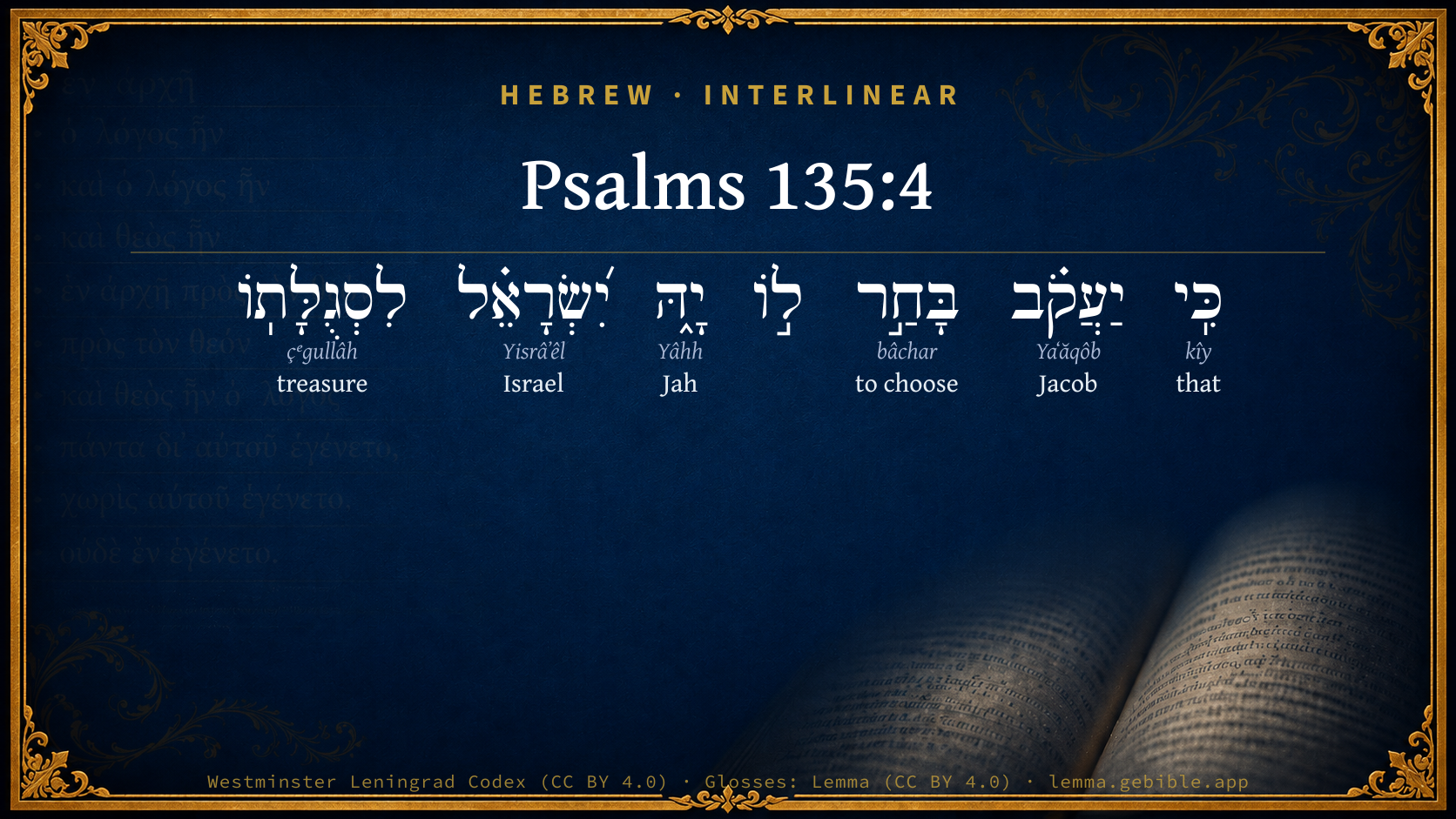
Hebrew (Westminster Leningrad Codex) Psalms 135:4 appears in the Hebrew Old Testament. The text above is from the Westminster Leningrad Codex. Each word links to its Strong’s number, a concise gloss, and parsing drawn from the Open Scriptures Hebrew Bible morphology. Click any word for its full Brown-Driver-Briggs (BDB) entry.
Download image
Cite this verse

Psalms 135:4 (World English Bible). Public Domain. Lemma interlinear Bible study tool, https://lemma.gebible.app/v/psalms/135/4.

Show BibTeX & RIS
BibTeX
RIS
English Translation
For Yah has chosen Jacob for himself; Israel for his own possession.
World English Bible · Public Domain
Download a study sheet

One document with this verse’s original text, its word-by-word gloss line, the meaning frame, cross-references with their text, attributed commentary, and full source and license credits — printable, and it pastes into notes with its structure intact.

This verse Autodidact and up

Study sheet (.html) Plain text (.txt)

A passage Seminary Student

Up to 50 verses in one chapter. A passage sheet keeps up to 6 commentary sources and 12 cross-references per verse, in the order this page ranks them, and says so on the sheet whenever that leaves anything out. Ask for a single verse and you get the Autodidact verse sheet above.

Everything on this page stays free to read, with no account — the sheet is a download of what is already on screen, not access to it.

Want to remove ads? Support Godless Engineer
Compare translations 3

The same verse in 3 English versions, stacked beneath the original-language interlinear above. Click any original word for its lexicon entry.

Each is an independent rendering of the whole verse — the interlinear is not word-aligned to these translations.

Highlighted words mark where these versions differ — a whole-verse word diff, not a word-by-word alignment.

  • World English Bible Public Domain
    For Yah has chosen Jacob for himself; Israel for his own possession.
  • King James Version Public Domain
    For the LORD hath chosen Jacob unto himself, and Israel for his peculiar treasure.
  • unfoldingWord Literal Text CC BY-SA 4.0
    For Yah chose Jacob for himself; Israel for his special possession.

unfoldingWord Literal Text — © unfoldingWord, licensed CC BY-SA 4.0. Word-aligned USFM3 via Door43 (git.door43.org/unfoldingWord/en_ult).

Versions to compare (up to 4)

3 of 4 selected

Show all 17 translations

Every available English version of this verse, each an independent rendering of the whole verse.

  • World English Bible Public Domain
    For Yah has chosen Jacob for himself; Israel for his own possession.
  • Berean Standard Bible Public Domain
    For the LORD has chosen Jacob as His own, Israel as His treasured possession.
  • Majority Standard Bible Public Domain
    For the LORD has chosen Jacob as His own, Israel as His treasured possession.
  • King James Version Public Domain
    For the LORD hath chosen Jacob unto himself, and Israel for his peculiar treasure.
  • American Standard Version (1901) Public Domain
    For Jehovah hath chosen Jacob unto himself, `And' Israel for his own possession.
  • Revised Version (1885) Public Domain
    For the LORD hath chosen Jacob unto himself, and Israel for his peculiar treasure.
  • Geneva Bible (1599) Public Domain
    For the Lord hath chosen Iaakob to himselfe, and Israel for his chiefe treasure.
  • Young's Literal Translation Public Domain
    For Jacob hath Jah chosen for Himself, Israel for His peculiar treasure.
  • Literal Standard Version CC BY-SA 4.0
    For YAH has chosen Jacob for Himself, || Israel for His peculiar treasure.
  • Unlocked Literal Bible CC BY-SA 4.0
    For Yahweh has chosen Jacob for himself, Israel as his possession.
  • unfoldingWord Literal Text CC BY-SA 4.0
    For Yah chose Jacob for himself; Israel for his special possession.
  • Darby Bible Public Domain
    For Jah hath chosen Jacob unto himself, Israel for his own possession.
  • World Messianic Bible Public Domain
    For the LORD has chosen Jacob for himself, Israel for his own possession.
  • Webster's Bible Public Domain
    For the LORD hath chosen Jacob to himself, and Israel for his peculiar treasure.
  • Free Bible Version CC BY-SA 4.0
    For the Lord has chosen Jacob for himself; Israel as his very own.
  • Bible in Basic English Public Domain
    For the Lord has taken Jacob for himself, and Israel for his property.
  • JPS Tanakh (1917) Public Domain
    For the LORD hath chosen Jacob unto Himself, and Israel for His own treasure.

Literal Standard Version (2020), Covenant Press — licensed CC BY-SA 4.0. Text via the HelloAO Bible API (eBible.org). Unlocked Literal Bible (unfoldingWord) — licensed CC BY-SA 4.0. Text via the HelloAO Bible API (eBible.org). unfoldingWord Literal Text — © unfoldingWord, licensed CC BY-SA 4.0. Word-aligned USFM3 via Door43 (git.door43.org/unfoldingWord/en_ult). Free Bible Version, Dr. Jonathan Gallagher — licensed CC BY-SA 4.0. Text via the HelloAO Bible API (eBible.org).

Word by word

More ways to search: Search by grammar → Find every occurrence → Compare this word →

Practice this passage: Drill this verse → Learn its vocabulary →

לִסְגֻלָּתֽוֹ
çᵉgullâh
H5459
“to/for · treasure · his”
Preposition + Noun, Common, Feminine, Singular, Construct + Suffix, Personal, 3rd Person, Masculine, Singular
Part of Speech
Preposition + Noun
Type
Common
Gender
Feminine
Number
Singular
State
Construct
Full BDB Definition

Origin: from an unused root meaning to shut up

TWOT: 1460a

possession, property - valued property, peculiar treasure - treasure
  1. כִּֽי kîy H3588 “that” Conjunction
  2. יַעֲקֹ֗ב Yaʻăqôb H3290 “Jacob” Noun, Proper
  3. בָּחַ֣ר bâchar H977 “to choose” Verb, Qal, Perfect, 3rd Person, Masculine, Singular
  4. יָ֑הּ Yâhh H3050 “Jah” Noun, Proper
  5. יִ֝שְׂרָאֵ֗ל Yisrâʼêl H3478 “Israel” Noun, Proper

About this verse

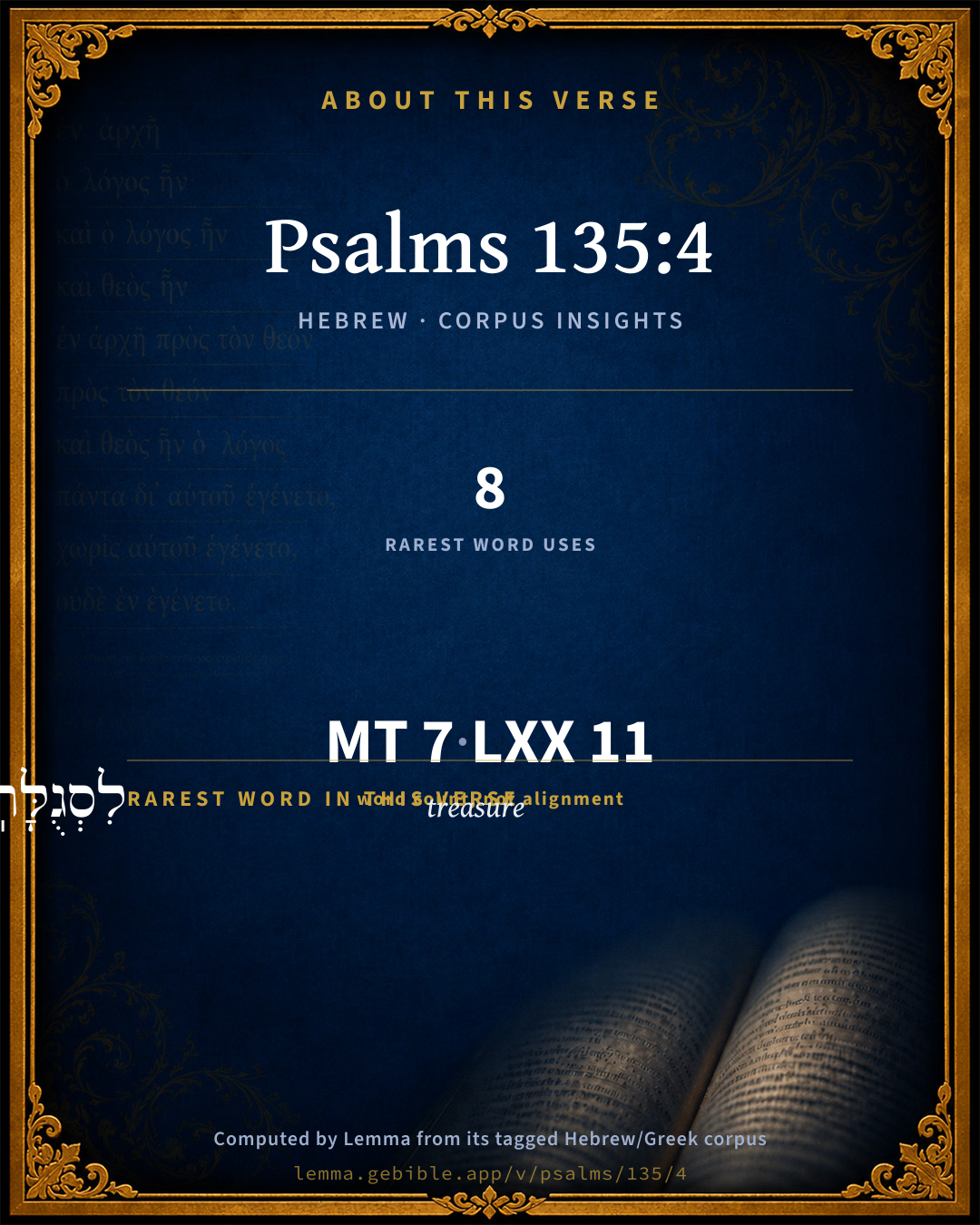
These counts appear in no published source. They are computed here, from the morphology-tagged text and Lemma’s own curated glosses. What Lemma adds →

7
words
6
distinct lemmas
Wisdom
section

Notable vocabulary

The rarest word here is לִסְגֻלָּתֽוֹ treasure H5459 — appearing just 8 times in the whole Hebrew Bible.

Shared distinctive vocabulary

לִסְגֻלָּתֽוֹ treasure H5459 occurs in 8 verses of the Hebrew Bible. Also found in:

Grammatical profile

  • 1 verb
  • 4 nouns
  • 1 preposition
  • 1 conjunction

Verb forms

  • בָּחַ֣ר Qal · Perfect

Hebrew & Septuagint length

In English translation the verse runs 12 words from the Hebrew and 14 from the Septuagint (LXX English) — closely comparable.

A rough comparison of the two English renderings, which tokenize alike — not a word-level alignment.

Word counts can differ between the Hebrew and the Greek without any difference in meaning — e.g. the Hebrew direct-object marker אֵת has no separate Greek word, and Greek often adds the article ὁ.

In the original languages it is 7 Hebrew tokens and 11 Greek tokens — but the two are counted differently (Hebrew bundles its prefixes and suffixes into one token; the Greek is in lemma form), so that isn’t a like-for-like length.

Cross-references

13

Topical passages linked to Psalms 135:4 in the Treasury of Scripture Knowledge — connected by theme and wording, ordered by reader-vote popularity; previews shown in the World English Bible.

  • 1 Peter 2:9 But you are a chosen race, a royal priesthood, a holy nation, a people for God's own possession, that you may show forth the excellencies of him who called you out of darkness into his marvelous light:
  • Deuteronomy 10:15 Only Yahweh had a delight in your fathers to love them, and he chose their seed after them, even you above all peoples, as at this day.
  • Deuteronomy 7:6–7 For you are a holy people to Yahweh your God: Yahweh your God has chosen you to be a people for his own possession, above all peoples who are on the face of the earth.
  • Malachi 3:17 They shall be mine," says Yahweh of Hosts, "my own possession in the day that I make, and I will spare them, as a man spares his own son who serves him.
  • Deuteronomy 32:9 For Yahweh's portion is his people; Jacob is the lot of his inheritance.
  • 1 Samuel 12:22 For Yahweh will not forsake his people for his great name's sake, because it has pleased Yahweh to make you a people to himself.
  • Psalms 33:12 Blessed is the nation whose God is Yahweh, The people whom he has chosen for his own inheritance.
  • Psalms 105:6 You seed of Abraham, his servant, You children of Jacob, his chosen ones.
  • Isaiah 41:8 But you, Israel, my servant, Jacob whom I have chosen, the seed of Abraham my friend,
  • Isaiah 43:20–21 The animals of the field shall honor me, the jackals and the ostriches; because I give waters in the wilderness, and rivers in the desert, to give drink to my people, my chosen,
  • Zechariah 2:10–12 Sing and rejoice, daughter of Zion; for, behold, I come, and I will dwell in the midst of you,' says Yahweh.
  • Titus 2:14 who gave himself for us, that he might redeem us from all iniquity, and purify for himself a people for his own possession, zealous for good works.
  • Exodus 19:5–6 Now therefore, if you will indeed obey my voice, and keep my covenant, then you shall be my own possession from among all peoples; for all the earth is mine;

Cross-references courtesy of OpenBible.info (CC BY 4.0).

Hebrew and Greek witnesses Masoretic Hebrew ↔ Greek Septuagint

The same verse in the two great witnesses to the Old Testament, shown verse-for-verse.

You’re reading Greek Psalm 134 (Hebrew Psalm 135). The Septuagint counts the superscription, so verse numbers can differ from the Hebrew — chapter-level alignment, not verse-by-verse. Numbering follows Rahlfs.

These are two independent witnesses, not word-aligned to each other, and the Septuagint is shown in lemma (dictionary) form.

Hebrew Psalms 135:4 Masoretic · Westminster Leningrad Codex

כִּֽי יַעֲקֹ֗ב בָּחַ֣ר ל֣וֹ יָ֑הּ יִ֝שְׂרָאֵ֗ל לִסְגֻלָּתֽוֹ

For Yah has chosen Jacob for himself; Israel for his own possession.

World English Bible · Public Domain

Greek LXX Greek Psalm 134:4 Septuagint · lemma form

ὅτι ὁ ἰακώβ ἐκλέγω ἑαυτοῦ ὁ κύριος ἰσραήλ εἰς περιουσιασμός αὐτός

For the Lord has chosen Jacob for himself, and Israel for his peculiar treasure.

LXX2012 (modern English Septuagint) · Public Domain

Hebrew: Westminster Leningrad Codex (CC BY 4.0). Greek: Septuagint (public domain); English from LXX2012 (modern English Septuagint) (Public Domain). How the Septuagint differs from the Hebrew →

Commentary

Notes on Psalms 135:4 from classic Christian and Jewish commentators (each source and its license shown beneath its notes). The classic Christian expositions comment on the surrounding passage and are grouped to its opening verse, so a note may address several verses; the Jewish commentaries on the Tanakh (Rashi and others) are per-verse, so they appear only where the commentator wrote on this verse.

Lemma curates 59 commentaries, every one of them public domain or Creative Commons licensed, each selected and text-cleaned for this edition rather than reprinted as found. About our sources →

Trapp's Complete Commentary

John Trapp

Psa 135:4 For the LORD hath chosen Jacob unto himself, [and] Israel for his peculiar treasure.

Ver. 4. For the Lord hath chosen] God’s distinguishing grace should make his elect lift up many a humble, joyful, and thankful heart to him.

And Israel for his peculiar treasure] Such as he maketh more reckoning of than of all the world besides. The Hebrew word here rendered peculiar treasure, seemeth to signify a jewel made up of three precious stones, in the form of a triangle, Segullah inde dici Segol, grammatici volunt. The saints are God’s jewels, Mal 3:17, his ornament, yea, the beauty of his ornament, and that set in majesty, Eze 7:20, his royal diadem, Isa 62:3.

John Trapp, A Commentary or Exposition upon All the Books of the Old and New Testament (1647–1656) — public domain. Text from a community e-Sword module.

The Biblical Illustrator

Joseph S. Exell

Psa_135:4

The Lord hath chosen Jacob unto Himself.

A strange yet gracious choice

This is a psalm of praise all through. It is to be sung to the highsounding cymbals. There is not a low note anywhere; it is all robust, exhilarating, joyful. It is Hallelujah! from beginning to end; and it did not seem possible to the psalmist that he could omit from it the high jubilant note of election; for if there is anything that makes believers hearts sing unto the Lord, it is the recollection that He has chosen them, and fixed His love upon them.

I. The choice.

1. Divine.

2. Sovereign--irrespective of character.

3. Most gracious.

4. Very wonderful.

When you have told me why He chose Jacob, I shall then try to find out why He chose me; and if I should find that out, probably you will at the same time discover why He chose you. God never acts unreasonably; yet He does not find His reasons for acting in men, but within Himself, in His compassion, in the eternal counsels of His own will.

II. The reason or result of Gods choice.

1. That we might know Him.

2. That we might keep His truth alive in the world.

3. To keep up His worship.

4. That He might commune with us.

III. The separation which grows out of this choice. He led Israel out into the wilderness that there He might speak to their hearts. He drew them away from men; He made them live solitary and alone, like eagles on the rock, that they might dwell there with Him, and have no strange god among them. Blessed are the people who enjoy this separation; but unhappy are the men and women who talk about election, and yet have never known the separation which stamps their election as being a matter of fact.

IV. Their elevation. His peculiar treasure. Gods people are everything to Him; there is nothing that you have, that you account rich or rare, that is anything to you in value in comparison with what Gods people are to Him. His delight is in them: the pleasure which God has in His people is truly wonderful. (C. H. Spurgeon.)

The Biblical Illustrator, edited by Joseph S. Exell (c. 1880s–1900s) — public domain. Text from a community e-Sword module.

Joseph Benson's Commentary

Psa 135:4-5. For the Lord hath chosen Jacob, &c. — Here we have a third reason why the Israelites should praise the Lord, namely, “the circumstance of their having been selected from among the nations to be his church, to receive the law and the promises, to have his presence residing in the midst of them, and to be the guardians of the true faith and worship.” For I know that the Lord is great, &c. — Here he assigns a fourth reason for their praising God, “his superiority over the gods of the heathen, and, consequently, over those who worshipped them; from whence followed this comfortable inference, that he was able to protect and to defend his people against every enemy.” — Horne.

Joseph Benson's Commentary on the Old and New Testaments (1811–1818) — public domain. Text from a community e-Sword module.

J. A. Alexander on Psalms

Joseph Addison Alexander

4. (Psa 135:4) For Jacob did Jah choose for himself, Israel for his own possession. They are particularly bound to praise him, as his chosen and peculiar people. The last word in Hebrew means a possession of peculiar value, set apart and distinguished from all others. See Exo 19:5, Deu 7:6; Deu 14:2; Deu 26:18.

Joseph Addison Alexander, The Psalms Translated and Explained (1850) — public domain. Text from a community e-Sword module.

Tyndale Open Study Notes

Tyndale Open Resources

135:4 The synonyms Jacob and Israel include all twelve tribes. The Lord cherishes his chosen people. They are his treasure out of all the kingdoms of the world (Exod 19:5-6).

Tyndale Open Study Notes — © Tyndale Open Resources, licensed CC BY-SA 4.0. Text via the HelloAO Bible API.

Geneva Bible (1599)

Geneva Bible translators

That is, hath freely loved the posterity of Abraham.

Geneva Bible (1599) marginal notes — public domain. Text via Bolls.life.

Adam Clarke's Commentary

Verse 4. For the Lord hath chosen Jacob] This is a third reason. He has taken the Israelites for his peculiar people, סגלתו segullatho, his peculiar treasure; and now has brought them home to himself from their captivity and wanderings.

Adam Clarke's Commentary on the Bible (1810–1826) — public domain. Text from a community e-Sword/MySword module.

John Calvin's Commentaries

4. For God hath chosen Jacob Other reasons are given afterwards why they should praise God, drawn from his government of the world. But as it was only the children of Abraham who were favored with the knowledge of God at that time, and were capable of praising him, the Psalmist directs them to the fact of their having been chosen by God to be his peculiar people, as affording matter for thanksgiving. The mercy was surely one of incomparable value, and which might well stir them up to fervent gratitude and praise, adopted as they were into favor with God, while the whole Gentile world was passed by. The praise of their election is given by the Psalmist to God — a clear proof that they owed the distinction not to any excellency of their own, but to the free mercy of God the Father which had been extended to them. He has laid all without exception under obligation to his service, for

“he maketh his sun to rise on the evil and on the good.” (Matthew 5:45.)

But he bound the posterity of Abraham to him by a closer tie, such as that by which he now adopts men generally into his Church, and unites them with the body of his only-begotten Son. “Comme c’est aujourd’huy de tous ceux qu’il adopte en sa bergerie, et ente au corps de son fils unique.” — Fr.

John Calvin's Commentaries (1540-1563) — public domain. Text from the Calvin Translation Society English edition (1840s-50s) via the Christian Classics Ethereal Library (ccel.org). Calvin's coverage is partial (roughly two-thirds of the Bible); uncommented books and verses are honest gaps, never fabricated. The 19th-century editor's footnotes and remarks are omitted so the notes are faithfully Calvin's own voice.

Ellicott's Commentary for English Readers

(4) Peculiar treasure.—A special covenant-name for Israel (Exo_19:5; Deu_7:6, &c.), and of private property (1Ch_29:3; Ecc_2:8).

A Bible Commentary for English Readers, edited by Charles John Ellicott (1878–1897) — public domain. Text from a community e-Sword module.

The Cambridge Bible for Schools and Colleges

gen. ed. J. J. S. Perowne

4. the Lord] Heb. Jah. The verse is based upon Deu_7:6; cp. Exo_19:5.

The Cambridge Bible for Schools and Colleges (gen. ed. J. J. S. Perowne; Cambridge University Press, 1878–1918) — public domain. Text from a community e-Sword module.

John Gill's Exposition

For the Lord hath chosen Jacob unto himself,.... To be his own special people, and not another's; for his own service, and for his glory; and to be an habitation for himself, and to be for ever with him. This is not to be understood personally of Jacob, though a chosen vessel of mercy; nor of his natural posterity as such, though chosen as a nation to outward favours; for not all they, only some of them, were chosen to special grace and glory, a remnant according to the election of grace: but mystical and spiritual Jacob and Israel are meant, even the whole church and people of God, whether Jews or Gentiles; these God has chosen, of his own free grace and good will, to all the blessings of grace and glory, and that from all eternity; which choice will remain firm and immutable, in time and for ever; and therefore is worthy of praise and thanksgiving, now, and to all eternity;

and Israel for his peculiar treasure; by whom they are accounted as such; even as the peculiar treasure of kings, as silver, gold, jewels, and precious stones; as his inheritance, his portion, and peculiar people; see Exo 19:5.

John Gill's Exposition of the Whole Bible (1746–1763) — public domain (CC PDM 1.0). Text via the HelloAO Bible API.

Albert Barnes' Notes on the Bible

For the Lord hath chosen Jacob unto himself - The descendants of Jacob. He has selected them from among all the inhabitants of the earth to be his special people.

And Israel for his peculiar treasure - The word here rendered treasure, means that which is acquired; property; wealth. They were what God possessed, owned, or claimed among all the people of the earth as especially his own. He had chosen them; he had redeemed them; he had made them his own, and he regarded them with the interest with which anyone looks on his own property, the fruit of his own toil. See Exo 19:5; Deu 7:6; Deu 32:9; 1Ki 8:53.

Albert Barnes' Notes on the Bible (1834–1885) — public domain. Text from a community e-Sword/MySword module.

The Treasury of David

Charles H. Spurgeon

Ver. 4. For the LORD hath chosen Jacob unto himself. Jehovah hath chosen Jacob. Should not the sons of Jacob praise him who has so singularly favoured them Election is one of the most forcible arguments for adoring love. Chosen! chosen unto himself! who can be grateful enough for being concerned in this privilege "Jacob have I loved", said Jehovah, and he gave no reason for his love except that he chose to love. Jacob had then done neither good nor evil, yet thus the Lord determined, and thus he spake. If it be said that the choice was made upon foresight of Jacob's character, it is, perhaps, even more remarkable; for there was little enough about Jacob that could deserve special choice. By nature Jacob was by no means the most lovable of men. No, it was sovereign grace which dictated the choice. But, mark, it was not a choice whose main result was the personal welfare of Jacob's seed: the nation was chosen by God unto himself, to answer the divine ends and purposes in blessing all mankind. Jacob's race was chosen to be the Lord's own, to be the trustees of his truth, the maintainers of his worship, the mirrors of his mercy. Chosen they were; but mainly for this end, that they might be a peculiar people, set apart unto the service of the true God.

And Israel for his peculiar treasure. God's choice exalts; for here the name is changed from Jacob, the supplanter, to Israel, the prince. The love of God gives a new name and imparts a new value; for the comparison to a royal treasure is a most honourable one. As kings have a special regalia, and a selection of the rarest jewels, so the Lord deigns to reckon his chosen nation as his wealth, his delight, his glory. What an honour to the spiritual Israel that they are all this to the Lord their God! We are a people near and dear unto him; precious and honourable in his sight. How can we refuse our loudest, heartiest, sweetest music? If we did not extol him, the stones in the street would cry out against us.

Ver. 4. For the LORD hath chosen, etc. God's distinguishing grace should make his elect lift up many a humble, joyful, and thankful heart to him. John Trapp.

Ver. 4. Jacob, Israel. Praise the Lord for enroling you in this company. To quicken you in this work of praise, consider what you were; you were not a people, God raised you up from the very dunghill to this preferment; remember your past estate. Look, as old Jacob considered what he had been when God preferred him (Ge 32:10); "With my staff I passed over this Jordan, and now I am become two bands; "so do you say, I am a worthless creature, it is God that hath taken me into his grace, praised be the Lord that hath chosen me. Then consider how many are left to perish in the wide world. Some live out of the church's pale that never heard of Christ, and many others have only a loose general form of Christianity. Oh! blessed be God that hath chosen me to be of the number of his peculiar people. It is said (Zec 13:8), "And it shall come to pass in all the land, saith the Lord, that two parts shall be cut off and die, but the third shall be left therein." We pass through many bolters before we come to be God's peculiar people, as the corn is ground, bolted, searched before it comes to be fine flour. Many have not the knowledge of God, and others live in the church but are carnal; and for me to be one of his peculiar people, a member of Christ's mystical body, oh! what a privilege is this! And then what moved him to all this? Nothing but his own free grace. Therefore praise the Lord. Thomas Manton.

Ver. 4. His peculiar treasure. The Hebrew word scgullah signifieth God's special jewels, God's proper ones, or God's secret ones, that he keeps in store for himself, and for his own special service and use. Princes lock up with their own hands in secret their most precious and costly jewels; and so doth God his: "For the LORD hath chosen Jacob unto himself, and Israel for his peculiar treasure", or for his secret gain. Thomas Brooks.

Ver. 4. His peculiar treasure. Will not a man that is not defective in his prudentials secure his jewels? "They shall be mine in that day when I make up my jewels, and I will spare them as a father his son that serveth him:" Mal 3:17. If a house be on fire, the owner of it will first take care of his wife and children, then of his jewels, and last of all, of his lumber and rubbish. Christ secures first his people, for they are his jewels; the world is but lumber and rubbish. Richard Mayhew.

Ver. 4. It is a song of praise, and therefore election is mentioned because it is a motive for song.

1. The Choice "The Lord hath chosen." Divine. Sovereign. Gracious. Immutable.

2. The Consecration "Chosen Jacob to himself." To know him. To preserve his truth. To maintain his worship. To manifest his grace. To keep alive the hope of the Coming One.

3. The Separation implied in the special choice. By being taken into covenant: Abraham and his seed. By receiving the covenant inheritance: Canaan. By redemption. By power and by blood out of Egypt. Wilderness separation. Settled establishment in their own land.

4. The Elevation. In namefrom Jacob to Israel. In valuefrom worthless to precious. In purpose and use crown jewels. In preservation kept as treasures. In delightGod rejoices in his people as his heritage.

Psalms 135:5*

Charles H. Spurgeon's The Treasury of David (1869–1885) — public domain. Psalms only. Text from a community e-Sword/MySword module.

Whedon's Commentary on the Bible

Daniel D. Whedon

4. Chosen Jacob—Copied from Deu_7:6.

Peculiar treasure—See Mal_3:17, where the same word is rendered “jewels.” In these four verses Jehovah occurs four times; Jah, three times; and Elohim, once.

Daniel D. Whedon (gen. ed.), Commentary on the Old and New Testaments (1874–1909) — public domain. Text from a community e-Sword module.

The Pulpit Commentary

For the Lord hath chosen Jacob unto himself. This is the first reason why Israel should praise God. Israel is his people, his chosen people, selected by him out of all the nations of the earth to be his own, his inheritance. (Deu_4:20 Deu_7:6 Deu_14:2, Deu_14:21, etc.) And Israel for his peculiar treasure. (see Exo_19:5)

The selection of Israel.

"Peculiar treasure" is a special covenant-name for Israel. (Exo_19:5 Deu_7:6) As used in the Scripture, "election" is not a theological term. It is not what it has been made, a doctrinal term, on which a sectarian system can be based. It stands for a fact or method of Divine dealing. It does not apply exclusively to any one thing, or any one people. God is always working in this way, electing, or selecting, the best agencies for carrying out his various purposes, now of wisdom and mercy, now of judgment and destruction. It is a poetic setting, and a comfortable self-glorifying, for the psalmist to speak of Jehovah as having "chosen Jacob unto himself, and Israel for his peculiar treasure." The sober fact is that this particular nation was selected to carry out a particular Divine mission in the world; and it would have done better if it had thought more of its responsibility, and less of its privilege. Dr. T. Arnold wrote of Rome, Athens, and Jerusalem as representing the three people of God"s election two for things temporal, and one for things eternal. Since his time we have learned to extend his thought, and to see in every nation a distinct Divine election to some ministry for the blessing of the whole of humanity. To us the election of Israel is no more than a representative and suggestive election.

I IF WE TAKE THE TERM "ELECTION," WE THINK OF A PRIVILEGE. The old Jews did this, regarding themselves as a petted nation, standing in the favor of God in an altogether unique manner. Consequently, they presumed on their privilege, and let it encourage self-pleasing. Those do it in modern times who make the sovereignty of their election the foundation of their religious hope. Antinomian presumptions always attend on the conception of God"s election as privilege. Frail man easily turns privilege into favoritism.

II IF WE TAKE THE TERM "SELECTION," WE THINK OF DUTY AND RESPONSIBILITY. And this is in every way healthier for us. God wants co-workers, agents in the sense-spheres, the human spheres; and he is always looking for such, always selecting such, always separating such. It is indeed an honor unspeakable to be selected; but if we think of ourselves as such, we almost forget the honor and the privilege, because we are so fully urged to noble endeavor by the burden of our responsibility. R.T.

The Pulpit Commentary (1880–1919), ed. H.D.M. Spence-Jones & Joseph S. Exell — public domain. Text from a community e-Sword module.

Lesson kit

Teaching starters — assembled from the data on this page, not authored interpretation. Every prompt links to the verse data it draws on. Edit before teaching.

Psalms, in the Wisdom, opens this verse with 7 words (6 distinct Hebrew lemmas). Its most distinctive word is çᵉgullâh (“treasure”). A historical commentator’s framing appears above. Read the whole chapter for the surrounding context.

Discussion questions

  1. The word çᵉgullâh carries the sense “treasure.” How does it shape the verse?
  2. How does Exodus 19:5, which shares the word «treasure», read alongside this verse?
  3. These translations render this verse differently. What is at stake in choosing one wording over another?
  4. «בָּחַ֣ר» is a Qal Perfect verb. How does that grammatical form shape the action described?
  5. Compare how Trapp's Complete Commentary and The Biblical Illustrator read this verse. Where do they agree or differ?

Things to notice

Reading settings

Reading text

Shown beneath each verse's original-language words.

Old Testament
Old Testament edition

Read the OT as the Masoretic Hebrew (MT) or the Greek Septuagint (LXX).

English shown for the Greek Septuagint (in the Hebrew ↔ Greek comparison).

Comparing translations? Open the Compare panel on any verse page to stack up to four side by side.