
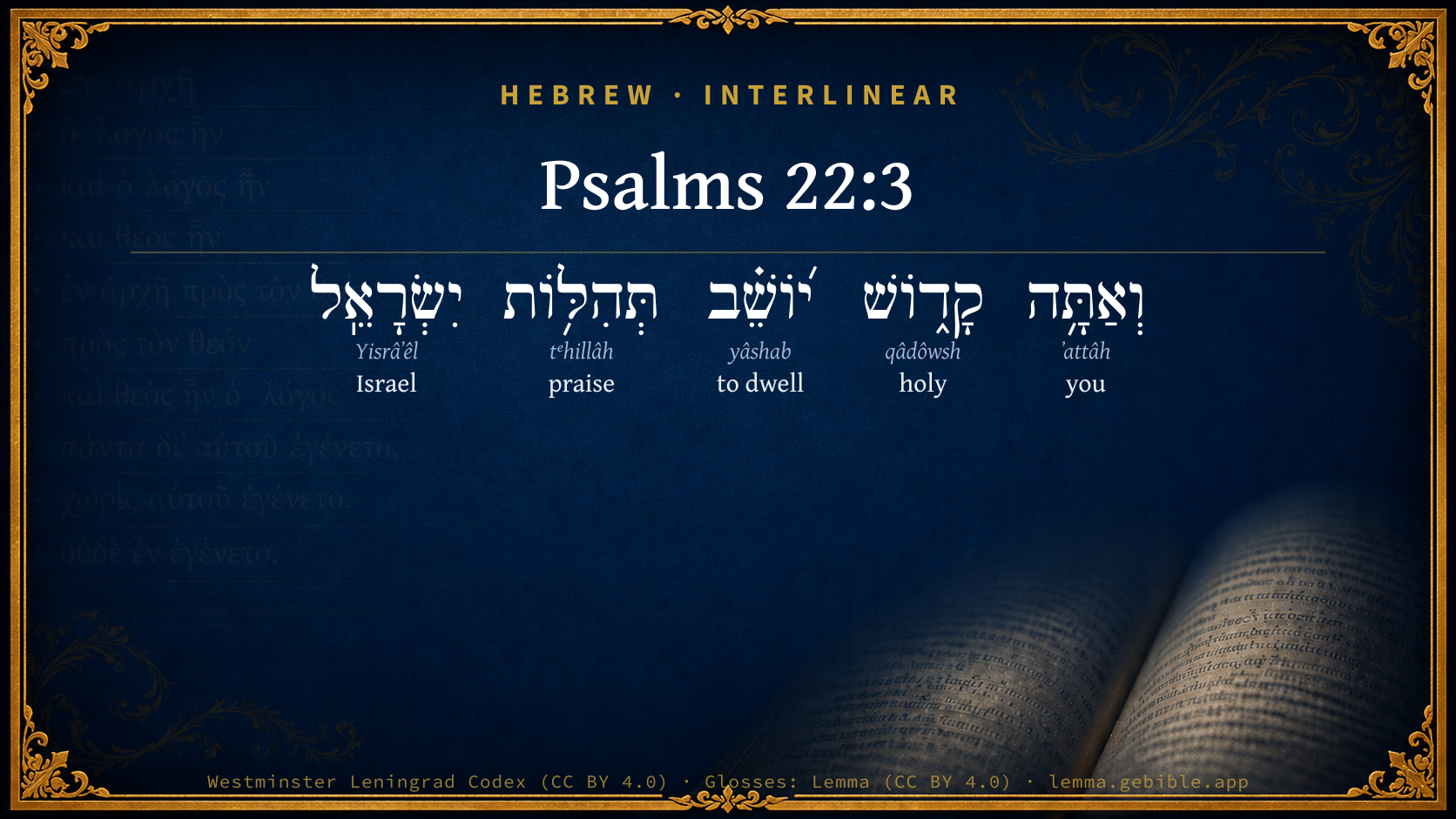
Psalms 22:3

Hebrew (Westminster Leningrad Codex) Psalms 22:3 appears in the Hebrew Old Testament. The text above is from the Westminster Leningrad Codex. Each word links to its Strong’s number, a concise gloss, and parsing drawn from the Open Scriptures Hebrew Bible morphology. Click any word for its full Brown-Driver-Briggs (BDB) entry.
Download image
Cite this verse

Psalms 22:3 (World English Bible). Public Domain. Lemma interlinear Bible study tool, https://lemma.gebible.app/v/psalms/22/3.

Show BibTeX & RIS
BibTeX
RIS
English Translation
But you are holy, You who inhabit the praises of Israel.
World English Bible · Public Domain
Download a study sheet

One document with this verse’s original text, its word-by-word gloss line, the meaning frame, cross-references with their text, attributed commentary, and full source and license credits — printable, and it pastes into notes with its structure intact.

This verse Autodidact and up

Study sheet (.html) Plain text (.txt)

A passage Seminary Student

Up to 50 verses in one chapter. A passage sheet keeps up to 6 commentary sources and 12 cross-references per verse, in the order this page ranks them, and says so on the sheet whenever that leaves anything out. Ask for a single verse and you get the Autodidact verse sheet above.

Everything on this page stays free to read, with no account — the sheet is a download of what is already on screen, not access to it.

Want to remove ads? Support Godless Engineer
Compare translations 3

The same verse in 3 English versions, stacked beneath the original-language interlinear above. Click any original word for its lexicon entry.

Each is an independent rendering of the whole verse — the interlinear is not word-aligned to these translations.

Highlighted words mark where these versions differ — a whole-verse word diff, not a word-by-word alignment.

  • World English Bible Public Domain
    But you are holy, You who inhabit the praises of Israel.
  • King James Version Public Domain
    But thou art holy, O thou that inhabitest the praises of Israel.
  • unfoldingWord Literal Text CC BY-SA 4.0
    Yet you are holy, sitting the praises of Israel.

unfoldingWord Literal Text — © unfoldingWord, licensed CC BY-SA 4.0. Word-aligned USFM3 via Door43 (git.door43.org/unfoldingWord/en_ult).

Versions to compare (up to 4)

3 of 4 selected

Show all 18 translations

Every available English version of this verse, each an independent rendering of the whole verse.

  • World English Bible Public Domain
    But you are holy, You who inhabit the praises of Israel.
  • Berean Standard Bible Public Domain
    Yet You are holy, enthroned on the praises of Israel.
  • Majority Standard Bible Public Domain
    Yet You are holy, enthroned on the praises of Israel.
  • King James Version Public Domain
    But thou art holy, O thou that inhabitest the praises of Israel.
  • American Standard Version (1901) Public Domain
    But thou art holy, O thou that inhabitest the praises of Israel.
  • Revised Version (1885) Public Domain
    But thou art holy, O thou that inhabitest the praises of Israel.
  • Geneva Bible (1599) Public Domain
    But thou art holy, and doest inhabite the prayses of Israel.
  • Douay-Rheims (1899) Public Domain
    O my God, I shall cry by day, and thou wilt not hear: and by night, and it shall not be reputed as folly in me.
  • Young's Literal Translation Public Domain
    And Thou `art' holy, Sitting -- the Praise of Israel.
  • Literal Standard Version CC BY-SA 4.0
    And You [are] holy, || Sitting—the Praise of Israel.
  • Unlocked Literal Bible CC BY-SA 4.0
    Yet you are holy; you sit as king with the praises of Israel.
  • unfoldingWord Literal Text CC BY-SA 4.0
    Yet you are holy, sitting the praises of Israel.
  • Darby Bible Public Domain
    And thou art holy, thou that dwellest amid the praises of Israel.
  • World Messianic Bible Public Domain
    But you are holy, you who inhabit the praises of Israel.
  • Webster's Bible Public Domain
    \\22:2\\O my God, I cry in the day-time, but thou hearest not; and in the night season, and am not silent.
  • Free Bible Version CC BY-SA 4.0
    Yet you are holy, and the praises of Israel are your throne.
  • Bible in Basic English Public Domain
    But you are holy, O you who are seated among the praises of Israel.
  • JPS Tanakh (1917) Public Domain
    (22-4) Yet Thou art holy, O Thou that art enthroned upon the praises of Israel.

Literal Standard Version (2020), Covenant Press — licensed CC BY-SA 4.0. Text via the HelloAO Bible API (eBible.org). Unlocked Literal Bible (unfoldingWord) — licensed CC BY-SA 4.0. Text via the HelloAO Bible API (eBible.org). unfoldingWord Literal Text — © unfoldingWord, licensed CC BY-SA 4.0. Word-aligned USFM3 via Door43 (git.door43.org/unfoldingWord/en_ult). Free Bible Version, Dr. Jonathan Gallagher — licensed CC BY-SA 4.0. Text via the HelloAO Bible API (eBible.org).

Word by word

More ways to search: Search by grammar → Find every occurrence → Compare this word →

Practice this passage: Drill this verse → Learn its vocabulary →

תְּהִלּ֥וֹת
tᵉhillâh
H8416
“praises of”
Noun, Common, Feminine, Plural, Construct
Part of Speech
Noun
Type
Common
Gender
Feminine
Number
Plural
State
Construct
Full BDB Definition

Origin: from H1984

TWOT: 500c

praise, song or hymn of praise - praise, adoration, thanksgiving (paid to God) - act of general or public praise - praise-song (as title) - praise (demanded by qualities or deeds or attributes of God) - renown, fame, glory - of Damascus, God - object of praise, possessor of renown (figuratively)
  1. וְאַתָּ֥ה ʼattâh H859 “and · you” Conjunction + Pronoun, Personal, 2nd Person, Masculine, Singular
  2. קָד֑וֹשׁ qâdôwsh H6918 “holy” Adjective, Adjective, Masculine, Singular, Absolute
  3. י֝וֹשֵׁ֗ב yâshab H3427 “dwelling” Verb, Qal, Participle Active, Masculine, Singular, Construct
  4. יִשְׂרָאֵֽל Yisrâʼêl H3478 “Israel” Noun, Proper

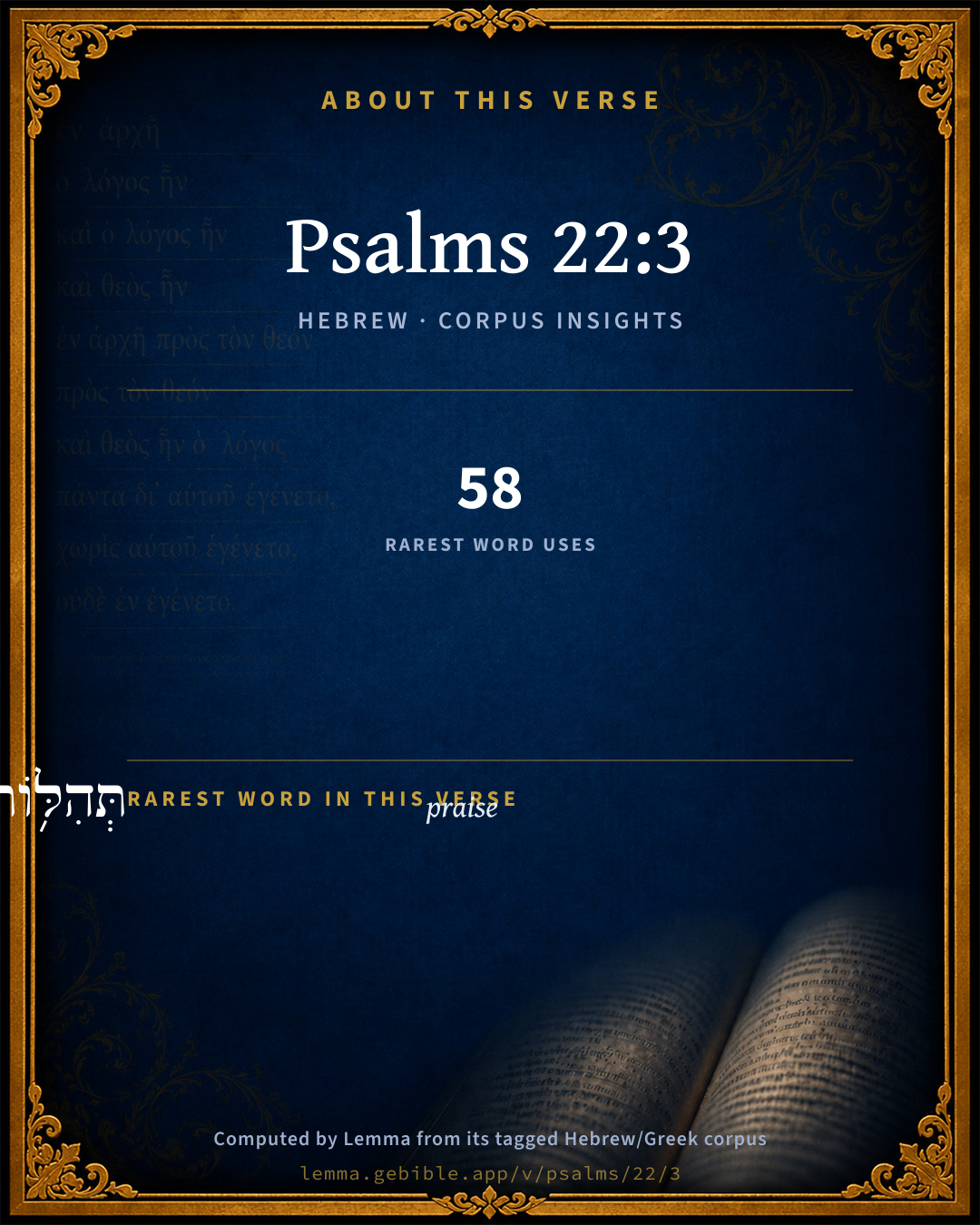
About this verse

These counts appear in no published source. They are computed here, from the morphology-tagged text and Lemma’s own curated glosses. What Lemma adds →

5
words
5
distinct lemmas
Wisdom
section

Shared distinctive vocabulary

תְּהִלּ֥וֹת praise H8416 occurs in 57 verses of the Hebrew Bible. Also found in:

Grammatical profile

  • 1 verb
  • 2 nouns
  • 1 adjective
  • 1 pronoun

Verb forms

  • י֝וֹשֵׁ֗ב Qal · Participle Active

Hebrew & Septuagint length

In English translation the verse runs 11 words from the Hebrew and 10 from the Septuagint (LXX English) — closely comparable.

A rough comparison of the two English renderings, which tokenize alike — not a word-level alignment.

Word counts can differ between the Hebrew and the Greek without any difference in meaning — e.g. the Hebrew direct-object marker אֵת has no separate Greek word, and Greek often adds the article ὁ.

Cross-references

7

Topical passages linked to Psalms 22:3 in the Treasury of Scripture Knowledge — connected by theme and wording, ordered by reader-vote popularity; previews shown in the World English Bible.

  • Deuteronomy 10:21 He is your praise, and he is your God, who has done for you these great and awesome things, which your eyes have seen.
  • Psalms 50:23 Whoever offers the sacrifice of thanksgiving glorifies me, And prepares his way so that I will show God's salvation to him."
  • Isaiah 6:3 One called to another, and said, "Holy, holy, holy, is Yahweh of Hosts! The whole earth is full of his glory!"
  • Revelation 4:8 The four living creatures, each one of them having six wings, are full of eyes around about and within. They have no rest day and night, saying, "Holy, holy, holy, holy, holy, holy, holy, holy, holy is the Lord God, the Almighty, who was and who is and who is to come!"
  • Psalms 99:9 Exalt Yahweh, our God. Worship at his holy hill, For Yahweh, our God, is holy!
  • Psalms 65:1 Praise waits for you, God, in Zion. To you shall vows be performed.
  • Psalms 145:17 Yahweh is righteous in all his ways, And gracious in all his works.

Cross-references courtesy of OpenBible.info (CC BY 4.0).

Hebrew and Greek witnesses Masoretic Hebrew ↔ Greek Septuagint

The same verse in the two great witnesses to the Old Testament, shown verse-for-verse.

You’re reading Greek Psalm 21 (Hebrew Psalm 22). The Septuagint counts the superscription, so verse numbers can differ from the Hebrew — chapter-level alignment, not verse-by-verse. Numbering follows Rahlfs.

These are two independent witnesses, not word-aligned to each other, and the Septuagint is shown in lemma (dictionary) form.

Hebrew Psalms 22:3 Masoretic · Westminster Leningrad Codex

וְאַתָּ֥ה קָד֑וֹשׁ י֝וֹשֵׁ֗ב תְּהִלּ֥וֹת יִשְׂרָאֵֽל

But you are holy, You who inhabit the praises of Israel.

World English Bible · Public Domain

Greek LXX Greek Psalm 21:3 Septuagint · lemma form

ὁ θεός ἐγώ κράζω ἡμέρα καί οὐ εἰςἀκούω καί νύξ καί οὐ εἰς ἄνοια ἐγώ

But you, the praise of Israel, dwell in a sanctuary.

LXX2012 (modern English Septuagint) · Public Domain

Hebrew: Westminster Leningrad Codex (CC BY 4.0). Greek: Septuagint (public domain); English from LXX2012 (modern English Septuagint) (Public Domain). How the Septuagint differs from the Hebrew →

Commentary

Notes on Psalms 22:3 from classic Christian and Jewish commentators (each source and its license shown beneath its notes). The classic Christian expositions comment on the surrounding passage and are grouped to its opening verse, so a note may address several verses; the Jewish commentaries on the Tanakh (Rashi and others) are per-verse, so they appear only where the commentator wrote on this verse.

Lemma curates 59 commentaries, every one of them public domain or Creative Commons licensed, each selected and text-cleaned for this edition rather than reprinted as found. About our sources →

Trapp's Complete Commentary

John Trapp

Psa 22:3 But thou [art] holy, [O thou] that inhabitest the praises of Israel.

Ver. 3. But thou art holy] And therefore to be sanctified in righteousness, Isa 5:16, whatever betide me or my prayers. I also will trust and try thee to the uttermost, for thou waitest to be gracious; and being a God of judgment, thou best understandest when and how to dispense and deal forth thy favours to thy suppliants, Isa 30:18. And if I ask good things of thee and miss, it is because I ask amiss, Jas 4:3. If I be straitened, it is not in thee, but in mine own bowels. They that have conduit water come into their houses, if no water come, they conclude not the spring to be dry, but the pipes to be stopped or broken. If prayer speed not, we must be sure the fault is not in God, but in ourselves; were we but ripe for mercy he is ready to extend it to us, and even waits for the purpose.

O thou that inhabitest the praises of Israel] i.e. The sanctuary, where thou art continually praised by thine Israel, who have the happiness to receive thine answer to their suits, though I cannot. Some render it, O sancte, sempiterne, et laudatissime.

John Trapp, A Commentary or Exposition upon All the Books of the Old and New Testament (1647–1656) — public domain. Text from a community e-Sword module.

The Biblical Illustrator

Joseph S. Exell

Psa_22:3

But Thou art holy, O Thou that inhabitest the praises of Israel.

A habitation of God

There is ordinarily something like a proportion maintained between the power of a monarch and the splendour of his palace. If you visit countries you will generally find that the mightier the king and the more extended his sway the more sumptuous are the royal residences. And the criterion is altogether a just one; for we have a full right to expect that the residence of the monarch will be a kind of index of his might; that in proportion to the largeness of his revenues and the extent of his dominion will be the magnificence of architecture and the richness of decoration which distinguish his mansion from those of his subjects. The house is, indeed, in most cases throughout society, the sign of the means of its inhabitant; it grows loftier than before, and is furnished in a more costly style as a man advances in the world and gathers to himself more of opulence and influence. There will be exceptions to every such rule; but these will ordinarily be in cases of meanness and penuriousness. But there is a King whose empire is all space, and whose subjects all that breathe. What shall be a fitting palace for Him? How shall the rule we have laid down be proved applicable in the instance of our Maker? It must fail, because nothing, oven of His own workmanship, can bear any proportion with Him. Solomon said, The heaven, even the heaven of heavens, cannot contain Thee. And when we go on to speak of churches, we are compelled to finish Solomons sentence and say, How much less this house which I have built. And yet as that temple, so churches may be properly styled--houses of God. He abides in them as He abides not in any other structure. And they ought to be beautiful. It is no good sign when palaces are more and more costly, and churches less and less noble. If God is to have a house at all, that house should be the noblest that we have the power of rearing; bearing such proportion as our ability can effectuate, to the greatness of the Being who is to show Himself within its walls. Otherwise, if our churches be inferior to our other structures, less splendid in design, less rich in architecture, we give the strongest of all possible proofs that we are less disposed to do honour to God than to ourselves; that we think the curtains good enough for the ark, and reserve the cedar for our own habitation. It was not thus with our ancestors, whom we are ready enough to accuse of superstition, but in whom there must have been better and loftier feelings. Witness the cathedrals which yet crest our land; mightier and more sumptuous, as they ought to be, than even our palaces. Tell me not that a mere dark superstition actuated the men who designed and executed these sublime edifices. The long-drawn aisles, the fretted reels, the dim recesses, the soaring spires, all witness that the architect had grand thoughts of God, and strove to embody them in combinations of the wood and the stone, even as the poet his conceptions in the melodies of verse, or the orator his in the majesty of eloquence. It is a cold and withered piety which catches no inspiration from the structure. And there must, we believe, have been lofty and ardent piety in those who could plan structures that thus seem to furnish instances of their piety to successive generations. The cathedral, with its awe-inciting vastness, its storied windows, its mellowed light, its deepened shadows, appears to me like the rich volume of some old divine: I gather from the work the mind of the author, and it is a mind which has grown great in musing upon God. But we have another cathedral to throw open before you, another dwelling place of Deity, not builded up of the stars which God originally wrought into His pavilion, nor yet of the marble and the cedar, which we ourselves may work into sumptuous edifices. Listen to our text. How is God therein addressed? O Thou, that inhabitest the praises of Israel. It is the Lord Jesus Christ who speaks, and He it is who directs attention to the structure, declaring that it has not only been reared, but is actually inhabited by God. For though Israel be only the Church, and every member of that Church have been born in sin and shapen in iniquity, I find no less a Being than the Redeemer Himself, and that too in His last moments, when trial was before Him in all its severity, addressing His Father as Thou who inhabitest the praises of Israel. Now, is there any proportion here between the house and the inhabitant? Here is a cathedral built of human praises. Why should it be a cathedral in any sense worthy of God, or one within which God might be expected to dwell? You tell me that very rich and acceptable must be the thanksgiving of angels; burning and beautiful creatures, who spend existence in magnifying the Being by whom it was bestowed. Who doubts it! But they have only to thank God for creation. Their praise must be like that of Adam, whilst he was yet in innocence, and paradise in loveliness; whose morning and evening hymn spoke glowingly of a glorious Benefactor. And I can thank God for creation. The angels song is mine, though mine belongs not to the angel. But I have to thank God for more than creation, for more than life. I have to thank Him for a second creation, for life out of death; and angels must yield to me here. If, then, sanctuaries are to be builded of praise, who shall be the architects of that in which Deity may be most expected to take up His abode? Behold the structures. Yonder is that which unfallen creatures are roaring; and very noble and brilliant is the fabric. How lofty those columns, which are formed out of anthems that commemorate the inaccessible majesties of Godhead! How solemn those dim recesses, where mention is made of the mysteries of the Divine nature! How rich that roof, which is wrought out of melodies which hymn the goodness of the universal Parent! But now turn to that which fallen creatures build. It is based on the Rock of Ages; the sure foundation stone, which God Himself laid in Zion. And its walls, what are they but the celebration of attributes, which would have been comparatively hidden if not discovered in redemption? Its pillars, what but song upon song, each witnessing to perfections which could not show themselves in an unstained creation! Its aisles, what but prolonged choruses, telling out, till lost in the depths of eternity, the marvels of a work which even cherubim and seraphim had failed to imagine! And what its domes, its pinnacles, its spires, but soaring notes which bear aloft the stupendous truth, that He who is to everlasting could die, and that He who was from everlasting could be born; that God became man, and that man may now rise into fellowship with God! Ah! this is the cathedral. This could never have been built had not God come out from the secrecies of His magnificence, and thrown open depths in Himself which the most penetrating intelligence could never have explored. There is not a stone in this which may not be said to have been hewn by Himself out of the unfathomable mine of His perfections; there is not a niche which is not filled with a brighter image of Deity than the universe could have furnished had there never been transgression; there is not an altar on which burns not a more brilliant fire than could have been kindled had not the flame of Gods wrath against sin been quenched in the blood of Gods only begotten Son. And Christ, as He hung upon the Cross and contemplated the effects of the work which He was then bringing to a close, must have looked on wondrous structures, each of loftiest architecture and splendid ornament--the regenerated earth, the universe no longer defiled by one dark spot; but He knew that His work was to be preeminently illustrious, and the source of the highest glory of all to our Creator. Upon this, therefore, might He be expected to fasten; and though all orders of being were before Him, eager to build their Maker a house--angel and archangel, from whose swelling choir started, as by enchantment, a thousand ethereal temples--who shall marvel that He selected us the feeble, us the sinful, and knowing that He was making us heirs of God, yea, joint heirs with Himself, left us to rear a sanctuary which should be more honoured than any other; addressing Himself thus with His dying breath to His Father--O Thou that inhabitest the praises of Israel? (H. Melvill, B. D.)

The Biblical Illustrator, edited by Joseph S. Exell (c. 1880s–1900s) — public domain. Text from a community e-Sword module.

Joseph Benson's Commentary

Psa 22:3. But thou art holy — “But notwithstanding thou dost not answer me at present, I am persuaded that thou wilt do so, for thou art holy, good, and gracious;” O thou that inhabitest the praises of Israel — That dwellest in the place where the praises of Israel have always been offered for mercies granted unto them: or, who receivest and rightly possessest the praises of Israel; whom thy people are perpetually praising for one mercy or another; and therefore, I trust I also shall have occasion to praise thee.

Joseph Benson's Commentary on the Old and New Testaments (1811–1818) — public domain. Text from a community e-Sword module.

Whedon's Commentary on the Bible

Daniel D. Whedon

3. Thou art holy—Faith strengthens itself (Psa_22:3-5) in the reflection, God is holy,—and in the retrospect, Our fathers (the fathers of the nation) trusted; they cried, and were delivered. His must be a righteous cause which derives support from the holiness and covenant faithfulness of God.

Inhabitest the praises of Israel—Sittest enthroned over the praises of Israel.

Daniel D. Whedon (gen. ed.), Commentary on the Old and New Testaments (1874–1909) — public domain. Text from a community e-Sword module.

J. A. Alexander on Psalms

Joseph Addison Alexander

4. (Psa 22:3). And thou (art) holy, inhabiting the praises of Israel. Here begins his statement of the grounds on which he might claim to be heard, and all which may be summed up in this, that Jehovah was the covenant God of Israel. The word translated holy, in its widest sense, includes all that distinguishes God from creatures, not excepting what are usually termed his natural perfections. Hence the epithet is often found connected with descriptions of his power, eternity, &c. See Isa 6:3; Isa 40:25-26; Isa 57:15; Hab 3:3; Psa 111:9. The primary meaning of the verb appears to be that of separation, which may here be alluded to, in reference to Jehovah's peculiar relation to the chosen people. Or it may be taken in its wider and higher sense, leaving the other to be expressed in the last clause. "Thou art the glorious and perfect God who inhabitest the praises of Israel," i.e. dwellest among those praises, and art constantly surrounded by them. Some prefer, however, to retain the primary meaning of the Hebrew verb, sitting (enthroned upon) the praises of Israel.

Joseph Addison Alexander, The Psalms Translated and Explained (1850) — public domain. Text from a community e-Sword module.

Tyndale Open Study Notes

Tyndale Open Resources

22:3 God, the holy King, is set apart from all his creation, but he chooses to reveal himself to Israel. • God greatly desires that his people offer praises to him.

Tyndale Open Study Notes — © Tyndale Open Resources, licensed CC BY-SA 4.0. Text via the HelloAO Bible API.

Geneva Bible (1599)

Geneva Bible translators

He meaneth the place of praising, even the Tabernacle: or else it is so called, because he gave the people continually occasion to praise him.

Geneva Bible (1599) marginal notes — public domain. Text via Bolls.life.

Jamieson, Fausset & Brown

Robert Jamieson, A. R. Fausset & David Brown

Still he not only refrains from charging God foolishly, but evinces his confidence in God by appealing to Him.

thou art holy--or possessed of all the attributes which encourage trust, and the right object of the praises of the Church: hence the sufferer need not despair.

Jamieson, Fausset & Brown — Commentary Critical and Explanatory on the Whole Bible (1871) — public domain (CC PDM 1.0). Text via the HelloAO Bible API.

Adam Clarke's Commentary

Verse 3. But thou art holy] Though I be not heard, even while I cry earnestly, yet I cannot impute any fault or unkindness to my Maker; for thou art holy, and canst do nothing but what is right. This is the language of profound resignation, in trials the most difficult to be borne.

Inhabitest the praises of Israel.] Thou dwellest in the sanctuary where the praises, thanksgivings, and sacrifices of thy people are continually offered.

Adam Clarke's Commentary on the Bible (1810–1826) — public domain. Text from a community e-Sword/MySword module.

John Calvin's Commentaries

3. Yet thou art holy. In the Hebrew, it is properly, And thou art holy: but the copula ו, vau, ought, without doubt, to be rendered by the adversative particle yet. Some think that the eternal and immutable state of God is here set in opposition to the afflictions which David experienced; As ישב, yashab, not only signifies to inhabit, but also to remain or continue, (see Psalm 102:13,) Hammond thinks this last is the meaning here, and renders the word, “But thou remainest or continuest to be holy, O thou, the praises of, or who art the praises of Israel, that is, the object of all their praises; or more simply, But thou remainest holy, the praises of Israel.”

John Calvin's Commentaries (1540-1563) — public domain. Text from the Calvin Translation Society English edition (1840s-50s) via the Christian Classics Ethereal Library (ccel.org). Calvin's coverage is partial (roughly two-thirds of the Bible); uncommented books and verses are honest gaps, never fabricated. The 19th-century editor's footnotes and remarks are omitted so the notes are faithfully Calvin's own voice.

Ellicott's Commentary for English Readers

(3) But.—In spite of his seeming desertion the poet still believes Jehovah is the God of the covenant—still the Holy One in whom His people could trust.

The phrase “inhabiting the praises of Israel,” recalls the more usual “thou that dwellest between the cherubims” (1Sa_4:4; 2Sa_6:2; Psa_80:1; Psa_99:1, where see Note). But the idea here is more spiritual. The ever-ascending praises of His people become a throne for the Divine King, and take the place of the outstretched wings of the cherubim. Perhaps there is a reminiscence of Exo_15:11-12. This explanation is at once more literal and better than the Rabbinical, “enthroned as the praises.” (Comp. Aquila: “as the hymns.”)

A Bible Commentary for English Readers, edited by Charles John Ellicott (1878–1897) — public domain. Text from a community e-Sword module.

The Cambridge Bible for Schools and Colleges

gen. ed. J. J. S. Perowne

3. An appeal to God’s moral character, as the Holy One of Israel. The Heb. word for holy is derived from a root signifying separation. It characterises God negatively, as separate from the limitations and imperfections of the world and man; and positively, it comes to express the essential nature of God in its moral aspect, as pure, righteous, faithful, supremely exalted. In virtue of His holiness he cannot be false to His covenant. Cp. Habakkuk’s plea (Hab_1:12); and for another side of the truth, Isa_5:16.

O thou that inhabitest the praises of Israel] Rather as R.V. marg., O thou that art enthroned upon the praises of Israel: a bold adaptation of the phrase that sittest enthroned upon the cherubim (2Sa_6:2; 2Ki_19:15; Psa_80:1; Psa_99:1). The praises of Israel, ascending like clouds of incense, form as it were the throne upon which Jehovah sits. They are a perpetual memorial of His mighty acts in times past (Exo_15:11; Psa_78:4; Isa_63:7); and surely He cannot have ceased to give occasion for those praises (Psa_22:25)! The P.B.V. is based on an untenable construction of the words, in its rendering, And thou continuest holy, O thou worship of Israel, and it takes praises of Israel to mean God Himself as the object of Israel’s praises.

The Cambridge Bible for Schools and Colleges (gen. ed. J. J. S. Perowne; Cambridge University Press, 1878–1918) — public domain. Text from a community e-Sword module.

John Gill's Exposition

But thou art holy,.... Which may be considered either as an argument with his God, why he should hear and answer him, since he is holy, just, and faithful; he has promised, when any call upon him in a day of trouble, he will hear and answer them, and will be glorified by them; this Christ did, and therefore pleads his faithfulness to his promise: or rather a reason quieting him under divine desertion, and a sense of divine wrath, that God was righteous in all his ways, and holy in all his works; and that whereas he was the surety of his people, and had all their sins on him, it was perfectly agreeable to the holiness and justice of God to treat him in the manner he did; yea, it was done to declare his righteousness, that he might appear to be just, while he is the justifier of him that believes in him;

O thou that inhabitest the praises of Israel; either the place where Israel offered the sacrifices of praise to God, the tabernacle or temple, the house of prayer and praise in which Jehovah dwelt: or the true Israel of God praising him, who are formed for himself, and called by his grace to show forth his praises; among whom he takes up his residence: or else the praises themselves; and so the phrase denotes God's gracious acceptance of them, and well pleasedness in them, signified by his inhabiting of them, and the frequent and constant ascription of them to him: and perhaps respect may be had chiefly to the praises of his people for providing such a Saviour for them, settling him in the fulness of time, and not sparing him, but delivering him up into the hands of justice and death for them; and for giving all things freely with him.

John Gill's Exposition of the Whole Bible (1746–1763) — public domain (CC PDM 1.0). Text via the HelloAO Bible API.

Albert Barnes' Notes on the Bible

But thou art holy - Thou art righteous and blameless. This indicates that the sufferer had still unwavering confidence in God. Though his prayer seemed not to be heard, and though he was not delivered, he was not disposed to blame God. He believed that God was righteous, though he received no answer; he doubted not that there was some sufficient reason why he was not answered. This is applicable, not only to the Redeemer, in whom it was most fully illustrated, but also to the people of God everywhere. It expresses a state of mind such as all true believers in God have - confidence in him, whatever may be their trials; confidence in him, though the answer to their prayers may be long delayed; confidence in him, though their prayers should seem to be unanswered. Compare the notes at Job 13:15.

O thou that inhabitest the praises of Israel - That dwellest where praise is celebrated; that seemest to dwell in the midst of praises. The language here refers to the praises offered in the tabernacle or temple. God was supposed to dwell there, and he was surrounded by those who praised him. The sufferer looks upon him as worshipped by the multitude of his people; and the feeling of his heart is, that though he was himself a sufferer - a great and apparently unpitied sufferer - though he, by his afflictions, was not permitted to unite in those lofty praises, yet he could own that God was worthy of all those songs, and that it was proper that they should be addressed to him.

Albert Barnes' Notes on the Bible (1834–1885) — public domain. Text from a community e-Sword/MySword module.

Matthew Poole's English Annotations

Thou art holy, i. e just and true in all thy ways, and therefore hearing prayers, and keeping thy covenant; a true lover of holiness, and of all holy men. This he adds, either,

1. To aggravate his misery, that such a God should neglect and forsake him. Or rather,

2. To strengthen his faith, and to enforce his prayers, and prevail with God, for the honour of his holy name, to hear and help him.

That inhabitest the praises of Israel; either,

1. That dwellest in thy tabernacle and ark, which is called Israel’s glory, 1Sa 4:21, and the place where God was praised, Isa 64:11. Or,

2. That receivest and rightly possessest the praises of Israel, whom the people are perpetually praising for one mercy or another; and therefore I trust I also shall have occasion to praise thee. But because this Hebrew verb, when it is used transitively, and is taken for inhabiting, is generally, as far as I have observed, construed with a preposition, which here it is not, this verse may seem to be better rendered thus, as it is by divers learned men, But thou abidest, or perseverest, or continuest to be (as this verb is used, Psa 9:7; 55:19; 102:12)

holy, ( notwithstanding thy present neglect of my prayers and miseries,) O the praises, or, O thou who art the praises, (or, and the praises, i.e. the great cause and object of the praises,) of Israel, i. e whom Israel solemnly and usually praised, Deu 10:21; Jer 17:14.

Matthew Poole's English Annotations on the Holy Bible (1683–1685) — public domain. Text from a community e-Sword/MySword module.

The Treasury of David

Charles H. Spurgeon

Ver. 3. But thou art holy, O thou that inhabitest the praises of Israel. However ill things may look, there is no ill in thee, O God! We are very apt to think and speak hardly of God when we are under his afflicting hand, but not so the obedient Son. He knows too well his Father's goodness to let outward circumstances libel his character. There in no unrighteousness with the God of Jacob, he deserves no censure; let him do what he will, he is to be praised, and to reign enthroned amid the songs of his chosen people. If prayer be unanswered it is not because God is unfaithful, but for some other good and weighty reason. If we cannot perceive any ground for the delay, we must leave the riddle unsolved, but we must not fly in God's face in order to invent an answer. While the holiness of God is in the highest degree acknowledged and adored, the afflicted speaker in this verse seems to marvel how the holy God could forsake him, and be silent to his cries. The argument is, thou art holy, Oh! why is it that thou dost disregard thy holy One in his hour of sharpest anguish? We may not question the holiness of God, but we may argue from it, and use it as a plea in our petitions.

Ver. 3. But thou art holy. Here is the triumph of faiththe Saviour stood like a rock in the wide ocean of temptation. High as the billows rose, so did his faith, like the coral rock, wax greater and stronger till it became an island of salvation to our shipwrecked souls. It is as if he had said, "It matters not what I endure. Storms may howl upon me; men despise; devils tempt; circumstances overpower; and God himself forsake me, still God is holy; there is no unrighteousness in him." John Stevenson.

Ver. 3. But thou art holy. Does it seem strange that the heart in its darkness and sorrow should find comfort in this attribute of God? No, for God's holiness is but another aspect of his faithfulness and mercy. And in that remarkable name, "the Holy One of Israel", we are taught that he who is the "holy" God is also the God who has made a covenant with his chosen. It would be impossible for an Israelite to think of God's holiness without thinking also of that covenant relationship. "Be ye holy; for I, the Lord your God am holy, "were the words in which Israel was reminded of their relation to God. See especially Le 19:1. We see something of this feeling in such passages as Ps 89:16-19 99: 5-9 Ho 11:8-9; Isa 41:14 47:4. J. J. Stewart Perowne.

Ver. 3. Were temptations never so black, faith will not hearken to an ill word spoken against God, but will justify God always. David Dickson.

Ver. 3. Whatever God may do, we must settle it in our minds that he is holy and to be praised.

Psalms 22:4*

Charles H. Spurgeon's The Treasury of David (1869–1885) — public domain. Psalms only. Text from a community e-Sword/MySword module.

The Pulpit Commentary

But thou art holy. Still God is holy; the Sufferer casts no reproach upon him, but "commits himself to him that judgeth righteously". (1Pe_2:23) O thou that inhabitest the praises of Israel. God is seen enthroned in his sanctuary, where the praises and prayers of Israel are ever being offered up to him. If he hears them, he will assuredly, in his own good time, hear the Sufferer.

The Pulpit Commentary (1880–1919), ed. H.D.M. Spence-Jones & Joseph S. Exell — public domain. Text from a community e-Sword module.

John Wesley's Explanatory Notes

But thou art - Just and true in all thy ways, this he adds to strengthen his faith, and to enforce his prayers, and prevail with God for the honour of his holy name, to hear and help him. Inhabitest - Whom thy people are perpetually praising.

John Wesley, Explanatory Notes Upon the Whole Bible (1754–1765) — public domain. Text via the GEBible commentary corpus.

Keil & Delitzsch

C. F. Keil & F. Delitzsch

(Heb.: 22:4-6) The sufferer reminds Jahve of the contradiction between the long season of helplessness and His readiness to help so frequently and so promptly attested. ואתּה opens an adverbial clause of the counterargument: although Thou art...Jahve is קדושׁ, absolutely pure, lit., separated (root קד, Arab. qd, to cut, part, just as ṭahur, the synonym of ḳadusa, as the intransitive of ṭahara = ab‛ada, to remove to a distance, and בּר pure, clean, radically distinct from p-rus, goes back to בּרר to sever), viz., from that which is worldly and common, in one word: holy. Jahve is holy, and has shown Himself such as the תּהלּות of Israel solemnly affirm, upon which or among which He sits enthroned. תהלות are the songs of praise offered to God on account of His attributes and deeds, which are worthy of praise (these are even called תהלות in Psa 78:4; Exo 15:11; Isa 63:7), and in fact presented in His sanctuary (Isa 64:10). The combination יושׁב תּהלּות (with the accusative of the verbs of dwelling and tarrying) is like יושׁב כּרבים, Psa 99:1; Psa 80:2. The songs of praise, which resounded in Israel as the memorials of His deeds of deliverance, are like the wings of the cherubim, upon which His presence hovered in Israel. In Psa 22:5, the praying one brings to remembrance this graciously glorious self-attestation of God, who as the Holy One always, from the earliest times, acknowledged those who fear Him in opposition to their persecutors and justified their confidence in Himself. In Psa 22:5 trust and rescue are put in the connection of cause and effect; in Psa 22:6 in reciprocal relation. פּלּט and מלּט are only distinguished by the harder and softer sibilants, cf. Psa 17:13 with Psa 116:4. It need not seem strange that such thoughts were at work in the soul of the Crucified One, since His divine-human consciousness was, on its human side, thoroughly Israelitish; and the God of Israel is also the God of salvation; redemption is that which He himself determined, why, then, should He not speedily deliver the Redeemer?

Keil & Delitzsch — Biblical Commentary on the Old Testament (1861–1891) — public domain (CC PDM 1.0). Text via the HelloAO Bible API. (Old Testament only.)

unfoldingWord translationNotes

Door43 World Missions Community

you sit as king with the praises of Israel

"the praises of Israel are the throne on which you sit as king." The praises of Israel are described as if they are a throne upon which God can sit and rule, or as a house in which God can live. AT: "you are king and the people of Israel praise you" (See: Metaphor)

of Israel

Here "Israel" represents the people of Israel. (See: Metonymy)

were not disappointed

This can be stated in active form. AT: "you did not disappoint them" or "you did not fail them" (See: Active or Passive)

were not disappointed

This can be stated in positive form. AT: "you saved them" or "you did for them what they needed you to do" (See: Double Negatives)

translationWords

holy

king

praise

Israel

ancestor

trust

cry

unfoldingWord translationNotes — © Distant Shores Media and the Door43 World Missions Community, licensed CC BY-SA 4.0. Source: git.door43.org/Door43/en_tn.

Rashi

Rabbi Shlomo Yitzchaki (Rashi)

I call out by day I call out to You every day, and You do not answer.

Rashi on the Tanakh — English translations: “The Judaica Press complete Tanach with Rashi, translated by A. J. Rosenberg” (CC BY 4.0); “Pentateuch with Rashi's commentary by M. Rosenbaum and A.M. Silbermann, 1929-1934” (public domain); “The Metsudah Tanach series, Lakewood, N.J” (CC BY 4.0); and “The Book of Joshua, Metsudah Publications, 1997” (CC BY 4.0). Text via Sefaria.

Radak

Rabbi David Kimhi (Radak)

my God, I call by day: – i.e. in the day;

but Thou answerest not; And at night: – and in the night I call;

but there is no rest for me: – from my crying, and Thou dost not answer, דמיה (rest) is a noun, not an adjective.

Radak on the Tanakh — English translations: “Sefaria Community Translation” (CC0 1.0 (public-domain dedication)); “Eliyahu Munk, HaChut Hameshulash” (CC BY 4.0); “Rabbi Mike Feuer, Jerusalem Anthology” (CC BY 4.0); and “R. David Kimhi on the first book of Psalms, Translated by R.G. Finch, London, 1919” (public domain). Text via Sefaria.

Lesson kit

Teaching starters — assembled from the data on this page, not authored interpretation. Every prompt links to the verse data it draws on. Edit before teaching.

Psalms, in the Wisdom, opens this verse with 5 words (5 distinct Hebrew lemmas). Its most distinctive word is tᵉhillâh (“praise”). A historical commentator’s framing appears above. Read the whole chapter for the surrounding context.

Discussion questions

  1. What does “praise” (tᵉhillâh) contribute to the verse as a whole?
  2. How does Exodus 15:11, which shares the word «praise», read alongside this verse?
  3. These translations render this verse differently. What is at stake in choosing one wording over another?
  4. «י֝וֹשֵׁ֗ב» is a Qal Participle Active verb. How does that grammatical form shape the action described?
  5. Compare how Trapp's Complete Commentary and The Biblical Illustrator read this verse. Where do they agree or differ?

Things to notice

Reading settings

Reading text

Shown beneath each verse's original-language words.

Old Testament
Old Testament edition

Read the OT as the Masoretic Hebrew (MT) or the Greek Septuagint (LXX).

English shown for the Greek Septuagint (in the Hebrew ↔ Greek comparison).

Comparing translations? Open the Compare panel on any verse page to stack up to four side by side.