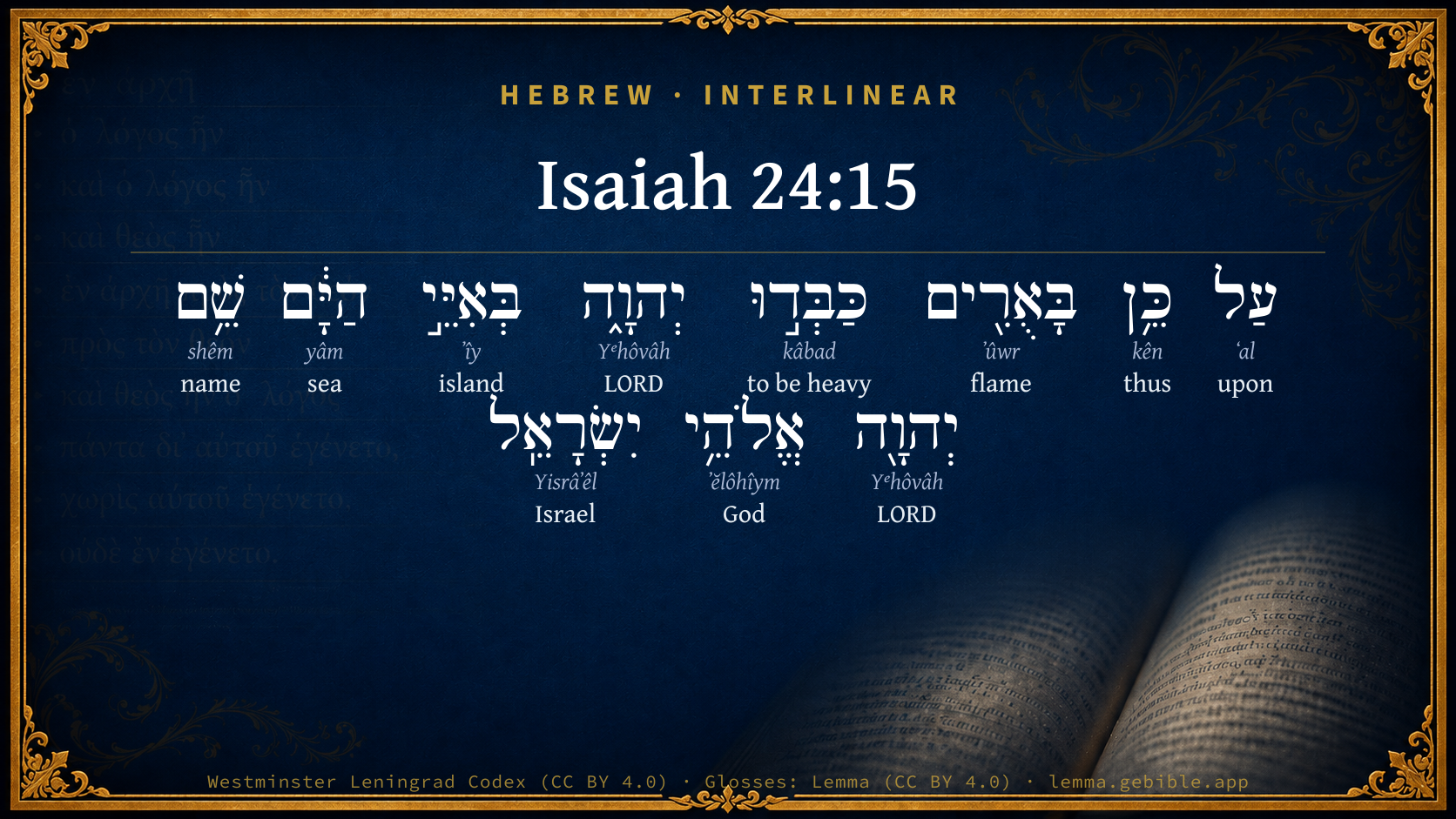
Isaiah 24:15

Hebrew (Westminster Leningrad Codex) Isaiah 24:15 appears in the Hebrew Old Testament. The text above is from the Westminster Leningrad Codex. Each word links to its Strong’s number, a concise gloss, and parsing drawn from the Open Scriptures Hebrew Bible morphology. Click any word for its full Brown-Driver-Briggs (BDB) entry.
Download image
Cite this verse

Isaiah 24:15 (World English Bible). Public Domain. Lemma interlinear Bible study tool, https://lemma.gebible.app/v/isaiah/24/15.

Show BibTeX & RIS
BibTeX
RIS
English Translation
Therefore glorify Yahweh in the east, even the name of Yahweh, the God of Israel, in the isles of the sea!
World English Bible · Public Domain
Highlights
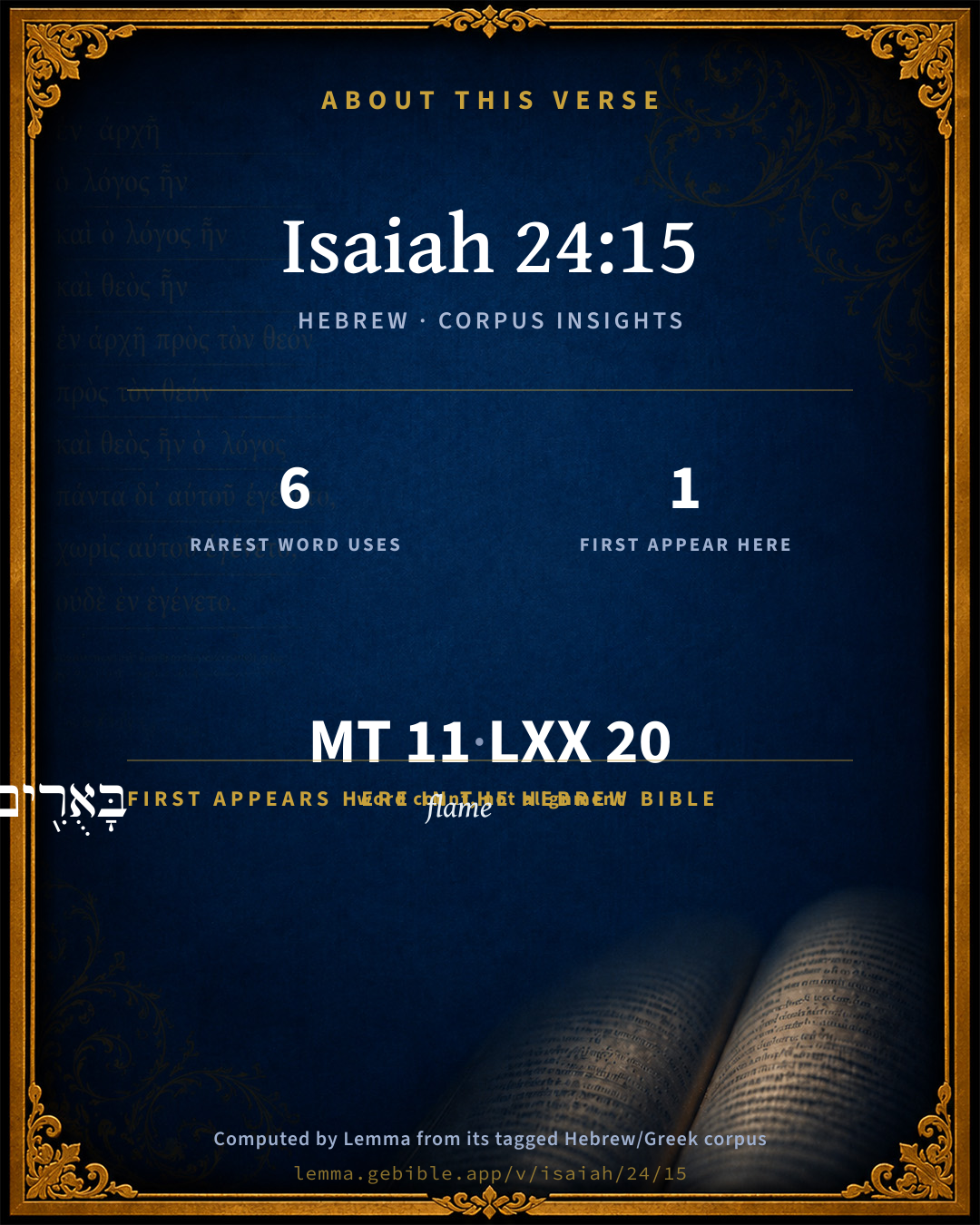
  • 1 first appearance in the Hebrew Bible
Full analysis ↓
Download a study sheet

One document with this verse’s original text, its word-by-word gloss line, the meaning frame, cross-references with their text, attributed commentary, and full source and license credits — printable, and it pastes into notes with its structure intact.

This verse Autodidact and up

Study sheet (.html) Plain text (.txt)

A passage Seminary Student

Up to 50 verses in one chapter. A passage sheet keeps up to 6 commentary sources and 12 cross-references per verse, in the order this page ranks them, and says so on the sheet whenever that leaves anything out. Ask for a single verse and you get the Autodidact verse sheet above.

Everything on this page stays free to read, with no account — the sheet is a download of what is already on screen, not access to it.

Want to remove ads? Support Godless Engineer
Compare translations 3

The same verse in 3 English versions, stacked beneath the original-language interlinear above. Click any original word for its lexicon entry.

Each is an independent rendering of the whole verse — the interlinear is not word-aligned to these translations.

Highlighted words mark where these versions differ — a whole-verse word diff, not a word-by-word alignment.

  • World English Bible Public Domain
    Therefore glorify Yahweh in the east, even the name of Yahweh, the God of Israel, in the isles of the sea!
  • King James Version Public Domain
    Wherefore glorify ye the LORD in the fires, even the name of the LORD God of Israel in the isles of the sea.
  • unfoldingWord Literal Text CC BY-SA 4.0
    Therefore glorify Yahweh in the east, in the coastlands of the sea, the name of Yahweh, the God of Israel.

unfoldingWord Literal Text — © unfoldingWord, licensed CC BY-SA 4.0. Word-aligned USFM3 via Door43 (git.door43.org/unfoldingWord/en_ult).

Versions to compare (up to 4)

3 of 4 selected

Show all 18 translations

Every available English version of this verse, each an independent rendering of the whole verse.

  • World English Bible Public Domain
    Therefore glorify Yahweh in the east, even the name of Yahweh, the God of Israel, in the isles of the sea!
  • Berean Standard Bible Public Domain
    Therefore glorify the LORD in the east. Extol the name of the LORD, the God of Israel in the islands of the sea.
  • Majority Standard Bible Public Domain
    Therefore glorify the LORD in the east. Extol the name of the LORD, the God of Israel in the islands of the sea.
  • King James Version Public Domain
    Wherefore glorify ye the LORD in the fires, even the name of the LORD God of Israel in the isles of the sea.
  • American Standard Version (1901) Public Domain
    Wherefore glorify ye Jehovah in the east, even the name of Jehovah, the God of Israel, in the isles of the sea.
  • Revised Version (1885) Public Domain
    Wherefore glorify ye the LORD in the east, even the name of the LORD, the God of Israel, in the isles of the sea.
  • Geneva Bible (1599) Public Domain
    Wherefore praise yee the Lord in the valleis, euen the Name of the Lord God of Israel, in the yles of the sea.
  • Douay-Rheims (1899) Public Domain
    Therefore glorify ye the Lord in instruction: the name of the Lord God of Israel in the islands of the sea.
  • Young's Literal Translation Public Domain
    Therefore in prosperity honour ye Jehovah, In isles of the sea, the name of Jehovah, God of Israel.
  • Literal Standard Version CC BY-SA 4.0
    Therefore honor YHWH in prosperity, || In islands of the sea, the Name of YHWH, God of Israel.
  • Unlocked Literal Bible CC BY-SA 4.0
    Therefore in the east glorify Yahweh, and in the isles of the sea give glory to the name of Yahweh, the God of Israel.
  • unfoldingWord Literal Text CC BY-SA 4.0
    Therefore glorify Yahweh in the east, in the coastlands of the sea, the name of Yahweh, the God of Israel.
  • Darby Bible Public Domain
    Therefore glorify Jehovah in the east, the name of Jehovah, the God of Israel, in the isles of the west.
  • World Messianic Bible Public Domain
    Therefore glorify the LORD in the east, even the name of the LORD, the God of Israel, in the islands of the sea!
  • Webster's Bible Public Domain
    Wherefore glorify ye the LORD in the fires, even the name of the LORD God of Israel in the isles of the sea.
  • Free Bible Version CC BY-SA 4.0
    From the east they glorify the Lord; from the sea shores they praise the name of the Lord, the God of Israel.
  • Bible in Basic English Public Domain
    Give praise to the Lord in the east, to the name of the Lord, the God of Israel, in the sea-lands.
  • JPS Tanakh (1917) Public Domain
    'Therefore glorify ye the LORD in the regions of light, even the name of the LORD, the God of Israel, in the isles of the sea.'

Literal Standard Version (2020), Covenant Press — licensed CC BY-SA 4.0. Text via the HelloAO Bible API (eBible.org). Unlocked Literal Bible (unfoldingWord) — licensed CC BY-SA 4.0. Text via the HelloAO Bible API (eBible.org). unfoldingWord Literal Text — © unfoldingWord, licensed CC BY-SA 4.0. Word-aligned USFM3 via Door43 (git.door43.org/unfoldingWord/en_ult). Free Bible Version, Dr. Jonathan Gallagher — licensed CC BY-SA 4.0. Text via the HelloAO Bible API (eBible.org).

Word by word

More ways to search: Search by grammar → Find every occurrence → Compare this word →

Practice this passage: Drill this verse → Learn its vocabulary →

About this verse

These counts appear in no published source. They are computed here, from the morphology-tagged text and Lemma’s own curated glosses. What Lemma adds →

11
words
10
distinct lemmas
Prophets
section

Notable vocabulary

The rarest word here is בָּאֻרִ֖ים flame H217 — appearing just 6 times in the whole Hebrew Bible.

First appearance in Scripture

This word makes its first canonical appearance in the Hebrew Bible here:

  • בָּאֻרִ֖ים flame H217

Shared distinctive vocabulary

בָּאֻרִ֖ים flame H217 occurs in 6 verses of the Hebrew Bible. Also found in:

Grammatical profile

  • 1 verb
  • 8 nouns
  • 1 preposition
  • 1 particle

Verb forms

  • כַּבְּד֣וּ Piel · Imperative

Repetition

A word recurs within this verse — often emphatic in Hebrew:

  • יְהוָ֑ה LORD H3068 ×2

Hebrew & Septuagint length

In English translation the verse runs 21 words from the Hebrew and 22 from the Septuagint (LXX English) — closely comparable.

A rough comparison of the two English renderings, which tokenize alike — not a word-level alignment.

Word counts can differ between the Hebrew and the Greek without any difference in meaning — e.g. the Hebrew direct-object marker אֵת has no separate Greek word, and Greek often adds the article ὁ.

In the original languages it is 11 Hebrew tokens and 20 Greek tokens — but the two are counted differently (Hebrew bundles its prefixes and suffixes into one token; the Greek is in lemma form), so that isn’t a like-for-like length.

Cross-references

21

Topical passages linked to Isaiah 24:15 in the Treasury of Scripture Knowledge — connected by theme and wording, ordered by reader-vote popularity; previews shown in the World English Bible.

  • Malachi 1:11 For from the rising of the sun even to the going down of the same, my name is great among the nations, and in every place incense will be offered to my name, and a pure offering: for my name is great among the nations," says Yahweh of Hosts.
  • Isaiah 42:4 He will not fail nor be discouraged, until he have set justice in the earth; and the isles shall wait for his law.
  • Isaiah 42:10 Sing to Yahweh a new song, and his praise from the end of the earth; you who go down to the sea, and all that is therein, the isles, and the inhabitants of it.
  • Isaiah 49:1 Listen, isles, to me; and listen, you peoples, from far: Yahweh has called me from the womb; from the bowels of my mother has he made mention of my name:
  • Isaiah 51:5 My righteousness is near, my salvation is gone forth, and my arms shall judge the peoples; the isles shall wait for me, and on my arm shall they trust.
  • Isaiah 60:9 Surely the isles shall wait for me, and the ships of Tarshish first, to bring your sons from far, their silver and their gold with them, for the name of Yahweh your God, and for the Holy One of Israel, because he has glorified you.
  • Genesis 10:4–5 The sons of Javan: Elishah, Tarshish, Kittim, and Dodanim.
  • Job 35:9–10 "By reason of the multitude of oppressions they cry out; They cry for help by reason of the arm of the mighty.
  • Isaiah 11:11–12 It shall happen in that day, that the Lord will set his hand again the second time to recover the remnant of his people, who shall remain, from Assyria, and from Egypt, and from Pathros, and from Cush, and from Elam, and from Shinar, and from Hamath, and from the islands of the sea.
  • Isaiah 25:3 Therefore shall a strong people glorify you; a city of awesome nations shall fear you.
  • Isaiah 41:5 The isles have seen, and fear; the ends of the earth tremble; they draw near, and come.
  • Isaiah 66:19 I will set a sign among them, and I will send such as escape of them to the nations, to Tarshish, Pul, and Lud, who draw the bow, to Tubal and Javan, to the isles afar off, who have not heard my fame, neither have seen my glory; and they shall declare my glory among the nations.
  • Habakkuk 3:17–18 For though the fig tree doesn't flourish, Nor fruit be in the vines; The labor of the olive fails, The fields yield no food; The flocks are cut off from the fold, And there is no herd in the stalls:
  • Zephaniah 2:11 Yahweh will be awesome to them, for he will famish all the gods of the land. Men will worship him, everyone from his place, even all the shores of the nations.
  • Zechariah 10:9–12 I will sow them among the peoples; And they will remember me in far countries; And they will live with their children, and will return.
  • Zechariah 13:8–9 It shall happen that in all the land," says Yahweh, Two parts in it will be cut off and die; But the third will be left in it.
  • Acts 16:25 But about midnight Paul and Silas were praying and singing hymns to God, and the prisoners were listening to them.
  • 1 Peter 1:7 that the proof of your faith, which is more precious than gold that perishes even though it is tested by fire, may be found to result in praise, glory, and honor at the revelation of Jesus Christ--
  • 1 Peter 3:15 But sanctify the Lord God in your hearts; and always be ready to give an answer to everyone who asks you a reason concerning the hope that is in you, with humility and fear:
  • 1 Peter 4:12–14 Beloved, don't be astonished at the fiery trial which has come upon you, to test you, as though a strange thing happened to you.
  • Revelation 15:2–4 I saw something like a sea of glass mixed with fire, and those who overcame the beast, his image, and the number of his name, standing on the sea of glass, having harps of God.

Cross-references courtesy of OpenBible.info (CC BY 4.0).

Hebrew and Greek witnesses Masoretic Hebrew ↔ Greek Septuagint

The same verse in the two great witnesses to the Old Testament, shown verse-for-verse.

These are two independent witnesses, not word-aligned to each other, and the Septuagint is shown in lemma (dictionary) form.

Hebrew Isaiah 24:15 Masoretic · Westminster Leningrad Codex

עַל כֵּ֥ן בָּאֻרִ֖ים כַּבְּד֣וּ יְהוָ֑ה בְּאִיֵּ֣י הַיָּ֔ם שֵׁ֥ם יְהוָ֖ה אֱלֹהֵ֥י יִשְׂרָאֵֽל

Therefore glorify Yahweh in the east, even the name of Yahweh, the God of Israel, in the isles of the sea!

World English Bible · Public Domain

Greek LXX Isaiah 24:15 Septuagint · lemma form

διά οὗτος ὁ δόξα κύριος ἐν ὁ νήσος εἰμί ὁ θάλασσα ὁ ὄνομα κύριος ἔνδοξος εἰμί κύριος ὁ θεός ἰσραήλ

Therefore shall the glory of the Lord be in the isles of the sea; the name of the Lord shall be glorious.

LXX2012 (modern English Septuagint) · Public Domain

On this verse, Adam Clarke's Commentary discusses the Septuagint’s reading. Read the note in Commentary ↓

Hebrew: Westminster Leningrad Codex (CC BY 4.0). Greek: Septuagint (public domain); English from LXX2012 (modern English Septuagint) (Public Domain). How the Septuagint differs from the Hebrew →

Targum (Aramaic paraphrase)

1

The Targum is the ancient Jewish Aramaic paraphrase of the Hebrew Scriptures — an interpretive translation, not the Hebrew text itself. Onkelos (literal) and Pseudo-Jonathan (expansive) render the Torah, and Jonathan the Prophets. Coverage is partial: where no permissively-licensed English translation exists for a verse, only the Aramaic is shown. This is verse-level text, not a word-by-word alignment to the Hebrew.

  1. Targum Jonathan Prophets (Joshua–Malachi)
    עַל כֵּן בְּמֵיתֵי נְהוֹרָא לְצַדִיקַיָא יִקְרוֹן קֳדָם יְיָ בְּנִיסֵי יַמָא יְהוֹן מוֹדָן וּמְבָרְכִין שְׁמָא דַייָ אֱלָהָא דְיִשְׂרָאֵל:

    When light shall come to the righteous, they shall glorify the Lord: in the islands of the sea they shall laud and bless the name of the Lord, the God of Israel.

    Targum Jonathan — Aramaic: “Mikraot Gedolot” (public domain). English: “Sefaria Community Translation” (CC0 1.0 (public-domain dedication)); “London "Chaldee Paraphrase," 1871” (public domain). Text via Sefaria.

Commentary

Notes on Isaiah 24:15 from classic Christian and Jewish commentators (each source and its license shown beneath its notes). The classic Christian expositions comment on the surrounding passage and are grouped to its opening verse, so a note may address several verses; the Jewish commentaries on the Tanakh (Rashi and others) are per-verse, so they appear only where the commentator wrote on this verse.

Lemma curates 59 commentaries, every one of them public domain or Creative Commons licensed, each selected and text-cleaned for this edition rather than reprinted as found. About our sources →

Trapp's Complete Commentary

John Trapp

Isa 24:15 Wherefore glorify ye the LORD in the fires, [even] the name of the LORD God of Israel in the isles of the sea.

Ver. 15. Glorify ye God in the fires.] In ipsis ignibus, in the hottest fires of afflictions, "rejoice in hope, be patient in tribulation"; praise God for crosses also: this is Christianorum propria virtus, saith Jerome.

In the isles of the sea.] Quicunqui quocunque loco, et inter quoseunque sitis. {a}

{a} Jun.

John Trapp, A Commentary or Exposition upon All the Books of the Old and New Testament (1647–1656) — public domain. Text from a community e-Sword module.

The Biblical Illustrator

Joseph S. Exell

Isa_24:15

Wherefore glorify ye the Lord in the fires

Glorifying the Lord in the fires

The suffering child of God will glorify Him in the fires--

I.

BY ACKNOWLEDGING HIS POWER. The same Almighty One who fed Elijah, in the terrible days of dearth, and who delivered Daniel from the power of the lions, still watches over and provides for His people.

II. BY RECOGNISING HIS WISDOM. He knows (as no short-sighted mortal can) when it is safe for us to enjoy prosperity, and when it is needful for our souls health to endure disappointment and trouble.

III. BY A FRANK ACKNOWLEDGMENT OF HIS GOODNESS. If Our Heavenly Father had ceased to feel an interest in our welfare, He would not have employed the means to do us good. (J. N. Norton.)

I. WHO ARE EXPECTED TO GLORIFY THE LORD.

1. to glorify is exemplified in 1Ch_29:10-18. Then the wicked cannot do that (Job_20:5).

2. But the Church triumphant does (Rev_7:11-12).

3. And the Church militant ought to have this one aim. Let us take as an example, St. Paul (Php_3:10-14).

The Lord glorified by His suffering people

II. WHAT THE FIRES ARE IN WHICH WE GLORIFY GOD.

1. Determined self-humiliation, etc.; duties unpleasant, but religious.

2. Personal troubles are often perplexing. Faith is given, not to annihilate these, but to endure them.

3. Others trials.

4. Our bodily afflictions.

5. Amongst the hottest fires are fiery darts. Paul was thus tried.

6. Enmity against our beloved Church. Foes within and without.

7. Fear of death.

III. BUT ONE IS EVER PRESENT IN THE FIRES.

1. In them once, alone.

2. Leads others safely through.

IV. THE FIRES ARE BURNING BY GODS PERMISSION. Like powerful remedies of surgeon or physician.

1. To manifest His chosen.

2. To purify.

3. To strengthen. Opposition invigorates. (W. W. Tyler.)

How to honour God in trouble

Whether ye eat, or drink, or whatsoever ye do, do all to the glory of God. What an extensive admonition is this! And yet even this does not include the whole of Gods claim upon us. We are required to honour Him, not only in all we do, but in all we suffer.

I. THE STATE HERE SUPPOSED. In the fires. Stripped of metaphor, the passage supposes a state of suffering. In this state we may be found--

1. As men. Man is born to trouble as the sparks fly upward.

2. As Christians. Many are the afflictions of the righteous.

II. THE DUTY HERE ENJOINED. Glorify ye the Lord in the fires. The glory of God is essential or declarative. We cannot add to the former. But, the heavens declare the glory of God. All His works praise Him. How? By the impressions and displays of His perfections; by showing us what He is, and what He deserves. Thus, Christians are appointed to show forth the praises--virtues--excellences--of Him who hath called them, etc.; which is done by their language and their lives. Hence, we glorify God in our afflictions when we verbally and practically acknowledge--

1. His agency.

2. His rectitude. He is righteous in all His ways, and holy in all His works.

3. His wisdom.

4. His goodness.

5. His power.

III. THE REASONS.

1. Because you have the finest opportunity. The scene naturally awakens attention. Nothing is so impressive as the graces of a

Christian in trouble.

2. The obligations you are under to the blessed God.

3. Hope should influence you. Verily there is a reward for the righteous. (W. Jay.)

Glorifying God in affliction

There never was such affliction as mine, said a poor sufferer, restlessly tossing on a sick bed, in a city hospital. I dont think there ever was such a racking pain. Once, was faintly uttered from the next bed. The first speaker paused for a moment, and then began, in a still more impatient tone: Nobody knows what I pass through; nobody ever suffered more pain. One, was again whispered from the adjoining bed. I take it you mean yourself, poor soul! but--Oh! not myself--not myself, exclaimed the other, her pale face flushing as if some wrong had been offered, not to herself but to another. There was a short pause, and then the sweet, gentle voice uttered the sacred words, When they had platted a crown of thorns, they put it upon His head, and a reed in His right hand: and they bowed the knee before Him, and mocked Him, saying, Hail, King of the Jews! And they spit upon Him, and took the reed, and smote Him on the head. And when they came unto a place called Golgotha, they gave Him vinegar to drink, mingled with gall. And they crucified Him. And, about the ninth hour, Jesus cried with a loud voice, saying: My God, My God, why hast Thou forsaken Me? The voice ceased, and the nurse handed a cup of barley water, flavoured with a grateful acid, to the lips of both sufferers. Thank you, nurse, said the last speaker. They gave Him gall to eat, and vinegar to drink. She is talking about Jesus, said the other sick woman, but talking about His sufferings cant mend mine. But it lightens hers, said the nurse. I wonder how? Hush! said the nurse. The gentle voice began: Surely He hath borne our griefs, and carried our sorrows. He was wounded for our transgressions; He was bruised for our iniquities: the chastisement of our peace was upon Him; and with His stripes we are healed. Verily, even in the midst of affliction and suffering Gods true children will learn to glorify Him. (J. N. Norton.)

Galileos recognition of God in his blindness

How touching that saying of blind Galileo, It has pleased God that it shall be so, and it must please me too. (J. N. Norton.)

The fires

The term fires is a local designation meaning the east, as the land of sunrise, or of dawning light, and so standing in opposition to the west, which is represented in the next clause as the isles of the sea. The deliverance is one that calls for a chorus of praise from one end of the earth to the other. (T. W. Chambers, D. D.)

The Biblical Illustrator, edited by Joseph S. Exell (c. 1880s–1900s) — public domain. Text from a community e-Sword module.

Joseph Benson's Commentary

Isa 24:15. Wherefore glorify ye the Lord — These seem to be the words of the prophet directing and exciting God’s people to glorify him in their afflictions, because of that deliverance which he had promised, and would assuredly grant them; in the fires — When you are in the furnace of affliction. But, as the word בארים, here translated, in the fires, is not used elsewhere in Scripture, in this sense, others render it, in the valleys; and others again, in the holes, or caves: as if he had said, Glorify ye the Lord, who are forced to hide yourselves in secret places. Possibly, however, the word may be better rendered, for lights, or illuminations, which may be understood, either of the light of the truth which God would reveal to them, or of the comfort which God would confer upon them, light being frequently taken in both senses in Scripture. For this Hebrew word, in all other places of Scripture where it is found, signifies the Urim, which was in the high-priest’s breast-plate, and which properly signifies lights or illuminations, as both Jews and Christians understand it: see note on Exo 28:30. Add to this, that this part of the prophecy seems to concern the days of the gospel, and that light which the Jews should then receive by the Messiah, of whom the high-priest, with his ephod and urim, was a type. Thus understood, this is an exhortation to the converted Jews to bless God for the true Urim, even for Christ and the gospel. The name of the Lord in the isles of the sea — In remote countries beyond the sea, which in Scripture are commonly called isles. It is a just observation of Mr. Scott, that “the chief accomplishment of this prophecy seems to have been after the destruction of Jerusalem by the Romans. At that season there was a small company like the gleanings of the vine, or of the olive, which had embraced Christianity; and wherever they were dispersed among the nations, and in the isles of the sea, they lifted up their voice in songs of praise, while they beheld the majesty of God displayed in accomplishing these predictions; and mingled thanksgivings with their fervent prayers; nay, they excited one another to glorify God in the fiery trial of persecution, and though banished to the remotest regions. The destruction of Jerusalem was exceedingly conducive to the establishment of the Christian Church; and, in this respect, was the subject of joy and praise to the primitive Christians.”

Joseph Benson's Commentary on the Old and New Testaments (1811–1818) — public domain. Text from a community e-Sword module.

The Preacher's Complete Homiletical Commentary

Joseph S. Exell (gen. ed.)

GLORIFYING GOD IN THE FIRES

Isa_24:15. Glorify ye the Lord in the fires.

We are required to honour God, not only in all we do (1Co_10:31), but in all we suffer (text). Consider—

I. THE STATE HERE SUPPOSED. “In the fires.” Fire and water are both Scriptural figures of affliction (Psa_66:12; Isa_43:2; 1Pe_4:12). Stripped of metaphor, the passage before us supposes a state of suffering. In this state we may be found—

1. As men (Job_5:6-7; H. E. I., 47–51);

2. As Christians (Psa_34:19). This may seem strange to the natural man, who concludes that the favourite of Heaven is entitled to every indulgence upon earth; and it has proved a source of temptation to the people of God themselves, who have been led from their sufferings to suspect their safety. But this inference is unscriptural (Heb_2:10; Isa_53:10; Mat_10:25; Heb_12:6; H. E. I., 189–196). Could we view many of those who are infinitely dear to God, we should find them in a state of affliction, often exceedingly trying; and we should see them there, not hardening themselves by infidel reasonings or stoical apathy; not endeavouring to banish all sense of their sorrows by repairing to the dissipations of the world; but waiting humbly upon God (Psa_61:1-2; H. E. I., 157, 158). This is well; but it is not enough to seek God in our afflictions, we must serve Him. Consider, then—

II. THE DUTY HERE ENJOINED. “Glorify,” &c. We cannot add to God’s essential glory, but we can declare it; we can make it more fully and widely known (Psa_19:1). This is the duty to which we are at all times called (1Pe_2:9). We discharge it in affliction, when we verbally and practically acknowledge—

1. God’s agency, recognising that our trial has not come upon us by accident, but by His appointment or permission (Job_2:10; H. E. I., 143; P. D., 92, 99).

2. His rectitude (Psa_145:17; Dan_9:7; Psa_119:75).

3. His wisdom, which regulates His corrections and every circumstance connected with them. He never errs in the time, the place, the kind, the instrument, the continuance of affliction; it is precisely the very thing we need, and nothing could be altered without injury (H. E. I., 179–188).

4. His goodness, in sending the affliction at all (H. E. I., 162–165), and in the alleviations and compensations by which it is accompanied (H. E. I., 117–121). A grateful mind will never overlook these.

5. His power, to support us in the affliction, and in due season to deliver us from it. All the records of Scripture should minister to our faith in His ability to help and deliver; He is unchangeable; He is as near you as He was to His people of old; and you are as dear to Him as they were (H. E. I., 198–202).

III. REASONS FOR DISCHARGING THIS DUTY. We ought to glorify God in the fires—

1. Because it is our duty to honour Him at all times, and affliction cannot possibly exempt us from it. Though He has permitted affliction to come upon us, He still remains our Creator, our Preserver, our Benefactor, our Redeemer, and as such is entitled to the homage of our heart and life.

2. Because affliction furnishes one of the finest opportunities for honouring God (H. E. I., 3692–3694).

3. Hope should animate us, because it is distinctly declared that those who honour God shall be honoured by Him.

As the consequence of sanctifying God in the fires, one of two things is certain: either they will be removed, for when the end is answered the dispensation will cease; or you will be compensated for their continuance, by increasing either the present internal supports of grace, or the future recompense of glory, or in both these ways combined.

But can we, who are so weak, perform a duty so hard? No, you cannot do it; but the grace of God will be sufficient even for this. View your difficulties in connection with your supplies, God’s commands in connection with His promises, and boldly face them all (Php_4:12-13).—William Jay: Works, vol. xii. pp. 159–169.

Glorify God—

1. In the fires of persecution by resolute adherence to the truth;

2. In the fires of temptation by a firm resistance to evil;

3. In the fires of affliction by patient submission to His will.—George Smith, D.D.

The Preacher's Complete Homiletical Commentary (gen. ed. Joseph S. Exell; Funk & Wagnalls, c. 1892) — public domain (pre-1929). A full-Bible homiletical/sermon-outline anthology covering 65 of 66 books (2 John is absent from the source module). Text from a community e-Sword module.

Jamieson, Fausset & Brown

Robert Jamieson, A. R. Fausset & David Brown

in the fires--VITRINGA translates, "in the caves." Could it mean the fires of affliction (Pe1 1:7)? They were exiles at the time. The fires only loose the carnal bonds off the soul, without injuring a hair, as in the case of Shadrach, Meshach, and Abed-nego. LOWTH reads, in the islands (Eze 26:18). Rather translate for "fires," "in the regions of morning light," that is, the east, in antithesis to the "isles of the sea," that is, the west [MAURER]. Wheresoever ye be scattered, east or west, still glorify the Lord (Mal 1:11).

Jamieson, Fausset & Brown — Commentary Critical and Explanatory on the Whole Bible (1871) — public domain (CC PDM 1.0). Text via the HelloAO Bible API.

Adam Clarke's Commentary

Verse 15. In the isles of the sea - "In the distant coasts of the sea."] For בארים beurim, in the valleys, I suppose we ought to read באיים beiyim, in the isles, which is in a great degree justified by the repetition of the word in the next member of the sentence, with the addition of הים haiyam, the sea, to vary the phrase, exactly in the manner of the prophet. איים iyim is a word chiefly applied to any distant countries, especially those lying on the Mediterranean Sea. Others conjecture ביארים biorim, בהרים beharim, באמים beummim, בעמים beammim, בחורים bechorim, באורים beurim, a באר bar, illustrate - Le Clerc. Twenty-three MSS. of Kennicott's, many of De Rossi's, and some of my own, read באורים beorim, in the valleys. The Septuagint do not acknowledge the reading of the text, expressing here only the word איים iyim, εν ταις νησοις, in the islands, and that not repeated. But MSS. Pachom. and I. D. II. supply in this place the defect in the other copies of the Septuagint thus,

Δια τουτο ἡ δοξα Κυριου εσται εν ταις νησοις της θαλασσης· εν ταις νησοις το ονομα του Κυριου Θεου Ισραηλ ενδοξον εσται·

"Therefore the glory of the Lord shall be in the isles of the sea: in the islands shall the name of the Lord God of Israel be glorified."

Kimchi says, that by באורים beurim, in the valleys, is meant the cities, because they were generally built in valleys. The Vulgate has in doctrinis, and so my old MS., in techingis. Coverdale translates, Praise the name of the Lord God of Israel in the valleys and in the floodis. It should not be rendered in the fires; none of the ancient Versions understood it thus. According to which the Septuagint had in their Hebrew copy באיים beiyim, repeated afterwards, not בארים beurim.

Adam Clarke's Commentary on the Bible (1810–1826) — public domain. Text from a community e-Sword/MySword module.

Ellicott's Commentary for English Readers

(15) Wherefore glorify ye the Lord in the fires.—The last word, which is identical in form with the Urim of the high priest’s breastplate, has been very differently interpreted:—(1) Taking it in the sense of “light,” it has been taken as meaning the east, as contrasted with the “isles of the sea” as a synonym for the west, and so standing parallel to the familiar phrase “from the rising of the sun to the going down of the same” (Mal_1:11; Isa_59:19), and, we may add, to the like formula in Assyrian inscriptions, e.g., that of Esarhaddon (Records of the Past, iii. 111). So Homer, “the dawn and the sun” (Il, xii. 239) as a phrase for the East; and our Orient and East have substantially the same significance. (2) It has been rendered simply “regions,” or “countries” (Cheyne). (3) It has been interpreted of the “fiery trial” of tribulation, or of the “light” of Divine truth. Of these, (1) has the merit of being more in harmony with the primary meaning of the word, and giving a more vivid antithesis. The “isles of the sea” we have met in Isa_11:11.

A Bible Commentary for English Readers, edited by Charles John Ellicott (1878–1897) — public domain. Text from a community e-Sword module.

The Cambridge Bible for Schools and Colleges

gen. ed. J. J. S. Perowne

15. The words are those of the hymn of praise from over the sea, as is shewn by the particle Wherefore, referring to the unexpressed cause of rejoicing.

in the fires] This gives no sense. R.V. has in the east; strictly “the (regions of) lights,” which is the translation adopted by the majority of commentators. The idea would then be that the West calls on the East to join in the praise of Jehovah. But the form does not occur elsewhere and is not improbably written by mistake for “coasts,” which is repeated in the next line in accordance with what is called ‘the ascending rhythm.’

the Lord God of Israel] The singers, therefore, are in all probability Israelites.

in the isles] in the coasts.

The Cambridge Bible for Schools and Colleges (gen. ed. J. J. S. Perowne; Cambridge University Press, 1878–1918) — public domain. Text from a community e-Sword module.

John Gill's Exposition

Wherefore glorify ye the Lord, in the fires,.... These are the words of the remnant, now triumphing and singing, calling upon others also to glorify the Lord in the fires of affliction and tribulation, in which they had lately been, and had themselves done: or, "in the valleys" (u); in low estates and conditions: or, "in holes" (w); dens and clefts of rocks, where they fled from their persecuting enemies; but neither of these versions suit the state of the true church, as it will be at this time. The word "Urim", here used, which is one of the names of what was put into the breastplate of the high priest, signifies "lights"; which sense of the word the Vulgate Latin version retains, rendering it, "in doctrines glorify the Lord", and so the Targum,

"therefore, when light cometh to the righteous, they shall glorify the Lord;''

and so the words may be rendered, "glorify the Lord for the Urim", or "the lights"; for Christ, who has the true "Urim" and "Thummim", lights and perfections; for the light of his Gospel, and the truths of it, which will now be spread in a most wonderful manner throughout the world; to which times may be applied those words, "arise, shine, for thy light is come, and the glory of the Lord is risen upon thee--and the Gentiles shall come to thy light, and kings to the brightness of thy rising", Isa 60:1 and which will be a just and sufficient reason for giving glory to the Lord:

even the name of the Lord God of Israel, in the isles of the sea; whose name will now be known, not in Israel, or among the Jews only, but in all distant and foreign countries, which are sometimes meant by the isles of the sea; and in all islands, even the most remote, who will have reason to join with them on the continent to glorify God, whose name will now be great in all the earth.

(u) "in vallibus". So Kimchi, Ben Melech, Munster, Pagninus, Montanus, Piscator. (w) "In cavernis vel speluncis", Forerius, Sanctius.

John Gill's Exposition of the Whole Bible (1746–1763) — public domain (CC PDM 1.0). Text via the HelloAO Bible API.

Albert Barnes' Notes on the Bible

Wherefore glorify ye the Lord - The prophet, in this verse, calls upon the people to join in the praise of Yahweh wherever they are scattered. In the previous verse he describes the scattered few who were left in the land, or who had escaped to the adjacent islands in the sea, as celebrating the praises of God where they were. In this verse he calls on all to join in this wherever they were scattered.

In the fires - Margin, ‘Valleys.’ The Septuagint reads, Ἐν τοῖς νήσοις En tois nēsois - ‘In the islands.’ The Chaldee, ‘Therefore, when light shall come to the just, they shall glorify the Lord.’ Lowth supposes that the word: בארים bâ'uriym should have been באיים bâ'iyiym, ‘in the islands,’ or ‘coasts.’ But the MSS. do not give authority for this reading; the only authority which Lowth refers to being that of the Septuagint. Other conjectures have been made by others, but all without any authority from MSS. The Hebrew world in the plural form does not occur elsewhere in the Scriptures. The proper signification of the word אור 'ôr is light, and it is applied

(a) to daylight, or daybreak, 1Sa 14:36; Neh 8:3;

(b) to light from daybreak to mid-day, Job 24:14;

(c) the sun, Job 31:26; Job 37:21;

(d) light as the emblem of happiness;

(e) light as the emblem of knowledge is also used to denote fire, Eze 5:2; Isa 44:16; Isa 47:14,

In the plural form it is applied, in connection with the word “Thummim,” to the gems or images which were on the breastplate of the high priest, and from which responses were obtained. Exo 28:30 : ‘And thou shalt put in the breastplate of judgment the Urim (האוּרים hâ'ûriym) and the Thummim’ (compare Lev 8:8; Ezr 2:63). Probably it was thus used to denote the splendor or beauty of the gems there set, or perhaps the light or instruction which was the result of consulting the oracle. The proper meaning of the word is, however, light, and it usually and naturally suggests the idea of the morning light, the aurora; perhaps, also, the northern light, or the aurora borealis. It in no instance means caves, or valleys. Vitringa supposed it referred to caves, and that the address was to the “Troglodytes,” or those who had been driven from their homes, and compelled to take up their residence in caves. The word probably refers either to the regions of the morning light, the rising of the sun; or of the northern light, the aurora borealis; and in either case, the reference is doubtless to those who would be carried away to Babylon, and who were called on there by the prophet to glorify God. ‘In those regions of light, where the morning dawns; or where the northern skies are illuminated at night, there glorify God’ (see the note at Isa 14:13). The reasons for this opinion are,

(1) That such is the natural and proper sense of the word. It properly refers to light, and not to caves, to valleys, or to islands.

(2) The parallelism, the construction, demands such an interpretation.

It would then be equivalent to calling on the scattered people to glorify God in the East, and in the West; in the regions of the rising sun and in the coasts of the sea; or wherever they were scattered. And the sense is,

(1) that they should be encouraged to do this by the prospect of a return;

(2) that it was their duty still to do this wherever they were; and

(3) that the worship of the true God would be in fact continued and celebrated, though his people were scattered, and driven to distant lands.

In the isle of the sea - The coasts and islands of the Mediterranean Isa 24:14)

Albert Barnes' Notes on the Bible (1834–1885) — public domain. Text from a community e-Sword/MySword module.

Haydock's Catholic Bible Commentary

Instruction. The Church is like an island, compared with the rest of the world; or it preaches the gospel to all nations, and to the islands, like Great Britain. (Worthington) --- Apostolic men are required to preach incessantly to all sorts of people. Hebrew, "in light;" or Pagnin, "in vales." (Menochius)

George Leo Haydock (1774–1849), Haydock's Catholic Family Bible and Commentary, 1859 edition — public domain. Excludes Psalms (Douay-Rheims chapter numbering differs from Protestant) and Deuterocanonical books (Catholic canon only).

Matthew Poole's English Annotations

Glorify ye the Lord: these are the words either,

1. Of the remnant, who being themselves delivered, do encourage and exhort their brethren to glorify God with them; or,

2. Of the prophet, directing and exciting God’s people to glorify God in their afflictions, because of that deliverance which he had promised, and would assuredly give to them.

In the fires; when you are in the furnace of affliction; although this word is never used in Scripture in this sense. Others therefore render the word, in the valleys; and others, in the holes, you that are now forced to hide yourselves in holes. Possibly it may be better rendered, for light or illumination; which may be understood either of the light of the truth which God would reveal to them, or for the comfort and felicity which God would confer upon them; light being frequently taken both ways in Scripture. For this Hebrew word, in all other places of Scripture where it is found, signifies that Urim which was in the high priest’s breastplate, and which properly signifies illumination, as both Jews and Christians render it, whereof that was both a sign and instrument; of which See Poole "Exo 28:30". Add to this, that this part of the prophecy seems to concern the days of the gospel, and that light which the Jews should then receive by the Messias, of whom the high priest with his ephod and Urim was a type. And so this is an exhortation to the converted Jews to bless God for the true Urim, even for Christ and the gospel. And some of the ancient translators had this signification of the word in their eye, as the vulgar Latin, who render it, in doctrines; and the Chaldee, who translate it, when light shall come to the just. But this I propose with submission.

In the isles of the sea; in remote countries beyond the sea, which in Scripture are commonly called isles, as hath been formerly and oft observed; whereby he seems to imply that he here speaks not so much of a temporal felicity which the Jews should receive and enjoy in their own country, as of a spiritual advantage which they should have by the Messias in the places where they were dispersed.

Matthew Poole's English Annotations on the Holy Bible (1683–1685) — public domain. Text from a community e-Sword/MySword module.

Whedon's Commentary on the Bible

Daniel D. Whedon

15. Glorify… in the fires — This is a doubtful translation. Better, in the east, or, in the regions of the east. So lexicons by Furst and by Gesenius. Evidently the meaning is: “Wherever ye redeemed, ye tried and delivered friends of Jehovah, come from — whether from the west (Isa_24:14) or from the east, shout ye God’s praises.”

Even… isles of the sea — A poetic, but not logical, transposition. In straight prose the sense is: “All ye of the east, and all ye from the isles of the sea in the west,” etc.

Daniel D. Whedon (gen. ed.), Commentary on the Old and New Testaments (1874–1909) — public domain. Text from a community e-Sword module.

The Pulpit Commentary

Wherefore glorify ye the Lord in the fires. The reading baiyyim, "in the fires," is doubtful. If it be regarded as sound, we must understand the "fiery trials" which were coming on the faithful remnant. But the LXX seems to have had the reading baiyyim, "in the islands" or "in the coasts;" and so Lowth, Hitzig, and Mr. Oheyne.

Man"s duty in times of refining.

"Wherefore glorify ye the Lord in the east;" margin, "fires" (Revised Version). The word translated "fires" in the Authorized Version is a difficult one. It points to the "land of the sun," which would be the east country, to which Judah was taken for its captivity, and which was to it as a refining fire; or some think to the "land of volcanic fires," which would be the shores of the Mediterranean Sea. We prefer to see a figurative reference to the refining fires of the time of exile. It is in strict keeping with the mission of Isaiah that he should thus bid the people "glorify God in the fires." Whether the passage directly refers to the flight of the people to the islands of the sea, or to the great deportation into Chaldea, the general truth is set before us that, when we are in God"s chastising and correcting hand, our supreme desire and endeavor should be to "glorify God in the fires." And this is done

I WHEN THE SUFFERING IS RECOGNIZED AS CHASTISEMENT. Suffering is often spoken of as if it were accident, hereditary taint, or the fault of other people; but God is not glorified until we see and admit that it is fatherly chastisement. The burden of woe resting on humanity is overwhelming, unless we can see that God is in it, and thereby is but chastening his children betimes. The world is God"s erring child. It glorifies the Father to see that he will not let him go on in sin. "What son is he whom the lather chasteneth not?

II WHEN WE ADMIT THE SIN FOR WHICH THE CHASTISEMENT IS SENT. God always sends chastisements that can have a revealing power, and bear evident relation to particular sins. National sins are shown up by national calamities, bodily sins by bodily sufferings. This point may gain large and various illustration, as in Saul, David, Ahab, Jonah, etc. We glorify God when we let the chastisement show us the sin act as the revealer to reveal the bad self.

III WHEN WE DETERMINE TO PUT THE SIN AWAY. For chastisement then is shown to be effective; it reaches its end: God is seen not to have wrought in vain. Correction is "for our profit, that we may be partakers of his righteousness.

IV WHEN WE COME OUT OF THE CHASTISEMENT PURIFIED, HUMBLED, SUBMISSIVE, AND OBEDIENT. Our Father is glorified when we are made children indeed. Beautifully is it said of the Lord Jesus that, "though he were a Son, yet learned he obedience by the things which he suffered." Glorifying God by the spirit of sonship, which he kept all through the burning of the dreadful refining fires of Calvary. Trust, submission, clinging love, patient waiting, these still glorify God in the fires. R.T.

The Pulpit Commentary (1880–1919), ed. H.D.M. Spence-Jones & Joseph S. Exell — public domain. Text from a community e-Sword module.

John Wesley's Explanatory Notes

In distress - When you are in the furnace of affliction. In the isles - In remote countries, beyond the sea, which in scripture are commonly called isles.

John Wesley, Explanatory Notes Upon the Whole Bible (1754–1765) — public domain. Text via the GEBible commentary corpus.

J. A. Alexander on Isaiah

Joseph Addison Alexander

“Therefore in the fires glorify Jehovah, in the islands of the sea the name of Jehovah God of Israel.” This seems to be an address to the persons who had already been described as praising God, exhorting them to do so still. The word translated ‘fires’ is now commonly agreed to be a local designation The weight of exegetical authority preponderates in favor of the meaning in the east (as the region of sunrise or of dawning light) in opposition to the sea or west.

Joseph Addison Alexander, The Prophecies of Isaiah (1846–1847; New York: Scribner, 1870–1878) — public domain. Text from a community e-Sword module.

Rashi

Rabbi Shlomo Yitzchaki (Rashi)

Therefore, for the lights (בָּאֻרִים). Jonathan paraphrases: When lights come to the righteous, concerning the two good tidings, both that of the redemption from Babylon and that of Edom. ([Most manuscripts read:] Jonathan paraphrases: When lights come to the righteous, concerning the two lights, etc.) And Menachem stated (Machbereth, p. 32) that אֻרִים is an expression of holes and crevices where they were fleeing, and so (Gen. 11:28): “אוּר, the valley of the Chaldees,” and so (supra 11: 8): “And on the hole (מְאוּרַת) of an adder,” the hole of its dwelling.

Rashi on the Tanakh — English translations: “The Judaica Press complete Tanach with Rashi, translated by A. J. Rosenberg” (CC BY 4.0); “Pentateuch with Rashi's commentary by M. Rosenbaum and A.M. Silbermann, 1929-1934” (public domain); “The Metsudah Tanach series, Lakewood, N.J” (CC BY 4.0); and “The Book of Joshua, Metsudah Publications, 1997” (CC BY 4.0). Text via Sefaria.

Ibn Ezra

Rabbi Abraham ibn Ezra

באורים Some explain it, In the countries; comp. כשרים אור the land of the Chaldæans (Gen. 11:31); others: In valleys. The former explanation is the right one.

שם The name. Supply כבדו glorify; for the verb כבדו in the first half of the sentence refers also to the second. They (ver. 14) can also be explained to refer to the righteous.

Ibn Ezra on the Tanakh — English translations: “Sefaria Community Translation” (CC0 1.0 (public-domain dedication)); “Yalkut, Sifsei Chachomim Chumash, Metsudah Publications, 2009” (CC BY 4.0); and “Commentary of Ibn Ezra on Isaiah - trans. by M. Friedlander, 1873” (public domain). Text via Sefaria.

Lesson kit

Teaching starters — assembled from the data on this page, not authored interpretation. Every prompt links to the verse data it draws on. Edit before teaching.

Isaiah, in the Prophets, opens this verse with 11 words (10 distinct Hebrew lemmas). Its most distinctive word is ʼûwr (“flame”). A historical commentator’s framing appears above. Read the whole chapter for the surrounding context.

Discussion questions

  1. What does “flame” (ʼûwr) contribute to the verse as a whole?
  2. This is the first place “flame” appears in Scripture (first appears here). What does its debut here establish?
  3. How does Isaiah 31:9, which shares the word «flame», read alongside this verse?
  4. What does the repetition of “LORD” (2× in this one verse) do in this verse?
  5. The translations on this page render this verse differently — a whole-verse word diff, not a word-by-word alignment. What might account for the different wordings?
  6. «כַּבְּד֣וּ» is a Piel Imperative verb. How does that grammatical form shape the action described?
  7. Compare how Trapp's Complete Commentary and The Biblical Illustrator read this verse. Where do they agree or differ?

Things to notice

Reading settings

Reading text

Shown beneath each verse's original-language words.

Old Testament
Old Testament edition

Read the OT as the Masoretic Hebrew (MT) or the Greek Septuagint (LXX).

English shown for the Greek Septuagint (in the Hebrew ↔ Greek comparison).

Comparing translations? Open the Compare panel on any verse page to stack up to four side by side.