
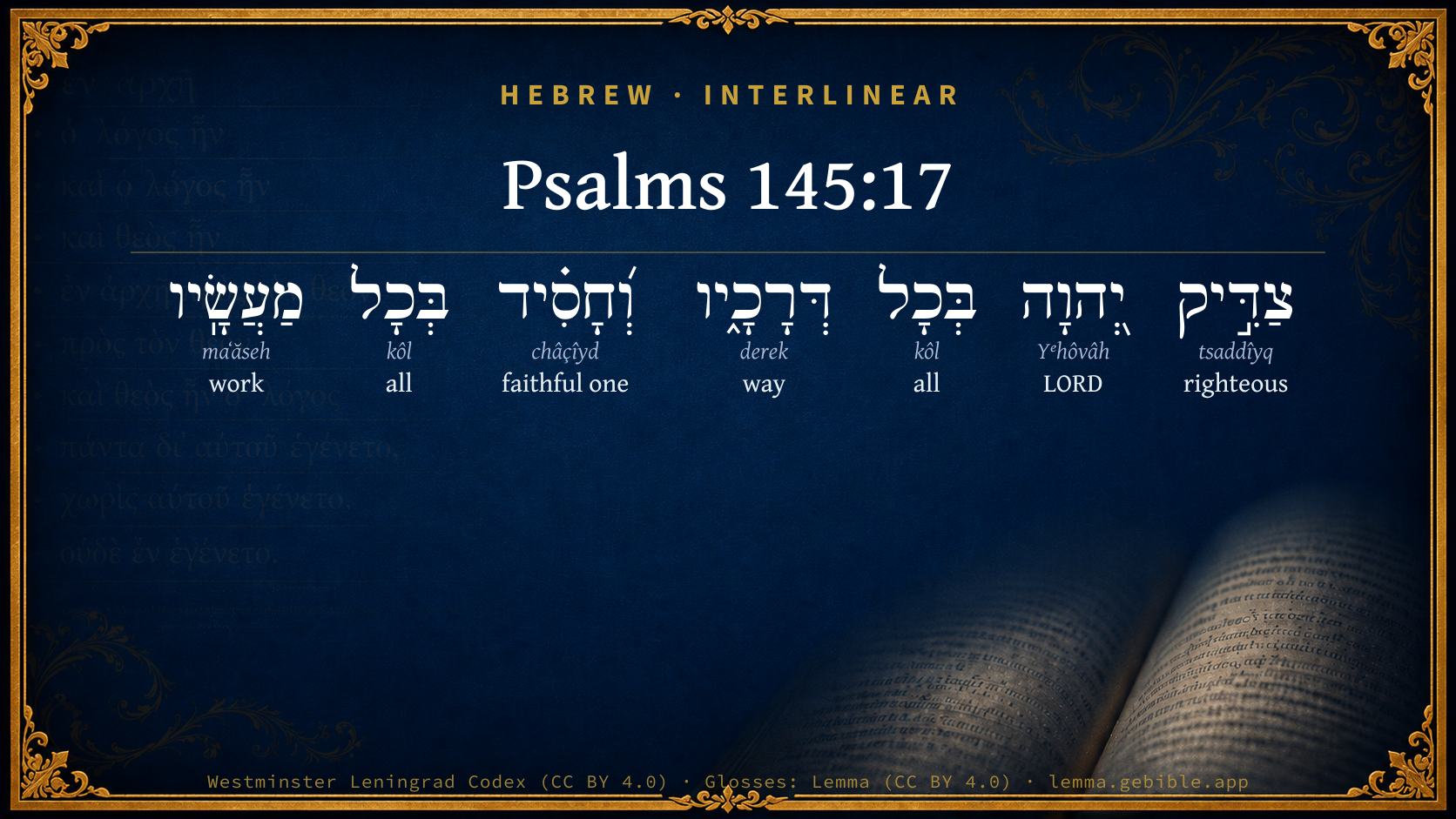
Psalms 145:17

Hebrew (Westminster Leningrad Codex) Psalms 145:17 appears in the Hebrew Old Testament. The text above is from the Westminster Leningrad Codex. Each word links to its Strong’s number, a concise gloss, and parsing drawn from the Open Scriptures Hebrew Bible morphology. Click any word for its full Brown-Driver-Briggs (BDB) entry.
Download image
Cite this verse

Psalms 145:17 (World English Bible). Public Domain. Lemma interlinear Bible study tool, https://lemma.gebible.app/v/psalms/145/17.

Show BibTeX & RIS
BibTeX
RIS
English Translation
Yahweh is righteous in all his ways, And gracious in all his works.
World English Bible · Public Domain
Download a study sheet

One document with this verse’s original text, its word-by-word gloss line, the meaning frame, cross-references with their text, attributed commentary, and full source and license credits — printable, and it pastes into notes with its structure intact.

This verse Autodidact and up

Study sheet (.html) Plain text (.txt)

A passage Seminary Student

Up to 50 verses in one chapter. A passage sheet keeps up to 6 commentary sources and 12 cross-references per verse, in the order this page ranks them, and says so on the sheet whenever that leaves anything out. Ask for a single verse and you get the Autodidact verse sheet above.

Everything on this page stays free to read, with no account — the sheet is a download of what is already on screen, not access to it.

Want to remove ads? Support Godless Engineer
Compare translations 3

The same verse in 3 English versions, stacked beneath the original-language interlinear above. Click any original word for its lexicon entry.

Each is an independent rendering of the whole verse — the interlinear is not word-aligned to these translations.

Highlighted words mark where these versions differ — a whole-verse word diff, not a word-by-word alignment.

  • World English Bible Public Domain
    Yahweh is righteous in all his ways, And gracious in all his works.
  • King James Version Public Domain
    The LORD is righteous in all his ways, and holy in all his works.
  • unfoldingWord Literal Text CC BY-SA 4.0
    Yahweh righteous in all of his ways and faithful in all of his works.

unfoldingWord Literal Text — © unfoldingWord, licensed CC BY-SA 4.0. Word-aligned USFM3 via Door43 (git.door43.org/unfoldingWord/en_ult).

Versions to compare (up to 4)

3 of 4 selected

Show all 17 translations

Every available English version of this verse, each an independent rendering of the whole verse.

  • World English Bible Public Domain
    Yahweh is righteous in all his ways, And gracious in all his works.
  • Berean Standard Bible Public Domain
    The LORD is righteous in all His ways and kind in all His deeds.
  • Majority Standard Bible Public Domain
    The LORD is righteous in all His ways and kind in all His deeds.
  • King James Version Public Domain
    The LORD is righteous in all his ways, and holy in all his works.
  • American Standard Version (1901) Public Domain
    Jehovah is righteous in all his ways, And gracious in all his works.
  • Revised Version (1885) Public Domain
    The LORD is righteous in all his ways, and gracious in all his works.
  • Geneva Bible (1599) Public Domain
    The Lord is righteous in all his wayes, and holy in all his workes.
  • Young's Literal Translation Public Domain
    Righteous `is' Jehovah in all His ways, And kind in all His works.
  • Literal Standard Version CC BY-SA 4.0
    YHWH [is] righteous in all His ways, || And kind in all His works.
  • Unlocked Literal Bible CC BY-SA 4.0
    Yahweh is righteous in all his ways and gracious in all he does.
  • unfoldingWord Literal Text CC BY-SA 4.0
    Yahweh righteous in all of his ways and faithful in all of his works.
  • Darby Bible Public Domain
    Jehovah is righteous in all his ways, and kind in all his works.
  • World Messianic Bible Public Domain
    The LORD is righteous in all his ways, and gracious in all his works.
  • Webster's Bible Public Domain
    The LORD is righteous in all his ways, and holy in all his works.
  • Free Bible Version CC BY-SA 4.0
    The Lord does right in everything—his actions are always trustworthy.
  • Bible in Basic English Public Domain
    The Lord is upright in all his ways, and kind in all his works.
  • JPS Tanakh (1917) Public Domain
    The LORD is righteous in all His ways, and gracious in all His works.

Literal Standard Version (2020), Covenant Press — licensed CC BY-SA 4.0. Text via the HelloAO Bible API (eBible.org). Unlocked Literal Bible (unfoldingWord) — licensed CC BY-SA 4.0. Text via the HelloAO Bible API (eBible.org). unfoldingWord Literal Text — © unfoldingWord, licensed CC BY-SA 4.0. Word-aligned USFM3 via Door43 (git.door43.org/unfoldingWord/en_ult). Free Bible Version, Dr. Jonathan Gallagher — licensed CC BY-SA 4.0. Text via the HelloAO Bible API (eBible.org).

Word by word

More ways to search: Search by grammar → Find every occurrence → Compare this word →

Practice this passage: Drill this verse → Learn its vocabulary →

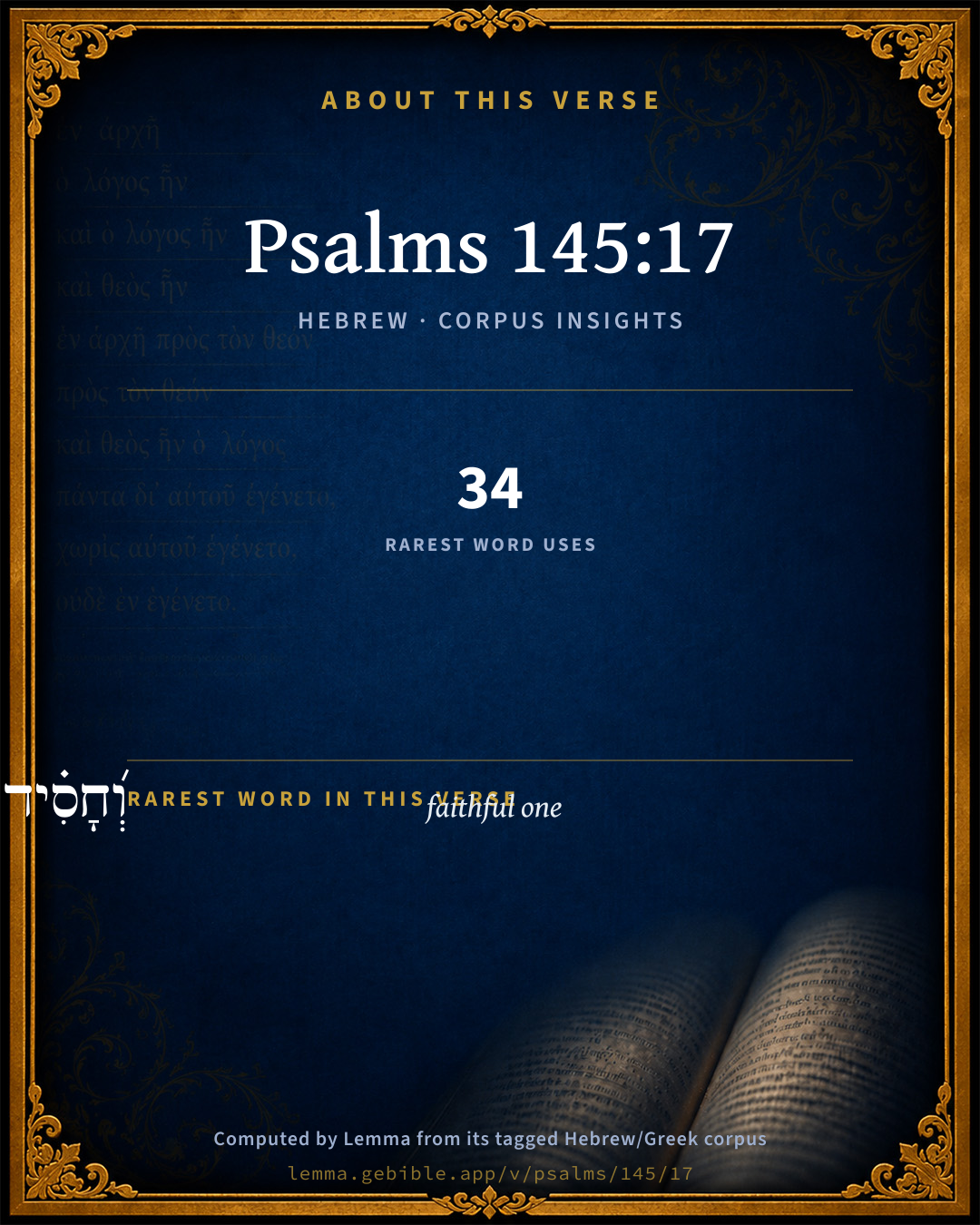
About this verse

These counts appear in no published source. They are computed here, from the morphology-tagged text and Lemma’s own curated glosses. What Lemma adds →

7
words
6
distinct lemmas
Wisdom
section

Shared distinctive vocabulary

וְ֝חָסִ֗יד faithful one H2623 occurs in 32 verses of the Hebrew Bible. Also found in:

Grammatical profile

  • 5 nouns
  • 2 adjectives

Repetition

A word recurs within this verse — often emphatic in Hebrew:

  • בְּכָל all H3605 ×2

Hebrew & Septuagint length

In English translation the verse runs 13 words from the Hebrew and 14 from the Septuagint (LXX English) — closely comparable.

A rough comparison of the two English renderings, which tokenize alike — not a word-level alignment.

Word counts can differ between the Hebrew and the Greek without any difference in meaning — e.g. the Hebrew direct-object marker אֵת has no separate Greek word, and Greek often adds the article ὁ.

Cross-references

19

Topical passages linked to Psalms 145:17 in the Treasury of Scripture Knowledge — connected by theme and wording, ordered by reader-vote popularity; previews shown in the World English Bible.

  • Deuteronomy 32:4 The Rock, his work is perfect; For all his ways are justice: A God of faithfulness and without iniquity, Just and right is he.
  • Zephaniah 3:5 Yahweh, in the midst of her, is righteous. He will do no wrong. Every morning he brings his justice to light. He doesn't fail, but the unjust know no shame.
  • Psalms 103:6 Yahweh executes righteous acts, And justice for all who are oppressed.
  • Isaiah 45:21 Declare you, and bring [it] forth; yes, let them take counsel together: who has shown this from ancient time? who has declared it of old? Haven't I, Yahweh? and there is no God else besides me, a just God and a Savior; there is no one besides me.
  • Psalms 116:5 Gracious is Yahweh, and righteous; Yes, our God is merciful.
  • Psalms 50:6 The heavens shall declare his righteousness, For God himself is judge. Selah.
  • Psalms 89:14 Righteousness and justice are the foundation of your throne. Loving kindness and truth go before your face.
  • Psalms 99:3–4 Let them praise your great and awesome name. He is Holy!
  • Romans 3:25–26 whom God set forth to be an atoning sacrifice, through faith in his blood, for a demonstration of his righteousness through the passing over of prior sins, in God's forbearance;
  • Revelation 19:11 I saw the heaven opened, and behold, a white horse, and he who sat on it is called Faithful and True. In righteousness he judges and makes war.
  • Genesis 18:25 Be it far from you to do things like that, to kill the righteous with the wicked, that so the righteous should be as the wicked. May that be far from you. Shouldn't the Judge of all the earth do right?"
  • Zechariah 9:9 Rejoice greatly, daughter of Zion! Shout, daughter of Jerusalem! Behold, your king comes to you! He is righteous, and having salvation; Lowly, and riding on a donkey, Even on a colt, the foal of a donkey.
  • Revelation 15:3–4 They sang the song of Moses, the servant of God, and the song of the Lamb, saying, "Great and marvelous are your works, Lord God, the Almighty; Righteous and true are your ways, you King of the nations.
  • 1 Samuel 2:2–3 There is none holy as Yahweh; For there is none besides you, Neither is there any rock like our God.
  • Romans 3:5–6 But if our unrighteousness commends the righteousness of God, what will we say? Is God unrighteous who inflicts wrath? I speak like men do.
  • Revelation 4:8 The four living creatures, each one of them having six wings, are full of eyes around about and within. They have no rest day and night, saying, "Holy, holy, holy, holy, holy, holy, holy, holy, holy is the Lord God, the Almighty, who was and who is and who is to come!"
  • Revelation 16:5–7 I heard the angel of the waters saying, "You are righteous, who are and who were, you Holy One, because you have judged these things.
  • Revelation 19:2 for true and righteous are his judgments. For he has judged the great prostitute, who corrupted the earth with her sexual immorality, and he has avenged the blood of his servants at her hand."
  • Psalms 97:2 Clouds and darkness are around him. Righteousness and justice are the foundation of his throne.

Cross-references courtesy of OpenBible.info (CC BY 4.0).

Hebrew and Greek witnesses Masoretic Hebrew ↔ Greek Septuagint

The same verse in the two great witnesses to the Old Testament, shown verse-for-verse.

You’re reading Greek Psalm 144 (Hebrew Psalm 145). The Septuagint counts the superscription, so verse numbers can differ from the Hebrew — chapter-level alignment, not verse-by-verse. Numbering follows Rahlfs.

These are two independent witnesses, not word-aligned to each other, and the Septuagint is shown in lemma (dictionary) form.

Hebrew Psalms 145:17 Masoretic · Westminster Leningrad Codex

צַדִּ֣יק יְ֭הוָה בְּכָל דְּרָכָ֑יו וְ֝חָסִ֗יד בְּכָל מַעֲשָֽׂיו

Yahweh is righteous in all his ways, And gracious in all his works.

World English Bible · Public Domain

Greek LXX Greek Psalm 144:17 Septuagint · lemma form

δίκαιος κύριος ἐν πᾶς ὁ ὁδός αὐτός καί ὅσιος ἐν πᾶς ὁ ἔργον αὐτός

The Lord is righteous in all his ways, and holy in all his works.

LXX2012 (modern English Septuagint) · Public Domain

On this verse, The Cambridge Bible for Schools and Colleges discusses the Septuagint’s reading. Read the note in Commentary ↓

Hebrew: Westminster Leningrad Codex (CC BY 4.0). Greek: Septuagint (public domain); English from LXX2012 (modern English Septuagint) (Public Domain). How the Septuagint differs from the Hebrew →

Commentary

Notes on Psalms 145:17 from classic Christian and Jewish commentators (each source and its license shown beneath its notes). The classic Christian expositions comment on the surrounding passage and are grouped to its opening verse, so a note may address several verses; the Jewish commentaries on the Tanakh (Rashi and others) are per-verse, so they appear only where the commentator wrote on this verse.

Lemma curates 59 commentaries, every one of them public domain or Creative Commons licensed, each selected and text-cleaned for this edition rather than reprinted as found. About our sources →

Trapp's Complete Commentary

John Trapp

Psa 145:17 The LORD [is] righteous in all his ways, and holy in all his works.

Ver. 17. The Lord is righteous in all his ways] This we must hold for an undoubted truth, though we see not always the reason of his proceedings. Sinful men dare to reprehend oft times what they do not comprehend.

John Trapp, A Commentary or Exposition upon All the Books of the Old and New Testament (1647–1656) — public domain. Text from a community e-Sword module.

The Biblical Illustrator

Joseph S. Exell

Psa_145:17

The Lord is righteous in all His ways.

The Divine ways

I. God has many ways of dealing with His universe. Gods ways are His methods of action.

1. He has settled methods of action in relation to His inanimate universe He has a way of managing the seas, and the stars, and all the blind forces of Nature.

2. He has settled methods of action in relation to His sentient universe. The smallest insect and the hugest mammoth He manages by their instincts.

3. He has settled methods of action in relation to His moral universe.

(1) With the unfallen. The myriads who retain their pristine virtues.

(2) With the fallen. These include the impenitent and the repentant. He has methods of dealing with them, they are settled and unalterable.

II. In all Gods ways He is absolutely righteous.

1. This is a matter of necessity. He could not but be righteous: whatever He does must be right because He does it, for there is nothing higher than Himself, nothing outside of Himself. He is absolutely irresponsible. What the infinitely wise, holy, and loving does, must be righteous.

2. This is a matter for rejoicing. How blessed the thought that He, with whom we have to do, on whom we are absolutely dependent, to whom we are amenable for all our conduct, and who will settle our destiny at last, will never do us wrong, will always act righteously. Moral--Trust in Him. (David Thomas, D. D.)

The Biblical Illustrator, edited by Joseph S. Exell (c. 1880s–1900s) — public domain. Text from a community e-Sword module.

Joseph Benson's Commentary

Psa 145:17. The Lord is righteous in all his ways — And not unrighteous in any of them; and holy in all his works — Always acting like himself, with perfect rectitude and purity. In all his acts of government he is just, injurious to none, but administering justice to all: his ways are equal, though ours are unequal. In giving laws, in deciding controversies, in recompensing services, and punishing offences, he is incontestably righteous and holy, and we are in duty bound to acknowledge it. But the word חסיד, here rendered holy, generally signifies merciful, and, it seems, ought to have been so translated here. There is a mixture of mercy in the most severe and terrible works and dispensations of God toward men in this life, judgment without mercy being reserved for the next life, Jas 2:13; Rev 14:10.

Joseph Benson's Commentary on the Old and New Testaments (1811–1818) — public domain. Text from a community e-Sword module.

J. A. Alexander on Psalms

Joseph Addison Alexander

17. (Psa 145:17) Righteous (is) Jehovah in all his ways and merciful in all his works. Justice and mercy are not mentioned here as opposites, but rather as equivalents, the goodness of God being really included in the rectitude so frequently ascribed to him.

Joseph Addison Alexander, The Psalms Translated and Explained (1850) — public domain. Text from a community e-Sword module.

Geneva Bible (1599)

Geneva Bible translators

He praiseth God, not only because he is beneficial to all his creatures, but also in that he justly punisheth the wicked, and mercifully examineth his by the cross, giving them strength and delivering them.

Geneva Bible (1599) marginal notes — public domain. Text via Bolls.life.

Jamieson, Fausset & Brown

Robert Jamieson, A. R. Fausset & David Brown

holy . . . works--literally, "merciful" or "kind, goodness" (Psa 144:2) is the corresponding noun.

righteous--in a similar relation of meaning to "righteousness" (Psa 145:7).

Jamieson, Fausset & Brown — Commentary Critical and Explanatory on the Whole Bible (1871) — public domain (CC PDM 1.0). Text via the HelloAO Bible API.

Adam Clarke's Commentary

Verse 17. The Lord is righteous] It was the similarity of this to the omitted verse, which should have been the fourteenth, that caused it to be omitted.

Adam Clarke's Commentary on the Bible (1810–1826) — public domain. Text from a community e-Sword/MySword module.

John Calvin's Commentaries

17. Jehovah is righteous in all his ways. He does not now speak of God’s goodness merely in providing all his creatures with their daily food, but comprehends other parts of his providence, as in correcting men for their sins, restraining the wicked, trying the patience of his people under the cross, and governing the world by judgments which are often inscrutable to us. The ground upon which praise is here ascribed to God may seem a common one, being in every one’s mouth; but in nothing is wisdom shown more than in holding fast the truth, that God is just in all his ways, so as to retain in our hearts an unabated sense of it amidst all troubles and confusions. Though all acknowledge God to be just, most men are no sooner overtaken by affliction than they quarrel with his severity: unless their wishes are immediately complied with, they are impatient, and nothing is more common than to hear his justice impeached. As it is everywhere abused by the wicked imputations men cast upon it, here it is very properly vindicated from such ungrateful treatment, and asserted to be constant and unfailing, however loudly the word may disparage it. It is expressly added, in all his ways and works, for we fail to give God due honor unless we recognize a consistent tenor of righteousness in the whole progress of his operation. Nothing is more difficult in the time of trouble, when God has apparently forsaken us, or afflicts us without cause, than to restrain our corrupt feelings from breaking out against his judgments; as we are told of the emperor Mauricius in a memorable passage of history, that seeing his sons murdered by the wicked and perfidious traitor Phocas, and being about to be carried out himself to death, he cried out — “Thou art righteous, O God, and just are thy judgments!” As this man of no bad character opposed such a shield to the cruel trials he met with, we must learn to put a check upon our spirits, and always give God’s righteousness the honor due to it. David, however, goes farther still, intimating that God, even when he seems to be most severe, is so far from being cruel as to temper his heaviest judgments with equity and clemency.

John Calvin's Commentaries (1540-1563) — public domain. Text from the Calvin Translation Society English edition (1840s-50s) via the Christian Classics Ethereal Library (ccel.org). Calvin's coverage is partial (roughly two-thirds of the Bible); uncommented books and verses are honest gaps, never fabricated. The 19th-century editor's footnotes and remarks are omitted so the notes are faithfully Calvin's own voice.

The Cambridge Bible for Schools and Colleges

gen. ed. J. J. S. Perowne

17. righteous] True to His character. Cp. Psa_145:7.

holy] So the LXX, ὅσιος, which is used of God in the N.T. in Rev_15:4; Rev_16:5. But the word châsîd as applied to God (here and in Jer_3:12 only) means full of lovingkindness, loving. See App., Note I.

The Cambridge Bible for Schools and Colleges (gen. ed. J. J. S. Perowne; Cambridge University Press, 1878–1918) — public domain. Text from a community e-Sword module.

John Gill's Exposition

The Lord is righteous in all his ways,.... Christ is righteous in all the ways of providence, in which he is jointly concerned with his Father: there are some of the ways of providence, which are now intricate and perplexed, are unsearchable and past finding out, and cannot be easily reconciled to the justice and faithfulness of God, respecting the prosperity of the wicked and the afflictions of the righteous; but these will before long be made manifest, and they will appear to be just and true. And so in all his ways of grace, in all his decrees; in the choice of some to everlasting life, and the leaving of others; with respect to either of these, there is no unrighteousness in him: nor in the redemption of men, for which an adequate price is given; and in which mercy and truth, righteousness and peace, meet together; nor in the justification of a sinner, which is not done without a righteousness, but in such manner that God is just while he is the justifier of him that believes in Jesus; nor in the pardon of sin, which is upon the foot of a satisfaction made to the justice of God, by the blood and sacrifice of Christ; nor in eternal life, the gift of God through Christ, which none inherit but righteous ones. Christ is righteous in all his suretyship engagements, which he has punctually performed, and in the execution of all his offices; in doing which, righteousness and faithfulness are the girdle of his loins and reins: and so likewise he is and will appear righteous in his judgments on his and his people's enemies, in the destruction of antichrist and his followers. And, moreover, he is righteous in all the ways he prescribes for his people to walk in, in all his commandments and ordinances; which are all holy, just, and good;

and holy in all his works; in all his works of providence; doing no evil, though he suffers it for wise ends, and overrules it for good: and in all his works of grace; in election, which is through holiness and to it; in the redemption of his people, which is from a vain conversation, and that they might be a peculiar people, zealous of good works; in the calling of them with an holy calling, and to holiness; in bringing them to glory, which is through regeneration and sanctification. It may be rendered, is "merciful" or "bountiful in all his works" (k); all he does flowing from his grace, mercy, and goodness.

(k) "misericors", Pagninus, Montanus, so Ainsworth; "benignus", Tigurine version, Musculus, Junius & Tremellius, Piscator, Gejerus.

John Gill's Exposition of the Whole Bible (1746–1763) — public domain (CC PDM 1.0). Text via the HelloAO Bible API.

Albert Barnes' Notes on the Bible

The Lord is righteous in all his ways - In his own character; in his laws; in his providential dealings; in his arrangements for the redemption and salvation of man. In his own character he is what it is desirable that a God should be; in all his laws he ordains that only which it is desirable should be enacted; in all his dealings with people he does that which it is desirable should be done. He violates no right; he wrongs no one; he demands of no one a service which would be unjust; he makes no arrangements for pardon and salvation which it is not best should be made. It is much for a man to be able to say in all that occurs to him under the divine administration, “It is right;” it is much for a man to have such confidence in God as to be able to feel that all he does in respect to nations is the best thing that could be done. Compare Psa 89:14, note; Psa 97:2, note.

And holy in all his works - Margin, merciful, or bountiful. The Hebrew word is merciful. The idea seems to be that righteousness and mercy are equally consulted in his arrangements; that they meet together, and act harmomoniously in the divine plans. Compare the notes at Psa 85:10.

Albert Barnes' Notes on the Bible (1834–1885) — public domain. Text from a community e-Sword/MySword module.

Matthew Poole's English Annotations

Holy; or rather, merciful, as this word most commonly signifies. There is a mixture of mercy in the most severe and terrible works of God in this life, judgment without mercy being reserved for the next life, Jam 2:13; Rev 14:10.

Matthew Poole's English Annotations on the Holy Bible (1683–1685) — public domain. Text from a community e-Sword/MySword module.

The Treasury of David

Charles H. Spurgeon

Ver. 17. The LORD is righteous in all his ways, and holy in all his works. His ways and works are both worthy to be praised. Jehovah cannot be unjust or impure. Let his doings be what they may, they are in every case righteous and holy. This is the confession of the godly who follow his ways, and of the gracious who study his works. Whatever God is or does must be right. In the salvation of his people he is as righteous and holy as in any other of his ways and works: he has not manifested mercy at the expense of justice, but the rather he has magnified his righteousness by the death of his Son.

Ver. 17. The LORD is righteous in all his ways, etc. The ground upon which praise is here ascribed to God may seem a common one, being in every one's mouth; but in nothing is wisdom shown more than in holding fast the truth, that God is just in all his ways, so as to retain in our hearts an unabated sense of it amidst all troubles and confusions. Though all acknowledge God to be just, most men are no sooner overtaken by affliction than they quarrel with his severity: unless their wishes are immediately complied with, they are impatient, and nothing is more common than to hear his justice impeached. As it is everywhere abused by the wicked imputations men cast upon it, here it is very properly vindicated from such ungrateful treatment, and asserted to be constant and unfailing, however loudly the world may disparage it. It is expressly added, "in all his ways and works"; for we fail to give God due honour unless we recognise a constant tenor of righteousness in the whole progress of his operation. Nothing is more difficult in the time of trouble, when God has apparently forsaken us, or afflicts us without cause, than to restrain our corrupt feelings from breaking out against his judgments; as we are told of the Emperor Mauricius in a memorable passage of history, that seeing his sons murdered by the wicked and perfidious traitor Phocas, and being about to be carried out himself to death, he cried out "Thou art righteous, O God, and just are thy judgments." John Calvin.

Ver. 17. Holy in all his works. God is good, the absolute and perfect; and from good nothing can come but good: and therefore all which God has made is good, as he is; and therefore if anything in the world seems to be bad, one of two things must be true of it.

Either it is not bad, though it seems so to us; and God will bring good out of it in his good time, and justify himself to men, and show us that he is holy in all his works, and righteous in all his ways. Or else

If the thing be really bad, then God did not make it. It must be a disease, a mistake, a failure, of man's making, or some person's making, but not of God's making. For all that he has made he sees eternally; and behold, it is very good. Charles Kingsky, in "The Good News of God", 1878.

Ver. 17.

1. What God declares himself to be.

2. What his people find him to be.

3. What all creatures will ultimately acknowledge him to be. G. R.

Psalms 145:18*

Charles H. Spurgeon's The Treasury of David (1869–1885) — public domain. Psalms only. Text from a community e-Sword/MySword module.

The Pulpit Commentary

The Lord is righteous in all his ways, and holy (rather, gracious, or merciful) in all his works. Mercy and truth meet in God. (Psa_85:10) He is at once perfectly just, and absolutely tender and compassionate. All his works" experience both his justice and his tenderness. (comp. Psa_25:8 Psa_116:5, etc.)

The absoluteness of the Divine righteousness.

"The Lord is righteous in all his ways, and gracious in all his works." This is not the impression every man has of God; it is not the impression even the good man has of God at all times. It is the good man"s thought of God when he is at his best; raised by holy emotion above himself. He can say, "The Lord is righteous in all his ways

I WHEN HE TRIES TO READ THE HISTORY OF THE PAST. The story of the ages is kept for us in order that we may find in it what God has been, and therefore what God is. History as a series of facts is but a poor affair. The philosophy of history is its intercept, and the Divine philosophy of history (God in history) is the supreme interest of it. But it is difficult work, because man can never fully take the Divine standpoint about anything. He is always obliged to get his faith to help his judgment. And yet, what is ever coming out more and more clearly to the devout student is the righteousness of God"s ways. He sees how God has made things come right.

II WHEN HE TRIES TO READ THE MYSTERIES OF THE PRESENT. This is always perplexing work, because of the disturbing influence of feeling and prejudice. God"s ways are not always what we like, and then it is very easy to say that they are not right. The good man has constantly to fall back upon his absolute knowledge of what God is, and upon his deep, experimental conviction of God"s righteous goodness, in order to undo the tangle in which things seem to have got, and to put things into an order and relation that bring to view the Divine righteousness.

III WHEN HE TRIES TO READ GOD"S DEALINGS WITH HIMSELF. Under previous divisions we have had in mind the macrocosm, the whole world of things and people. Now we have in mind the microcosm, the limited sphere of the individual life. And the personal element so seriously influences a man that it takes a whole long life before an adequate impression of the absolute righteousness of God can be gained. And yet it is there, in every man"s life. To see it, and live in the joy of it, is heaven. R.T.

The Pulpit Commentary (1880–1919), ed. H.D.M. Spence-Jones & Joseph S. Exell — public domain. Text from a community e-Sword module.

unfoldingWord translationNotes

Door43 World Missions Community

Yahweh is righteous in all his ways

"People can see from everything that Yahweh does that he is righteous"

gracious in all he does

"and he is gracious in all he does" or "people can see from everything that Yahweh does that he is gracious"

is near to all those who call to him

Here "is near" means "ready to help." AT: "is always ready to help all those who call to him" (See: Metaphor)

to all who call to him in trustworthiness

The abstract noun "trustworthiness" can be stated as an action. AT: "to all who tell only the truth when they pray" or "to all whom he trusts when they pray" (See: Abstract Nouns)

translationWords

righteous

grace

call

trust

fulfill

honor

save

unfoldingWord translationNotes — © Distant Shores Media and the Door43 World Missions Community, licensed CC BY-SA 4.0. Source: git.door43.org/Door43/en_tn.

Lesson kit

Teaching starters — assembled from the data on this page, not authored interpretation. Every prompt links to the verse data it draws on. Edit before teaching.

Psalms, in the Wisdom, opens this verse with 7 words (6 distinct Hebrew lemmas). Its most distinctive word is châçîyd (“faithful one”). A historical commentator’s framing appears above. Read the whole chapter for the surrounding context.

Discussion questions

  1. What does “faithful one” (châçîyd) contribute to the verse as a whole?
  2. Deuteronomy 33:8 shares the word «faithful one» with this verse. How do the two illuminate each other?
  3. “all” occurs 2× in this one verse. What is the effect of the repetition?
  4. These translations render this verse differently. What is at stake in choosing one wording over another?
  5. Reading how Trapp's Complete Commentary and The Biblical Illustrator read this verse, where do the two commentators agree and where do they part?

Things to notice

Reading settings

Reading text

Shown beneath each verse's original-language words.

Old Testament
Old Testament edition

Read the OT as the Masoretic Hebrew (MT) or the Greek Septuagint (LXX).

English shown for the Greek Septuagint (in the Hebrew ↔ Greek comparison).

Comparing translations? Open the Compare panel on any verse page to stack up to four side by side.