Isaiah 27:6

Hebrew (Westminster Leningrad Codex) Isaiah 27:6 appears in the Hebrew Old Testament. The text above is from the Westminster Leningrad Codex. Each word links to its Strong’s number, a concise gloss, and parsing drawn from the Open Scriptures Hebrew Bible morphology. Click any word for its full Brown-Driver-Briggs (BDB) entry.
Download image
Cite this verse

Isaiah 27:6 (World English Bible). Public Domain. Lemma interlinear Bible study tool, https://lemma.gebible.app/v/isaiah/27/6.

Show BibTeX & RIS
BibTeX
RIS
English Translation
In days to come shall Jacob take root; Israel shall blossom and bud; and they shall fill the surface of the world with fruit.
World English Bible · Public Domain
Download a study sheet

One document with this verse’s original text, its word-by-word gloss line, the meaning frame, cross-references with their text, attributed commentary, and full source and license credits — printable, and it pastes into notes with its structure intact.

This verse Autodidact and up

Study sheet (.html) Plain text (.txt)

A passage Seminary Student

Up to 50 verses in one chapter. A passage sheet keeps up to 6 commentary sources and 12 cross-references per verse, in the order this page ranks them, and says so on the sheet whenever that leaves anything out. Ask for a single verse and you get the Autodidact verse sheet above.

Everything on this page stays free to read, with no account — the sheet is a download of what is already on screen, not access to it.

Want to remove ads? Support Godless Engineer
Compare translations 3

The same verse in 3 English versions, stacked beneath the original-language interlinear above. Click any original word for its lexicon entry.

Each is an independent rendering of the whole verse — the interlinear is not word-aligned to these translations.

Highlighted words mark where these versions differ — a whole-verse word diff, not a word-by-word alignment.

  • World English Bible Public Domain
    In days to come shall Jacob take root; Israel shall blossom and bud; and they shall fill the surface of the world with fruit.
  • King James Version Public Domain
    He shall cause them that come of Jacob to take root: Israel shall blossom and bud, and fill the face of the world with fruit.
  • unfoldingWord Literal Text CC BY-SA 4.0
    the coming, Jacob will take root; Israel will blossom and bud, and they will fill the face of the world produce.

unfoldingWord Literal Text — © unfoldingWord, licensed CC BY-SA 4.0. Word-aligned USFM3 via Door43 (git.door43.org/unfoldingWord/en_ult).

Versions to compare (up to 4)

3 of 4 selected

Show all 18 translations

Every available English version of this verse, each an independent rendering of the whole verse.

  • World English Bible Public Domain
    In days to come shall Jacob take root; Israel shall blossom and bud; and they shall fill the surface of the world with fruit.
  • Berean Standard Bible Public Domain
    In the days to come, Jacob will take root. Israel will bud and blossom and fill the whole world with fruit.
  • Majority Standard Bible Public Domain
    In the days to come, Jacob will take root. Israel will bud and blossom and fill the whole world with fruit.
  • King James Version Public Domain
    He shall cause them that come of Jacob to take root: Israel shall blossom and bud, and fill the face of the world with fruit.
  • American Standard Version (1901) Public Domain
    In days to come shall Jacob take root; Israel shall blossom and bud; and they shall fill the face of the world with fruit.
  • Revised Version (1885) Public Domain
    In days to come shall Jacob take root; Israel shall blossom and bud: and they shall fill the face of the world with fruit.
  • Geneva Bible (1599) Public Domain
    Hereafter, Iaakob shall take roote: Israel shall florish and growe, and the world shall be filled with fruite.
  • Douay-Rheims (1899) Public Domain
    When they shall rush in unto Jacob, Israel shall blossom and bud, and they shall fill the face of the world with seed.
  • Young's Literal Translation Public Domain
    Those coming in He causeth to take root, Jacob doth blossom, and flourished hath Israel, And they have filled the face of the world `with' increase.
  • Literal Standard Version CC BY-SA 4.0
    He causes those coming in to take root, || Jacob blossoms, and Israel has flourished, || And they have filled the face of the world [with] increase.
  • Unlocked Literal Bible CC BY-SA 4.0
    In the coming day, Jacob will take root; Israel will blossom and bud; and they will fill the surface of the ground with fruit.”
  • unfoldingWord Literal Text CC BY-SA 4.0
    the coming, Jacob will take root; Israel will blossom and bud, and they will fill the face of the world produce.
  • Darby Bible Public Domain
    In the future Jacob shall take root; Israel shall blossom and bud, and they shall fill the face of the world with fruit.
  • World Messianic Bible Public Domain
    In days to come, Jacob will take root. Israel will blossom and bud. They will fill the surface of the world with fruit.
  • Webster's Bible Public Domain
    He shall cause them that descend from Jacob to take root: Israel shall blossom and bud, and fill the face of the world with fruit.
  • Free Bible Version CC BY-SA 4.0
    In the future the descendants of Jacob will be like a tree taking root. Israel will flower and send out shoots, and fill the whole world with fruit!
  • Bible in Basic English Public Domain
    In days to come Jacob will take root: Israel will put out buds and flowers; and the face of the world will be full of fruit.
  • JPS Tanakh (1917) Public Domain
    In days to come shall Jacob take root, Israel shall blossom and bud; and the face of the world shall be filled with fruitage.

Literal Standard Version (2020), Covenant Press — licensed CC BY-SA 4.0. Text via the HelloAO Bible API (eBible.org). Unlocked Literal Bible (unfoldingWord) — licensed CC BY-SA 4.0. Text via the HelloAO Bible API (eBible.org). unfoldingWord Literal Text — © unfoldingWord, licensed CC BY-SA 4.0. Word-aligned USFM3 via Door43 (git.door43.org/unfoldingWord/en_ult). Free Bible Version, Dr. Jonathan Gallagher — licensed CC BY-SA 4.0. Text via the HelloAO Bible API (eBible.org).

Word by word

More ways to search: Search by grammar → Find every occurrence → Compare this word →

Practice this passage: Drill this verse → Learn its vocabulary →

About this verse

These counts appear in no published source. They are computed here, from the morphology-tagged text and Lemma’s own curated glosses. What Lemma adds →

10
words
10
distinct lemmas
Prophets
section

Notable vocabulary

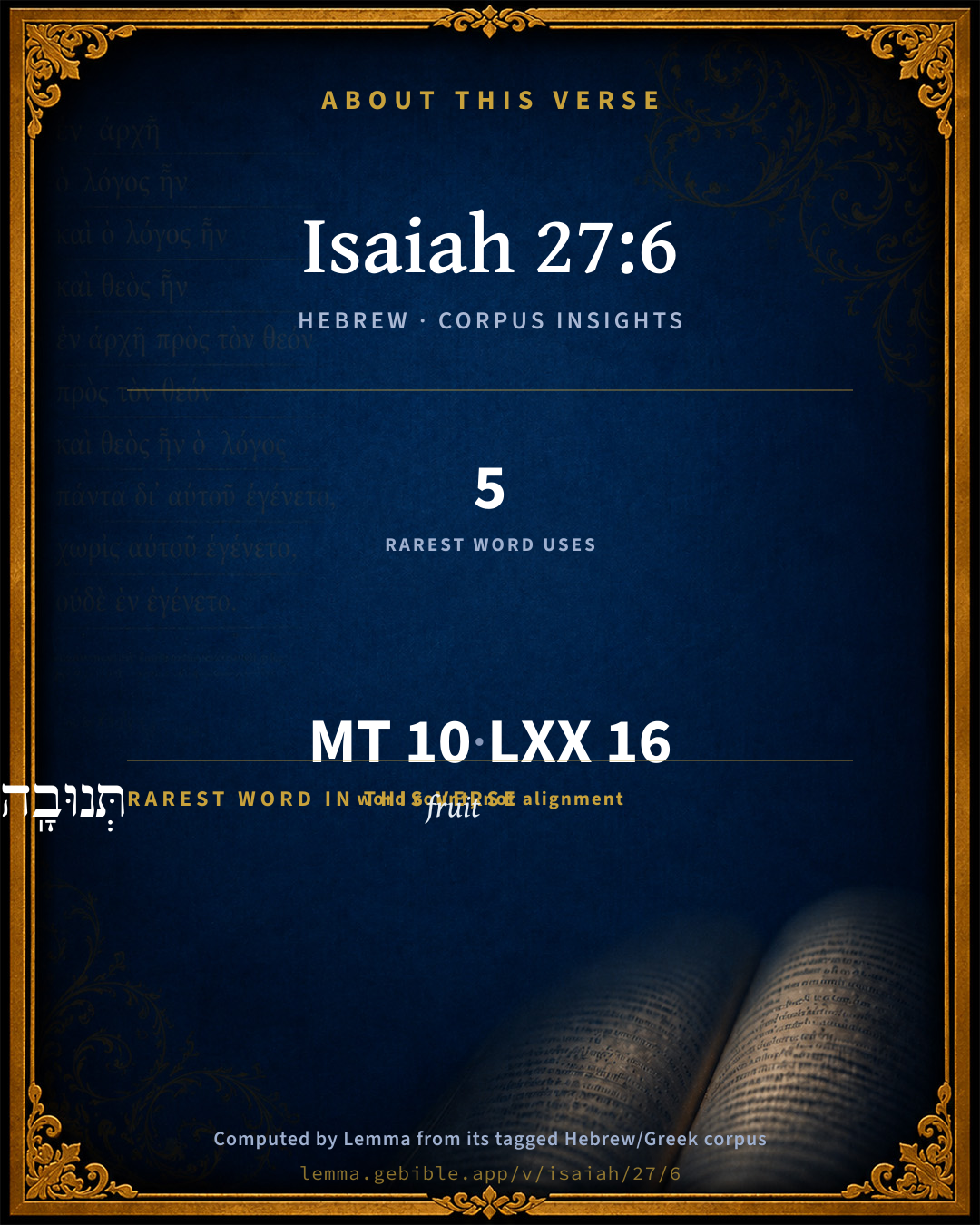
The rarest word here is תְּנוּבָֽה fruit H8570 — appearing just 5 times in the whole Hebrew Bible.

Shared distinctive vocabulary

תְּנוּבָֽה fruit H8570 occurs in 5 verses of the Hebrew Bible. Also found in:

Grammatical profile

  • 5 verbs
  • 5 nouns

Verb forms

  • הַבָּאִים֙ Qal · Participle Active
  • יַשְׁרֵ֣שׁ Hiphil · Imperfect
  • יָצִ֥יץ Hiphil · Imperfect
  • וּפָרַ֖ח Qal · Sequential Perfect
  • וּמָלְא֥וּ Qal · Sequential Perfect

Hebrew & Septuagint length

In English translation the verse runs 24 words from the Hebrew and 23 from the Septuagint (LXX English) — closely comparable.

A rough comparison of the two English renderings, which tokenize alike — not a word-level alignment.

Word counts can differ between the Hebrew and the Greek without any difference in meaning — e.g. the Hebrew direct-object marker אֵת has no separate Greek word, and Greek often adds the article ὁ.

In the original languages it is 10 Hebrew tokens and 16 Greek tokens — but the two are counted differently (Hebrew bundles its prefixes and suffixes into one token; the Greek is in lemma form), so that isn’t a like-for-like length.

Cross-references

12

Topical passages linked to Isaiah 27:6 in the Treasury of Scripture Knowledge — connected by theme and wording, ordered by reader-vote popularity; previews shown in the World English Bible.

  • Isaiah 37:31 The remnant that is escaped of the house of Judah shall again take root downward, and bear fruit upward.
  • Hosea 14:5–6 I will be like the dew to Israel. He will blossom like the lily, And send down his roots like Lebanon.
  • Romans 11:16–26 If the first fruit is holy, so is the lump. If the root is holy, so are the branches.
  • Psalms 92:13–15 They are planted in Yahweh's house. They will flourish in our God's courts.
  • Isaiah 54:1–3 Sing, barren, you who didn't bear; break forth into singing, and cry aloud, you who did not travail with child: for more are the children of the desolate than the children of the married wife, says Yahweh.
  • Hosea 2:23 I will sow her to me in the earth; And I will have mercy on her who had not obtained mercy; And I will tell those who were not my people, 'You are my people;' And they will say, 'My God!'"
  • Zechariah 2:11 Many nations shall join themselves to Yahweh in that day, and shall be my people; and I will dwell in the midst of you, and you shall know that Yahweh of Hosts has sent me to you.
  • Isaiah 60:22 The little one shall become a thousand, and the small one a strong nation; I, Yahweh, will hasten it in its time.
  • Zechariah 10:8–9 I will signal for them, and gather them; For I have redeemed them; And they will increase as they have increased.
  • Isaiah 6:13 If there are yet a tenth in it, It also shall in turn be eaten up: As a terebinth, and as an oak, whose stock remains, when they are felled; So the holy seed is its stock."
  • Isaiah 49:20–23 The children of your bereavement shall yet say in your ears, The place is too small for me; give place to me that I may dwell.
  • Jeremiah 30:19 Out of them shall proceed thanksgiving and the voice of those who make merry: and I will multiply them, and they shall not be few; I will also glorify them, and they shall not be small.

Cross-references courtesy of OpenBible.info (CC BY 4.0).

Hebrew and Greek witnesses Masoretic Hebrew ↔ Greek Septuagint

The same verse in the two great witnesses to the Old Testament, shown verse-for-verse.

These are two independent witnesses, not word-aligned to each other, and the Septuagint is shown in lemma (dictionary) form.

Hebrew Isaiah 27:6 Masoretic · Westminster Leningrad Codex

הַבָּאִים֙ יַשְׁרֵ֣שׁ יַֽעֲקֹ֔ב יָצִ֥יץ וּפָרַ֖ח יִשְׂרָאֵ֑ל וּמָלְא֥וּ פְנֵי תֵבֵ֖ל תְּנוּבָֽה

In days to come shall Jacob take root; Israel shall blossom and bud; and they shall fill the surface of the world with fruit.

World English Bible · Public Domain

Greek LXX Isaiah 27:6 Septuagint · lemma form

ὁ ἔρχομαι τέκνον ἰακώβ βλαστάνω καί ἐκ ἀντιἵημι ἰσραήλ καί ἐνπίμπλημι ὁ οἰκέω ὁ καρπός αὐτός

they that are coming are the children of Jacob. Israel shall bud and blossom, and the world shall be filled with his fruit.

LXX2012 (modern English Septuagint) · Public Domain

On this verse, Haydock's Catholic Bible Commentary discusses the Septuagint’s reading. Read the note in Commentary ↓

Hebrew: Westminster Leningrad Codex (CC BY 4.0). Greek: Septuagint (public domain); English from LXX2012 (modern English Septuagint) (Public Domain). How the Septuagint differs from the Hebrew →

Targum (Aramaic paraphrase)

1

The Targum is the ancient Jewish Aramaic paraphrase of the Hebrew Scriptures — an interpretive translation, not the Hebrew text itself. Onkelos (literal) and Pseudo-Jonathan (expansive) render the Torah, and Jonathan the Prophets. Coverage is partial: where no permissively-licensed English translation exists for a verse, only the Aramaic is shown. This is verse-level text, not a word-by-word alignment to the Hebrew.

  1. Targum Jonathan Prophets (Joshua–Malachi)
    יִתְכַּנְשׁוּן מִבֵּינֵי גַלְוַתְהוֹן וִיתוּבוּן לְאַרְעֲהוֹן תַּמָן יִתְיְלִידוּן דְבֵית יַעֲקֹב יִפְשׁוּן וְיִסְגוּן דְבֵית יִשְׂרָאֵל וְיִמְלוּן אַפֵי תֵבֵל בְּנֵי בְנִין:

    They shall be gathered from the midst of their captivity, and return to their country; there children shall be born to the house of Jacob; they of the house of Israel shall be fruitful, and they shall multiply; their children's children shall fill the face of the world.

    Targum Jonathan — Aramaic: “Mikraot Gedolot” (public domain). English: “Sefaria Community Translation” (CC0 1.0 (public-domain dedication)); “London "Chaldee Paraphrase," 1871” (public domain). Text via Sefaria.

Commentary

Notes on Isaiah 27:6 from classic Christian and Jewish commentators (each source and its license shown beneath its notes). The classic Christian expositions comment on the surrounding passage and are grouped to its opening verse, so a note may address several verses; the Jewish commentaries on the Tanakh (Rashi and others) are per-verse, so they appear only where the commentator wrote on this verse.

Lemma curates 59 commentaries, every one of them public domain or Creative Commons licensed, each selected and text-cleaned for this edition rather than reprinted as found. About our sources →

Trapp's Complete Commentary

John Trapp

Isa 27:6 He shall cause them that come of Jacob to take root: Israel shall blossom and bud, and fill the face of the world with fruit.

Ver. 6. He shall cause them that come to Jacob,] i.e., His proselytes; or, that come from Jacob, i.e., his posterity. Vitium haec conditio est, The condition of vines is such as that they must undergo cold blasts and hard winters; howbeit, at the return of the spring they recover their verdure, and flourish again. So shall the seed of Jacob: their dead shall live, {Isa 26:19} and the mountain of the Lord shall be exalted above all mountains. {Isa 2:2}

John Trapp, A Commentary or Exposition upon All the Books of the Old and New Testament (1647–1656) — public domain. Text from a community e-Sword module.

The Biblical Illustrator

Joseph S. Exell

Isa_27:6

He shall cause them that come of Jacob to take root

The future prosperity of the Church the effects of Divine influence

I.

IN RESPECT OF NUMBER. Under the ancient dispensation, the spiritual Israel were comparatively few. But at the commencement of the Christian dispensation the wall of partition was broken down, and the boundaries of the Church were greatly enlarged.

II. IN RESPECT OF SPIRITUAL VIGOUR. Others remain in a state of spiritual death. But concerning them that come of Jacob, it is here asserted that they shall take root.

III. IN RESPECT OF BEAUTY. Christ Himself, the branch of the Lord, is beautiful and glorious (Isa_4:2); and believers in Christ are made comely through His comeliness put upon them (Eze_16:14).

IV. IN RESPECT OF FRUITFULNESS. Believers are denominated in Scripture, trees of righteousness, to intimate that they should bring forth fruit unto God. They abound in every good word and work.

V. IN RESPECT OF JOY. It is when the dews of heaven drop upon the pastures of the wilderness that it is said, the little hills rejoice on every side. The abundant joy of New Testament times, especially of the times referred to in the passage before us, is often spoken of in Scripture.

VI. IN RESPECT OF STABILITY. It is here promised that the Lord shall cause them that come of Jacob to take root The vicissitudes which take place in human affairs teach us the vanity of the world, and the perishing nature of all that seems most durable in this region of shadows. The Church of God, however, has been like Mount Zion, which cannot be moved.

VII. IN RESPECT OF EXTENT. (R. Jack.)

The Biblical Illustrator, edited by Joseph S. Exell (c. 1880s–1900s) — public domain. Text from a community e-Sword module.

Joseph Benson's Commentary

Isa 27:6. He shall cause them of Jacob to take root — To be firmly settled in their possessions. The words may be rendered, In times to come he shall cause Jacob to take root. Israel shall blossom and bud — Shall revive and flourish. The metaphor of a vine is still pursued, and these expressions signify the increase of the Jewish people, after their return from their captivity in Babylon. And fill the face of the world with fruit — Their posterity shall be so numerous that their own land shall not be sufficient for them, but they shall be forced to seek habitations in other countries, and shall replenish them with people. This prediction was indeed fulfilled after the captivity; for the Jews filled all Judea and Syria, and were spread over all the Roman empire, as appears, not only from their own histories, but from the books of the New Testament. See note on Isa 26:15. But, perhaps, this is chiefly intended to be understood of the spiritual seed of Jacob, or of believers, who are often called God’s Israel, as Rom 9:6, and elsewhere.

Joseph Benson's Commentary on the Old and New Testaments (1811–1818) — public domain. Text from a community e-Sword module.

The Preacher's Complete Homiletical Commentary

Joseph S. Exell (gen. ed.)

THE FUTURE PROSPERITY OF ISRAEL

Isa_27:6. He shall cause them, &c. [1093]

[1093] Note the translation of this verse by Alexander and Delitzsch, in which Kay, Birks, and Cheyne concur.

It did not often happen to ancient nations to rise into new vigour after being conquered and removed. Ancient Assyria and Babylon fell, and their influence faded. But it was otherwise with Israel. They had flourished; abused their trust; were punished by being conquered and removed. But they did not perish. From the Babylonian grave they rose. Centuries longer they existed, until their crowning sin. No further need for their national existence. It ceased. But their separate identity as a race continued. The Jew is everywhere. Everywhere he is a witness to the truth of the Bible. And the influence of the Jewish people continues. The influence of the classic writers of Greece and Rome continues. Their study is essential to a liberal education. But only the few enjoy that advantage. The literature of the Jewish race was confined almost entirely to their sacred books. But how wide its influence! Read by the scholar and the peasant, &c. Lifts men’s thoughts above the level of this world, and presents a loftier ideal of human character than any of the mere “thinkers” of ancient or modern times.

Nor is it only the perpetuation and influence of a literature. It is the perpetuation of a type of moral life. One who came of Jacob has exerted and is exerting an influence never equalled. Born in a manger, trained in poverty, dying on a cross, He has been and is the fountain of spiritual life to millions. In Him they have become a new seed of Jacob (Gal_3:29).

The text foretells the stability, the growth, and the diffusion of the Church.

I. ITS STABILITY. “Take root.” This is necessary to growth. And life is necessary to it. You may plant a stone, or a piece of dried wood, but it can never take root. Why? It wants the mysterious principle called life. Reasons for this. And the roots are the firmest part of the plant. Hence the metaphor—a man is rooted in his position. Fine forest-tree with roots, like arms, many feet on every side. Impossible to dislodge that tree. This is one of the emblems of the stability of the Christian’s spiritual position (Col_2:7). Thus the stability of the Church, the aggregate of spiritual men, is set forth in the text. It has struck its roots so deep, and spread them so far, that, as hitherto, so in the future, it shall continue. Storms of opposition, persecution, infidelity unable to uproot it. “The gates of hell shall not prevail.”

II. ITS GROWTH. Rooting of a tree only valuable in relation to its continued life and growth. Change is the law of life. Look at it in the individual member of the spiritual Israel. In the living tree in spring the bud breaksforth, then the beautiful blossom—promise of the fruit. So in the Christian life. Gradually it develops by a certain though irregular progression. Nor will this promise of fruitfulness be falsified (Gal_5:22-23; Rom_6:22; Psa_92:13-14; H. E. I., 2508–2516, 2538–2544). Multiply this by the number of living members in any Church, and how much of spiritual goodness and beauty will be in that circle! Not only within it, but in the homes, among the neighbours, over the whole sphere of their influence. Then multiply this by all the Churches. What an amount of moral beauty thus in the world!

III. ITS DIFFUSION. “And fill the face of the world with fruit.” This vision was always present to the prophet’s eye. Suppose it realised, and the whole world converted. Then the world will be filled with goodness. But it is all in the spiritual succession from Jacob. How much comes of little! So it has ever been; small beginnings, gradual growth, great endings.

Do you say you cannot believe in the world’s conversion? Do you believe the harvest comes from the seed? That Jesus multiplied the loaves? Is anything too hard for the Lord?—J. Rawlinson.

The Preacher's Complete Homiletical Commentary (gen. ed. Joseph S. Exell; Funk & Wagnalls, c. 1892) — public domain (pre-1929). A full-Bible homiletical/sermon-outline anthology covering 65 of 66 books (2 John is absent from the source module). Text from a community e-Sword module.

Tyndale Open Study Notes

Tyndale Open Resources

27:6 Jacob’s descendants will take root and the remnant will increase (37:31; cp. 5:24; 14:30; for application to the Messiah, see 11:1, 10). • fill the whole earth: The fulfillment of this prophecy extends beyond the restoration of Israel from exile to the second coming of the Lord Jesus. It includes all the righteous children of God—Jews and Gentiles—who suffer but remain obedient as they wait for the fullness of redemption (see 26:18; John 15:1-8).

Tyndale Open Study Notes — © Tyndale Open Resources, licensed CC BY-SA 4.0. Text via the HelloAO Bible API.

Geneva Bible (1599)

Geneva Bible translators

Though I afflict and diminish my people for a time, yet shall the root spring again and bring forth in great abundance.

Geneva Bible (1599) marginal notes — public domain. Text via Bolls.life.

Jamieson, Fausset & Brown

Robert Jamieson, A. R. Fausset & David Brown

He--Jehovah. Here the song of the Lord as to His vineyard (Isa 27:2-5) ends; and the prophet confirms the sentiment in the song, under the same image of a vine (compare Psa 92:13-15; Hos 14:5-6).

Israel . . . fill . . . world-- (Rom 11:12).

Jamieson, Fausset & Brown — Commentary Critical and Explanatory on the Whole Bible (1871) — public domain (CC PDM 1.0). Text via the HelloAO Bible API.

Adam Clarke's Commentary

Verse 6. To take root - "From the root"] For ישרש yashresh, I read, with the Syriac, משרש mishshoresh. And for יציץ ופרח yatsits uparach, יציצו פרח yatsitsu parach, joining the ו vau to the first word, and taking that into construction with the first part of the sentence, Israel shall bud forth. I suppose the dialogue to be continued in this verse, which pursues the same image of the allegory, but in the way of metaphor.

Adam Clarke's Commentary on the Bible (1810–1826) — public domain. Text from a community e-Sword/MySword module.

Ellicott's Commentary for English Readers

(6) He shall cause them that come of Jacob . . .—Better, In the days that come Jacob shall strike root. The figure of Israel as the vine of Jehovah’s vineyard is carried to its close. The true Israel of God shall go through its normal stages of growth, and its restoration shall be as “the riches of the Gentiles” (Rom_11:12; Hos_14:6). With this picture of blessedness the psalm of the Church of the future comes to an end.

A Bible Commentary for English Readers, edited by Charles John Ellicott (1878–1897) — public domain. Text from a community e-Sword module.

The Cambridge Bible for Schools and Colleges

gen. ed. J. J. S. Perowne

6. The verse is attached to the song, but forms no integral part of it. It reads as in R.V.: In days to come shall Jacob take root, &c. By a unique ellipsis the word “days” is omitted in the original; hence the mistaken rendering of A.V., “them that come.”

and fill the face of the world with fruit] For a contrast see ch. Isa_14:21. The fruitfulness anticipated belongs to the sphere of temporal prosperity,—teeming population, &c.

The Cambridge Bible for Schools and Colleges (gen. ed. J. J. S. Perowne; Cambridge University Press, 1878–1918) — public domain. Text from a community e-Sword module.

John Gill's Exposition

He shall cause them that come of Jacob to take root,.... That is, the posterity of Jacob, the seed of Israel, in a spiritual sense; such who are Israelites indeed, in whom there is no guile; these shall be so far from being plucked up, or rooted out of the vineyard, the church, that they shall take deeper root, and their roots shall spread yet more and more; they shall be rooted and grounded in the love of God, and also in Christ, and be built up in him, as well as firmly settled and established in the church, Eph 3:17 or, "them that come to Jacob (u)"; proselytes unto him, converted Gentiles, that come to the church of Christ, signified by "Jacob", and give up themselves unto it, and are added to it, these shall take root. The words may be rendered, in days "to come, he shall cause Jacob to take root": or, he "shall take root", as Aben Ezra, Jarchi, and Ben Melech supply the words; and so they are a prophecy of the stability and prosperous estate of the church in the latter day:

Israel shall blossom and bud, and fill the face of the world with fruit; which may be understood of the fruits of grace and righteousness, which shall appear upon the people of God, in all parts of the world; or of the great number of converts everywhere; so the Targum, by "fruit", understands children's children; the sense is, that when the church of God, in the latter day, is settled and established, grounded in Christ, and in the doctrines of grace, it shall be in very flourishing and fruitful circumstances, abounding in grace and good works, and with numbers of converts; it shall be like the mustard tree, when it becomes so great a tree as that the birds of the air make their nests in it; and as the stone cut out of the mountain without hands, when it becomes a great mountain, and fills the whole earth, Mat 13:31 compare with this Isa 37:31.

(u) So some in Gataker.

John Gill's Exposition of the Whole Bible (1746–1763) — public domain (CC PDM 1.0). Text via the HelloAO Bible API.

Albert Barnes' Notes on the Bible

He shall cause them that come of Jacob to take root - This language is derived from the vine, as the shoots or cuttings of the vine take root and flourish. To take root, therefore, is an emblem denoting that the descendants of Jacob, or the people of God, would increase and prosper.

Shall blossom and bud - An image also taken from the vine, or from fruit trees in general, and meaning that they should greatly flourish in the time succeeding their return from the captivity.

And fill the face of the world with fruit - On the meaning of the word ‘face,’ see the note at Isa 25:7. The sense is, that the people of God would so increase and flourish that the true religion would ultimately fill the entire world. The same idea of the universal prevalence of the true religion is often advanced by this prophet, and occurs in various parts of the hymns or songs which we are now considering (see Isa 25:6-8). The figure which is used here, drawn from the vine, denoting prosperity by its increase and its fruit, is beautifully employed in Psa 92:13-14 :

Those that be planted in the house of Yahweh,

Shall flourish in the courts of our God.

They shall still bring forth fruit in old age;

They shall be rich and green.

Albert Barnes' Notes on the Bible (1834–1885) — public domain. Text from a community e-Sword/MySword module.

Haydock's Catholic Bible Commentary

Rush in. Some understand this of the enemies of the true Israel, that shall invade it in vain. Others of the spiritual invasion made by the apostles of Christ. (Challoner) --- Protestants, "He shall cause them that come of Jacob to take root." Septuagint, "those who come are children of Jacob." (Haydock)

George Leo Haydock (1774–1849), Haydock's Catholic Family Bible and Commentary, 1859 edition — public domain. Excludes Psalms (Douay-Rheims chapter numbering differs from Protestant) and Deuterocanonical books (Catholic canon only).

Matthew Poole's English Annotations

To take root; to be firmly settled in their possessions, and not tossed hither and thither, as they have been.

Fill the face of the world with fruit; their posterity shall be so numerous, that their own land shall not be sufficient for them, but they shall be forced to seek habitations in other countries, and shall replenish them with people. But this seems to be understood of the spiritual seed of Jacob, or of believers, who are oft called God’s Israel, as Rom 9:6, and elsewhere.

Matthew Poole's English Annotations on the Holy Bible (1683–1685) — public domain. Text from a community e-Sword/MySword module.

Whedon's Commentary on the Bible

Daniel D. Whedon

6. The song of the vineyard is here explained. The posterity of Jacob, the true Israel which God owns, shall, as this divinely nourished vine, take root, grow, extend branches, send down new roots, and spread blossoms and fruit to all parts of the earth. Rom_11:12. Israel becometh thus “the riches of the Gentiles.”

Daniel D. Whedon (gen. ed.), Commentary on the Old and New Testaments (1874–1909) — public domain. Text from a community e-Sword module.

The Pulpit Commentary

He shall cause them that come of Jacob to take root; rather, in the days to come Jacob shall strike root. Jacob, lately the vineyard, is now compared to a single vine, which becomes strong by striking its roots deep into the soil, and then, as a consequence, blossoms and buds, and fills the face of the world with fruit. So the Israel of God, firmly rooted in the soil of God"s favor, would blossom with graces of all kinds, and bring forth the abundant fruit of good works.

The world-mission of Israel.

Just as "no man liveth unto himself," but every man liveth for the circle in which he is set, so no nation liveth unto itself it liveth for the world of nations in its time, and for all the ages. This universal truth is illustrated for us in the case of prominent, or elect, or selected nations. Egypt keeps alive the sense of mystery for the world, the claims of the unknown. Chaldea pleads in all the world for the claims of human observation, for the basis-principle of science. Greece keeps up today its mission to the world, and preaches to us the claims of the "beautiful," the basis of all art, all ideal creations. Rome declares to the world the supreme importance of wise and stable government for the ordering of society. And Israel has its voice in every land and every age, pleading for the foundation-principles of religion, which are the unity and spirituality of God. Israel is a tree whose branches overspread the earth; these are its leaves, and these leaves are for the healing of the nations that are diseased and dying of idolatries and sensuousness. As we think of Israel after the flesh, we should remember that we are the true Israel, the spiritual Israel, who hold fast and testify for the old Mosaic truths, "God is One" and "God is a Spirit." The world-mission of Israel is

I To PRESERVE THE WORLD"S TRUTH. That is, In the beginning God." This truth was given to man as man. It is man"s birthright. When man became mentally and emotionally biased by yielding to self-will and sin, this first truth was imperiled. If man, as God created him, had thought, he would only have thought of God, one God. When sinful man thinks, he runs along one or other of two lines he either conceives of two gods, one presiding over pleasant things, and the other over disasters; or else he thinks of many gods, each one occupying a more or less limited sphere. So "monotheism" was put in peril, and had to be preserved through all the ages during which God left man to a free experiment of that self-willedness which he had chosen. In his infinite wisdom God preserved the essential and foundation-truths of religion for long ages in a direct Adamic line, giving to men length of life sufficient to permit of tradition covering the long generations up to the Flood. After the Flood, God preserved the world"s truth in the one Abrahamic family; and when that family grew into a nation, he made it, in a very solemn way, the depositary of the world"s truth, and set it in a central land, where it might be but slightly influenced by the notions of surrounding nations. "What advantage then hath the Jew? or what profit is there in circumcision? Much every way, chiefly because that unto them were committed the oracles of God." It is true that Israel did not prove faithful to its duty of preserving the world"s truth; but after the chastisement of the Babylonian exile (and to that the prophet is referring in our text) they never fell into idolatry, and they exist to-day, scattered everywhere, but holding fast their trust of monotheistic truth.

II To EXHIBIT THE WORKING OF THAT TRUTH. "Example is better than precept." The world might fairly ask to see a national life raised on the foundation of belief in one unseen, spiritual God. Israel is that nation. It is in many respects a striking example. It failed only when it shifted from its foundation. A glance at the old world, which grouped round the eastern end of the Mediterranean, will show how central "little Palestine" was, so as to be in view of all the nations, as a "city set on a hill." The practical applications of this part of the subject are that we hold the trust of these truths, and of the yet further revelations that have been given; and the question of supreme interest to all around us is Do they make us better men and women? Are others won to accept our truths because of the illustrations which we find for them in our lives and relations? Do we "walk worthy of our calling?

III To WITNESS THROUGHOUT THE WORLD FOR THAT TRUTH. The presence of a Jew anywhere is a plea for belief in one God. The exaggerated stubbornness with which Jews plead for this truth prevents their being willing to receive the further revelation concerning the one God, that he has been manifest in the flesh. We who are the spiritual Jews have it as our work to proclaim "God in Christ reconciling the world unto himself" to all the nations. Jews have but half a mission now; but the time is coming when their veil shall be taken away; they shall see in Jesus of Nazareth the Son of God, and join with us in going out through all the world, and preaching the old truth and the new gospel to every creature. R.T.

The Pulpit Commentary (1880–1919), ed. H.D.M. Spence-Jones & Joseph S. Exell — public domain. Text from a community e-Sword module.

John Wesley's Explanatory Notes

Take root - To be firmly settled in their possessions. Fruit - Their posterity shall seek habitations in other countries, and replenish them with people. But this seems to be understood of the spiritual seed of Jacob.

John Wesley, Explanatory Notes Upon the Whole Bible (1754–1765) — public domain. Text via the GEBible commentary corpus.

Keil & Delitzsch

C. F. Keil & F. Delitzsch

The prophet now adds to the song of the vineyard, by way of explanation. "In future will Jacob strike roots, Israel blossom and bud, and fill the surface of the globe with fruits." We may see from הבּאים (acc. temp. as in Ecc 2:16, equivalent in meaning to "Behold, the days come," Jer 7:32, etc.), that the true language of prophecy commences again here. For the active וּמלאוּ, compare Jer 19:4; Eze 8:17, etc. The prophet here says, in a figure, just the same as the apostle in Rom 11:12, viz., that Israel, when restored once more to favour as a nation, will become "the riches of the Gentiles."

Keil & Delitzsch — Biblical Commentary on the Old Testament (1861–1891) — public domain (CC PDM 1.0). Text via the HelloAO Bible API. (Old Testament only.)

J. A. Alexander on Isaiah

Joseph Addison Alexander

“(In) coming (days) shall Jacob take root, Israel shall bud and blossom, and they shall fill the face of the earth with fruit.” The construction of the first clause in the English Bible (them that come of Jacob shall He cause to take root) is forbidden by the collocation of the words, and by the usage of the verb, which always means to take root.

Joseph Addison Alexander, The Prophecies of Isaiah (1846–1847; New York: Scribner, 1870–1878) — public domain. Text from a community e-Sword module.

unfoldingWord translationNotes

Door43 World Missions Community

General Information:

Isaiah is speaking. He continues to describe the people of Israel as a vineyard. (See: Isaiah 27:2)

In the coming day

This speaks about a day as if it travels and arrives somewhere. AT: "In the future" (See: Metaphor)

Jacob will take root; Israel will blossom and bud

Yahweh blessing the people of Israel and causing them to prosper is spoken of as if they were a vine that grows roots and blossoms. AT: "the descendants of Israel will prosper like a vine that has taken root and blossomed" (See: Metaphor)

Jacob ... Israel

Here "Jacob" and "Israel" are metonyms that represent the descendants of Jacob. (See: Metonymy)

they will fill the surface of the ground with fruit

Yahweh causing the people of Israel to prosper greatly so that they can help other people is spoken of as if they were a vine that grows so much fruit that it would cover the earth. (See: Metaphor)

translationWords

Jacob

Israel

fruit

unfoldingWord translationNotes — © Distant Shores Media and the Door43 World Missions Community, licensed CC BY-SA 4.0. Source: git.door43.org/Door43/en_tn.

Rashi

Rabbi Shlomo Yitzchaki (Rashi)

Those who came, whom Jacob caused to take root Do you not know what I did at first? Those who came to Egypt which Jacob caused to take root, flourished and blossomed there until they filled the face of the world with fruitage.

Rashi on the Tanakh — English translations: “The Judaica Press complete Tanach with Rashi, translated by A. J. Rosenberg” (CC BY 4.0); “Pentateuch with Rashi's commentary by M. Rosenbaum and A.M. Silbermann, 1929-1934” (public domain); “The Metsudah Tanach series, Lakewood, N.J” (CC BY 4.0); and “The Book of Joshua, Metsudah Publications, 1997” (CC BY 4.0). Text via Sefaria.

Ibn Ezra

Rabbi Abraham ibn Ezra

. בהבאים ═ הבאים In future. According to some: the children. generations. הדורות הבאים ═ הבאים

ישרש He shall cause to take root. Comp. ישרשיח ותשרש and didst cause it to take deep root (Psa. 80:10).

תנובה. Fruit.

Ibn Ezra on the Tanakh — English translations: “Sefaria Community Translation” (CC0 1.0 (public-domain dedication)); “Yalkut, Sifsei Chachomim Chumash, Metsudah Publications, 2009” (CC BY 4.0); and “Commentary of Ibn Ezra on Isaiah - trans. by M. Friedlander, 1873” (public domain). Text via Sefaria.

Lesson kit

Teaching starters — assembled from the data on this page, not authored interpretation. Every prompt links to the verse data it draws on. Edit before teaching.

Isaiah, in the Prophets, opens this verse with 10 words (10 distinct Hebrew lemmas). Its most distinctive word is tᵉnûwbâh (“fruit”). A historical commentator’s framing appears above. Read the whole chapter for the surrounding context.

Discussion questions

  1. How does “fruit” (tᵉnûwbâh) shape what this verse is saying?
  2. Deuteronomy 32:13 shares the word «fruit» with this verse. How do the two illuminate each other?
  3. These translations render this verse differently. What is at stake in choosing one wording over another?
  4. The verb «הַבָּאִים֙» is Qal Participle Active. How does its form color the action?
  5. Reading how Trapp's Complete Commentary and The Biblical Illustrator read this verse, where do the two commentators agree and where do they part?

Things to notice

Reading settings

Reading text

Shown beneath each verse's original-language words.

Old Testament
Old Testament edition

Read the OT as the Masoretic Hebrew (MT) or the Greek Septuagint (LXX).

English shown for the Greek Septuagint (in the Hebrew ↔ Greek comparison).

Comparing translations? Open the Compare panel on any verse page to stack up to four side by side.