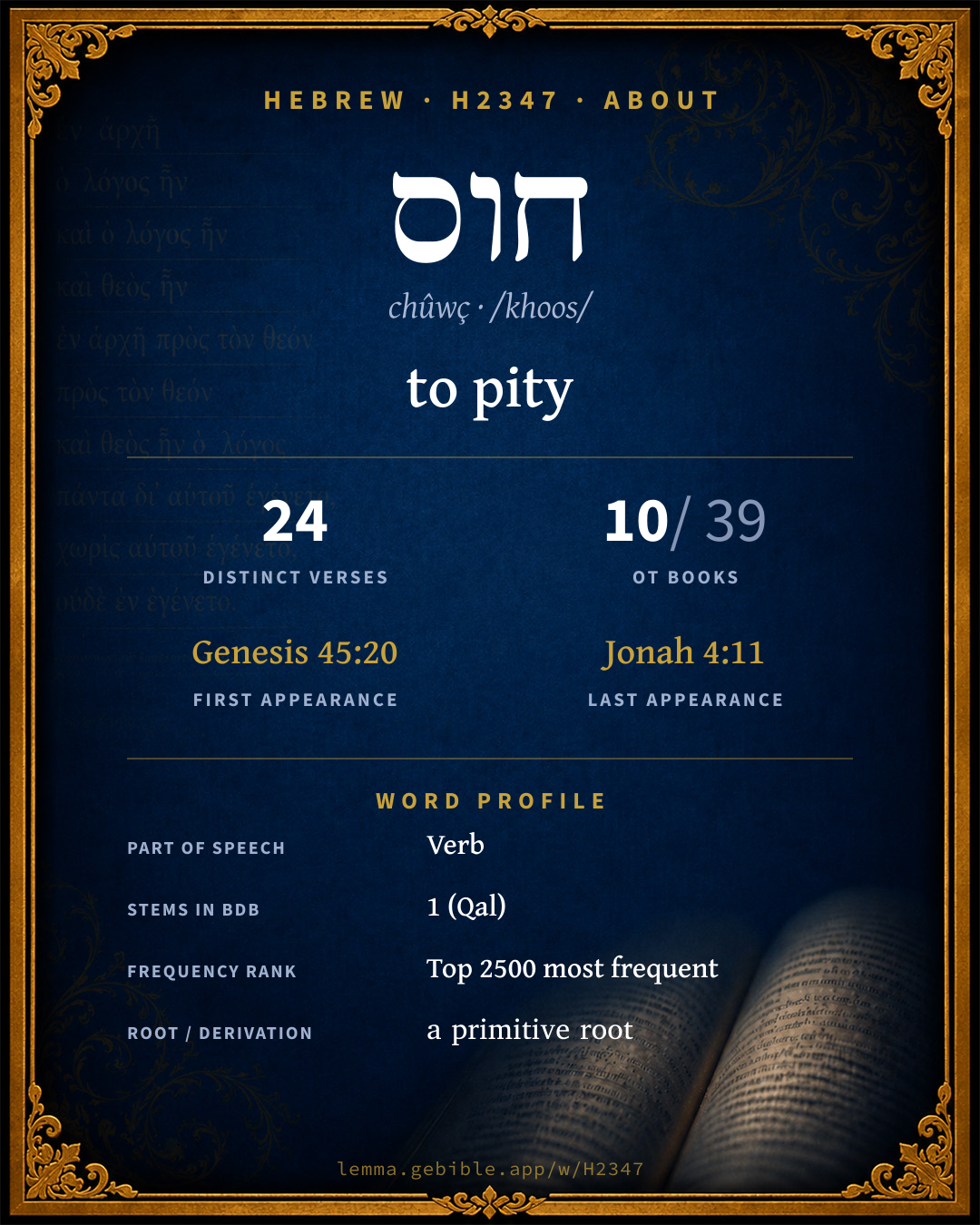
חוּס
to pity
Full lexicon entry — Brown-Driver-Briggs (BDB)
From Brown-Driver-Briggs (BDB)
Where this word appears
Grammar key — what these labels mean
Part of speech
- Verb
- An action or state-of-being word.
Stem
- Qal
- The basic, simple active stem — the plain form of the verb (“he wrote”). Here: ‘of the eye’
Form
- Imperfect
- An incomplete, ongoing, or future action (“he will / would write”).
- Sequential Imperfect
- An imperfect with prefixed waw — the standard past-narrative form (waw-consecutive imperfect).
- Jussive
- A third- or second-person volitional form expressing wish or command (“let him write”).
- Imperative
- A direct command (“write!”).
- Perfect
- A completed action or state — Hebrew marks aspect (completeness) more than strict tense (“he wrote”).
Person
- 3rd Person
- The one spoken about (“he / she / it / they”).
- 1st Person
- The speaker (“I / we”).
- 2nd Person
- The one addressed (“you”).
Gender
- Feminine
- Grammatically feminine.
- Common
- Either gender — not distinguished for this form.
- Masculine
- Grammatically masculine.
Number
- Singular
- One.
Grammatical forms
- Verb, Qal, Imperfect, 3rd Person, Feminine, Singular 11 times (46%)
- Verb, Qal, Imperfect, 1st Person, Common, Singular 3 times (13%)
- Verb, Qal, Sequential Imperfect, 3rd Person, Feminine, Singular 2 times (8%)
- Verb, Qal, Imperfect, 3rd Person, Masculine, Singular 2 times (8%)
- Verb, Qal, Jussive, 3rd Person, Feminine, Singular 2 times (8%)
- Verb, Qal, Imperative, 2nd Person, Masculine, Singular 2 times (8%)
- Verb, Qal, Perfect, 2nd Person, Masculine, Singular 1 time (4%)
- Verb, Qal, Perfect, 3rd Person, Feminine, Singular 1 time (4%)
Parsed forms decoded from the imported morphology (morphhb / Westminster Leningrad Codex — WLC text public domain, morphhb tagging CC BY 4.0), counted across 24 parsed occurrences — not distinct verses.
Every verse where H2347 appears — 24 distinct verses across 10 books. Click any verse to open its interlinear word-by-word view. Verse text shown in the World English Bible for context — . Each verse’s Hebrew form is shown with its reference; the English is not keyword-highlighted, since the data carries no word-level English alignment. Use “Compare translations” on any verse to read it across multiple English versions. This concordance covers the Hebrew Bible; Septuagint (Greek Old Testament) occurrences are not indexed here.
Genesis 1 verse
Deuteronomy 5 verses
- Deuteronomy 7:16 תָחֹ֥ס Qal impf 3fs You shall consume all the peoples who Yahweh your God shall deliver to you; your eye shall not pity them: neither shall you serve their gods; for that will be a snare to you.
- Deuteronomy 13:8 תָח֤וֹס Qal impf 3fs you shall not consent to him, nor listen to him; neither shall your eye pity him, neither shall you spare, neither shall you conceal him:
- Deuteronomy 19:13 תָח֥וֹס Qal impf 3fs Your eye shall not pity him, but you shall put away the innocent blood from Israel, that it may go well with you.
- Deuteronomy 19:21 תָח֖וֹס Qal impf 3fs Your eyes shall not pity; life [shall go] for life, eye for eye, tooth for tooth, hand for hand, foot for foot.
- Deuteronomy 25:12 תָח֖וֹס Qal impf 3fs then you shall cut off her hand, your eye shall have no pity.
1 Samuel 1 verse
Nehemiah 1 verse
Psalms 1 verse
Isaiah 1 verse
Jeremiah 2 verses
- Jeremiah 13:14 אָח֛וּס Qal impf 1cs I will dash them one against another, even the fathers and the sons together, says Yahweh: I will not pity, nor spare, nor have compassion, that I should not destroy them.
- Jeremiah 21:7 יָח֣וּס Qal impf 3ms Afterward, says Yahweh, I will deliver Zedekiah king of Judah, and his servants, and the people, even such as are left in this city from the pestilence, from the sword, and from the famine, into the hand of Nebuchadrezzar king of Babylon, and into the hand of their enemies, and into the hand of those who seek their life: and he shall strike them with the edge of the sword; he shall not spare them, neither have pity, nor have mercy.
Ezekiel 9 verses
- Ezekiel 5:11 תָח֣וֹס Qal impf 3fs Therefore, as I live, says the Lord Yahweh, surely, because you have defiled my sanctuary with all your detestable things, and with all your abominations, therefore will I also diminish [you]; neither shall my eye spare, and I also will have no pity.
- Ezekiel 7:4 תָח֥וֹס Qal impf 3fs My eye shall not spare you, neither will I have pity; but I will bring your ways on you, and your abominations shall be in the midst of you: and you shall know that I am Yahweh.
- Ezekiel 7:9 תָח֥וֹס Qal impf 3fs My eye shall not spare, neither will I have pity: I will bring on you according to your ways; and your abominations shall be in the midst of you; and you shall know that I, Yahweh, do strike.
- Ezekiel 8:18 תָח֥וֹס Qal impf 3fs Therefore will I also deal in wrath; my eye shall not spare, neither will I have pity; and though they cry in my ears with a loud voice, yet will I not hear them.
- Ezekiel 9:5 תָּחֹ֥ס Qal juss 3fs To the others he said in my hearing, Go you through the city after him, and strike: don't let your eye spare, neither have you pity;
- Ezekiel 9:10 תָח֥וֹס Qal impf 3fs As for me also, my eye shall not spare, neither will I have pity, but I will bring their way on their head.
- Ezekiel 16:5 חָ֨סָה Qal pf 3fs No eye pitied you, to do any of these things to you, to have compassion on you; but you were cast out in the open field, for that your person was abhorred, in the day that you were born.
- Ezekiel 20:17 וַ/תָּ֧חָס conj + Qal wimpf 3fs Nevertheless my eye spared them, and I didn't destroy them, neither did I make a full end of them in the wilderness.
- Ezekiel 24:14 אָח֖וּס Qal impf 1cs I, Yahweh, have spoken it: it shall happen, and I will do it: I will not go back, neither will I spare, neither will I repent; according to your ways, and according to your doings, shall they judge you, says the Lord Yahweh.
Joel 1 verse
Jonah 2 verses
- Jonah 4:10 חַ֨סְתָּ֙ Qal pf 2ms Yahweh said, "You have been concerned for the vine, for which you have not labored, neither made it grow; which came up in a night, and perished in a night.
- Jonah 4:11 אָח֔וּס Qal impf 1cs Shouldn't I be concerned for Nineveh, that great city, in which are more than one hundred twenty thousand persons who can't discern between their right hand and their left hand; and also much cattle?"
About this entry
At a glance — auto-summarized from this page’s data, not written by a person. Every figure links to its source below. This summary describes the numbers; it doesn’t interpret them.
חוס (chûwç) is a Hebrew verb most often rendered “to pity.” Where the King James Version says “shall not spare,” newer translations reach for “pity” (Berean Standard Bible); the renderings breakdown has the detail. The Hebrew Bible uses it across 24 verses — uncommon. Ezekiel dominates its distribution — 9 of 24 verses. Debuting at Genesis 45:20, it then recurs through the corpus. For the data behind this summary, explore the sense tree and the renderings breakdown below.
Gloss history
Strong's 1890 vs modern scholarship
About this word
Strong's H2347 catalogs a Hebrew word from the Hebrew Old Testament.
These counts are not copied from any lexicon or concordance. They are computed here, from the morphology-tagged Hebrew Old Testament. What Lemma adds →
- 24
- distinct verses
- The word appears in 24 distinct verses.
- 10 / 39
- OT books
- The word appears in 10 of 39 Old Testament books.
- #1,327
- by frequency
- Top 2500 most frequent Hebrew words (rank 1,327 of 8,640 Hebrew words by occurrence).
View all 24 occurrences in the concordance →
Most concentrated in
- Ezekiel 9 verses 38%
- Deuteronomy 5 verses 21%
- Jeremiah 2 verses 8%
By section of the Old Testament
By traditional corpus
Conventional, traditional groupings — biblical authorship is debated, so this is a traditional corpus grouping, not an authorship claim. Each share is this word’s portion of its verses in that division of the Hebrew canon. Each figure is a share of the word’s 24 distinct verses.
- Prophets (Nevi'im) 16 verses · 67%
- Torah (Pentateuch) 6 verses · 25%
- Writings (Ketuvim) 2 verses · 8%
How translations render this word
Counts come from each version’s own published word-to-Strong’s tagging or interlinear alignment — an approximate guide to how each version renders this word, not a word-level alignment the data otherwise carries. Because each total is that version’s own tagged count, the per-version totals vary from one another and need not match the appearance or distinct-verse counts above. These counts may also differ from a printed concordance because Lemma counts each distinctly tagged rendering and does not collapse phrase taggings into a single head-word total. This is a fixed set of word-tagged versions (KJV, ASV, BSB, ULT) and does not change with the reading translation you choose elsewhere. Each version’s license is shown beside its name below (and on Sources).
- King James Version: Shall not spare 5×, Spare 4×, Shall not pity 3×
- American Standard Version: Shall not spare 4×, Spare 3×, Shall not pity 2×
- Berean Standard Bible: Pity 7×, Spare 2×
- unfoldingWord Literal Text: Pity 5×, Have pity 4×, Shall 3×
King James Version Public Domain
Renders H2347 across 24 tagged occurrences — most commonly:
Plus 12 renderings that appear only once — usually multi-word phrases or single function words the recovered tagging swept in, not distinct renderings.
American Standard Version Public Domain
Renders H2347 across 24 tagged occurrences — most commonly:
Plus 15 renderings that appear only once — usually multi-word phrases or single function words the recovered tagging swept in, not distinct renderings.
Berean Standard Bible Public Domain
Renders H2347 across 22 tagged occurrences — most commonly:
Plus 13 renderings that appear only once — usually multi-word phrases or single function words the recovered tagging swept in, not distinct renderings. Not rendered by a distinct English word in 2 further occurrences.
unfoldingWord Literal Text CC BY-SA 4.0
Renders H2347 across 34 tagged occurrences — most commonly:
Plus 20 renderings that appear only once — usually multi-word phrases or single function words the recovered tagging swept in, not distinct renderings.
Senses in the full BDB
What do BDB’s symbols mean?
BDB uses these scholarly abbreviations:
| Symbol | Meaning |
|---|---|
| 𝔊 | the Septuagint (the ancient Greek translation, LXX) |
| 𝔙 | the Vulgate (the Latin translation) |
| 𝔖 | the Syriac version (the Peshitta) |
| 𝔗 | the Targum (the Aramaic translation) |
| ψ | the Psalms |
| √ | root (the underlying root or stem) |
| ‖ | parallel passage (a synonymous or contrasted parallel) |
| † | the dagger: every passage where the word occurs is cited |
The 4 senses and sub-senses the full Brown-Driver-Briggs lexicon distinguishes for this word, in lexicon order (not ranked by frequency), with BDB’s own verbatim wording and sub-sense lettering. Shown in Hebrew script with BDB’s own scholarly abbreviations. The condensed entry is in the Lexicon Entry tab. See also the Forms in the corpus table below.
Qal
- Pf. 3 fs. חָסָה Ez 16:5, 2 ms. חַ֫סְתָּ Jon 4:10; Impf. 3 ms. יָחוּס Je 21:7; יָחֹס ψ 72:13; 3 fs. תָּחוּס Is 13:18; תָּחוֹס Dt 7:16 + 9 times (Ges§ 72 R 4 Bö§ 1133 (2)); תָּחֹס Gn 45:20 Ez 9:5; וַתָּ֫חָס 1 S 24:11 Ez 20:17; 1 s. אָחוּס Je 13:14 + 2 times; Imv. חוּ֫סָה Jo 2:17 Ne 13:22:— e.g. Ezekiel 16:5
- a. of the eye, עין, תח(ו)ס על (לא) the eye shall (not) look with compassion, pity, upon Dt 7:16; 13:9; 19:13; Is 13:18 Ez 7:4; 20:17; לא חסה עָלַיִךְ עין Ez 16:5; עֵינְכֶם אַל־תָּחֹס עַל־כְּלֵיכֶם Gn 45:20 (RJE) let not your eye look with regret upon your stuff; with ellipsis of עַיִן 1 S 24:11 (but read וָאָחֻס for וַתָּחָס 𝔊 𝔖 We Klo Dr); with ellipsis of על Dt 19:21; 25:12 Ez 5:11; 7:9; 8:18; 9:10; ע֯ל תחס עיני֯כם (אל) Ez 9:5. e.g. Deuteronomy 7:16
- b. of God חוסה על Ne 13:22 Jo 2:17; לא אחוס על נינוה Jon 4:11; ellipsis of עַל Je 13:14 Ez 24:14. e.g. Nehemiah 13:22
- c. of man: the Messianic king על־דַּל וְאֶבְיוֹן ψ 72:13 he shall have pity on poor and needy; Nebuchadrezzar עליהם (i.e. on Zedekiah and the people) Je 21:7; Jonah, על חקיקיון Jon 4:10.—Vid. also חמל. e.g. Psalms 72:13
Senses from the full Brown-Driver-Briggs lexicon (Brown, Driver, Briggs; Oxford 1906 — public domain), digitized via Sefaria, supplemented by the OpenScriptures HebrewLexicon (CC BY 4.0). Full attribution on Sources.
Word origin
vb. pity, look upon with compassion (Aramaic ܚܳܣ, חוּס pity, spare; Assyrian ḫûs, in n.pr. cf. DlPr 181)—
— Brown-Driver-Briggs (Oxford 1906, public domain), digitized via Sefaria, supplemented by the OpenScriptures HebrewLexicon (CC BY 4.0). See Sources.
Origin: a primitive root
Jastrow Dictionary
A second Hebrew/Aramaic lexicon for comparison, covering Aramaic and post-biblical (Talmudic, Targumic, Midrashic) usage that the biblical-Hebrew BDB does not. Matched by lemma rather than by Strong’s number, so a lemma may carry more than one Jastrow headword (shown separately below), and the entries cover usage well beyond the Bible.
חוּס
- (b. h.)
- 1. [to bend over, have affection for (v. Jon. IV, 10),] to protect, spare, have consideration for (with על). Neg. XII, 5 אם כך חָסָה התורה וכ׳ if the Law has such consideration for man’s property of small value &c. Sot. 14ᵃ אם ככה ח׳ וכ׳ if the Law made such considerate provision for those transgressing &c. Y. Keth. IV, end, 29ᵇ חָסוּ על כבודן וכ׳ cared more for their honour than &c.; a. v. fr.—[ e.g. Jonah 4:10
- 2. to be connected, related.—Denom. חַיִיס.]
חוּס ²
- Targ. Ex. XII, 27 (h. text פסח). Targ. II Chr. XXXVI, 15 חָאִיס ed. Lag. (oth. ed. חָס); a. fr.—Taan. 24ᵃ גברא … חָס עלי דידי היכי חָיֵיס will a man that has no consideration for his son …, care for my concerns? Pes. 39ᵃ מאי חסא דחס וכ׳ what typical meaning has ḥasa (חָסָא)? The Lord spared us (in Egypt, v. Targ. Ex. l. c.); a. e.
- to commiserate, grace, favor (h. חָנַן). Targ. Ps. XXXVII, 21; a. fr.
- to have affection for. Targ. Mal. III, 17 (ed. Lag. חייס; h. text חמל).—[Targ. Is. XXX, 14 ניחיס some ed., read בחֲיָס.]
A Dictionary of the Targumim, the Talmud Babli and Yerushalmi, and the Midrashic Literature (Marcus Jastrow; London, Luzac, 1903) — Public Domain. Digitized via Sefaria. Digitized via Sefaria. Full attribution on Sources.
Forms in the corpus
The 19 distinct written forms H2347 takes in the Hebrew Bible, most frequent first — each parse links to that stem’s occurrences in the concordance. Hebrew forms include their vowel points and cantillation, so a single lemma takes many written forms.
| Form | Parsing | Example | Uses |
|---|---|---|---|
| תָח֥וֹס | Verb, Qal, Imperfect, 3rd Person, Feminine, Singular | Deuteronomy 19:13 | 5 |
| תָח֖וֹס | Verb, Qal, Imperfect, 3rd Person, Feminine, Singular | Deuteronomy 19:21 | 2 |
| אָח֔וּס | Verb, Qal, Imperfect, 1st Person, Common, Singular | Jonah 4:11 | 1 |
| אָח֖וּס | Verb, Qal, Imperfect, 1st Person, Common, Singular | Ezekiel 24:14 | 1 |
| אָח֛וּס | Verb, Qal, Imperfect, 1st Person, Common, Singular | Jeremiah 13:14 | 1 |
| וְ/ח֥וּסָ/ה | Verb, Qal, Imperative, 2nd Person, Masculine, Singular | Nehemiah 13:22 | 1 |
| וַ/תָּ֣חָס | Verb, Qal, Sequential Imperfect, 3rd Person, Feminine, Singular | 1 Samuel 24:10 | 1 |
| וַ/תָּ֧חָס | Verb, Qal, Sequential Imperfect, 3rd Person, Feminine, Singular | Ezekiel 20:17 | 1 |
| ח֧וּסָ/ה | Verb, Qal, Imperative, 2nd Person, Masculine, Singular | Joel 2:17 | 1 |
| חַ֨סְתָּ֙ | Verb, Qal, Perfect, 2nd Person, Masculine, Singular | Jonah 4:10 | 1 |
| חָ֨סָה | Verb, Qal, Perfect, 3rd Person, Feminine, Singular | Ezekiel 16:5 | 1 |
| יָ֭חֹס | Verb, Qal, Imperfect, 3rd Person, Masculine, Singular | Psalms 72:13 | 1 |
| יָח֣וּס | Verb, Qal, Imperfect, 3rd Person, Masculine, Singular | Jeremiah 21:7 | 1 |
| תָח֣וֹס | Verb, Qal, Imperfect, 3rd Person, Feminine, Singular | Ezekiel 5:11 | 1 |
| תָח֤וֹס | Verb, Qal, Imperfect, 3rd Person, Feminine, Singular | Deuteronomy 13:8 | 1 |
| תָח֥וּס | Verb, Qal, Imperfect, 3rd Person, Feminine, Singular | Isaiah 13:18 | 1 |
| תָחֹ֥ס | Verb, Qal, Imperfect, 3rd Person, Feminine, Singular | Deuteronomy 7:16 | 1 |
| תָּחֹ֖ס | Verb, Qal, Jussive, 3rd Person, Feminine, Singular | Genesis 45:20 | 1 |
| תָּחֹ֥ס | Verb, Qal, Jussive, 3rd Person, Feminine, Singular | Ezekiel 9:5 | 1 |
Septuagint verse parallels
This word appears in 23 verses that also exist in the Greek Old Testament (Septuagint), out of the 24 Hebrew verses it occurs in. You can read those verses in Greek by switching the Old Testament edition to the Septuagint.
Read these verses in the Septuagint
- Genesis 45:20
- Deuteronomy 7:16
- 1 Samuel 24:10
- Psalms 72:13
- Isaiah 13:18
- Jeremiah 13:14
- Ezekiel 5:11
- Joel 2:17
- Jonah 4:10
This is a verse-level parallel only — the same verses exist in both the Hebrew and Greek Old Testaments. No word-level Hebrew↔Greek correspondence is claimed: the data carries no such alignment, so no Greek word is shown as this Hebrew word’s translation. Coverage is not total — the Septuagint omits the deuterocanon and renumbers the Psalms, so some Hebrew verses have no direct Greek parallel.