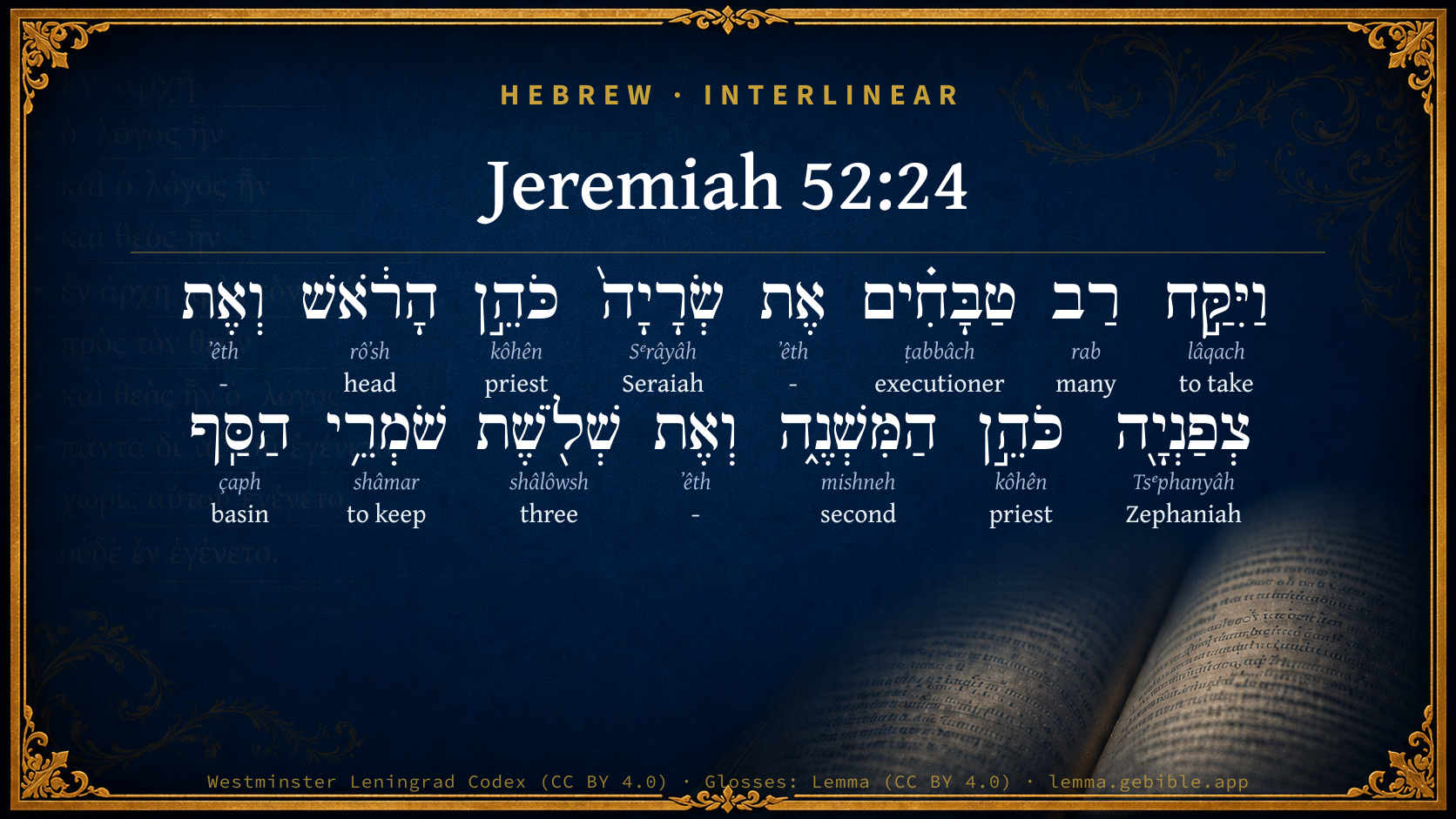
Jeremiah 52:24

Hebrew (Westminster Leningrad Codex) Jeremiah 52:24 appears in the Hebrew Old Testament. The text above is from the Westminster Leningrad Codex. Each word links to its Strong’s number, a concise gloss, and parsing drawn from the Open Scriptures Hebrew Bible morphology. Click any word for its full Brown-Driver-Briggs (BDB) entry.
Download image
Cite this verse

Jeremiah 52:24 (World English Bible). Public Domain. Lemma interlinear Bible study tool, https://lemma.gebible.app/v/jeremiah/52/24.

Show BibTeX & RIS
BibTeX
RIS
English Translation
The captain of the guard took Seraiah the chief priest, and Zephaniah the second priest, and the three keepers of the threshold:
World English Bible · Public Domain
Download a study sheet

One document with this verse’s original text, its word-by-word gloss line, the meaning frame, cross-references with their text, attributed commentary, and full source and license credits — printable, and it pastes into notes with its structure intact.

This verse Autodidact and up

Study sheet (.html) Plain text (.txt)

A passage Seminary Student

Up to 50 verses in one chapter. A passage sheet keeps up to 6 commentary sources and 12 cross-references per verse, in the order this page ranks them, and says so on the sheet whenever that leaves anything out. Ask for a single verse and you get the Autodidact verse sheet above.

Everything on this page stays free to read, with no account — the sheet is a download of what is already on screen, not access to it.

Want to remove ads? Support Godless Engineer
Compare translations 3

The same verse in 3 English versions, stacked beneath the original-language interlinear above. Click any original word for its lexicon entry.

Each is an independent rendering of the whole verse — the interlinear is not word-aligned to these translations.

Highlighted words mark where these versions differ — a whole-verse word diff, not a word-by-word alignment.

  • World English Bible Public Domain
    The captain of the guard took Seraiah the chief priest, and Zephaniah the second priest, and the three keepers of the threshold:
  • King James Version Public Domain
    And the captain of the guard took Seraiah the chief priest, and Zephaniah the second priest, and the three keepers of the door:
  • unfoldingWord Literal Text CC BY-SA 4.0
    The commander of the bodyguards took prisoner Seraiah, the high priest, together with Zephaniah, the second priest, and the three gatekeepers.

unfoldingWord Literal Text — © unfoldingWord, licensed CC BY-SA 4.0. Word-aligned USFM3 via Door43 (git.door43.org/unfoldingWord/en_ult).

Versions to compare (up to 4)

3 of 4 selected

Show all 18 translations

Every available English version of this verse, each an independent rendering of the whole verse.

  • World English Bible Public Domain
    The captain of the guard took Seraiah the chief priest, and Zephaniah the second priest, and the three keepers of the threshold:
  • Berean Standard Bible Public Domain
    The captain of the guard also took away Seraiah the chief priest, Zephaniah the priest of second rank, and the three doorkeepers.
  • Majority Standard Bible Public Domain
    The captain of the guard also took away Seraiah the chief priest, Zephaniah the priest of second rank, and the three doorkeepers.
  • King James Version Public Domain
    And the captain of the guard took Seraiah the chief priest, and Zephaniah the second priest, and the three keepers of the door:
  • American Standard Version (1901) Public Domain
    And the captain of the guard took Seraiah the chief priest, and Zephaniah the second priest, and the three keepers of the threshold:
  • Revised Version (1885) Public Domain
    And the captain of the guard took Seraiah the chief priest, and Zephaniah the second priest, and the three keepers of the door:
  • Geneva Bible (1599) Public Domain
    And the chiefe steward tooke Sheraiah the chiefe Priest, and Zephaniah the seconde Priest, and the three keepers of the doore.
  • Douay-Rheims (1899) Public Domain
    And the general took Saraias the chief priest, and Sophonias the second priest, and the three keepers of the entry.
  • Young's Literal Translation Public Domain
    And the chief of the executioners taketh Seraiah the head priest, and Zephaniah the second priest, and the three keepers of the threshold,
  • Literal Standard Version CC BY-SA 4.0
    And the chief of the executioners takes Seraiah the head priest, and Zephaniah the second priest, and the three keepers of the threshold,
  • Unlocked Literal Bible CC BY-SA 4.0
    The commander of the bodyguards took prisoner Seraiah, the high priest, together with Zephaniah, the second priest, and the three gatekeepers.
  • unfoldingWord Literal Text CC BY-SA 4.0
    The commander of the bodyguards took prisoner Seraiah, the high priest, together with Zephaniah, the second priest, and the three gatekeepers.
  • Darby Bible Public Domain
    And the captain of the body-guard took Seraiah the chief priest, and Zephaniah the second priest, and the three doorkeepers.
  • World Messianic Bible Public Domain
    The captain of the guard took Seraiah the chief priest, and Zephaniah the second priest, and the three keepers of the threshold,
  • Webster's Bible Public Domain
    And the captain of the guard took Seraiah the chief priest, and Zephaniah the second priest, and the three keepers of the door:
  • Free Bible Version CC BY-SA 4.0
    The commander of the guard took as prisoners Seraiah, the chief priest, Zephaniah the priest, second in rank, and the three Temple doorkeepers.
  • Bible in Basic English Public Domain
    And the captain of the armed men took Seraiah, the chief priest, and Zephaniah, the second priest, and the three door-keepers;
  • JPS Tanakh (1917) Public Domain
    And the captain of the guard took Seraiah the chief priest, and Zephaniah the second priest, and the three keepers of the door;

Literal Standard Version (2020), Covenant Press — licensed CC BY-SA 4.0. Text via the HelloAO Bible API (eBible.org). Unlocked Literal Bible (unfoldingWord) — licensed CC BY-SA 4.0. Text via the HelloAO Bible API (eBible.org). unfoldingWord Literal Text — © unfoldingWord, licensed CC BY-SA 4.0. Word-aligned USFM3 via Door43 (git.door43.org/unfoldingWord/en_ult). Free Bible Version, Dr. Jonathan Gallagher — licensed CC BY-SA 4.0. Text via the HelloAO Bible API (eBible.org).

Word by word

More ways to search: Search by grammar → Find every occurrence → Compare this word →

Practice this passage: Drill this verse → Learn its vocabulary →

צְפַנְיָ֖ה
Tsᵉphanyâh
H6846
“Zephaniah”
Noun, Proper
Part of Speech
Noun
Type
Proper
Full BDB Definition

Origin: from H6845 and H3050

TWOT: None

Zephaniah = "Jehovah has treasured" - the 9th in order of the 12 minor prophets; descendant of king Hezekiah of Judah and prophet in the time of king Josiah of Judah - son of Maaseiah and second priest in the reign of king Zedekiah of Judah; succeeded Jehoiada and an officer of the temple; slain at Riblah on the capture of Jerusalem - father of Josiah and Hen in the time of the prophet Zechariah - a Levite
  1. וַיִּקַּ֣ח lâqach H3947 “and · to take” Conjunction + Verb, Qal, Sequential Imperfect, 3rd Person, Masculine, Singular
  2. רַב rab H7227 “many of” Noun, Common, Masculine, Singular, Construct
  3. טַבָּחִ֗ים ṭabbâch H2876 “executioners” Noun, Common, Masculine, Plural, Absolute
  4. אֶת ʼêth H853 “-” Particle, Direct Object
  5. שְׂרָיָה֙ Sᵉrâyâh H8304 “Seraiah” Noun, Proper
  6. כֹּהֵ֣ן kôhên H3548 “priest of” Noun, Common, Masculine, Singular, Construct
  7. הָרֹ֔אשׁ rôʼsh H7218 “the · head” Particle, Definite Article + Noun, Common, Masculine, Singular, Absolute
  8. וְאֶת ʼêth H853 “and · -” Conjunction + Particle, Direct Object
  9. כֹּהֵ֣ן kôhên H3548 “priest of” Noun, Common, Masculine, Singular, Construct
  10. הַמִּשְׁנֶ֑ה mishneh H4932 “the · second” Particle, Definite Article + Noun, Common, Masculine, Singular, Absolute
  11. וְאֶת ʼêth H853 “and · -” Conjunction + Particle, Direct Object
  12. שְׁלֹ֖שֶׁת shâlôwsh H7969 “three” Adjective, Cardinal number, Masculine, Singular, Construct
  13. שֹׁמְרֵ֥י shâmar H8104 “keeping” Verb, Qal, Participle Active, Masculine, Plural, Construct
  14. הַסַּֽף çaph H5592 “the · basin” Particle, Definite Article + Noun, Common, Masculine, Singular, Absolute

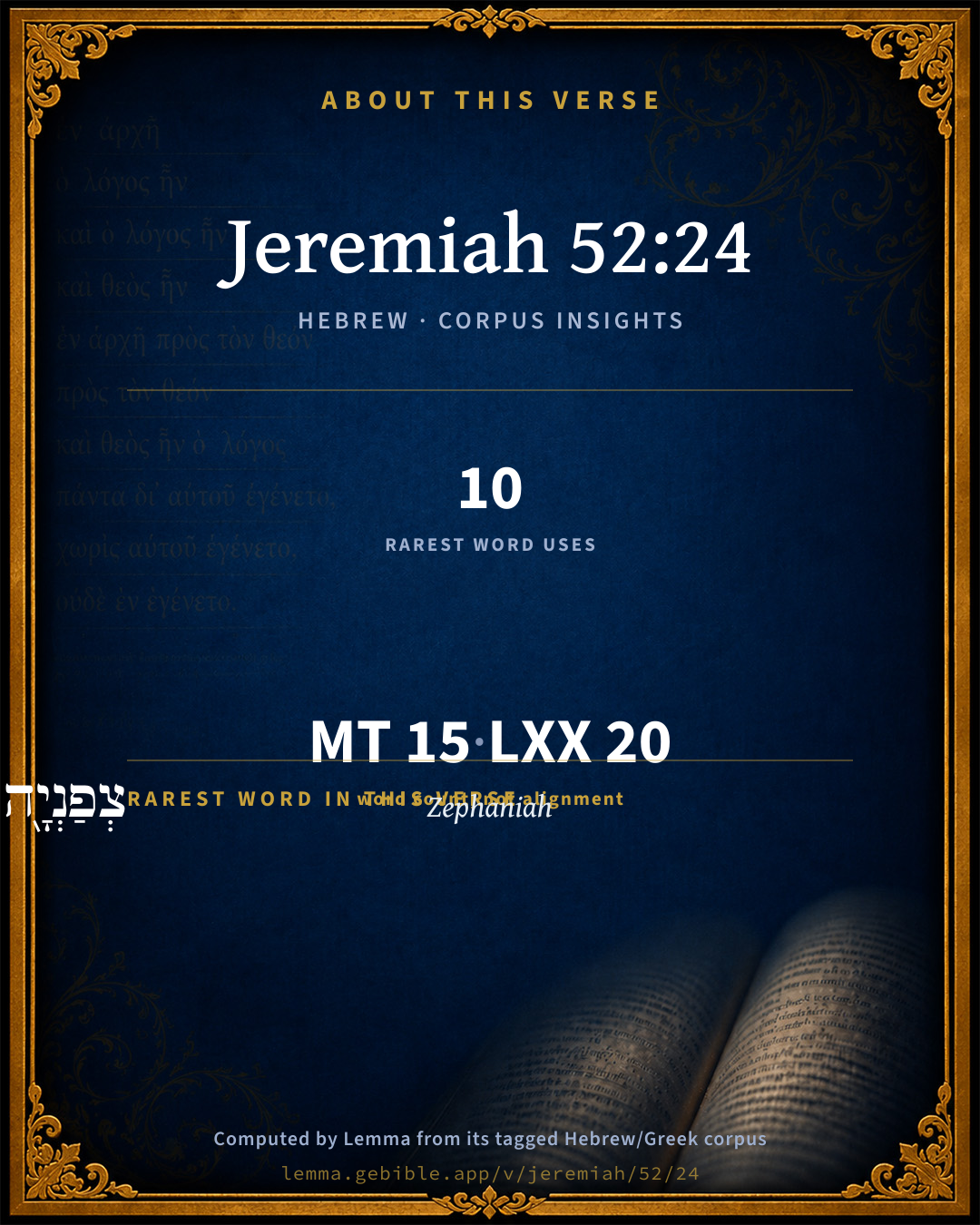
About this verse

These counts appear in no published source. They are computed here, from the morphology-tagged text and Lemma’s own curated glosses. What Lemma adds →

15
words
12
distinct lemmas
Prophets
section

Notable vocabulary

The rarest word here is צְפַנְיָ֖ה Zephaniah H6846 — appearing just 10 times in the whole Hebrew Bible.

Shared distinctive vocabulary

צְפַנְיָ֖ה Zephaniah H6846 occurs in 10 verses of the Hebrew Bible. Also found in:

Grammatical profile

  • 2 verbs
  • 9 nouns
  • 1 adjective
  • 3 particles

Verb forms

  • וַיִּקַּ֣ח Qal · Sequential Imperfect
  • שֹׁמְרֵ֥י Qal · Participle Active

Repetition

A word recurs within this verse — often emphatic in Hebrew:

  • כֹּהֵ֣ן priest H3548 ×2

Hebrew & Septuagint length

In the original languages it is 15 Hebrew tokens and 20 Greek tokens — but the two are counted differently (Hebrew bundles its prefixes and suffixes into one token; the Greek is in lemma form), so that isn’t a like-for-like length.

Cross-references

12

Topical passages linked to Jeremiah 52:24 in the Treasury of Scripture Knowledge — connected by theme and wording, ordered by reader-vote popularity; previews shown in the World English Bible.

  • 2 Kings 25:18 The captain of the guard took Seraiah the chief priest, and Zephaniah the second priest, and the three keepers of the threshold:
  • 1 Chronicles 6:14 and Azariah became the father of Seraiah, and Seraiah became the father of Jehozadak;
  • Jeremiah 21:1 The word which came to Jeremiah from Yahweh, when king Zedekiah sent to him Pashhur the son of Malchijah, and Zephaniah the son of Maaseiah, the priest, saying,
  • Jeremiah 29:25 Thus speaks Yahweh of Hosts, the God of Israel, saying, Because you have sent letters in your own name to all the people who are at Jerusalem, and to Zephaniah the son of Maaseiah, the priest, and to all the priests, saying,
  • Jeremiah 35:4 and I brought them into the house of Yahweh, into the chamber of the sons of Hanan the son of Igdaliah, the man of God, which was by the chamber of the princes, which was above the chamber of Maaseiah the son of Shallum, the keeper of the threshold.
  • Jeremiah 37:3 Zedekiah the king sent Jehucal the son of Shelemiah, and Zephaniah the son of Maaseiah, the priest, to the prophet Jeremiah, saying, Pray now to Yahweh our God for us.
  • Ezra 7:1 Now after these things, in the reign of Artaxerxes king of Persia, Ezra the son of Seraiah, the son of Azariah, the son of Hilkiah,
  • Jeremiah 29:29 Zephaniah the priest read this letter in the ears of Jeremiah the prophet.
  • Jeremiah 52:15 Then Nebuzaradan the captain of the guard carried away captive of the poorest of the people, and the residue of the people who were left in the city, and those who fell away, who fell to the king of Babylon, and the residue of the multitude.
  • 1 Chronicles 9:19–26 Shallum the son of Kore, the son of Ebiasaph, the son of Korah, and his brothers, of his father's house, the Korahites, were over the work of the service, keepers of the thresholds of the tent: and their fathers had been over the camp of Yahweh, keepers of the entry.
  • Psalms 84:10 For a day in your courts is better than a thousand. I would rather be a doorkeeper in the house of my God, Than to dwell in the tents of wickedness.
  • Jeremiah 52:12 Now in the fifth month, in the tenth day of the month, which was the nineteenth year of king Nebuchadrezzar, king of Babylon, came Nebuzaradan the captain of the guard, who stood before the king of Babylon, into Jerusalem:

Cross-references courtesy of OpenBible.info (CC BY 4.0).

Hebrew and Greek witnesses Masoretic Hebrew ↔ Greek Septuagint

The same verse in the two great witnesses to the Old Testament, shown verse-for-verse.

These are two independent witnesses, not word-aligned to each other, and the Septuagint is shown in lemma (dictionary) form.

Hebrew Jeremiah 52:24 Masoretic · Westminster Leningrad Codex

וַיִּקַּ֣ח רַב טַבָּחִ֗ים אֶת שְׂרָיָה֙ כֹּהֵ֣ן הָרֹ֔אשׁ וְאֶת צְפַנְיָ֖ה כֹּהֵ֣ן הַמִּשְׁנֶ֑ה וְאֶת שְׁלֹ֖שֶׁת שֹׁמְרֵ֥י הַסַּֽף

The captain of the guard took Seraiah the chief priest, and Zephaniah the second priest, and the three keepers of the threshold:

World English Bible · Public Domain

Greek LXX Structure differs

In the Septuagint, Jeremiah is about an eighth shorter than the Hebrew and arranges its material differently — the Oracles Against the Nations (Hebrew chapters 46–51) appear in the middle of the Greek book, after 25:13. Because the chapter and verse boundaries do not line up, a verse-for-verse comparison with the Hebrew is not shown.

A verse-for-verse comparison isn’t shown here because the chapters and verses don’t line up. Switch to the LXX edition with the MT / LXX toggle above to read the Greek directly.

Hebrew: Westminster Leningrad Codex (CC BY 4.0). Greek: Septuagint (public domain); English from a public-domain English Septuagint. How the Septuagint differs from the Hebrew →

Targum (Aramaic paraphrase)

1

The Targum is the ancient Jewish Aramaic paraphrase of the Hebrew Scriptures — an interpretive translation, not the Hebrew text itself. Onkelos (literal) and Pseudo-Jonathan (expansive) render the Torah, and Jonathan the Prophets. Coverage is partial: where no permissively-licensed English translation exists for a verse, only the Aramaic is shown. This is verse-level text, not a word-by-word alignment to the Hebrew.

  1. Targum Jonathan Prophets (Joshua–Malachi)
    וּדְבַר רַב קָטוֹלַיָא יַת שְׂרָיָה כַּהֲנָא רַבָּא וְיַת צְפַנְיָה סְגַן כַּהֲנַיָא וְיַת תְּלָתָא אֲמַרְכְּלַיָא:

    (no public-domain English translation for this verse)

    Targum Jonathan — Aramaic: “Mikraot Gedolot” (public domain). English: “Sefaria Community Translation” (CC0 1.0 (public-domain dedication)); “London "Chaldee Paraphrase," 1871” (public domain). Text via Sefaria.

Commentary

Notes on Jeremiah 52:24 from classic Christian and Jewish commentators (each source and its license shown beneath its notes). The classic Christian expositions comment on the surrounding passage and are grouped to its opening verse, so a note may address several verses; the Jewish commentaries on the Tanakh (Rashi and others) are per-verse, so they appear only where the commentator wrote on this verse.

Lemma curates 59 commentaries, every one of them public domain or Creative Commons licensed, each selected and text-cleaned for this edition rather than reprinted as found. About our sources →

Joseph Benson's Commentary

Jer 52:24-25. And the captain of the guard took Seraiah the chief priest — 1Ch 6:14, he was the father of Ezra; Ezr 7:1. And Zephaniah the second priest — See note on Jer 29:26; 2Ki 25:18. And the three keepers of the door — These were not the ordinary porters, who were taken from among the Levites, but were priests who stood at the door to receive the offerings of the people, and thus were keepers of the sacred treasury, an office of high trust and consideration: see 2Ki 12:9; 2Ki 23:4. He took also out of the city a eunuch —

An officer: so it is in the parallel place, 2Ki 25:19, where, instead of seven men, we read five. Josephus agrees with the reading here. And the principal scribe of the host — The muster-master-general, as we style him, or secretary of war. And threescore men that were in the midst of the city — Of whom see note on 2Ki 25:19.

Joseph Benson's Commentary on the Old and New Testaments (1811–1818) — public domain. Text from a community e-Sword module.

Lange's Commentary on the Holy Scriptures

4. THE EXECUTION OF THE REPRESENTATIVES OF THE PEOPLE AND STATEMENT OF THE NUMBER OF THE CAPTIVES

Jer_52:24-30

24And the captain of the guard [halberdiers] took Seraiah the chief priest, and 25Zephaniah the second priest, and the three keepers of the door: He took also out of the city a eunuch [court officer], which had the charge [was25 overseer] of the men of war; and seven men of them that were near the king’s person, which were found in the city; and the principal scribe26 of the host [the scribe, the prince of the host], who mustered the people of the land; and three-score men of the people 26of the land, that were found in the midst of the city. So Nebuzar-adan the captain of the guard took them and brought them to the king of Babylon to Riblah.27And the king of Babylon smote them, and put them to death in Riblah in the land 28of Hamath. Thus Judah was carried away captive out of his own land. This is the people whom Nebuchadrezzar carried away captive: in the seventh year three 29thousand Jews and three and twenty: In the eighteenth year of Nebuchadrezzar he carried away captive from Jerusalem eight hundred and thirty and two persons: 30In the three and twentieth year of Nebuchadrezzar Nebuzar-adan the captain of the guard carried away captive of the Jews seven hundred forty and five persons: all the persons were four thousand and six hundred.

EXEGETICAL AND CRITICAL

Jer_52:24-27. And the captain … out of his own land. These verses differ from the corresponding verses in 2 Kings 25, with the exception of some trifling variations in language, only in the statement of a, number (seven instead of five in Jer_52:25), of which hereafter. It is related that representatives of all classes of the people, priests, officials and simple citizens had to suffer death, evidently in token that Nebuchadnezzar held not only the king but the people guilty of rebellion. At the head of those executed stands the high-priest Seraiah, who is nowhere mentioned in the book of Jeremiah. According to 1 Chron. 5:40 he was the son of Azariah and grandson of Hilkiah; according to Ezr_7:1, Ezra was descended from him.—After Seraiah is mentioned Zephaniah, doubtless the same who is mentioned in Jer_21:1; Jer_29:25; Jer_29:29; Jer_37:3 as priest simply and son of Maaseiah. Here he is called the second priest, but in 2 Kings 25. second priest only without the article. As according to 2Ki_23:4 (where as here three grades of priests are enumerated) there were several second priests, the reading of the Book of Kings is probably the correct one. Comp. Oehler in Herzog, R.-Enc. VI. S. 203, 4.—The keepers of the door [or threshold] are also mentioned in 2Ki_12:10; 2Ki_22:4; 2Ki_23:4; Jer_35:4. As only three of them are mentioned, we must regard these as the superiors of the four thousand Levitical שֹׁעֲרִים (1Ch_23:5). For further details consult Oehler in Herz., R.-Enc. VIII. S. 354–6.—In the second category of those executed are mentioned certain inhabitants of Jerusalem, who held offices at court, especially in the war-department. The city here seems to stand in antithesis both to the temple (Jer_52:24) and to the country (Jer_52:25 b). The one סָרִים (court-officer, but possibly at the same time eunuch, comp. rems. on Jer_29:2) was not the overseer, but only an overseer, etc. He was therefore one of the generals, perhaps commander of the city garrison.—And seven men. In 2 Kings 25 we read five men, whether correctly or incorrectly cannot here be decided as in Jer_52:12; Jer_52:22. The analogy of these cases however favors our text.—That were near the king’s person, literally, “that saw the king’s face,” viz. in the sense of a daily custom, is a designation of high, yea, highest position (Est_1:14; comp. Mat_18:10). These were therefore officials of high rank, and as it is not said that they were endued with military functions, they may be regarded as representatives of the civil authorities.—Scribe, the prince of the host. Scribe is not a writer in our sense. The title belongs not only, as Graf supposes, to the “people of the pen,” but is given to the highest officers of State. Comp. 2Sa_8:7; 2Sa_20:25; 2Ki_12:11; 1Ch_18:16; 1Ch_27:32. And in 2Ch_26:11 it is expressly recorded that Uzziah’s army went out “by the hand of Jeiel the scribe.” This Sopher was not the leader of the host, but chief of the war-department, minister or secretary of war. Comp. Saalschuetz, Mos. Recht. S. 63.—And threescore men. These sixty men appear as the third class of persons executed, and representatives of the country population, as is indicated by their number and the remark that they were found in the midst of the city (2Ki_25:19 “in the city”). This remark would be altogether superfluous, if the object was not to set forth that these men did not originally belong to the city.—On Riblah comp. rems. on Jer_39:5.—The words, Thus Judah was carried away captive out of his land, are found in both texts and in both places are appropriate. For in Jeremiah they form the transition to the numbering of the deported, and in 2 Kings they lead to the account of what happened in the country after the deportation. They therefore furnish no data for the solution of the question which of the two recensions is the original. Moreover, there seems to be an allusion in them to Jer_1:3.

Jer_52:28-30. This is the people … four thousand and six hundred. This section is entirely wanting in 2 Kings. It is difficult to bring it into harmony with the other statements respecting the deportations. The differences are as follows: 1. This section speaks of three deportations, while according to the other testimonies of the Old Testament there were only two (under Jehoiakim and Zedekiah). 2. The section follows a divergent chronology, stating that the deportations took place in the seventh, eighteenth and twenty-third years of Nebuchadnezzar, while this very chapter (Jer_52:12) and 2Ki_24:12; 2Ki_25:8 name the eighth and nineteenth years of Nebuchadnezzar as the dates of the deportation, but know nothing of any in the twenty-third year of this king. 3. According to this passage three thousand and twenty-three were carried away the first time, eight hundred and thirty-two the second time, seven hundred and forty-five the third time, total four thousand six hundred, which sum is expressly given at the close of Jer_52:30. According to 2Ki_24:14-16, however, eighteen thousand souls were carried away at the first deportation alone. There are no counter-statements with regard to the other numbers, but their smallness is surprising; of this hereafter. On these points we make the following remarks: 1. By the seventh year in Jer_52:28, we are certainly to understand the seventh year of Nebuchadnezzar, since both the other deportations are dated in years of this monarch. 2. These statements are not necessarily erroneous, but may possibly follow another reckoning of the years, and perhaps the same as Josephus follows (Antiqq. X., 8, 6; C. Ap. I., 21), though evidently only on the basis of this passage. Comp. Niebuhr, Ass. u. Bab., S. 68 sqq. 3. Jer_52:29 mentioning the eighteenth year after Jer_52:12 has stated the nineteenth as the date of the same fact, shows that we have here another author. 4. The view of Ewald (Gesch. d. V. Isr., III., 1 S. 435) which Graf also adopts, that in Jer_52:29 we are to read שֶׁבַע עֶשְׂרֵה, that accordingly one year before the last capture of Jerusalem three thousand and twenty-three were carried captive from the country (hence הוּדִים),after the capture eight hundred and thirty-two from the city (hence מִירוּשָׁלַם, Jer_52:29), and finally five years later from the land already somewhat repopulated seven hundred and forty-five, has much in its favor, but is yet not perfectly satisfactory. For the circumstance that the difference between the eighth and nineteenth, and the seventh and eighteenth years of Nebuchadnezzar is the same, does not authorize us to supply a word עֶשְׁרֵה, fallen out after שְׁבַע. Then, too, the deportation of the mass of the people during the war, at a time when the Egyptian army was to be feared (comp. Jer_37:5), is scarcely probable. Finally the assumption of a deportation five years after the capture of the city is pure hypothesis, for which there is no positive testimony. It is also not to be supposed that five years after the destruction, admitting the return of a few scattered individuals, an almost equally great number could be carried away as after the destruction of the capital. Would not these have rather again betaken themselves to flight? 5. Even if we grant that the strikingly small numbers of the exiles are to be judged from a specific point of view, and therefore do not necessarily imply an error, any more than the number of the years of Nebuchadnezzar’s reign, yet the differences between Jer_52:12; Jer_52:28 still remain, with the exceedingly obscure third deportation, as irremovable stones of stumbling, and I therefore agree with Niebuhr, when he says, “it cannot be a subject of doubt that Jer_52:28-30 in the fifty-second chapter of Jeremiah are a gloss.”

DOCTRINAL AND ETHICAL

1. “Docemur hoc capite, quod comminationes divinæ rum sint de pelvi fulgura, quodque Deus pro misericordia sua infinita calamitates a se immissas mitigare plerumque soleat, si seria interveniat pœnitentia.” Förster.

2. On Jer_52:1-3. “From this we see why God sometimes places ungodly rulers over a country, who cast it to destruction. It is done on account of the rulers’ and the people’s sins, that they may draw down the well merited punishment, as Sirach says. On account of violence, injustice and avarice, a kingdom passes from one nation to another (Jer_10:8). So also says king Solomon. Because of the sins of a nation occur many changes of rulers, but for the sake of the people who are intelligent and reasonable, the State is prolonged (Pro_28:2).” Wurtemb. Summarien.

3. On Jer_52:4. “God allows many slight and mild punishments to come as warnings, till at last comes the finishing stroke. This is a witness to the divine long-suffering (Rom_2:4).” Cramer.

4. On Jer_52:6. “The fact that in this siege compassionate women had to kill and eat their own children (Lam_4:10) is a reminder that by bodily hunger God would punish; 1. satiation and disgust towards His holy word and soul-food; 2. the terrible offering up of children to Moloch; 3. the loose discipline of children.” Cramer.

5. On Jer_52:7. “No fortress can protect the ungodly, even though they had their nest in the clouds.” Cramer.

6. On Jer_52:8. “An example of faithless, perjured men of war. But as Zedekiah broke his oath to the king at Babylon, he was paid back in the same coin.” Cramer. “His people forsook the poor king Zedekiah on his flight and he was captured, from which we see that great men cannot depend on their body-guard; these flee in time of need, and leave their masters in the lurch. The surest and best protection is when we have the holy angels for our guard … This angelic protection is, however, to be obtained and preserved by faith and godliness, but is lost by unbelief and ungodly conduct.” Wurtemb. Summ.

7. On Jer_52:9-11. The punishment of perjury. “Ubi monemur, quod fides hosti, etiam barbaro, qualis hodie Turca, a Christianis data, mimine violanda.” Förster.

8. On Jer_52:9. sqq. “God had shown Zedekiah by Jeremiah a way in which he could escape the calamity. But because he forsook the Lord and would not follow it, the others were only leaky cisterns (Jer_2:13). For woe to the rebellious who take counsel without the Lord (Isa_30:1). This is useful for an instance against the holy by works, who reject God’s way of escaping the Devil; when they devise other ways for themselves they are caught by the Chaldeans of hell.” Cramer.

9. On Jer_52:12 sqq. “Holy places, external ceremonies and opus operatum do not avail for hypocrites … If God punished His own institution so severely, how shall human institutions remain unpunished?” Cramer.

10. On Jer_52:12. “Quale fatum, ne et nostris obtingat templis … caveamus, ne profanemus templa ulterius tum externa vel materialia, tum interna vel spiritualia in cordibus nostris, de quibus 1Co_3:16 sqq.; Jer_6:19 sqq.” Förster.

11. On Jer_52:15. “It is another work of mercy that some of Judah were preserved. For God’s grace is always to be found in His punishments.” Cramer.

12. On Jer_52:15. “He who will not serve God and his neighbor at home and in quiet, must learn to do it in a strange land in affliction and distress.” Cramer.

13. On Jer_52:24 sqq. “As teachers are often to blame for their behaviour that sin gets the upper hand in a community, it is exceedingly just when God brings such for an example into great punitive judgment (1Sa_2:27-34).” Starke.

14. On Jer_52:24. “The priests are caught and slain; 1. because they could not believe the truth for themselves; 2. because they led others astray; 3. because they appealed to the temple of the Lord; 4. because they persecuted the true prophets; 5. because they troubled the whole church of God. But he who troubleth shall bear his judgment, whosoever he be (Gal_5:10).” Cramer.

15. On Jer_52:31 sqq. “Sane omnino verisimile videtur judicio Philippi Melanchthonis in Chron. part, I fol. 33 Evilmerodachum amplexum esse doctrinam Danielis de Vero Deo, quam et pater publico edic professus est, eamque ob causam clementiam exercuisse erga regem Jechoniam.” Förster.—“Narrant Hebræi hujusmodi fabulam: Evilmerodach, qui patre suo Nabuchodonosor vivente per septem annos inter bestias, ante regnaverat, postquam ille restitutus in regno est, usque ad mortem patris cum Joakim rege Judæ in vinculis fuit; quo mortuo, quum rursus in regnum succederet, et non susciperetur a principibus, qui metuebant, ne viveret qui dicebatur extinctus, ut fidem patris mortui faceret, aperuit sepulcrum et cadaver ejus unco et funibus traxit.” Jerome on Jer_14:18-19. Josephus speaks of it as follows: “Ἀβιλαμαρώδαχος εὐθὺς τὸν ‘Ιεχωνίαν τῶν δεσμῶν ἀφεὶς ἐν τοῖς ἀναγκαιοτάτοις φίλοις εἱχε … ‘Ο γὰρ πατὴρ αὐτοῦ τὴν πίστιν οὐκ ἐφύλαξε τῷ ’Ιεχωνία, παραδόντι μετὰ γυναικαῶν καὶ τέκνων καὶ τῆς συγγενείας ὅλης ἑκουσίως ἑαυτὸν ὑπὲρ τῆς πατρἰδος, ὡς ἄν μὴ κατασκαφείη ληφθεῖσα τῇ πολιορκίᾳ.” (Antiqq., X. 11, 21.)

16. On Jer_52:31 sqq. “Ceterum potest hoc exemplo, quod Jechonias rex dignitati suæ in exilio Babylonico restitutus, refutari exceptio Judæorum contra vaticinium Jacobi (Gen_49:10) de Messia jamdudum exhibito, postquam per Romanos sceptrum de Juda ablatum, id quod τεκμήριον Messiæ jamjam nascituri esse debuit.” Förster.

17. On Jer_52:31 sqq. “No one should despair in misfortune, for the right hand of the Highest can change all (Psa_77:10) and Christ rules even in the midst of His enemies (Psa_110:2). For His are the praise, the glory and the power from everlasting to everlasting. Amen.” Cramer.

HOMILETICAL AND PRACTICAL

1. On Jer_52:1-11. The truth of the word “What a man soweth, that shall he also reap,” exhibited in the example of the Jewish State under Zedekiah.1. The seed (Jer_52:2); 2. The crop (a) the siege, (b) the famine, (c) the capture of the city and flight of the king, (d) the punishment of the king and his princes, (e) the fate of the people (Jer_52:3).

2. On Jer_52:12-20. The rejection of Judah appears at first sight a contradiction. For Jerusalem is the holy city (Mat_4:5; Neh_11:1; Neh_11:18), the city of God (Psa_46:5; Psa_48:2; Psa_48:9; Psa_78:3); the temple is the house of Jehovah (Jer_7:2. etc.); God’s service rests on divine authority (Ex. chh. 25–27, 30, 31). But God cannot contradict Himself. We have, therefore, to show “the unity of the divine thoughts in the choice and rejection of Jerusalem.” 1. The rejection was a conditional one (Jer_7:3 sqq). Hence notwithstanding the election the rejection involved nothing contradictory, but was a necessary consequence of the unfulfilled condition.—2. The election remains (a) objectively notwithstanding the rejection; it is (b) subjectively brought to its realization by the rejection; the latter as a means of discipline operating to produce the disposition, from which alone thefulfillment of this condition can proceed. Comp. rems. on Jer_32:41, p. 288.

3. On Jer_52:24-27. “That great lords sometimes make an example of gross miscreants, promotes righteousness, only it must not be done on the innocent, or with such severity that there is no proportion between the crime and its punishment (Jos_7:25).” Starke.

4. On Jer_52:31-34. The deliverance of Jehoiachin. 1. It shows us that the Lord can help (a) out of great distress (grievous imprisonment of thirty-seven years), (b) in a glorious manner. 2. It admonishes us (a) to steadfast patience, (b) to believing hope, Psalms 13 [“It was a prelude and pledge of the liberation and exaltation of the Jewish Nation, when it had been humbled and purified by the discipline of suffering; and of its return to its own land; and a joyful pre-announcement of that far more glorious future restoration which the prophets in the Old Testament, and the Apostles in the New foretell—of Israel to God in Christ; to whom, with the Father and Holt Ghost, be ascribed all honor, glory, dominion, adoration and praise, now and forever. Amen.” Wordsworth.—S. R. A.].

Footnotes:

[25]Jer_52:25.—In 2 Kings 25 we findהוּא for הָָיה. The former does not necessarily, as Hitzig asserts, signify “which is.” הוּא takes the place of the copula generally, without reference to time. Comp. Ewald, § 297 b.

[26]Jer_52:25—ואת ספר. In 2 Kings 25 הַסֹּפר, which I regard as the more correct reading.

Lange's Commentary on the Holy Scriptures (Critical, Doctrinal, and Homiletical), ed. John Peter Lange, English translation edited by Philip Schaff (1864–1880) — public domain. Text from a community e-Sword module.

Geneva Bible (1599)

Geneva Bible translators

Which served in the high Priest’s stead, if he had any necessary impediment.

Geneva Bible (1599) marginal notes — public domain. Text via Bolls.life.

Matthew Henry's Commentary

We have here a very melancholy account, 1. Of the slaughter of some great men, in cold blood, at Riblah, seventy-two in number (according to the number of the elders of Israel, Num 11:24, Num 11:25), so they are computed, Kg2 25:18, Kg2 25:19. We read there of five out of the temple, two out of the city, five out of the court, and sixty out of the country. The account here agrees with that, except in one article; there it is said that there were five, here there were seven, of those that were near the king, which Dr. Lightfoot reconciles thus, that he took away seven of those that were near the king, but two of them were Jeremiah himself and Ebed-melech, who were both discharged, as we have read before, so that there were only five of them put to death, and so the number was reduced to seventy-two, some of all ranks, for they had all corrupted their way; and it is probable that such were made examples of as had been most forward to excite and promote the rebellion against the king of Babylon. Seraiah the chief priest is put first, whose sacred character could not exempt him from this stroke; how should it, when he himself had profaned it by sin? Seraiah the prince was a quiet prince (Jer 51:59), but perhaps Seraiah the priest was not so, but unquiet and turbulent, by which he had made himself obnoxious to the king of Babylon. The leaders of this people had caused them to err, and now they are in a particular manner made monuments of divine justice. 2. Of the captivity of the rest. Come and see how Judah was carried away captive out of his own land (Jer 52:27), and how it spued them out as it spued out the Canaanites that went before them, which God had told them it would certainly do if they trod in their steps and copied out their abominations, Lev 18:28. Now here is an account, (1.) Of two captivities which we had an account of before, one in the seventh year of Nebuchadnezzar (the same with that which is said to be in his eighth year, Kg2 24:12), another in his eighteenth year, the same with that which is said (Jer 52:12) to be in his nineteenth year. But the sums here are very small, in comparison with what we find expressed concerning the former (Kg2 24:14, Kg2 24:16), when there were 18,000 carried captive, whereas here they are said to be 3023; they are also small in comparison with what we may reasonably suppose concerning the latter; for, when all the residue of the people were carried away (Jer 52:15), one would think there should be more than 832 souls; therefore Dr. Lightfoot conjectures that, these accounts being joined to the story of the putting to death of the great men at Riblah, all that are here said to be carried away were put to death as rebels. (2.) Of a third captivity, not mentioned before, which was in the twenty-third year of Nebuchadnezzar, four years after the destruction of Jerusalem (Jer 52:30): Then Nebuzaradan came, and carried away 745 Jews; it is probable that this was done in revenge of the murder of Gedaliah, which was another rebellion against the king of Babylon, and that those who were now taken were aiders and abetters of Ishmael in that murder, and were not only carried away, but put to death for it; yet this is uncertain. If this be the sum total of the captives (all the persons were 4600, Jer 52:30), we may see how strangely they were reduced from what they had been, and may wonder as much how they came to be so numerous again as afterwards we find them; for it should seem that, as at first in Egypt, so again in Babylon, the Lord made them fruitful in the land of their affliction, and the more they were oppressed the more they multiplied. And the truth is, this people were often miracles both of judgment and mercy.

Matthew Henry's Commentary on the Whole Bible (1708–1710) — public domain (CC PDM 1.0). Text via the HelloAO Bible API.

Jamieson, Fausset & Brown

Robert Jamieson, A. R. Fausset & David Brown

Seraiah--different from the Seraiah (Jer 51:59), son of Neriah; probably son of Azariah (Ch1 6:14).

Zephaniah--son of Maaseiah (see on Jer 21:1; Jer 29:25).

Jamieson, Fausset & Brown — Commentary Critical and Explanatory on the Whole Bible (1871) — public domain (CC PDM 1.0). Text via the HelloAO Bible API.

Adam Clarke's Commentary

Verse 24. The second priest] 2Kg 25:18.

The three keepers] The priests who stood at the door to receive the offerings of the people, see 2Kg 20:9; 2Kg 23:4.

Adam Clarke's Commentary on the Bible (1810–1826) — public domain. Text from a community e-Sword/MySword module.

The Cambridge Bible for Schools and Colleges

gen. ed. J. J. S. Perowne

24. Seraiah the chief priest] probably identical with the ancestor of Ezra, mentioned Ezr_7:1.

Zephaniah] See on Jer_21:1.

keepers of the door] Heb. threshold. See on Jer_35:4.

24–27. Omitted in ch. 39, but cp. with it 2Ki_25:18-21.

The Cambridge Bible for Schools and Colleges (gen. ed. J. J. S. Perowne; Cambridge University Press, 1878–1918) — public domain. Text from a community e-Sword module.

John Gill's Exposition

He took also out of the city an eunuch, which had the charge of the men of war,.... The master-master-general of the army:

and seven men of them which were near the king's person which were found in the city; or, "saw the face of the king": or rather, "made to see his face" (h); these were ministers of state, who were always at court, and assisted in councils of state, and introduced persons into the king's presence; in Kg2 25:19; they are said to be but "five"; but Josephus (i) has seven, as here; perhaps two of them were of less note, and so not reckoned, as Jarchi observes: some will have it, that the two scribes of the judges are left out; but others, more probably, Jeremiah and Baruch, who were first taken, and afterwards dismissed:

and the principal scribe of the host, who mustered the people of the land; or the scribe of the prince of the army, as the Targum; the general's secretary:

and threescore men of the people of the land, that were found in the midst of the city: persons of prime note, who, upon the invasion, betook themselves from the country to the city of Jerusalem with their effects, and to defend it. Josephus (k) calls them rulers or governors.

(h) "ex videntibus facies, vel faciem regis", Montanus, Piscator; "de videre facientibus facies regis", Schmidt. (i) Antiqu. l. 10. c. 8. sect. 5. (k) Ibid.

John Gill's Exposition of the Whole Bible (1746–1763) — public domain (CC PDM 1.0). Text via the HelloAO Bible API.

Haydock's Catholic Bible Commentary

Second in dignity to the high priest, a chief officer of the temple.

George Leo Haydock (1774–1849), Haydock's Catholic Family Bible and Commentary, 1859 edition — public domain. Excludes Psalms (Douay-Rheims chapter numbering differs from Protestant) and Deuterocanonical books (Catholic canon only).

Matthew Poole's English Annotations

See Poole "2Ki 25:18", where we have the same words. This Seraiah was not he mentioned Jer 51:59, but the son of Azariah, 1Ch 6:14. By the

second priest, interpreters understand him that supplied the place of the high priest in case he were sick, &c., he that was sent by Zedekiah to the prophet, Jer 21:1, and whom Jeremiah chose by his letters, Jer 29:25, for not setting Jeremiah in the stocks. It is probable there were more keepers of the door, but the captain of the guard took only three of the principal.

Matthew Poole's English Annotations on the Holy Bible (1683–1685) — public domain. Text from a community e-Sword/MySword module.

John Wesley's Explanatory Notes

Three - It is probable there were more keepers of the door, but the captain of the guard took only three of the chief.

John Wesley, Explanatory Notes Upon the Whole Bible (1754–1765) — public domain. Text via the GEBible commentary corpus.

Keil & Delitzsch

C. F. Keil & F. Delitzsch

The account given regarding the arrest of the chief officers of the temple and of the city, and concerning their transportation to Riblah, where Nebuchadnezzar caused them to be executed, agrees with Kg2 25:18-21, except in some unimportant variations, which, however, do not alter the sense; the explanation has been already given in the commentary on that passage. In 2 Kings, the account of the appointment of Gedaliah as the governor of Judah, together with that of his assassination by Ishmael, which follows the narrative just referred to, is here omitted, because the matter has bee already more fully stated in the passage Jer 40:7 on to Jer 43:7, and had no close connection with the object of the present chapter. Instead of this, there follows here, in Jer 52:28-30 (as a continuation of the remark made, Jer 52:27, "Thus was Judah carried away captive out of his own land"), a calculation of the number of the Jews taken to Babylon at the three deportations: in the seventh year of Nebuchadnezzar, 3023 Jews; in the eighteenth year, 832 souls from Jerusalem; and in the twenty-third year, 745 souls, - in all, 4600 persons. The correctness of these data is vouched for by the exactness of the separate numbers, and the agreement of the sum with the individual items. In other respects, however, they present various difficulties. There is, first, the chronological discrepancy that the second deportation is here placed in the eighteenth year of Nebuchadnezzar, in contradiction with Jer 52:12, according to which, the deportation after the taking of Jerusalem occurred in the nineteenth year of Nebuchadnezzar; and 832 souls could not well be carried out of Jerusalem during the siege. This difference can be settled only by assuming that this list of deportations was derived from another source than the preceding notice regarding the destruction of Jerusalem, in which the years of Nebuchadnezzar's reign were reckoned in some other way than elsewhere in Jeremiah and in the books of Kings, probably from the date of the actual commencement of his reign, which followed a year after he first appeared in Judah, from which his reign is dated elsewhere; see Comm. on Daniel at Dan 1:1. According to this mode of computation, the seventh year would correspond to the eighth of the common reckoning, and be the year in which Jehoiachin was carried away to Babylon, together with a large number of the people. But this does not agree with 3023, which is given as the number of those who were carried away; for, at that time, according to Kg2 24:14, Kg2 24:16, as many as 10,000 Jews, or, according to another view of these verses, even 18,000, were carried away to Babylon. This difference does not permit of being explained in any way. Ewald (History of the People of Israel, iii. p. 738) accordingly assumes that in Jer 52:28, after שׁבע, the word עשׂרה has been omitted, as in Ch2 36:9, where the age of Jehoiachin is given; hence he thinks that, instead of "in the seventh," we must read "in the seventeenth year of Nebuchadnezzar." On such a view, the reference would be to a deportation which took place under Zedekiah, a year before the capture, or during the time of the siege of Jerusalem, and that, too, out of the country districts of Judah in contrast with Jerusalem, Jer 52:29. This supposition is favoured not merely by the small number of those who are said to have been carried away, but also by the context of the narrative, inasmuch as, in what precedes, it is only the capture of Jerusalem and the deportation of the people in Zedekiah's time that is treated of. Ngelsbach has objected to this supposition, that it was not likely the great mass of the people would be carried away during the war, at a time when the approach of the Egyptian army (cf. Jer 37:5) was an object of dread. But the objection does not weaken the supposition, since the former rests on two presuppositions that are quite erroneous: viz., first, that the deportation took place before the defeat of the auxiliary army from Egypt, where as it may have followed that event; and secondly, that the Chaldeans, by keeping the hostile Jews in the country, might have been able to get some assistance against the Egyptian army, whereas, by removing the hostile population of Judah, they would but diminish the number of the enemies with which they had to contend. We therefore regard this conjecture as highly probable, because it is the means of settling all difficulties, and because we can thereby account for the small number of those who were carried away in the deportations during and after the destruction of Jerusalem.

Regarding the third deportation, which was effected by Nebuzaradan (Jer 52:30) in the twenty-third, or, according to another reckoning, in the twenty-fourth year of Nebuchadnezzar, i.e., in the fifth year after the destruction of Jerusalem, we have no other information; for the statement of Josephus, Antt. x. 9. 7, that Nebuchadnezzar made war upon the Ammonites and Moabites in that year, has not been placed beyond a doubt, and is probably a mere inference from this verse, taken in connection with the prophecies in Jer 48 and 49. Yet there is nothing improbable in the statement, viewed by itself. For it must be borne in mind that, after the appointment of Gedaliah as governor, and the departure of the Chaldean hosts, many Jews, who had fled during the war, returned into the country. Hence, in spite of the fact that, after the murder of Gedaliah, a multitude of Jews, fearing the vengeance of the Chaldeans, fled to Egypt, many may have still remained in the country; and many other fugitives may not have returned till afterwards, and given occasion to the Chaldeans for removing other 745 disturbers of the peace to Babylon, four or five years after Jerusalem had been laid in ashes. This deportation may have taken place on the occasion of the subjugation of the Moabites, Ammonites, and Idumeans, or during the war with the Phoenicians, possibly because they had rendered assistance to these nations against the Chaldeans. These verses thus contain nothing to justify the assumption of M. von Niebuhr (Gesch. Assyr. und Babels, S. 58, note) and Ngelsbach, that they are a gloss. The paucity of those who were carried away is not to be attributed to a desire on the part of the writer of this inserted portion to represent the calamity as not so very terrible after all; nor is it due to the substitution of the number of the Levites for that of the entire people, - two wholly arbitrary assumptions: it is completely explained by a consideration of the historical circumstances. The best of the population of Judah had already been carried away, and Zedekiah and his counsellors must have said to themselves, when they rebelled against Nebuchadnezzar, that the latter would not spare this time; thus they must have defended themselves to the utmost, as is shown by the very fact that the siege of Jerusalem lasted eighteen months. In this manner, war, pestilence, and famine carried off a great number of the population of Jerusalem; so that, of men who were able-bodied and fit for war, and who could be carried into exile, not more than 4600 fell into the hands of the Chaldeans. During the war, also, many had concealed themselves in inaccessible places, while the lowest of the people were left behind in the country to cultivate the fields. Still more strange might appear the circumstance that the sum-total of those who were carried away to Babylon, viz., 10,000 with Jehoiachin, and 4600 under Zedekiah, - 14, 600 in all, - is evidently disproportionate to the number of those who returned to Jerusalem and Judah under Zerubbabel, which number is given in Ezr 2:64 at 42, 360, exclusive of men and maid servants. For this reason, Graf is of opinion that still later deportations may have taken place, of which no mention is made anywhere. This assumption, however, has little probability. On the other hand, we must consider these points: (1.) In the accounts given of those who were carried away, only full-grown and independent persons of the male sex are reckoned, while, along with fathers, both their wives and their children went into exile. (2.) Even so early as the first capture of Jerusalem in the fourth year of Jehoiakim, a number of prisoners of war, perhaps not inconsiderable, came to Babylon; these might unite with the thousands of their brethren who were carried thither at a later period. (3.) When the exiles had settled down in Babylon, and there found not only a means of livelihood, but even in many instances, as is clear from several intimations, attained to opulence as citizens, many, even of those who had been left in the country, may have gone to Babylon, in the hope of finding there greater prosperity than in Judah, now laid waste and depopulated by war. (4.) From the time when the 10,000 were carried away with Jehoiachin, in the year 599 b.c., till the return under Zerubbabel, 536 b.c., 63 years, i.e., nearly two generations, had passed, during which the exiles might largely increase in numbers. If we take all these elements into consideration, then, in the simple fact that the number of those who returned amounts to nearly three times the numbers of those given as having been carried away under Jehoiachin and Zedekiah, we cannot find such a difficulty as entitles us to doubt the correctness of the numbers handed down to us.

Keil & Delitzsch — Biblical Commentary on the Old Testament (1861–1891) — public domain (CC PDM 1.0). Text via the HelloAO Bible API. (Old Testament only.)

unfoldingWord translationNotes

Door43 World Missions Community

Seraiah

See how you translated this man's name in Jeremiah 36:26.

gatekeepers

people who guard the gate of a city

drafting men into the army

"forcing men to fight in the army"

translationWords

prison

high priest

Zephaniah

unfoldingWord translationNotes — © Distant Shores Media and the Door43 World Missions Community, licensed CC BY-SA 4.0. Source: git.door43.org/Door43/en_tn.

Lesson kit

Teaching starters — assembled from the data on this page, not authored interpretation. Every prompt links to the verse data it draws on. Edit before teaching.

Jeremiah, in the Prophets, opens this verse with 15 words (12 distinct Hebrew lemmas). Its most distinctive word is Tsᵉphanyâh (“Zephaniah”). A historical commentator’s framing appears above. Read the whole chapter for the surrounding context.

Discussion questions

  1. How does “Zephaniah” (Tsᵉphanyâh) shape what this verse is saying?
  2. 2 Kings 25:18 shares the word «Zephaniah» with this verse. How do the two illuminate each other?
  3. “priest” occurs 2× in this one verse. What is the effect of the repetition?
  4. These translations render this verse differently. What is at stake in choosing one wording over another?
  5. The verb «וַיִּקַּ֣ח» is Qal Sequential Imperfect. How does its form color the action?
  6. Reading how Joseph Benson's Commentary and Lange's Commentary on the Holy Scriptures read this verse, where do the two commentators agree and where do they part?

Things to notice

Reading settings

Reading text

Shown beneath each verse's original-language words.

Old Testament
Old Testament edition

Read the OT as the Masoretic Hebrew (MT) or the Greek Septuagint (LXX).

English shown for the Greek Septuagint (in the Hebrew ↔ Greek comparison).

Comparing translations? Open the Compare panel on any verse page to stack up to four side by side.