

Romans 1:31
Greek (Tischendorf 8th ed.) Romans 1:31 appears in the Greek New Testament. The text above is from the Tischendorf 8th edition. Each word links to its Strong’s number and a concise gloss. Click any word for its full Thayer’s Greek Lexicon entry.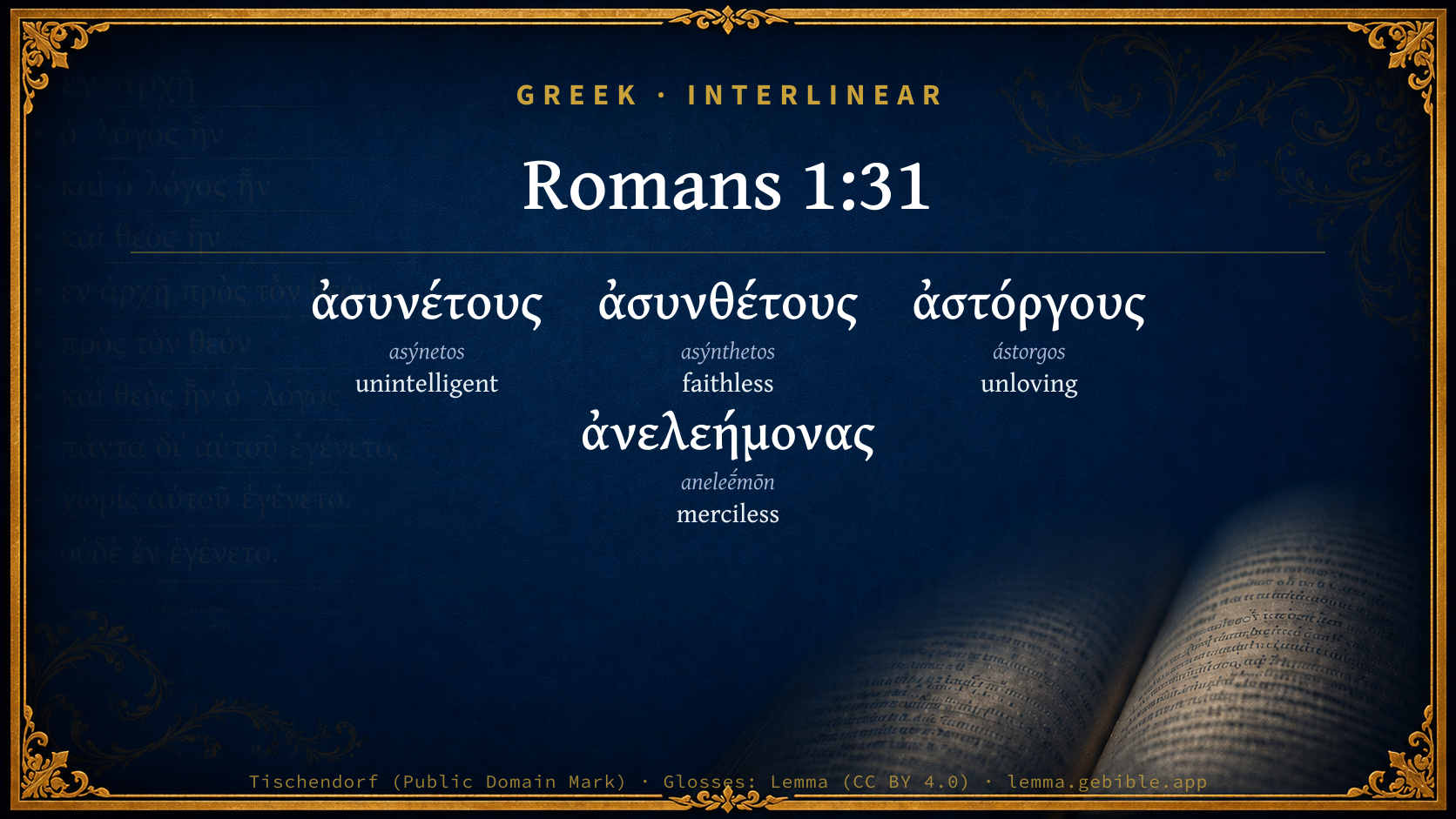
without understanding, covenant-breakers, without natural affection, unforgiving, unmerciful;
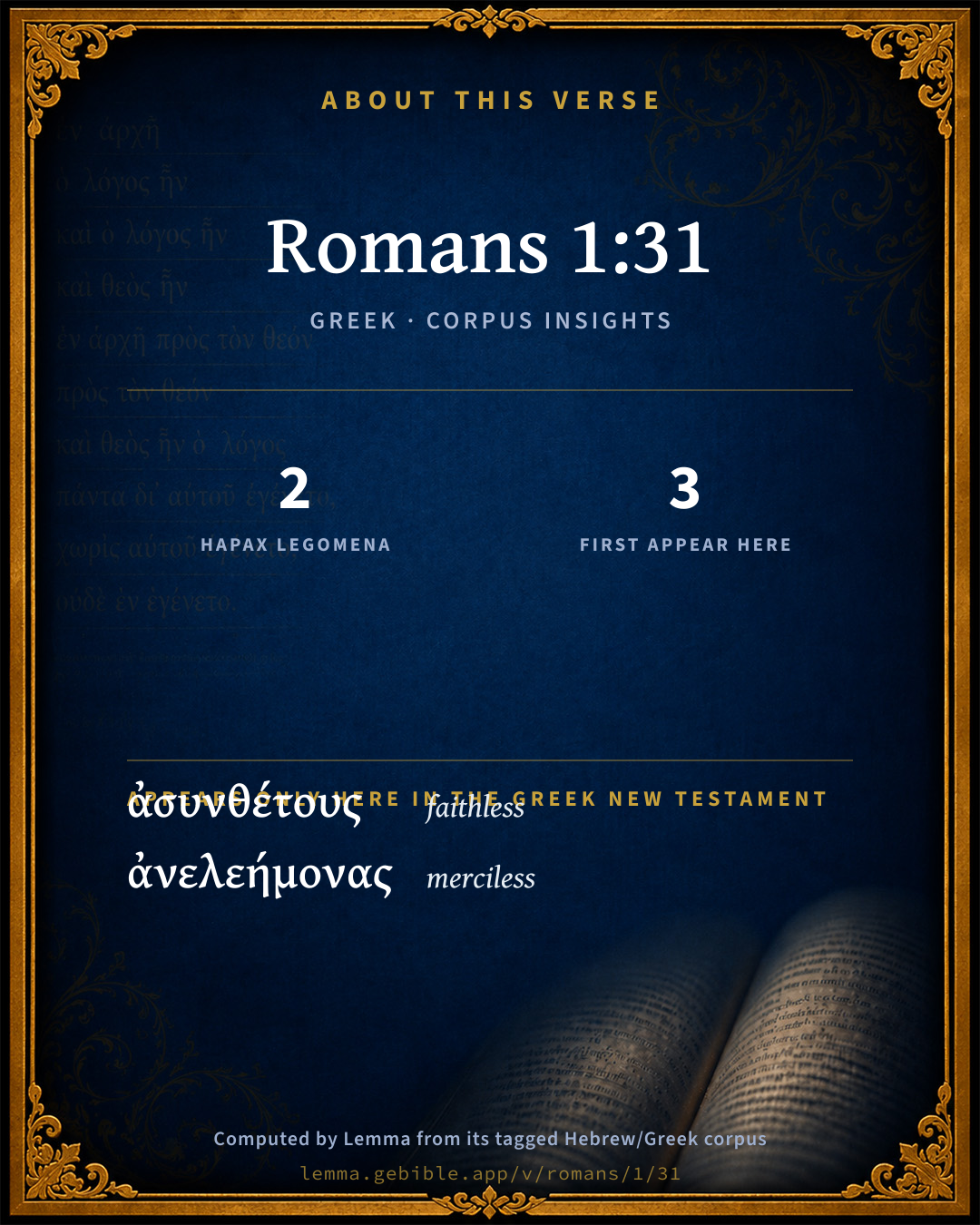
- 2 hapax legomena — only here in the Greek New Testament
- 3 first appearances in the Greek New Testament
Download a study sheet
One document with this verse’s original text, its word-by-word gloss line, the meaning frame, cross-references with their text, attributed commentary, and full source and license credits — printable, and it pastes into notes with its structure intact.
This verse Autodidact and up
A passage Seminary Student
Up to 50 verses in one chapter. A passage sheet keeps up to 6 commentary sources and 12 cross-references per verse, in the order this page ranks them, and says so on the sheet whenever that leaves anything out. Ask for a single verse and you get the Autodidact verse sheet above.
Everything on this page stays free to read, with no account — the sheet is a download of what is already on screen, not access to it.
Compare translations 3
The same verse in 3 English versions, stacked beneath the original-language interlinear above. Click any original word for its lexicon entry.
Each is an independent rendering of the whole verse — the interlinear is not word-aligned to these translations.
Highlighted words mark where these versions differ — a whole-verse word diff, not a word-by-word alignment.
-
World English Bible Public Domain
without understanding, covenant-breakers, without natural affection, unforgiving, unmerciful;
-
King James Version Public Domain
Without understanding, covenantbreakers, without natural affection, implacable, unmerciful:
-
unfoldingWord Literal Text CC BY-SA 4.0
senseless, faithless, heartless, merciless.
unfoldingWord Literal Text — © unfoldingWord, licensed CC BY-SA 4.0. Word-aligned USFM3 via Door43 (git.door43.org/unfoldingWord/en_ult).
Show all 19 translations
Every available English version of this verse, each an independent rendering of the whole verse.
-
World English Bible Public Domain
without understanding, covenant-breakers, without natural affection, unforgiving, unmerciful;
-
Berean Standard Bible Public Domain
They are senseless, faithless, heartless, merciless.
-
Majority Standard Bible Public Domain
They are senseless, faithless, heartless, unforgiving, merciless.
-
King James Version Public Domain
Without understanding, covenantbreakers, without natural affection, implacable, unmerciful:
-
American Standard Version (1901) Public Domain
without understanding, covenant-breakers, without natural affection, unmerciful:
-
Revised Version (1885) Public Domain
without understanding, covenant-breakers, without natural affection, unmerciful:
-
Geneva Bible (1599) Public Domain
Which men, though they knew ye Lawe of God, how that they which comit such things are worthie of death, yet not onely do the same, but also fauour them that doe them.
-
Douay-Rheims (1899) Public Domain
Foolish, dissolute, without affection, without fidelity, without mercy.
-
Young's Literal Translation Public Domain
unintelligent, faithless, without natural affection, implacable, unmerciful;
-
Literal Standard Version CC BY-SA 4.0
unintelligent, faithless, without natural affection, implacable, unmerciful;
-
Unlocked Literal Bible CC BY-SA 4.0
They are senseless, faithless, heartless, and unmerciful.
-
unfoldingWord Literal Text CC BY-SA 4.0
senseless, faithless, heartless, merciless.
-
Darby Bible Public Domain
void of understanding, faithless, without natural affection, unmerciful;
-
World Messianic Bible Public Domain
without understanding, covenant breakers, without natural affection, unforgiving, unmerciful;
-
Webster's Bible Public Domain
Without understanding, covenant-breakers, without natural affection, implacable, unmerciful:
-
Free Bible Version CC BY-SA 4.0
They don't want to understand, they don't keep their promises, they don't show any kindness or compassion.
-
Bible in Basic English Public Domain
Without knowledge, not true to their undertakings, unkind, having no mercy:
-
Text-Critical English NT CC BY 4.0
senseless, untrustworthy, without natural affection, irreconcilable, and unmerciful.
-
Tyndale New Testament (1534) Public Domain
with out vnderstondinge covenaunte breakers vnlovinge trucebreakers and merciles.
Literal Standard Version (2020), Covenant Press — licensed CC BY-SA 4.0. Text via the HelloAO Bible API (eBible.org). Unlocked Literal Bible (unfoldingWord) — licensed CC BY-SA 4.0. Text via the HelloAO Bible API (eBible.org). unfoldingWord Literal Text — © unfoldingWord, licensed CC BY-SA 4.0. Word-aligned USFM3 via Door43 (git.door43.org/unfoldingWord/en_ult). Free Bible Version, Dr. Jonathan Gallagher — licensed CC BY-SA 4.0. Text via the HelloAO Bible API (eBible.org).
Word by word
More ways to search: Search by grammar → Find every occurrence → Compare this word →
Practice this passage: Drill this verse → Learn its vocabulary →
- Appears 1× in the Greek New Testament
- First appears here
- Part of Speech
- Adjective
- Case
- Accusative
- Number
- Plural
- Gender
- Masculine
Full Thayer's Definition
- ἀσυνέτους asýnetos G801 “unintelligent” Adjective, Accusative, Plural, Masculine
- ἀσυνθέτους asýnthetos G802 “faithless” Adjective, Accusative, Plural, Masculine
- ἀστόργους ástorgos G794 “unloving” Adjective, Accusative, Plural, Masculine
- ἀνελεήμονας aneleḗmōn G415 “merciless” Adjective, Accusative, Plural, Masculine
About this verse
These counts appear in no published source. They are computed here, from the morphology-tagged text and Lemma’s own curated glosses. What Lemma adds →
- 4
- words
- 4
- distinct lemmas
- Pauline Epistles
- section
Notable vocabulary
2 hapax legomena — words that appear only here in the entire Greek New Testament:
First appearance in Scripture
These words make their first canonical appearance in the Greek New Testament here:
Shared distinctive vocabulary
ἀστόργους unloving G794 occurs in 2 verses of the Greek New Testament. Also found in:
Cross-references
9Topical passages linked to Romans 1:31 in the Treasury of Scripture Knowledge — connected by theme and wording, ordered by reader-vote popularity; previews shown in the World English Bible.
- Proverbs 18:2 A fool has no delight in understanding, But only in revealing his own opinion.
- 2 Timothy 3:3 without natural affection, unforgiving, slanderers, without self-control, fierce, no lovers of good,
- Romans 3:11 There is no one who understands. There is no one who seeks after God.
- Isaiah 33:8 The highways lie waste, the wayfaring man ceases: [the enemy] has broken the covenant, he has despised the cities, he doesn't regard man.
- Jeremiah 4:22 For my people are foolish, they don't know me; they are foolish children, and they have no understanding; they are wise to do evil, but to do good they have no knowledge.
- Matthew 15:16 So Jesus said, "Do you also still not understand?
- 2 Kings 18:14–37 Hezekiah king of Judah sent to the king of Assyria to Lachish, saying, I have offended; return from me: that which you put on me will I bear. The king of Assyria appointed to Hezekiah king of Judah three hundred talents of silver and thirty talents of gold.
- Isaiah 27:11 When the boughs of it are withered, they shall be broken off; the women shall come, and set them on fire; for it is a people of no understanding: therefore he who made them will not have compassion on them, and he who formed them will show them no favor.
- Romans 1:20–21 For the invisible things of him since the creation of the world are clearly seen, being perceived through the things that are made, even his everlasting power and divinity; that they may be without excuse.
Cross-references courtesy of OpenBible.info (CC BY 4.0).
Where the printed editions differ
1 variantPlaces in this verse where the major printed Greek editions disagree on the wording in a way that affects the translation — a comparison of editions, not a manuscript-by-manuscript collation. The editions are the modern critical texts (Nestlé-Aland 28/27, SBL, Westcott-Hort, Tregelles, Tyndale House) and the traditional texts behind the KJV (the Textus Receptus and the Byzantine/Majority text). It is not a claim about which reading is original.
-
Extra text
ἀσπόνδους,
“implacable,”
In TRByz Not in NA28NA27TynSBLWHTregἀσπόνδους, (aspondous) 'implacable,' is only in traditional manuscripts (TR+Byz)
Textual data: Translators Amalgamated Greek New Testament (STEPBible TAGNT) · CC BY 4.0.
Lesson kit
Teaching starters — assembled from the data on this page, not authored interpretation. Every prompt links to the verse data it draws on. Edit before teaching.
Romans, in the Pauline Epistles, opens this verse with 4 words (4 distinct Greek lemmas). Its most distinctive word is asýnthetos (“faithless”). A historical commentator’s framing appears above. Read the whole chapter for the surrounding context.
Discussion questions
- The word asýnthetos carries the sense “faithless.” How does it shape the verse?
- 2 words here appear nowhere else in the Greek New Testament. Why might the author reach for such rare wording?
- 3 words make their first appearance in Scripture here. What does this debut establish?
- How does 2 Timothy 3:3, which shares the word «unloving», read alongside this verse?
- The translations on this page render this verse differently — a whole-verse word diff, not a word-by-word alignment. What might account for the different wordings?
- Compare how Bengel's Gnomon and Hodge's Commentary on Romans, Ephesians & First Corinthians read this verse. Where do they agree or differ?
Things to notice
- 2 words in this verse appear nowhere else in the Greek New Testament.
- 3 words make their first canonical appearance in Scripture here.
- These translations choose different wording for 13 words in this verse.
- 4 distinct Greek lemmas span 4 words in this verse.
Commentary
Notes on Romans 1:31 from classic Christian and Jewish commentators (each source and its license shown beneath its notes). The classic Christian expositions comment on the surrounding passage and are grouped to its opening verse, so a note may address several verses; the Jewish commentaries on the Tanakh (Rashi and others) are per-verse, so they appear only where the commentator wrote on this verse.
Lemma curates 59 commentaries, every one of them public domain or Creative Commons licensed, each selected and text-cleaned for this edition rather than reprinted as found. About our sources →
Bengel's Gnomon
Johann Albrecht Bengel
Bengel's Gnomon of the New Testament — English translation (T&T Clark, Edinburgh, 1860) — public domain. Text from a community e-Sword module.
Hodge's Commentary on Romans, Ephesians & First Corinthians
Charles Hodge
Charles Hodge — Commentary on Romans (1835), First Corinthians (1857), and Ephesians (1856) — public domain. Text from a community e-Sword module.
Geneva Bible (1599)
Geneva Bible translators
Geneva Bible (1599) marginal notes — public domain. Text via Bolls.life.
Adam Clarke's Commentary
Adam Clarke's Commentary on the Bible (1810–1826) — public domain. Text from a community e-Sword/MySword module.
John Calvin's Commentaries
John Calvin's Commentaries (1540-1563) — public domain. Text from the Calvin Translation Society English edition (1840s-50s) via the Christian Classics Ethereal Library (ccel.org). Calvin's coverage is partial (roughly two-thirds of the Bible); uncommented books and verses are honest gaps, never fabricated. The 19th-century editor's footnotes and remarks are omitted so the notes are faithfully Calvin's own voice.
Ellicott's Commentary for English Readers
A Bible Commentary for English Readers, edited by Charles John Ellicott (1878–1897) — public domain. Text from a community e-Sword module.
The Cambridge Bible for Schools and Colleges
gen. ed. J. J. S. Perowne
The Cambridge Bible for Schools and Colleges (gen. ed. J. J. S. Perowne; Cambridge University Press, 1878–1918) — public domain. Text from a community e-Sword module.
John Gill's Exposition
John Gill's Exposition of the Whole Bible (1746–1763) — public domain (CC PDM 1.0). Text via the HelloAO Bible API.
Trapp's Complete Commentary
John Trapp
John Trapp, A Commentary or Exposition upon All the Books of the Old and New Testament (1647–1656) — public domain. Text from a community e-Sword module.
Albert Barnes' Notes on the Bible
Albert Barnes' Notes on the Bible (1834–1885) — public domain. Text from a community e-Sword/MySword module.
Haydock's Catholic Bible Commentary
George Leo Haydock (1774–1849), Haydock's Catholic Family Bible and Commentary, 1859 edition — public domain. Excludes Psalms (Douay-Rheims chapter numbering differs from Protestant) and Deuterocanonical books (Catholic canon only).
Matthew Poole's English Annotations
Matthew Poole's English Annotations on the Holy Bible (1683–1685) — public domain. Text from a community e-Sword/MySword module.
Whedon's Commentary on the Bible
Daniel D. Whedon
Daniel D. Whedon (gen. ed.), Commentary on the Old and New Testaments (1874–1909) — public domain. Text from a community e-Sword module.
John Wesley's Explanatory Notes
John Wesley, Explanatory Notes Upon the Whole Bible (1754–1765) — public domain. Text via the GEBible commentary corpus.
Godbey's Commentary on the New Testament
William B. Godbey
William B. Godbey, Commentary on the New Testament (1896–1900) — public domain. Text from a community e-Sword module.
McGarvey & Pendleton's Commentaries
J. W. McGarvey
J. W. McGarvey (with Philip Y. Pendleton), Commentaries on the New Testament (The Fourfold Gospel, 1914; Acts; and the epistles) — public domain. Text from a community e-Sword/MySword module.
The People's New Testament
B. W. Johnson
B. W. Johnson's The People's New Testament with Notes (1889–1891) — public domain. Electronic text from the Christian Classics Ethereal Library (CCEL) ThML edition.
International Critical Commentary
International Critical Commentary — older volumes (1896–1929), various authors — public domain. Text from a community e-Sword module.