
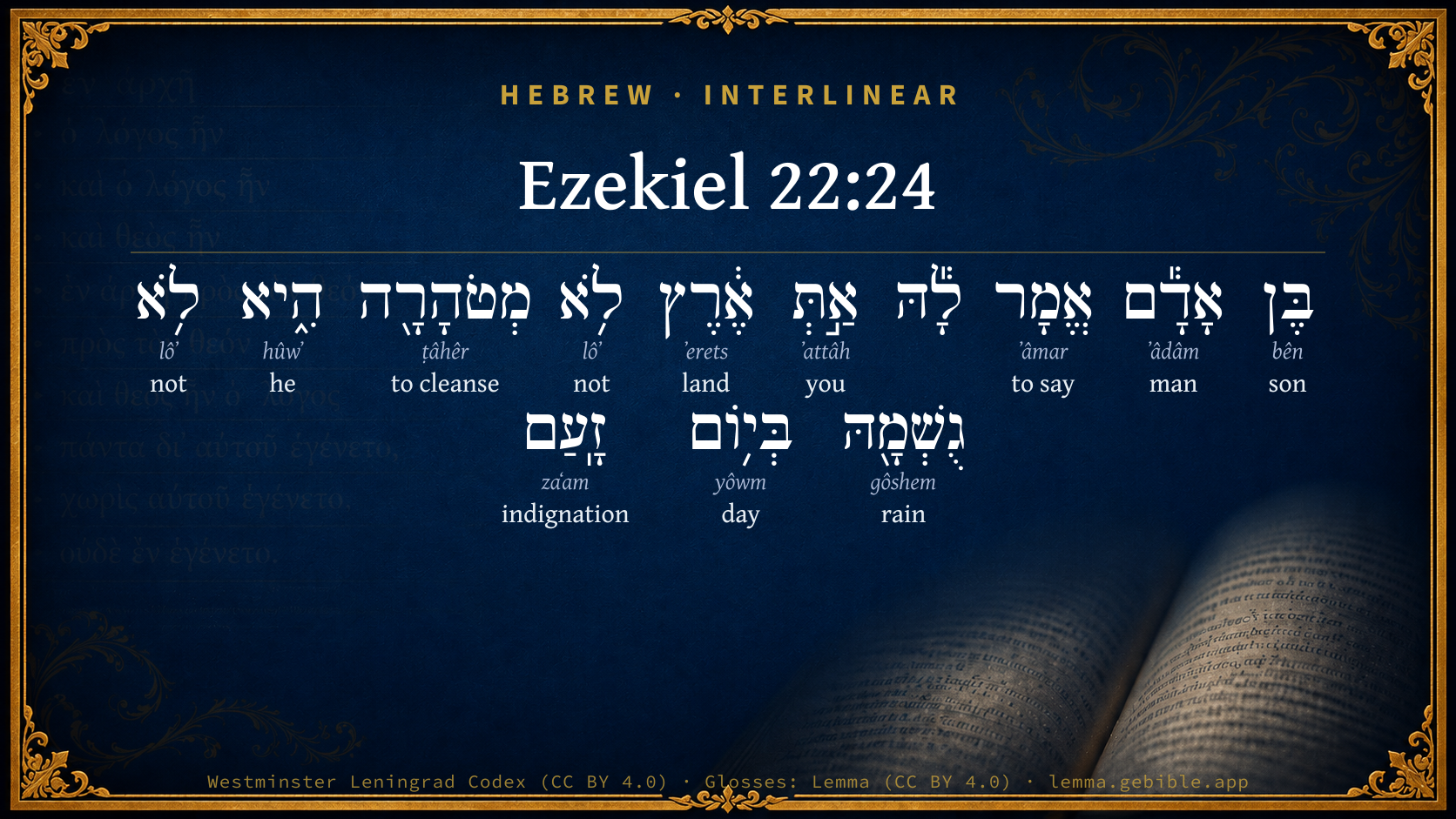
Ezekiel 22:24

Hebrew (Westminster Leningrad Codex) Ezekiel 22:24 appears in the Hebrew Old Testament. The text above is from the Westminster Leningrad Codex. Each word links to its Strong’s number, a concise gloss, and parsing drawn from the Open Scriptures Hebrew Bible morphology. Click any word for its full Brown-Driver-Briggs (BDB) entry.
Download image
Cite this verse

Ezekiel 22:24 (World English Bible). Public Domain. Lemma interlinear Bible study tool, https://lemma.gebible.app/v/ezekiel/22/24.

Show BibTeX & RIS
BibTeX
RIS
English Translation
Son of man, tell her, You are a land that is not cleansed, nor rained on in the day of indignation.
World English Bible · Public Domain
Highlights
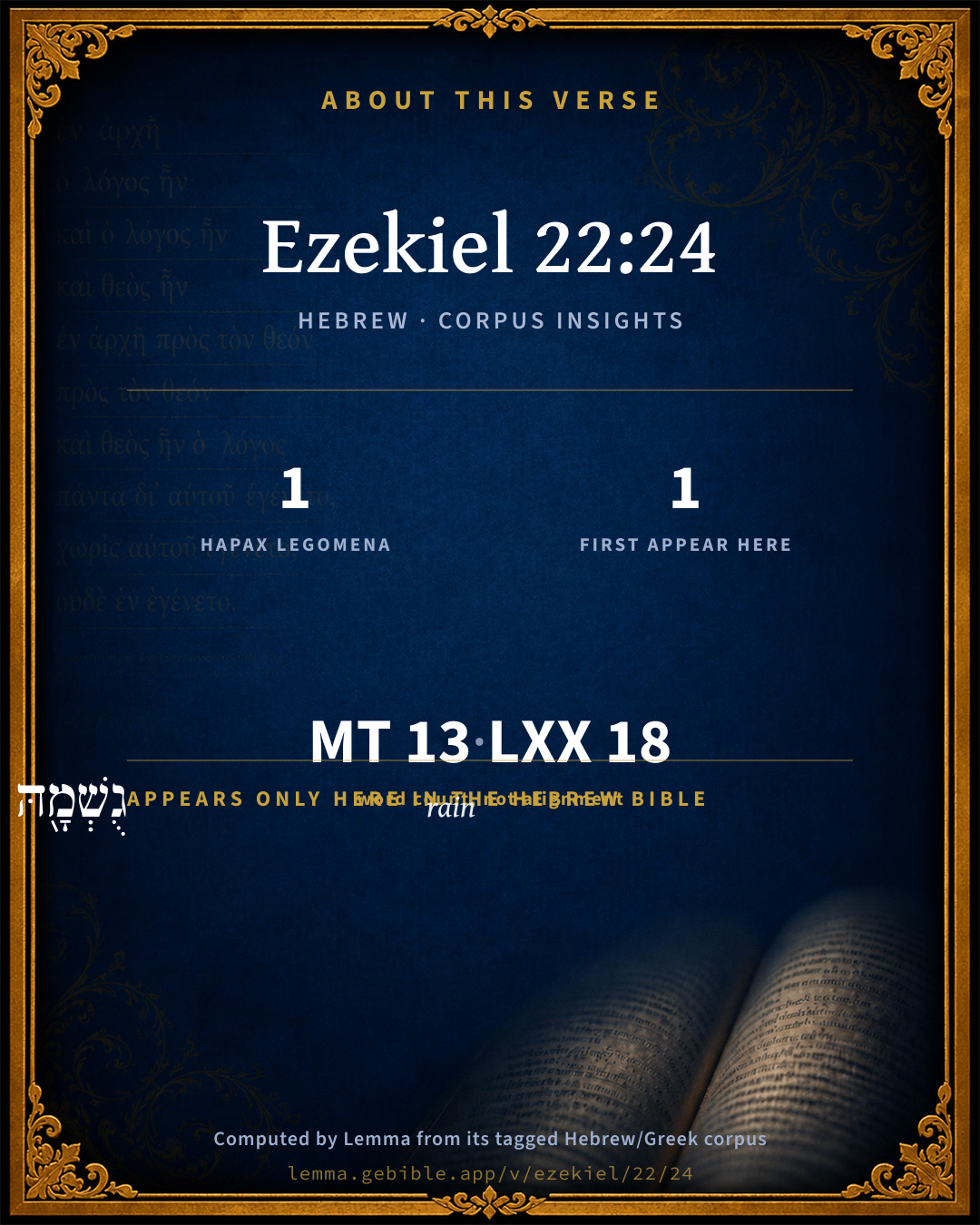
  • 1 hapax legomenon — only here in the Hebrew Bible
  • 1 first appearance in the Hebrew Bible
Full analysis ↓
Download a study sheet

One document with this verse’s original text, its word-by-word gloss line, the meaning frame, cross-references with their text, attributed commentary, and full source and license credits — printable, and it pastes into notes with its structure intact.

This verse Autodidact and up

Study sheet (.html) Plain text (.txt)

A passage Seminary Student

Up to 50 verses in one chapter. A passage sheet keeps up to 6 commentary sources and 12 cross-references per verse, in the order this page ranks them, and says so on the sheet whenever that leaves anything out. Ask for a single verse and you get the Autodidact verse sheet above.

Everything on this page stays free to read, with no account — the sheet is a download of what is already on screen, not access to it.

Want to remove ads? Support Godless Engineer
Compare translations 3

The same verse in 3 English versions, stacked beneath the original-language interlinear above. Click any original word for its lexicon entry.

Each is an independent rendering of the whole verse — the interlinear is not word-aligned to these translations.

Highlighted words mark where these versions differ — a whole-verse word diff, not a word-by-word alignment.

  • World English Bible Public Domain
    Son of man, tell her, You are a land that is not cleansed, nor rained on in the day of indignation.
  • King James Version Public Domain
    Son of man, say unto her, Thou art the land that is not cleansed, nor rained upon in the day of indignation.
  • unfoldingWord Literal Text CC BY-SA 4.0
    “Son of man, say to her, ‘You are a land that has not been cleansed. There is no rain on the day of wrath!

unfoldingWord Literal Text — © unfoldingWord, licensed CC BY-SA 4.0. Word-aligned USFM3 via Door43 (git.door43.org/unfoldingWord/en_ult).

Versions to compare (up to 4)

3 of 4 selected

Show all 18 translations

Every available English version of this verse, each an independent rendering of the whole verse.

  • World English Bible Public Domain
    Son of man, tell her, You are a land that is not cleansed, nor rained on in the day of indignation.
  • Berean Standard Bible Public Domain
    “Son of man, say to her, ‘In the day of indignation, you are a land that has not been cleansed, upon which no rain has fallen.’
  • Majority Standard Bible Public Domain
    “Son of man, say to her, ‘In the day of indignation, you are a land that has not been cleansed, upon which no rain has fallen.’
  • King James Version Public Domain
    Son of man, say unto her, Thou art the land that is not cleansed, nor rained upon in the day of indignation.
  • American Standard Version (1901) Public Domain
    Son of man, say unto her, Thou art a land that is not cleansed, nor rained upon in the day of indignation.
  • Revised Version (1885) Public Domain
    Son of man, say unto her, thou art a land that is not cleansed, nor rained upon in the day of indignation.
  • Geneva Bible (1599) Public Domain
    Sonne of man, say vnto her; Thou art the land, that is vncleane, and not rained vpon in the day of wrath.
  • Douay-Rheims (1899) Public Domain
    Son of man, say to her: Thou art a land that is unclean, and not rained upon in the day of wrath.
  • Young's Literal Translation Public Domain
    `Son of man, say to it, Thou `art' a land, It `is' not cleansed nor rained on in a day of indignation.
  • Literal Standard Version CC BY-SA 4.0
    “Son of man, say to it, You [are] a land, || It [is] not cleansed nor rained on in a day of indignation.
  • Unlocked Literal Bible CC BY-SA 4.0
    “Son of man, say to her, 'You are a land that has not been cleansed. There is no rain on the day of wrath!
  • unfoldingWord Literal Text CC BY-SA 4.0
    “Son of man, say to her, ‘You are a land that has not been cleansed. There is no rain on the day of wrath!
  • Darby Bible Public Domain
    Son of man, say unto her, Thou art a land that is not cleansed, nor rained upon in the day of indignation.
  • World Messianic Bible Public Domain
    “Son of man, tell her, ‘You are a land that is not cleansed nor rained on in the day of indignation.’
  • Webster's Bible Public Domain
    Son of man, say to her, Thou art the land that is not cleansed, nor rained upon in the day of indignation.
  • Free Bible Version CC BY-SA 4.0
    “Son of man, tell the city of Jerusalem, at the time of punishment, you are a country that has not been made clean, a place where no rain has fallen,
  • Bible in Basic English Public Domain
    Son of man, say to her, You are a land on which no rain or thunderstorm has come in the day of wrath.
  • JPS Tanakh (1917) Public Domain
    'Son of man, say unto her: Thou art a land that is not cleansed, nor rained upon in the day of indignation.

Literal Standard Version (2020), Covenant Press — licensed CC BY-SA 4.0. Text via the HelloAO Bible API (eBible.org). Unlocked Literal Bible (unfoldingWord) — licensed CC BY-SA 4.0. Text via the HelloAO Bible API (eBible.org). unfoldingWord Literal Text — © unfoldingWord, licensed CC BY-SA 4.0. Word-aligned USFM3 via Door43 (git.door43.org/unfoldingWord/en_ult). Free Bible Version, Dr. Jonathan Gallagher — licensed CC BY-SA 4.0. Text via the HelloAO Bible API (eBible.org).

Word by word

More ways to search: Search by grammar → Find every occurrence → Compare this word →

Practice this passage: Drill this verse → Learn its vocabulary →

גֻשְׁמָ֖הּ
gôshem
H1656
“rain · her”
Noun, Common, Masculine, Singular, Construct + Suffix, Personal, 3rd Person, Feminine, Singular
Part of Speech
Noun
Type
Common
Gender
Masculine
Number
Singular
State
Construct
Full BDB Definition

Origin: from H1652

TWOT: 389

(Pual) to be rained upon (verb) - rain (noun masculine)
  1. בֶּן bên H1121 “son of” Noun, Common, Masculine, Singular, Construct
  2. אָדָ֕ם ʼâdâm H120 “man” Noun, Common, Masculine, Singular, Absolute
  3. אֱמָר ʼâmar H559 “say” Verb, Qal, Imperative, 2nd Person, Masculine, Singular
  4. אַ֣תְּ ʼattâh H859 “you” Pronoun, Personal, 2nd Person, Feminine, Singular
  5. אֶ֔רֶץ ʼerets H776 “land” Noun, Common, Both, Singular, Absolute
  6. לֹ֥א lôʼ H3808 “not” Particle, Negative
  7. מְטֹהָרָ֖ה ṭâhêr H2891 “cleansed” Verb, Pual, Participle Passive, Feminine, Singular, Absolute
  8. הִ֑יא hûwʼ H1931 “he” Pronoun, Personal, 3rd Person, Feminine, Singular
  9. לֹ֥א lôʼ H3808 “not” Particle, Negative
  10. בְּי֥וֹם yôwm H3117 “in/at · day of” Preposition + Noun, Common, Masculine, Singular, Construct
  11. זָֽעַם zaʻam H2195 “indignation” Noun, Common, Masculine, Singular, Absolute

About this verse

These counts appear in no published source. They are computed here, from the morphology-tagged text and Lemma’s own curated glosses. What Lemma adds →

13
words
11
distinct lemmas
Prophets
section

Notable vocabulary

1 hapax legomenon — a word that appears only here in the entire Hebrew Bible:

  • גֻשְׁמָ֖הּ rain H1656

First appearance in Scripture

This word makes its first canonical appearance in the Hebrew Bible here:

  • גֻשְׁמָ֖הּ rain H1656

Shared distinctive vocabulary

זָֽעַם indignation H2195 occurs in 22 verses of the Hebrew Bible. Also found in:

Grammatical profile

  • 2 verbs
  • 6 nouns
  • 2 pronouns
  • 1 preposition
  • 2 particles

Verb forms

  • אֱמָר Qal · Imperative
  • מְטֹהָרָ֖ה Pual · Participle Passive

Repetition

A word recurs within this verse — often emphatic in Hebrew:

Hebrew & Septuagint length

In English translation the verse runs 21 words from the Hebrew and 26 from the Septuagint (LXX English) — closely comparable.

A rough comparison of the two English renderings, which tokenize alike — not a word-level alignment.

Word counts can differ between the Hebrew and the Greek without any difference in meaning — e.g. the Hebrew direct-object marker אֵת has no separate Greek word, and Greek often adds the article ὁ.

In the original languages it is 13 Hebrew tokens and 18 Greek tokens — but the two are counted differently (Hebrew bundles its prefixes and suffixes into one token; the Greek is in lemma form), so that isn’t a like-for-like length.

Cross-references

10

Topical passages linked to Ezekiel 22:24 in the Treasury of Scripture Knowledge — connected by theme and wording, ordered by reader-vote popularity; previews shown in the World English Bible.

  • 2 Chronicles 28:22 In the time of his distress did he trespass yet more against Yahweh, this same king Ahaz.
  • 2 Chronicles 36:14–16 Moreover all the chiefs of the priests, and the people, trespassed very greatly after all the abominations of the nations; and they polluted the house of Yahweh which he had made holy in Jerusalem.
  • Isaiah 1:5 Why should you be beaten more, That you revolt more and more? The whole head is sick, And the whole heart faint.
  • Isaiah 9:13 Yet the people have not turned to him who struck them, neither have they sought Yahweh of Hosts.
  • Jeremiah 2:30 In vain have I struck your children; they received no correction: your own sword has devoured your prophets, like a destroying lion.
  • Jeremiah 5:3 O Yahweh, don't your eyes look on truth? you have stricken them, but they were not grieved; you have consumed them, but they have refused to receive correction: they have made their faces harder than a rock; they have refused to return.
  • Jeremiah 6:29 The bellows blow fiercely; the lead is consumed of the fire: in vain do they go on refining; for the wicked are not plucked away.
  • Jeremiah 44:16–19 As for the word that you have spoken to us in the name of Yahweh, we will not listen to you.
  • Ezekiel 24:13 In your filthiness is lewdness: because I have cleansed you and you weren't cleansed, you shall not be cleansed from your filthiness any more, until I have caused my wrath toward you to rest.
  • Zephaniah 3:2 She didn't obey the voice. She didn't receive correction. She didn't trust in Yahweh. She didn't draw near to her God.

Cross-references courtesy of OpenBible.info (CC BY 4.0).

Hebrew and Greek witnesses Masoretic Hebrew ↔ Greek Septuagint

The same verse in the two great witnesses to the Old Testament, shown verse-for-verse.

These are two independent witnesses, not word-aligned to each other, and the Septuagint is shown in lemma (dictionary) form.

Hebrew Ezekiel 22:24 Masoretic · Westminster Leningrad Codex

בֶּן אָדָ֕ם אֱמָר לָ֕הּ אַ֣תְּ אֶ֔רֶץ לֹ֥א מְטֹהָרָ֖ה הִ֑יא לֹ֥א גֻשְׁמָ֖הּ בְּי֥וֹם זָֽעַם

Son of man, tell her, You are a land that is not cleansed, nor rained on in the day of indignation.

World English Bible · Public Domain

Greek LXX Ezekiel 22:24 Septuagint · lemma form

υἱός ἄνθρωπος εἶπον αὐτός σύ εἰμί γῆ ὁ οὐ βρέχω οὐδέ ὑετός γίγνομαι ἐπί σύ ἐν ἡμέρα ὀργή

Son of man, say to her, You are the land that is not rained upon, neither has rain come upon you in the day of wrath;

LXX2012 (modern English Septuagint) · Public Domain

On this verse, The Cambridge Bible for Schools and Colleges discusses the Septuagint’s reading. Read the note in Commentary ↓

Hebrew: Westminster Leningrad Codex (CC BY 4.0). Greek: Septuagint (public domain); English from LXX2012 (modern English Septuagint) (Public Domain). How the Septuagint differs from the Hebrew →

Targum (Aramaic paraphrase)

1

The Targum is the ancient Jewish Aramaic paraphrase of the Hebrew Scriptures — an interpretive translation, not the Hebrew text itself. Onkelos (literal) and Pseudo-Jonathan (expansive) render the Torah, and Jonathan the Prophets. Coverage is partial: where no permissively-licensed English translation exists for a verse, only the Aramaic is shown. This is verse-level text, not a word-by-word alignment to the Hebrew.

  1. Targum Jonathan Prophets (Joshua–Malachi)
    בַּר אָדָם אֲמַר לָהּ אַתְּ אַרְעָא דְיִשְׂרָאֵל אַרְעָא לָא מִדַכְיָא הִיא וְלָא אִתְעֲבִידוּ בָּהּ עוֹבָדִין טָבִין דְיִגְנוּן עֲלָהּ בְּיוֹם לְוָט:

    (no public-domain English translation for this verse)

    Targum Jonathan — Aramaic: “Mikraot Gedolot” (public domain). English: “Sefaria Community Translation” (CC0 1.0 (public-domain dedication)); “London "Chaldee Paraphrase," 1871” (public domain). Text via Sefaria.

Commentary

Notes on Ezekiel 22:24 from classic Christian and Jewish commentators (each source and its license shown beneath its notes). The classic Christian expositions comment on the surrounding passage and are grouped to its opening verse, so a note may address several verses; the Jewish commentaries on the Tanakh (Rashi and others) are per-verse, so they appear only where the commentator wrote on this verse.

Lemma curates 59 commentaries, every one of them public domain or Creative Commons licensed, each selected and text-cleaned for this edition rather than reprinted as found. About our sources →

Trapp's Complete Commentary

John Trapp

Eze 22:24 Son of man, say unto her, Thou [art] the land that is not cleansed, nor rained upon in the day of indignation.

Ver. 24. Thou art the land that is not cleansed.] From thy filthiness, and the fire of my judgments.

Nor rained upon.] Non compluta; no mercy shown thee, no good done upon thee by all.

John Trapp, A Commentary or Exposition upon All the Books of the Old and New Testament (1647–1656) — public domain. Text from a community e-Sword module.

The Biblical Illustrator

Joseph S. Exell

Eze_22:24

Thou art the land that is not cleansed, nor rained upon in the day of indignation.

Practical uses of the state of the land of Judah

We propose to speak concerning the special instruction which the prophet received to intimate her state. It was not communicated to him as a secret, or whispered in the ears of a few select friends. A commission is prefixed, by, which he was commanded to proclaim the state of the land in the public ear: Son of man, say unto her, Thou art the land that is not cleansed, nor rained on in the day of indignation. On several considerations this solemn formality was necessary.

1. It was necessary on account of the stiffness and haughtiness of the people. In the temper of every backsliding church pride is a reigning corruption; but among the peculiar people, it appears at that time to have risen to the highest elevation of vanity and guilt. Blown up by lying divinations, and full of extravagant notions of their own importance, they persuaded themselves that peculiar privileges could not be forfeited, nor an everlasting possession alienated and transferred. But the Lord, having declared by the mouth of Jeremiah that He would mar the pride of Judah, and the great pride of Jerusalem, sent fresh instructions unto Ezekiel in Babylon to carry on the approaches, and to invest and storm the stronghold of the national pride.

2. This solemn formality was necessary on account of the depravation of national manners, and the inefficacy of means which had been used to retrieve national honour. Kings, princes, and judges, priests, prophets, and people, despised exhortation and warning, and humbled not themselves under correction and chastisement. In this state of depravation and impurity the day of indignation found the land, and its filthiness increasing, and hardening under the heart, Ezekiel, a little after the delivery of the message sent him in the text, added Eze_24:12-14.

3. This solemn formality was necessary to justify the violent measures that were to be adopted for removing the barrenness and filth of the land. Milder expedients to correct the depravity and recover the glory of the nation being used without effect, violent measures became necessary, and were actually pursued. Lam_2:6. Under church and state the spirit of judgment and the spirit of burning kindled and devoured together the thorns and the briars in both. These measures of justice and violence were communicated to Ezekiel, in a message which stands recorded before the text (Eze_22:18-22).

4. The solemn formality of a special message concerning the state of the land in the day of indignation was necessary, to contrast the singularity of her mercies with the singularity of her sins. Terms and expressions very uncommon are used concerning their sufferings. Proverb, by-word, derision, scorn, reproach, taunt, hissing, laugh stock, astonishment, curse are bitter expressions which frequently occur, and have a dreadful reality in their history. Now, from the justice and equity of the Lord their God we may infer that people, whom in His wrath He made a derision to the world, had made themselves a scandal and abhorrence to the world by their crimes.

5. This solemn formality was necessary to stop the mouths of that murmuring and gainsaying people, and to cut off occasion of complaining as if they had been surprised or taken unawares. The corrupt and filthy state of the land, which was become a nuisance to the world, had been set forth in the plainest language, and as it resisted ordinary means of cleansing, an example was necessary for the honour of the God of the land, the God of the whole earth; but before He made the example, this instruction is sent to Ezekiel, Son of man, say unto her, Thou art the land that is not cleansed, etc.

Application--

1. After hearing the state of the land of Judah described, are ye highly elevated? Believers, the glory of the Most High over all the earth, breaking forth in the execution of judgment upon the land of Judah in the day of His indignation, is the glory of our God. In His glory our God is a consuming fire; and in His glory our God is love!

2. After reading and hearing the state of the land of Judah in the day of indignation, are ye deeply humbled? Next to Gethsemane and Golgotha, where sin and wrath met upon the Son of God, stand the city of Jerusalem and the land of Judah, where iniquity set its throne, and wrath poured itself into the cup of fury full of mixture. About this humbling monument we will walk, and view it on every side, looking upon Him whom we have pierced, and whom God hath made to be sin or us, that we might be made the righteousness of God in Him.

3. After reading and hearing the state of the land of Judah in the day of indignation, are ye rejoicing in hope? With Israelites, Gentiles are now fellow heirs, and of the same body, partakers of the promises of God in Christ by the Gospel, and drink the waters of the river whose streams made Jerusalem a rejoicing and her people a joy. The river of consolation flowing out of the promises of Messiah, the heat of indignation could not dry up. Flowing through the blood and fire and ashes of Jerusalem, it deepened and widened, and filled its course, till at last it run over the mountains of Jerusalem, spread itself into the valleys of the Gentiles, and in deserts and wildernesses poured into families and churches the water of life.

4. After reading and hearing the state of the land of Judah in the day of indignation, are we trembling with fear? To infidels and atheists, to sinners in Zion and hypocrites in heart, wrath is an object of fearful and certain apprehension. Against all ungodliness and unrighteousness of men who hold the truth in unrighteousness, it is revealed, and unless they hide themselves in the Saviour, even Jesus who delivered us from the wrath to come, it will fall, either in this or the other world, or in both, in a destroying storm.

5. After reading and hearing the state of the land of Judah in the day of indignation, are ye established in the faith of the providence of God? By the judgment which He executeth the Lord is known, and known not only to live but to reign.

6. After reading and hearing the state of the land of Judah in the day of indignation, are we prepared unto every good work? Exhortations to good works were disregarded by that gainsaying and perverse race of evil-doers. Show yourselves to be men of spirit and business, men full of faith and of good works. If a day of indignation be coming, where should we be found? Under the righteousness of Christ, and at our business. Do ye look for it? what manner of persons ought ye to be in holy conversation and godliness? (A. Shanks.)

Applications from the state of the land of Judah to the present times

Water is a natural mirror, and when men look into it face answereth to face. Scripture is a spiritual mirror, and when we look into it, church answereth to church, and one generation of evil-doers to another.

1. Errors and heresies of the most pernicious quality are appearing amongst us, and perverting and corrupting multitudes from the simplicity that is in Christ. Fools who adore no Creator, believe no providence, and fear no Judge, walk on every side; and against God, in whom they live and move and have their being, utter many blasphemous words. By some who profess to know God, the revelation of His will in the holy Scriptures is rejected; and by others who acknowledge the inspiration of these holy writings, truths revealed in them are denied and misrepresented.

2. Truth, where it is believed and preached, appears to have purifying influence on very few. Where converting and healing doctrine is preached, few appear to be converted and healed; and Holy Scripture itself, which shows unto men the way of salvation, is either neglected by the greatest part who acknowledge its inspiration, or read without faith and love and profit to their souls.

3. Under the dispensations of providence, our principles and manners are not amended. In smiling and frowning dispensations the voice of the Lord is disregarded, and our conduct is becoming worse and worse every day. The goodness of Providence, the calling of the elect out of the world, and the charter of the Son of God to the uttermost parts of the earth, are not evidences that the Lord will not enter into judgment with us for our iniquities, and the iniquities of our fathers together. Britain, like Judah, may be wiped as a man wipeth a dish, wiping it, and turning it upside down. His jealousy for His glory is not extinguished. His indignation against sin is not cooled. The threatenings in His Word are not blotted out, nor is His power to execute these abated. When He shall ride out for bringing forth judgment unto truth, if degenerated churches and sinful kingdoms will not give way by repentance and reformation, they must be crushed under the wheels of His chariot. (A. Shanks.)

Like priests, like people

Manton says: O ye ministers of the Word, consider well that you are the first sheets from the Kings press; others are printed after your copy. If the first sheet be well set, a thousand more are stamped with ease. See, then, that the power of religion prevail over your own hearts, lest you not only lose your own souls, but cause the ruin of others. Correcting for the press is work which has to be done with great care, since thousands of copies will be faulty if the proof sheet be not as it should be. So should the minister of a congregation be seriously earnest to be right, because his people will imitate him. Like priest, like people; the sheep will follow the shepherd. What need there is that the pastor should order his steps aright, lest he lead a whole flock astray! If the town clock be wrong, half the watches in the place will be out of time. (C. H. Spurgeon.)

Degeneration of the priests

Someone asked Boniface the martyr whether it was lawful to give sacramental wine in a wooden cup. Time was, said he, when there were wooden chalices and golden priests; but now there are golden chalice: and wooden priests.

No distinction made

Joseph Cook tells that when he was in Halle, Professor Tholuck said to him, with the emphasis of tears in his deep, spiritual eyes, that he regretted nothing so much in the arrangements of the German State churches as that the distinction between the converted and unconverted, which Jonathan Edwards and Whitfield drew so deeply on the mind of New England, was almost unknown to the Church practice of Germany. We are all mixed pell-mell, said he; there is no distinct on made between one who has made a solemn public profession to lead a religious life and one who has not. (H. O. Mackay.)

Dishonest gain

Most men are sickened of the gaming table by their losses. He (Wilberforce) left it because on one particular night he won £600. The thought that men of straitened means or portionless younger sons might be crippled by his gains preyed upon his sensitive spirit, and he resolved to play no more, that he might be free from the blood-guiltiness of adding to the list of victims whom gambling had hurled from wealth to beggary, and from happiness to suicide. (W. M. Punshon, D. D.)

.

The Biblical Illustrator, edited by Joseph S. Exell (c. 1880s–1900s) — public domain. Text from a community e-Sword module.

Joseph Benson's Commentary

Eze 22:24-25. Thou art the land that is not cleansed nor rained upon, &c. — Though God’s judgments have been as violent floods, and as hottest fires, thou hast not been cleansed from thy wickedness by the punishments I have sent upon thee, nor purified by the instructions and admonitions which I have given thee by my prophets; which, if they had been duly received, would have been instrumental in cleansing thee from all thy filthiness, as the heavy rains wash away the filth that lies upon the earth: see Isa 4:4; Joh 15:3; Eph 5:26; 1Pe 1:22. Or this latter clause, nor rained upon, may be taken literally, and signify that God had withheld rain from them, which was one of the judgments wherewith God punished them in the day of his wrath, Jer 14:4. There is a conspiracy of her prophets — That is, of the false prophets: a contrivance to speak all alike, smooth words, and to utter promises of peace and safety: they are all agreed together to deceive the people, and to plot the ruin of the true prophets, and those that favour them. They have devoured souls — They have brought men to ruin and destruction, by deceiving them with their false predictions; and taken away their lives, by false accusations and evil practices. They have taken the treasure and precious things — As a reward of their lies. By their cunning arts they have obtained riches, power, and honours, and have drained the people of their substance; they have made her — Namely, the land; many widows — By persuading Zedekiah to persist in the war, which filled Jerusalem with dead husbands and forlorn widows.

Joseph Benson's Commentary on the Old and New Testaments (1811–1818) — public domain. Text from a community e-Sword module.

Geneva Bible (1599)

Geneva Bible translators

Thou art like a barren land which the Lord plagueth with drought.

Geneva Bible (1599) marginal notes — public domain. Text via Bolls.life.

Jamieson, Fausset & Brown

Robert Jamieson, A. R. Fausset & David Brown

land . . . not cleansed--not cleared or cultivated; all a scene of desolation; a fit emblem of the moral wilderness state of the people.

nor rained upon--a mark of divine "indignation"; as the early and latter rain, on which the productiveness of the land depended, was one of the great covenant blessings. Joel (Joe 2:23) promises the return of the former and latter rain, with the restoration of God's favor.

Jamieson, Fausset & Brown — Commentary Critical and Explanatory on the Whole Bible (1871) — public domain (CC PDM 1.0). Text via the HelloAO Bible API.

Adam Clarke's Commentary

Verse 24. Thou art the land that is not cleansed] Thou art like a country where there is no rain, either to cleanse the garments, or fertilize the ground.

Adam Clarke's Commentary on the Bible (1810–1826) — public domain. Text from a community e-Sword/MySword module.

Ellicott's Commentary for English Readers

(24) That is not cleansed.—The third and last Divine communication of this chapter begins with Eze_22:23, and contains a further enumeration of the sins of Israel, showing that they have been committed by all classes alike, and ending, like the others, with the prophecy of the outpouring of God’s wrath. There is much difference of opinion as to the meaning of the clause “that is not cleansed;” the most probable view is that it speaks of the land as neglected and uncared for—the stones not gathered up and the weeds allowed to grow. It has had neither human care, nor has it received the Divine blessing of rain.

A Bible Commentary for English Readers, edited by Charles John Ellicott (1878–1897) — public domain. Text from a community e-Sword module.

The Cambridge Bible for Schools and Colleges

gen. ed. J. J. S. Perowne

24. the land … not cleansed] A land. The words “not cleansed” are parallel to “not rained upon.” In the east, however, raining upon is not a figure for cleansing, but for removing the curse and judgment, and blessing with fertility (Jer_3:3). LXX. has “not wetted by rain” here, which most moderns accept, cf. ch. Eze_34:26; Lev_26:4; Deu_11:14; 1Ki_8:35-36.

The Cambridge Bible for Schools and Colleges (gen. ed. J. J. S. Perowne; Cambridge University Press, 1878–1918) — public domain. Text from a community e-Sword module.

John Gill's Exposition

Son of man, say unto her, thou land,.... Thou land of Israel, as the Targum:

thou art not cleansed; from filthiness, by the fire of divine judgments; or reformed from sins, by the instructions, cautions, and exhortations of the prophets; none of these things had any effect upon her to make her wiser and better. So the Targum,

"a land not cleansed it is, and good works are not done in it, to protect it in the day of cursing:''

nor rained upon in the day of indignation; no cooling shower to quench the fire of divine wrath; nothing to avert or stop the judgments of God; no refreshment and comfort from the doctrines of the prophets, which fell like rain: it is a judgment upon a people to have no rain, either in a temporal or spiritual sense; see Zac 14:17. In the Talmud (h), this text is brought to prove that the flood did not come upon the land of Israel.

(h) T. Bab. Zebachim, fol. 113. 1.

John Gill's Exposition of the Whole Bible (1746–1763) — public domain (CC PDM 1.0). Text via the HelloAO Bible API.

Haydock's Catholic Bible Commentary

Rained upon, or watered with the instructions of the prophets, chap. xx. 46.

George Leo Haydock (1774–1849), Haydock's Catholic Family Bible and Commentary, 1859 edition — public domain. Excludes Psalms (Douay-Rheims chapter numbering differs from Protestant) and Deuterocanonical books (Catholic canon only).

Matthew Poole's English Annotations

Thou; the land of Israel.

Is not cleansed, nor rained upon; though God’s judgments have been as violent storms and floods, though they have been as hottest fires, yet neither thy filth hath been carried away, nor thy dross melted out of thee by them, still thou retainest both. Therefore is

indignation kindled against thee, and thou shalt be deprived of the dews of heaven, the rain that should cool thy thirsty land shall be withholden, that rain that should make the ground fruitful shall not descend.

Matthew Poole's English Annotations on the Holy Bible (1683–1685) — public domain. Text from a community e-Sword/MySword module.

Whedon's Commentary on the Bible

Daniel D. Whedon

24. Not cleansed — LXX., not rained upon. The rains, which in the East are especially considered marks of the divine favor, have been withdrawn. There have been no floods to wash away the filth and blood from the soil, nor showers sufficient to moisten the ground and make it fertile. Instead of “not cleansed,” Keil reads, “not shined upon,” which would give the added thought that the land was deprived of both sunshine and rain.

Daniel D. Whedon (gen. ed.), Commentary on the Old and New Testaments (1874–1909) — public domain. Text from a community e-Sword module.

Rashi

Rabbi Shlomo Yitzchaki (Rashi)

it was not rained upon on the day of fury The rain fit to cleanse it on the day of fury was not given it, and the explanation of the matter is as the Targum paraphrases: Good deeds were not performed in her which would protect her on the day of curse.

Rashi on the Tanakh — English translations: “The Judaica Press complete Tanach with Rashi, translated by A. J. Rosenberg” (CC BY 4.0); “Pentateuch with Rashi's commentary by M. Rosenbaum and A.M. Silbermann, 1929-1934” (public domain); “The Metsudah Tanach series, Lakewood, N.J” (CC BY 4.0); and “The Book of Joshua, Metsudah Publications, 1997” (CC BY 4.0). Text via Sefaria.

Lesson kit

Teaching starters — assembled from the data on this page, not authored interpretation. Every prompt links to the verse data it draws on. Edit before teaching.

Ezekiel, in the Prophets, opens this verse with 13 words (11 distinct Hebrew lemmas). Its most distinctive word is gôshem (“rain”). A historical commentator’s framing appears above. Read the whole chapter for the surrounding context.

Discussion questions

  1. The word gôshem carries the sense “rain.” How does it shape the verse?
  2. 1 word here appears nowhere else in the Hebrew Bible. Why might the author reach for such rare wording?
  3. This is the first place “rain” appears in Scripture (first appears here). What does its debut here establish?
  4. How does Psalms 38:3, which shares the word «indignation», read alongside this verse?
  5. What does the repetition of “not” (2× in this one verse) do in this verse?
  6. These translations render this verse differently; the difference is in the English rendering, not the original. What questions does that raise?
  7. «אֱמָר» is a Qal Imperative verb. How does that grammatical form shape the action described?
  8. Compare how Trapp's Complete Commentary and The Biblical Illustrator read this verse. Where do they agree or differ?

Things to notice

  • 1 word in this verse appears nowhere else in the Hebrew Bible.
  • 1 word makes its first canonical appearance in Scripture here.
  • This verse counts 13 Hebrew ↔ 18 Greek words.
  • These translations choose different wording for 11 words in this verse.
  • “not” occurs 2× in this single verse.

Reading settings

Reading text

Shown beneath each verse's original-language words.

Old Testament
Old Testament edition

Read the OT as the Masoretic Hebrew (MT) or the Greek Septuagint (LXX).

English shown for the Greek Septuagint (in the Hebrew ↔ Greek comparison).

Comparing translations? Open the Compare panel on any verse page to stack up to four side by side.