Jeremiah 3:9

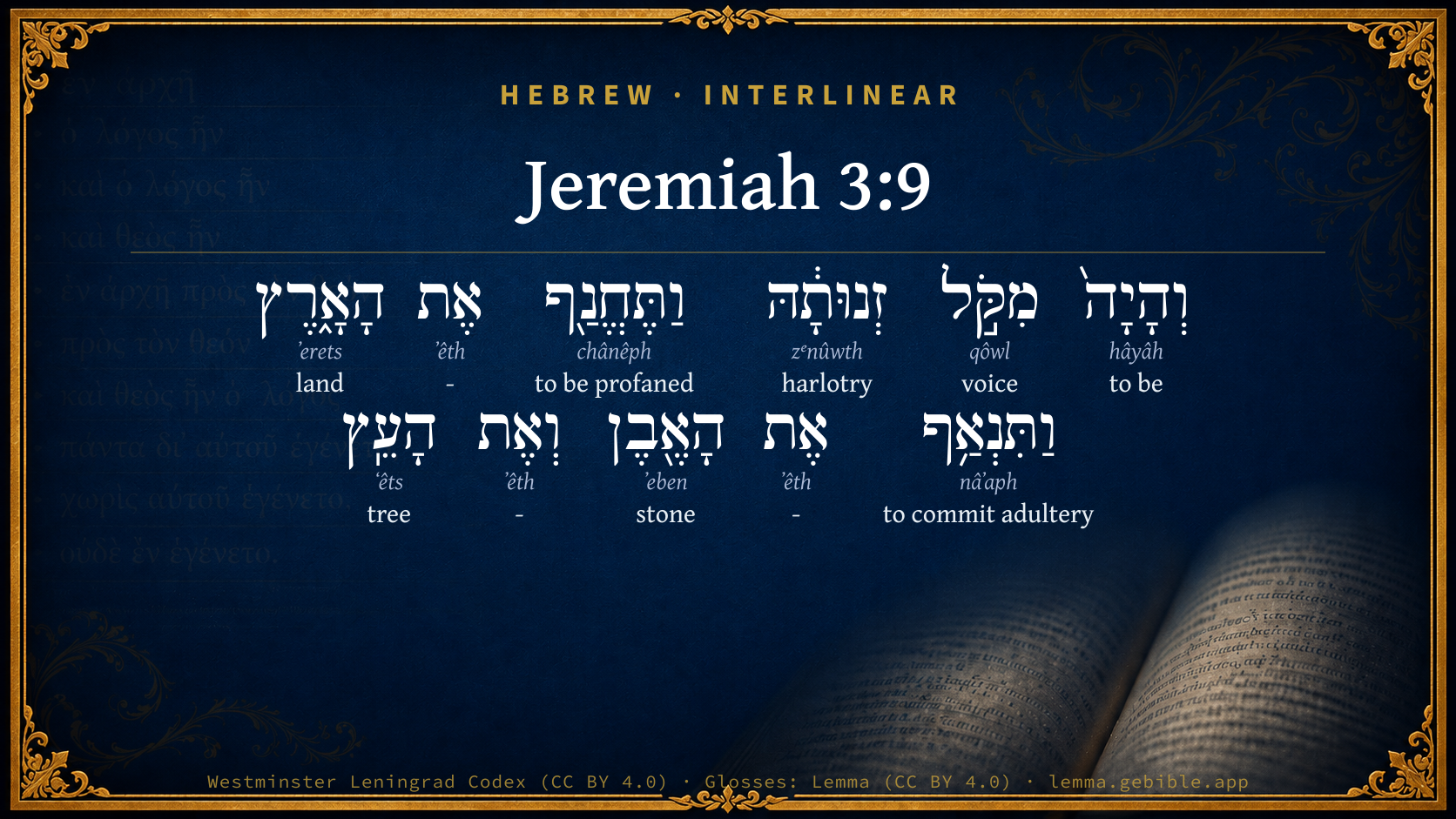
Hebrew (Westminster Leningrad Codex) Jeremiah 3:9 appears in the Hebrew Old Testament. The text above is from the Westminster Leningrad Codex. Each word links to its Strong’s number, a concise gloss, and parsing drawn from the Open Scriptures Hebrew Bible morphology. Click any word for its full Brown-Driver-Briggs (BDB) entry.
Download image
Cite this verse

Jeremiah 3:9 (World English Bible). Public Domain. Lemma interlinear Bible study tool, https://lemma.gebible.app/v/jeremiah/3/9.

Show BibTeX & RIS
BibTeX
RIS
English Translation
It happened through the lightness of her prostitution, that the land was polluted, and she committed adultery with stones and with stocks.
World English Bible · Public Domain
Download a study sheet

One document with this verse’s original text, its word-by-word gloss line, the meaning frame, cross-references with their text, attributed commentary, and full source and license credits — printable, and it pastes into notes with its structure intact.

This verse Autodidact and up

Study sheet (.html) Plain text (.txt)

A passage Seminary Student

Up to 50 verses in one chapter. A passage sheet keeps up to 6 commentary sources and 12 cross-references per verse, in the order this page ranks them, and says so on the sheet whenever that leaves anything out. Ask for a single verse and you get the Autodidact verse sheet above.

Everything on this page stays free to read, with no account — the sheet is a download of what is already on screen, not access to it.

Want to remove ads? Support Godless Engineer
Compare translations 3

The same verse in 3 English versions, stacked beneath the original-language interlinear above. Click any original word for its lexicon entry.

Each is an independent rendering of the whole verse — the interlinear is not word-aligned to these translations.

Highlighted words mark where these versions differ — a whole-verse word diff, not a word-by-word alignment.

  • World English Bible Public Domain
    It happened through the lightness of her prostitution, that the land was polluted, and she committed adultery with stones and with stocks.
  • King James Version Public Domain
    And it came to pass through the lightness of her whoredom, that she defiled the land, and committed adultery with stones and with stocks.
  • unfoldingWord Literal Text CC BY-SA 4.0
    And her prostitution was from thoughtlessness. And she defiled the land, and committed adultery the stone and the tree.

unfoldingWord Literal Text — © unfoldingWord, licensed CC BY-SA 4.0. Word-aligned USFM3 via Door43 (git.door43.org/unfoldingWord/en_ult).

Versions to compare (up to 4)

3 of 4 selected

Show all 18 translations

Every available English version of this verse, each an independent rendering of the whole verse.

  • World English Bible Public Domain
    It happened through the lightness of her prostitution, that the land was polluted, and she committed adultery with stones and with stocks.
  • Berean Standard Bible Public Domain
    Indifferent to her own infidelity, Israel had defiled the land and committed adultery with stones and trees.
  • Majority Standard Bible Public Domain
    Indifferent to her own infidelity, Israel had defiled the land and committed adultery with stones and trees.
  • King James Version Public Domain
    And it came to pass through the lightness of her whoredom, that she defiled the land, and committed adultery with stones and with stocks.
  • American Standard Version (1901) Public Domain
    And it came to pass through the lightness of her whoredom, that the land was polluted, and she committed adultery with stones and with stocks.
  • Revised Version (1885) Public Domain
    And it came to pass through the lightness of her whoredom, that the land was polluted, and she committed adultery with stones and with stocks.
  • Geneva Bible (1599) Public Domain
    So that for the lightnesse of her whoredome shee hath euen defiled the lande: for shee hath committed fornication with stones and stockes.
  • Douay-Rheims (1899) Public Domain
    And by the facility of her fornication she defiled the land, and played the harlot with stones and with stocks.
  • Young's Literal Translation Public Domain
    And it hath come to pass, from the vileness of her fornication, that the land is defiled, and she committeth fornication with stone and with wood.
  • Literal Standard Version CC BY-SA 4.0
    And it has come to pass, from the vileness of her fornication, that the land is defiled, and she commits fornication with stone and with wood.
  • Unlocked Literal Bible CC BY-SA 4.0
    Her prostitution was nothing to her; she defiled the land, and she committed adultery with stones and trees.
  • unfoldingWord Literal Text CC BY-SA 4.0
    And her prostitution was from thoughtlessness. And she defiled the land, and committed adultery the stone and the tree.
  • Darby Bible Public Domain
    And it came to pass through the lightness of her fornication that she polluted the land, and committed adultery with stones and with stocks.
  • World Messianic Bible Public Domain
    Because she took her prostitution lightly, the land was polluted, and she committed adultery with stones and with wood.
  • Webster's Bible Public Domain
    And it came to pass through the lightness of her lewdness, that she defiled the land, and committed adultery with stones and with stocks.
  • Free Bible Version CC BY-SA 4.0
    Israel didn't care about the immorality, as she made herself and the land unclean, committing adultery by worshiping stones and trees.
  • Bible in Basic English Public Domain
    So that through all her loose behaviour the land became unclean, and she was untrue, giving herself to stones and trees.
  • JPS Tanakh (1917) Public Domain
    and it came to pass through the lightness of her harlotry, that the land was polluted, and she committed adultery with stones and with stocks;

Literal Standard Version (2020), Covenant Press — licensed CC BY-SA 4.0. Text via the HelloAO Bible API (eBible.org). Unlocked Literal Bible (unfoldingWord) — licensed CC BY-SA 4.0. Text via the HelloAO Bible API (eBible.org). unfoldingWord Literal Text — © unfoldingWord, licensed CC BY-SA 4.0. Word-aligned USFM3 via Door43 (git.door43.org/unfoldingWord/en_ult). Free Bible Version, Dr. Jonathan Gallagher — licensed CC BY-SA 4.0. Text via the HelloAO Bible API (eBible.org).

Word by word

More ways to search: Search by grammar → Find every occurrence → Compare this word →

Practice this passage: Drill this verse → Learn its vocabulary →

זְנוּתָ֔הּ
zᵉnûwth
H2184
“harlotry · her”
Noun, Common, Feminine, Singular, Construct + Suffix, Personal, 3rd Person, Feminine, Singular
Part of Speech
Noun
Type
Common
Gender
Feminine
Number
Singular
State
Construct
Full BDB Definition

Origin: from H2181

TWOT: 563b

fornication, harlotry
  1. וְהָיָה֙ hâyâh H1961 “and · to be” Conjunction + Verb, Qal, Sequential Perfect, 3rd Person, Masculine, Singular
  2. מִקֹּ֣ל qôwl H6963 “from · voice of” Preposition + Noun, Common, Masculine, Singular, Construct
  3. וַתֶּחֱנַ֖ף chânêph H2610 “and · to be profaned” Conjunction + Verb, Qal, Sequential Imperfect, 3rd Person, Feminine, Singular
  4. אֶת ʼêth H853 “-” Particle, Direct Object
  5. הָאָ֑רֶץ ʼerets H776 “the · land” Particle, Definite Article + Noun, Common, Both, Singular, Absolute
  6. וַתִּנְאַ֥ף nâʼaph H5003 “and · to commit adultery” Conjunction + Verb, Qal, Sequential Imperfect, 3rd Person, Feminine, Singular
  7. אֶת ʼêth H853 “-” Particle, Direct Object
  8. הָאֶ֖בֶן ʼeben H68 “the · stone” Particle, Definite Article + Noun, Common, Feminine, Singular, Absolute
  9. וְאֶת ʼêth H853 “and · -” Conjunction + Particle, Direct Object
  10. הָעֵֽץ ʻêts H6086 “the · tree” Particle, Definite Article + Noun, Common, Masculine, Singular, Absolute

About this verse

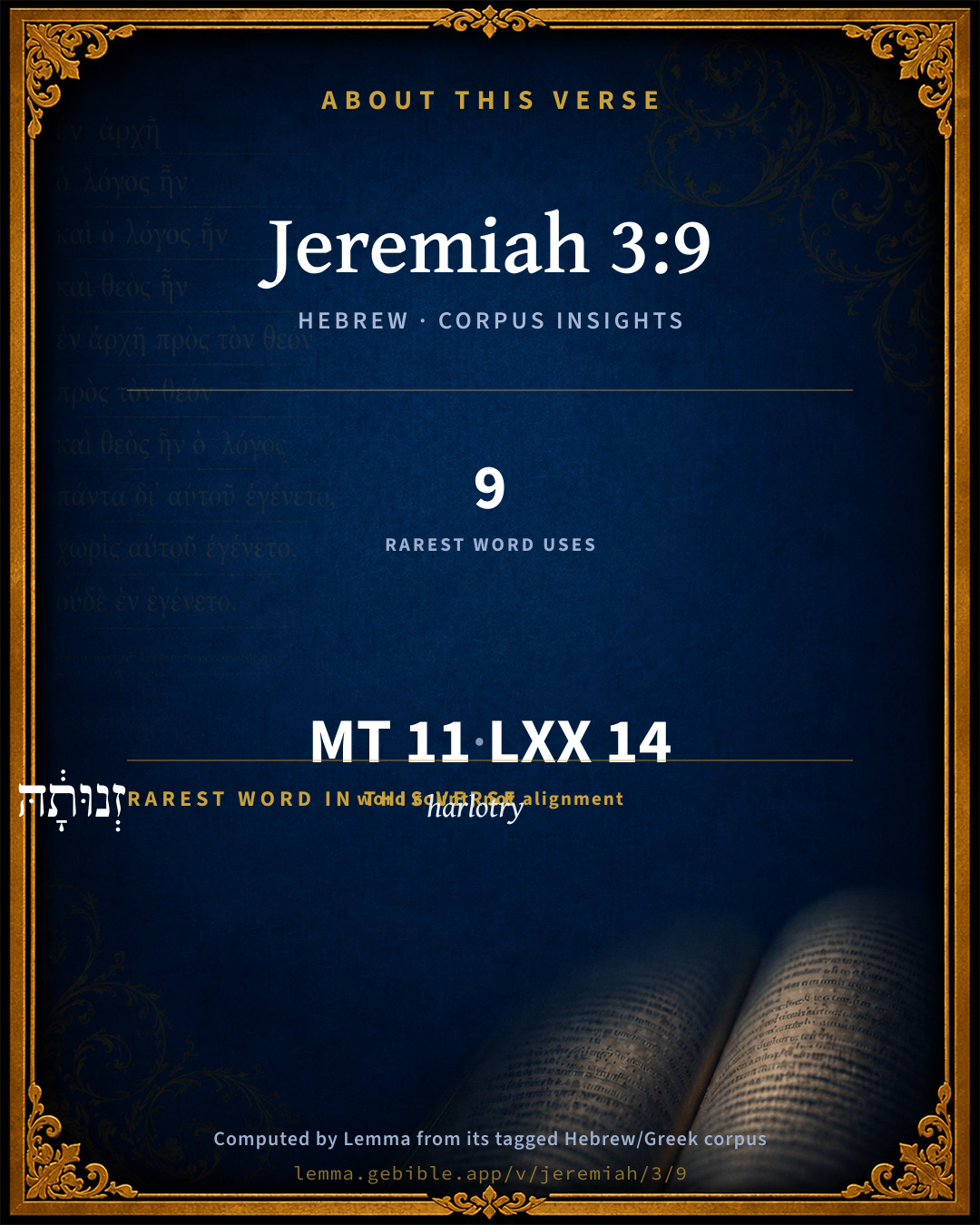
These counts appear in no published source. They are computed here, from the morphology-tagged text and Lemma’s own curated glosses. What Lemma adds →

11
words
9
distinct lemmas
Prophets
section

Notable vocabulary

The rarest word here is זְנוּתָ֔הּ harlotry H2184 — appearing just 9 times in the whole Hebrew Bible.

Shared distinctive vocabulary

זְנוּתָ֔הּ harlotry H2184 occurs in 9 verses of the Hebrew Bible. Also found in:

Grammatical profile

  • 3 verbs
  • 5 nouns
  • 3 particles

Verb forms

  • וְהָיָה֙ Qal · Sequential Perfect
  • וַתֶּחֱנַ֖ף Qal · Sequential Imperfect
  • וַתִּנְאַ֥ף Qal · Sequential Imperfect

Hebrew & Septuagint length

In the original languages it is 11 Hebrew tokens and 14 Greek tokens — but the two are counted differently (Hebrew bundles its prefixes and suffixes into one token; the Greek is in lemma form), so that isn’t a like-for-like length.

Cross-references

9

Topical passages linked to Jeremiah 3:9 in the Treasury of Scripture Knowledge — connected by theme and wording, ordered by reader-vote popularity; previews shown in the World English Bible.

  • Jeremiah 2:27 who tell a stock, You are my father; and to a stone, You have brought me forth: for they have turned their back to me, and not their face; but in the time of their trouble they will say, Arise, and save us.
  • Isaiah 57:6 Among the smooth [stones] of the valley is your portion; they, they are your lot; even to them have you poured a drink-offering, you have offered an offering. Shall I be appeased for these things?
  • Jeremiah 3:2 Lift up your eyes to the bare heights, and see; where have you not been lain with? By the ways have you sat for them, as an Arabian in the wilderness; and you have polluted the land with your prostitution and with your wickedness.
  • Jeremiah 2:7 I brought you into a plentiful land, to eat the fruit of it and the goodness of it; but when you entered, you defiled my land, and made my heritage an abomination.
  • Jeremiah 10:8 But they are together brutish and foolish: the instruction of idols! it is but a stock.
  • Habakkuk 2:19 Woe to him who says to the wood, 'Awake!' or to the mute stone, 'Arise!' Shall this teach? Behold, it is overlaid with gold and silver, and there is no breath at all in the midst of it.
  • Ezekiel 16:17 You also took your beautiful jewels of my gold and of my silver, which I had given you, and made for yourself images of men, and played the prostitute with them;
  • Ezekiel 23:10 These uncovered her nakedness; they took her sons and her daughters; and her they killed with the sword: and she became a byword among women; for they executed judgments on her.
  • Hosea 4:12 My people consult with their wooded idol, And answer to a stick of wood. Indeed the spirit of prostitution has led them astray, And they have been unfaithful to their God.

Cross-references courtesy of OpenBible.info (CC BY 4.0).

Hebrew and Greek witnesses Masoretic Hebrew ↔ Greek Septuagint

The same verse in the two great witnesses to the Old Testament, shown verse-for-verse.

These are two independent witnesses, not word-aligned to each other, and the Septuagint is shown in lemma (dictionary) form.

Hebrew Jeremiah 3:9 Masoretic · Westminster Leningrad Codex

וְהָיָה֙ מִקֹּ֣ל זְנוּתָ֔הּ וַתֶּחֱנַ֖ף אֶת הָאָ֑רֶץ וַתִּנְאַ֥ף אֶת הָאֶ֖בֶן וְאֶת הָעֵֽץ

It happened through the lightness of her prostitution, that the land was polluted, and she committed adultery with stones and with stocks.

World English Bible · Public Domain

Greek LXX Structure differs

In the Septuagint, Jeremiah is about an eighth shorter than the Hebrew and arranges its material differently — the Oracles Against the Nations (Hebrew chapters 46–51) appear in the middle of the Greek book, after 25:13. Because the chapter and verse boundaries do not line up, a verse-for-verse comparison with the Hebrew is not shown.

A verse-for-verse comparison isn’t shown here because the chapters and verses don’t line up. Switch to the LXX edition with the MT / LXX toggle above to read the Greek directly.

On this verse, John Gill's Exposition discusses the Septuagint’s reading. Read the note in Commentary ↓

Hebrew: Westminster Leningrad Codex (CC BY 4.0). Greek: Septuagint (public domain); English from a public-domain English Septuagint. How the Septuagint differs from the Hebrew →

Targum (Aramaic paraphrase)

1

The Targum is the ancient Jewish Aramaic paraphrase of the Hebrew Scriptures — an interpretive translation, not the Hebrew text itself. Onkelos (literal) and Pseudo-Jonathan (expansive) render the Torah, and Jonathan the Prophets. Coverage is partial: where no permissively-licensed English translation exists for a verse, only the Aramaic is shown. This is verse-level text, not a word-by-word alignment to the Hebrew.

  1. Targum Jonathan Prophets (Joshua–Malachi)
    וַהֲוָה מִדְקַלִילָא בְעֵינָהָא טַעֲוָתָהָא וְחַיֵבַת יַת אַרְעָא וּטְעַת עִם פַּלְחֵי אַבְנַיָא וְאָעַיָא:

    (no public-domain English translation for this verse)

    Targum Jonathan — Aramaic: “Mikraot Gedolot” (public domain). English: “Sefaria Community Translation” (CC0 1.0 (public-domain dedication)); “London "Chaldee Paraphrase," 1871” (public domain). Text via Sefaria.

Commentary

Notes on Jeremiah 3:9 from classic Christian and Jewish commentators (each source and its license shown beneath its notes). The classic Christian expositions comment on the surrounding passage and are grouped to its opening verse, so a note may address several verses; the Jewish commentaries on the Tanakh (Rashi and others) are per-verse, so they appear only where the commentator wrote on this verse.

Lemma curates 59 commentaries, every one of them public domain or Creative Commons licensed, each selected and text-cleaned for this edition rather than reprinted as found. About our sources →

Jamieson, Fausset & Brown

Robert Jamieson, A. R. Fausset & David Brown

it--Some take this verse of Judah, to whom the end of Jer 3:8 refers. But Jer 3:10 puts Judah in contrast to Israel in this verse. "Yet for all this," referring to the sad example of Israel; if Jer 3:9 referred to Judah, "she" would have been written in Jer 3:10, not "Judah." Translate, "It (the putting away of Israel) had come to pass through . . . whoredom; and (that is, for) she (Israel) had defiled the land" &c. [MAURER]. English Version, however, may be explained to refer to Israel.

lightness--"infamy." [EWALD]. MAURER not so well takes it from the Hebrew root, "voice," "fame."

Jamieson, Fausset & Brown — Commentary Critical and Explanatory on the Whole Bible (1871) — public domain (CC PDM 1.0). Text via the HelloAO Bible API.

Trapp's Complete Commentary

John Trapp

Jer 3:9 And it came to pass through the lightness of her whoredom, that she defiled the land, and committed adultery with stones and with stocks.

Ver. 9. And it came to pass through the lightness of her whoredom.] Or, better, Through the vocalness of it; the loudness of her lewdness. Heb., the voice or noise of her whoredom, the fame and bruit of it, for it is spoken of far and near.

And committed adultery with stones and with stocks.] Haec fere omnia in caecum, erroneum, meretriciumque Papatum apte hodie torqueri possunt. Do not idolatrous Papists even the same?

John Trapp, A Commentary or Exposition upon All the Books of the Old and New Testament (1647–1656) — public domain. Text from a community e-Sword module.

Joseph Benson's Commentary

Jer 3:9-10. And through the lightness of her whoredom — “By this phrase,” says Blaney, “I take to be meant, that she was not nice in the choice of the objects, but was ready to prostitute herself to all that came in her way; that is, she eagerly fell in with all kinds of idolatrous worship indiscriminately, descending so low as to images of wood and stone.” That she defiled the land — Brought the whole land under the guilt of idolatry. Yet for all this — Though God saw what she did, and though she saw the shameful idolatry of Israel, and what she had suffered; yet Judah hath not turned unto me, &c. — When they had a good king that would have reformed the nation, they did not heartily concur with him in that good work. In the reigns of Manasseh and Amon, who were disposed to idolatry, the people were so too, and all the country was corrupted by it, none fearing the ruin which Israel, by this sin, had brought on themselves. God therefore tried whether they would manifest a different spirit and conduct under a good king, but the evil disposition was still the same, and they returned not to the Lord with all their hearts, but feignedly — They were forced indeed to an external compliance with Josiah, who went further in destroying idolatry than the best of his predecessors had done, joined with him in keeping a very solemn passover, and in professing to renew their covenants with God, 2Ch 34:32; 2Ch 35:17; but they were not sincere in all this, nor were their hearts right with God. For which reason God, at that very time, said, I will remove Judah out of my sight, as I have removed Israel, (2Ki 23:27,) because Judah was not removed from their sin by the sight of Israel’s removal from their land.

Joseph Benson's Commentary on the Old and New Testaments (1811–1818) — public domain. Text from a community e-Sword module.

Tyndale Open Study Notes

Tyndale Open Resources

3:9 land has been polluted: As a result of Israel’s apostasy, fertile fields no longer produced crops and sheep did not graze on green grass (Isa 57:6).

Tyndale Open Study Notes — © Tyndale Open Resources, licensed CC BY-SA 4.0. Text via the HelloAO Bible API.

Geneva Bible (1599)

Geneva Bible translators

The Hebrew word may either signify lightness, and wantonness, or noise and brute.

Geneva Bible (1599) marginal notes — public domain. Text via Bolls.life.

Adam Clarke's Commentary

Verse 9. The lightness of her whoredom] The grossness of her idolatry: worshipping objects the most degrading, with rites the most impure.

Adam Clarke's Commentary on the Bible (1810–1826) — public domain. Text from a community e-Sword/MySword module.

John Calvin's Commentaries

Here the Prophet completes his charge, — that so far was it that the punishment which God had inflicted on the Israelites, had any effect on the tribe of Judah, that she surpassed by her levity and lustfulness the whoredomes of her sister. She has polluted, he says, the land, or made the land to sin, that is, rendered the land guilty. It is indeed what greatly exaggerates the crime, when it is said that the land became guilty or contaminated. The land, we know, was in itself pure, and could contract no pollution from the vices of men; but that the impiety of men might be exhibited the more detestable, the land is said to have been contaminated by them:

Or, it may be said that the land was made guilty. How so? The reason why they are said to have contaminated the land or to have made it guilty or to have implicated it in their own vices, he gives in these words, she has played the harlot with stone and with wood Of this metaphor of playing the harlot it is not necessary now to speak; for we have said already, that this similitude is often repeated, because God had united that people to himself and bound them to him, as it were, by the sacred bond of marriage. Hence whenever the people departed from the pure worship of God, they were justly said to have played the harlot, for they violated their pledged faith: as simplicity of faith is spiritual chastity, so apostasy is that shamelessness and perfidy, when a wife becomes unfaithful to her husband by following adulterers. It afterwards follows —

John Calvin's Commentaries (1540-1563) — public domain. Text from the Calvin Translation Society English edition (1840s-50s) via the Christian Classics Ethereal Library (ccel.org). Calvin's coverage is partial (roughly two-thirds of the Bible); uncommented books and verses are honest gaps, never fabricated. The 19th-century editor's footnotes and remarks are omitted so the notes are faithfully Calvin's own voice.

Ellicott's Commentary for English Readers

(9) The lightness of her whoredom.—Lightness in the ethical sense of “levity.” Apostasy was treated once more as if it had been a light thing (1Ki_16:31). The word is, however, very variously interpreted, and the meaning of “voice,” or “cry,” in the sense in which the “cry” of Sodom and Gomorrah was great (Gen_18:20), seems more satisfactory. On “stones” and “stocks,” see Note on Jer_2:27.

A Bible Commentary for English Readers, edited by Charles John Ellicott (1878–1897) — public domain. Text from a community e-Sword module.

The Cambridge Bible for Schools and Colleges

gen. ed. J. J. S. Perowne

9. lightness] frivolity. The Hebrew word occurs here only in this sense.

with stones and with stocks] See on Jer_2:27.

The Cambridge Bible for Schools and Colleges (gen. ed. J. J. S. Perowne; Cambridge University Press, 1878–1918) — public domain. Text from a community e-Sword module.

John Gill's Exposition

And it came to pass, through the lightness of her whoredom,.... Or the "swiftness" (b) of it; when it was once set on foot, it ran through the land presently one taking it from and following the example of another; or it became a light thing with her to commit idolatry; it was looked upon as a small thing, a trivial offence at most: so the Targum,

"it came to pass that her idols were light in her eyes;''

not lightly esteemed of, but it was a light thing to commit idolatry with them; interpreting the word as the Masora, which it follows: and to the same sense the Septuagint version, "her fornication was for nothing"; it stood for nothing, it was not reckoned as a sin: the Arabic version is, "her fornication was with nothing"; with an idol, which is nothing in the world, Co1 8:4, some choose to render it, "because of the voice or fame of her whoredom" (c), or idolatry; it sounded forth, and the fame, or rather infamy of it, went out through the whole land: wherefore it follows,

that she defiled the land; polluted it with sin, involved it in guilt, and exposed it to punishment:

and committed adultery with stones and with stocks; that is, with images made of stone and wood, which they served and worshipped as gods; and is the adultery or idolatry they are charged with, and by which the land was defiled. The Targum is,

"she erred or committed idolatry with the worshippers of stone and wood.''

This, by what follows, seems to be understood not of Judah, but of Israel.

(b) "a levitate", a "velocem esse", Calvin. (c) Heb. "propter vocem scortationis ejus, vel famosam scortationem", Piscator; "a voce scortationis ejus", Schmidt; "propter famam scortationis ejus", Cocceius; "prae famosa scortatione", Junius & Tremellius.

John Gill's Exposition of the Whole Bible (1746–1763) — public domain (CC PDM 1.0). Text via the HelloAO Bible API.

Albert Barnes' Notes on the Bible

Lightness - Others render as in the margin.

Defiled - Rather, profaned. The land especially consecrated to Yahweh’s service was treated by Judah as a common land.

Albert Barnes' Notes on the Bible (1834–1885) — public domain. Text from a community e-Sword/MySword module.

Matthew Poole's English Annotations

The lightness of her whoredom; whether of Judah’s or of Israel’s is not agreed upon, but the right applying of it doth depend much upon the right acceptation of the word lightness, which comes from a Hebrew word that signifies voice; and so it may refer either to the noise or fame of it, that would fly abroad, and thus it is applied to Israel, i.e. though Israel’s whoredoms were never so much blazed abroad, yet Judah regarded it not. Or it may be taken for the heinousness of it, a crying voice, as Gen 4:10, and so by an hypallage, her whoredoms of fame, or notorious whoredoms; and is not ill expressed here by

lightness of her whoredom, noting her impudence in it, as we use to term a common harlot a light woman; and thus it is applied to Judah, both the foregoing and following words seeming to be an aggravation of Judah’s refractoriness.

Defiled the land; brought the whole land under the imputation of filthiness.

With stones and with stocks, i.e. with idols made of stone and wood, a metonymy of the matter, to note the baseness of the fact.

Matthew Poole's English Annotations on the Holy Bible (1683–1685) — public domain. Text from a community e-Sword/MySword module.

Whedon's Commentary on the Bible

Daniel D. Whedon

9. Lightness — This rendering of the Hebrew is made under the influence of the ancient Versions, but cannot be vindicated. There is in the Old Testament no clear and sufficient support of this sense. And even were it better supported it does not easily suit the passage. The marginal “fame” is nearer, but incorrect. The word for this would be shem, (שׁם,) while the meaning of kol (קול) is noise, or voice. Hence the rendering should be, the noise of her whoredoms, etc., reference being had to the riotous orgies of idolatry.

Daniel D. Whedon (gen. ed.), Commentary on the Old and New Testaments (1874–1909) — public domain. Text from a community e-Sword module.

The Pulpit Commentary

Through the lightness of her whoredom; i.e. through the slight importance which she attached to her whoredom. So apparently the ancient versions. The only sense, however, which the word kol ever has in Hebrew is not "lightness," but "sound," "voice," and perhaps "rumor". (Gen_45:16) Hence it is more strictly accurate to render "through the cry." etc., (comp. Gen_4:10 Gen_19:13) or "through the fame," etc. (as Authorized Version, margin). But neither of these seems quite suitable to the context, and if, as King James"s translators seem to have felt it necessary to do, we desert the faithful translation, and enter on the path of conjecture, why not emend kol into klon (there is no vav, and such fragments of true readings are not altogether uncommon in the Hebrew text), which at once yields a good meaning the disgrace of her whoredom?" Ewald thinks that kol may be taken in the sense of k"lon; but this is really more arbitrary than emending the text. With stones, etc. (see Jer_2:27)

The Pulpit Commentary (1880–1919), ed. H.D.M. Spence-Jones & Joseph S. Exell — public domain. Text from a community e-Sword module.

Rashi

Rabbi Shlomo Yitzchaki (Rashi)

and she committed adultery with the stones Jonathan paraphrases: And she strayed with the worshippers of stones and wood. And Jonathan renders מִקֹל as an expression of lightness, since her idols were light in her eyes.

Rashi on the Tanakh — English translations: “The Judaica Press complete Tanach with Rashi, translated by A. J. Rosenberg” (CC BY 4.0); “Pentateuch with Rashi's commentary by M. Rosenbaum and A.M. Silbermann, 1929-1934” (public domain); “The Metsudah Tanach series, Lakewood, N.J” (CC BY 4.0); and “The Book of Joshua, Metsudah Publications, 1997” (CC BY 4.0). Text via Sefaria.

Lesson kit

Teaching starters — assembled from the data on this page, not authored interpretation. Every prompt links to the verse data it draws on. Edit before teaching.

Jeremiah, in the Prophets, opens this verse with 11 words (9 distinct Hebrew lemmas). Its most distinctive word is zᵉnûwth (“harlotry”). A historical commentator’s framing appears above. Read the whole chapter for the surrounding context.

Discussion questions

  1. The word zᵉnûwth carries the sense “harlotry.” How does it shape the verse?
  2. How does Numbers 14:33, which shares the word «harlotry», read alongside this verse?
  3. The translations on this page render this verse differently — a whole-verse word diff, not a word-by-word alignment. What might account for the different wordings?
  4. «וְהָיָה֙» is a Qal Sequential Perfect verb. How does that grammatical form shape the action described?
  5. Compare how Jamieson, Fausset & Brown and Trapp's Complete Commentary read this verse. Where do they agree or differ?

Things to notice

Reading settings

Reading text

Shown beneath each verse's original-language words.

Old Testament
Old Testament edition

Read the OT as the Masoretic Hebrew (MT) or the Greek Septuagint (LXX).

English shown for the Greek Septuagint (in the Hebrew ↔ Greek comparison).

Comparing translations? Open the Compare panel on any verse page to stack up to four side by side.