
Jeremiah 23:11

Hebrew (Westminster Leningrad Codex) Jeremiah 23:11 appears in the Hebrew Old Testament. The text above is from the Westminster Leningrad Codex. Each word links to its Strong’s number, a concise gloss, and parsing drawn from the Open Scriptures Hebrew Bible morphology. Click any word for its full Brown-Driver-Briggs (BDB) entry.
Download image
Cite this verse

Jeremiah 23:11 (World English Bible). Public Domain. Lemma interlinear Bible study tool, https://lemma.gebible.app/v/jeremiah/23/11.

Show BibTeX & RIS
BibTeX
RIS
English Translation
for both prophet and priest are profane; yes, in my house have I found their wickedness, says Yahweh.
World English Bible · Public Domain
Download a study sheet

One document with this verse’s original text, its word-by-word gloss line, the meaning frame, cross-references with their text, attributed commentary, and full source and license credits — printable, and it pastes into notes with its structure intact.

This verse Autodidact and up

Study sheet (.html) Plain text (.txt)

A passage Seminary Student

Up to 50 verses in one chapter. A passage sheet keeps up to 6 commentary sources and 12 cross-references per verse, in the order this page ranks them, and says so on the sheet whenever that leaves anything out. Ask for a single verse and you get the Autodidact verse sheet above.

Everything on this page stays free to read, with no account — the sheet is a download of what is already on screen, not access to it.

Want to remove ads? Support Godless Engineer
Compare translations 3

The same verse in 3 English versions, stacked beneath the original-language interlinear above. Click any original word for its lexicon entry.

Each is an independent rendering of the whole verse — the interlinear is not word-aligned to these translations.

Highlighted words mark where these versions differ — a whole-verse word diff, not a word-by-word alignment.

  • World English Bible Public Domain
    for both prophet and priest are profane; yes, in my house have I found their wickedness, says Yahweh.
  • King James Version Public Domain
    For both prophet and priest are profane; yea, in my house have I found their wickedness, saith the LORD.
  • unfoldingWord Literal Text CC BY-SA 4.0
    “For both prophet and priest are polluted; even in my house I have found their evil”—the declaration of Yahweh.

unfoldingWord Literal Text — © unfoldingWord, licensed CC BY-SA 4.0. Word-aligned USFM3 via Door43 (git.door43.org/unfoldingWord/en_ult).

Versions to compare (up to 4)

3 of 4 selected

Show all 18 translations

Every available English version of this verse, each an independent rendering of the whole verse.

  • World English Bible Public Domain
    for both prophet and priest are profane; yes, in my house have I found their wickedness, says Yahweh.
  • Berean Standard Bible Public Domain
    “For both prophet and priest are ungodly; even in My house I have found their wickedness,” declares the LORD.
  • Majority Standard Bible Public Domain
    “For both prophet and priest are ungodly; even in My house I have found their wickedness,” declares the LORD.
  • King James Version Public Domain
    For both prophet and priest are profane; yea, in my house have I found their wickedness, saith the LORD.
  • American Standard Version (1901) Public Domain
    for both prophet and priest are profane; yea, in my house have I found their wickedness, saith Jehovah.
  • Revised Version (1885) Public Domain
    for both prophet and priest are profane; yea, in my house have I found their wickedness, saith the LORD.
  • Geneva Bible (1599) Public Domain
    For both the prophet and the Priest doe wickedly: and their wickednesse haue I found in mine House, saith the Lord.
  • Douay-Rheims (1899) Public Domain
    For the prophet and the priest are defiled: and in my house I have found their wickedness, saith the Lord.
  • Young's Literal Translation Public Domain
    For both prophet and priest have been profane, Yea, in My house I found their wickedness, An affirmation of Jehovah.
  • Literal Standard Version CC BY-SA 4.0
    “For both prophet and priest have been profane, || Indeed, I found their wickedness in My house,” || A declaration of YHWH.
  • Unlocked Literal Bible CC BY-SA 4.0
    “For both the prophets and the priests are polluted. I even found their wickedness in my house!—this is Yahweh's declaration—
  • unfoldingWord Literal Text CC BY-SA 4.0
    “For both prophet and priest are polluted; even in my house I have found their evil”—the declaration of Yahweh.
  • Darby Bible Public Domain
    For both prophet and priest are profane: even in my house have I found their wickedness, saith Jehovah.
  • World Messianic Bible Public Domain
    for both prophet and priest are profane. Yes, in my house I have found their wickedness,” says the LORD.
  • Webster's Bible Public Domain
    For both prophet and priest are profane; even in my house have I found their wickedness, saith the LORD.
  • Free Bible Version CC BY-SA 4.0
    Both prophets and priests show no respect for me. I see wickedness even in my Temple, declares the Lord.
  • Bible in Basic English Public Domain
    For the prophet as well as the priest is unclean; even in my house I have seen their evil-doing, says the Lord.
  • JPS Tanakh (1917) Public Domain
    For both prophet and priest are ungodly; yea, in My house have I found their wickedness, saith the LORD.

Literal Standard Version (2020), Covenant Press — licensed CC BY-SA 4.0. Text via the HelloAO Bible API (eBible.org). Unlocked Literal Bible (unfoldingWord) — licensed CC BY-SA 4.0. Text via the HelloAO Bible API (eBible.org). unfoldingWord Literal Text — © unfoldingWord, licensed CC BY-SA 4.0. Word-aligned USFM3 via Door43 (git.door43.org/unfoldingWord/en_ult). Free Bible Version, Dr. Jonathan Gallagher — licensed CC BY-SA 4.0. Text via the HelloAO Bible API (eBible.org).

Word by word

More ways to search: Search by grammar → Find every occurrence → Compare this word →

Practice this passage: Drill this verse → Learn its vocabulary →

חָנֵ֑פוּ
chânêph
H2610
“to be profaned”
Verb, Qal, Perfect, 3rd Person, Common, Plural
Part of Speech
Verb
Stem
Qal
Form
Perfect
Person
3rd Person
Gender
Common
Number
Plural
Full BDB Definition

Origin: a primitive root

TWOT: 696

to be profaned, be defiled, be polluted, be corrupt - (Qal) - to be polluted - to be profane, be godless - (Hiphil) - to pollute - to make profane, make godless, cause to be defiled
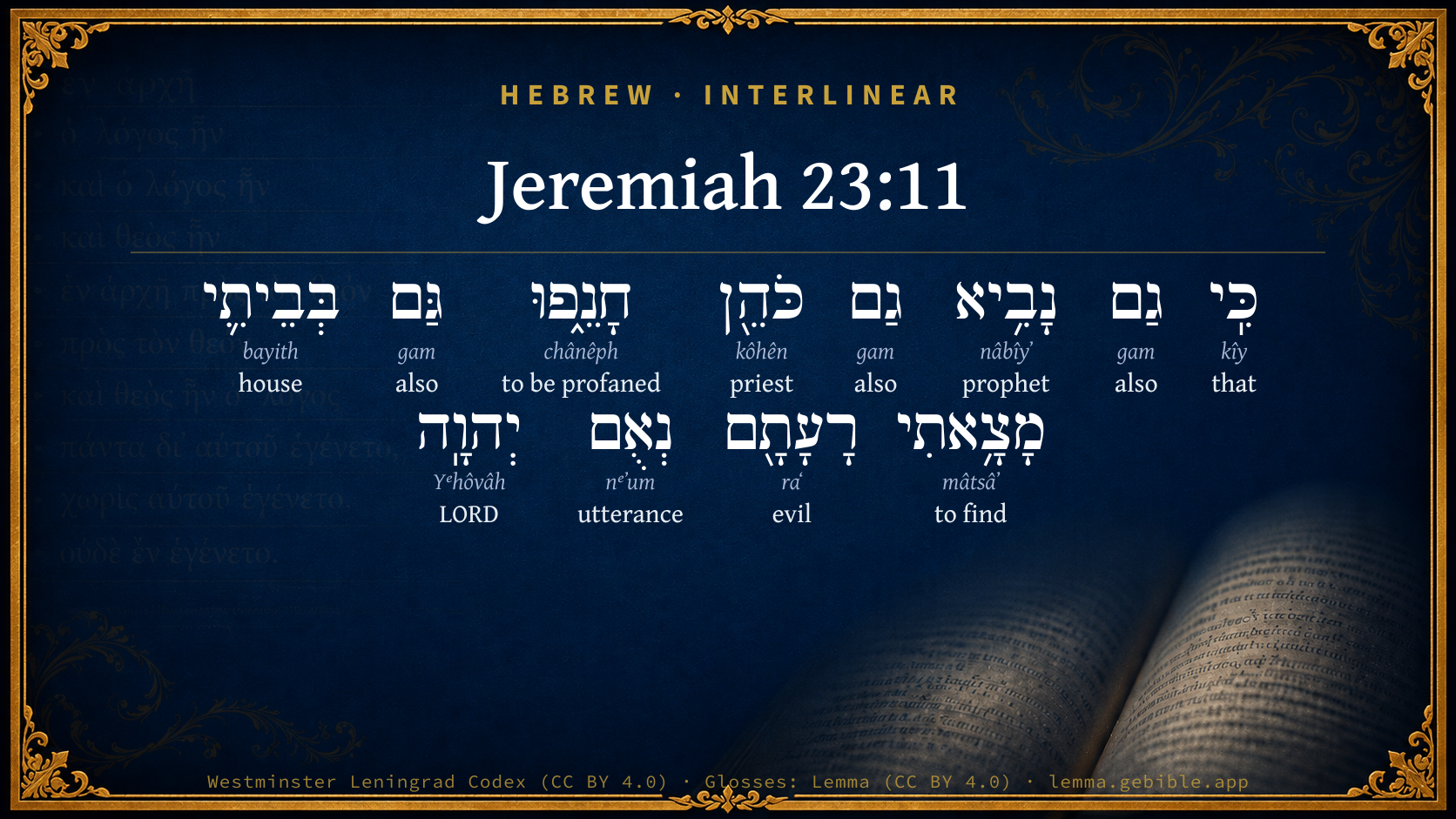
  1. כִּֽי kîy H3588 “that” Conjunction
  2. גַם gam H1571 “also” Adverb
  3. נָבִ֥יא nâbîyʼ H5030 “prophet” Noun, Common, Masculine, Singular, Absolute
  4. גַם gam H1571 “also” Adverb
  5. כֹּהֵ֖ן kôhên H3548 “priest” Noun, Common, Masculine, Singular, Absolute
  6. גַּם gam H1571 “also” Particle, Accusative
  7. בְּבֵיתִ֛י bayith H1004 “in/at · house · my” Preposition + Noun, Common, Masculine, Singular, Construct + Suffix, Personal, 1st Person, Common, Singular
  8. מָצָ֥אתִי mâtsâʼ H4672 “to find” Verb, Qal, Perfect, 1st Person, Common, Singular
  9. רָעָתָ֖ם raʻ H7451 “evil · their” Noun, Common, Feminine, Singular, Construct + Suffix, Personal, 3rd Person, Masculine, Plural
  10. נְאֻם nᵉʼum H5002 “utterance of” Noun, Common, Masculine, Singular, Construct
  11. יְהוָֽה Yᵉhôvâh H3068 “LORD” Noun, Proper

About this verse

These counts appear in no published source. They are computed here, from the morphology-tagged text and Lemma’s own curated glosses. What Lemma adds →

12
words
10
distinct lemmas
Prophets
section

Notable vocabulary

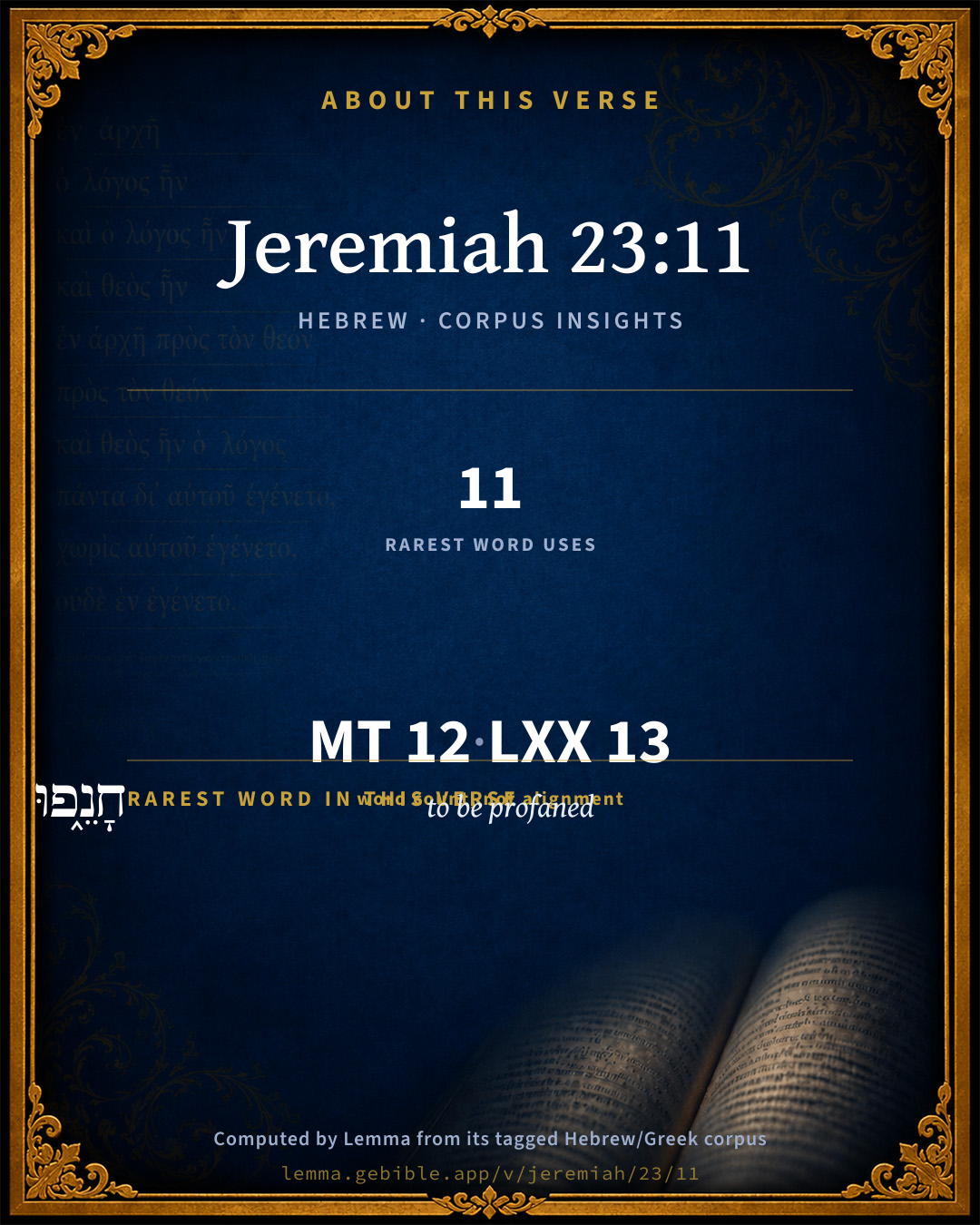
The rarest word here is חָנֵ֑פוּ to be profaned H2610 — appearing just 11 times in the whole Hebrew Bible.

Shared distinctive vocabulary

חָנֵ֑פוּ to be profaned H2610 occurs in 9 verses of the Hebrew Bible. Also found in:

Grammatical profile

  • 2 verbs
  • 6 nouns
  • 1 conjunction
  • 2 adverbs
  • 1 particle

Verb forms

  • חָנֵ֑פוּ Qal · Perfect
  • מָצָ֥אתִי Qal · Perfect

Repetition

A word recurs within this verse — often emphatic in Hebrew:

Hebrew & Septuagint length

In the original languages it is 12 Hebrew tokens and 13 Greek tokens — but the two are counted differently (Hebrew bundles its prefixes and suffixes into one token; the Greek is in lemma form), so that isn’t a like-for-like length.

Cross-references

19

Topical passages linked to Jeremiah 23:11 in the Treasury of Scripture Knowledge — connected by theme and wording, ordered by reader-vote popularity; previews shown in the World English Bible.

  • Jeremiah 6:13 For from the least of them even to the greatest of them everyone is given to covetousness; and from the prophet even to the priest everyone deals falsely.
  • Zephaniah 3:4 Her prophets are arrogant and treacherous people. Her priests have profaned the sanctuary. They have done violence to the law.
  • Matthew 21:12–13 Jesus entered into the temple of God, and drove out all of those who sold and bought in the temple, and overthrew the money-changers' tables and the seats of those who sold the doves.
  • Jeremiah 32:34 But they set their abominations in the house which is called by my name, to defile it.
  • Ezekiel 23:39 For when they had slain their children to their idols, then they came the same day into my sanctuary to profane it; and, behold, thus have they done in the midst of my house.
  • 2 Chronicles 36:14 Moreover all the chiefs of the priests, and the people, trespassed very greatly after all the abominations of the nations; and they polluted the house of Yahweh which he had made holy in Jerusalem.
  • Jeremiah 7:10–11 and come and stand before me in this house, which is called by my name, and say, We are delivered; that you may do all these abominations?
  • Jeremiah 7:30 For the children of Judah have done that which is evil in my sight, says Yahweh: they have set their abominations in the house which is called by my name, to defile it.
  • Jeremiah 8:10 Therefore will I give their wives to others, and their fields to those who shall possess them: for everyone from the least even to the greatest is given to covetousness; from the prophet even to the priest every one deals falsely.
  • Jeremiah 11:15 What has my beloved to do in my house, seeing she has worked lewdness [with] many, and the holy flesh is passed from you? when you do evil, then you rejoice.
  • Ezekiel 8:16 He brought me into the inner court of Yahweh's house; and see, at the door of the temple of Yahweh, between the porch and the altar, were about twenty-five men, with their backs toward the temple of Yahweh, and their faces toward the east; and they were worshipping the sun toward the east.
  • 2 Chronicles 33:5 He built altars for all the host of the sky in the two courts of the house of Yahweh.
  • 2 Chronicles 33:7 He set the engraved image of the idol, which he had made, in the house of God, of which God said to David and to Solomon his son, In this house, and in Jerusalem, which I have chosen out of all the tribes of Israel, will I put my name forever:
  • Jeremiah 5:31 the prophets prophesy falsely, and the priests bear rule by their means; and my people love to have it so: and what will you do in the end of it?
  • Jeremiah 23:15 Therefore thus says Yahweh of Hosts concerning the prophets: Behold, I will feed them with wormwood, and make them drink the water of gall; for from the prophets of Jerusalem is ungodliness gone forth into all the land.
  • Ezekiel 7:20 As for the beauty of his ornament, he set it in majesty; but they made the images of their abominations [and] their detestable things therein: therefore have I made it to them as an unclean thing.
  • Ezekiel 8:5–6 Then said he to me, Son of man, lift up your eyes now the way toward the north. So I lifted up my eyes the way toward the north, and see, northward of the gate of the altar this image of jealousy in the entry.
  • Ezekiel 8:11 There stood before them seventy men of the elders of the house of Israel; and in the midst of them stood Jaazaniah the son of Shaphan, every man with his censer in his hand; and the odor of the cloud of incense went up.
  • Ezekiel 22:25–26 There is a conspiracy of her prophets in the midst of it, like a roaring lion ravening the prey: they have devoured souls; they take treasure and precious things; they have made her widows many in the midst of it.

Cross-references courtesy of OpenBible.info (CC BY 4.0).

Hebrew and Greek witnesses Masoretic Hebrew ↔ Greek Septuagint

The same verse in the two great witnesses to the Old Testament, shown verse-for-verse.

These are two independent witnesses, not word-aligned to each other, and the Septuagint is shown in lemma (dictionary) form.

Hebrew Jeremiah 23:11 Masoretic · Westminster Leningrad Codex

כִּֽי גַם נָבִ֥יא גַם כֹּהֵ֖ן חָנֵ֑פוּ גַּם בְּבֵיתִ֛י מָצָ֥אתִי רָעָתָ֖ם נְאֻם יְהוָֽה

for both prophet and priest are profane; yes, in my house have I found their wickedness, says Yahweh.

World English Bible · Public Domain

Greek LXX Structure differs

In the Septuagint, Jeremiah is about an eighth shorter than the Hebrew and arranges its material differently — the Oracles Against the Nations (Hebrew chapters 46–51) appear in the middle of the Greek book, after 25:13. Because the chapter and verse boundaries do not line up, a verse-for-verse comparison with the Hebrew is not shown.

A verse-for-verse comparison isn’t shown here because the chapters and verses don’t line up. Switch to the LXX edition with the MT / LXX toggle above to read the Greek directly.

Hebrew: Westminster Leningrad Codex (CC BY 4.0). Greek: Septuagint (public domain); English from a public-domain English Septuagint. How the Septuagint differs from the Hebrew →

Targum (Aramaic paraphrase)

1

The Targum is the ancient Jewish Aramaic paraphrase of the Hebrew Scriptures — an interpretive translation, not the Hebrew text itself. Onkelos (literal) and Pseudo-Jonathan (expansive) render the Torah, and Jonathan the Prophets. Coverage is partial: where no permissively-licensed English translation exists for a verse, only the Aramaic is shown. This is verse-level text, not a word-by-word alignment to the Hebrew.

  1. Targum Jonathan Prophets (Joshua–Malachi)
    אֲרֵי אַף סָפַר אַף כָּהֵן גְנִיבוּ אוֹרְחַתְהוֹן אַף בְּבֵית מַקְדְשִׁי גַלְיָן קָדָמַי בִּישַׁתְהוֹן אֲמַר יְיָ:

    (no public-domain English translation for this verse)

    Targum Jonathan — Aramaic: “Mikraot Gedolot” (public domain). English: “Sefaria Community Translation” (CC0 1.0 (public-domain dedication)); “London "Chaldee Paraphrase," 1871” (public domain). Text via Sefaria.

Commentary

Notes on Jeremiah 23:11 from classic Christian and Jewish commentators (each source and its license shown beneath its notes). The classic Christian expositions comment on the surrounding passage and are grouped to its opening verse, so a note may address several verses; the Jewish commentaries on the Tanakh (Rashi and others) are per-verse, so they appear only where the commentator wrote on this verse.

Lemma curates 59 commentaries, every one of them public domain or Creative Commons licensed, each selected and text-cleaned for this edition rather than reprinted as found. About our sources →

Trapp's Complete Commentary

John Trapp

Jer 23:11 For both prophet and priest are profane; yea, in my house have I found their wickedness, saith the LORD.

Ver. 11. For both prophet and priest are profane.] What wonder, therefore, that the people were so? I have read of a woman, who, living in professed doubt of the Godhead, after better illumination and repentance, did often protest that the vicious life of a great scholar in that town did conjure up those damnable doubts ia her soul. {a} And of another, that he desired a profane preacher to point him out a nearer way to heaven than that he had taught in his sermons, for he went not that way himself. Our Saviour foretelleth {Mat 24:12} that "iniquity shall abound, love wax cold," &c.; and why? "Many false prophets shall arise."

Yea, in my house have I found their wickedness.] Sin is not a little aggravated as by the time, sc., If committed on the Lord’s day; so by the place, sc., If done in God’s house, and in his special presence. Unclean glances or worldly thoughts in hearing, &c., argue a profane heart. Like as it were a sign the orthodox party were but weak, if, while they were at sermons, Papists dared come in and put them out.

{a} Mrs Ward’s Happiness of Paradise.

John Trapp, A Commentary or Exposition upon All the Books of the Old and New Testament (1647–1656) — public domain. Text from a community e-Sword module.

Joseph Benson's Commentary

Jer 23:11-12. For both the prophet and the priest are profane — The priests, by their formality and hypocrisy, profaned the ordinances of God which they were appointed to administer; and the prophets, by their lies, false doctrine, and corrupt practice, profaned the word of God, which they pretended to deliver. Yea, in my house have I found their wickedness: saith the Lord — Even in my temple, where they assemble under a pretence to worship and do me honour, they say and do many things contrary to my law, and are guilty of various acts of profaneness and immorality. Such profaners of things sacred were formerly Hophni and Phinehas. Wherefore their way shall be as slippery ways — In which they shall not walk with any steadiness, safety, or satisfaction: or they shall fail and miscarry in all their designs.

Joseph Benson's Commentary on the Old and New Testaments (1811–1818) — public domain. Text from a community e-Sword module.

Tyndale Open Study Notes

Tyndale Open Resources

23:11 Judah’s religious leaders had committed despicable acts, not just in their private lives and in the hills and fields where pagan worship occurred, but even in the Temple, in the presence of the Lord.

Tyndale Open Study Notes — © Tyndale Open Resources, licensed CC BY-SA 4.0. Text via the HelloAO Bible API.

Geneva Bible (1599)

Geneva Bible translators

My Temple is full of their idolatry and superstitions.

Or, are hypocrites.

Geneva Bible (1599) marginal notes — public domain. Text via Bolls.life.

Jamieson, Fausset & Brown

Robert Jamieson, A. R. Fausset & David Brown

profane-- (Eze 23:39; Zep 3:4).

in my house-- (Jer 7:30). They built altars to idols in the very temple (Kg2 23:12; Eze 8:3-16). Compare as to covetousness under the roof of the sanctuary, Mat 21:13; Joh 2:16.

Jamieson, Fausset & Brown — Commentary Critical and Explanatory on the Whole Bible (1871) — public domain (CC PDM 1.0). Text via the HelloAO Bible API.

Adam Clarke's Commentary

Verse 11. In my house] They had even introduced idolatry into the Temple of God!

Adam Clarke's Commentary on the Bible (1810–1826) — public domain. Text from a community e-Sword/MySword module.

John Calvin's Commentaries

He adds here that it ought not to appear strange that the prophets were silent when they ought to have loudly cried out, because they were guilty themselves: and whence can freedom of speech come except from a good conscience? Hypocrites, who indulge themselves, are indeed often severe against others, and even more than necessary; but no one can dare honestly to cry out against wickedness, but he who is innocent. For he who condemns others seems to make a law for himself, according to what a heathen writer has said, (Cicero in Salustium.) Then the Prophet here shews to us why the prophets were not only idle, but were even like stocks and stones; for in speaking against wickedness, it was necessary for them in the first place to amend themselves; for their lives were wholly dissolute. As then they were of all the most wicked, they could not boldly cry out against others; and hence the Prophet condemns them, because their own impiety prevented them to perform their own duty.

It is, indeed, possible for one to live soberly, honestly, and justly, and yet to connive at the wickedness of others; but the Prophet here condemns the prophets and priests on two accounts, — for being mute, and for not undertaking God’s cause when they saw the land polluted with all kinds of defilements; and he then shews the fountain of this evil, that is, the cause why they were idle and wholly indifferent, and that was, because they dared not say a word against those crimes of which they were themselves guilty, yea, with which they were more loaded than even the common people. We now perceive the Prophet’s object in saying that both the priests and the prophets had acted impiously; it was to shew, that their contempt of God, for which they were notorious, and also their wickedness, had taken away from them all power and freedom in acting.

It is added, Even in my house have I found their wickedness He enhances what he had said of their impiety; for they were not only infamous and wicked in common life, as to the duties of the Second Table; but they also corrupted the whole service of God, and the true Prophets were derided by them. For what was found to be the priests’ wickedness in the Temple, except that they practiced a sort of merchandise under the cover of the priesthood? and then the prophets vitiated and adulterated God’s worship; and what was religion to them but the means of filthy lucre or gain? When, therefore, the prophets thus trod under foot the service of God, corrupted and perverted the Law to make gain or to acquire power, their impiety was not only seen in the habits of daily life, but also in the very Temple of God, that is, with regard to the sacerdotal office.

Now, since this is true as to what took place under the Law, there is no wonder that such a base example is to be seen in the present day. And hence also is discovered the folly of the Papists, who think that they ingeniously evade every objection as to the crimes of the Pope and his filthy clergy, by saying that the Pope indeed may be wicked, as almost all of them have been, and that the same thing may be said of their mitred bishops; but that the Pope, as a Pope, cannot err, and that the bishops, as bishops, that is, in their government and office, are ruled by the Holy Spirit, because they represent the Church. But are they better than these ancient priests, whom God himself had expressly appointed, and to whom he commanded obedience to be rendered by the whole people? But the Prophet not only says here that they were wicked, that they acted impiously and wickedly towards their neighbors, that they committed plunders and robberies, that they were given to violence and rapacity, that they abandoned themselves to adultery and to every other crime; but he says also, that their wickedness was found in the very Temple, that is, in the very sacred office itself; for not only was their life wicked, but they also impiously and perfidiously corrupted the doctrine of God and subverted his worship.

John Calvin's Commentaries (1540-1563) — public domain. Text from the Calvin Translation Society English edition (1840s-50s) via the Christian Classics Ethereal Library (ccel.org). Calvin's coverage is partial (roughly two-thirds of the Bible); uncommented books and verses are honest gaps, never fabricated. The 19th-century editor's footnotes and remarks are omitted so the notes are faithfully Calvin's own voice.

Ellicott's Commentary for English Readers

(11) In my house have I found their wickedness.—Prophet and priest are joined, as before (Jer_5:31; Jer_6:13; Jer_8:10), as playing into each other’s hands. It seems probable, from Jer_32:34, that the sins of Ahaz and Manasseh had been repeated under Jehoiakim, and that the worship of other gods had been carried on side by side with that of Jehovah. With this, almost as its natural accompaniment, there may have been sins of another kind—shameless greed or yet more shameless profligacy—like those of the sons of Eli (1Sa_2:22).

A Bible Commentary for English Readers, edited by Charles John Ellicott (1878–1897) — public domain. Text from a community e-Sword module.

The Cambridge Bible for Schools and Colleges

gen. ed. J. J. S. Perowne

11. in my house have I found their wickedness] Cp. Jer_6:13, and see 2Ki_21:5; 2Ki_23:12.

The Cambridge Bible for Schools and Colleges (gen. ed. J. J. S. Perowne; Cambridge University Press, 1878–1918) — public domain. Text from a community e-Sword module.

John Gill's Exposition

For both prophet and priest are profane,.... Being guilty of the afore mentioned sins. The Targum is,

"the scribe and the priest;''

and such were the scribes and priests in the time of our Lord; they played "the hypocrite" (q), as some render the word here; and are often charged with the sin of hypocrisy, and called hypocrites, Mat 22:18;

yea, in my house have I found their wickedness, saith the Lord; where they officiated in holy things, or should have done so; where the one should have instructed the people, and the other offered sacrifices for them, according to the will of God; there they committed wickedness, which was an aggravation of their sin, as was the case of Eli's sons, Sa1 2:22; perhaps the same sin was committed by these men; or idolatry may be meant; setting up images, and building altars for them in the house of God; see Jer 7:30; or carrying on traffic and merchandise, whereby the temple was made a house of merchandise, as it was in the times of Christ, Joh 2:14.

(q) "hypocritae fuerunt", Vatablus, Montanus; "hypocritas agunt", Piscator; "hypocrisin exercent", Schmidt, Cocceius.

John Gill's Exposition of the Whole Bible (1746–1763) — public domain (CC PDM 1.0). Text via the HelloAO Bible API.

Albert Barnes' Notes on the Bible

For both prophet and priest are profane - While by their office they are consecrated to God, they have made themselves common and unholy by their sins. See Jer 3:9 note.

Yea, in my house - This may refer to sins such as those of the sons of Eli 1Sa 2:22, or that they had defiled the temple by idolatrous rites.

Albert Barnes' Notes on the Bible (1834–1885) — public domain. Text from a community e-Sword/MySword module.

Haydock's Catholic Bible Commentary

Defiled. Hebrew, "hypocrites." My priests retain the appearance of religion, to join with impostors in deluding the people.

George Leo Haydock (1774–1849), Haydock's Catholic Family Bible and Commentary, 1859 edition — public domain. Excludes Psalms (Douay-Rheims chapter numbering differs from Protestant) and Deuterocanonical books (Catholic canon only).

Matthew Poole's English Annotations

Those whose work was to reveal the mind of God to the people, and who pretended to that office; and those that were employed in offering sacrifices, and other works which belonged to the priestly office, according to the law; the whole ecclesiastical order, all their ministry, were

profane; not merely hypocritical, but lewd, immoral, and debauched. Yea, they were grown to that impudence, that they made the temple, which was the Lord’s house, a den of thieves, a place where they committed

wickedness. Thus it was in the time of Eli, 1Sa 2:22, and more generally afterward, 2Ch 36:14. See Jer 7:10,11, and Jer 23:14 of this chapter. There is no more certain sign of a ruining nation, than when God suffereth in it a lewd and corrupt ministry.

Matthew Poole's English Annotations on the Holy Bible (1683–1685) — public domain. Text from a community e-Sword/MySword module.

Whedon's Commentary on the Bible

Daniel D. Whedon

11. Both prophet and priest are profane — Instead of being specially holy, they are specially wicked. Even into the very temple covetousness and impurity had come. See 2Ki_23:12; Eze_23:39; Zep_3:4.

Daniel D. Whedon (gen. ed.), Commentary on the Old and New Testaments (1874–1909) — public domain. Text from a community e-Sword module.

The Pulpit Commentary

Both prophet and priest are profane; i.e. are unholy, disobeying the Divine commands. (see on Jer_5:7) The same two important classes specified as in Jer_6:13. Yea, in my house, etc. Evidently some sin specially incongruous with its locality is referred to, either idolatry (comp. Jer_7:30) or the totemistic worship of figures of animals. (Eze_8:10, Eze_8:11) Comp. note on Jer_5:7.

The Pulpit Commentary (1880–1919), ed. H.D.M. Spence-Jones & Joseph S. Exell — public domain. Text from a community e-Sword module.

unfoldingWord translationNotes

Door43 World Missions Community

Connecting Statement:

Jeremiah continues to deliver Yahweh's message about the false prophets and priests that he began in Jeremiah 23:9.

the prophets and the priests are polluted

The prophets and priests are defiled by sin in the same way that water can be polluted by filth. AT: "the prophets and the priests are sinful" (See: Metaphor)

I even found their wickedness in my house!

The abstract noun "wickedness" can be stated as an action. AT: "I know that they have even acted wickedly in my temple!" (See: Abstract Nouns)

in my house

This refers to the temple in Jerusalem.

this is Yahweh's declaration

Yahweh speaks of himself by name to express the certainty of what he is declaring. See how you translated this in Jeremiah 1:8. AT: "this is what Yahweh has declared" or "this is what I, Yahweh, have declared" (See: First, Second, or Third Person)

their way will be like a slippery place in the darkness

The danger of their actions is spoken of as if they were about to fall off the slippery edge of a cliff in the dark and injure themselves. AT: "there actions are unstable and dangerous, like walking on a slippery place in the darkness" (See: Simile)

I will send disaster against them

Yahweh speaks of disaster as an enemy that he will send to attack the priests and false prophets. AT: "I will cause them to experience disaster" (See: Metaphor)

in the year of their punishment

"when their time for punishment comes" or "when the time comes for me to punish them"

translationWords

priest

house of God

darkness

send

punish

unfoldingWord translationNotes — © Distant Shores Media and the Door43 World Missions Community, licensed CC BY-SA 4.0. Source: git.door43.org/Door43/en_tn.

Rashi

Rabbi Shlomo Yitzchaki (Rashi)

both prophet and priest Even these, from whom everyone learns.

even in My house have I found their evil For they placed an image in the Temple.

Rashi on the Tanakh — English translations: “The Judaica Press complete Tanach with Rashi, translated by A. J. Rosenberg” (CC BY 4.0); “Pentateuch with Rashi's commentary by M. Rosenbaum and A.M. Silbermann, 1929-1934” (public domain); “The Metsudah Tanach series, Lakewood, N.J” (CC BY 4.0); and “The Book of Joshua, Metsudah Publications, 1997” (CC BY 4.0). Text via Sefaria.

Lesson kit

Teaching starters — assembled from the data on this page, not authored interpretation. Every prompt links to the verse data it draws on. Edit before teaching.

Jeremiah, in the Prophets, opens this verse with 12 words (10 distinct Hebrew lemmas). Its most distinctive word is chânêph (“to be profaned”). A historical commentator’s framing appears above. Read the whole chapter for the surrounding context.

Discussion questions

  1. How does “to be profaned” (chânêph) shape what this verse is saying?
  2. Numbers 35:33 shares the word «to be profaned» with this verse. How do the two illuminate each other?
  3. “also” occurs 3× in this one verse. What is the effect of the repetition?
  4. These translations render this verse differently. What is at stake in choosing one wording over another?
  5. The verb «חָנֵ֑פוּ» is Qal Perfect. How does its form color the action?
  6. Reading how Trapp's Complete Commentary and Joseph Benson's Commentary read this verse, where do the two commentators agree and where do they part?

Things to notice

Reading settings

Reading text

Shown beneath each verse's original-language words.

Old Testament
Old Testament edition

Read the OT as the Masoretic Hebrew (MT) or the Greek Septuagint (LXX).

English shown for the Greek Septuagint (in the Hebrew ↔ Greek comparison).

Comparing translations? Open the Compare panel on any verse page to stack up to four side by side.