Isaiah 25:2

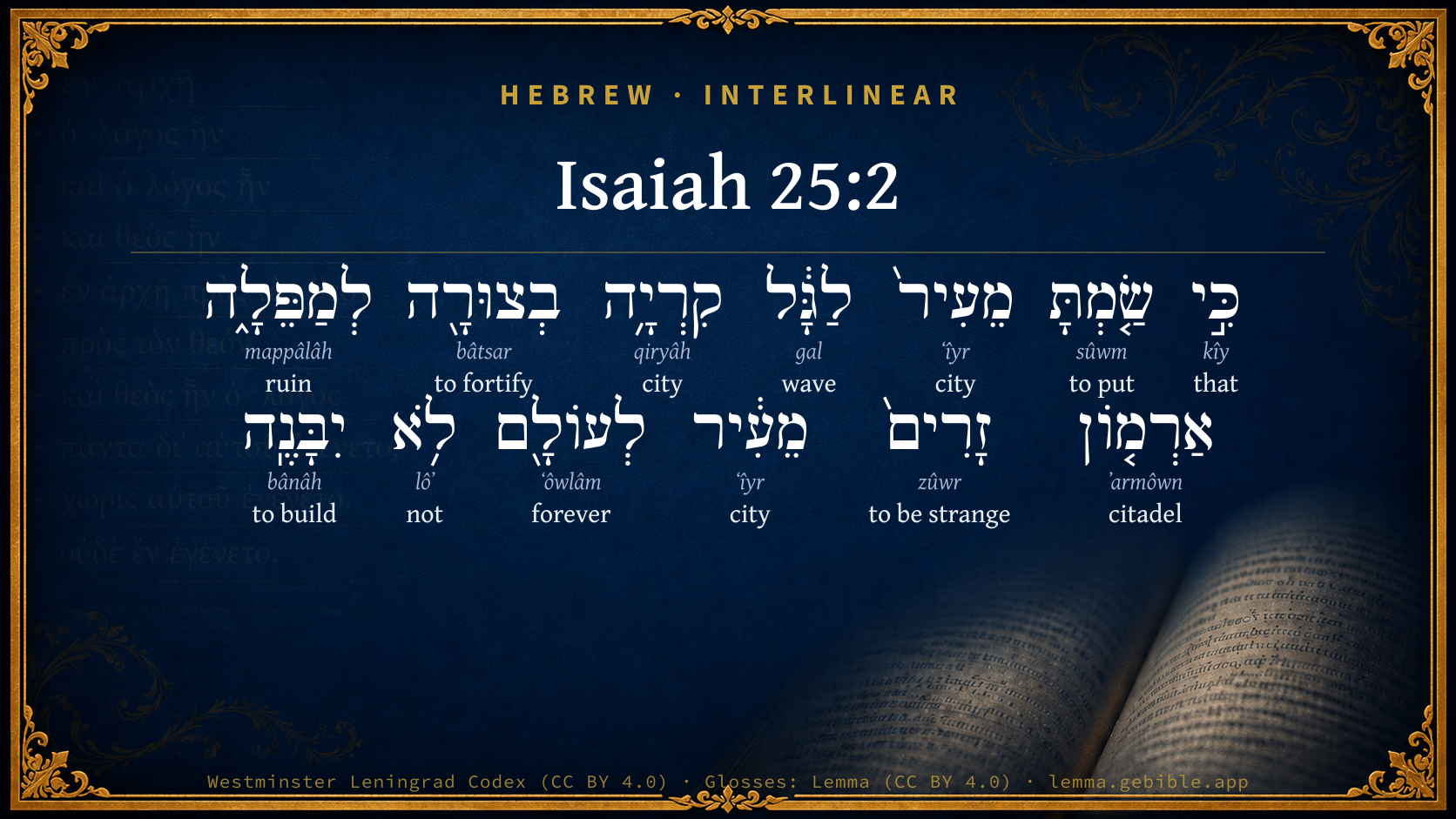
Hebrew (Westminster Leningrad Codex) Isaiah 25:2 appears in the Hebrew Old Testament. The text above is from the Westminster Leningrad Codex. Each word links to its Strong’s number, a concise gloss, and parsing drawn from the Open Scriptures Hebrew Bible morphology. Click any word for its full Brown-Driver-Briggs (BDB) entry.
Download image
Cite this verse

Isaiah 25:2 (World English Bible). Public Domain. Lemma interlinear Bible study tool, https://lemma.gebible.app/v/isaiah/25/2.

Show BibTeX & RIS
BibTeX
RIS
English Translation
For you have made of a city a heap, of a fortified city a ruin, a palace of strangers to be no city; it shall never be built.
World English Bible · Public Domain
Download a study sheet

One document with this verse’s original text, its word-by-word gloss line, the meaning frame, cross-references with their text, attributed commentary, and full source and license credits — printable, and it pastes into notes with its structure intact.

This verse Autodidact and up

Study sheet (.html) Plain text (.txt)

A passage Seminary Student

Up to 50 verses in one chapter. A passage sheet keeps up to 6 commentary sources and 12 cross-references per verse, in the order this page ranks them, and says so on the sheet whenever that leaves anything out. Ask for a single verse and you get the Autodidact verse sheet above.

Everything on this page stays free to read, with no account — the sheet is a download of what is already on screen, not access to it.

Want to remove ads? Support Godless Engineer
Compare translations 3

The same verse in 3 English versions, stacked beneath the original-language interlinear above. Click any original word for its lexicon entry.

Each is an independent rendering of the whole verse — the interlinear is not word-aligned to these translations.

Highlighted words mark where these versions differ — a whole-verse word diff, not a word-by-word alignment.

  • World English Bible Public Domain
    For you have made of a city a heap, of a fortified city a ruin, a palace of strangers to be no city; it shall never be built.
  • King James Version Public Domain
    For thou hast made of a city an heap; of a defenced city a ruin: a palace of strangers to be no city; it shall never be built.
  • unfoldingWord Literal Text CC BY-SA 4.0
    For you have made a city a heap, a fortified city a ruin, a palace of foreigners not a city; it will not be built forever.

unfoldingWord Literal Text — © unfoldingWord, licensed CC BY-SA 4.0. Word-aligned USFM3 via Door43 (git.door43.org/unfoldingWord/en_ult).

Versions to compare (up to 4)

3 of 4 selected

Show all 17 translations

Every available English version of this verse, each an independent rendering of the whole verse.

  • World English Bible Public Domain
    For you have made of a city a heap, of a fortified city a ruin, a palace of strangers to be no city; it shall never be built.
  • Berean Standard Bible Public Domain
    Indeed, You have made the city a heap of rubble, the fortified town a ruin. The fortress of strangers is a city no more; it will never be rebuilt.
  • Majority Standard Bible Public Domain
    Indeed, You have made the city a heap of rubble, the fortified town a ruin. The fortress of strangers is a city no more; it will never be rebuilt.
  • King James Version Public Domain
    For thou hast made of a city an heap; of a defenced city a ruin: a palace of strangers to be no city; it shall never be built.
  • American Standard Version (1901) Public Domain
    For thou hast made of a city a heap, of a fortified city a ruin, a palace of strangers to be no city; it shall never be built.
  • Revised Version (1885) Public Domain
    For thou hast made of a city an heap; of a defenced city a ruin: a palace of strangers to be no city; it shall never be built.
  • Geneva Bible (1599) Public Domain
    For thou hast made of a citie an heape, of a strong citie, a ruine: euen the palace of strangers of a citie, it shall neuer be built.
  • Young's Literal Translation Public Domain
    For Thou didst make of a city a heap, Of a fenced city a ruin, A high place of strangers from `being' a city, To the age it is not built.
  • Literal Standard Version CC BY-SA 4.0
    For You made of a city a heap, || Of a fortified city a ruin, || A high place of strangers from [being] a city, || It is not built for all time.
  • Unlocked Literal Bible CC BY-SA 4.0
    For you have made the city a heap, a fortified city, a ruin, and a fortress of strangers into no city.
  • unfoldingWord Literal Text CC BY-SA 4.0
    For you have made a city a heap, a fortified city a ruin, a palace of foreigners not a city; it will not be built forever.
  • Darby Bible Public Domain
    For thou hast made of the city a heap, of the fortified town a ruin, the palace of strangers to be no city; it shall never be built up.
  • World Messianic Bible Public Domain
    For you have made a city into a heap, a fortified city into a ruin, a palace of strangers to be no city. It will never be built.
  • Webster's Bible Public Domain
    For thou hast made of a city a heap; of a fortified city a ruin: a palace of strangers to be no city; it shall never be built.
  • Free Bible Version CC BY-SA 4.0
    You have turned the city into a pile of rubble; the fortified town is now a ruin; the foreigner palace is gone. It is no longer a city and it will never be rebuilt.
  • Bible in Basic English Public Domain
    For you have made a town a waste place: a strong town a mass of broken walls; the tower of the men of pride has come to an end; it will never be put up again.
  • JPS Tanakh (1917) Public Domain
    For Thou hast made of a city a heap, of a fortified city a ruin; a castle of strangers to be no city, it shall never be built.

Literal Standard Version (2020), Covenant Press — licensed CC BY-SA 4.0. Text via the HelloAO Bible API (eBible.org). Unlocked Literal Bible (unfoldingWord) — licensed CC BY-SA 4.0. Text via the HelloAO Bible API (eBible.org). unfoldingWord Literal Text — © unfoldingWord, licensed CC BY-SA 4.0. Word-aligned USFM3 via Door43 (git.door43.org/unfoldingWord/en_ult). Free Bible Version, Dr. Jonathan Gallagher — licensed CC BY-SA 4.0. Text via the HelloAO Bible API (eBible.org).

Word by word

More ways to search: Search by grammar → Find every occurrence → Compare this word →

Practice this passage: Drill this verse → Learn its vocabulary →

לְמַפֵּלָ֑ה
mappâlâh
H4654
“to/for · ruin”
Preposition + Noun, Common, Feminine, Singular, Absolute
Part of Speech
Preposition + Noun
Type
Common
Gender
Feminine
Number
Singular
State
Absolute
Full BDB Definition

Origin: from H5307

TWOT: 1392d

a ruin
  1. כִּ֣י kîy H3588 “that” Conjunction
  2. שַׂ֤מְתָּ sûwm H7760 “to put” Verb, Qal, Perfect, 2nd Person, Masculine, Singular
  3. מֵעִיר֙ ʻîyr H5892 “from · city” Preposition + Noun, Common, Feminine, Singular, Absolute
  4. לַגָּ֔ל gal H1530 “to/for the · wave” Preposition, Determined + Noun, Common, Masculine, Singular, Absolute
  5. קִרְיָ֥ה qiryâh H7151 “city” Noun, Common, Feminine, Singular, Absolute
  6. בְצוּרָ֖ה bâtsar H1219 “fortified” Adjective, Adjective, Feminine, Singular, Absolute
  7. אַרְמ֤וֹן ʼarmôwn H759 “citadel of” Noun, Common, Masculine, Singular, Construct
  8. זָרִים֙ zûwr H2114 “strange” Adjective, Adjective, Masculine, Plural, Absolute
  9. מֵעִ֔יר ʻîyr H5892 “from · city” Preposition + Noun, Common, Feminine, Singular, Absolute
  10. לְעוֹלָ֖ם ʻôwlâm H5769 “to/for · forever” Preposition + Noun, Common, Masculine, Singular, Absolute
  11. לֹ֥א lôʼ H3808 “not” Particle, Negative
  12. יִבָּנֶֽה bânâh H1129 “to build” Verb, Niphal, Imperfect, 3rd Person, Masculine, Singular

About this verse

These counts appear in no published source. They are computed here, from the morphology-tagged text and Lemma’s own curated glosses. What Lemma adds →

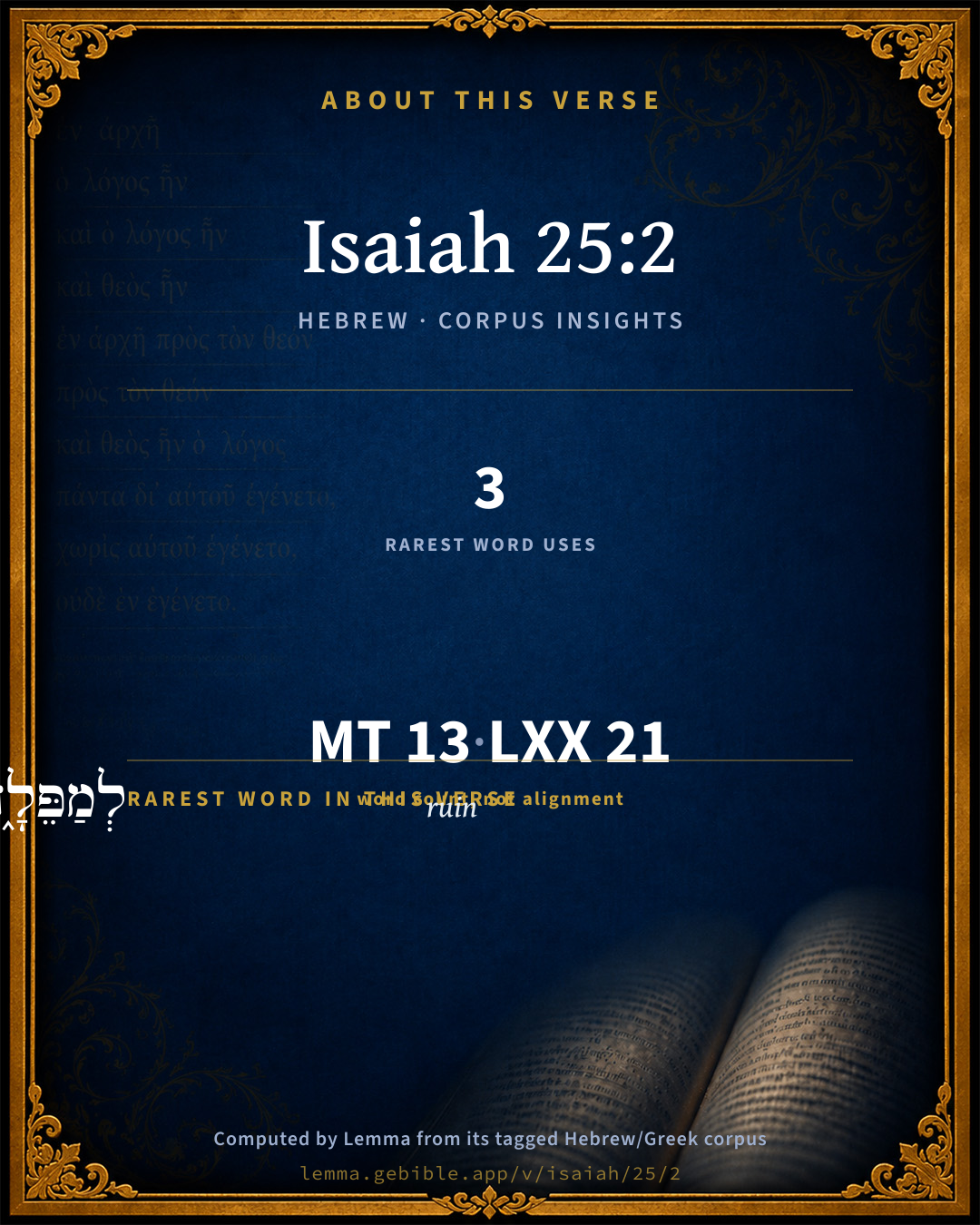
13
words
12
distinct lemmas
Prophets
section

Notable vocabulary

The rarest word here is לְמַפֵּלָ֑ה ruin H4654 — appearing just 3 times in the whole Hebrew Bible.

Shared distinctive vocabulary

לְמַפֵּלָ֑ה ruin H4654 occurs in 3 verses of the Hebrew Bible. Also found in:

Grammatical profile

  • 2 verbs
  • 7 nouns
  • 2 adjectives
  • 1 conjunction
  • 1 particle

Verb forms

  • שַׂ֤מְתָּ Qal · Perfect
  • יִבָּנֶֽה Niphal · Imperfect

Repetition

A word recurs within this verse — often emphatic in Hebrew:

  • מֵעִיר֙ city H5892 ×2

Hebrew & Septuagint length

In English translation the verse runs 28 words from the Hebrew and 28 from the Septuagint (LXX English) — the same length.

A rough comparison of the two English renderings, which tokenize alike — not a word-level alignment.

Word counts can differ between the Hebrew and the Greek without any difference in meaning — e.g. the Hebrew direct-object marker אֵת has no separate Greek word, and Greek often adds the article ὁ.

In the original languages it is 13 Hebrew tokens and 21 Greek tokens — but the two are counted differently (Hebrew bundles its prefixes and suffixes into one token; the Greek is in lemma form), so that isn’t a like-for-like length.

Cross-references

12

Topical passages linked to Isaiah 25:2 in the Treasury of Scripture Knowledge — connected by theme and wording, ordered by reader-vote popularity; previews shown in the World English Bible.

  • Isaiah 13:22 Wolves shall cry in their castles, and jackals in the pleasant palaces: and her time is near to come, and her days shall not be prolonged.
  • Isaiah 17:1 The burden of Damascus. Behold, Damascus is taken away from being a city, and it shall be a ruinous heap.
  • Isaiah 25:12 The high fortress of your walls has he brought down, laid low, and brought to the ground, even to the dust.
  • Deuteronomy 13:16 You shall gather all the spoil of it into the midst of the street of it, and shall burn with fire the city, and all the spoil of it every whit, to Yahweh your God: and it shall be a heap forever; it shall not be built again.
  • Isaiah 14:23 I will also make it a possession for the porcupine, and pools of water: and I will sweep it with the broom of destruction, says Yahweh of Hosts.
  • Isaiah 21:9 and, behold, here comes a troop of men, horsemen in pairs. He answered, Fallen, fallen is Babylon; and all the engraved images of her gods are broken to the ground.
  • Isaiah 23:13 Behold, the land of the Chaldeans: this people was not; the Assyrian founded it for those who dwell in the wilderness; they set up their towers; they overthrew the palaces of it; they made it a ruin.
  • Jeremiah 51:26 They shall not take of you a stone for a corner, nor a stone for foundations; but you shall be desolate for ever, says Yahweh.
  • Nahum 3:12–15 All your fortresses will be like fig trees with the first-ripe figs: if they are shaken, they fall into the mouth of the eater.
  • Revelation 18:2–3 He cried with a mighty voice, saying, "Fallen, fallen is Babylon the great, and she has become a habitation of demons, a prison of every unclean spirit, and a prison of every unclean and hateful bird!
  • Revelation 18:19 They cast dust on their heads, and cried, weeping and mourning, saying, 'Woe, woe, the great city, in which all who had their ships in the sea were made rich by reason of her great wealth!' For in one hour is she made desolate.
  • Isaiah 17:3 The fortress shall cease from Ephraim, and the kingdom from Damascus, and the remnant of Syria; they shall be as the glory of the children of Israel, says Yahweh of Hosts.

Cross-references courtesy of OpenBible.info (CC BY 4.0).

Hebrew and Greek witnesses Masoretic Hebrew ↔ Greek Septuagint

The same verse in the two great witnesses to the Old Testament, shown verse-for-verse.

These are two independent witnesses, not word-aligned to each other, and the Septuagint is shown in lemma (dictionary) form.

Hebrew Isaiah 25:2 Masoretic · Westminster Leningrad Codex

כִּ֣י שַׂ֤מְתָּ מֵעִיר֙ לַגָּ֔ל קִרְיָ֥ה בְצוּרָ֖ה לְמַפֵּלָ֑ה אַרְמ֤וֹן זָרִים֙ מֵעִ֔יר לְעוֹלָ֖ם לֹ֥א יִבָּנֶֽה

For you have made of a city a heap, of a fortified city a ruin, a palace of strangers to be no city; it shall never be built.

World English Bible · Public Domain

Greek LXX Isaiah 25:2 Septuagint · lemma form

ὅτι τίθημι πόλις εἰς χῶμα πόλις ὀχυρός ὁ πίπτω αὐτός ὁ θεμέλιον ὁ ἀσεβής πόλις εἰς ὁ αἰών οὐ μή οἰκοδομέω

For you have made cities a heap, even cities made strong that their foundations should not fall: the city of ungodly men shall not be built for ever.

LXX2012 (modern English Septuagint) · Public Domain

On this verse, Joseph Benson's Commentary discusses the Septuagint’s reading. Read the note in Commentary ↓

Hebrew: Westminster Leningrad Codex (CC BY 4.0). Greek: Septuagint (public domain); English from LXX2012 (modern English Septuagint) (Public Domain). How the Septuagint differs from the Hebrew →

Targum (Aramaic paraphrase)

1

The Targum is the ancient Jewish Aramaic paraphrase of the Hebrew Scriptures — an interpretive translation, not the Hebrew text itself. Onkelos (literal) and Pseudo-Jonathan (expansive) render the Torah, and Jonathan the Prophets. Coverage is partial: where no permissively-licensed English translation exists for a verse, only the Aramaic is shown. This is verse-level text, not a word-by-word alignment to the Hebrew.

  1. Targum Jonathan Prophets (Joshua–Malachi)
    אֲרֵי שַׁוִיתָא קִרְוֵי פַצְחִין לְגַלִין כְּרַךְ תַּקִיף לְדִמְחַמְרָא בֵּית דַחֲלַת עַמְמַיָא בְּקַרְתָּא יְרוּשְׁלֵם לַעֲלָם לָא יִתְבְּנֵי:

    For thou hast made the unfortified cities heaps; the fortified city is a ruin; the idolatrous house of the nations in the city of Jerusalem, shall never be built up again.

    Targum Jonathan — Aramaic: “Mikraot Gedolot” (public domain). English: “Sefaria Community Translation” (CC0 1.0 (public-domain dedication)); “London "Chaldee Paraphrase," 1871” (public domain). Text via Sefaria.

Commentary

Notes on Isaiah 25:2 from classic Christian and Jewish commentators (each source and its license shown beneath its notes). The classic Christian expositions comment on the surrounding passage and are grouped to its opening verse, so a note may address several verses; the Jewish commentaries on the Tanakh (Rashi and others) are per-verse, so they appear only where the commentator wrote on this verse.

Lemma curates 59 commentaries, every one of them public domain or Creative Commons licensed, each selected and text-cleaned for this edition rather than reprinted as found. About our sources →

Trapp's Complete Commentary

John Trapp

Isa 25:2 For thou hast made of a city an heap; [of] a defenced city a ruin: a palace of strangers to be no city; it shall never be built.

Ver. 2. For thou hast made of a city an heap.] Babylonem intelligit, say some. Narratur eversio urbis Romae, say others; the ruin of Rome is here foretold; which is therefore also, say they, called a palace of strangers; {a} because Antichrist with his adherents reigneth there. Jerome saith the Jews understand it to be Rome, which shall be in the end destroyed, and then their poor nation shall be relieved. {as Isa 25:4} It may be so.

{a} Aσεβων πολις. - Sept.

John Trapp, A Commentary or Exposition upon All the Books of the Old and New Testament (1647–1656) — public domain. Text from a community e-Sword module.

Joseph Benson's Commentary

Isa 25:2. Thou hast made of a city a heap — Nineveh, Babylon, Ar of Moab, or any other strong city, or fortress, possessed by the enemies of the people of God. Vitringa has made it appear probable that Babylon is chiefly meant, “which was emphatically called the city; which was remarkably fortified, and which was inhabited by strangers, as the Assyrians and Babylonians are commonly called in prophetical language, and in the destruction of which the ancient believers rejoiced most especially, having therein a pledge and earnest of future deliverance, and particularly a type of the deliverance of the Christian Church from persecution, by the fall of spiritual Babylon.” See Rev 18:20; and Rev 19:1. A palace of strangers — A royal city, in which were the palaces of strangers, that is, of the kings of strange people, or of the Gentiles. Bishop Lowth on the authority of two MSS., instead of זרים, strangers, reads זדים, proud ones: which reading, he thinks, the LXX. countenance, as they render the word ασεβων, the ungodly. To be no city; it shall never be built — It has been, or shall be, utterly and irrecoverably destroyed.

Joseph Benson's Commentary on the Old and New Testaments (1811–1818) — public domain. Text from a community e-Sword module.

Geneva Bible (1599)

Geneva Bible translators

That is, a place whereas all vagabonds may live without danger, and as it were at ease, as in a palace.

Not only of Jerusalem, but also of these other cities which have been thine enemies.

Geneva Bible (1599) marginal notes — public domain. Text via Bolls.life.

Jamieson, Fausset & Brown

Robert Jamieson, A. R. Fausset & David Brown

a city . . . heap--Babylon, type of the seat of Antichrist, to be destroyed in the last days (compare Jer 51:37, with Rev. 18:1-24, followed, as here, by the song of the saints' thanksgiving in Rev. 19:1-21). "Heaps" is a graphic picture of Babylon and Nineveh as they now are.

palace--Babylon regarded, on account of its splendor, as a vast palace. But MAURER translates, "a citadel."

of strangers--foreigners, whose capital pre-eminently Babylon was, the metropolis of the pagan world. "Aliens from the commonwealth of Israel, strangers from the covenants of promise" (Isa 29:5; Eph 2:12; see in contrast, Joe 3:17).

never be built-- (Isa 13:19-20, &c.).

Jamieson, Fausset & Brown — Commentary Critical and Explanatory on the Whole Bible (1871) — public domain (CC PDM 1.0). Text via the HelloAO Bible API.

Adam Clarke's Commentary

Verse 2. A city - "The city"] Nineveh, Babylon, Ar, Moab, or any other strong fortress possessed by the enemies of the people of God.

For the first מעיר meir, of a city, the Syriac and Vulgate read העיר hair, the city; the Septuagint and Chaldee read ערים arim, cities, in the plural, transposing the letters. After the second מעיר meir, a MS. adds לגל lagol, for a heap.

A palace of strangers - "The palace of the proud ones"] For זרים zarim, strangers, MS. Bodl. and another read זדים zedim, the proud: so likewise the Septuagint; for they render it ασεβων here, and in Isa 25:5, as they do in some other places: see De 18:20; De 18:22. Another MS. reads צרים tsarim, adversaries; which also makes a good sense. But זרים zarim, strangers, and זדים zedim, the proud, are often confounded by the great similitude of the letters ד daleth and ר resh. See Mal 3:15; Mal 4:1; Ps 19:14, in the Septuagint; and Ps 54:5, where the Chaldee reads זדים zedim, compared with Ps 86:16.

Adam Clarke's Commentary on the Bible (1810–1826) — public domain. Text from a community e-Sword/MySword module.

Ellicott's Commentary for English Readers

(2) Thou hast made of a city an heap.—The city spoken of as “the palace of strangers” was, probably in the prophet’s thought, that which he identified with the oppressors and destroyers of his people—i.e., Nineveh or Babylon; but that city was also for him the representation of the world-power which in every age opposes itself to the righteousness of God’s kingdom. The Babylon of Isaiah becomes the type of the mystical Babylon of the Apocalypse. The words as they stand expand the thought of Isa_24:10. (Comp. Isa_27:10.)

A Bible Commentary for English Readers, edited by Charles John Ellicott (1878–1897) — public domain. Text from a community e-Sword module.

The Cambridge Bible for Schools and Colleges

gen. ed. J. J. S. Perowne

2. The fall of a hostile city. The word “city” can hardly in this case be understood collectively, although the terms of the description are too vague to shew what historic city is intended. All that appears is that it is a city which, in the age of the prophet, symbolised the hostility of the world to the kingdom of God; its identification will depend on the date assigned to the prophecy. If for instance the author lived during or shortly after the Exile, the “defenced city” would be most naturally identified with Babylon (see however on the next verse).

a palace of strangers] Better, of aliens (as in ch. Isa_1:7).

The Cambridge Bible for Schools and Colleges (gen. ed. J. J. S. Perowne; Cambridge University Press, 1878–1918) — public domain. Text from a community e-Sword module.

John Gill's Exposition

For thou hast made of a city an heap,.... Which is to be understood, not of Samaria, nor of Jerusalem; rather of Babylon; though it is best to interpret it of the city of Rome, as Jerom says the Jews do; though they generally explain it of many cities, which shall be destroyed in the times of Gog and Magog, as Aben Ezra and Kimchi; and so the Targum has it in the plural number; perhaps not only the city of Rome, but all the antichristian states, the cities of the nations, all within the Romish jurisdiction are meant; which shall all fall by the earthquake, sooner or later, and become a heap:

of a defenced city, a ruin; or, "for a fall" (c); the same thing is meant as before: it designs the fall of mystical Babylon or Rome, called the great and mighty city, Rev 18:2,

a palace of strangers; which Kimchi interprets of Babylon, which, he says, was a palace to the cities of the Gentiles, who are called strangers; and it is said, that that city was originally built for strangers, that dwelt in tents, in Arabia Deserts; but it is best to understand it of Rome, as before, which is the palace of such who are aliens from the commonwealth of Israel, and strangers from the covenants of promise, who have introduced a strange religion, and are the worshippers of strange gods, Dan 11:38. The Targum renders it,

"the house of the gods of the people in the city of Jerusalem;''

and this will be made

to be no city, it shall never be built; any more, when once it is destroyed, signified by the angels casting a millstone into the sea, which shall never be taken up again, or found more, Rev 18:21.

(c) "in lapsum".

John Gill's Exposition of the Whole Bible (1746–1763) — public domain (CC PDM 1.0). Text via the HelloAO Bible API.

Albert Barnes' Notes on the Bible

For thou hast made - This is supposed to be uttered by the Jews who should return from Babylon, and therefore refers to what would have been seen by them. In their time it would have occurred that God had made of the city an heap.

Of a city - I suppose the whole scope of the passage requires us to understand this of Babylon. There has been, however, a great variety of interpretation of this passage. Grotius supposed that Samaria was intended. Calvin that the word is used collectively, and that various cities are intended. Piscator that Rome, the seat of antichrist, was intended. Jerome says that the Jews generally understand it of Rome. Aben Ezra and Kimchi, however, understand it to refer to many cities which they say will be destroyed in the times of Gog and Magog. Nearly all these opinions may be seen subjected to an examination, and shown to be unfounded, in Vitringa.

An heap - It is reduced to ruins (see the notes at Isa. 13; 14) The ruin of Babylon commenced when it was taken by Cyrus, and the Jews were set at liberty; it was not completed until many centuries after. The form of the Hebrew here is, ‘Thou hast placed from a city to a ruin:’ that is, thou hast changed it from being a city to a pile of ruins.

Of a defensed city - A city fortified, and made strong against the approach of an enemy. How true this was of Babylon may be seen in the description prefixed to Isa. 13.

A palace - This word properly signifies the residence of a prince or monarch Jer 30:18; Amo 1:4, Amo 1:7, Amo 1:10, Amo 1:12. Here it is applied to Babylon on account of its splendor, as if it were a vast palace, the residence of princes.

Of strangers - Foreigners; a term often given to the inhabitants of foreign lands, and especially to the Babylonians (see the note at Isa 1:7; compare Eze 28:7; Joe 3:17). It means that this was, by way of eminence, The city of the foreigners; the capital of the whole Pagan world; the city where foreigners congregated and dwelt.

It shall never be built - (See the notes at Isa 13:19-22)

Albert Barnes' Notes on the Bible (1834–1885) — public domain. Text from a community e-Sword/MySword module.

Haydock's Catholic Bible Commentary

City; Jerusalem, or rather Babylon, (chap. xxi.; Calmet) or every city (Haydock) in the world. (Menochius) --- Strangers: the temples of idols.

George Leo Haydock (1774–1849), Haydock's Catholic Family Bible and Commentary, 1859 edition — public domain. Excludes Psalms (Douay-Rheims chapter numbering differs from Protestant) and Deuterocanonical books (Catholic canon only).

Matthew Poole's English Annotations

A city; which is put collectively for cities. He speaks of the cities of

strangers, as the following clause explains it, or of enemies of God, and of his people. And under the name cities he comprehends their countries and kingdoms, of which cities are an eminent and commonly the strongest part.

A palace of strangers; the royal cities, in which were the palaces of strangers, i.e. of the kings of strange people, or of the Gentiles.

It shall never be built; their cities and palaces have been or shall be utterly and irrecoverably destroyed.

Matthew Poole's English Annotations on the Holy Bible (1683–1685) — public domain. Text from a community e-Sword/MySword module.

The Pulpit Commentary

Thou hast made of a city a heap. No particular city is pointed at. The prophet has in his mind the fate of all those cities which have been enemies of Jehovah and persecutors of the saints upon earth. A defended city; i.e. "a fenced, or fortified, city." A palace of strangers. As the "city" of this passage is not an individual city, so the "palace" is not an individual palace. All the palaces of those who were "strangers" to God and his covenant have ceased to be they are whelmed in the general destruction. (see Isa_24:20) They will never rise again out of their ruins.

The Pulpit Commentary (1880–1919), ed. H.D.M. Spence-Jones & Joseph S. Exell — public domain. Text from a community e-Sword module.

John Wesley's Explanatory Notes

A city - Which is put for cities: or of enemies of God and his people. And under the name cities he comprehends their countries and kingdoms. Strangers - The royal cities, in which were the palaces of strangers, of Gentiles. No city - Their cities and palaces have been or shall be utterly and irrecoverably destroyed.

John Wesley, Explanatory Notes Upon the Whole Bible (1754–1765) — public domain. Text via the GEBible commentary corpus.

J. A. Alexander on Isaiah

Joseph Addison Alexander

“For Thou hast turned (it) from a city to a heap, a justified town to a ruin, a palace of strangers from (being) a city; forever it shall not be built. Therefore a powerful people shall honor Thee, a city of terrible nations shall fear Thee.” The destruction of Babylon, and the fulfillment of prophecy thereby, shall lead even the boldest and wildest of the heathen to acknowledge Jehovah as the true God. It is usual to apply the terms of this verse specifically to the Medes and Persians as the conquerors of Babylon. There seems to be no need of applying the verse to a cordial voluntary recognition of Jehovah. It may just as well denote a compulsory extorted homage, fear being taken in its proper sense. The verse will then be an apt description of the effect produced by Jehovah’s overthrow of Babylon on the Babylonians themselves. There is something unusual in the expression city of nations. It must either be explained as implying a plurality of subject nations, or the word translated nations must be taken in its secondary sense of Gentiles, heathen, as applied to individuals or to one community.

Joseph Addison Alexander, The Prophecies of Isaiah (1846–1847; New York: Scribner, 1870–1878) — public domain. Text from a community e-Sword module.

Rashi

Rabbi Shlomo Yitzchaki (Rashi)

For You have made Mount Seir from a city into a heap.

a palace of strangers, because of the city Because of the iniquity they committed in Your city, that they destroyed it, You shall make its palaces a ruin, which shall never be rebuilt.

Rashi on the Tanakh — English translations: “The Judaica Press complete Tanach with Rashi, translated by A. J. Rosenberg” (CC BY 4.0); “Pentateuch with Rashi's commentary by M. Rosenbaum and A.M. Silbermann, 1929-1934” (public domain); “The Metsudah Tanach series, Lakewood, N.J” (CC BY 4.0); and “The Book of Joshua, Metsudah Publications, 1997” (CC BY 4.0). Text via Sefaria.

Ibn Ezra

Rabbi Abraham ibn Ezra

For thou hast made a city an heap, etc. Many cities will be destroyed, when Gog and Magog will come. According to R. Moses Hakkohen it refers to the period of Sennacherib.

לגל An heap. Comp. Gen. 31:51.

זרים Strangers. Non-Israelites.

מעיר Of every city.

Ibn Ezra on the Tanakh — English translations: “Sefaria Community Translation” (CC0 1.0 (public-domain dedication)); “Yalkut, Sifsei Chachomim Chumash, Metsudah Publications, 2009” (CC BY 4.0); and “Commentary of Ibn Ezra on Isaiah - trans. by M. Friedlander, 1873” (public domain). Text via Sefaria.

Lesson kit

Teaching starters — assembled from the data on this page, not authored interpretation. Every prompt links to the verse data it draws on. Edit before teaching.

Isaiah, in the Prophets, opens this verse with 13 words (12 distinct Hebrew lemmas). Its most distinctive word is mappâlâh (“ruin”). A historical commentator’s framing appears above. Read the whole chapter for the surrounding context.

Discussion questions

  1. The word mappâlâh carries the sense “ruin.” How does it shape the verse?
  2. Isaiah 17:1 shares the word «ruin» with this verse. How do the two illuminate each other?
  3. “city” occurs 2× in this one verse. What is the effect of the repetition?
  4. These translations render this verse differently. What is at stake in choosing one wording over another?
  5. The verb «שַׂ֤מְתָּ» is Qal Perfect. How does its form color the action?
  6. Reading how Trapp's Complete Commentary and Joseph Benson's Commentary read this verse, where do the two commentators agree and where do they part?

Things to notice

Reading settings

Reading text

Shown beneath each verse's original-language words.

Old Testament
Old Testament edition

Read the OT as the Masoretic Hebrew (MT) or the Greek Septuagint (LXX).

English shown for the Greek Septuagint (in the Hebrew ↔ Greek comparison).

Comparing translations? Open the Compare panel on any verse page to stack up to four side by side.